
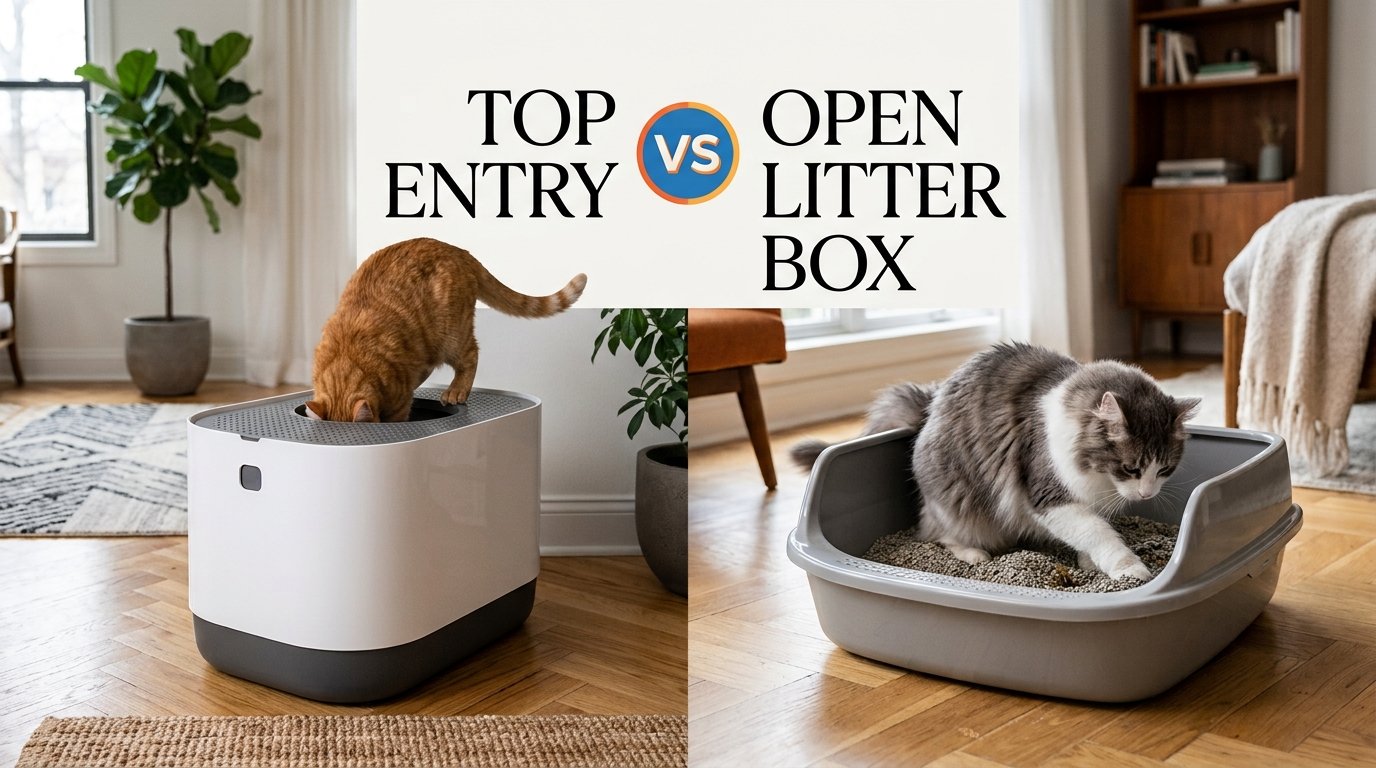
A top entry litter box traps litter on a textured lid. An open box skips that trick entirely and bets on easy access instead. That’s the whole tradeoff, and it’s the thing that actually decides which one your cat will use and which one just sits there collecting dust.
This guide compares the Top Entry Litter Box against the Amazon Basics Large Cat Litter Box on what matters day to day: how much litter ends up on your floor, how long cleaning takes, and which cats each design fails. We’ve also added sizing rules, a “how many boxes do you need” breakdown, and a buying checklist, since most comparisons skip the parts that actually prevent litter box problems.
Top Entry Vs Open Litter Box: The Full Comparison
⚡ Quick Verdict
Go with the Amazon Basics Large Cat Litter Box if you’re not sure which to pick. It’s faster to clean, it doesn’t ask an older cat to jump, and it comes with a scoop you’d otherwise buy separately. Choose the top entry style instead if your cat digs aggressively, there’s no dog raiding the box, and you don’t mind lifting a lid every time you scoop.
Analysis: Top Entry Litter Box

Best for: owners fighting a serious litter-tracking problem, homes with a dog that won’t leave the box alone, and cats who like an enclosed space.
A top entry litter box uses height instead of a lid to control mess. Your cat climbs onto the top, drops in through the opening, and on her way out brushes litter off her paws onto a textured, often gridded surface before it falls back into the tray. That’s the entire selling point, and it works: less litter on your floor, full stop.
There’s a second benefit most comparisons skip. Dogs generally can’t reach the litter inside because the opening sits up high and the walls are tall enough that a dog would have to climb in the same way the cat does. Most dogs won’t bother trying. If yours treats the litter box like a snack bar, that alone might settle the decision for you.
The tradeoff shows up in airflow and access. Odor has less room to escape, so you’ll notice a smell faster if you skip a day of scooping. And climbing in is a real physical task, not a step over a low wall. Kittens, cats recovering from surgery, and cats with arthritis or hip pain can struggle with it or refuse it outright. One niche upside: cats that “pee high,” meaning they spray sideways instead of squatting, are often better contained by a top entry box’s tall walls than by any open design.
Build Quality & Design
Most top entry boxes use thick, high-walled plastic built to take a daily jump without flexing. The lid does double duty as the paw-cleaning surface and the main entrance, so check how it attaches before you buy. Lids held on by small plastic tabs can crack or pop loose after months of daily lifting, and a wobbly base will spook a cat badly enough that she stops using the box entirely. Look for a wide footprint and a lid that clips down firmly rather than one that just balances in place.
Performance & Speed
This design isn’t built for speed. It’s built for containment. Cats usually adjust to the entry within a few days, but you’ll still lift a lid every time you scoop, and that takes longer than pulling a scoop across an open tray. If tracking is your biggest complaint, the tradeoff pays off. If a fast daily routine matters more, it won’t.
Features & Functionality
Most models keep it simple: a tray, a lid, and an opening. You might get a hook for the scoop or a slot for a carbon filter, but there’s no self-cleaning mechanism and usually no included scoop. That’s not really a flaw, it’s a design choice. It’s a tool built for one job, and there are fewer parts around to break.
User Experience
Day to day, you lift the lid, scoop, and set it back down. The annoyance scales with how heavy and awkward that lid is. A light, well-hinged one barely registers after the first week. A stiff or oddly shaped one gets old fast. In exchange, you get a box that hides waste from view, which matters if the litter box lives in a living room or a small apartment.
Value for Money
You’ll usually pay more upfront than for a basic open tray, and you likely won’t get a scoop with it. But you may spend less later on floor mats, vacuum bags, and stain remover if tracking has been a real problem in your house. Whether that math works in your favor depends entirely on how bad the tracking is right now.
✅ Advantages
❌ Disadvantages
Analysis: Amazon Basics Large Open Box
Best for: multi-cat households, senior or injured cats, kittens, and anyone who wants a fast daily cleaning routine.
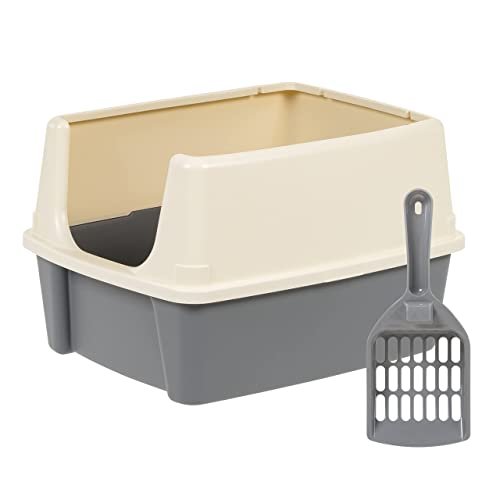
The Amazon Basics Large Cat Litter Box takes the opposite approach: high sides to hold litter in, and a low front cutout so any cat can just walk in. No jump, no climb, no learning curve. That makes it the safer default for kittens still growing into their bodies and for older cats whose joints don’t love vertical movement anymore.
It’s built from BPA-free, recyclable plastic, and it ships with a scoop plus a built-in spot to store it, so you’re not hunting under the sink for a scooper covered in dust. The open top lets you see the litter level and your cat’s waste at a glance, which matters more than it sounds. Changes in stool or urine are often the first sign something’s wrong with a cat’s health, and an open box makes that easy to catch during a normal scoop.
Build Quality & Design
The plastic holds up to daily scratching and digging without cracking, and the high sides contain scatter reasonably well even without a lid. At 19 x 15 x 11.75 inches it fits most adult cats comfortably, including larger breeds, and the low front cutout doesn’t sacrifice wall height everywhere else, just where the cat needs to step through.
Performance & Speed
This is where the open design wins outright. Scooping takes seconds because there’s nothing to remove first. Cats get in and out instantly, which tends to mean fewer accidents from cats who put off using a box they find annoying to enter. Airflow also keeps litter drier for longer between full changes.
Features & Functionality
The included scoop and onboard storage are small things that add up. You’re not buying a separate scoop, and you’re not leaving one lying around where it collects dust or gets knocked into the litter itself. Beyond that, there isn’t much else going on here, and that’s the point.
User Experience
There’s genuinely nothing to figure out. No lid to lift, no clips to manage. That makes it a solid pick for kids helping with pet chores, for anyone dealing with their own mobility limits, and for cats who take one look at a top entry box and simply refuse to use it.
Value for Money
At its price point, getting a scoop and storage bundled in makes this one of the better deals in the category. You won’t pay extra later for a scoop you’d otherwise need, and the durable plastic means you’re not replacing it every year.
✅ Advantages
❌ Disadvantages
How Many Litter Boxes Do You Actually Need?
Neither box works well if you don’t have enough of them. The standard advice from feline behaviorists is the “N+1 rule”: one litter box per cat, plus one extra. One cat means two boxes. Two cats means three. It sounds like overkill until you remember that some cats won’t use a box another cat used first, and a dirty or contested box is one of the most common reasons cats start going outside it.
| Number of Cats | Recommended Litter Boxes |
|---|---|
| 1 cat | 2 boxes |
| 2 cats | 3 boxes |
| 3 cats | 4 boxes |
| 4 cats | 5 boxes |
Placement matters as much as count. Spread boxes across different rooms or floors instead of lining them up together, since a row of boxes in one spot works like a single box to a cat who wants privacy or is avoiding another cat in the house. Keep boxes away from loud appliances, heavy foot traffic, and dead-end corners where a cat could feel trapped.
What Size Litter Box Does Your Cat Need?
Both boxes in this comparison run large, and that’s not an accident. An undersized litter box is one of the most common causes of missed scoops and accidents outside it. The general rule: the box should measure at least 1.5 times your cat’s body length, measured from nose to the base of the tail, not including the tail itself.
| Cat Size | Approx. Body Length | Minimum Box Length |
|---|---|---|
| Kitten | ~6-8 in | ~9-12 in |
| Average adult cat | ~9-10 in | ~14-15 in |
| Large breed (Maine Coon, Ragdoll) | ~16 in | ~24 in |
The Amazon Basics box measures 19 x 15 x 11.75 inches, which is comfortable for most adult cats. If you own a large breed, measure your own cat before assuming any “large” box is actually large enough for her.
Major Factors to Consider
Choosing a litter box means balancing your cat’s physical needs against your own tolerance for cleaning. Here are the factors that actually change the outcome, not just the ones that sound good on a spec sheet.
Performance
How much litter and odor actually stay inside the box, not what the packaging promises. A high-performing box keeps floors clean and smells contained through a full day between scoops.
Speed & Efficiency
How long a full scoop actually takes you, start to finish, including any lid you have to lift first. This adds up fast if you’re scooping twice a day.
Price & Value
What you pay upfront against what you’d spend later on a separate scoop, floor mats, or odor control you wouldn’t need with a better design.
Build Quality
Whether the plastic holds up to daily digging and jumping without cracking, and whether a lid or base stays stable under an active cat.
Design & Aesthetics
Whether the box fits your space and, more importantly, whether your cat actually understands how to get in and out without hesitation.
Durability
How many years of daily use the box can take before the plastic scratches through, retains odor, or a lid mechanism fails.
Feature Comparison
This table lines up the top entry and open designs feature by feature, so you can skip straight to what matters for your household.
| Feature | Top Entry Litter Box | Amazon Basics Large Open Box |
|---|---|---|
| High-sided design | ✓ | ✓ |
| Open-top accessibility | ✗ | ✓ |
| BPA-free plastic | ✓ | ✓ |
| Includes litter scoop | ✗ | ✓ |
| Onboard scoop storage | ✗ | ✓ |
| Privacy enclosure | ✓ | ✗ |
| Easy monitoring of waste | ✗ | ✓ |
| Low-entry front | ✗ | ✓ |
| Reduces litter tracking | ✓ | ✓ |
| Dog-resistant opening | ✓ | ✗ |
| Good for kittens | ✗ | ✓ |
| Suitable for senior cats | ✗ | ✓ |
Specifications Comparison
The table below covers the core specs for both models. Pay attention to entry style and included equipment; those two lines usually decide the day-to-day experience more than anything else on the sheet.
| Specification | Top Entry Litter Box | Amazon Basics Large Open Box |
|---|---|---|
| Price | Varies | Affordable |
| Weight | Lightweight | Lightweight |
| Dimensions | Compact | 19″ x 15″ x 11.75″ |
| Material | Plastic | BPA-free plastic |
| Entry style | Top entry | Open front |
| Includes scoop | No | Yes |
| Storage | None | Onboard |
| Best for | Privacy, dog-proofing | Accessibility, speed |
🏆 Winner: Amazon Basics Large Open Box
Score Breakdown
The Amazon Basics box wins because it works for the widest range of cats, not just the easiest ones. Kittens, seniors, and cats who’ve never seen a litter box like this before can all use it without a learning curve, and the included scoop means it’s ready the day it arrives.
Choose the Open Box If…
You Want a Complete Kit
The included scoop and storage mean you don’t need to buy anything extra to get started. It’s a complete solution in one affordable box.
You Have a Senior Cat, a Kitten, or a Recovering Cat
The lowered front entry lets any cat step in without jumping. It’s a safer, more accessible setup that reduces physical stress and encourages regular use, which matters most for older cats and cats healing from surgery.
You Want to Monitor Your Cat’s Health
The open design makes it simple to see waste changes at a glance during a normal scoop, and to notice when the box needs attention before it gets bad.
You Want the Fastest Possible Cleanup
No lid to lift means scooping takes seconds. This is the box for anyone who wants a two-second maintenance routine, not a project.
Choose the Top Entry Box Instead If…
Your Cat Digs Like It’s a Job
Aggressive diggers send litter flying over any wall short of a lid. If floor tracking is your single biggest complaint, this design solves it better than an open box ever will.
You Have a Dog That Won’t Leave the Box Alone
A dog tall or motivated enough to reach an open tray usually can’t manage a top entry opening. If this is a real problem in your house, it can be the deciding factor on its own.
Your Cat Is Young, Agile, and Not Bothered by the Jump
Healthy adult cats with no joint issues generally adapt within days. Watch for hesitation the first week; if she avoids it, that’s a real signal, not stubbornness.
You Don’t Mind Lifting a Lid Every Day
The tradeoff for less mess is a slightly longer cleaning routine. If that’s a fair trade for you, the top entry design earns its keep.
Litter Box Buying Checklist
Run through this before you buy either box, or before you decide the one you already own isn’t working.
- Measure your cat nose to tail base. The box should be at least 1.5 times that length.
- Count your cats and add one. That’s your minimum number of boxes under the N+1 rule.
- If you’re going top entry, check how the lid attaches. Avoid ones held on by small plastic tabs.
- Watch for hesitation. Kittens, seniors, and cats recovering from surgery often can’t or won’t jump.
- Factor in any dog in the house that’s shown interest in the litter box.
- Budget for a scoop separately if the box you’re buying doesn’t include one.
- Plan on full litter changes every 1 to 2 weeks for clumping litter, weekly for non-clumping, not just daily scooping.
🎯 Final Recommendation
For most households, the Amazon Basics Large Cat Litter Box is the safer default. It works for kittens, seniors, and cats who’ve never seen a top entry box in their life, and the included scoop means you’re using it the same day it arrives. Reach for the top entry design only when a specific problem calls for it: heavy digging, a dog that won’t leave the litter alone, or floors you’re tired of cleaning twice a day.
Summary
- The Amazon Basics box works for cats at every life stage. The top entry box doesn’t, since jumping in isn’t optional.
- Top entry boxes trap litter on the lid, but you pay for it with a longer cleaning routine every time you scoop.
- Dogs generally can’t reach into a top entry box. They often can reach into an open one, so factor that in if you have a curious dog.
- Neither box replaces the N+1 rule. If you have more than one cat, budget for one box per cat plus a spare.
- Box size matters more than box style. Aim for at least 1.5 times your cat’s body length before comparing anything else.
- The Amazon Basics box ships with a scoop and storage. The top entry model usually doesn’t.
- If you go top entry, check how the lid attaches first. Weak tabs crack, and a wobbly base will scare a cat off for good.
Frequently Asked Questions
Which product is better overall?
The Amazon Basics model is better for most households because it works for cats of every age and ability. Its design makes daily cleaning faster and doesn’t force any cat to jump to use it.
Is the price difference worth it?
Usually, yes. The Amazon Basics box includes a scoop and storage you’d otherwise buy separately, which offsets most or all of any price gap right away.
Which has better build quality?
Both use durable plastic built for daily use. The Amazon Basics box uses BPA-free material specifically, but a top entry box’s real weak point is usually the lid attachment, not the tray itself, so check that on any model you’re considering.
Which is better for beginners?
The Amazon Basics box. There’s no lid to remove and no learning curve for you or your cat, which matters most in the first few weeks of ownership.
What are the main differences between top entry and open litter boxes?
Entry style and accessibility. Top entry boxes focus on privacy and litter containment at the cost of a jump-in entrance. Open boxes focus on accessibility and fast cleaning at the cost of some scatter and less privacy.
Will a top entry litter box keep my dog out of it?
In most cases, yes. The opening sits high and narrow enough that a dog can’t reach the litter without climbing in the same way the cat does, and most dogs won’t try. It’s not guaranteed with larger or more determined dogs, but it solves the problem for most households.
Can kittens use a top entry litter box?
Not comfortably, at least not right away. Kittens generally need a low-entry or open box until they’re around 4 to 6 months old and have the coordination to jump and climb safely.
How many litter boxes do I need for two cats?
Three. The standard rule is one litter box per cat plus one extra, so two cats need three boxes placed in separate locations, not lined up in one spot.
What size litter box does a large cat need?
At least 1.5 times your cat’s body length from nose to tail base. For a large breed around 16 inches long, that puts the minimum box length near 24 inches, well beyond what most “large” boxes on the shelf actually measure.
Do top entry litter boxes smell more?
They contain smell better while the lid is on, since airflow is limited, but that same limited airflow means odor builds up faster between scoops than in an open box. Scoop daily and it’s a non-issue either way.
How often should I fully change the litter, not just scoop it?
For clumping litter, every 1 to 2 weeks with daily scooping in between. For non-clumping litter, weekly. Multi-cat households usually need to run on the shorter end of both ranges.

Written by Mishu
A passionate cat lover and indoor living enthusiast, Mishu is the founder and voice behind Indoor Living Cat – a go-to resource for cat owners who want to create the happiest, healthiest life for their feline companions indoors.
View Full Profile