
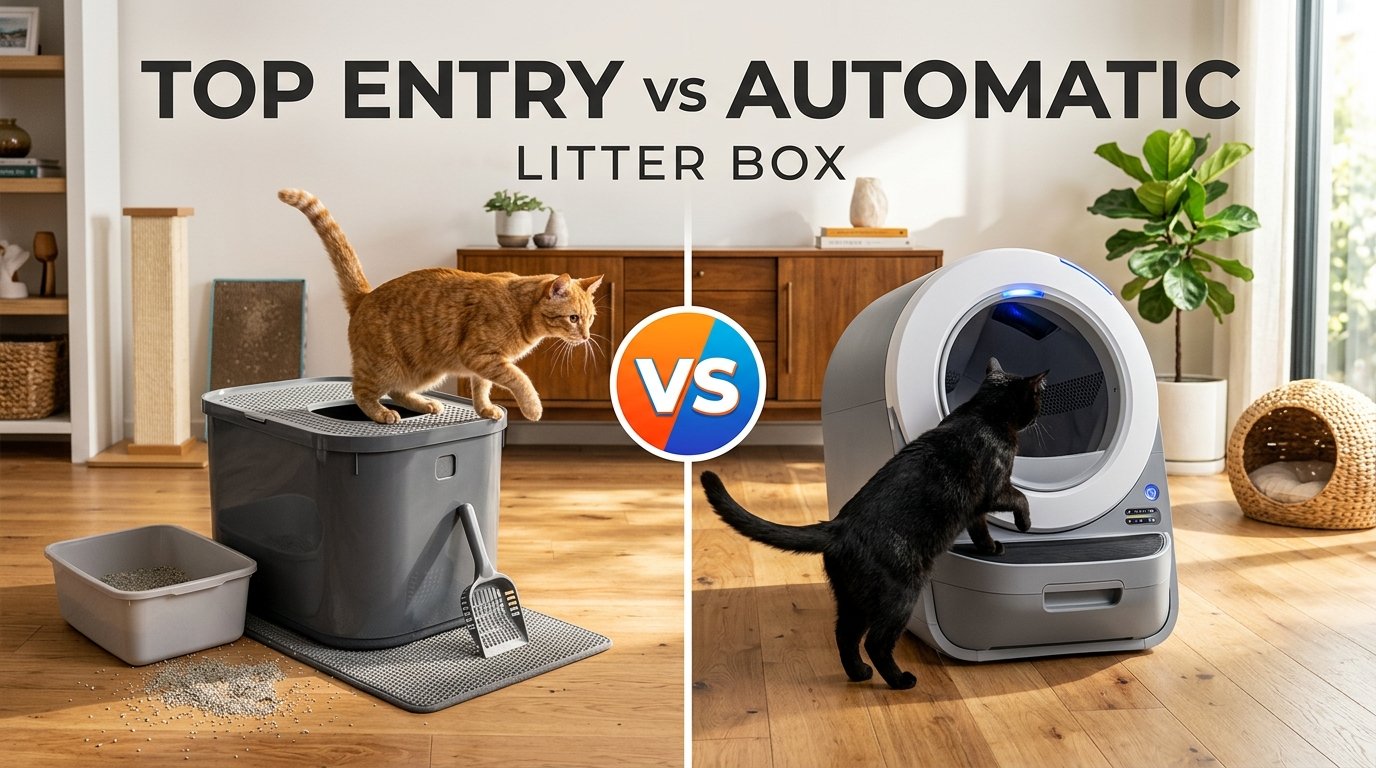
Pick the Cumrige Automatic Litter Box if scooping is the chore you dread and your cat is a healthy adult. Pick the Amazon Basics Top Entry if your budget is tight, your outlets are limited, or you mostly want litter to stay off the floor. That’s the top entry vs automatic litter box decision in two sentences. The rest of this page checks it against your cat’s age, size, and temperament.
We compared these two boxes because they sit at opposite ends of the category. The Amazon Basics is a manual tub with a filtered lid, high walls, and no moving parts. The Cumrige is a 95L rotating drum with safety sensors, a 15L waste bin, and a Tuya Smart app. Below you’ll find a side-by-side table, the real cost math, what vets and behaviorists say about covered boxes, a step-by-step plan for switching your cat, and a checklist to run before you buy.
Last updated September 2026. This post contains Amazon affiliate links. If you buy through them, we may earn a commission at no extra cost to you. Specs come from manufacturer listings, and our scores are editorial ratings, not lab measurements, so confirm details on the product page before you order.
⚡ Quick Verdict: Top Entry vs Automatic Litter Box
The Cumrige Automatic Litter Box wins for busy owners with healthy adult cats. It handles the scooping, holds up to 15 days of waste by the manufacturer’s count, and sends full-bin alerts to your phone. The Amazon Basics Top Entry wins on price, on small spaces, and for anyone who doesn’t want a motor or an app in the house.
One caution before you buy either. If your cat is a senior, a young kitten, or a large breed, read the “Which Box Fits Your Cat” table below first. Neither box is the first choice for those cats.
Top Entry vs Automatic Litter Box at a Glance
Side-by-side photo of both boxes in the same room with a tape measure or a cat for scale.
Suggested alt text: Amazon Basics top entry litter box next to the Cumrige automatic litter box
This table covers the ten differences that decide most purchases. Each row is expanded further down.
| Factor | Top Entry (Amazon Basics) | Automatic (Cumrige) |
|---|---|---|
| How waste is removed | You scoop by hand | Drum rotates and drops clumps into a sealed 15L bin |
| Upfront cost | Low. Similar top-entry boxes from other brands list around $28 to $43 at major pet retailers | Several times higher. Prices swing with promotions, so check the live listing |
| Daily effort | Scoop once or twice a day | Empty the bin as it fills (up to 15 days per the manufacturer) and top off litter |
| Litter tracking | Low. The exit jump and filtered lid shake off most litter | Not a top-entry design, so a litter mat outside the box helps |
| Odor | Lid holds smell in, but waste sits until you scoop | Waste moves to a sealed bin; the listing describes a deodorizing design |
| Noise | Silent | Motor runs each cycle. The listing says whisper-quiet but gives no decibel rating |
| Power and Wi-Fi | None needed | Plug-in. App features need a 2.4 GHz Wi-Fi network |
| Footprint | 20.5 x 14.75 x 14.38″ | Large. Check the listing dimensions against your space |
| Best for | Agile adult cats, tight budgets, cats that spray or dig | Busy owners, frequent travelers, tech-friendly homes |
| Watch out for | Seniors, kittens, large cats, cats that dislike enclosed boxes | Cats spooked by motion or noise, Wi-Fi setup, a heavier unit |
How Each Type Works
Top-Entry Litter Boxes
A top-entry box is an enclosed tub with the door in the lid. Your cat hops in from above and hops out the same way. That jump does most of the anti-tracking work: paws land on the lid’s grate, and loose litter falls back inside. The tall walls also keep spray and kicked litter off your wall. Amazon’s version adds a removable lid and a scoop holder on the side. If you’re also weighing side-door boxes, our top entry vs front entry litter box guide covers that matchup.
Automatic (Self-Cleaning) Litter Boxes
An automatic box removes the waste for you. Designs vary. LitterMaid uses a rake, ScoopFree uses disposable trays, and Litter-Robot and the Cumrige use rotating drums. After your cat leaves, the Cumrige’s sensors confirm the coast is clear, the drum turns, clumps separate from clean litter, and the waste drops into the sealed bin. Sensors also pause the cycle if your cat walks back in.
What About a Top Entry Automatic Litter Box?
The two categories overlap. The ScoopFree Ultra Top-Entry, for example, pairs a top opening with a self-cleaning rake, though it comes with disposable trays and crystal litter, according to Catster’s roundup. It’s a different product from the Cumrige and isn’t reviewed here. If you want both features in one box, that’s the category to search.
Analysis: Amazon Basics Top Entry
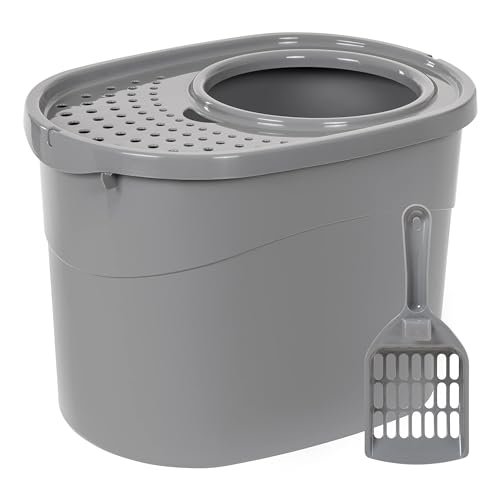
This manual, top-entry box is for owners who want litter to stay inside and would rather not plug anything in. It has no motor, no app, and nothing that can fail except the plastic itself.
The Amazon Basics Top Entry Litter Box is built around high walls and a lid with a filtered opening. Your cat jumps in, does the job, and jumps out. That exit jump shakes loose most of the litter that would otherwise ride out on their paws, and the tall sides keep spray off your walls. Owners of cats that dig hard or pee high tend to like this design for exactly that reason.
The plastic is BPA-free and recyclable. The lid lifts off for cleaning, and the scoop stores on the box so it’s always within reach. That’s the whole feature list. It’s short on purpose.
Build Quality & Design
The box is molded from BPA-free plastic and handles daily use without flexing. It measures 20.5 x 14.75 x 14.38 inches, compact enough for a bathroom corner or the gap beside a closet door, and the neutral grey blends into most rooms. The trade-off is interior space. The outer length is 20.5 inches, so the room inside is smaller, and a long cat can run out of turning room. The sizing rule further down shows how to check.
Performance & Speed
Everything depends on you. The box contains litter well, which cuts your sweeping time. With no moving parts, it’s silent and always ready. There are no motors or sensors to fail. What it can’t do is remove waste. Droppings sit until you scoop, and the lid holds the smell in the meantime. Scoop once a day at minimum, twice if you can.
Features & Functionality
The lid has a filtered opening that catches stray litter, and the walls give your cat privacy. The scoop hangs on the box. You can lift the lid for a quick check without taking it off. There’s no electricity, no Wi-Fi, and no setup, so it goes anywhere your cat will use it.
User Experience
Scooping takes seconds once the lid is off, and you set the schedule. There’s no software to update and no cycle to wait on. The downside is the flip side of the upside: nobody scoops it but you.
Value for Money
It’s the cheaper route by a wide margin because there are no electronics to pay for. Similar top-entry boxes from other brands list around $28 to $43 at major pet retailers, so check the current Amazon price. Your only ongoing cost is litter. Plan to replace the box when scratches hold odor no matter how hard you scrub.
✅ Advantages
❌ Disadvantages
Analysis: Cumrige Automatic Litter Box
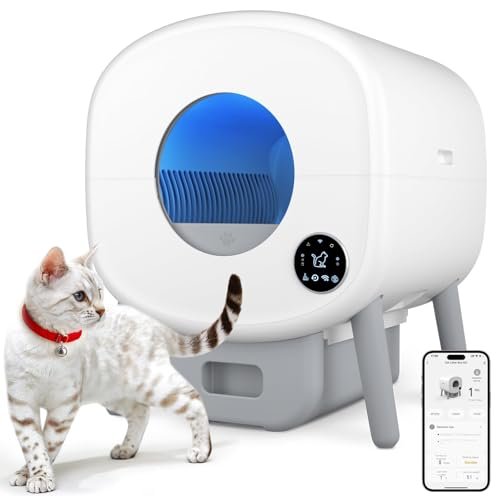
This automatic box is for owners who want the cleaning routine handled for them. It suits households that care about odor control, hands-off maintenance, and health tracking, and it keeps your cat safe with sensors that pause the drum.
The Cumrige is a self-cleaning rotating drum. The listing gives it a 95L roller for cats from 2.2 to 33 lbs and a 15L waste bin the manufacturer says lasts about 15 days. Those two numbers matter most to people who travel or hate the daily scoop. It also works with single or multiple cats. If you’re shopping for a multi-cat home, see our guide to the best automatic litter box for multiple cats.
Safety sensors detect your cat and pause the cleaning cycle. The Tuya Smart app adds remote control, health tracking, full-bin alerts, and one-touch waste disposal. One catch: it connects to 2.4 GHz Wi-Fi only, which trips up anyone whose phone or router is set to 5 GHz.
Screenshot of the Tuya Smart app dashboard showing a cleaning log and full-bin alert (use your own screenshot).
Suggested alt text: Tuya Smart app screen for the Cumrige automatic litter box
Build Quality & Design
The Cumrige has a modern look, and the large drum is designed to rotate waste smoothly without clogging. The exterior wipes clean, and a detachable waterproof liner makes the inside easier to wash. The sensors sit inside the structure, which keeps them away from dust and spills. Expect a heavy, motorized unit with a big footprint, so measure your space first.
Performance & Speed
A cycle starts after your cat leaves. The manufacturer calls the motor whisper-quiet, though the listing gives no decibel rating, so light sleepers should read owner reviews before placing it in a bedroom. The drum separates clumps from clean litter, which means clumping litter is what it’s built around. The listing also names mineral and hybrid litters.
Features & Functionality
The standout is the Tuya Smart app: real-time cleaning status, bathroom-visit tracking, and alerts. Beyond that you get safety sensors, one-touch waste disposal, and a deodorizing design. Remember that the app only shows patterns. It won’t diagnose anything, so a sudden change in visits is a reason to call your vet.
User Experience
Setup is quick once your phone is on a 2.4 GHz network. Maintenance drops to emptying the bin, topping off litter, and wiping the drum now and then. The bigger hurdle is your cat. Plan a gradual transition using the steps further down.
Value for Money
The upfront price is several times higher than a manual box. Here’s the offset: if daily scooping takes two minutes, that’s 730 minutes a year, just over 12 hours. Add bin liners and litter to the running costs, and you get a fair picture. The cost table below lays it out.
✅ Advantages
❌ Disadvantages
Major Factors to Consider
Six things decide whether a top entry or an automatic litter box works in your home. Work through them in order, and you’ll usually know the answer before you finish.
Performance
Automatic units remove waste on a sensor trigger. A manual box does nothing until you do. If you scoop twice a day, the two perform about the same for your cat. The real difference is who does the work and how often.
Speed & Efficiency
This is how quickly the box recovers after use. The Cumrige cycles after your cat exits. A manual box recovers when you scoop. If you’re out ten hours a day, that’s ten hours of used litter, which is where automation earns its price.
Price & Value
Manual boxes cost a fraction of automatic ones. The automatic price buys back time and cuts odor, but only if your cat accepts the machine. A box the cat refuses is a wasted purchase at any price. The cost table below adds up litter, bags, and wear.
Build Quality & Durability
A manual box has few failure points, and it fails slowly: scratched plastic that holds odor. An automatic box adds a motor, sensors, and an app, so check the warranty and whether parts can be replaced. Replace any box once odor or staining survives a proper wash.
Design & Aesthetics
A top-entry box hides its contents behind a lid, which helps in a living room. Automatic boxes are larger and look more technical. Measure the spot first, and leave room around a motorized unit so the drum and bin are easy to reach.
Cat Size, Age & Temperament
This factor overrides the other five. Top entry needs a cat that can jump about 14 inches both ways. Automatic needs a cat above the minimum weight (2.2 lbs for the Cumrige) and calm enough to tolerate a moving drum. Size matters too: a box should be at least 1.5 times your cat’s length, so a cat that measures 14 inches needs 21 inches of interior space.
Which Box Fits Your Cat? A Situation-by-Situation Guide
Your cat’s body and temperament should settle this before price does. Find your situation in the first column.
| Your situation | Top Entry | Automatic | Best bet |
|---|---|---|---|
| Young kitten | Too tall to enter easily | Only above the 2.2 lb minimum, and only after a gradual introduction | Low open tray until the kitten grows |
| Healthy adult, good jumper | Good fit | Good fit | Either. Choose on budget and time |
| Senior or arthritic cat | Poor fit. Jumping in and out strains stiff joints | Check the entrance height on the listing before buying | Low-entry open box |
| Large breed (Maine Coon, Ragdoll) | Tight. Check interior length against the 1.5x rule | Rated to 33 lbs with a 95L drum | Automatic |
| Multi-cat home | One exit lets one cat block another. Add a spare box | Fits multiple cats per the listing, but the bin fills faster. See our automatic litter box for two cats guide | Automatic, plus one extra box |
| Anxious or noise-sensitive cat | Enclosed boxes can feel like a trap | Motor noise and movement can scare | Introduce slowly and keep a plain box available |
| Cat that sprays, digs, or kicks | Tall walls contain it | Depends on the entrance design | Top entry |
| Dog in the house | Top entry generally keeps dogs out | Dogs can reach an open drum | Top entry |
| Frequent traveler | Waste sits until you return or a sitter scoops | 15L bin and app alerts | Automatic, with a person still checking in |
| Small apartment or no spare outlet | Fits almost anywhere | Large and needs power | Top entry |
Photo of your own cat sizing up either box, or measuring nose to tail base with a tape measure.
Suggested alt text: Cat being measured for a litter box using the nose-to-tail-base rule
Feature Comparison
This table shows where the two boxes differ at a glance. App connectivity, safety sensors, and hands-off cleaning belong to the Cumrige. Zero power draw and a top-entry design belong to the Amazon Basics.
| Feature | Amazon Basics Top Entry | Cumrige Automatic Litter Box |
|---|---|---|
| Automatic Cleaning | ✗ | ✓ |
| App Connectivity | ✗ | ✓ |
| Safety Sensors | ✗ | ✓ |
| No Electricity Required | ✓ | ✗ |
| Health Tracking | ✗ | ✓ |
| Top Entry Design | ✓ | ✗ |
| Scoop Included | ✓ | Not needed |
| Large Waste Capacity | ✗ | ✓ |
| Quiet Operation (Cumrige’s is a manufacturer claim) | ✓ | ✓ |
| BPA-Free Material | ✓ | Not stated on the listing |
Specifications Comparison
Use these numbers to check fit before you order. Measure your floor space, and compare your cat’s weight and body length to the rows below.
| Specification | Amazon Basics Top Entry | Cumrige Automatic Litter Box |
|---|---|---|
| Cleaning Method | Manual | Automatic |
| Entry Style | Top entry (cat jumps in through the lid) | Rotating drum, not top entry |
| Weight | Lightweight | Heavy (Motorized) |
| Power Source | None | Electric |
| Connectivity | None | 2.4G Wi-Fi (Tuya Smart app) |
| Capacity | Standard | 95L Drum / 15L Bin |
| Waste Handling | Scoop by hand | Sealed bin, up to 15 days per manufacturer |
| Material | BPA-Free Recyclable Plastic | High-Grade Polymer |
| Dimensions | 20.5 x 14.75 x 14.38″ | Large footprint (see listing) |
| Litter Type | Any litter you prefer | Clumping recommended; listing also names mineral and hybrid |
| Ideal Cat Weight | Agile adult cats. Check interior length for large cats | 2.2 to 33 lbs |
What Each Box Really Costs
The sticker price is only part of it. This table lists every cost type so you can compare the whole picture.
| Cost type | Amazon Basics Top Entry | Cumrige Automatic |
|---|---|---|
| Upfront price | Low. Similar top-entry boxes list around $28 to $43 at major pet retailers | Several times higher. Check the live listing, since promotions swing the price |
| Litter | Any litter you like | Clumping litter is what the sifting drum is built around |
| Waste bags | Your own scoop bags | Bin liners, an ongoing purchase |
| Electricity | None | Runs continuously. The listing gives no wattage |
| Parts that wear | Plastic scratches and holds odor | Motor, sensors, drum, and liner |
| Your time | Scooping every day | Emptying the bin, topping off litter, wiping the drum |
The Time Math
If scooping takes two minutes a day, that’s 730 minutes a year, just over 12 hours. Scoop twice daily, as many behaviorists advise, and you’re near 24 hours. An automatic box cuts that number without erasing it. You’ll still empty the bin, refill litter, and wipe the drum. Whether the price gap is worth it depends on how much those hours are worth to you and whether your cat accepts the machine.
What Vets and Behaviorists Say About Covered and Automatic Boxes
Both of these boxes are enclosed to some degree, and that’s the part experts push back on most. Here’s where published guidance lands, and where it leaves room for your own cat.
- Covered boxes are a mixed bag. Maddie’s Fund notes that most cats dislike covered boxes, especially in multi-cat homes, and Cat Behavior Associates recommends uncovered boxes so a cat can’t be ambushed while inside. Yet Arm & Hammer’s litter guide says there’s no evidence cats in general prefer one type over another. Your cat’s reaction is the deciding evidence.
- Size matters more than style. The box should be at least 1.5 times your cat’s length, measured from nose to the base of the tail, and wide enough to turn around in.
- One box per cat, plus one. Spread them around the house and put one on each floor in a multi-level home.
- Older cats need easy access. Shelter and veterinary guides recommend accessible boxes for kittens, elderly cats, and cats with mobility problems, which usually means a large tray with a low entry.
- Scoop daily, wash on a schedule. Scoop at least once a day. Full-wash advice ranges from weekly to monthly for clumping litter, so let odor guide you. If smell or staining survives a wash, replace the box.
- Litter basics. Most cats prefer unscented, clumping litter kept 2 to 3 inches deep.
When to call the vet: If your cat strains, makes repeated trips with little output, or starts going outside the box, book a visit. Straining with little or no urine can signal a urinary blockage, which is an emergency. A health-tracking app can flag a change in visits, but it can’t tell you why.
Try Before You Buy: The Cardboard Test for Top-Entry Boxes
You can test whether your cat will use a top-entry box for almost nothing. Skip this if your cat is a senior or has trouble jumping.
- Find a sturdy cardboard box or lidded storage tub about 14 inches tall, which matches the Amazon Basics height of 14.38 inches.
- Cut a round hole in the lid roughly 9 inches across, close to the entry size several top-entry boxes list.
- Put a couple of inches of your cat’s usual litter inside and set the box next to their current one.
- Watch for a few days. If your cat jumps in and out without hesitating, a top-entry box is a fair bet. If they circle it or avoid it, save your money.
How to Introduce Your Cat to an Automatic Litter Box
Cats can be startled by a machine that moves when they leave. One scare can put them off the box for good, so go slowly. These steps adapt the transition guidance in Litter-Robot’s getting-started guide, which applies to any rotating-drum box. Check the Cumrige manual for model details.
- Confirm your cat’s weight. Every automatic box has a minimum. The Cumrige lists 2.2 lbs.
- Place the new box where the old one sits. Location matters, and cats notice moves.
- Leave it unplugged for a day or two. Let your cat explore a box that does nothing.
- Add a scoop of used litter from the old box. The familiar scent says this is a toilet.
- Use treats. Leave a few near the entrance so the box gets a good reputation.
- Run one cycle while you’re home. Power it on, let your cat watch from a distance, then switch it off again.
- Keep the old box nearby until your cat uses the new one consistently. Then move to full automatic mode.
If the Tuya App Won’t Connect
- Put your phone on the 2.4 GHz band during pairing. The Cumrige doesn’t support 5 GHz.
- Many routers merge both bands under one network name. If yours does, split them temporarily in the router settings or use a phone hotspot in 2.4 GHz mode.
- Move the router or a Wi-Fi extender closer to the box while you pair it.
- Still stuck? Check the manual and contact the seller before returning it.
Common Problems and Quick Fixes
| Problem | Likely cause | Fix |
|---|---|---|
| Litter still ends up on the floor (top entry) | Cat digs hard or flings litter on exit | Add a litter mat outside the box and keep litter 2 to 3 inches deep |
| Cat won’t use the top-entry box | Jump is too high or the box feels enclosed | Try the cardboard test, then switch to a low open box |
| Top-entry box smells | Lid traps odor while waste sits | Scoop twice a day, wash on a schedule, replace scratched plastic |
| Cat avoids the automatic box | Motion, noise, or a new smell | Restart the introduction steps and keep the old box available |
| App won’t pair | Phone or router on 5 GHz | Use 2.4 GHz during setup |
| Waste bin smells | Bin left too long or liner not sealed | Empty it before it’s full and swap the liner |
| Cat goes outside the box | Box aversion, or a health problem | Rule out a medical cause with your vet first |
Before You Buy: A Quick Checklist
- ☐ I measured my cat from nose to the base of the tail and multiplied by 1.5.
- ☐ My cat can clear a 14-inch jump in both directions (top entry only).
- ☐ My cat weighs more than 2.2 lbs (Cumrige minimum).
- ☐ There’s an outlet near the spot I’ve picked (automatic only).
- ☐ My phone and router can use a 2.4 GHz network (Cumrige app).
- ☐ I’ve planned one box per cat plus one spare.
- ☐ I have room for a litter mat outside the box.
- ☐ I’ve checked the warranty and return terms on the listing.
- ☐ I’ve booked a vet visit if my cat has recently changed bathroom habits.
Printable one-page version of this checklist or a simple decision flowchart (jump ability, age, budget, outlet).
Suggested alt text: Decision flowchart for choosing between a top entry and an automatic litter box
🏆 Winner: Cumrige Automatic Litter Box
Score Breakdown
9.2/10
9.5/10
9.8/10
8.5/10
8.8/10
9.0/10
Scores are editorial ratings, not lab measurements.
The Cumrige wins because it takes the scooping off your plate. A 15L bin rated for up to 15 days, safety sensors, and an app that logs bathroom visits add up to a box that a busy owner can mostly ignore. A manual box can’t match that. It loses points on price, size, and the 2.4 GHz Wi-Fi requirement, and it only works if your cat accepts it.
Pick the Cumrige If:
- You dread the daily scoop and can afford the higher price.
- You travel often or work long hours.
- Your cat is a confident adult, or a large breed that needs a roomy drum.
- You want an app that logs bathroom visits and warns you when the bin is full.
Choose Amazon Basics Top Entry If…
Budget-Conscious Buyers
Choose the Amazon Basics box if money is tight. It gives you containment and durable plastic without paying for electronics. It’s the cheapest way to keep your floors cleaner.
Specific Use Case
Choose it if you have limited space or no free outlet. It’s manual and compact, so it fits in a small bathroom or closet corner. Apartment dwellers who want zero setup will appreciate that.
Preference Scenario
Choose it if you want full control of the cleaning schedule. Some owners dislike motor noise or the chance of a software glitch. A manual box works the same way every day, with or without Wi-Fi.
Value Seekers
Choose it if you value simplicity over features. There are no apps, updates, or replacement parts to chase, and the plastic is easy to scrub. You replace it when it scratches and holds odor.
🎯 Final Recommendation
Buy the Cumrige if you value convenience, health tracking, and hands-off maintenance, and if your cat is a healthy adult that can handle a machine. Buy the Amazon Basics Top Entry if you want a low price, a small footprint, and a box with nothing to break. The Amazon box is a good choice for the right cat, and that cat is agile and average-sized.
If you live with a senior, a kitten, or a large cat that hates enclosed boxes, neither is the first pick. A large, low-entry open tray will serve that cat better, and you can add automation later. Whichever you choose, give your cat time to adjust and keep the old box around for a while.
Summary
- The Amazon Basics Top Entry is a manual, top-entry box. It’s cheap, silent, and needs no power or Wi-Fi.
- The Cumrige is a 95L rotating drum with sensors, a 15L bin, and a Tuya Smart app.
- Manual top entry suits tight budgets, small spaces, and agile adult cats that dig or spray.
- Automatic suits busy owners, travelers, and homes that don’t mind technology.
- Seniors, kittens, and large cats often do better with a low-entry open tray than with either box.
- Box size should be at least 1.5 times your cat’s length, and you need one box per cat plus one.
- Run the cardboard test before buying a top-entry box, and introduce an automatic box slowly.
- Check your space, your cat’s weight, and your Wi-Fi band before you order.
Frequently Asked Questions
Which product is better overall?
The Cumrige, for most healthy adult cats in busy homes. It automates the scooping, holds up to 15 days of waste by the manufacturer’s count, and tracks bathroom visits in the app. The Amazon Basics wins on price and simplicity, and it’s the better pick if you have no spare outlet or don’t want software involved.
Is the price difference worth it?
It is if you’re the one scooping and you value the time. At two minutes a day, scooping costs about 12 hours a year. It isn’t if your budget is tight, your cat is nervous around machines, or you’re home all day and don’t mind the chore. Prices shift with sales, so check both listings.
Which has better build quality?
They fail in different ways. The Amazon Basics has no motor or electronics, so the usual failure is scratched plastic that holds odor. The Cumrige has a motor, sensors, and a drum, so more can go wrong and the warranty matters. Read the warranty terms on the listing before you buy.
Which is better for beginners?
The Amazon Basics Top Entry, because there are no apps to set up, no sensors to calibrate, and no power requirements. The exception is a new kitten, which can’t easily jump into a top-entry box. A young kitten needs a low open tray at first.
Which offers better value for money?
The Amazon Basics wins if you measure by upfront cost. The Cumrige wins if you measure by time saved and features. The better value depends on whether your scarcer resource is money or time.
What are the main differences?
Cleaning method, power needs, and features. Amazon Basics is a manual, non-electronic box that relies on high walls and a lid to contain litter. The Cumrige is an automated, app-connected drum that uses sensors and a sealed bin to handle waste.
Do cats like top entry litter boxes?
Some do and some don’t. Arm & Hammer’s litter guide says there’s no evidence that cats in general prefer one type over another. Young, agile cats and diggers often take to them. Seniors, large cats, and anxious cats often don’t. Try the cardboard test above before you commit.
Are top entry litter boxes good for senior cats?
Usually not. Jumping in and out puts strain on stiff joints, and veterinary and shelter guidance favors easy-access, low-entry boxes for older cats. If your senior already uses a top-entry box, watch for hesitation or accidents near the box, and switch if you see either.
Do top entry litter boxes reduce litter tracking?
Mostly, yes. The exit jump knocks litter off paws, and the lid’s filter catches some of what’s left. They don’t stop tracking entirely, so put a litter mat next to the box to catch the rest.
Do top entry litter boxes smell?
They can. The lid holds odor in, and your cat meets that smell first when waste sits. Scoop at least once a day, wash the box on a schedule, and replace scratched plastic that holds odor after a wash.
Are automatic litter boxes worth it?
For busy owners and frequent travelers, usually yes. For nervous cats, small spaces, or tight budgets, often no. Count the bin liners, the litter, and the chance that a motor or sensor fails after the warranty ends.
Can kittens use the Cumrige automatic litter box?
The listing gives a minimum cat weight of 2.2 lbs, so stay above that. Even then, introduce the box with the power off first and run a cycle only while you’re home. A kitten that gets scared once may avoid the box for good.
Does the Cumrige work without Wi-Fi?
The remote features, which are app control, health tracking, and full-bin alerts, need a 2.4 GHz connection. The listing doesn’t say whether the automatic cycle keeps running without Wi-Fi, so check the manual or ask the seller before you buy.
How often do you empty the Cumrige’s waste bin?
The manufacturer says the 15L bin lasts about 15 days. That’s the seller’s figure, and it will shrink with more cats. The app sends an alert when the bin is full.
Sources and Further Reading
- Maddie’s Fund: litter box tips (box size, covered boxes, litter choice)
- Cat Behavior Associates: litter box checklist (box count, scooping, placement)
- Arm & Hammer: top entry vs side entry litter boxes
- Cats.com: how many litter boxes per cat
- Good News for Pets: litter box tips adapted from Blackwell’s Five-Minute Veterinary Consult
- Litter-Robot: introducing your cat to an automatic litter box
- Catster: best top-entry litter boxes

Written by Mishu
A passionate cat lover and indoor living enthusiast, Mishu is the founder and voice behind Indoor Living Cat – a go-to resource for cat owners who want to create the happiest, healthiest life for their feline companions indoors.
View Full Profile