
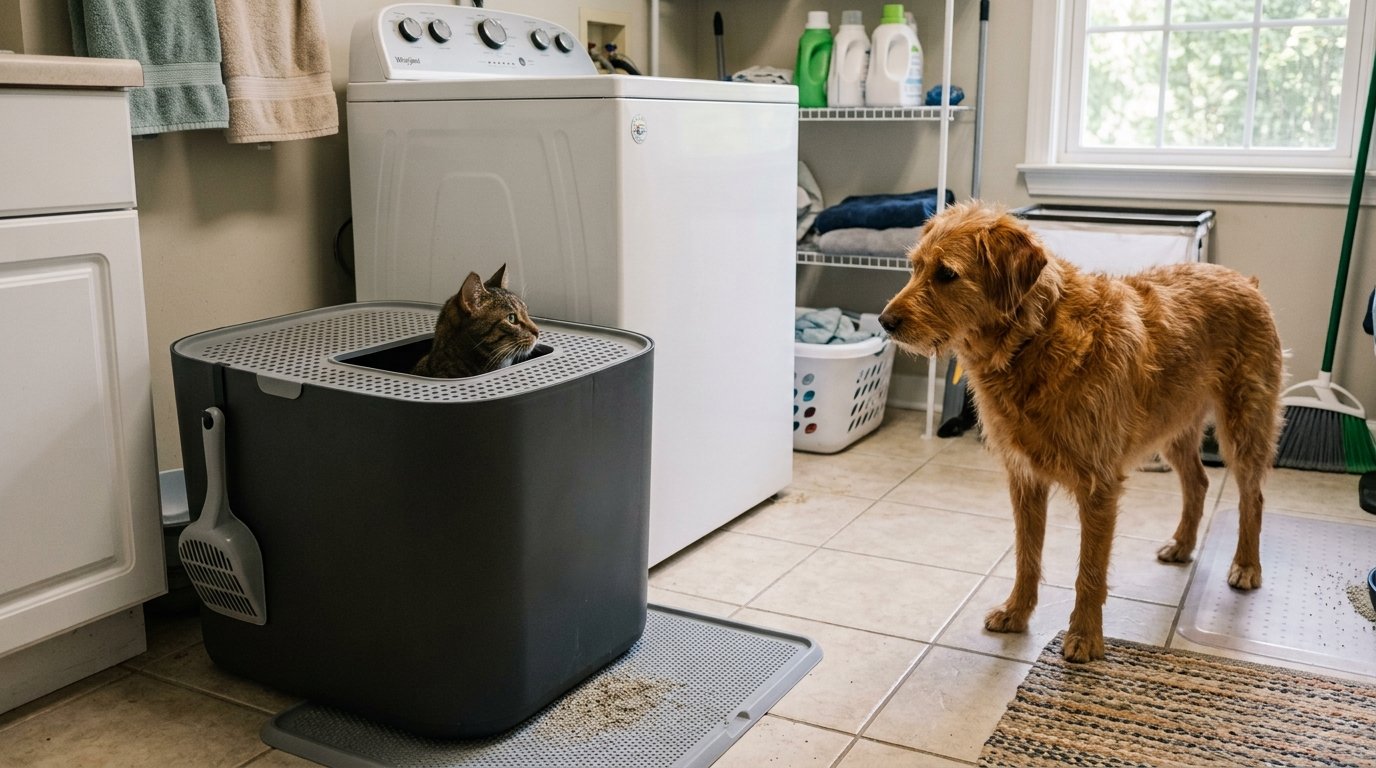
A top entry litter box to keep dogs out works on one piece of math: if your dog’s skull is wider than the entry hole, your dog isn’t getting in. The boxes below use openings of roughly 9 to 10.5 inches. That stops a Labrador, a Golden, a Husky, a Beagle. It will not stop a Chihuahua, a Dachshund, or a determined Jack Russell, and I’d rather tell you that now than after you’ve paid for shipping.
So the buying decision splits two ways. Big dog, average cat, and you just need the lid to stay on. Small dog, and you need the box plus a second barrier like a cat door or a gate. I’ve covered both below, along with the setups that beat a top entry litter box in a few specific situations.
Disclosure: some links here are affiliate links. If you buy through one, we earn a commission at no extra cost to you. It doesn’t change the ranking. Prices and stock change often, so check the listing before you order.
⚡ Quick Verdict
Does a Top Entry Box Actually Keep Dogs Out?
Mostly yes, and the failure cases are predictable. Grab a tape measure and check your dog’s head at the widest point, usually just behind the eyes. Compare that to the entry diameter listed on the box. If the dog’s head is wider, the barrier holds. If it’s narrower, the dog can get its nose in, and a hungry dog will figure that out inside a week.
Height matters too. These boxes sit about 14.5 inches tall. A tall dog can reach the lid without effort, and lids on most top entry models sit on by friction, not by latch. Big dogs don’t squeeze through the hole. They knock the whole lid off. That’s the real failure mode people write reviews about.
| Your dog | What usually happens | What to add |
|---|---|---|
| Large breed (Lab, Golden, Shepherd, Husky) | Head won’t fit a 9 to 10.5 inch opening. Blocked on day one. | Weight on the lid or a strap if the dog nudges it loose. |
| Medium breed (Beagle, Cocker, Border Collie) | Blocked, though a Beagle will keep testing the lid seam. | Place the box in a corner so the dog can’t get leverage on the lid. |
| Small breed (Chihuahua, Dachshund, Yorkie, Mini Poodle) | Head fits. Some will climb in. This is where top entry alone fails. | Cat door in a closet or a gate with a cat pass-through. |
| Puppy of any breed | Blocked now, maybe not in four months. | Plan for adult head size, not puppy size. |
Why dogs go after cat litter in the first place
Cat food runs higher in protein and fat than most dog food, and enough of that passes through to make cat stool smell like a snack to a dog. Vets call the behavior coprophagia. It’s common, it’s usually not a sign of illness, and scolding rarely fixes it because the reward is immediate and the correction is not.
The health side is worth taking seriously. Dogs can pick up intestinal parasites this way, and swallowed clumping clay can pack into the gut. If your dog has already been raiding the box and you’re seeing vomiting, straining, or a dog that’s off food, that’s a vet call, not a hardware problem. The box stops the access. A vet handles what’s already happened.
List of Top Entry Litter Boxes That Keep Dogs Out
| Image | Product | Best for | Score | Link |
|---|---|---|---|---|
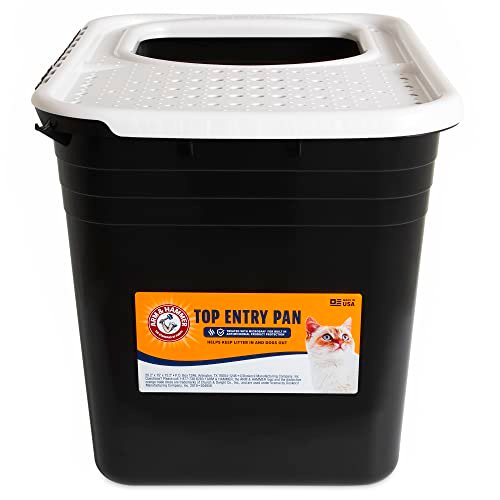 |
Arm & Hammer Premium Top Entry Litter Box with Filter 🏆 Editor’s Pick |
Odor control and big cats | 9.5/10 | View on Amazon Free Shipping & 30-Day Returns |
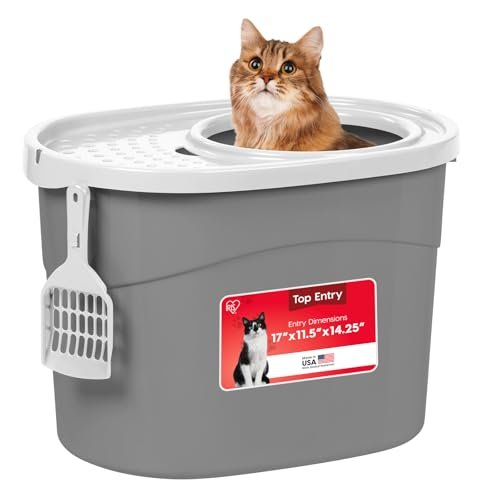 |
IRIS USA Top Entry Cat Litter Box, Gray/White 🥈 Runner-Up |
Small rooms and tracking | 8.8/10 | View on Amazon Free Shipping & 30-Day Returns |
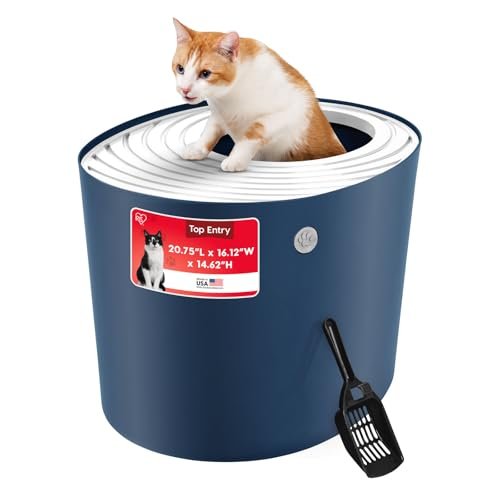 |
IRIS USA Top Entry Cat Litter Box, Navy/White 🐈 Best for Large Cats |
Maine Coons and Ragdolls | 8.5/10 | View on Amazon Free Shipping & 30-Day Returns |
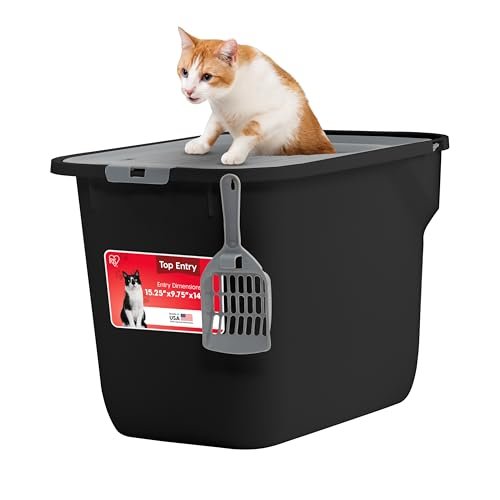 |
IRIS USA Large Top Entry Cat Litter Box, Black/Gray | Living rooms and open plans | 8.4/10 | View on Amazon Free Shipping & 30-Day Returns |
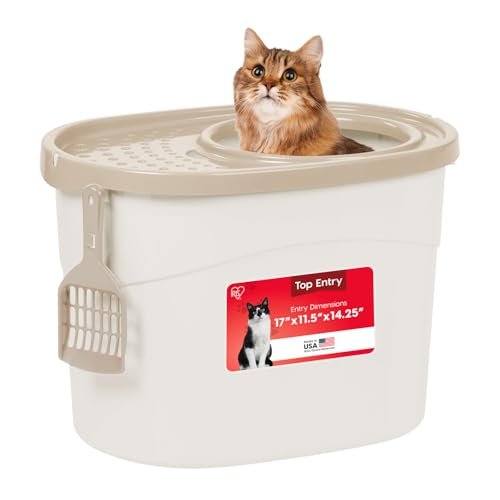 |
IRIS USA Top Entry Cat Litter Box, Beige | Neutral decor, scoop included | 8.2/10 | View on Amazon Free Shipping & 30-Day Returns |
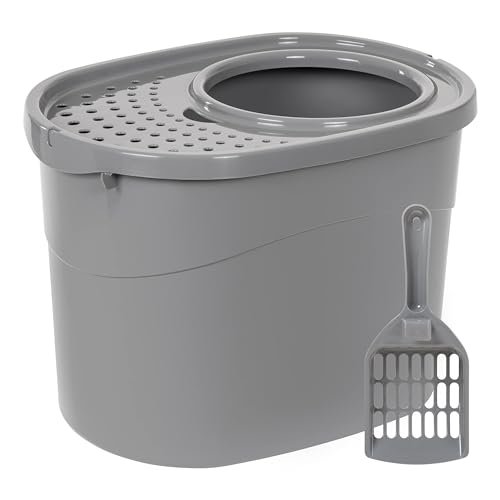 |
Amazon Basics Large Cat Litter Box, Top Entry 💰 Budget Pick |
Lowest cost per box | 7.8/10 | View on Amazon Free Shipping & 30-Day Returns |
📋 How We Evaluated
Scores weight four things, in this order:
- Dog resistance (40%) – entry width, wall height, and how firmly the lid seats.
- Cat comfort (25%) – interior floor area and whether an average 10 to 12 pound cat can turn around without touching the walls.
- Cleaning (20%) – corner radius, lid removal, and how well the plastic resists staining.
- Tracking and odor (15%) – lid texture, filter or antimicrobial treatment, and wall height against spray.
[EDITOR NOTE: replace this line with your real testing details. Example: “Tested over 6 weeks in a two-cat, one-dog household with a 65 lb Labrador and an 11 lb domestic shorthair.”] Adding named pets, a timeframe, and a photo of your own box is the single biggest E-E-A-T win available on this page.
Detailed Reviews
Arm & Hammer Premium Top Entry Litter Box with Filter🏆 Editor’s Pick
| Protection | Microban antimicrobial |
| Material | Recycled plastic |
| Compatibility | All litter types |
| Height | High-walled |
What We Found
Microban is built into the plastic rather than sprayed on, so it doesn’t wash off during a deep clean. It slows the bacteria that turn ammonia smell into a permanent feature of the box. That’s not a substitute for scooping daily. It buys you time between the full litter changes, which in a two-cat house is the difference between changing weekly and changing every ten days.
The entry is wider than the IRIS models, which is why it lands at the top for anyone with a Maine Coon, a Ragdoll, or a cat over about 15 pounds. The grate on the lid is aggressive. Paws get scraped clean on the way out, and the litter that falls through lands back in the pan instead of on your floor.
One honest tradeoff: that wider opening is slightly friendlier to a medium dog than a 9.25 inch hole. If you’ve got a Cocker Spaniel or a small Beagle, measure the dog’s head first. The walls are tall enough that enthusiastic diggers keep the litter inside, and the box takes pine, crystal, or standard clumping clay without complaint.
💬 My Take
Buy this one if your dog is big and your cat is bigger. It costs more than the IRIS boxes and it’s worth it for the odor alone.
Who It’s For
Multi-pet households where the box lives somewhere you can smell it, like a hallway or a small bathroom. Also the right pick for large-breed cats that get cramped in a standard IRIS shell.
Skip it if your floor space is tight or if your dog is under about 20 pounds. The wide entry works against you there.
✅ Pros
- Microban is molded into the plastic, so cleaning doesn’t remove it.
- Widest entry here, which suits cats over 15 pounds.
- Works with pine, crystal, and clumping clay.
- Made from recycled plastic.
❌ Cons
- Arm & Hammer suggests replacing the box yearly for best odor performance.
- Costs more than a basic plastic shell.
- Too big for a studio apartment bathroom.
- The wider hole gives a medium dog a better shot at reaching in.
IRIS USA Top Entry Cat Litter Box, Hooded Privacy, Large, Gray/White🥈 Runner-Up
| Dimensions | 20.5 x 14.75 x 14.38 inches |
| Material | Plastic |
| Design | Top-entry |
| Color | Gray/White |
What We Found
This is the box most people should start with. At 20.5 by 14.75 inches it slots beside a toilet or under a laundry shelf without taking the room hostage. The textured lid does the heavy lifting on tracking, catching granules on the way out and dropping them back through.
The hood cuts odor drift, which matters more than people expect in a small bathroom. Dogs get nothing here. The opening sits high and narrow, and the shell is light enough to carry to the bathtub for a scrub but stable enough that a cat launching out doesn’t tip it.
The limit is size. A 16 pound cat has to fold itself in, and long-haired breeds brush the sides. If your cat weighs under about 13 pounds, none of that applies and you’ll never think about it again. The lid lifts straight off for daily scooping.
💬 My Take
The default recommendation. Cheap, small, and it fixes both the dog problem and the tracking problem in one purchase.
Who It’s For
Apartments, small bathrooms, and anyone with a cat in the 8 to 13 pound range. It’s also the easiest one to buy two of, which you should if you have two cats.
Look elsewhere if your cat is large or if odor is already a running battle. There’s no carbon filter in this one.
✅ Pros
- Textured lid traps stray litter before it hits the floor.
- Smallest footprint on this list at 20.5 by 14.75 inches.
- Narrow high entry that dogs can’t work around.
- Light enough to carry to the tub for cleaning.
❌ Cons
- Tight for cats over roughly 14 pounds.
- Bare plastic holds odor once it gets scratched up.
- No carbon filter included.
- Lid sits by friction, so a big dog can nose it loose.
IRIS USA Top Entry Cat Litter Box, Hooded Privacy, Large, Navy/White🐈 Best for Large Cats
| Dimensions | 20.75 x 16.12 x 14.62 inches |
| Origin | USA |
| Entry Size | 9 x 10.5 inches |
| Material | Recyclable plastic |
What We Found
Same family as the gray model, roughly 1.4 inches wider across the body. That sounds like nothing. Inside the box it’s the difference between a cat turning around cleanly and a cat backing out. The 9 by 10.5 inch entry is the published number, which is useful because you can hold a tape measure against your dog’s head and get a real answer before you buy.
The grooved lid clears paws on exit. Interior walls are smooth with rounded corners, so scrubbing takes a minute rather than five, and there are no square seams where waste packs in. It’s made in the USA from recyclable plastic.
Navy hides less than you’d think. Clay dust shows on dark plastic, so expect to wipe the outside more often than you would with the beige version. Worth it if you like how it looks next to everything else in the room.
💬 My Take
Get this over the gray one if your cat is on the bigger side or if you’re feeding two cats through one box.
Who It’s For
Owners of Maine Coons, Ragdolls, Norwegian Forest Cats, or any cat that already looks cramped in a standard pan. Also good if you want the entry dimensions published so you can verify the dog fit yourself.
Not the pick for a tight bathroom. It needs the extra inch and a half of floor.
✅ Pros
- 20.75 by 16.12 inches gives big breeds room to turn.
- Entry dimensions are published, so you can measure your dog first.
- Smooth rounded interior wipes clean fast.
- Made in the USA from recyclable plastic.
❌ Cons
- Wider body needs more floor than the gray version.
- Navy plastic shows clay dust.
- No scoop hook on this model.
- No filter, so odor control comes down to your scooping schedule.
IRIS USA Large Top Entry Cat Litter Box, Hooded Privacy, Black/Gray
| Dimensions | 20.5 x 14.75 x 14.5 inches |
| Color | Black/Gray |
| Entry | 9.25-inch diameter |
| Material | Durable plastic |
What We Found
A 9.25 inch round entry is the tightest opening in this roundup, and that’s the point. Almost no dog gets a head through 9.25 inches except toy breeds. If you’re picking purely on dog resistance and your cat is average sized, this one’s the strongest barrier here.
The black and gray finish reads as furniture rather than pet gear, which is why it survives in living rooms where a beige box would stand out. High walls hold in the spray from cats that aim upward. Rounded interior edges mean no packed corners when you do the monthly scrub, and the included scoop hangs on a side hook so it isn’t living on your floor.
Downside is the same tradeoff in reverse. A 9.25 inch hole is narrow for a cat over 14 pounds, and older cats find round openings harder to line up than rectangular ones. Check your cat before you check your dog.
💬 My Take
The tightest entry of the bunch. Best choice if you have a small dog and an average cat, which is the hardest combination to solve.
Who It’s For
Anyone with a small or medium dog who needs the narrowest opening they can get, plus anyone placing the box in a visible room.
Skip it for large, senior, or arthritic cats. Round openings punish stiff joints.
✅ Pros
- 9.25 inch entry blocks all but toy breeds.
- Dark finish blends into living room furniture.
- Rounded edges make the monthly scrub quick.
- Scoop hangs on a side hook.
❌ Cons
- Black plastic shows white clay dust badly.
- Round 9.25 inch entry is tight for cats over 14 pounds.
- No carbon filter.
- Harder for senior cats to line up than a rectangular opening.
IRIS USA Top Entry Cat Litter Box, Hooded Privacy, Large, Beige
| Dimensions | 20.5 x 14.75 x 14.38 inches |
| Included | Scoop with hook |
| Entry | 9.25-inch diameter |
| Color | Beige |
What We Found
Mechanically this is the black model in a friendlier color. Same 9.25 inch entry, same 20.5 by 14.75 inch footprint, same scoop on a hook. Beige hides clay dust far better than black or navy, so the outside stays presentable between wipe-downs.
Walls run tall enough to catch cats that spray upward, and the lid holes pull litter off paws on the way out. For a dog, it’s the same wall of plastic as the black version: nothing to push, nothing to reach through.
The lid holes are the annoyance. Litter dust cakes inside them over a few months and a rag won’t reach. An old toothbrush and warm water handles it in about two minutes, but you do have to remember to do it. Light plastic also picks up urine staining if you skip the monthly wash.
💬 My Take
Pick this over the black one purely on color. Same box, less visible dust, and the scoop hook saves you hunting for it.
Who It’s For
Homes with light floors and neutral walls, and people who lose the scoop constantly. It hides the litter area from guests without looking like a piece of equipment.
Pass if you won’t commit to a monthly wash. Beige shows stains that black forgives.
✅ Pros
- Scoop hangs on the side, so it’s never on the floor.
- Beige hides clay dust better than dark plastic.
- Tall walls contain spray from vertical aimers.
- 9.25 inch entry keeps small and medium dogs out.
❌ Cons
- Lid holes cake with dust and need a brush to clear.
- Light plastic stains if you skip monthly washing.
- Entry is narrower than the Arm & Hammer opening.
- No filter or antimicrobial treatment.
Amazon Basics Large Cat Litter Box with High Sides, Top Entry💰 Budget Pick
| Material | BPA-free plastic |
| Features | Onboard scoop storage |
| Safety | Recyclable |
| Dimensions | 20.5 x 14.75 x 14.38 inches |
What We Found
Cheapest way to solve the dog problem. Standard 20.5 by 14.75 inch footprint, filtered lid, high sides, BPA-free recyclable plastic, scoop clipped on board. The barrier works the same as any other top entry box because physics doesn’t care what you paid.
The high sides earn their place with cats that dig at the edges. Removable top means you can check litter depth without a full disassembly, and the whole thing fits the same spot as the IRIS boxes if you ever swap.
Where it gives ground is the plastic. It flexes more than the IRIS shells when you carry it full, and the filtering lid clogs faster with heavy clay litter than with lightweight crystal. There’s no antimicrobial treatment, so odor management is entirely down to you. For a second or third box in a multi-cat house, that’s a fine trade.
💬 My Take
Buy it as box two or box three. As your only box, spend the extra on the IRIS gray and get thicker plastic.
Who It’s For
Budget buyers, and anyone following the one-box-per-cat-plus-one rule who needs three boxes without spending triple.
Not the right call if your dog has already learned to shove lids around. Thinner plastic gives more easily.
✅ Pros
- Lowest price here, which matters when you need two or three.
- BPA-free and recyclable.
- Removable top makes daily scooping fast.
- Scoop stores on the box.
❌ Cons
- No antimicrobial treatment like Microban.
- Plastic flexes when you carry it full.
- Filtering lid clogs with heavy clay litter.
- Lighter lid is easier for a big dog to dislodge.
Top Entry vs the Other Dog-Proof Setups
A top entry box isn’t the only way to keep a dog out of cat litter, and for some households it’s the wrong one. Here’s how the five common approaches compare.
| Setup | Stops small dogs? | Works for senior cats? | Rough cost | Main weakness |
|---|---|---|---|---|
| Top entry litter box | Sometimes | No | $ | The jump, and a lid a big dog can knock off. |
| Front entry hood with a flap door | No | Yes | $ | A dog just pushes the flap. |
| Litter box furniture or cabinet | Yes, if the side hole is cat-sized | Yes | $$$ | Heavy, and cleaning means crouching. |
| Cat door cut into a closet or basement door | Yes, with a microchip door | Yes | $$ | You have to cut a door. Renters, check your lease. |
| Pet gate with a cat pass-through | Depends on the gap width | Yes | $$ | A Dachshund fits through most cat gaps. |
The short version: big dog, healthy cat, buy a top entry box and you’re done. Small dog or an arthritic cat, put a normal open box behind a microchip cat door instead. Trying to force a top entry box on a 14 year old cat with stiff hips is how you end up cleaning the carpet.
What to Look For Before Buying
Six checks, in the order that actually decides whether the box works in your house.
1. Measure your dog’s head, not the dog
Widest point of the skull, just behind the eyes. Write the number down. Then compare it to the entry diameter in the product listing, which runs 9 to 10.5 inches on the boxes here. A dog whose head measures wider than the hole can’t get in, full stop. If the numbers are within half an inch of each other, assume the dog wins.
2. Measure your cat, nose to tail base
The interior floor should run about 1.5 times your cat’s body length so it can turn around and dig. A 20.5 by 14.75 inch box suits cats up to roughly 13 pounds. Above that, go to the 20.75 by 16.12 inch shell or the Arm & Hammer. Cats that don’t fit stop using the box, and they tell you by going on the bath mat.
3. Check the vertical clearance above the box
These boxes stand about 14.5 inches tall and your cat has to land on top. Leave at least 18 inches of open air above the lid. Under a low shelf or inside a cabinet, the cat clips its head on the way in and learns to avoid the box.
4. Look at plastic thickness and corner shape
Thin plastic flexes when you lift a full box and cracks at the stress points after a year or two. Rounded interior corners matter more than most buyers realize, because square corners pack with damp clay that a scoop can’t lift. Press the side wall in the reviews photos, or just read for anyone who mentions the box flexing.
5. Decide how much odor control you’re paying for
A hood contains smell. A carbon filter absorbs some of it. Microban built into the plastic slows the bacteria that make ammonia. None of the three replaces scooping once a day. Buy the feature if the box lives in a bathroom or a hallway, skip it if the box lives in a basement with a window.
6. Check how the lid stays on
Nearly every top entry lid sits by friction. A 70 pound dog can pop one off with a nose. If yours is persistent, set the box in a corner so the dog can’t get an angle on it, or put a 2 to 3 pound weight on the lid rim away from the entry hole. Don’t block the hole itself.
✅ Before you order, check all six
- Dog’s head measured and compared to the entry hole
- Cat under 13 lbs for a standard shell, over 13 lbs for the wide one
- At least 18 inches of clearance above the lid
- Cat is under 10 years old with no known joint problems
- Floor space of roughly 21 by 15 inches, plus room to lift the lid
- One box per cat, plus one spare
How to Switch Your Cat to a Top Entry Box in 7 Days
Cats reject sudden change. Most of the one-star reviews on top entry boxes are really reviews of a bad transition. Run it like this instead.
- Day 1 and 2: set the new box next to the old one, both filled with the same litter your cat already uses. Leave the lid off the new one entirely.
- Day 3: move a scoop of used litter from the old box into the new one. The smell tells the cat what the thing is for.
- Day 4: put the lid on. Lift the cat and set it inside through the hole once, then let it climb out on its own so it learns the exit route.
- Day 5: cut the old box’s litter down to about an inch. Shallow litter is less appealing to dig in, and cats pick the deeper option.
- Day 6: remove the old box. Watch where the cat goes over the next few hours.
- Day 7: if the cat is using the new box, you’re done. If it isn’t, put the old box back and repeat from day 3 with a slower pace.
💡 Tip
Fill to 2 to 3 inches, no more. People overfill top entry boxes because the walls are high, and then the cat’s back scrapes the lid on the way in and it stops going.
If your cat pees outside the box at any point in this process, stop and go back a step. Litter box avoidance can also point to a urinary tract problem, so if it continues after you’ve restored the old setup, call your vet rather than buying another box.
Cats That Should Not Use a Top Entry Box
The jump is the whole design, and for some cats that’s a problem you can’t train away.
- Senior cats. Arthritis is common in cats over about 10 and often goes undiagnosed. A 14 inch climb hurts, and a cat in pain finds somewhere softer to go.
- Kittens under 4 months. They can’t reliably jump that high or land it.
- Overweight cats. Both the jump and the opening work against a cat over about 18 pounds.
- Cats recovering from surgery or injury. Ask your vet before you reintroduce a high-entry box.
- Cats with a history of going outside the box. Don’t add difficulty to a problem you haven’t solved yet.
For any of these, the better dog-proof answer is an open or hooded box placed behind a cat door or a gate. The cat gets an easy entrance and the dog still gets nothing.
If Your Dog Still Gets In
Work down this list in order. The first three cost nothing.
- Move the box into a corner. Two walls remove the angles a dog needs to lever the lid off.
- Raise it. Set the box on a sturdy shelf or a low bench about 18 to 24 inches up. Most cats jump that easily. Most dogs don’t bother.
- Feed the dog on a schedule. A dog that eats twice a day on a fixed clock scavenges less than a free-fed dog.
- Weight the lid. Two or three pounds on the rim, away from the entry hole, defeats nose-shoving without trapping the cat.
- Add a gate with a cat pass-through. Measure the gap against your dog’s chest, not its head. Dachshunds are the usual escape artists here.
- Fit a microchip cat door. This is the only setup that works regardless of dog size, and it’s the one to pick if you have a small dog.
- Teach a solid “leave it.” Slower than hardware, and it’s the only fix that travels with you to someone else’s house.
Never punish the cat for the dog’s behavior, and don’t move the litter box somewhere the cat dislikes just to outrun the dog. A cat that won’t use its box creates a bigger mess than a dog that raids it.
Cutting Litter Tracking Even Further
The lid handles most of it. These three things handle the rest.
Pick a heavier, low-dust litter
Fine lightweight clay sticks to paws and floats into the air when the cat digs. Heavier clumping clay or larger-grain crystal litter drops off faster on the lid grate. Pine pellets track the least of anything, though plenty of cats refuse the texture, so buy a small bag before you commit.
Put a mat under the exit
A honeycomb or double-layer mat catches what the lid misses. Place it where the cat lands, not where you think it looks tidiest. Watch the cat once and you’ll know which side it uses.
Keep the depth at 2 to 3 inches
Deeper litter means more on the paws and more thrown against the lid. It also buries clumps where the scoop can’t find them, which is how boxes start to smell even when you’re scooping daily.
Frequently Asked Questions
Do top entry litter boxes really keep dogs out?
They stop any dog whose head is wider than the entry hole, which covers medium and large breeds against a 9 to 10.5 inch opening. Small breeds like Chihuahuas and Dachshunds can still get in. For those, pair the box with a microchip cat door or a gated room.
How long does it take a cat to adjust?
Two to seven days for most cats if you run both boxes side by side and move used litter across. Some take three weeks. Placing the cat inside once, then letting it exit on its own, teaches the route faster than anything else.
How do I clean a top entry litter box?
Lift the lid off and scoop daily. Once a month, empty it, wash with warm water and a pet-safe cleaner or unscented dish soap, and dry it fully before refilling. Use an old toothbrush on the lid holes. Avoid bleach and ammonia cleaners, since ammonia smells like urine to a cat and invites marking.
Are these boxes suitable for senior cats?
Usually not. Arthritis affects a large share of cats over 10, and a 14 inch climb is painful for a stiff cat. If your cat is older, hesitates before jumping, or has slowed down on the stairs, use a low-entry box behind a cat door instead.
Can I use any type of cat litter?
Clumping clay, crystal, and pine all work in these boxes. Heavier grains track less through the lid. Keep depth at 2 to 3 inches regardless of type, and check the manufacturer’s listing if you’re using a filtered lid, since very fine litter clogs filters faster.
Why does my dog eat cat poop?
Cat food is richer in protein and fat than dog food, and the leftovers in cat stool smell appealing to dogs. It’s a normal scavenging behavior rather than a sign of something wrong. Blocking access works better than correction, because the reward comes faster than the telling-off.
Is cat litter dangerous if my dog swallows it?
Clumping clay can expand and pack in the gut, and cat feces can carry intestinal parasites. A mouthful usually passes. If your dog is vomiting, straining, or off its food after raiding the box, call your vet. This article is general guidance, not veterinary advice.
How many litter boxes do I need in a multi-pet home?
The standard vet guidance is one per cat plus one spare, placed in separate rooms. Two cats means three boxes. Sharing a single box is a common trigger for cats going elsewhere, and a dog in the house raises the stress level further.
Where should I put a top entry box in a house with a dog?
Quiet corner, away from food bowls and the washing machine, with a clear escape route so the cat never feels cornered by the dog. Laundry rooms and spare bathrooms work well. Leave 18 inches of clearance above the lid and keep both walls of the corner against the box so the dog can’t lever the lid.
Top entry or front entry with a door?
Top entry for dog-proofing, because a flap door is exactly the kind of thing a dog pushes through. Front entry for senior cats, kittens, and cats that dislike enclosed jumps. If you need both, use a front entry box inside a room with a cat door.
🎯 Final Verdict
The Arm & Hammer Premium Top Entry Litter Box wins for most homes with a medium or large dog. Microban molded into the plastic keeps the odor curve flatter between changes, and the wider entry means large cats aren’t punished for your dog problem.
If your bathroom is small, the IRIS USA gray model does the same job in a 20.5 by 14.75 inch footprint for less money. For a small dog, buy the IRIS black or beige with the 9.25 inch entry and plan on adding a cat door, because no top entry box alone will stop a Dachshund.
Measure your dog’s head before you order. That one number decides which of these works.
About this guide
[EDITOR NOTE: replace this block with a real author bio and link it to your author page. Include your name, how many cats and dogs you live with, and how long you’ve been testing litter boxes. Add “Last updated” and “Reviewed by [vet name, DVM]” if you can get a review. This block is where most of your E-E-A-T signal lives.]
Health information here is general and isn’t a substitute for advice from your veterinarian. If your dog has eaten cat litter or feces and seems unwell, contact a vet.

Written by Mishu
A passionate cat lover and indoor living enthusiast, Mishu is the founder and voice behind Indoor Living Cat – a go-to resource for cat owners who want to create the happiest, healthiest life for their feline companions indoors.
View Full Profile