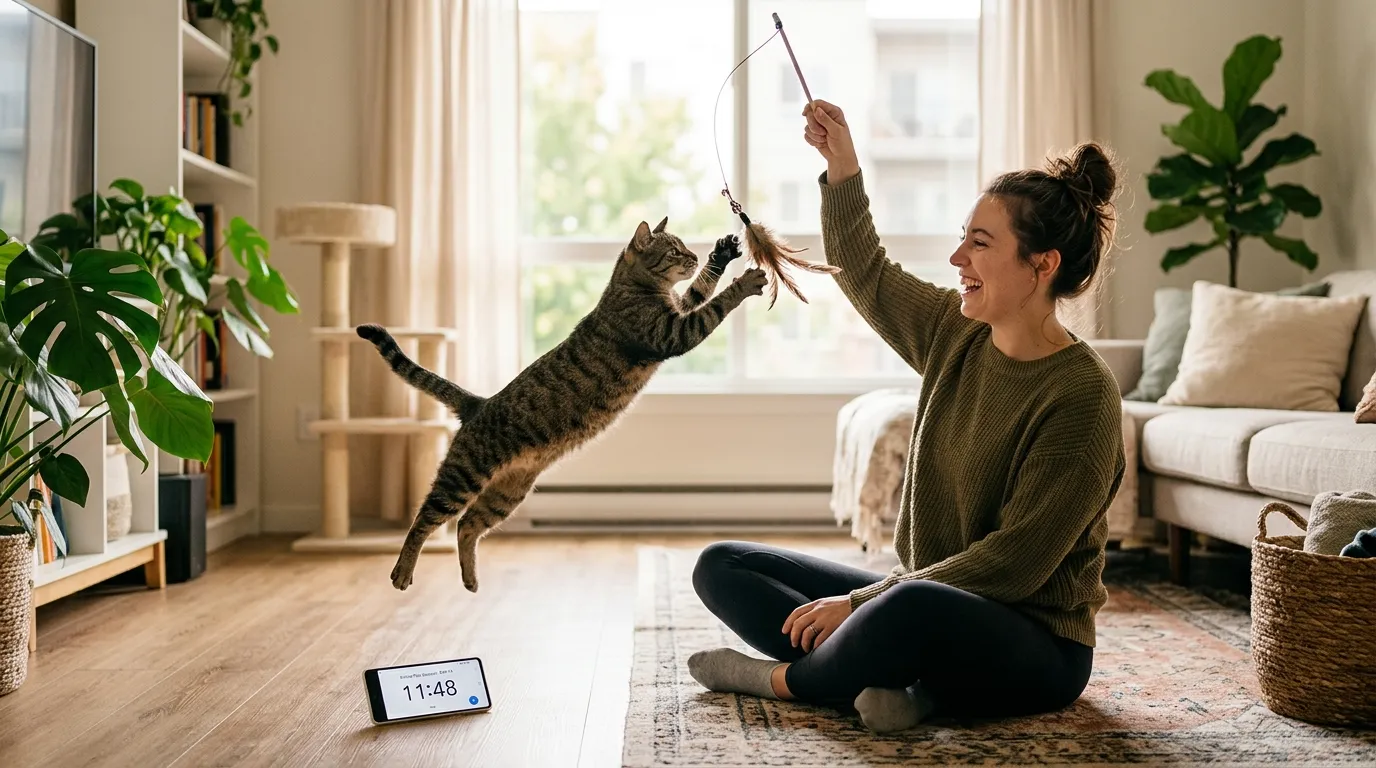
An indoor cat play schedule was the last thing I thought I needed until my cat started waking me up at 4am by sitting on my face. I was playing with her sometimes but without any consistency or timing and she had no way to anticipate when activity was coming or structure her day around it. An indoor cat play schedule is not complicated. It is simply two timed sessions per day placed at the right hours and followed by a meal. That single structure resolves the midnight racing, the attention-seeking aggression and the persistent meowing that most owners assume are personality traits when they are actually scheduling gaps. This article gives you the exact plan.
An effective indoor cat play schedule runs two sessions daily: ten to fifteen minutes in the morning before the first meal and ten to fifteen minutes in the evening before the last meal. Schedule both sessions at dawn and dusk to match the cat’s natural crepuscular activity peaks. Total active play time is twenty to thirty minutes daily. Consistency on five out of seven days per week produces stable behavioral results within one week.
The Indoor Cat Play Schedule That Actually Solves Behavioral Problems
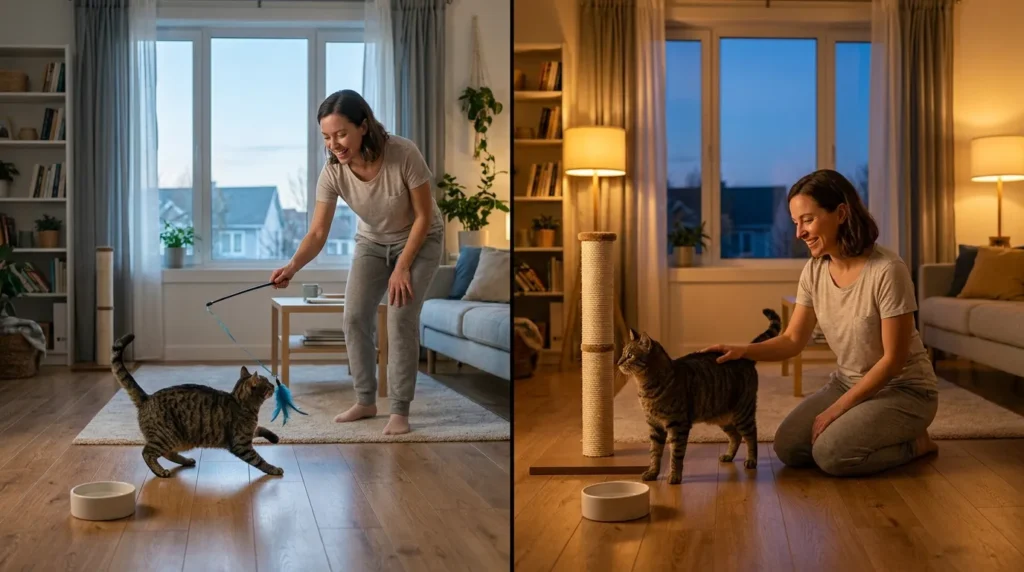
An indoor cat play schedule is a set of daily timed interactive sessions designed to discharge a cat’s predatory energy at predictable intervals rather than allowing it to accumulate and express unpredictably. The schedule works because it gives the cat’s nervous system something to anticipate. Within three to five days of consistent sessions most cats begin showing pre-play alertness at the scheduled times: pupils dilating, ears forward and body posture shifting from rest to readiness before the owner even picks up the toy.
The timing of both sessions matters more than their duration. Crepuscular activity peaks in domestic cats occur at dawn and dusk regardless of what the indoor environment is doing. A play session timed to meet those peaks discharges the drive at the biological moment it is highest rather than fighting the cat’s own physiology with a midday session that the cat is not prepared to engage with at full intensity.
The pre-meal placement is the second critical structural element. Playing before the morning meal and before the evening meal ties the session to the cat’s existing daily anchor points and completes the hunt-eat-groom-sleep cycle naturally. A cat that plays, catches the toy, receives a meal and then grooms and rests is running its biology exactly as designed. That sequence produces the calm settled rest that most owners spend months trying to achieve through other means.
How Long Each Session Should Run Based on Your Cat’s Age?
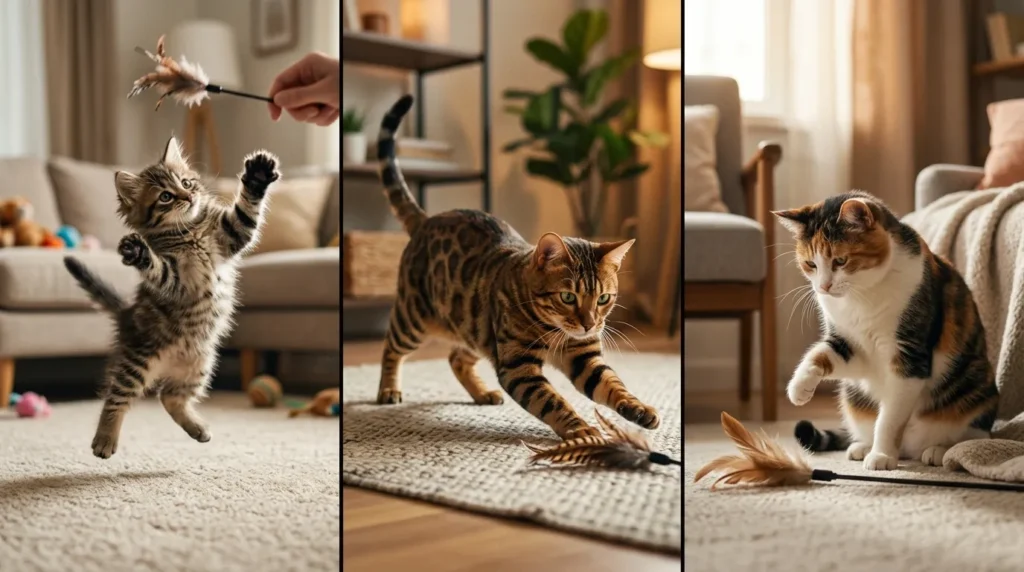
Session length in a daily indoor cat play schedule should match the cat’s age and energy capacity rather than a fixed target applied universally. Kittens under six months need four to five sessions of five to seven minutes each because their attention spans are shorter but their energy demand is genuinely higher. They tire and reset faster than adult cats and trying to run a fifteen-minute session with a four-month-old kitten usually produces overstimulation after minute eight.
| Life Stage | Session Length | Sessions Per Day | Total Daily |
| Kitten under 6 months | 5 to 7 minutes | 4 to 5 sessions | 20 to 35 minutes |
| Junior 6 to 18 months | 10 to 12 minutes | 2 to 3 sessions | 20 to 36 minutes |
| Adult 2 to 10 years | 10 to 15 minutes | 2 sessions | 20 to 30 minutes |
| Senior over 10 years | 5 to 8 minutes | 2 sessions | 10 to 16 minutes |
Senior cats need shorter gentler sessions not because they have stopped needing play but because their cardiovascular capacity and joint comfort have changed. A senior cat pushed through a full fifteen-minute session may show panting or reluctance in subsequent sessions that owners misread as disinterest when it is actually pain feedback. End senior sessions as soon as the cat shows reduced engagement rather than watching the clock.
The structure of how a cat moves through its full day shapes how much the scheduled sessions have to accomplish at each peak. A cat that uses vertical climbing, window enrichment and midday foraging throughout the day arrives at the evening session with a lower accumulated energy baseline and settles faster after it ends. A cat with an unstimulating day carries maximum accumulated energy into the evening session and takes longer to settle regardless of how well the session itself is structured. This is why what an indoor cat experiences across its whole day directly determines how effective the scheduled play sessions are at producing rest.
The Mistake That Cancels the Whole Schedule

The mistake that cancels an otherwise well-designed indoor cat play schedule is inconsistent timing. An owner who plays at 9am on weekdays and noon on weekends has not built a schedule. They have built two separate unconnected events that the cat cannot anticipate or regulate its energy around. The behavioral benefit of a play schedule comes almost entirely from the cat’s learned anticipation of when discharge is coming. Without consistent timing that anticipation never develops and the schedule produces no more behavioral stability than random play.
The second mistake is skipping the meal that follows each session. Playing and then leaving the house without feeding removes the eat step from the hunt-eat-groom-sleep cycle and leaves the cat in an activated state rather than a settled one. The meal after play is not optional. It is the signal the cat’s biology uses to shift from predatory alertness into the post-hunt grooming and sleep phase. A schedule without the meal is like a sentence without its ending.
Insight Tie both daily sessions to things you already do without thinking. Play before you make coffee then feed the cat while you drink it. Play before your own dinner then feed the cat at the same time you sit down to eat. That piggyback structure costs zero additional scheduling effort and makes the sessions virtually impossible to forget across busy weekdays.
Frequently Asked Questions
What time of day should I schedule my indoor cat’s play sessions?
Dawn and dusk produce the best results because they align with the cat’s natural crepuscular activity peaks. A 7am session and a 7pm session consistently outperforms the same total minutes run at noon or randomly across the day. Tie each session directly to the meal that follows it and the timing becomes self-reinforcing.
How do I know if the indoor cat play schedule is working?
Watch for three changes within the first week: midnight activity reduces, the cat begins showing alert anticipatory behavior at the scheduled session times before you pick up the toy and it grooms then rests within twenty minutes of each session ending. Those three signals confirm the schedule is working neurologically not just physically.
What if I miss a day?
Missing one day produces no meaningful consequence. Missing three or more consecutive days begins rebuilding the behavioral deficit the schedule was designed to prevent. Resume at the correct timing rather than compensating with a longer session. Longer single sessions do not carry forward the same benefit as consistent daily shorter ones.
Conclusion
An indoor cat play schedule is ten to fifteen minutes twice daily at dawn and dusk before each meal held consistently across most days of the week. That structure alone resolves midnight zoomies, attention-seeking aggression and persistent vocalization faster than any single toy purchase or environmental change. Start tonight with a session before your cat’s dinner and add the morning session tomorrow. Those two anchors done consistently will shift your cat’s entire behavioral baseline within a week.
An effective indoor cat play schedule consists of two daily interactive play sessions of ten to fifteen minutes each scheduled at dawn and dusk to align with natural crepuscular activity peaks. Each session must be followed immediately by a meal to complete the hunt-eat-groom-sleep cycle. Kittens need four to five sessions of five to seven minutes daily. Senior cats benefit from two gentle sessions of five to eight minutes. Consistency at the same times daily across five or more days per week produces visible behavioral improvement including reduced nighttime activity within five to seven days.