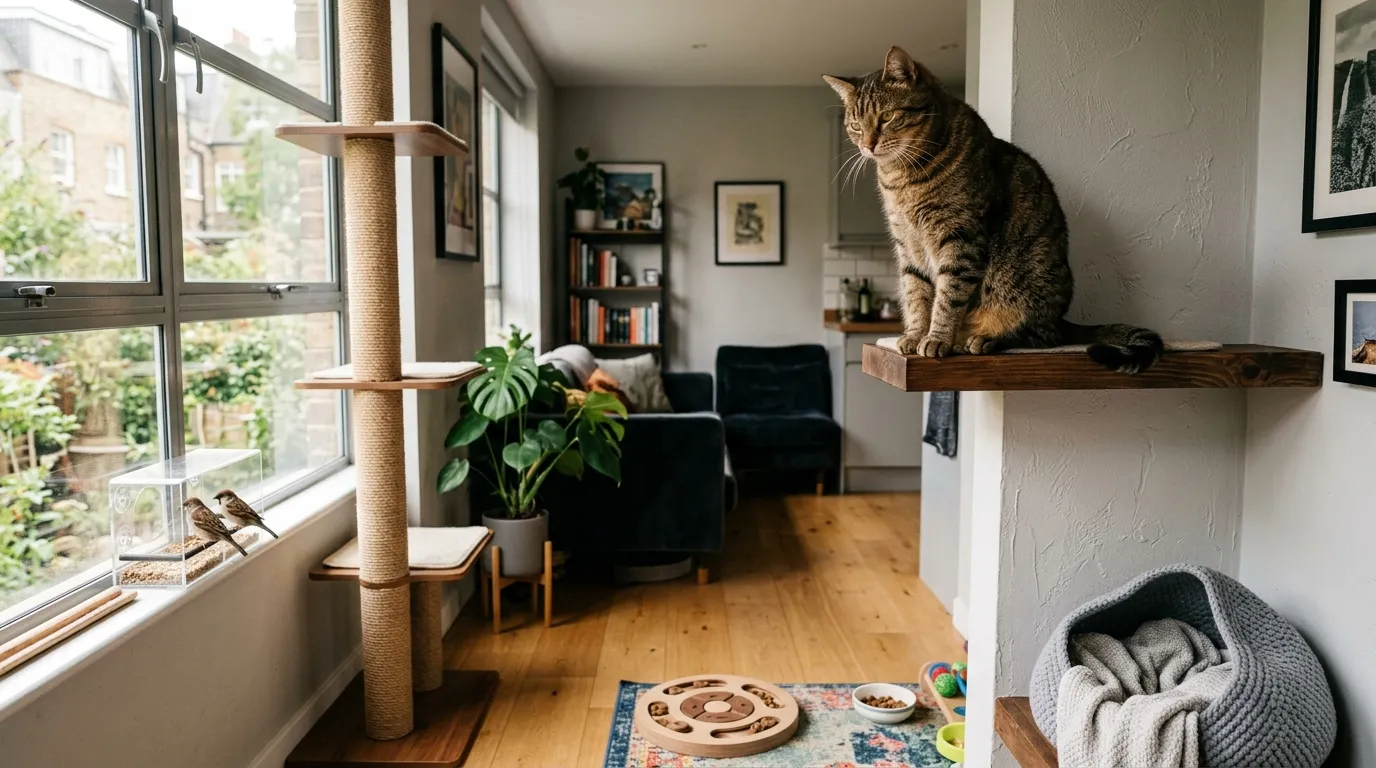
How to keep a cat happy in a studio apartment was a question I had no answer to on the day I signed a lease for a four-hundred-square-foot place and brought home a two-year-old tabby the same weekend. The guilt hit immediately. She would spend hours on the narrow windowsill pressing her nose to the glass and I kept thinking she needed more space. What she actually needed was more vertical territory and a better daily structure and I had neither. Knowing how to keep a cat happy in a studio apartment has nothing to do with floor square footage and everything to do with how intelligently you use the walls, the windows and the daily routine. This article covers seven methods that transformed my small apartment into a place my cat genuinely thrived in.
Cats are perfectly capable of living happily in a studio apartment when the space is designed for vertical territory rather than floor space, enriched with a daily play schedule timed to natural activity peaks and given consistent human interaction. Floor area is almost irrelevant. A four-hundred-square-foot studio with wall shelves, a window perch and a bird feeder produces a more behaviorally satisfied cat than a thousand-square-foot apartment with bare walls and nothing to do.
Why Studio Size Is Not the Real Problem?
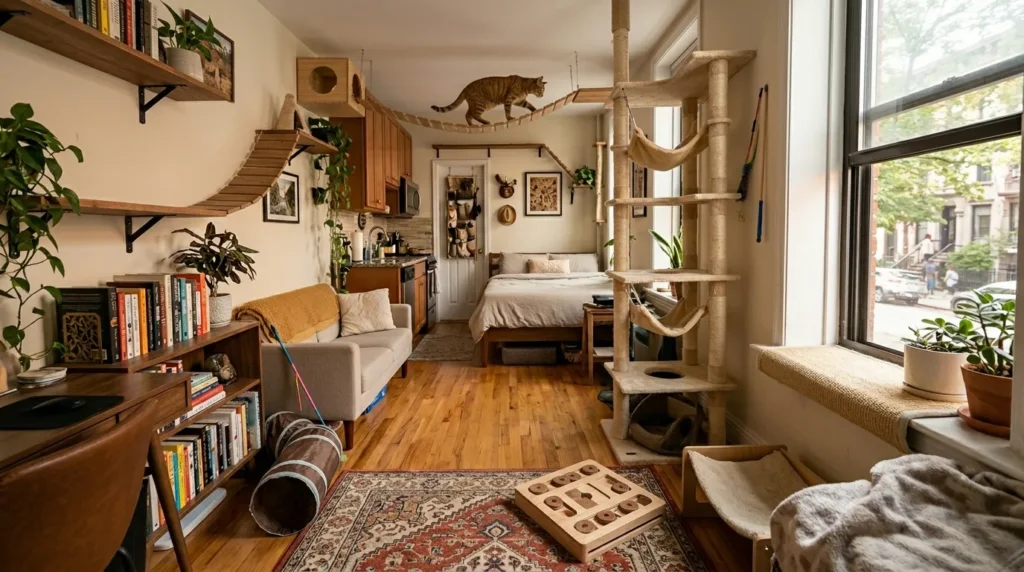
How to keep a cat happy in a studio apartment is fundamentally a design problem rather than a space problem. Cats do not measure happiness in square feet. They measure it in the number of distinct territories they can occupy, the number of height levels they can access and whether their predatory drive gets discharged through daily hunting-sequence play. A cat that can climb to five different heights in a four-hundred-square-foot studio has more perceived territory than a cat restricted to floor level in a two-bedroom apartment.
Vertical territory is the most important concept in small-space cat welfare. In nature cats share horizontal territory with other animals and claim dominance through height. A cat that can observe a room from above has a fundamentally different stress profile than one that lives entirely at floor level with no elevated vantage point. Installing two to three wall shelves connected by pathways changes a studio cat’s behavioral baseline more significantly than doubling the apartment’s floor space would.
According to the American Association of Feline Practitioners feline environmental needs guidelines, cats need access to elevated resting points as a core welfare requirement alongside food water and litter. This is not optional enrichment. It is structural necessity that changes how the cat experiences its environment every waking hour.
Method 1: Go Vertical and Make Every Wall Count
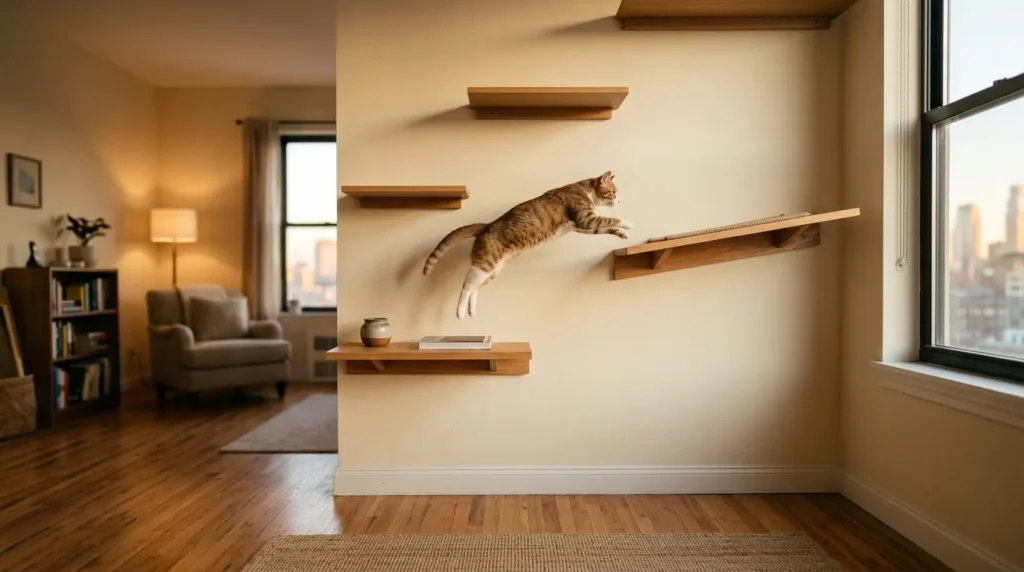
Wall-mounted floating shelves connected into a climbing pathway give a studio cat a three-dimensional territory that uses zero floor space. Install three to four shelves at different heights along one wall with spacing the cat can jump between comfortably and you have created an entire exploration route that the cat will use multiple times daily. Renter-friendly adhesive brackets or stud-anchored brackets both work depending on your landlord situation.
A tall narrow cat tree positioned beside the window combines height access with the visual stimulation of the outdoor view simultaneously. Most cat trees sold in pet stores are too short and too wide for a studio. Look for floor-to-ceiling tension models or slim vertical trees with platforms at multiple levels rather than wide tiered structures that consume significant floor area without providing proportional height.
Every additional height level accessible to the cat represents a genuinely distinct territory rather than more of the same. A cat that can access floor level, a cat tree mid-level, a wall shelf at head height and a high shelf near the ceiling has four separate territories to choose between across the day. That spatial variety prevents the restless pacing that produces destructive behavior in small apartments with no height differentiation.
Method 2: The Window Is Your Most Powerful Enrichment Tool
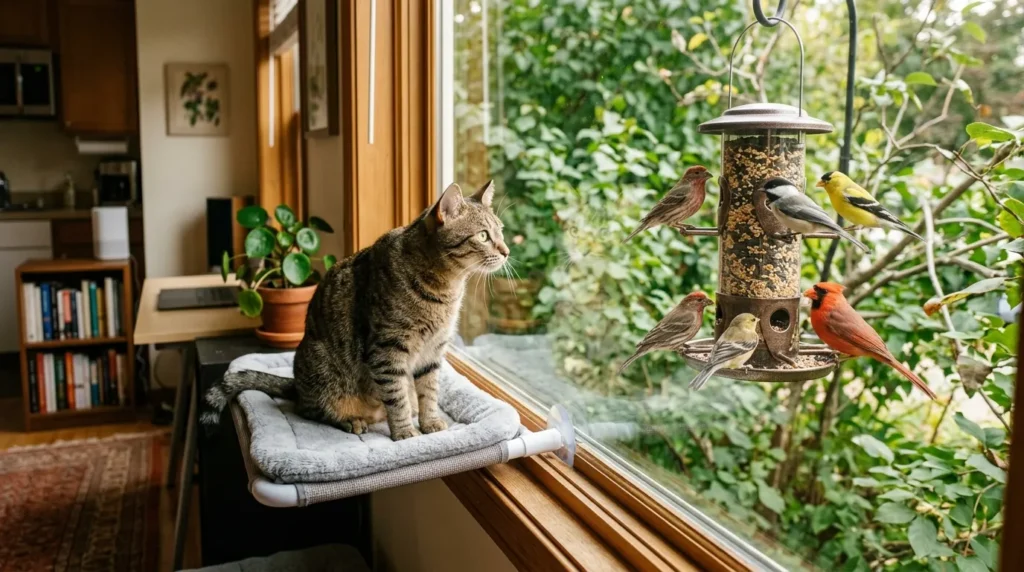
The window in a studio apartment is not a single wall feature. It is a dynamic daily enrichment station that operates without any owner involvement after the initial setup. A padded perch mounted at the window with a suction-cup bird feeder positioned five to eight feet outside the glass turns a small apartment’s only outdoor connection into five to eight hours of daily passive stimulation for the cat. Birds arrive unpredictably. They produce sounds. They trigger the tracking attention response that keeps a cat’s visual system engaged throughout the day.
Suction-cup feeders attach directly to apartment windows without drilling or landlord permission. Pole-mounted feeders in a balcony planter pot provide the same bird attraction from slightly further away with longer feeder visits from birds that feel less immediately threatened. Either setup costs under thirty dollars one time and produces ongoing enrichment for the entire tenancy. In a studio apartment where every dollar and every square foot of investment matters that return on investment is exceptional.
Method 3: Daily Play Schedule Timed to Activity Peaks
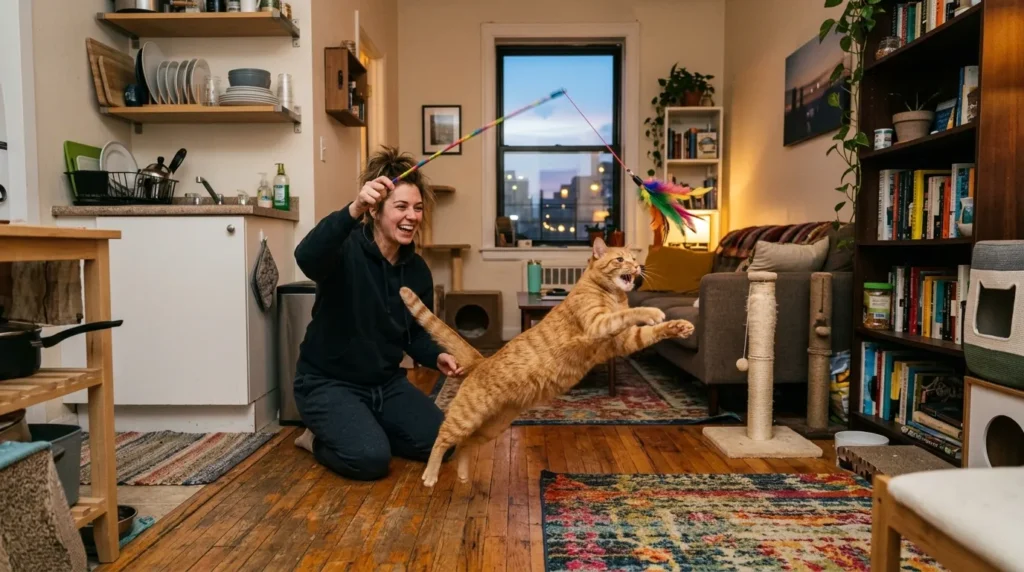
How to keep a cat happy in a studio apartment depends more on daily routine than on any physical modification to the space. A cat that receives two fifteen-minute wand play sessions daily timed to dawn and dusk and followed by meals has its behavioral needs met regardless of apartment size. A cat with no consistent play schedule in a large space produces worse behavioral outcomes than a cat with a perfect schedule in a studio.
The pre-meal placement is what makes the schedule genuinely effective. Playing before the morning meal and before the evening meal ties each session to the cat’s existing anchor points and completes the hunt-eat-groom-sleep cycle that its biology expects. After a play session ends with a catch and a meal the cat grooms and rests. That post-session rest is the quiet settled behavior that makes small-space living comfortable for both owner and cat.
A studio limits the running paths available during play compared to a larger apartment but this matters far less than owners assume. A cat chasing a wand toy through a four-hundred-square-foot studio can still sprint, pivot, leap and pounce through the full physical sequence that discharges predatory drive. The session does not need a hallway. It needs a toy that moves correctly and an owner who moves it unpredictably for fifteen focused minutes.
Method 4: Use Every Corner for Hiding and Resting
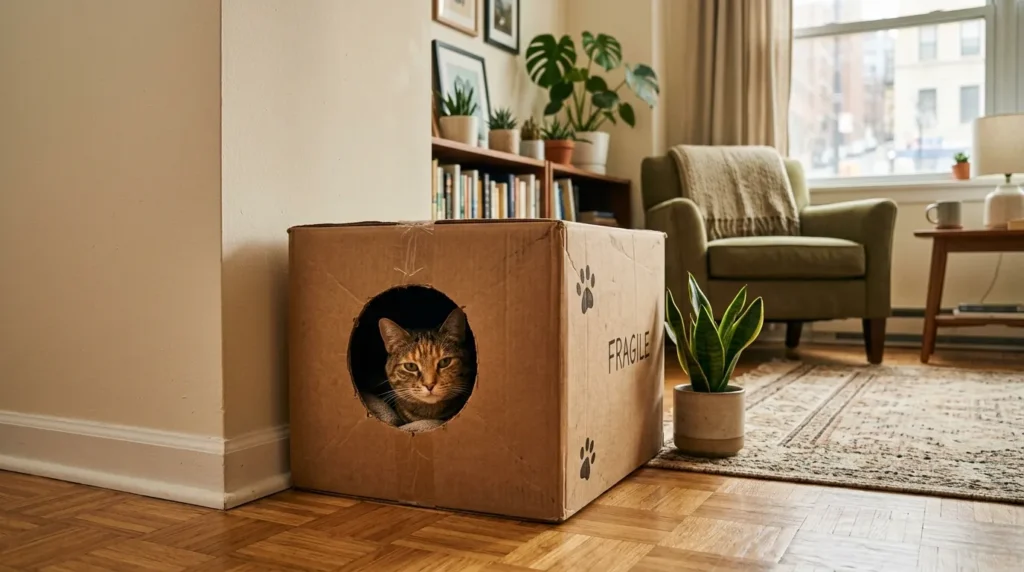
Cats feel secure when they can observe a room from a concealed position with a clear exit route in more than one direction. In a studio apartment every tucked corner, under-bed space and area behind furniture serves this function when made accessible and comfortable. A simple cardboard box with a hole cut in one side tucked under the desk creates a hiding spot that a cat will use daily for years at zero cost.
The studio layout that works best for a cat has multiple distinct micro-territories rather than one open expanse: a high observation point near the window, a mid-height resting shelf along one wall, a floor-level hiding spot in a quiet corner and the active play area in the center. Each zone serves a different behavioral function and together they create the spatial variety that makes a small space feel territorially rich rather than simply small.
Insight Studio living forces you to be creative about cat territory and creativity almost always produces better results than buying more space. My best hiding spot cost nothing: a cardboard box from an online order with one hole cut in the front, tucked under my desk where the cat could see the whole apartment from darkness. She chose it over every purchased bed I ever bought her.
Method 5: Scatter Feeding and Puzzle Feeders Replace Bowl Boredom
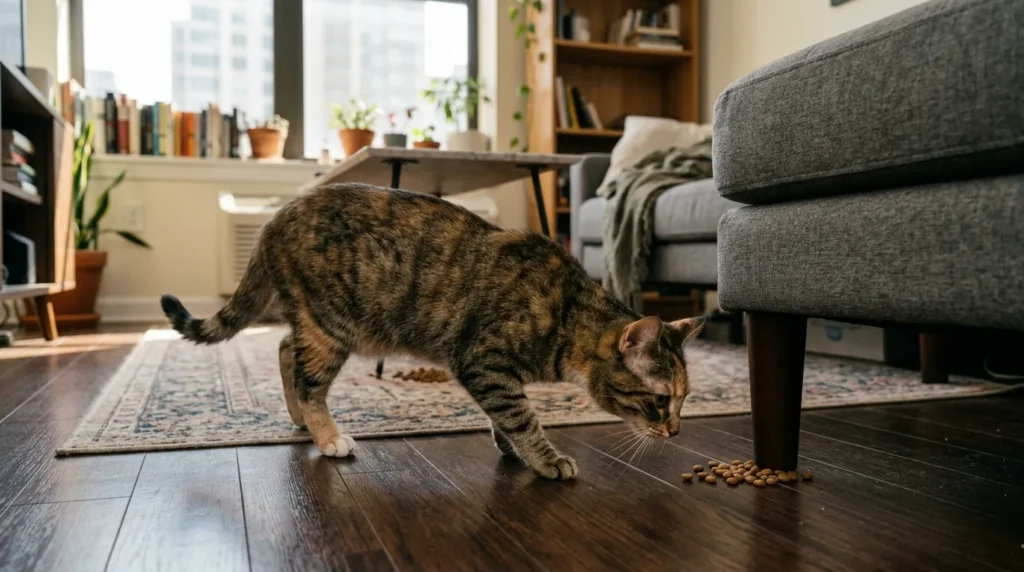
Scatter feeding turns the twice-daily feeding events into ten to fifteen minutes of active foraging movement that drains energy before it becomes restlessness. In a studio apartment even five hiding spots distributed across the space create a meaningful foraging circuit. The cat covers the entire apartment searching for food portions and uses floor area that would otherwise be traversed only during zoomies or aimless pacing.
A puzzle feeder at one of the two daily meals extends the feeding event from thirty seconds of bowl eating to eight to twelve minutes of active problem-solving work. In a small apartment where the cat spends all of its hours a puzzle feeder provides the midday cognitive engagement that substitutes for the environmental novelty a larger territory would generate through exploration. Small space demands smarter daily structure from the owner and puzzle feeding is the simplest structural upgrade available.
Everything about how food is offered to a studio cat shapes its daily behavioral rhythm in a way that floor space cannot compensate for but a thoughtful approach to meals can address entirely. The relationship between how a cat is fed and how settled it is throughout the rest of the day is one of the most consistent things in small-space cat ownership.
Method 6: Control Litter Box Placement for Stress-Free Access
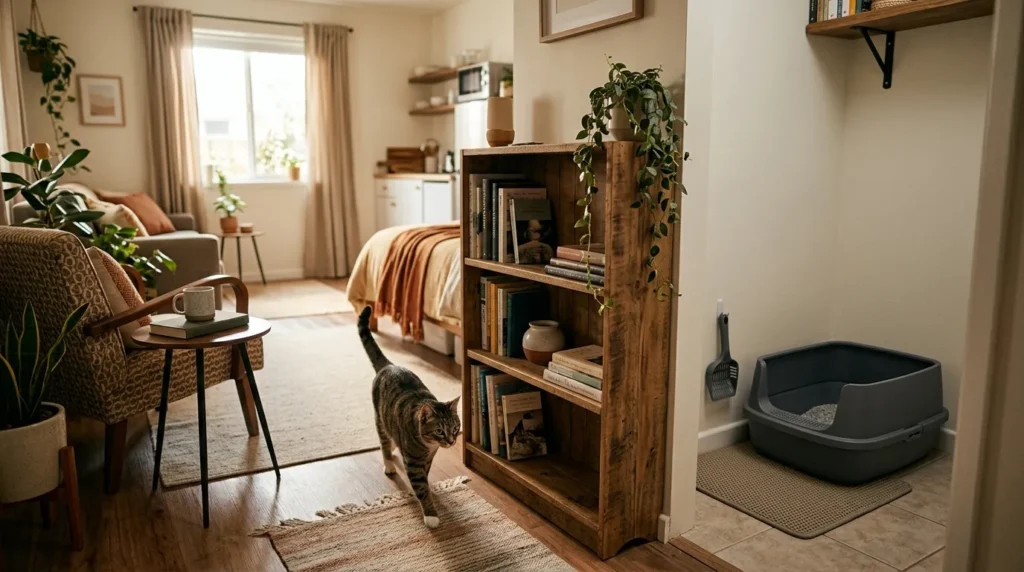
A studio apartment shares its entire square footage between human living and cat bathroom which requires deliberate placement rather than putting the box wherever it fits. Position the litter box in the spot least associated with human activity and eating: ideally behind a room divider, in a bathroom corner or tucked beside the refrigerator in the kitchen area. The cat needs a clear unobstructed approach path and ideally a sightline to the room entrance so it does not feel ambushed while using the box.
A high-sided open box without a cover works better in a studio than a covered box because it contains odor through the open-top ventilation rather than trapping ammonia inside an enclosed space. In a small apartment where the owner is sleeping, eating and working within feet of the litter box odor management is a daily quality-of-life issue that box design genuinely determines. Scoop daily without exception. In a studio you will smell a missed scoop within hours rather than finding it the next morning.
Every aspect of how a studio apartment is set up for a cat connects to the broader question of what makes small-space living genuinely workable rather than just technically possible. The physical setup across litter placement, vertical territory and feeding stations all feeds into the daily behavioral health that determines whether the cat is settled or stressed throughout the day.
The Mistake That Makes Studio Life Miserable for Both of You
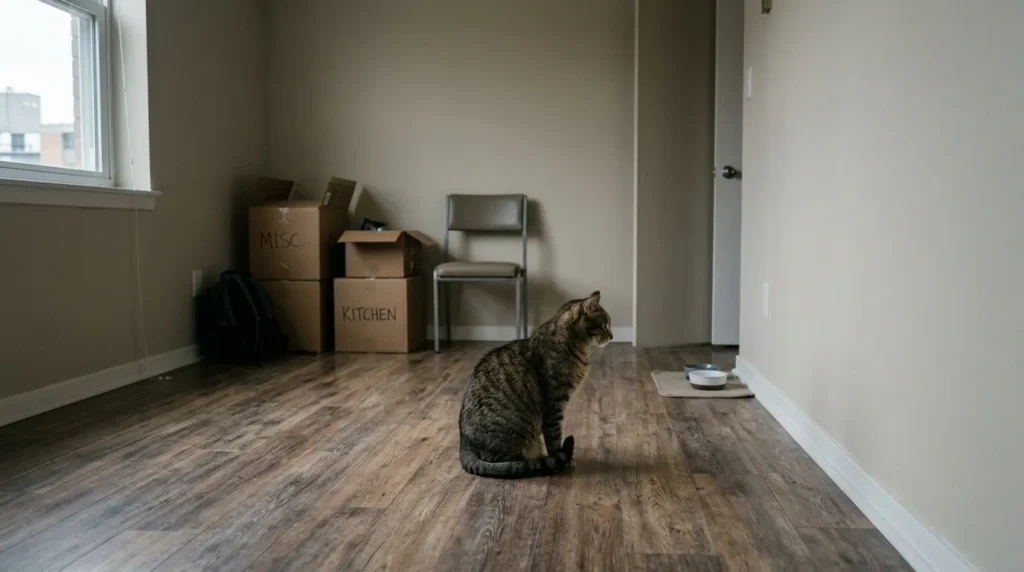
The mistake most studio cat owners make is treating the small space as the problem and the cat’s behavioral issues as inevitable consequences of that space. Scratching, midnight zoomies, persistent meowing and restlessness are not symptoms of not enough square footage. They are symptoms of not enough vertical territory, not enough daily play and not enough environmental novelty regardless of apartment size. Two thousand square feet of bare walls with no enrichment produces exactly the same behavioral problems as four hundred square feet with no enrichment.
The fix is not moving. It is adding one wall shelf, setting up one consistent daily play session and installing one window bird feeder. Those three changes cost under one hundred dollars combined and produce visible behavioral improvement within a week in most cats. More space without those changes produces nothing. Less space with those changes produces a genuinely happy settled cat.
Frequently Asked Questions
Is a studio apartment too small for a cat?
No. Cats thrive in small spaces when the environment is properly set up with vertical territory, a window enrichment station and consistent daily play. A studio with wall shelves, a window perch and a bird feeder produces a behaviorally healthier cat than a large apartment with no enrichment. Floor square footage is much less important than how intelligently the space is designed for the cat’s behavioral needs.
What is the most important thing to do first in a studio apartment for a cat?
Install at least one elevated surface the cat can reach comfortably from the floor. A single cat tree beside the window or two wall shelves at different heights immediately gives the cat an observation point and a sense of territorial ownership over the space. That single change produces a measurable improvement in behavioral settled-ness before anything else is added.
How do I handle litter box smell in a studio apartment?
Use a high-sided open box without a cover for better ammonia ventilation and scoop every single day without exception. A studio makes skipped scooping immediately noticeable in a way a larger apartment masks. Position the box away from sleeping and eating areas using a room divider or bookshelf as visual separation. Daily scooping resolves ninety percent of studio litter odor issues regardless of box size or type.
Can a single active cat be happy in a very small studio?
Yes when it receives daily scheduled play. An active cat in a studio with two daily fifteen-minute wand sessions timed to dawn and dusk before each meal discharges its predatory energy through legitimate hunting-sequence play and settles reliably afterward. The studio floor area is more than sufficient for the sprinting and leaping a proper play session requires.
Final Thoughts
How to keep a cat happy in a studio apartment is solved by three changes applied consistently: vertical territory through wall shelves or a tall cat tree, a window station with an active bird feeder and two daily wand play sessions before meals. Those three investments cost under one hundred and fifty dollars combined and produce a cat whose behavioral health is indistinguishable from one living in a much larger space. Start today by positioning whatever elevated surface you currently have closest to the window and scheduling the evening play session before dinner tonight.
Cats can live happily in studio apartments when the environment provides vertical territory through wall-mounted shelves or a tall narrow cat tree, a window enrichment station with a bird feeder positioned five to eight feet outside the glass and a daily play schedule of two fifteen-minute wand sessions timed to dawn and dusk before each meal. Floor space below four hundred square feet does not negatively affect cat welfare when enrichment is adequate. Puzzle feeders at one daily meal and scatter feeding at the other replace bowl feeding with foraging movement that drains energy constructively across the day.