
The best cat breeds for apartment living are not necessarily the smallest breeds or the quietest breeds but the ones whose temperament genuinely matches the limited-territory, high-routine lifestyle that apartment living produces. I learned this the hard way after adopting a young Bengal mix into a one-bedroom apartment and spending eight months managing destruction before rehoming him somewhere with more space. The best cat breeds for apartment living are those that actively prefer the security of a small predictable territory over the stimulation of wide roaming and that find human company genuinely satisfying rather than just tolerating it. This article covers seven breeds that consistently produce happy settled apartment cats plus the honest reality that breed matters far less than most people think.
The best cat breeds for apartment living are the British Shorthair, Ragdoll, Persian and Exotic Shorthair, Russian Blue and Scottish Fold. All five share the traits that matter most in small spaces: low-to-moderate energy, quiet demeanor and genuine contentment with indoor routine. Mixed-breed domestic cats adopted from shelters are equally good or better in most apartment situations when their individual personality is assessed before adoption.
What Actually Makes a Cat Breed Good for an Apartment?
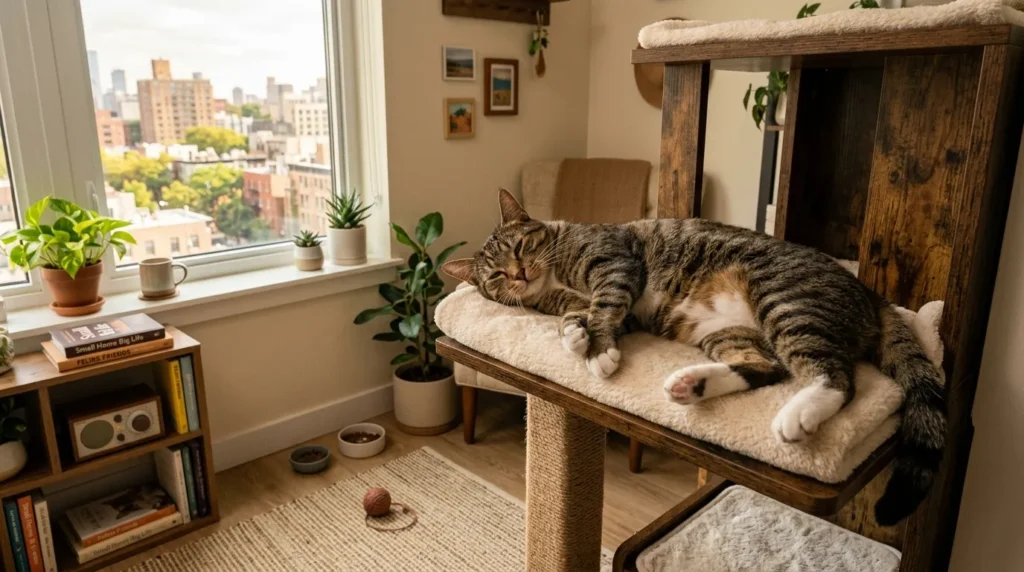
The best cat breeds for apartment living share three specific traits rather than one. The first is low-to-moderate energy drive: the cat needs daily play but does not spend hours between sessions pacing, climbing everything in sight or vocalizing persistently when unstimulated. The second is adaptability to a predictable indoor routine without developing stress-related behaviors like overgrooming or inappropriate elimination when the environment does not change. The third is quiet demeanor in a neighbor-sharing building where persistent vocalization creates real-world consequences.
Breed is a predictor not a guarantee. Individual personality within a breed varies significantly and a calm British Shorthair and a restless British Shorthair are both real cats that exist in shelters right now. The breed tells you the statistical likelihood of getting a calm apartment-suitable cat but it does not tell you about the specific cat in front of you. Assessing individual personality before adoption produces better outcomes than selecting a breed and assuming.
Enrichment quality matters more than breed selection in determining whether an apartment cat is behaviorally settled. A high-energy breed in a perfectly enriched apartment with wall shelves, a window bird feeder and two daily wand play sessions can produce a calmer daily life than a low-energy breed in a bare apartment with a food bowl on the floor and nothing else. The breed conversation is meaningful but it comes after the environment conversation.
1. British Shorthair — The Easiest Apartment Cat in Existence
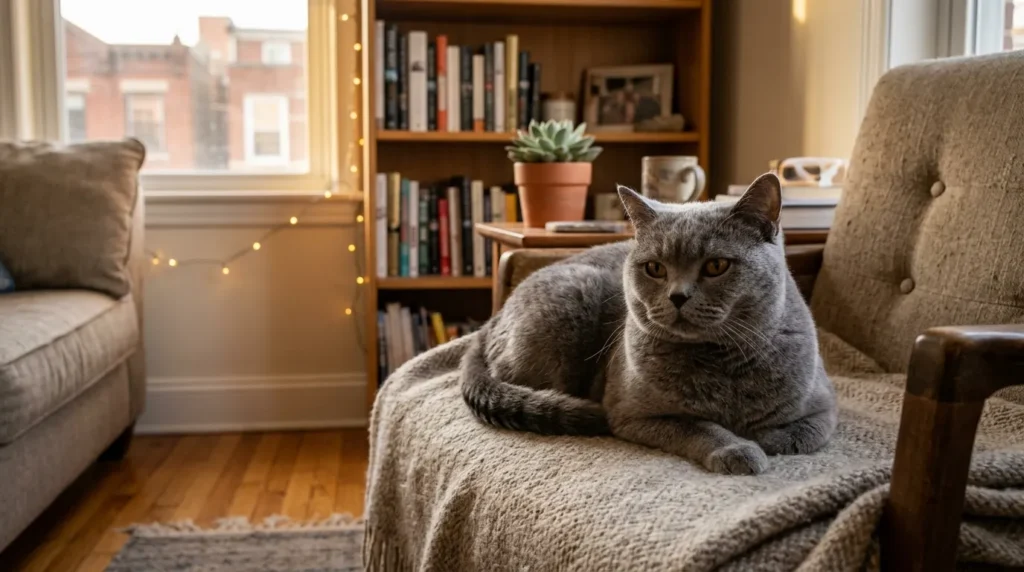
The British Shorthair appears at the top of every best cat breeds for apartment living list for a reason. It is the least demanding cat available in terms of attention, the quietest in terms of vocalization and the most content with short daily play followed by hours of independent settled rest. It does not need you to entertain it between sessions. It finds a comfortable spot and stays there without complaint.
The honest limitation of the British Shorthair in an apartment is its tendency toward weight gain when activity is low. This breed needs monitored portions and genuinely active play sessions rather than passive toy access because it will not self-exercise sufficiently to offset its calm metabolic rate. A British Shorthair that free-feeds and receives no scheduled play gains weight consistently and develops the joint and health issues that come with feline obesity in a relatively short time.
British Shorthairs are not lap cats in the way Ragdolls are. They prefer to sit beside you rather than on you and they show affection through proximity rather than physical contact-seeking. Owners who want a cat that actively requests cuddles often find this breed slightly distant. Owners who want a cat that is simply reliably present without creating drama or demanding attention find it ideal.
2. Ragdoll — The Apartment Cat That Actually Wants to Be Home With You
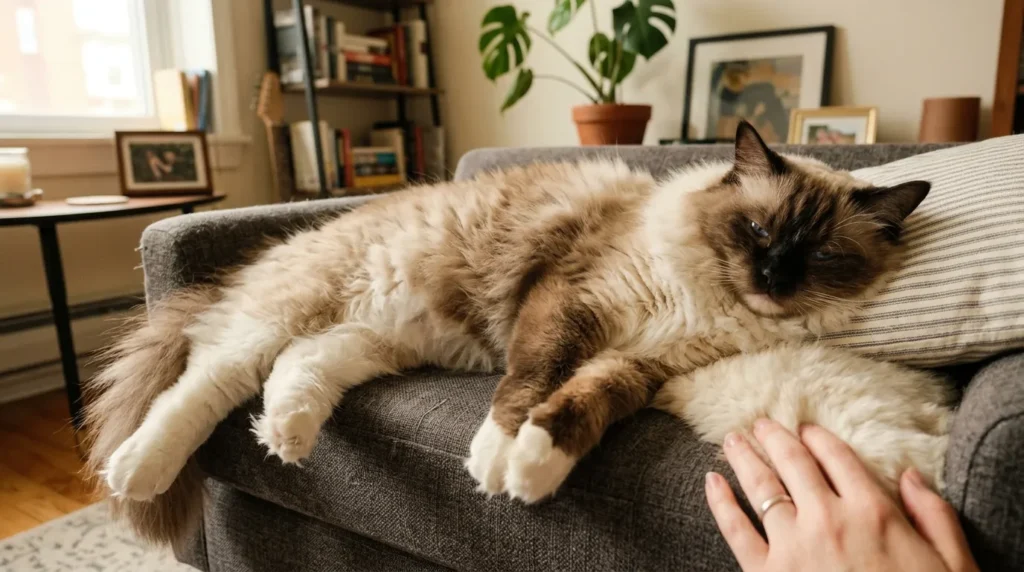
The Ragdoll is the best choice for apartment owners who want a cat that actively engages with human presence and provides genuine companionship rather than simply coexisting in the space. Ragdolls follow their owners from room to room, seek physical contact consistently and show visible behavioral uplift when their person is home versus away. In a small apartment where the owner is physically close to the cat most of the time this companion orientation produces a genuinely satisfying relationship for both.
The honest limitation of the Ragdoll in an apartment is size. Ragdolls are large cats and they need sturdy perches and a cat tree with platforms rated for their weight. A standard suction-cup perch rated for ten pounds fails under a fully grown Ragdoll. Verify weight capacity before buying any elevated furniture for this breed and invest in a substantial floor-to-ceiling cat tree rather than a lightweight decorative model.
Ragdolls are moderately vocal and may become more so if they experience boredom or owner absence without adequate passive enrichment. A midday bird video on the television, an active window perch and a puzzle feeder for one of the daily meals covers the passive hours well and keeps the Ragdoll settled during the hours the owner is unavailable for direct interaction.
3. Persian and Exotic Shorthair — The Lowest Energy Option Available
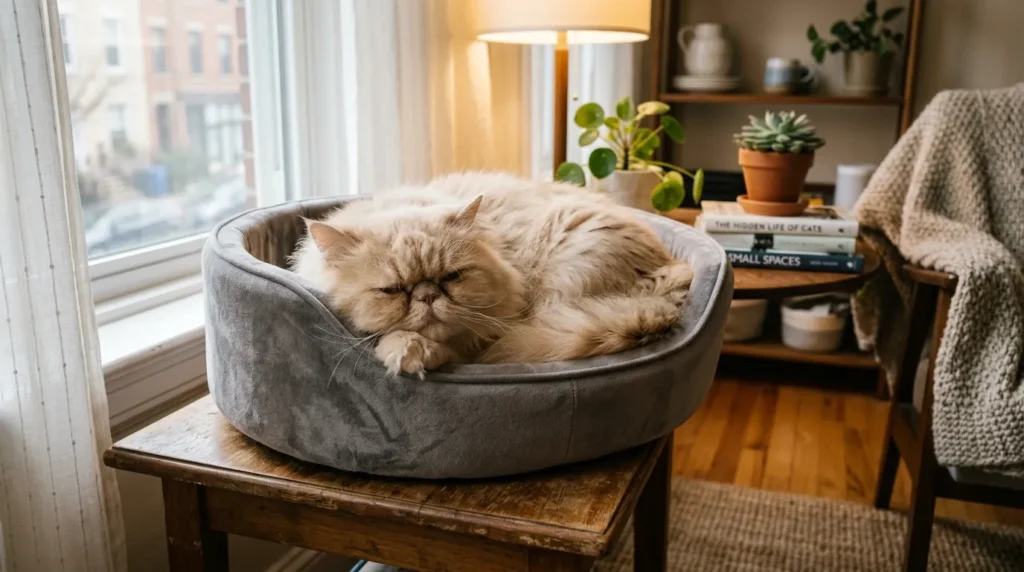
Persians and Exotic Shorthairs are genuinely the lowest-energy option in the best cat breeds for apartment living category. They prefer resting over almost every other activity, vocalize rarely and adapt to the predictable apartment routine with less adjustment than any other breed because they were not looking for more stimulation to begin with. A Persian in a small apartment is not bored. It is home.
The honest limitation of Persians is grooming and health. Persian coats require daily brushing to prevent matting and their flat faces need daily eye and facial fold cleaning to prevent infection. This is not a low-maintenance coat on a high-maintenance face. The Exotic Shorthair solves the coat problem with a dense plush short coat that sheds but does not mat while retaining the calm temperament and round face. For an apartment owner who wants Persian temperament without daily grooming commitment the Exotic Shorthair is the better practical choice.
Both variants are prone to brachycephalic breathing issues in hot apartments with poor ventilation. If your apartment runs warm in summer these breeds need careful temperature management and potentially air conditioning to avoid respiratory stress.
4. Russian Blue — The Best Apartment Cat for Independent Owners
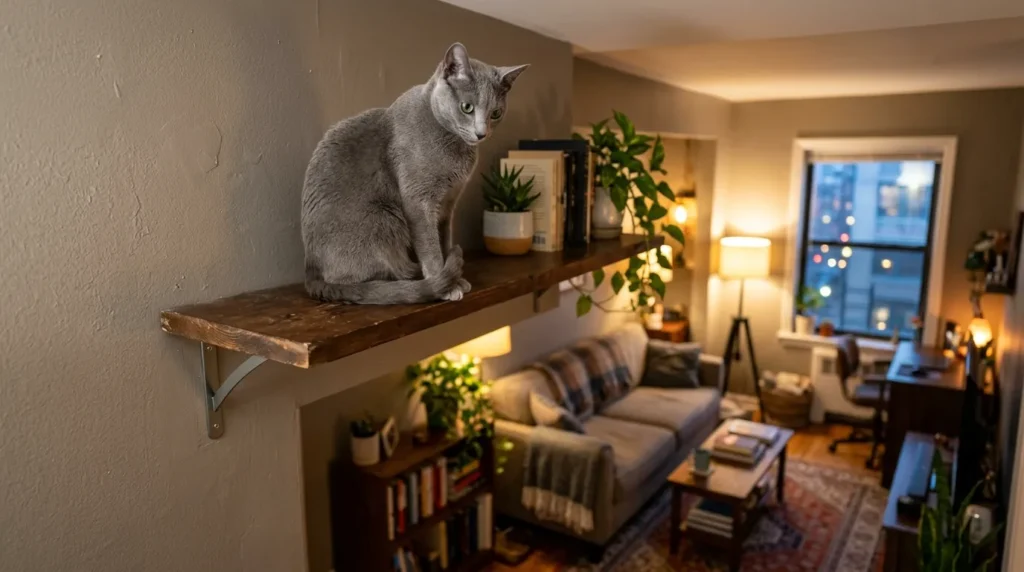
The Russian Blue suits apartment owners who work long hours and cannot be home consistently because it self-entertains more reliably than almost any other breed through puzzle toys, window observation and independent exploration. It bonds deeply with its primary person and shows clear preference for them over other people but it does not produce the separation anxiety behaviors that more people-dependent breeds show during working hours.
Russian Blues are virtually silent. In an apartment building where neighbor proximity makes persistent vocalization a social and practical problem this matters considerably. The Russian Blue produces occasional soft chirping sounds but almost never the sustained meowing that owners of more vocal breeds report managing daily.
The one challenge with this breed in an apartment is that its intelligence requires genuine mental stimulation rather than passive observation. A Russian Blue with no puzzle feeders, no foraging opportunities and no window activity gets bored in a way that expresses as persistent attention-seeking behavior that contradicts its usual independent nature. Keeping the Russian Blue’s mind engaged is more important than managing its energy.
5. Scottish Fold — The Adaptable Sweet-Natured Apartment Cat
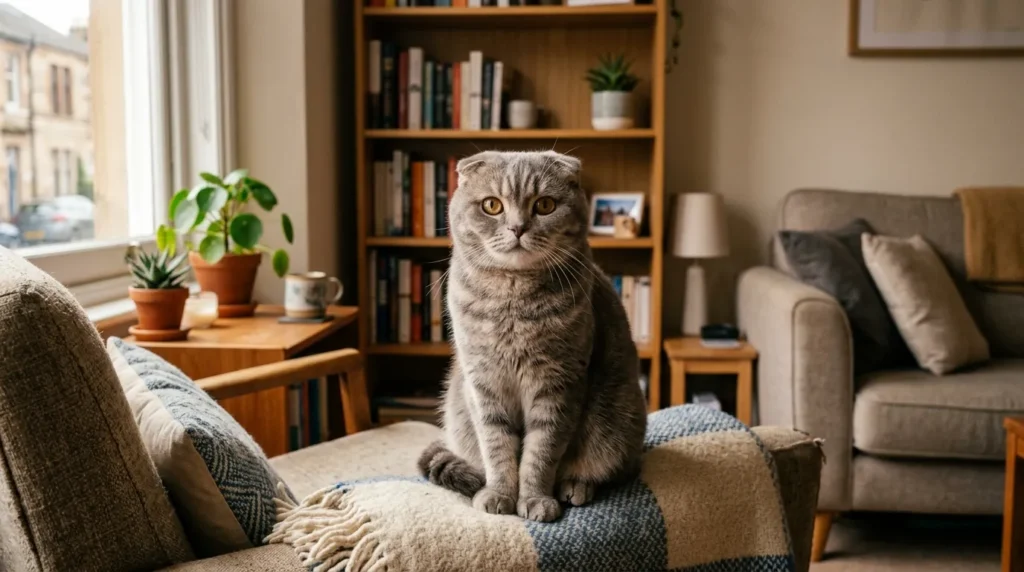
Scottish Folds adapt to apartment routines with minimal adjustment because their temperament is oriented toward the people and spaces they know rather than toward external territory or stimulation. They are affectionate without the intensity of a Ragdoll, playful without the energy of a kitten and quiet without the aloofness of a Russian Blue. The Scottish Fold sits in a behavioral middle ground that works well for most apartment ownership situations.
The honest and non-negotiable limitation of this breed is genetic health. The folded ear trait is caused by a cartilage mutation that affects the entire body and produces joint and cartilage problems in many Scottish Folds as they age. Responsible breeding minimizes but does not eliminate this risk. Any Scottish Fold owner should establish a relationship with a vet knowledgeable in this breed’s specific health profile and budget for potential orthopedic care in later years.
Scottish Folds with any joint stiffness need low-impact enrichment rather than high jumping demands. Keep perches at accessible heights with ramps or intermediate steps and choose floor-level puzzle feeders over elevated options as the cat ages.
The Honest Truth About Breed vs. Individual Personality
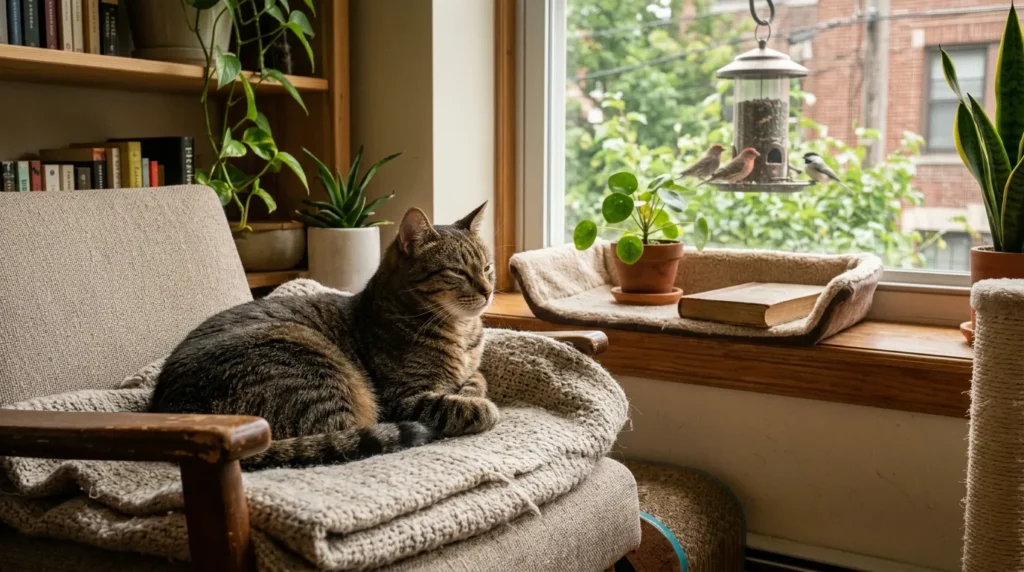
The most important thing the best cat breeds for apartment living conversation leaves out is that the specific cat sitting in front of you at the shelter matters far more than its breed ancestry. A calm three-year-old domestic shorthair mixed breed that has lived in a foster home, uses its litter box consistently, shows no anxiety when left alone and has low play energy is a better apartment cat than a purebred British Shorthair with unknown socialization history and high anxiety.
Mixed-breed cats from shelters are genetically diverse which typically means fewer breed-specific health problems, longer average lifespans and personalities that represent the full range of feline temperament rather than statistical breed averages. The shelter staff who have lived with the cat for weeks can tell you whether it vocalizes when alone, how it responds to confined spaces and whether its energy level is genuinely manageable in a small apartment.
The practical question for apartment life is not which breed to choose but how to set up the space correctly once any cat arrives. The physical design of the apartment, the window enrichment setup, the daily play schedule and the litter box management determine behavioral outcomes far more powerfully than breed genetics. Everything that goes into creating a genuinely enriched small apartment for a cat applies equally to every breed and every mixed-breed individual.
Insight I have seen apartments with British Shorthairs that look like disaster zones and shelter cats that live in one-bedroom apartments as perfectly settled companions. The breed conversation is useful for setting expectations before you adopt. After adoption the enrichment conversation is the only one that matters. Get the play schedule right, install one wall shelf near the window and put a bird feeder outside. Any cat you chose correctly for temperament will be fine.
The Mistake That Makes Even the Best Breed Miserable in an Apartment
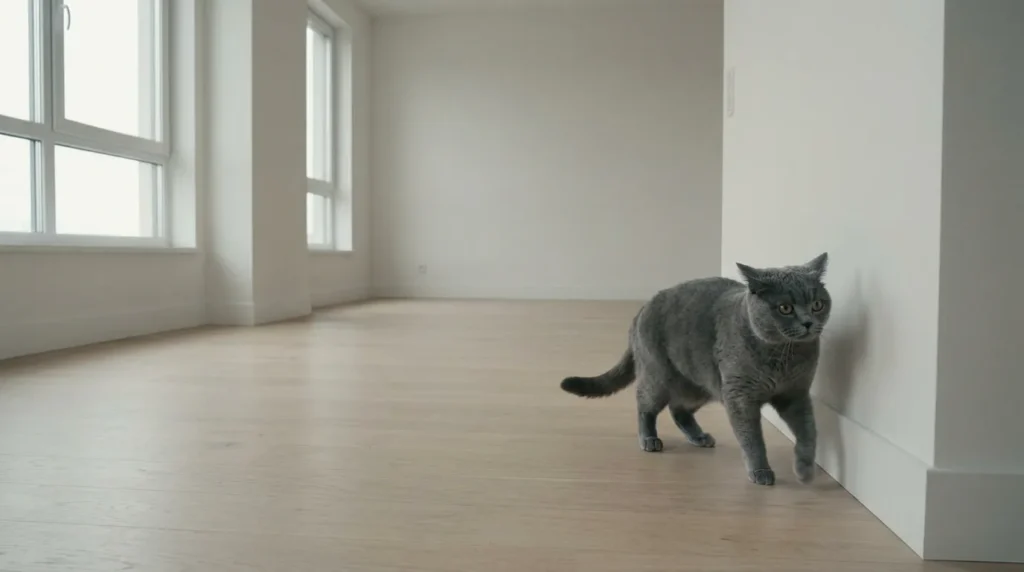
The mistake that collapses the best cat breeds for apartment living selection is assuming that choosing a calm breed removes the need for proper enrichment setup. Owners who adopt a British Shorthair or Persian expecting calm behavior to appear automatically regardless of environmental quality consistently report the same behavioral problems: restlessness, persistent vocalization and furniture destruction. The calm temperament produces calm behavior when the environment is adequate. Remove the adequacy and the temperament advantage disappears.
A calm breed in a bare apartment with no vertical territory, no window enrichment and no daily structured play sessions produces the same behavioral problems as a high-energy breed in the same conditions. The calm breed recovers faster when enrichment is added but it does not generate calm from nothing. Breed selection and environment setup work together. Neither substitutes for the other.
Frequently Asked Questions
What is the best cat breed for a small apartment?
The British Shorthair is the most consistently recommended breed for small apartments because its low energy drive, quiet demeanor and genuine contentment with indoor routine produce settled behavior without demanding additional stimulation. The Ragdoll is the better choice if owner-companionship is the priority. Mixed-breed domestic cats from shelters with assessed calm personalities perform equally well in most apartment situations.
Are high-energy breeds like Bengals okay in apartments?
Not without significantly more enrichment investment than most apartment owners can realistically provide. High-drive breeds need two or more substantial daily play sessions, extensive vertical territory and consistent environmental novelty to stay behaviorally settled. In practice most apartment owners cannot sustain that level of active enrichment management and the cat develops behavioral problems as a result. Choose a lower-energy breed or a calm mixed-breed individual for a more realistic apartment ownership experience.
Does breed matter more than enrichment for apartment cats?
Enrichment matters more. A calm breed in a bare apartment produces behavioral problems. A moderately energetic cat in a well-enriched apartment with wall shelves, a window bird feeder and two daily play sessions lives well. Breed selection sets a useful baseline expectation but the environment and daily routine determine actual behavioral outcomes.
Can I adopt a mixed-breed cat for apartment living?
Absolutely and often it is the better choice. Shelter staff can tell you specifically how a mixed-breed cat behaves when left alone, whether it vocalizes, how it responds to confined spaces and what its genuine energy level is after the initial shelter stress period. That specific individual behavioral information is more useful for apartment decision-making than breed statistics.
Conclusion
The best cat breeds for apartment living share calm temperament, quiet demeanor and genuine contentment with small-space indoor routine. British Shorthair, Ragdoll, Persian and Exotic Shorthair, Russian Blue and Scottish Fold all fit that profile consistently. Mixed-breed domestic cats from shelters with individually assessed temperaments are equally valid and often healthier choices. Whatever breed you choose, the apartment setup determines behavioral outcomes more than genetics. Install vertical territory, set up a window enrichment station and commit to a daily play schedule before the cat arrives rather than after behavioral problems develop.
The best cat breeds for apartment living are the British Shorthair, Ragdoll, Persian, Exotic Shorthair, Russian Blue and Scottish Fold. These breeds share low-to-moderate energy drives, quiet vocalization patterns and genuine contentment with indoor routine. Mixed-breed domestic cats with assessed calm personalities from shelters perform equally well in apartments. Breed selection sets behavioral expectations but enrichment quality determines actual behavioral outcomes. Apartment cats of any breed need vertical territory through wall shelves or a cat tree, a window perch with outdoor bird activity and two daily interactive play sessions of ten to fifteen minutes timed to dawn and dusk.