
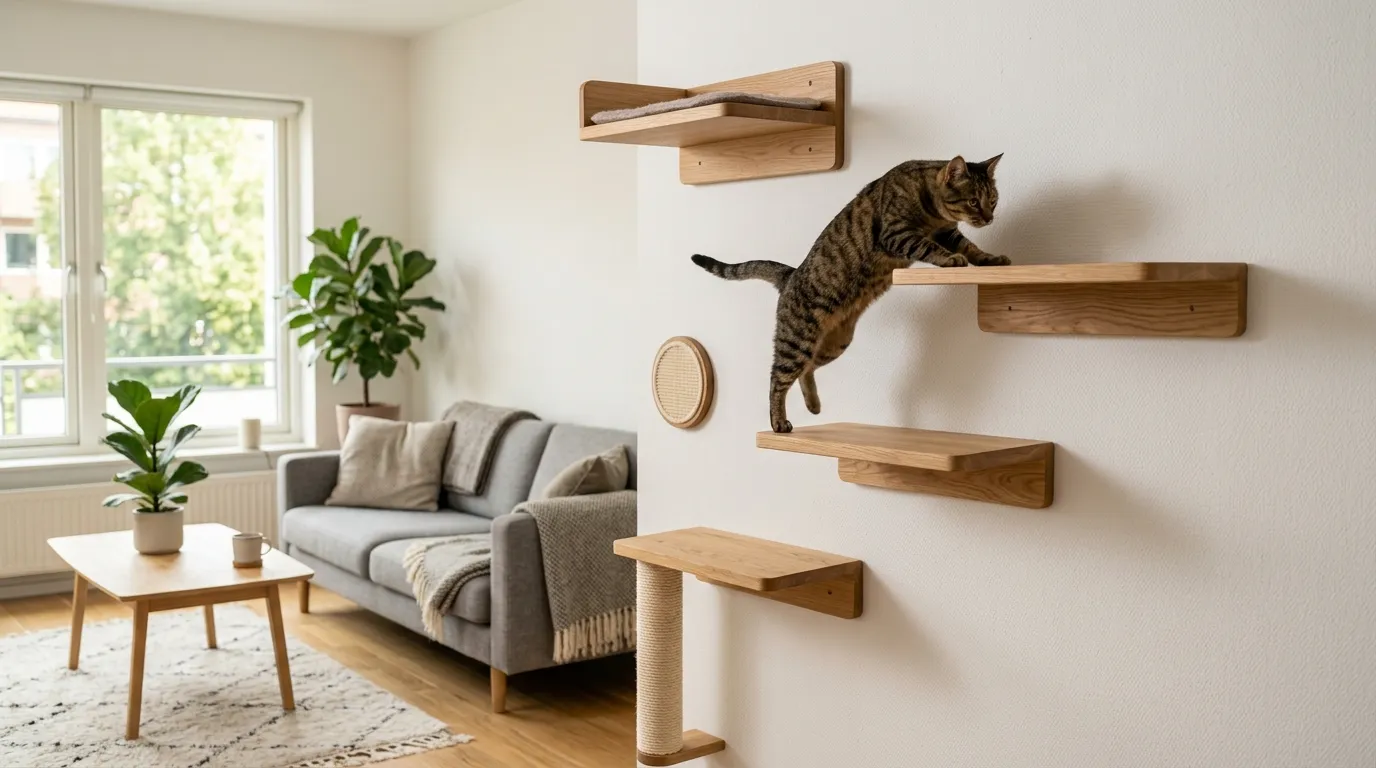
Your cat has taken over every horizontal surface in your apartment. The shelves, the counters, the sofa back are all unofficial cat furniture now. Learning how to build a cat wall for an apartment fixes this because it turns unused vertical wall space into dedicated cat territory without giving up a single square foot of floor. I found this out when my cat started jumping from the bookshelf to the top of the fridge every morning. She wanted height and I had nowhere obvious to give her. A cat wall gives your cat an aerial route that runs around the room at their level, so your furniture stays furniture. This guide covers planning, materials, installation, renter-friendly options, weight safety, and the mistakes that turn a cat wall into an expensive shelf your cat never touches.
To build a cat wall for an apartment, install staggered floating shelves at varying heights between 18 and 72 inches from the floor using anchors rated for dynamic load, ideally into studs. Add carpet or sisal covering for grip and connect shelves with ramps or jumps of no more than 18 inches. Renter-friendly builds use tension-mounted pole systems that need no wall drilling at all.
Cat Wall vs. Cat Tree vs. Cat Tower: Which One Actually Fits an Apartment?
Before you buy a single bracket, it’s worth knowing what you’re choosing between. A cat wall, a cat tree, and a cat tower all solve the same problem of giving your cat height, but they trade off floor space, cost, and customization very differently. Most apartment cats end up happiest with a wall system precisely because it doesn’t compete with your actual living space.
| Feature | Cat Wall (shelves) | Cat Tree | Cat Tower |
|---|---|---|---|
| Floor space used | None | 2–4 sq ft | 1–2 sq ft |
| Max height reachable | Ceiling (with enough shelves) | 4–6 ft typical | 5–7 ft typical |
| Renter-friendly | Yes, with tension-pole option | Yes, no installation needed | Yes, no installation needed |
| Customization | Full, you design the route | Fixed by manufacturer | Fixed by manufacturer |
| Good for multiple cats | Yes, if you plan enough landing spots | Limited, one tree gets crowded fast | Limited |
| Upfront effort | A weekend of measuring and installing | Unbox and place | Unbox and place |
If you rent, own multiple cats, or just want a design that matches your apartment instead of looking like it was built for a cat, the wall wins. If you want something with zero setup time and don’t mind the footprint, a tree or tower still does the job.
How to Build Cat Wall for Apartment? Planning the Layout First
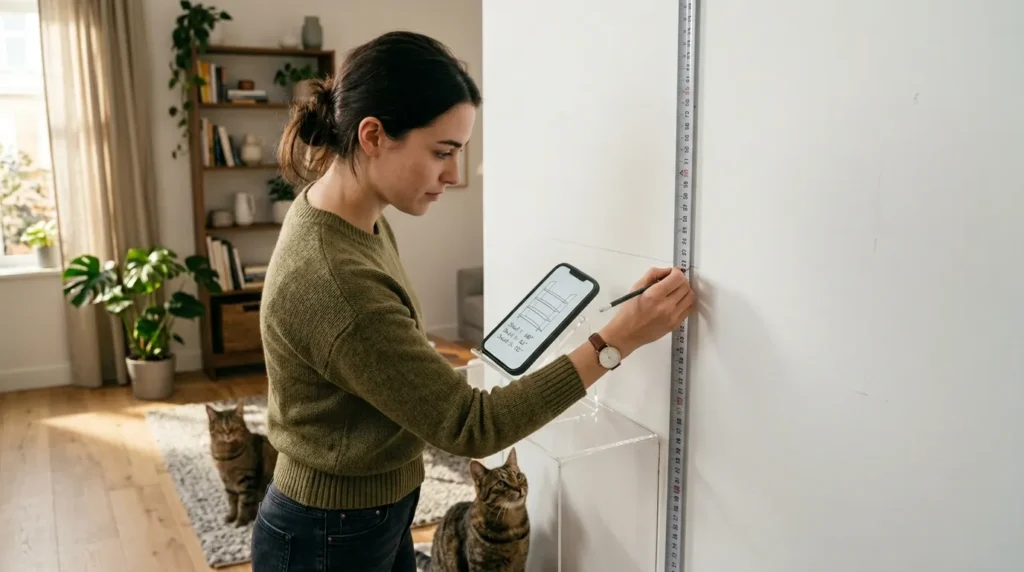
Planning the layout before a single screw goes into the wall saves real frustration later, and it’s the step most first-time cat wall builders rush past. A cat wall works as a connected system of surfaces your cat can travel between, not a set of isolated shelves they jump onto with nowhere to go next. Think of it less as decorating and more as designing a route your cat can follow from one end of the room to the other without touching the floor.
Walk the wall with a tape measure and mark three height zones: entry level at 24 to 30 inches from the floor, mid-level at 48 to 54 inches, and high level at 66 to 72 inches. Your cat needs an easy way up to the first shelf and an easy way down from the highest one. Keep the jump gap between any two connected shelves at 18 inches or less, so the route stays accessible for adult cats without demanding the athleticism of a young kitten.
| Zone | Height from floor | Purpose |
|---|---|---|
| Entry level | 24–30 in | First jump-on point, closest to floor and furniture |
| Mid-level | 48–54 in | Travel route, transition shelves, hammocks |
| High level | 66–72 in | Destination point, observation, corner shelves |
Find where the studs run before you commit to positions. A shelf that lands between studs needs wall anchors rated for well more than the shelf and cat’s combined weight. A ten-pound adult cat landing on a shelf creates a momentary impact force of roughly three to four times its body weight. Build for that number, not the cat’s resting weight.
Choosing the Right Shelves and Materials for a Cat Wall
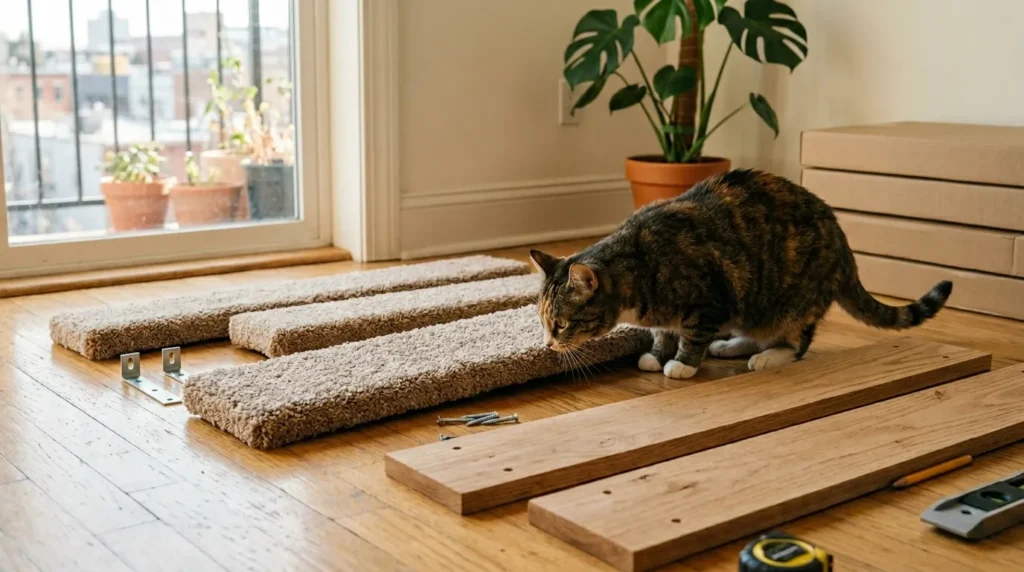
The shelf material determines both looks and safety, and the two don’t always line up in cat furniture. Standard floating shelves from hardware stores hold up fine structurally, but bare wood or laminate is slippery for a cat landing mid-jump, and slippage on landing is how falls happen. Every shelf on a cat wall needs a non-slip surface before your cat ever steps on it.
| Material | Grip | Durability | Notes |
|---|---|---|---|
| Short-pile carpet | High | Good, replace every 1–2 years | Also works as a scratching surface |
| Sisal sheet | High | Very good | Best for cats who scratch on landing |
| Cork tile | Medium | Good | Cleaner look, less scratch-friendly |
| Bare wood/laminate | Low, avoid | N/A | Slippery on landing, causes hesitant or refused jumps |
| Rubber-backed bath mat | High but avoid | Poor in this use | Traps moisture, grows mold on wood over time |
Carpet is the most common choice because it doubles as a scratching surface when your cat stretches on the shelf edge. Skip rubber-backed bath mats. They trap moisture against wood and can mold in an enclosed apartment.
For depth, aim for a minimum of eight inches so a cat can sit facing outward comfortably, and a maximum of twelve inches so the shelf doesn’t dominate a smaller room visually. Past twelve inches, a shelf starts looking like actual furniture bolted to the wall, which shifts the whole system away from the clean, intentional look that makes a cat wall work aesthetically as well as functionally.
How Much Weight Can a Cat Wall Shelf Hold?
This is the question most guides skip, and it’s the one that actually keeps your cat safe. A floating shelf’s listed weight rating almost always refers to static load — weight resting on it, not weight landing on it. A cat jumping onto a shelf hits it with roughly three to four times its resting body weight in that first split second of impact.
- Static rating you need: at least 3–4 times your cat’s actual body weight, per shelf and per bracket set.
- Example: a 12-pound cat needs brackets and anchors rated for at least 36–48 pounds of static load to safely absorb a landing.
- Multi-cat households: rate for the heaviest cat that might land on that shelf, not the average.
- Hollow drywall without a stud: even the best anchor is only as strong as the drywall around it. When you can’t hit a stud, use anchors specifically rated for dynamic or impact loads, not just hanging weight.
If you’re not sure a shelf can take repeated landings, don’t guess. Downgrade the shelf to a low-traffic decorative spot, or move it to a stud-backed position instead.
The Renter-Friendly Installation Approach
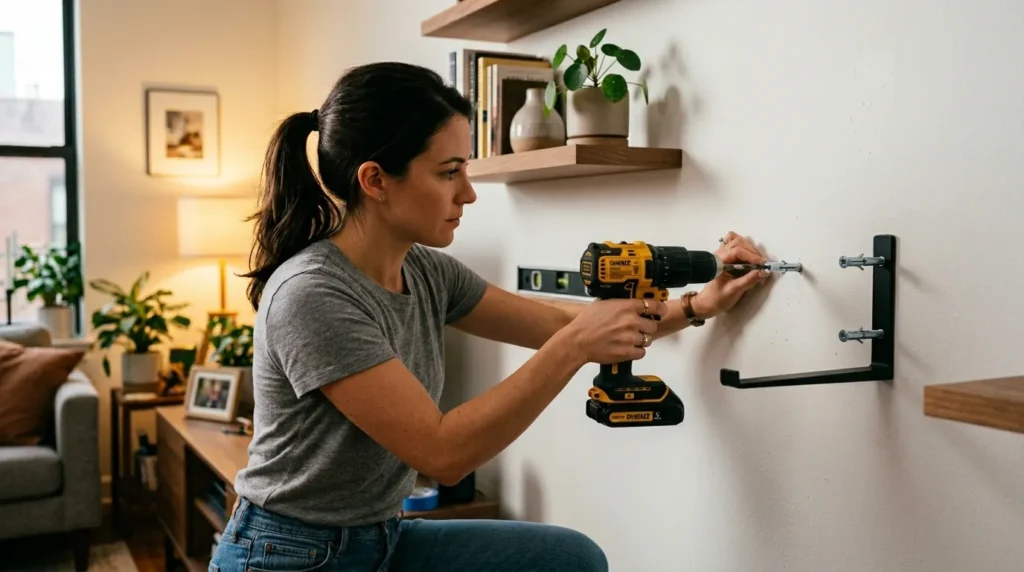
Building a cat wall in a rental means balancing structural security against wall damage, and those two goals pull in opposite directions once shelves get heavier. Here’s the honest answer: for a full cat wall your cat will actually land on daily, you need screws into studs or anchors rated for dynamic load. Command strips and adhesive mounts aren’t built for a cat landing on a surface that’s supposed to hold full body weight on impact.

What you can do as a renter is minimize the damage. Use the smallest bracket hardware that still meets the load requirement, and keep spackle on hand to fill holes before move-out. Two small screw holes per bracket, filled and painted, are genuinely invisible to most landlords, and touch-up paint costs nothing next to what a properly installed cat wall is worth. Photograph the wall condition before you start and return it to that state when you leave.
Tools and Materials Checklist
- Stud finder
- Tape measure and pencil
- Level
- Drill and drill bits
- Screws matched to your shelf brackets
- Wall anchors rated for dynamic/impact load (for non-stud positions)
- Floating shelves (6–14 depending on room size)
- Carpet, sisal, or cork covering, cut to shelf size
- Spackle and matching paint, for move-out repairs
What Does a DIY Cat Wall Cost?
Costs vary a lot by region and how many shelves you build, but a rough U.S. planning range looks like this:
| Build type | Shelf count | Typical cost range |
|---|---|---|
| Basic single-wall route | 6–8 shelves | Budget hardware-store shelves plus covering and hardware; check current local prices for an exact figure |
| Full room circuit | 10–14 shelves | Scales roughly with shelf count, plus ramps and a corner piece |
| Tension-pole freestanding system | 1 pole unit, multiple shelves | Usually sold as a complete kit; compare per-shelf cost against a DIY build before buying |
I’m not going to invent exact dollar figures here since hardware prices shift by store and region — check your local hardware store or the specific shelf and anchor products you’re buying before budgeting. What’s consistent is that shelf covering and anchors add up faster than people expect, so price the full parts list before you commit to a shelf count.
For a fully removable option, freestanding cat wall systems using tension poles that span floor to ceiling are widely available now. Shelves mount to the poles instead of the wall. No wall contact, no marks, and you can reposition the whole thing whenever you rearrange furniture. The limitation: tension systems work best with standard eight-foot ceilings, and the pole base footprint can compete with floor space in a very small room.
According to the American Association of Feline Practitioners, giving cats vertical territory indoors is a recognized part of environmental enrichment that reduces stress and territorial anxiety. This guide is part of our broader look at apartment cat furniture see best cat furniture for indoor cats for wall-mounted, freestanding, and tension systems compared side by side.
Building the Aerial Highway: Connecting Shelves Into a Route
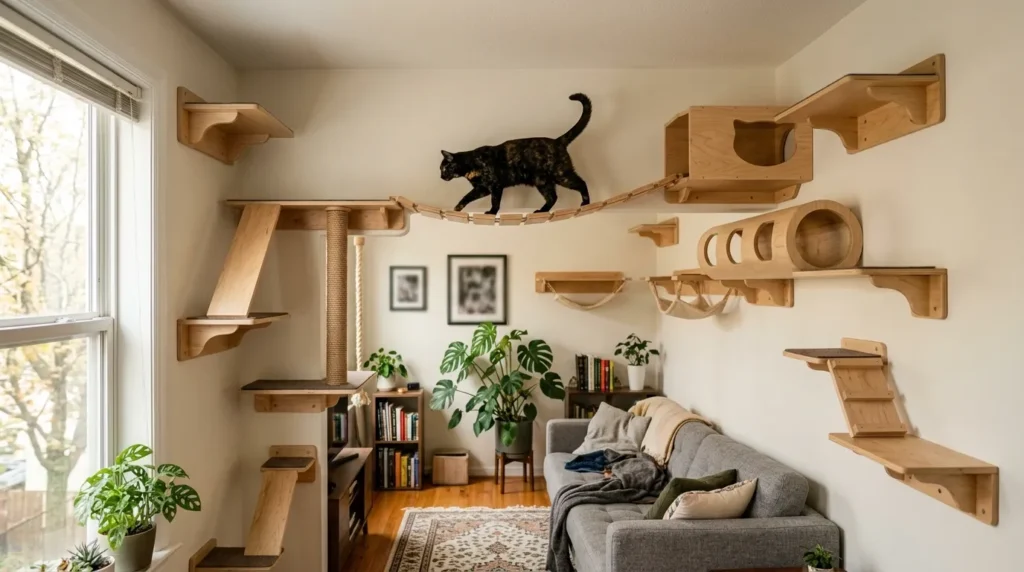
An aerial highway is a cat wall where every shelf connects to at least one other shelf through a jump or a ramp, so a cat can travel the whole route without touching the floor. This is what separates a genuinely used cat wall from a set of shelves your cat investigates once and ignores. Your cat should be able to get on the system at one point, cross the full circuit, and come down somewhere else entirely, with more than one path in between.
Ramps between levels help older cats and kittens especially, since they cut the impact load on joints compared to landing from a drop. A ramp between mid-level and high-level shelves also gives a startled cat a fast route between levels without needing to judge a jump under stress. Build ramps from the same material as your shelves and cover them in carpet cut on a diagonal, so the grip works going both up and down.
The corner transition is the piece most first-time builders miss entirely. When your route needs to turn, you need either an angled shelf that spans the corner or two shelves close enough to jump between at different heights. A corner shelf set at 45 degrees is the cleanest fix, and it usually becomes one of the most-used spots on the whole system, since cats treat corners as natural observation points.
Builder’s Note: Map your full route on paper or in a room-planning app before buying anything. Count the shelves, measure total linear footage, and build your hardware list before the first hardware store trip. I’ve watched people buy twelve identical shelves and then realize they needed four different sizes to make the transitions work. One hour of planning saves three hours of returns.
How to Add Enrichment Features to a Cat Wall?
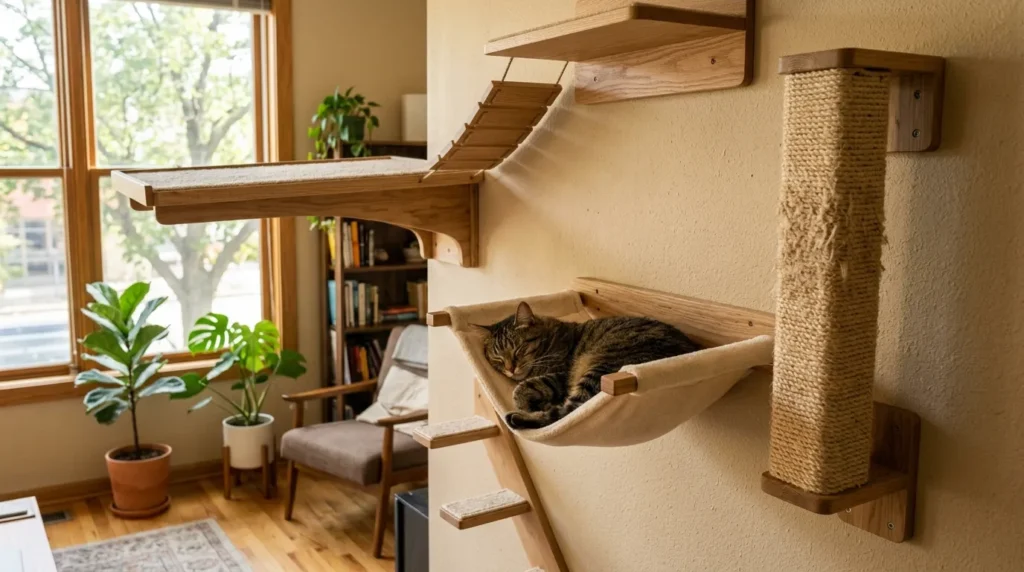
A cat wall with only flat shelves works, but it won’t hold your cat’s attention the way a system with varied surfaces does. Add a hammock shelf at mid-level, a sisal post built into the route, and a wide observation platform at window height, and a simple cat highway turns into a full environment your cat actually lives in instead of visiting occasionally.
| Feature | Best position | Why it matters |
|---|---|---|
| Window platform | Window-ledge height | Combines elevation with outdoor stimulation; usually the most-used spot within a week |
| Hammock perch | Mid-level | Distributes load across two mount points; needs weight-rated fabric |
| Sisal post | Entry level, near floor jump-on | Combines the route with a scratching outlet |
| Corner shelf (45°) | Any wall corner | Doubles as a route turn and an observation point |
Window-height platforms are the highest-value addition you can make. They combine the security of elevation with the mental stimulation of watching birds, squirrels, and street activity. Position one platform at exact window-ledge height and make sure the shelf depth is wide enough for your cat to sit facing out with their full body supported.
Hammock perches need a slightly different install because the load spreads across two mounting points and the angle of force shifts as the cat moves. Use the same stud-mounting approach as your flat shelves, and confirm the hammock fabric is rated for your cat’s weight before mounting it. A hammock that fails drops a cat from height and can create a lasting aversion to the whole system.
For a complete guide to enrichment beyond the wall itself, see indoor cat enrichment, which covers play routines, feeding strategies, and mental stimulation that pair with the physical space a cat wall provides.
Multi-Cat Households: Can One Cat Wall Work for Several Cats?
Yes, but it needs more planning than a single-cat build. Cats generally don’t like sharing a single shelf with another cat unless they’re already bonded, so the fix isn’t a bigger shelf, it’s more landing spots and more than one route.
- Build at least one shelf per cat at each height zone, not one shared shelf per zone.
- Add a second entry point on the opposite side of the room so cats aren’t forced to pass each other to get on the system.
- Give the highest, most desirable shelf enough width for one cat to fully claim it, since top spots tend to become status positions in multi-cat homes.
- Watch for one cat blocking a chokepoint shelf and denying access to the rest of the route. If that happens, add an alternate path around that section.
The Most Common Cat Wall Mistakes and How to Fix Them
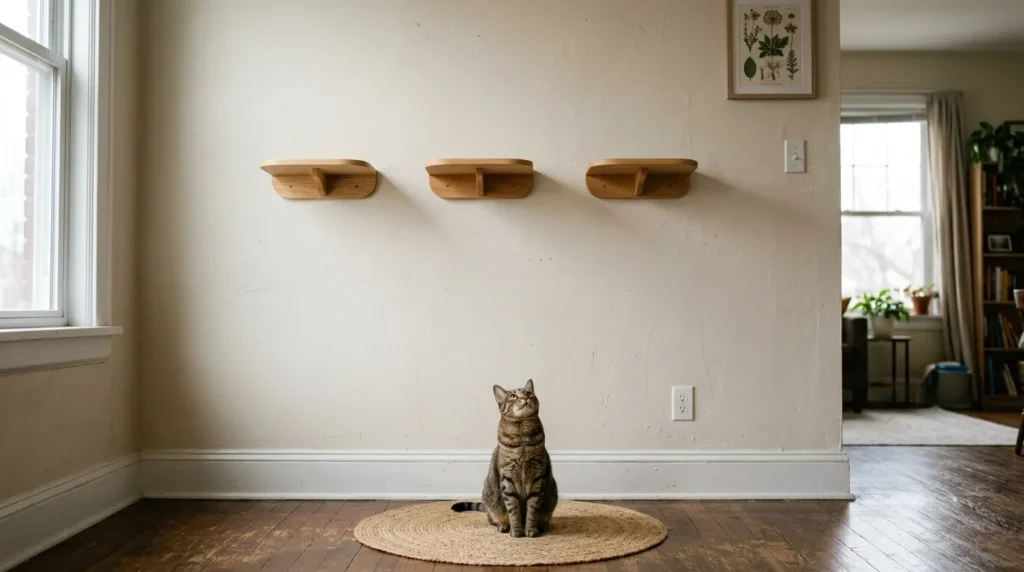
The most common mistake is installing shelves at the same height across the whole wall with no elevation variation. Flat, same-height shelving gives a cat nowhere to go: no route to follow, no high point to reach, no variety to make repeat use interesting. The cat checks it out once and never comes back, because there’s no behavioral payoff for using it.
The second mistake is building the system in the wrong room. A cat wall in a spare bedroom or hallway sits unused no matter how well it’s built, because cats want height in the rooms where their social life happens. Put it in the living room, or wherever you spend most of your time, and the cat uses it daily.
The third mistake is skipping the non-slip covering and assuming the cat will figure the landing out on its own. Cats decide whether to jump partly on what a surface looks like and partly on what they remember about how it felt last time. One slippery landing teaches a cat to avoid that shelf, and reversing that lesson can take weeks of coaxing.
The fourth mistake is under-rating the hardware. A shelf that looks fine holding a decorative plant can fail under a cat’s landing impact, since that impact load runs three to four times higher than static weight. Match your anchors to the impact load, not the resting weight, every time.
FAQ
Can I build a cat wall without drilling into the wall?
Yes, using tension-pole freestanding systems. They mount to the floor and ceiling with no wall contact and can hold multiple shelves. Weight capacity runs lower than stud-mounted shelves, so confirm the rating before installing.
How high should cat wall shelves be?
Start your lowest shelf at 24 to 30 inches from the floor and your highest at 66 to 72 inches. Keep jump gaps between any two connected shelves at 18 inches maximum.
What surface should I put on cat wall shelves?
Short-pile carpet, cork tiles, or sisal sheets all work well. Bare wood and laminate are slippery on landing and should always be covered before your cat uses the system.
How many shelves do I need for a cat wall?
A single-wall route typically needs six to eight shelves for a ten-foot wall. A full room circuit that turns corners usually needs ten to fourteen shelves, depending on room size.
How much weight can a cat wall shelf hold?
Rate your brackets and anchors for at least three to four times your cat’s body weight, since a landing jump hits the shelf far harder than the cat’s resting weight would suggest. A 12-pound cat needs hardware good for roughly 36 to 48 pounds of impact load.
Is a cat wall better than a cat tree?
For apartments, usually yes, mainly because it uses zero floor space and can be fully customized to your room. A cat tree wins if you want something you can unbox and place in ten minutes with no installation at all.
Can kittens use a cat wall safely?
Yes, with adjustments. Keep jump gaps smaller than the 18-inch adult maximum, add ramps rather than relying on jumps between early levels, and wait until the kitten is confidently jumping on furniture at home before introducing higher shelves.
How much does it cost to build a DIY cat wall?
It depends heavily on shelf count and materials, so price your specific shelf, anchor, and covering choices at your local hardware store before budgeting. Covering and hardware costs add up faster than the shelves themselves in most builds.
Will my landlord mind a cat wall?
Shelf screw holes are small and easy to fill before move-out. Photograph the wall condition before installing and patch correctly on exit. Most landlords accept this when the repair is done properly.
How do I get my cat to use the cat wall once it’s built?
Place treats on each shelf level when you first install the system, and use a wand toy to guide your cat up the route. Most cats adopt the system within three to five days when there’s a food reward on each level early on.
Can multiple cats share the same cat wall?
Yes, but plan for it. Build more than one shelf per height zone and add a second entry point, since most cats won’t willingly share a single shelf unless they’re already bonded.
Building a cat wall turns empty wall space into your cat’s primary living environment, and a basic system takes one weekend to complete. Plan the route first, rate your hardware for impact load rather than resting weight, and cover every shelf with a non-slip surface before your cat steps on it. Those three decisions determine whether your cat wall gets used daily or collects dust.
Building a cat wall for an apartment involves installing staggered floating shelves at heights between 24 and 72 inches from the floor, spaced no more than 18 inches apart for comfortable jumping. All shelf surfaces need non-slip covering using carpet, cork, or sisal before use. Shelves must be mounted into wall studs or anchors rated for dynamic impact load, at least three to four times the cat’s body weight, to support a landing cat safely. Renter-friendly alternatives include tension-pole freestanding systems that need no wall drilling. A connected aerial highway route lets cats travel the full system without returning to floor level, which is the key factor in sustained daily use. Multi-cat households need more than one shelf per height zone and more than one entry point to avoid access conflicts.

Written by Mishu
A passionate cat lover and indoor living enthusiast, Mishu is the founder and voice behind Indoor Living Cat – a go-to resource for cat owners who want to create the happiest, healthiest life for their feline companions indoors.
View Full Profile