

Your new cat wants nothing to do with you and you cannot figure out what you are doing wrong. Nothing feels worse than pouring affection into an animal that runs the other direction every time you enter the room. Learning how to bond with new cat is less about being loving and more about understanding what “safe” looks like from a cat’s perspective. I noticed that the moment I stopped trying to interact with my rescue cat and just sat near her with a book every evening, she started creeping closer on her own within three days. This guide explains exactly what builds trust with a cat, what destroys it and how to read the signs that the bond is genuinely forming.
To bond with a new cat, use passive presence instead of forced interaction, practice the slow blink to communicate safety, and use wand toy play to build confidence-based trust. Let every physical interaction be the cat’s choice. Most cats begin approaching voluntarily within one to three weeks when given this kind of respectful, low-pressure environment.
6 bonding techniques at a glance
| Technique | What it does | Typical timeline |
| Passive presence | Builds accumulated evidence that you are not a threat | Ongoing from day one |
| Slow blink | Signals safety in feline body language | Use daily, response often within days |
| Finger sniff consent test | Lets the cat opt into contact instead of having it forced on her | Use every time before petting |
| Wand toy play cycle | Builds confidence-based trust through the predatory sequence | 1 to 2 sessions daily, results in 1 to 2 weeks |
| Scent swapping | Creates familiarity before physical contact happens | Start day one, ongoing |
| Vertical space near you | Lets the cat choose proximity from a position of control | Set up once, effect builds over weeks |
Why Bonding with a New Cat Starts with Doing Less?

Bonding with a new cat is not about affection it is about safety. Until your cat’s nervous system registers you as a non-threat, the bonding hormones cannot activate. Trying harder makes things worse because in feline body language, moving toward someone and making direct eye contact signals predatory intent.

Passive presence is the single most effective bonding technique for new cats and almost no one uses it intentionally. You sit in the same room, do something boring like reading or working on a laptop and completely ignore the cat. No eye contact. No reaching out. No baby talk. You are simply existing in their space without making demands.
This works because cats make decisions about safety based on accumulated evidence over time. Every hour you spend nearby without anything threatening happening adds to a growing body of proof that you are safe. The cat approaches when their data says it is worth the risk and not a second before. If you are still in the first week of ownership, this same principle drives our day-by-day breakdown in first week with a new cat, which maps exactly when most cats make their first voluntary approach.
How to Bond with New Cat Using the Slow Blink?

The slow blink is the most powerful non-physical bonding signal you can send a cat. Research published by the University of Sussex confirmed that cats respond to slow blinking as a positive social signal, the way a relaxed cat in a colony would communicate that everything is fine and no threat exists. When you slow blink at your cat you are essentially speaking their language.
The technique is simple. Make soft, relaxed eye contact from across the room. Slowly narrow your eyes as if you are getting sleepy and let them close fully for about one second. Then look away. Do not stare. Do not hold eye contact waiting for a response. Just send the signal and look elsewhere.
Most cats respond by looking away themselves, which is actually a positive sign of olfactory recognition shifting toward comfort. Some will slow blink back. A cat that holds still and does not flinch during your slow blink is already starting to trust you even if they have not moved closer yet.
The Consent Test That Tells You When Touching Is Welcome
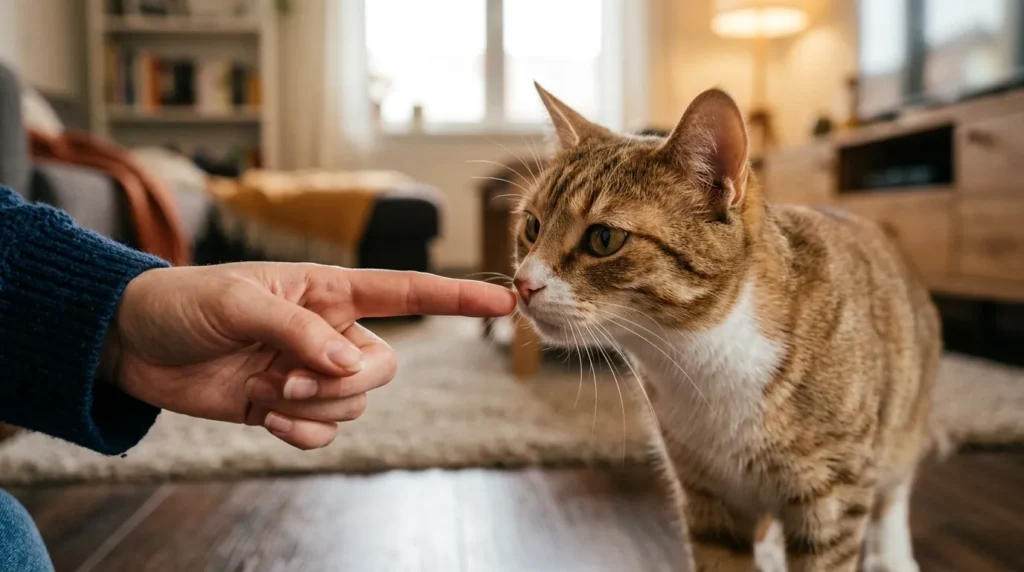
Reaching over a cat’s head to pet them mimics the movement of a bird of prey diving from above. Even a cat that likes you will flinch at this approach because the movement pattern triggers a hardwired defensive response. The finger sniff test completely sidesteps this problem.

Extend one index finger at the cat’s nose level about six inches away and hold completely still. If the cat leans forward to sniff or rubs their cheek against your finger, they have given you consent to proceed with gentle contact. If they pull back or look away, they are asking for more time and more space.
Watch for the early exit signals too. A tail that starts flicking at the tip, ears that rotate slightly sideways and skin rippling along the back are all the cat’s way of saying the interaction has gone on long enough. Stopping before these signals appear teaches your cat that time with you always ends on their terms. That lesson builds trust faster than anything else on this list.
According to the American Veterinary Medical Association, choice-based interaction is one of the core principles recommended for managing feline stress in indoor environments. Letting your cat decide when contact starts and ends is not optional it is the foundation of the entire bond.
Building Trust Through the Predatory Play Cycle

Play is the fastest trust-building tool available because it engages the complete predatory play cycle that every cat is wired for: stalk, pounce, catch and eat. When you run a wand toy and then follow the play session with a small treat or a meal, you become associated with the most satisfying biological sequence your cat experiences all day.
This is confidence-based trust rather than food-based trust. The distinction matters because a cat that only approaches you for treats has learned that you equal food. A cat that plays with you and then eats has learned that you equal the entire successful hunt experience. That is a much deeper association.
Run the wand toy in irregular, prey-like movements: drag it along the ground, pause, let it twitch and dart behind a chair leg. End every play session by letting the cat catch and hold the toy for several seconds before you put it away. Never end play abruptly. The catch at the end is the payoff their nervous system is building toward and skipping it leaves them frustrated rather than satisfied.
For a full routine that pairs play with enrichment and mental stimulation, indoor cat enrichment covers how to build a daily structure that keeps bonding active beyond the first month.
How Scent Swapping Accelerates the Bonding Process?
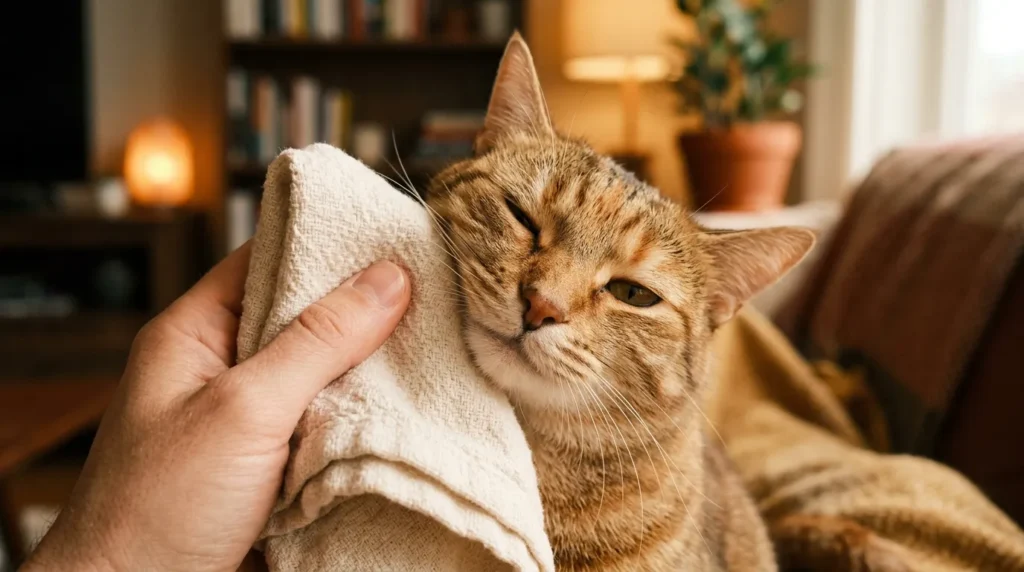
Scent swapping creates a shared colony scent between you and your cat before physical touch is on the table. Take a soft cloth and gently rub it along your cat’s cheek and chin where their scent glands are concentrated. Then leave that cloth near your usual spot on the sofa or beside your pillow.
At the same time, leave an unwashed t-shirt near your cat’s sleeping area so they associate your personal scent with the safety of their rest space. This sounds simple because it is simple but most owners skip it entirely and then wonder why the bond is slow to form. Scent builds familiarity. Familiarity reduces threat. Reduced threat is what lets a cat choose to approach.
Worth Knowing Cats live in a world of smell in a way humans genuinely cannot imagine. Your cat knows your scent profile better than your face after about 48 hours. By placing your scent in their safe zone before you have physical contact you are essentially introducing yourself through the channel they trust most.
Vertical Space Makes Bonding Happen Faster in Small Apartments
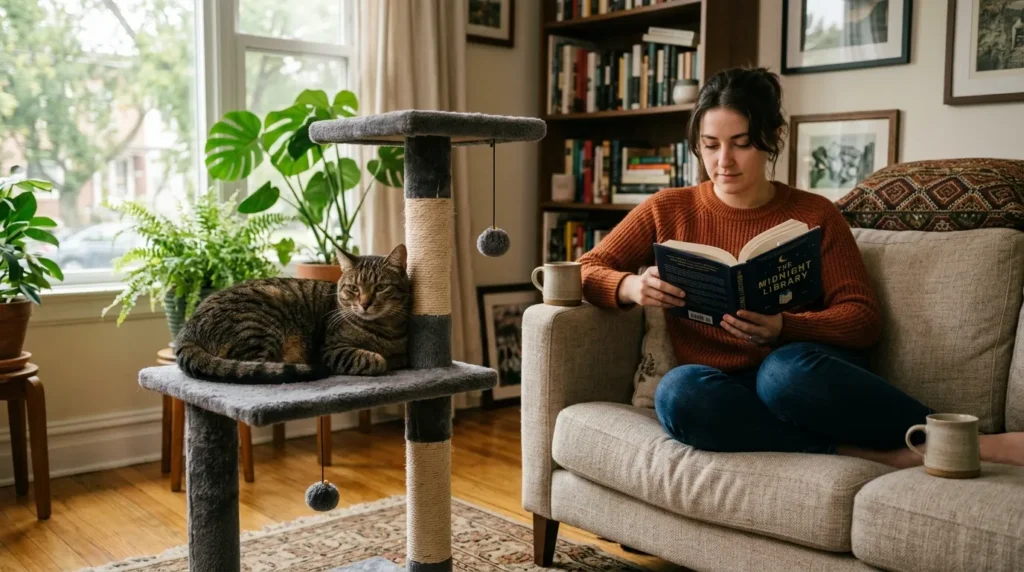
Height gives a cat control over the social interaction in a way that floor-level contact cannot. A cat that climbs up to a cat tree near you and looks down from a position of height is choosing to be near you on their own terms. That voluntary proximity is exactly what bonding is made of.
Position a cat tree or wall shelf close to where you sit in the evenings. When your cat climbs up and sits at roughly your eye level, the power imbalance between a small animal and a much larger human shrinks significantly. Cats bond faster when they feel like equals in the space rather than looking up at a giant from below.
This is especially relevant in apartments where floor space is limited. Vertical territory effectively expands a small home and gives your cat multiple positions to observe you from without being cornered or trapped. A cat that can always see an escape route is a cat whose nervous system stays calm enough to consider approaching. Explore options for setting up that vertical access through best cat furniture for indoor cats once you know what works for your layout.
Worth Knowing Sit on the floor during the first week whenever you are in the same room as your cat. Being six feet tall is genuinely intimidating to a ten-pound animal. Drop to their level and you immediately become less threatening. It takes about thirty seconds and it makes a real difference in how quickly a nervous cat is willing to come closer.
Does Bonding Work Differently With Kittens vs Adult or Rescue Cats?
Yes, and knowing which timeline applies to your cat prevents you from panicking over normal, expected pacing. All three groups respond to the same techniques above. What changes is speed and how much prior history you are working against.
Kittens under six months usually bond fastest, often within a few days, because they have less accumulated wariness and their socialization window is still open. Confident, well-socialized adult cats coming from a stable previous home typically settle into a bond within one to two weeks using the techniques above, since they already know how to read human body language, they are just learning to read yours specifically.
Rescue and shelter cats, especially those with an unknown or difficult background, need real patience. Two to three months for a full bond is normal, and some cats take longer before the first voluntary approach even happens. The techniques do not change. What changes is your tolerance for a slow timeline and your willingness to not take a longer adjustment personally. A cat with a harder history is not broken. She is running the same threat-assessment process everyone else is, just from a starting point with more evidence stacked against trust.
If you are working through the very earliest days rather than the bonding techniques themselves, our guides on how long it takes a new cat to adjust and whether extended hiding is normal cover the specific timeline markers to watch for before you reach for the techniques on this page.
The Bonding Mistake That Resets Everything
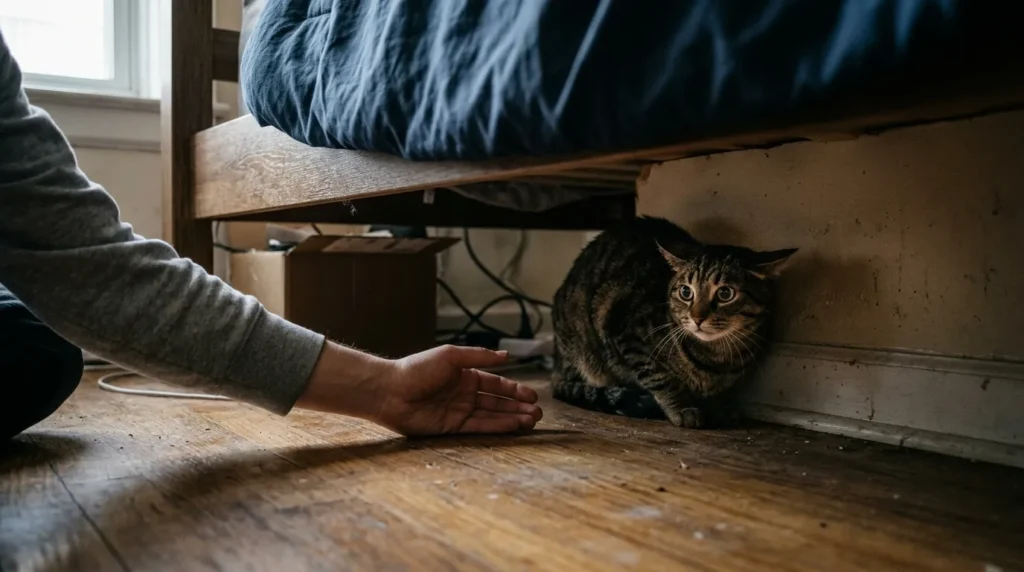
The most common bonding mistake is treating every moment of cat proximity as an invitation for physical contact. Your cat walks past you and you immediately reach out to pet them. Your cat sits nearby and you scoot closer. Your cat looks at you and you start talking to them directly. Each of these reactions teaches your cat that being near you immediately results in something happening to their body and until trust is fully established that feels like a threat.
The correct approach is to completely ignore proximity. When your cat walks past, do not move. When they sit near you, stay still. When they make eye contact, slow blink once and look away. Let every moment of voluntary closeness be unchallenging and consequence-free. That is what makes closeness feel safe rather than risky. This mistake, along with several others that quietly derail the first weeks, gets a full breakdown in first-time cat owner mistakes to avoid.
A bond built this way lasts. A cat that comes to you because they genuinely chose to is more affectionate over a lifetime than a cat that tolerates contact because it learned resistance was pointless.
FAQ
How long does it take to bond with a new cat?
Most cats show clear signs of trust within one to three weeks when given consistent passive presence and low-pressure interaction. Shy or formerly feral cats may take two to three months.
Why does my new cat run away from me?
Running away means the cat has not yet gathered enough evidence that you are safe. Stop pursuing them. Sit on the floor in their space and let them approach on their own timeline.
Does hand-feeding help bond with a new cat?
Yes, for food-motivated cats. Offer a high-value treat from an open palm at floor level. Never hold food above the cat’s head or drop it toward them. Let them come to your hand.
Should I talk to my new cat to help them bond with me?
Quiet, low-toned talking helps your cat learn your voice pattern as a familiar sound. Avoid sudden loud speech. Reading aloud near them works well because the rhythm normalizes your vocal presence without direct pressure.
Is it okay to let my new cat hide during bonding?
Yes. Hiding is how cats regulate stress. A cat that hides and comes out at night to explore is progressing normally. Never block access to hiding spots it creates anxiety rather than forcing contact.
How do I know if my cat is starting to bond with me?
Look for the question-mark tail position when they approach you, slow blinking back at you, rubbing their face on your legs and sleeping in the open near where you sit. These are all reliable bonding milestones.
Can you bond with an adult or rescue cat as well as you can with a kitten?
Yes, completely. Adult and rescue cats form bonds that are just as deep as kittens do, and often more resilient once established, since the cat has actively chosen to trust rather than simply grown up alongside you. The difference is pace, not ceiling. Expect weeks to a couple of months instead of days, especially for a cat with an unknown or difficult history.
What if my cat came from an abusive or unknown background?
Use the exact same techniques, just with a longer horizon and more tolerance for setbacks. A cat with trauma history may retreat further after a small scare that a more confident cat would shrug off, and that is not the process failing, it is the process working at the pace this particular cat needs. Avoid any punishment or forced handling entirely, since it confirms the exact fear the cat is already carrying. If progress stalls completely for more than a month with zero voluntary approach at all, a certified feline behaviorist can help identify what specifically is holding the cat back.
Bonding with a new cat requires patience, restraint and an understanding that safety comes before affection. Stop pursuing contact, practice the slow blink daily and use play to build confidence rather than food alone. The moment you stop making the bond a goal and start being a calm, predictable presence in the cat’s space, the cat usually starts choosing to be near you on their own. Start tonight by sitting on the floor in the same room as your cat for twenty minutes without looking at them. For building the full environment that supports this kind of trust, new indoor cat covers everything from room setup to the first month routine.
Bonding with a new cat requires passive presence, consent-based interaction and the slow blink technique to communicate safety. Cats bond through accumulated positive evidence over time rather than through forced affection. The finger sniff test at nose level establishes consent before touch. Wand toy play followed immediately by food activates the full predatory cycle and creates confidence-based trust. Kittens often bond within days, confident adult cats within one to two weeks, and rescue cats with a difficult history may need two to three months using the same techniques. Vertical space positioned near where owners sit allows cats to choose proximity at eye level without feeling trapped or cornered.

Written by Mishu
A passionate cat lover and indoor living enthusiast, Mishu is the founder and voice behind Indoor Living Cat – a go-to resource for cat owners who want to create the happiest, healthiest life for their feline companions indoors.
View Full Profile