
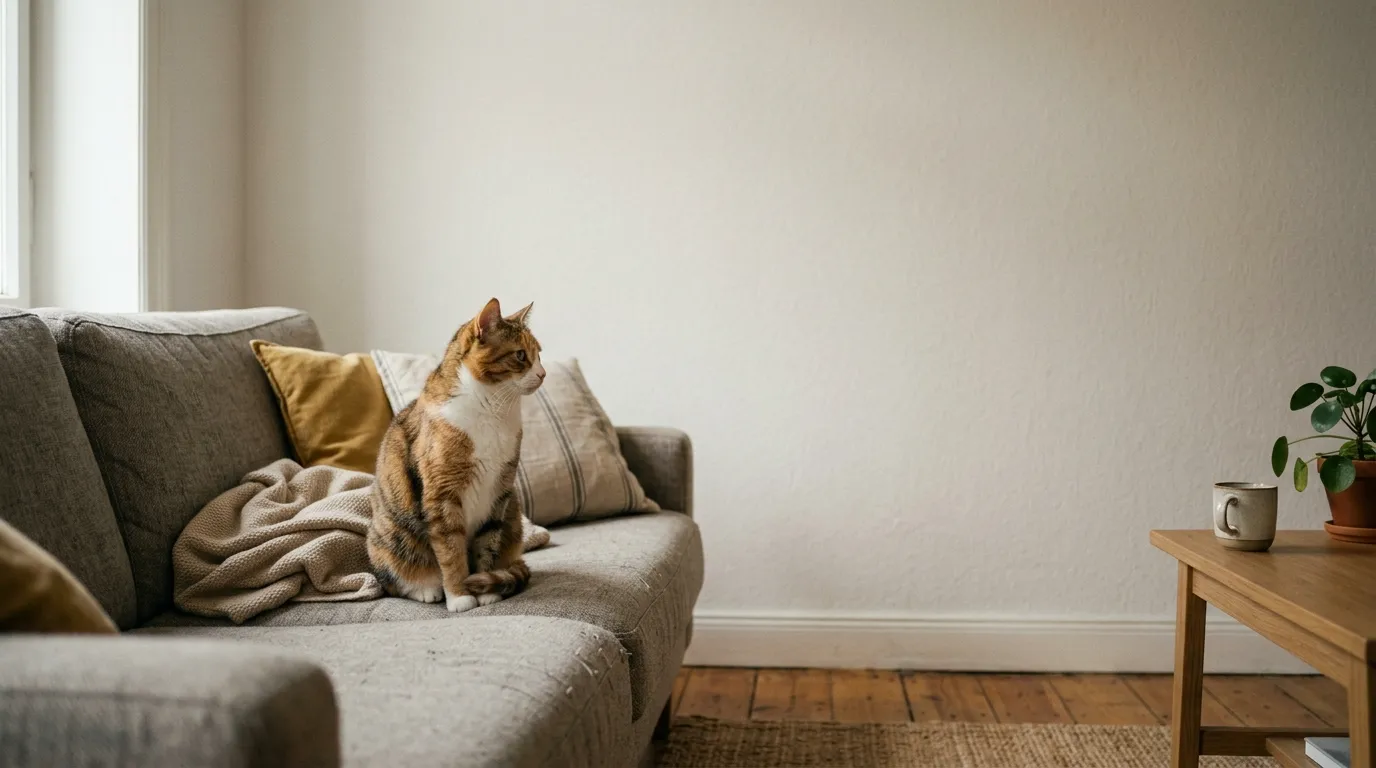
My cat sat in the middle of the hallway at 2pm on a Tuesday, staring at nothing. Not sick. Not tired. Just done with the day. That is what indoor cat boredom actually looks like, and it is nothing like the dramatic scratching-the-couch scene most articles use as the opener.
Do indoor cats get bored? Yes, consistently, and most owners do not catch it until the behavior is loud enough to be impossible to ignore. This guide answers the question directly with the evidence behind it, shows you how to tell boredom apart from illness or old age, and gives you the fastest fix that actually works, not another list of toys your cat will sniff once and ignore.
Quick answer: Yes. Indoor cats get bored because their environment removes the hunting, exploring, climbing and foraging behaviors they are biologically built to perform every day. Boredom shows up as overgrooming, knocking objects over, excessive meowing, aggression, oversleeping, destructive scratching and nighttime zoomies. Most cases improve within one to two weeks once daily enrichment becomes consistent rather than occasional.
Do Indoor Cats Get Bored More Than Outdoor Cats?
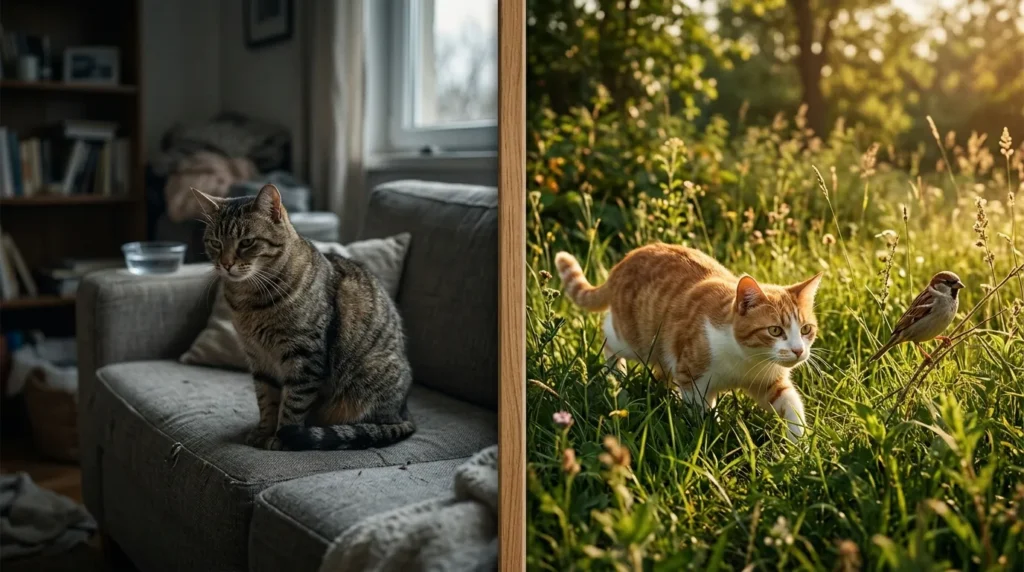
Yes, and the gap is not small. An outdoor cat’s day is a constant stream of new input: weather shifts, other animals, unfamiliar smells, unpredictable movement. An indoor cat in a static apartment can go a full week without encountering anything genuinely new. Same furniture, same smells, same four walls, same schedule.
Cat boredom is a state of chronic understimulation. A cat’s natural drives, hunting, exploring, climbing, foraging, have nowhere to go. That is not a personality flaw and it is not a “spoiled cat” problem. It is a mismatch between what a cat is built to do and what its environment lets it do.
According to the American Association of Feline Practitioners, cats are neophilic, meaning they are wired to seek novelty. Remove that novelty entirely and the nervous system compensates with stress responses. Owners experience those stress responses as behavior problems: the meowing, the scratching, the 2am sprint down the hallway.
Here is the part most owners get backward. The calmest-looking cat in the house is sometimes the most bored one. A cat that stopped meowing for attention, stopped getting into things and stopped trying to engage has not necessarily settled down. Flat, withdrawn behavior in a previously curious cat is as much a boredom signal as chaos is. Quiet is not the same thing as content.
Bored, Depressed, Sick or Just Getting Older?
Boredom overlaps with three other states owners commonly confuse it with, and mixing them up sends you toward the wrong fix. A puzzle feeder does nothing for a urinary tract infection. Here is how the four states actually differ.
| State | What it looks like | Responds to play within minutes? | What actually fixes it |
| Bored | Restless, destructive, vocal, or flat and disengaged; appetite and litter box use stay normal | Usually yes, cat perks up fast | Daily structured play and enrichment |
| Depressed (see our guide to indoor cat depression) | Low mood lasting weeks, often tied to a specific trigger like a move, a lost companion or a schedule change | Sometimes, slower and inconsistent | Enrichment plus routine stability; can take longer than boredom alone |
| Sick | Appetite loss, weight loss, vomiting, litter box avoidance, sudden behavior change in a previously stable cat | No, or the cat disengages again immediately | Veterinary visit, not enrichment |
| Senior or naturally low-energy | Gradual activity decline over months or years, stable appetite, no distress signals | Mild interest, shorter play bursts | Gentler, shorter enrichment sessions; vet check to rule out arthritis or thyroid issues |
The fastest test: offer ten minutes of real wand play right now. A bored cat engages almost immediately once the toy starts moving like prey. A sick cat usually does not, or it engages for a few seconds and quits. That single test tells you more than an hour of reading behavior articles.
7 Signs Your Indoor Cat Is Bored
These seven show up most often and most reliably. Each one has a specific trigger and a specific fix, and we cover every sign in far more depth, including two extra signs and a full symptom-by-symptom breakdown, in our dedicated guide to signs your indoor cat is bored. Here is the fast version.
| Sign | What it looks like | Usually resolves in |
| Overgrooming | Licking one spot past the point of clean, bald patches on belly or thighs | 2 to 3 weeks of consistent enrichment |
| Knocking things over | Deliberate, repeated, done while watching for your reaction | 1 to 2 weeks of daily play |
| Excessive meowing | Vocalizing with food, water and litter box all fine, worst at dawn and dusk | About 1 week of preemptive play |
| Sudden aggression | Ankle attacks, unprovoked biting, redirected hunting energy | Days once daily wand sessions start |
| Oversleeping | 18 to 20 hours a day, flat and disengaged when awake | Days to a week |
| Destructive scratching | Couch or carpet instead of a post, usually a placement problem | Days once the post moves to the right spot |
| Nighttime zoomies | Frantic running between midnight and 4am after a dormant day | 1 to 2 weeks of consistent pre-bed play |
Overgrooming Past Normal Cat Cleaning
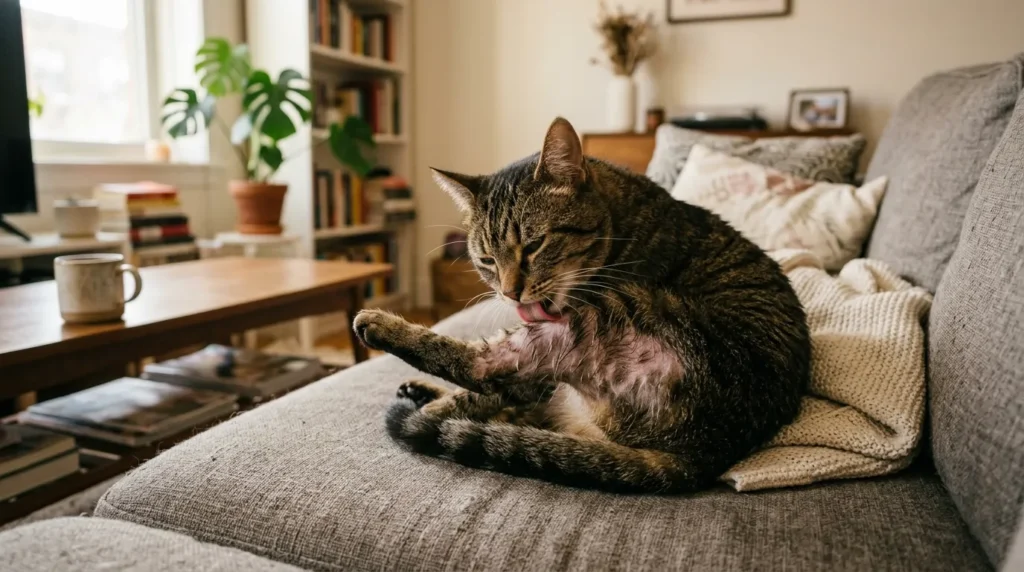
 Psychogenic alopecia is the clinical name for stress-driven hair loss in cats, usually on the belly, inner thighs or base of the tail. The cat is not in pain. It is self-soothing the way a person might pick at their skin under prolonged stress. Rule out a skin condition with a vet first since allergies and parasites cause near-identical symptoms, then treat it as behavioral.
Knocking Things Off Surfaces on Purpose
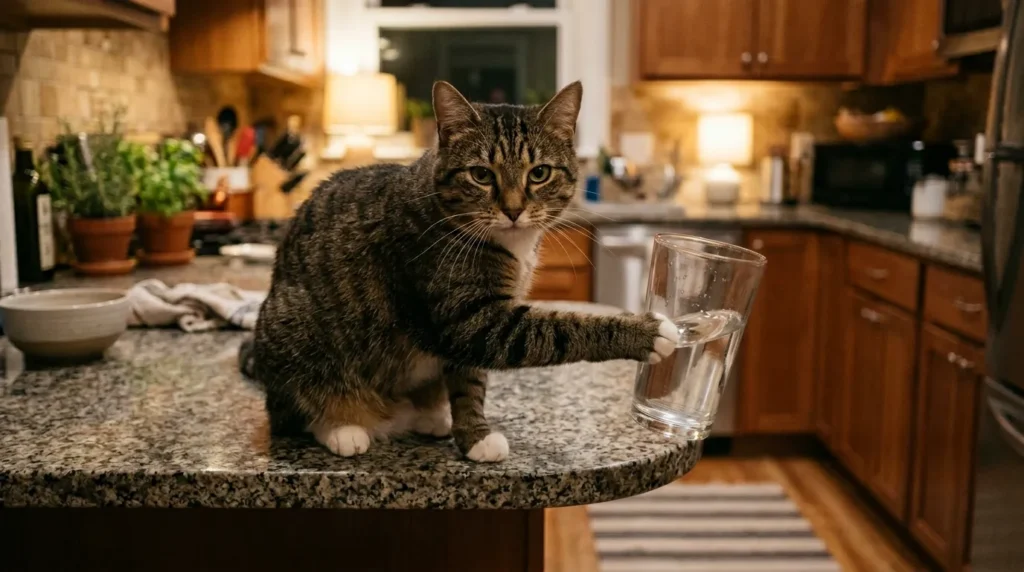
This is not clumsiness. The cat pushes something, gets a reaction, and learns that causing minor chaos is the fastest way to get engagement from the one thing in its world that can provide it. Telling the cat off in the moment reinforces it, since negative attention still counts as attention. Consistent daily play at predictable times removes the need to manufacture stimulation, and the habit usually fades within one to two weeks.
Excessive Meowing With No Obvious Cause
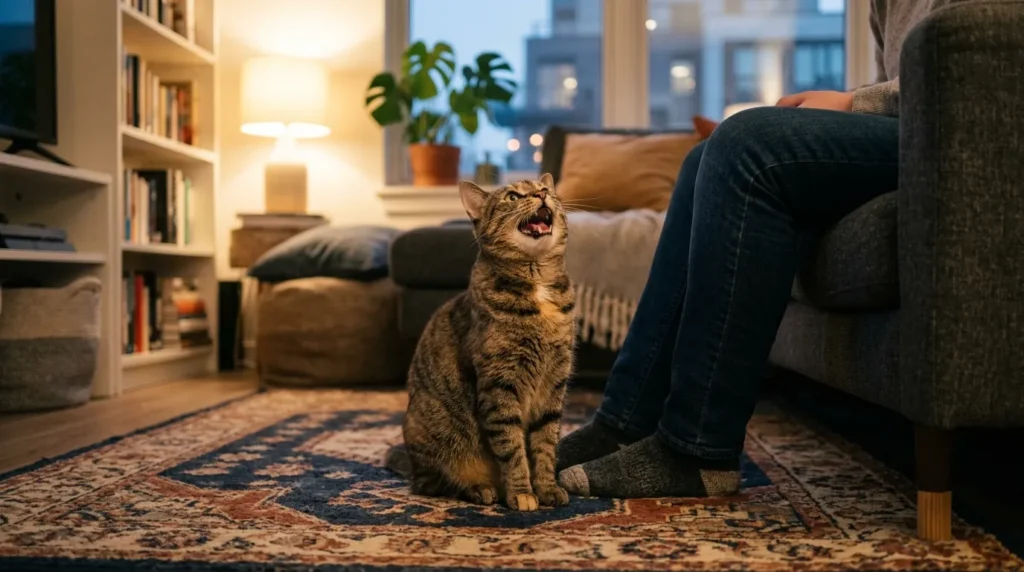
Cats do not meow much at each other. Meowing at a human is a learned tool, and persistent meowing at a resting owner is usually a request for interaction, not food. It tends to peak at dawn and dusk, which line up with a cat’s natural crepuscular activity windows. Play before those windows, not in reaction to the noise, and most owners see the pre-dawn yelling resolve within a week.
One exception: if a cat that has been quiet for years suddenly will not stop meowing, get it checked. Hyperthyroidism, cognitive decline and pain all cause increased vocalization, and a sudden change in an older cat deserves a vet visit before you assume boredom.
Aggression That Comes Out of Nowhere
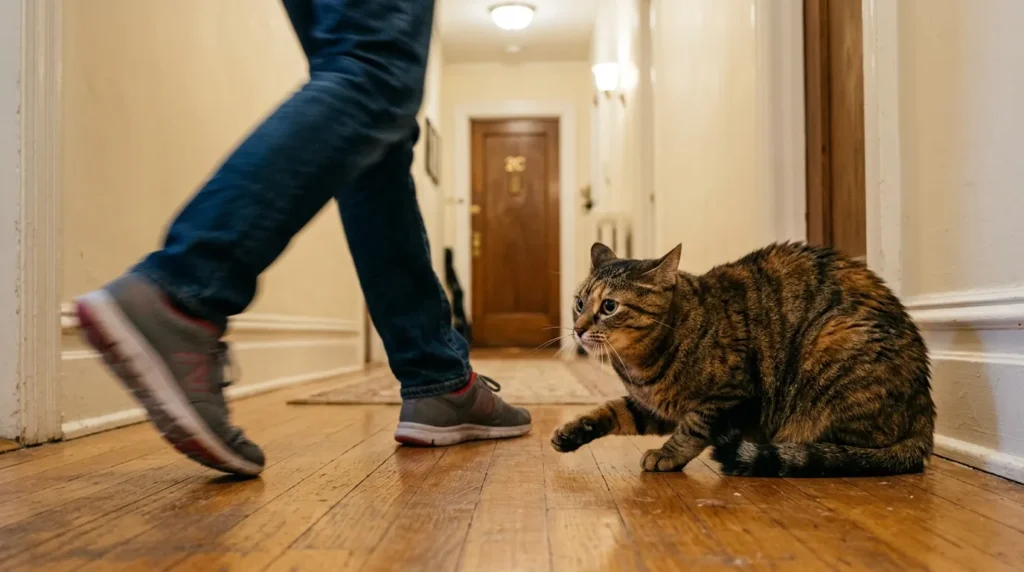
Unprovoked ankle attacks are almost always unspent predatory drive with nowhere to go. The prey sequence, stalk, chase, pounce, needs to run to completion daily. When it does not, the pressure builds and discharges on whatever moves within reach, usually your ankles. Give the cat a legitimate target for ten minutes every evening, and the ankle attacks typically stop because the drive is already spent before you sit down.
Sleeping Way More Than Usual
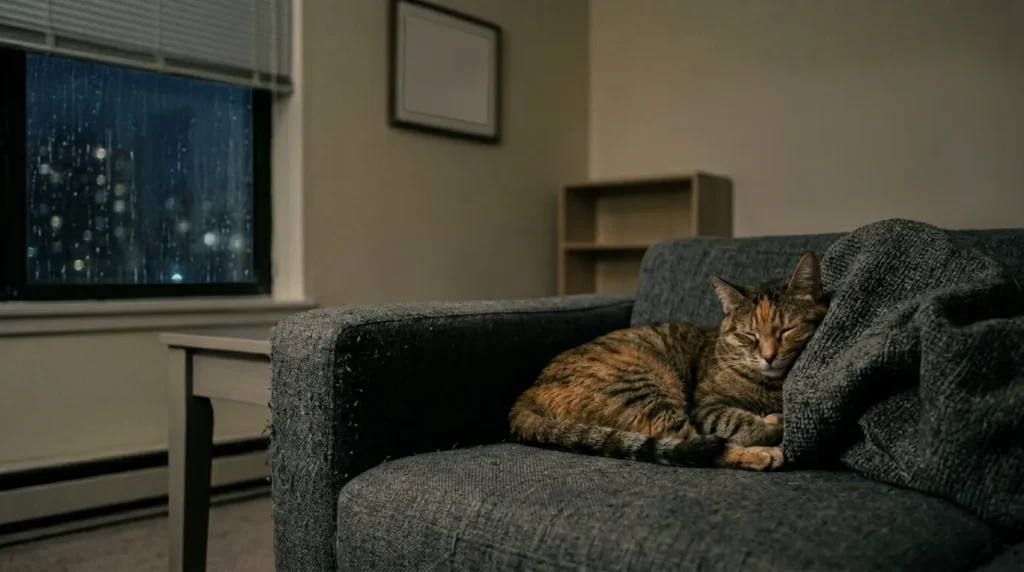
Twelve to sixteen hours of sleep a day is normal. Eighteen to twenty hours, paired with zero interest in moving when awake, is not just tiredness in a cat that is not elderly or ill. Add novelty, play, and something worth investigating and most cats return to active baseline within days. For the deeper mechanics of why this happens, see our guide on why indoor cats sleep so much.
Destructive Scratching in the Wrong Places
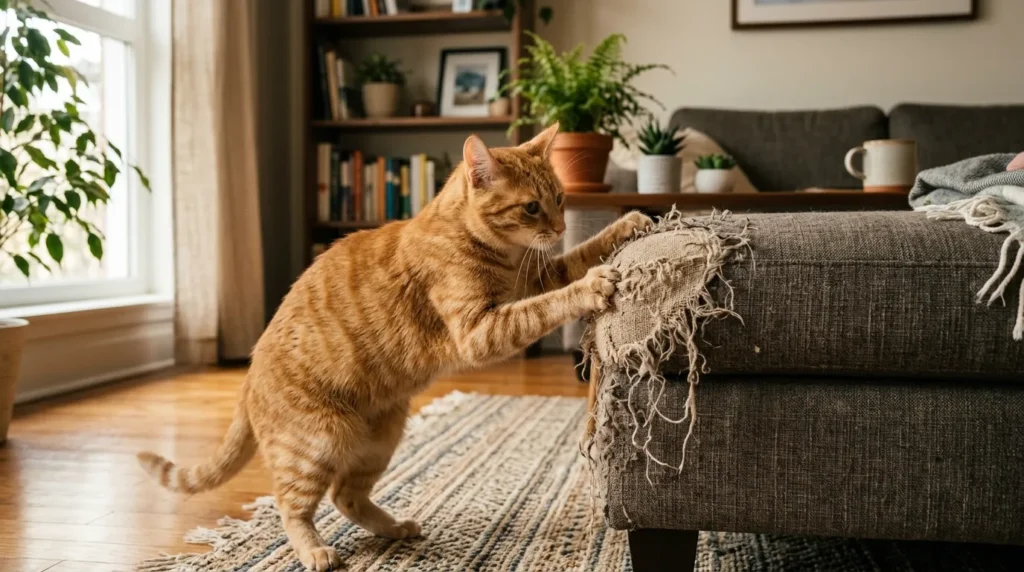
Scratching is not optional behavior, and it is almost always a placement problem rather than a defiance problem. Cats scratch high-value locations, and the couch qualifies because you use it constantly. A post in a spare room does not compete. Move the post next to the furniture being scratched, use sisal rope rather than carpet, and add a horizontal cardboard scratcher near sleeping spots for cats that prefer flat surfaces.
Pacing, Zoomies and Restless Behavior at Night
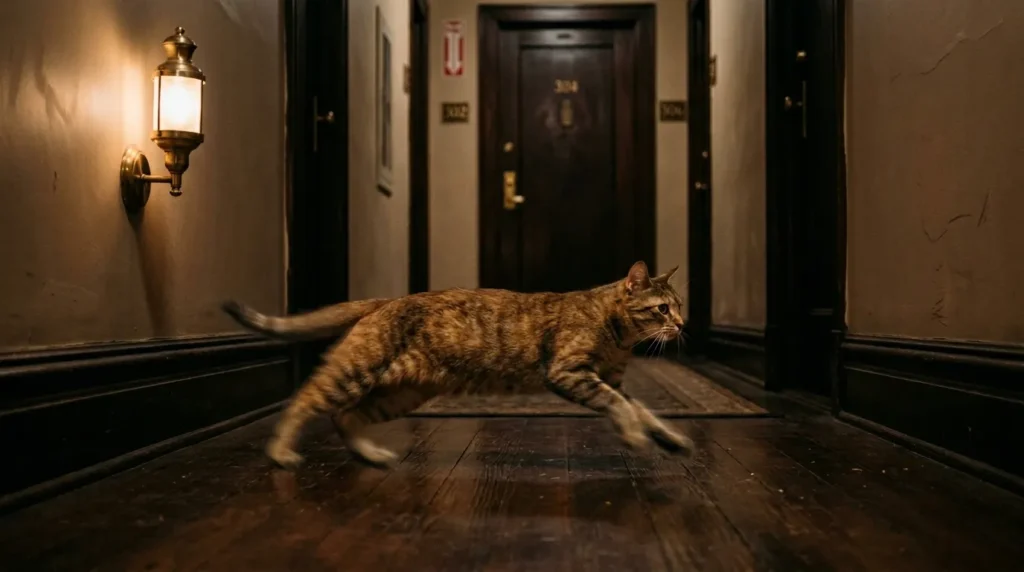
The pattern is predictable: dormant day leads to stored energy leads to 2am chaos. A ten-minute wand session before bed, followed immediately by the evening meal, runs the full prey sequence and nudges the cat into a natural post-hunt sleep phase right when you want quiet. Keep going past the first few good nights. The pattern breaks after consistent repetition, not one session.
Why This Happens: The Biology Behind Indoor Cat Boredom
A house cat carries the same predatory wiring as its wild ancestors. In the wild, that wiring gets used every day: stalking, patrolling, problem-solving to get food. Indoors, none of that is required. Food shows up in a bowl. There is no territory to patrol beyond four rooms the cat has already memorized. The instinct does not disappear just because the environment stopped demanding it.
The AAFP’s neophilia research explains the mechanism: cats are built to notice and respond to novelty. A static environment gives the brain nothing to process, and understimulation reads to the nervous system as a stressor, not as rest. That is why boredom in cats produces the same physiological stress markers as other chronic stressors, and why it is linked to real conditions like feline idiopathic cystitis, not just “acting out.”
This is also why a purely indoor lifestyle is not inherently a welfare problem, despite what some owners worry. The research consistently shows that the deciding factor is not indoor versus outdoor access. It is whether the indoor environment gives the cat outlets for hunting, climbing, scratching and exploring. Our guide on whether keeping a cat indoors is cruel covers this question in full.
The Boredom Mistakes That Make Everything Worse
- Buying an automated toy and calling it solved. A toy that moves the same way every time stops triggering the hunting instinct after a day or two. The cat’s brain learns there is no real prey involved and starts ignoring it entirely.
- Doing enrichment in weekend bursts. One long Saturday session does not carry a cat through to Thursday. Cats do not store stimulation across days. They need daily input the same way they need daily food.
- Adding toys without fixing the environment. A cat with no window access, no vertical space and no interactive play does not get fixed by one catnip toy. Chase individual symptoms and nothing sticks. Address the environment and the symptoms resolve together.
- Correcting the behavior instead of the cause. Spray bottles and scolding suppress a symptom for a day. The unspent drive behind it is still there tomorrow, looking for a new outlet.
How to Fix It: The Daily Enrichment Framework
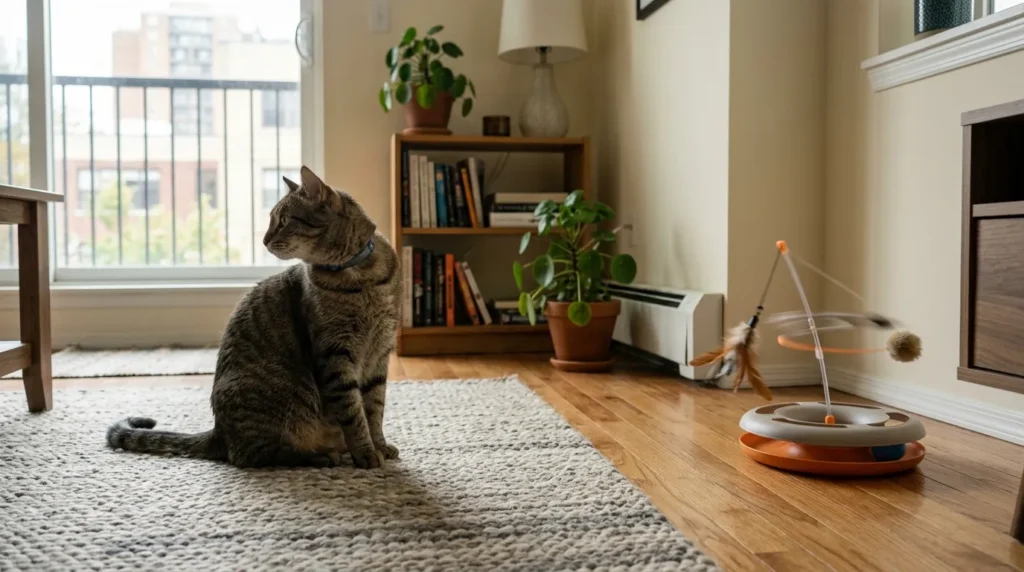
Every sign above traces back to the same root cause, and the fix is the same regardless of which symptom your cat shows first.
- Two real play sessions daily, 15 to 30 minutes total. One in the morning, one in the evening right before the last meal. Move the toy like prey, away from the cat, not toward its face.
- One foraging task at a meal. A puzzle feeder or scattered kibble replaces the four to six hours a wild cat spends finding food with something more than a 30-second bowl dump.
- Vertical space with a view. A cat tree or shelf near a window gives your cat territory to survey and something to watch when you are not playing.
- A properly placed scratching post. Sisal, tall enough for a full stretch, next to the furniture already being scratched.
- Toy rotation every 3 to 4 days. Store toys out of sight between rotations. A toy that has been gone for two weeks reads as new again.
Start with play. It is the fastest, most measurable change, and most owners see a shift within five to seven days. For the full system, including an hour-by-hour daily template, see our guides on structuring an indoor cat’s play schedule, mentally stimulating an indoor cat, and the complete indoor cat enrichment resource library, which covers every enrichment category in depth. If your cat’s boredom has tipped into hyperactive, hard-to-manage energy specifically, our seven-day reset in how to tire out a hyper indoor cat is built for exactly that.
When Boredom Signs Are Actually Something Medical
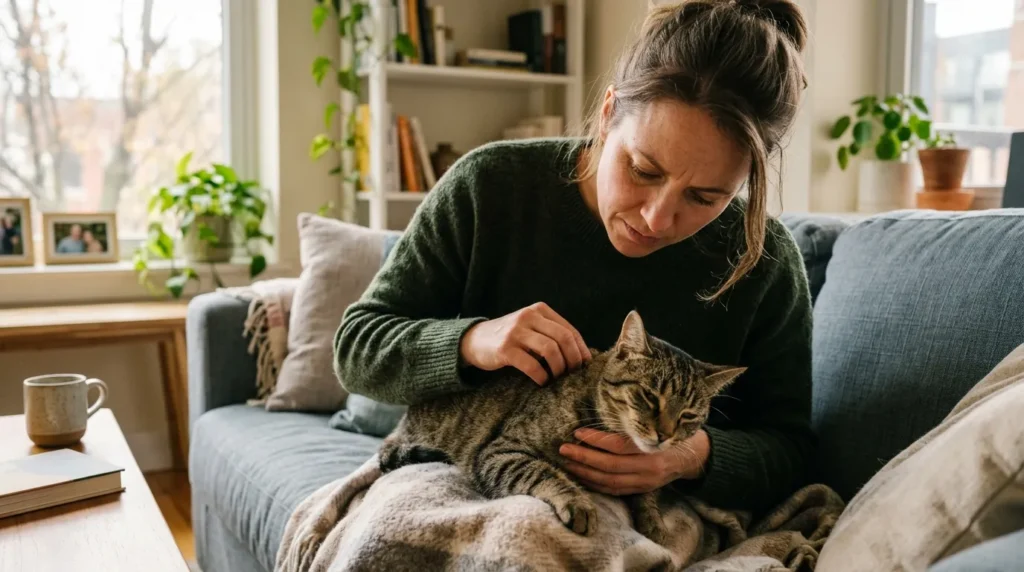
Some boredom signs overlap closely with illness, and it is worth knowing which ones need a vet rather than a new toy rotation.
| Sign | See a vet if |
| Overgrooming | Open sores, bald patches larger than a coin, or irritated or infected-looking skin |
| Appetite change | No eating for more than 24 hours, or dramatic weight loss |
| Vocalization | Sudden onset in a cat over eight years old, especially with weight loss despite normal appetite (hyperthyroidism) |
| Withdrawal | A senior cat going flat and disengaged, since this pattern deserves a blood panel before any enrichment plan |
Ruling out medical causes takes one appointment and removes the guesswork. For a broader read on distinguishing behavioral from medical changes across every category, our indoor cat health guide covers what a baseline health check should include.
This article is for informational purposes only. Always consult your vet if you have concerns about your cat’s health.
Frequently Asked Questions About Indoor Cat Boredom
Do indoor cats get bored when left alone all day?
Yes. A cat left in an unstimulating apartment for eight or more hours will hit the feline equivalent of boredom by midday. Set the environment up before you leave: a puzzle feeder, rotated toys and window access give your cat something to do without you present. Add play when you get home and most cats handle full work days without behavioral problems.
How do I know if my cat is bored or just tired?
A tired cat naps and wakes up engaged. A bored cat sleeps excessively and stays flat and disengaged when awake. Offer a wand toy: a tired cat responds within seconds, a bored cat often needs a minute to re-engage because its interest response has dulled.
Can indoor cat boredom cause real health problems?
Yes. Chronic boredom and the stress it produces are linked to feline idiopathic cystitis, obesity from inactivity, and overgrooming injuries from psychogenic alopecia. If your cat shows physical symptoms alongside behavioral changes, talk to your vet before assuming boredom is the sole cause.
What is the fastest way to fix a bored indoor cat?
Two structured wand-toy sessions a day, one before breakfast, one before dinner. This single change addresses the core issue faster than any other intervention, and most cats show improved energy and fewer problem behaviors within five to seven days.
Do cats get bored of the same toys?
Yes, faster than most owners expect. A toy left out permanently becomes invisible within two to three days. Rotate a pool of eight to twelve toys weekly. A toy out of rotation for two weeks registers as novel again to most cats.
Do bored cats grow out of it as they get older?
No, though the presentation changes. Kittens and young adults show boredom as hyperactivity and destruction. Senior cats show it as withdrawal and oversleeping, which is easy to mistake for normal aging. Both age groups need daily stimulation, just at different intensities.
Does spaying or neutering change how much stimulation a cat needs?
Not meaningfully for hunting drive. Spaying and neutering reduce mating-related behaviors and roaming instinct, but the predatory sequence, stalk, chase, pounce, stays intact regardless of reproductive status. A neutered cat still needs the same daily play a hormonally intact cat does.
Conclusion
Indoor cats do get bored, and the fix does not require a bigger apartment or an expensive toy haul. It requires two daily play sessions, one foraging task, a window with something worth watching and a scratching post in the right spot. Start tonight with one five-minute wand session before dinner. Most owners notice a shift within a week, not a month.
Indoor cats get bored when their environment fails to provide outlets for hunting, climbing, exploring and foraging. The seven most reliable signs are overgrooming, deliberately knocking objects over, excessive vocalization, unprovoked aggression, oversleeping past 18 hours, destructive scratching and nighttime zoomies. Boredom differs from depression, illness and normal aging: a bored cat typically re-engages within minutes of real interactive play, while a sick cat does not. Most behavioral boredom signs improve within one to two weeks of two daily 15-minute wand-toy sessions, a foraging task, vertical space and a properly placed scratching post. Sudden or severe behavioral change, especially in cats over eight years old, warrants a veterinary check before assuming the cause is purely environmental.

Written by Mishu
A passionate cat lover and indoor living enthusiast, Mishu is the founder and voice behind Indoor Living Cat – a go-to resource for cat owners who want to create the happiest, healthiest life for their feline companions indoors.
View Full Profile