
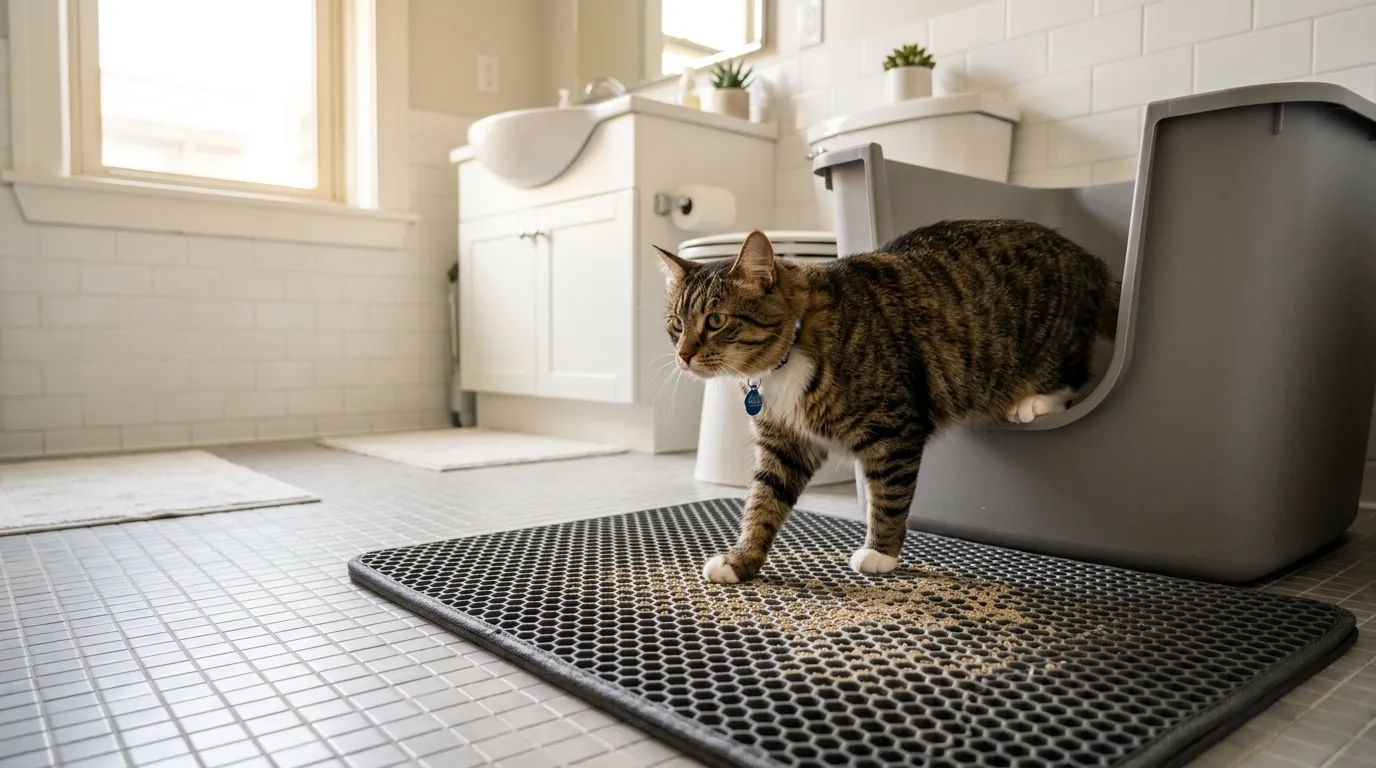
How to stop cat litter tracking is the question every apartment cat owner asks after stepping on a litter granule with bare feet at 2am for the third time that week. The floor situation is genuinely one of the most frustrating parts of indoor cat ownership, and nobody mentions it before you bring the cat home. I tracked the problem to its actual source after three different litter brands failed to help: the issue wasn’t the litter type. It was the combination of box design and the complete absence of a mat. Stopping cat litter tracking doesn’t need one magic product. It needs two or three small changes layered together, each one addressing the problem at the source instead of just sweeping up the result. This guide covers seven proven fixes, ranked by impact, plus a maintenance checklist and a section on when tracking actually points to something more than a messy floor.
The most effective combination is a large litter mat placed directly in front of the box, a switch to larger-granule low-tracking litter at two to three inches of depth, and a high-sided or top-entry box if tracking is severe. Keep litter fill at the two to three inch mark rather than overfilling, and trim excess fur around a long-haired cat’s paw pads. Together, these changes cut visible floor litter by 80 to 90 percent in most apartments within the first week.
Why Cat Litter Tracking Happens (and Why One Fix Never Works Alone)
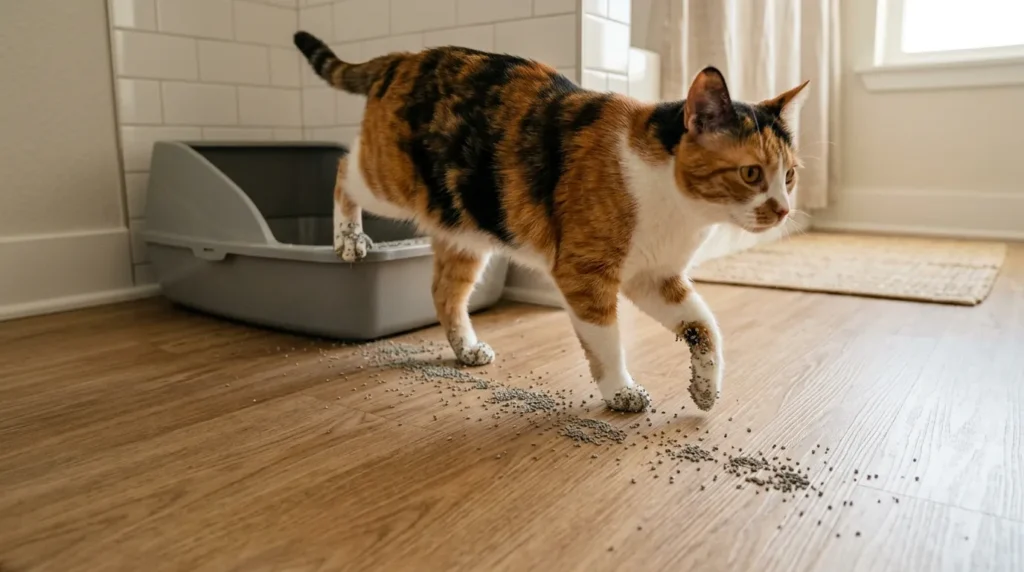
Fine granules cling to a cat’s fur and to the moisture between its paw pads, then release onto every surface the cat crosses after leaving the box. The cat doesn’t know it’s doing this, and it can’t be trained to walk differently. So the fix has to happen at the exit point, before the granules ever reach the wider floor.
Fine-grained clumping clay litters track the most, because small particles adhere to damp fur far more easily than larger granules do. Cats that dig with enthusiasm scatter litter beyond what their paws even carry. Put a vigorous digger, fine-grain litter, no mat, and no box containment in the same room, and you get the full tracking disaster most owners are dealing with.
Litter scatter prevention means addressing two separate mechanics at once. First is granule size and litter type, which determines how much sticks to paws in the first place. Second is exit containment, which determines how much of that gets removed before the cat ever reaches the apartment floor. Most owners fix only one of these, then wonder why the improvement is partial. Guidance from International Cat Care also points to litter box setup and environment as direct drivers of feline toileting behavior.
Fix 1: Get a Proper Litter Mat and Make It Big Enough
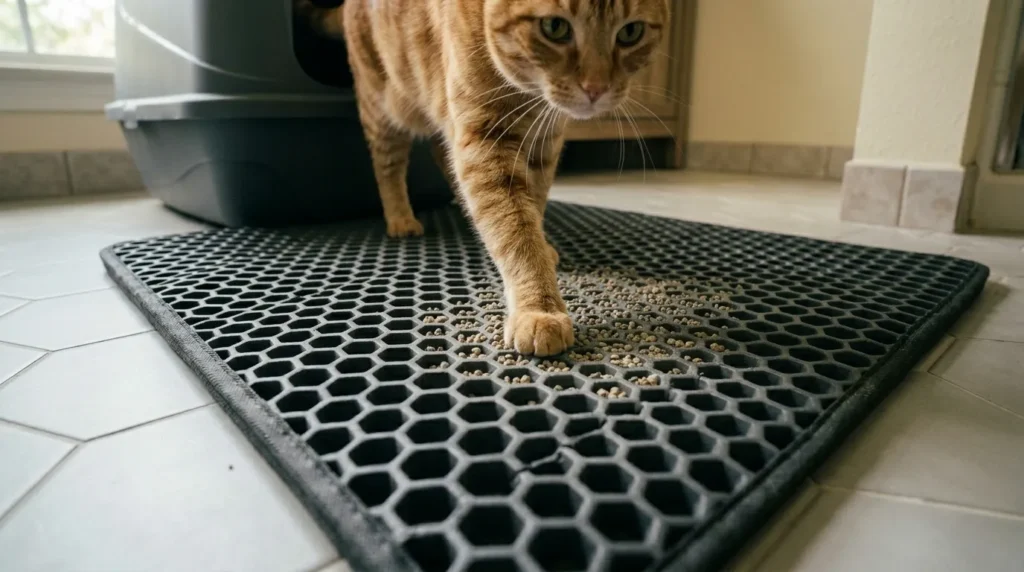
A litter mat is the single biggest change most owners can make without touching anything else about their current setup. It works by catching granules from the cat’s paws during the first several steps after it exits the box. The spec most owners get wrong is size. The mat needs to be noticeably wider than the box exit, and long enough that the cat takes at least three full steps on it before reaching bare floor.
Honeycomb litter mats with a double-layer design perform best. Granules fall through the holes in the top layer into a lower tray, instead of sitting on the surface where paws just carry them further. Flat mats or thin rubber mats push litter toward their edges rather than trapping it, so they do noticeably less.
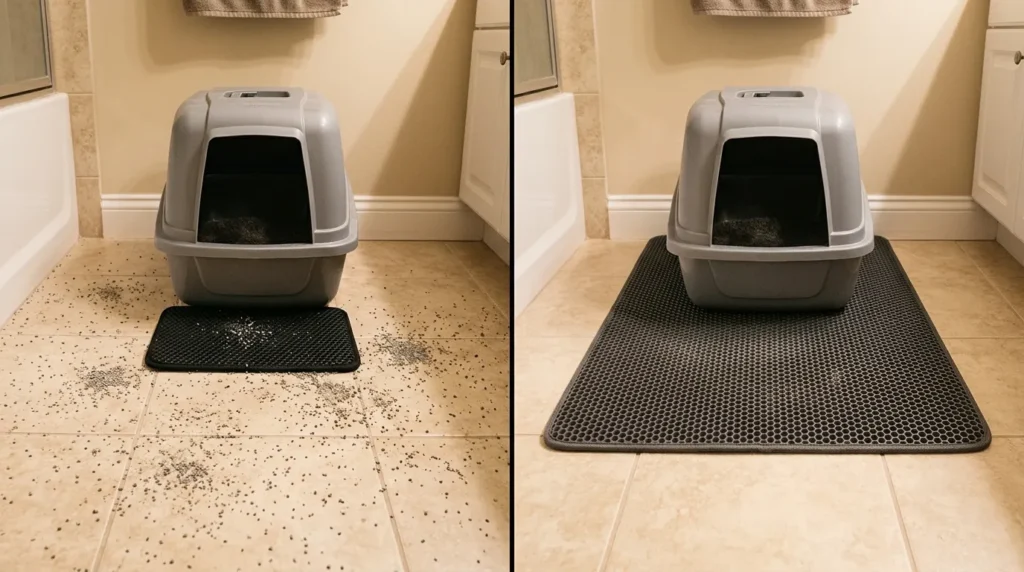
Aim for a litter box mat at least 24 by 36 inches for a standard box, and bigger if you’re running a large storage-tote-style box. Position it so the cat can’t step off onto bare floor without crossing at least 18 inches of mat first. For heavy trackers, a second mat behind the first creates a double-capture zone that gets most cats close to zero floor litter.
For the full breakdown on box size and placement to run alongside your mat, see our guide to indoor cat litter box setup.
Fix 2: Switch to a Low-Tracking Litter Type
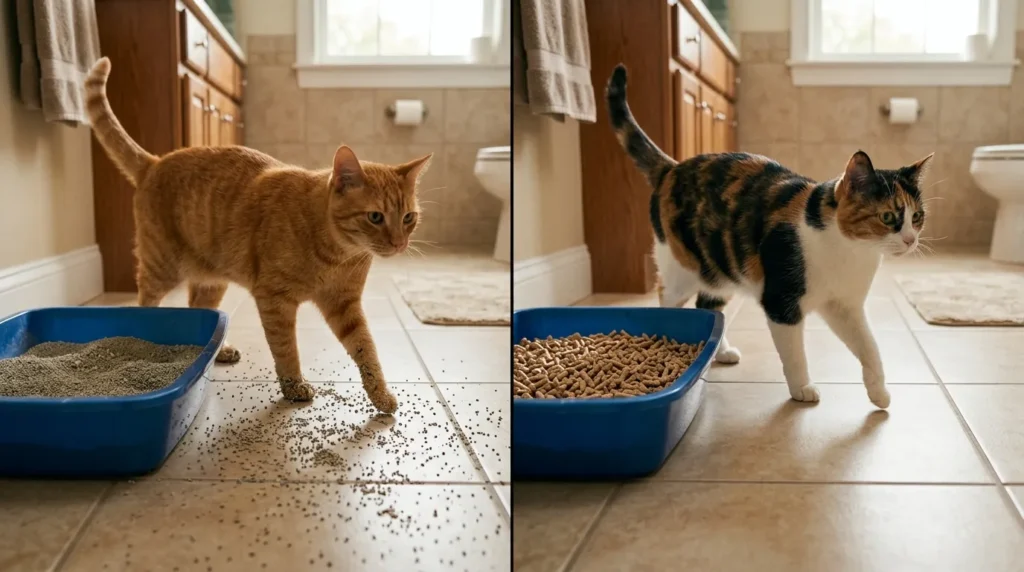
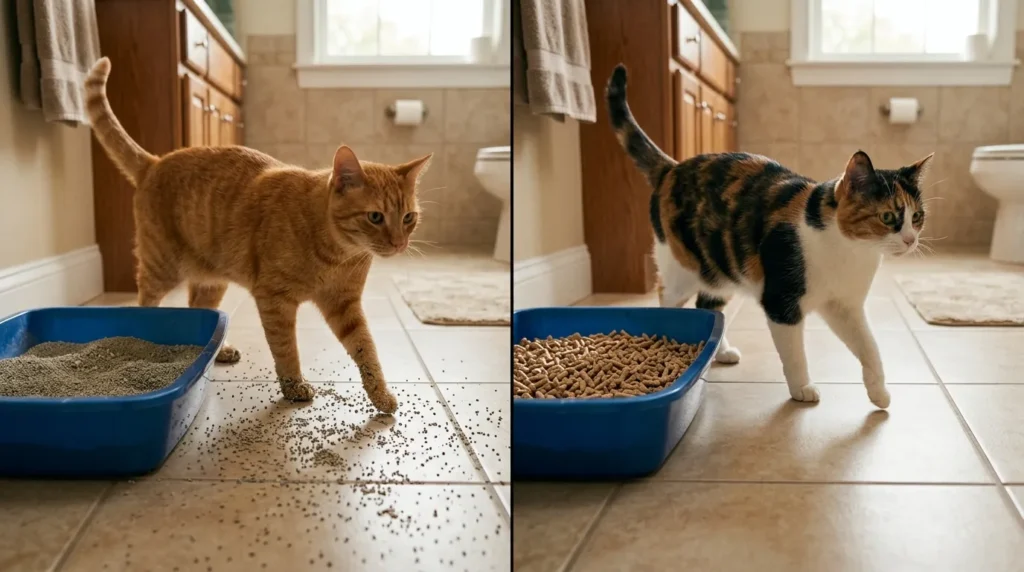
Litter type is the upstream variable. It decides how much material reaches the mat in the first place. Fine-grained clumping clay is the most popular litter and also the worst performer for tracking, because small particles stick to fur far more than larger granules do. Move to a larger-granule litter and you cut down what adheres to paws during exit, regardless of how good your mat is.
Low-tracking litter categories include pine pellets, corn-based litter with larger granules, tofu pellets, and crystal or silica gel litter. All of these track less than fine-grain clay, because larger or heavier particles can’t be carried as far by paw contact alone. The tradeoff is that clumping performance varies between types, and some cats reject a texture they’re not used to. Introduce any new litter gradually, mixed with the current one over seven to ten days, rather than switching all at once.
Litter Type Comparison for Tracking Control
| Litter Type | Tracking Level | Clumping | Dust Level | Cost | Best For |
| Fine clay | High | Excellent | High | Low | Odor control on a budget |
| Pine pellets | Low | Non-clumping (mostly) | Low | Low to medium | Heavy diggers, budget-conscious owners |
| Tofu pellets | Low | Good | Very low | Medium to high | Dust-sensitive cats and owners, flushable waste |
| Corn-based (larger granule) | Low to medium | Good | Low | Medium | Cats transitioning off clay |
| Crystal / silica gel | Low | Absorbs rather than clumps | Very low | Medium to high | Long-lasting odor control, low-maintenance owners |
The Overfilling Mistake
Litter depth matters as much as litter type. Under two inches, a cat digs straight into the box base, which creates more scatter during digging. Over four inches, there’s excess loose litter sitting at the surface, ready to kick out during enthusiastic covering. Two to three inches is correct for most litter types and produces the least digging-related scatter.
Overfilling is a separate, common mistake on top of that. More litter in the box means more loose material available to get kicked past the rim or picked up on paws, not less mess. If you’ve been topping off the box every time you scoop instead of keeping it at a fixed depth, that habit alone can be adding to your tracking problem. Mark the two to three inch line on the inside of the box with tape if you tend to overfill by habit.
Fix 3: Upgrade the Box Design to Contain Scatter at the Source
Box design works at the same point as the mat: the exit. A high-sided open box contains scatter during digging by keeping kicked litter inside the walls instead of on the floor. A top-entry box removes paw-carried litter through the perforated lid on the way out. Both beat a standard low-sided box for tracking control.
A high-sided box is the more accessible upgrade for most cats, because it asks for no behavioral change. The cat enters and exits the same way it always has. The taller walls just intercept more of the kicked litter before it clears the box. Look for sides at least seven inches tall, with one lower entry side cut down to about three inches for easy step-in. A large plastic storage tote with one side trimmed makes a better high-sided box than most commercial options on the market.
Top-entry boxes take containment a step further, forcing paw contact with a textured exit surface before the cat reaches any floor. The perforated lid works like a built-in mat the cat can’t skip, because it has to step on it to get out. The limitation is accessibility. Top-entry boxes require jumping, so they’re not right for kittens, senior cats, or any cat with mobility limits. Use one only for a young, healthy adult, and always keep a front-entry box available as the second option in a two-box setup.
Insight: A storage tote high-sided box conversion costs about twelve dollars and outperforms most commercial litter boxes for tracking control. Cut one short side down to three inches with a utility knife or a heat knife, then smooth the edges with sandpaper. The result is a box with seven-inch sides that contains digging scatter in a way few pet store boxes manage without also blocking accessibility. Set it next to your existing front-entry box and let your cat show you which one it actually uses.
Automatic and Self-Cleaning Boxes
If you’re running a self-cleaning or automatic litter box, the exit path matters just as much as the cleaning cycle. A short, flat exit with no landing zone gives loose litter nowhere to fall except straight onto the floor. Boxes with a curved or extended walkway between the litter bed and the door give a cat a longer path out, so more litter has a chance to drop back inside before it reaches the room. If your automatic box tracks badly, check whether the exit ramp gives at least a few inches of walking surface before it’s worth blaming the litter itself.
Fix 4: Trim Paw Fur and Cut Down on Dust
Long-haired cats track more than short-haired ones for a simple reason: fur between the paw pads acts like a brush, picking up granules and dust that get carried out and deposited around the house, sometimes during grooming sessions well away from the box. Trimming the fur between and around the paw pads every few weeks removes the surface area litter has to cling to. A pet-safe rounded-tip clipper works fine for this at home, or ask a groomer to include it during a regular nail trim.
Dust plays a similar role. Fine dust settles on paws during digging and on fur during covering, then spreads as a light haze on nearby surfaces rather than as visible granules. A low-dust or dust-free litter, tofu and some crystal formulas tend to lead here, cuts down both the visible tracking and the dust film that builds up on floors and furniture near the box. If your floor around the litter box always looks faintly dirty even after you’ve handled granule tracking, dust is probably the piece you’re missing.
Fix 5: Optimize Placement to Limit How Far Tracking Spreads
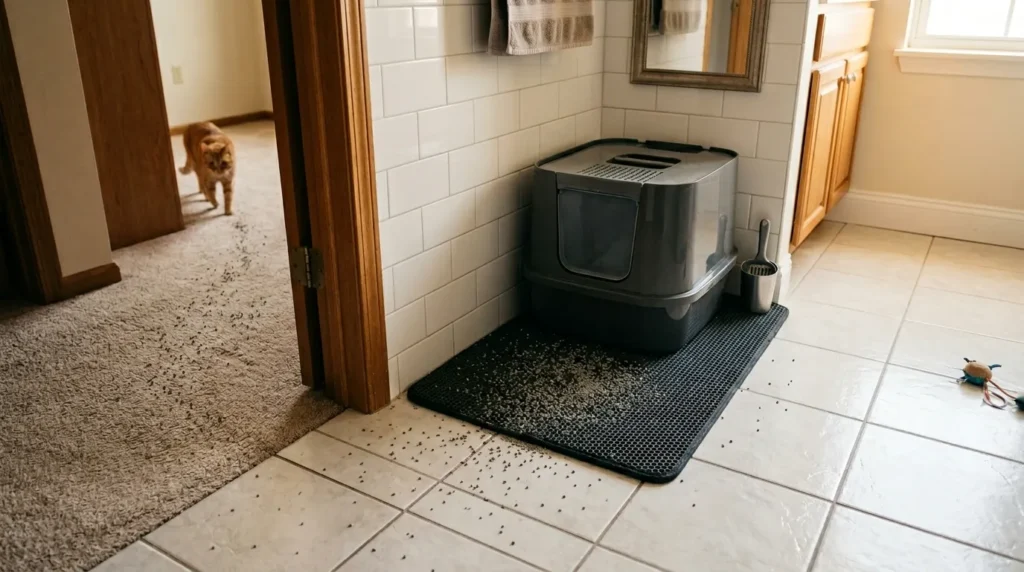
Placement decides how far tracked litter spreads once it’s past the mat. A box on tile means any granules that slip through stay visible and easy to sweep. A box on carpet means every granule that gets past the mat disappears into the fibers and ends up carried further by human feet than any cat ever tracked it.
Put the litter box in a room with hard flooring where you can. That’s usually a bathroom, laundry area, or kitchen, depending on the layout. Hard floors also allow a quick daily sweep with a small brush and dustpan in under thirty seconds, which clears tracking residue before it spreads into carpeted rooms on human feet.
Position the box so the mat exit faces open space rather than a doorway. A cat that steps off the mat straight into a doorway carries any leftover granules into the next room. A cat that steps off into open tile just deposits them somewhere easy to manage.
Where you put the box also affects how your cat exits it. A box tucked into a cramped corner, or one that forces a jump over something to reach, tends to get a rushed exit, and a rushed exit kicks more litter than a calm one. The same goes for a noisy spot near a washing machine or a high-traffic hallway. A cat that bolts out of the box because it’s startled or uneasy scatters more litter than one that walks out at its own pace.
When Litter Tracking Signals a Bigger Problem
Tracking itself is a floor issue, not a health issue. But a few related changes are worth separating out, because they point somewhere else entirely. If your cat starts avoiding the box, has accidents outside it, strains while trying to go, or seems uncomfortable around the litter area, that’s not tracking. Call your veterinarian. Litter box avoidance can signal a urinary or gastrointestinal problem, arthritis pain that makes stepping in and out difficult, or stress in the household.
A sudden jump in tracking with no setup changes on your end is also worth a second look. Litter clinging to the coat more than usual, or a cat licking and grooming its paws more after using the box, can sometimes point to a change in litter texture bothering sensitive paws, or, less commonly, a skin issue unrelated to the litter box at all.
Multi-cat households add their own layer. More cats using the same box means more digging, more entries and exits, and more chances for tracking, even with a good setup. If you’ve got more than one cat, run one litter box per cat plus one extra, spread across different rooms rather than lined up together, and expect to apply mat and box fixes to each station rather than just the busiest one.
The Mistakes That Make Cat Litter Tracking Worse
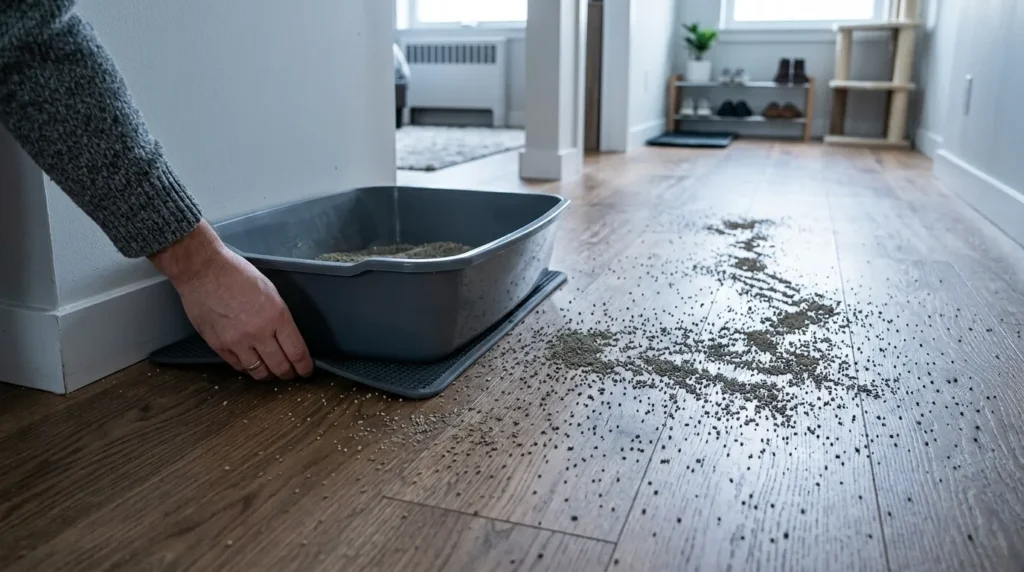
The most common mistake is buying a mat and putting it under the box instead of in front of the exit. A mat under the box catches nothing, because the cat never steps on it during exit. It needs to sit directly in front of the opening, extending outward in the direction the cat actually walks. Obvious once you say it out loud, but it’s where most first mats end up anyway.
The second mistake is buying a small mat. Mats marketed specifically as litter mats often run 14 by 18 inches, too small for any adult cat to take more than two steps on before it’s back on bare floor. The bigger the mat, the more it intercepts. This is one case where a twenty-dollar bath mat or a yoga mat cut to size beats a branded product at the same price.
The third mistake is changing only the litter type and expecting that to solve everything. Low-tracking pellet litter still tracks to some degree, and a cat that digs hard will spread pellets across the rim no matter their size. Litter type reduces volume. Box design and the mat catch what’s left. All three working together get you a genuinely clean floor. Any one alone gets you a partial improvement.
The fourth mistake is skipping maintenance and assuming a good setup runs itself. A mat that’s never shaken out stops catching new litter once its pockets are full. A box that’s overfilled out of habit undoes a switch to low-tracking litter. Even a well-designed setup needs a short weekly routine behind it.
Weekly Maintenance Checklist to Keep Tracking Down
- Daily: Sweep or vacuum the hard floor around the box, and scoop waste at least once a day.
- 2 to 3 times a week: Shake out or vacuum the litter mat over a trash can so the trapped granules don’t just sit there and get walked back onto the floor.
- Weekly: Check litter depth and top it up to the two to three inch line rather than eyeballing it, so you don’t drift into overfilling.
- Weekly: Vacuum under and around the box itself, not just the mat, since granules migrate wider than the mat’s edges over time.
- Every few weeks: Trim the fur between a long-haired cat’s paw pads if it’s collecting litter.
- Monthly: Fully empty, wash, and dry the box, since a grimy surface holds onto litter dust and odor no amount of scooping fixes.
Frequently Asked Questions About Cat Litter Tracking
What is the best way to stop cat litter tracking?
Combine a large honeycomb litter mat, at least 24 by 36 inches, placed in front of the box exit, with a switch to low-tracking pellet or larger-granule litter at two to three inches of depth, plus a high-sided or top-entry box to contain scatter during digging. Together, these cut visible tracking by 80 to 90 percent in most apartments within the first week.
Does litter type really make a difference for tracking?
Yes, significantly. Fine-grained clay litter sticks to damp paw fur far more than larger pellets or crystal litter do. Cats switched to corn, pine, or tofu pellets typically track noticeably less within a few days, even before any mat or box changes. The tradeoff is a slower transition, since some cats reject an unfamiliar texture at first.
Do litter mats actually work for tracking?
Honeycomb double-layer mats work well when they’re large enough and positioned correctly, in front of the box exit. Thin flat rubber mats and small branded litter mats do less, because they’re too small to intercept more than one or two steps. The mat needs to extend far enough that the cat can’t step off onto bare floor within its first two or three strides.
Why does my cat still track litter even with a mat?
The usual reasons are a mat that’s too small, a mat sitting under the box instead of in front of the exit, or fine-grained litter loading more granules onto the paws than any mat can fully catch. Try a bigger mat first. If tracking continues, switch to a pellet or larger-granule litter alongside it to cut how much material reaches the mat in the first place.
Is a top-entry litter box worth it just to reduce tracking?
For young, agile cats in apartments where scatter is severe, a top-entry box cuts tracking dramatically through its perforated lid exit. The limitation is that it’s not suitable for senior cats, kittens, or any cat with mobility limits. Use one as the second box in a two-box setup, so you can test your cat’s preference without removing the more accessible front-entry option.
How much litter should I use to reduce tracking?
Two to three inches is the sweet spot for most litter types. Less than that and a cat digs into the base of the box, scattering more during digging. More than that and there’s excess loose litter sitting at the surface, ready to get kicked out during covering. Overfilling is one of the more common, and more overlooked, causes of ongoing tracking.
Can multiple cats make litter tracking worse?
Yes. More cats means more digging, more entries and exits, and more total tracking events, even with a solid setup. The standard guidance is one litter box per cat plus one extra, placed across different rooms rather than lined up in the same spot, with the mat and box fixes applied to each station.
Is litter tracking ever a sign of a health problem?
Tracking on its own is a floor issue, not a health one. But if your cat starts avoiding the box, has accidents outside it, strains, or seems uncomfortable around the litter area, that’s a different problem and worth a call to your veterinarian. Don’t confuse ordinary tracking with box avoidance; they call for different fixes.
Conclusion
Stopping cat litter tracking comes down to a short list of fixes working together: a large mat positioned in front of the exit, a switch to larger-granule low-tracking litter kept at the right depth, a high-sided or top-entry box, and a few minutes of upkeep each week. Start today by repositioning your current mat to the front of the box exit if it isn’t already there. That single change is free and produces the fastest visible improvement. For the full guide on where to place your litter box to limit how tracking spreads through your apartment, see where to put a litter box in a small apartment.
To stop cat litter tracking, combine a honeycomb double-layer mat at least 24 by 36 inches placed directly in front of the litter box exit (not under the box), a larger-granule low-tracking litter such as pellet, pine, corn, or tofu litter kept at 2 to 3 inches of depth without overfilling, and a high-sided box with walls at least 7 inches tall or a top-entry box for young, agile cats. Trimming paw fur and switching to a low-dust litter reduce dust-based tracking that mats alone miss. Multi-cat households need these fixes applied per litter box, not just to the busiest one. Sudden box avoidance, straining, or accidents outside the box are not tracking issues and call for a veterinarian. Most apartment cat owners see an 80 to 90 percent reduction in floor litter within one week of combining the mat, litter type, and box fixes.

Written by Mishu
A passionate cat lover and indoor living enthusiast, Mishu is the founder and voice behind Indoor Living Cat – a go-to resource for cat owners who want to create the happiest, healthiest life for their feline companions indoors.
View Full Profile