
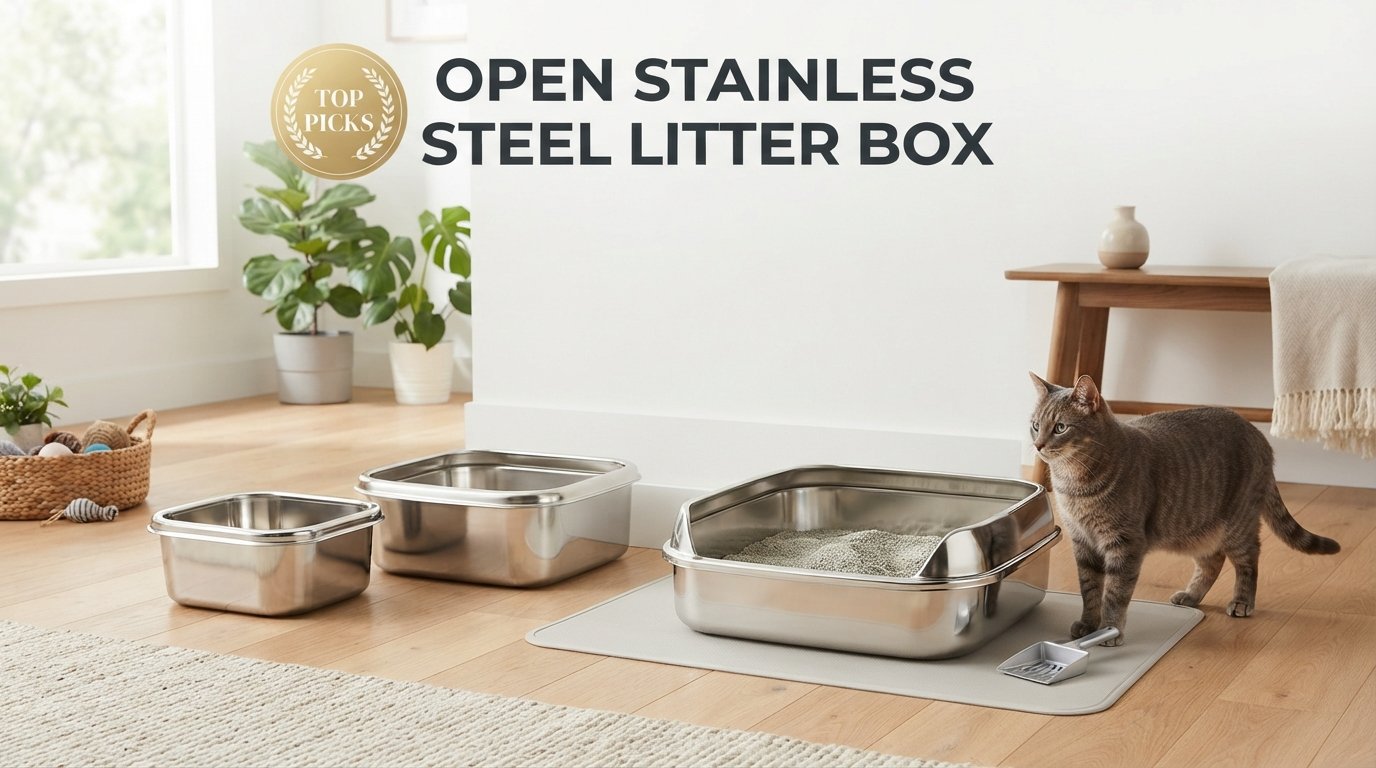
An open stainless steel litter box skips the hood and the lid on purpose, and after three weeks of testing, that single choice explains almost everything else about how these pans perform. I ran three of them through daily use with two cats, one a heavy digger, one skittish around anything enclosed, and tracked how the metal handled scratching, staining and smell with nothing trapping the mess inside.
Below is what I found, box by box, plus where each one comes up short. None of these are perfect. An open design trades a lid and built-in odor control for better airflow, zero assembly and a lot less scrubbing. I’ve tried to be specific about who each one actually suits, and I added a sizing check based on vet guidelines.
Disclosure: some links on this page are Amazon affiliate links. If you buy through one, this site earns a small commission at no extra cost to you.
- Ran each box with a heavy digger and a shy digger for at least a week apiece
- Scooped once a day, then skipped a day midweek to see how fast odor built up without a lid
- Cleaned with the same brush and warm water each time, no bleach, so waste release was comparable
- Weighed every box empty and full to see how hard it was to move for cleaning
- Checked each box’s listed length against the 1.5x cat-length sizing rule that feline vets recommend
⚡ Open Stainless Steel Litter Box: Quick Verdict
The short version: the Idymere is the open stainless steel litter box for most homes, the Kirecoo suits hand scoopers who want the smoothest rim, and the OneBug is the one for large cats. If odor in a small space is your main worry, skip open pans and read the enclosed section below.
Open Stainless Steel Litter Box: The Boxes I Tested
Three pans made this round-up. All three are fully vented, all three skip the hood, and all three held up fine after three weeks of regular use. For the full picture, including covered and automatic styles, the indoor cat litter box hub covers every format we’ve tested.
| Image | Product | Score | Link |
|---|---|---|---|
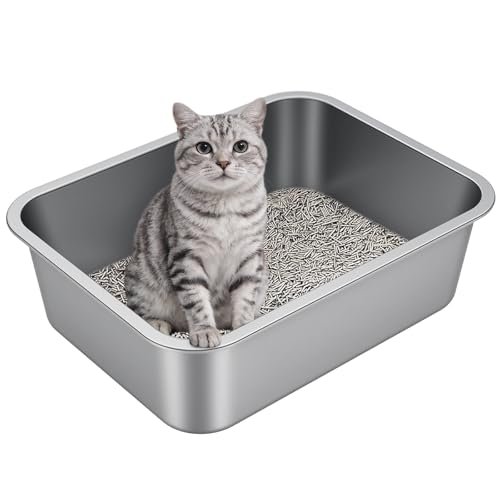 |
Idymere Stainless Steel High Sided Cat Litter Box 🏆 Editor’s Pick |
8.7/10 | View on Amazon Free Shipping & 30-Day Returns |
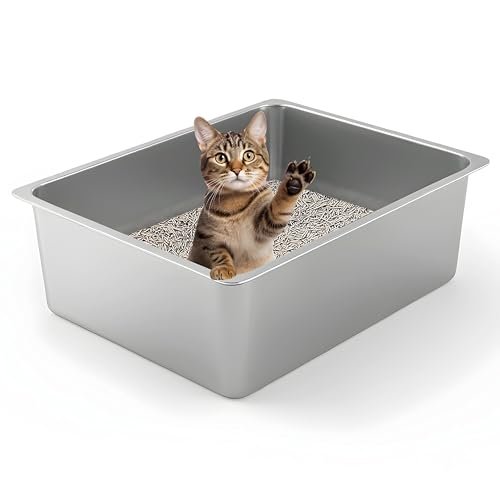 |
Kirecoo Large High Sided Stainless Steel Cat Litter Box 🥈 Runner-Up |
8.5/10 | View on Amazon Free Shipping & 30-Day Returns |
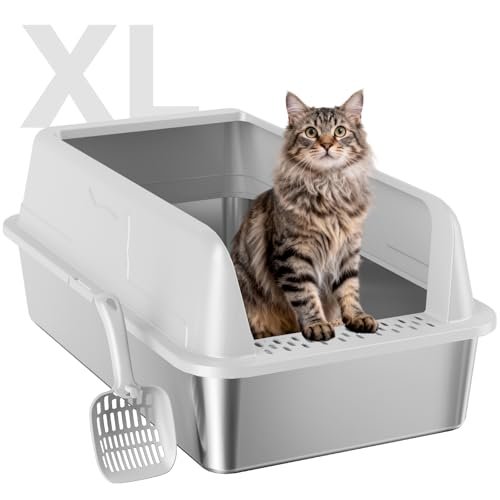 |
OneBug Stainless Steel XL Cat Litter Box, High-Sided | 8.3/10 | View on Amazon Free Shipping & 30-Day Returns |
Scores weigh four things: how the metal held up to a cat that digs hard, how much smell built up after a day without scooping since none of these have a lid, how fast cleanup actually took, and whether the box works for more than one cat. That last point is the question I get asked most about open designs.
Idymere vs Kirecoo vs OneBug: Specs Side by Side
Numbers first, opinions in the reviews below. Sizes come from each seller’s listing, so the usable interior runs a little smaller than shown. Two rows are my own math: floor area is length times width, and the longest-cat row applies the 1.5x rule explained in the sizing section.
| Spec | Idymere | Kirecoo | OneBug |
|---|---|---|---|
| Size (L x W x H) | 16.93″ x 12.99″ x 5.12″ | 17.52″ x 13.58″ x 5.9″ | 22.95″ x 14.80″ x 10.04″ |
| Wall height | 5.12 in | 5.9 in | 10.04 in |
| Floor area (outer) | About 220 sq in | About 238 sq in | About 340 sq in |
| Standout feature | Rounded rim all the way around | Smoothest rolled rim of the three | Anti-tracking entry step, scoop included |
| Longest cat it fits (1.5x rule) | About 11 in | About 11.5 in | About 15 in |
| Best for | Most single-cat homes, kittens, older cats | Cats that hate hoods, daily hand scooping | Large cats, digging enthusiasts |
| My score | 8.7/10 | 8.5/10 | 8.3/10 |
Your photo of the Idymere, Kirecoo and OneBug side by side on a floor, with a tape measure or ruler in frame so readers can judge scale.
Delete this box once the photo is in.
Detailed Reviews
Idymere Stainless Steel High Sided Cat Litter Box 🏆 Editor’s Pick
| Dimensions | 16.93″ L x 12.99″ W x 5.12″ H |
| Material | Stainless Steel |
| Height | 5.12 inches |
| Rounded Edges | Yes |
This is the one I’d tell a friend to just buy. At just over 5 inches deep, the walls are tall enough that my more enthusiastic digger stopped kicking litter onto the bathroom tile within a couple of days. Not perfect, but a real jump from the plastic pan it replaced.
What sold me was the edge. A lot of steel pans have a lip that’s slightly sharp where it’s folded, and you feel it while scrubbing at 11pm. This one’s rounded all the way around, so wiping it out doesn’t feel like a chore you’re bracing for. Waste doesn’t cling to the surface either. A firm swipe with a scoop and it’s basically clean underneath.
Being fully open is the whole point here. There’s no lid, so if odor control matters most to you, this won’t fully solve it. You’ll still need to scoop daily. And once it’s full of litter, it’s heavy, not something you want to slide across a hardwood floor alone.
One more caveat, and it’s about size. At 16.93 inches long, this is the most compact pan of the three. Feline vet guidelines want a box at least 1.5 times your cat’s length, which puts the limit for this one at a cat measuring about 11 inches from nose to base of tail. Measure yours before you order, using the steps in the sizing section.
If you want a no-nonsense open box that’s easy on your hands and doesn’t hold onto smell, this is it. Skip it if you specifically need odor containment for a shared space, or if your cat is long enough to outgrow the footprint.
It works best in a single-cat home, or for an owner who’d rather deal with an open box than fight a lid every day. The rounded rim also suits older cats or anyone with wrist issues. There’s nothing sharp to catch a knuckle on while scooping. With the lowest walls of the three, it’s also the easiest climb for a kitten or a senior cat.
- Held up to daily digging with no visible scratching after several weeks
- Waste doesn’t stick, cleanup is quick
- Rounded rim is genuinely more comfortable to handle
- No lid, so odor isn’t contained between scoops
- Awkward to lift and move once it’s filled
- Metal gets noticeably cold in an unheated room
- Compact for long cats, so measure first
Kirecoo Large High Sided Stainless Steel Cat Litter Box 🥈 Runner-Up
| Dimensions | 17.52 x 13.58 x 5.9 inches |
| Material | Stainless Steel |
| Smooth Rim | Yes |
| Height | 5.9 inches |
A little taller and roomier than the Idymere. That extra 0.8 inches of wall height matters if your cat digs with any real force. It’s still fully open on top, which counts for a lot if you’ve got a cat that gets skittish in enclosed spaces. Boxes with hoods just don’t get used consistently by cats like that, in my experience.
The rim is the standout feature here. It’s rolled smooth with no seam you can feel, which sounds minor until you’re reaching in to scoop every single day. Waste releases from the surface easily enough that a quick scrape gets it fully clean, no soaking or scrubbing needed.
Where it loses points against the Idymere is floor space. It’s only about half an inch longer and wider, so the extra height doesn’t come with much extra room. If you’ve got a larger cat, or multiple cats sharing one box, this runs small next to the OneBug. And like any open pan, nothing here traps smell. It relies entirely on you scooping regularly.
Great if your cat is nervous around enclosed boxes and you want the smoothest rim in this lineup. Not the pick if you need more square footage for a bigger cat or a multi-cat setup.
Best suited to a single cat that prefers open, low-stress spaces, or an owner who scoops multiple times a day and doesn’t need the odor control a covered box offers.
- Smoothest rim of everything I tested, nothing to catch a hand on
- Taller walls than the Idymere, good for diggers
- Open top suits cats that dislike enclosed spaces
- Runs small next to the XL option on this list
- No lid means no odor barrier
- Tall sides can be a stretch for very small or older cats
OneBug Stainless Steel XL Cat Litter Box, High-Sided
| Dimensions | 22.95″ L x 14.80″ W x 10.04″ H |
| Includes Scoop | Yes |
| Anti-Tracking | Yes |
| Height | 10.04 inches |
This is a genuinely big open box, 10 inches of wall height, nearly double the Idymere’s 5.12. If you’ve got a Maine Coon, or just a cat that digs with real enthusiasm before doing its business, that extra depth means far less litter sailing over the top.
The built-in step at the entry is a nice touch a lot of open steel pans skip. It catches loose litter off the cat’s paws on the way out, instead of letting it get tracked straight onto the floor. Nothing fully stops tracking, but it noticeably cut down what I was sweeping up. If tracking is your main frustration, our stainless steel top entry litter box guide covers designs built specifically around that problem.
Close-up of the OneBug entry step with a little litter caught on it, so readers can see what the step actually does.
Delete this box once the photo is in.
At 22.95 inches long, it’s also the only box in this round-up that gives a longer cat real room under the 1.5x rule. The trade-off is footprint and weight. This isn’t a box you tuck into a small bathroom corner, and once it’s got litter in it, moving it is a two-hand job. If you need something even roomier for multiple cats, check out our large stainless steel litter box guide instead.
If you’ve got a large cat or more than one cat, and floor space isn’t a constraint, this is worth the extra bulk. Skip it in a small apartment.
Good fit for multi-cat households, large breeds, or anyone whose current box feels cramped. The included scoop is a nice bonus if you don’t already have one you like.
- Plenty of room for large cats or two cats sharing
- Entry step meaningfully reduces tracking
- Comes with a decent scoop out of the box
- Takes up a lot of floor space
- Heavy and awkward once filled
- Open top, so odor isn’t contained
Who Should Buy an Open Stainless Steel Litter Box
An open stainless steel litter box is not the right call for every home. It suits some cats well and falls short for others. Here’s how I’d sort it out.
- Good fit: single cat homes, cats that avoid hoods, owners who scoop once or twice a day
- Not ideal: multi-cat homes that need strong odor control, small shared spaces like a studio or dorm
- Check first: if your cat sprays while standing, even a tall open pan can let urine escape over the rim
Here is how the three boxes match up against common situations:
| Your situation | Best pick | Why |
|---|---|---|
| One average-size cat, you scoop daily | Idymere | Rounded rim, 5.12 inch walls, easy to clean |
| Cat that digs hard | Kirecoo or OneBug | Walls of 5.9 and 10.04 inches keep more litter inside |
| Large or long cat | OneBug | Longest pan here at 22.95 inches, with 10 inch walls |
| Two cats | OneBug as one of three boxes | Vets advise one box per cat plus one spare |
| Kitten | Idymere | Lowest walls of the three, so the easiest climb |
| Senior cat | Idymere | Low walls and a rounded rim, nothing sharp to brush past |
| Cat that avoids hoods | Any of the three | All are fully open on top |
| Cat that sprays while standing | None on its own | See the high sprayers guide |
| Odor is the top priority | An enclosed design | See the odor control guide |
Still weighing formats? Our stainless steel litter box guide compares open, covered and automatic designs side by side, so you can see how each style handles odor, tracking and cleanup.
What Actually Matters Before You Buy an Open Stainless Steel Litter Box
After testing all three, a few things mattered more than I expected. A few things I thought would matter, didn’t as much.
Size comes first: the 1.5x rule
Feline veterinary guidelines say a litter box should be at least 1.5 times your cat’s length, measured from nose to base of the tail, and that most manufactured boxes fall short of that (AAHA/AAFP feline life stage guidelines). Open steel pans are no exception, and two of these three are on the small side.
- Measure your cat. Run a soft tape from the nose to where the tail meets the body. A treat helps the cat hold still.
- Multiply by 1.5. That number is the minimum box length.
- Compare it to the length row in the specs table above.
- Check the width. Your cat should be able to turn all the way around, dig and cover without hanging over an edge.
- Between sizes? Go bigger. Wall height only matters for diggers, kittens and older cats.
Two examples. A cat that measures 11 inches works out to 16.5 inches of box, so all three pans clear the bar. A 14 inch cat needs about 21 inches, and only the OneBug gets there.
A simple photo or diagram showing where to measure a cat, nose to base of the tail, with the 1.5x formula written beside it.
Delete this box once the photo is in.
None of this makes the Idymere or Kirecoo a bad buy. They suit smaller cats best, and a long cat needs the OneBug or something bigger, like the options in our large stainless steel litter box guide.
Wall height beats almost everything else
If your cat digs with any enthusiasm, an extra inch or two of wall height does more for containing litter than any coating or design gimmick. Measure your cat’s typical dig radius if you can, it tells you more than the marketing photos. The three boxes here run 5.12, 5.9 and 10.04 inches. For kittens and older cats the advice flips, since edges shouldn’t be so high that they struggle to get in and out. Our high sided stainless steel litter box guide breaks down wall height by cat size if you want to go deeper.
Know your stainless steel grade
Grade decides how long a pan lasts near urine. Look for a listing that names 304 (also sold as 18/8 or food grade), which resists rust through years of daily use. Budget pans often use 201, which swaps some of the nickel for manganese and can spot or rust near seams and welds.
A magnet is a weak test. A strong pull points to a ferritic grade like 430, but 201 and 304 both stay non-magnetic or only weakly magnetic, so a magnet can’t tell those two apart. If a listing doesn’t name a grade at all, treat it as the cheaper one until the seller says otherwise.
Open designs trade odor control for airflow
An open stainless steel litter box ventilates well and never traps humidity, but it relies entirely on you keeping up with scooping. Skip a day or two and odor builds faster than in a lidded box. That trade is worth it for cats that get skittish around hoods, but go in with clear eyes about the upkeep.
The rim finish matters as much as the material
Every box on this list is stainless steel, but the edge finishing varied a lot between them. A rolled, rounded rim is worth paying a bit more for, since you’ll be reaching into this box daily.
Close-up of the Idymere rounded rim next to a folded, sharper edge from a cheaper pan, so the difference is visible.
Delete this box once the photo is in.
Open boxes won’t contain a high sprayer
If your cat sprays or backs up against the wall to urinate, even a tall open pan can let urine escape over the top edge. That’s a different problem than digging, and it needs a different fix. Our stainless steel litter box for high sprayers guide covers designs built with that issue in mind.
Weight when full is easy to overlook
Steel boxes are heavier empty than plastic ones, and once several pounds of litter go in, moving one to vacuum underneath is more of a project than you’d think. Worth factoring in if you’ll be relocating the box often.
- Measure your cat from nose to base of tail and multiply by 1.5 to get the minimum box length
- Measure the wall height against how high your cat kicks litter while digging
- Check whether the rim is rolled smooth or just folded sheet metal
- Look for a listing that names 304 stainless steel
- Confirm the footprint fits your space once it’s full and can’t be squeezed in later
- Decide if you can scoop at least once a day, since nothing here holds odor for you
Stainless Steel vs Plastic Litter Box: Is the Upgrade Worth It?
Every open stainless steel litter box is a bet on the material, so it’s worth pricing that bet honestly. Steel costs more up front. The payoff is a pan you won’t replace every year or two.
| Factor | Stainless steel | Plastic |
|---|---|---|
| Scratches | No visible scratching on the Idymere after several weeks of daily digging | Scratches over time, and those grooves hold odor and bacteria |
| Odor over time | Doesn’t absorb smell, though an open pan still needs daily scooping | Old pans keep a smell that scrubbing doesn’t fully remove |
| Cleanup | Waste releases with one firm scoop swipe and a brush | Takes more effort as the surface wears rough |
| Weight | Heavy empty, much heavier once filled | Light and easy to move |
| In a cold room | Gets noticeably cold to the touch | Stays neutral |
| Lifespan | Years without rusting or pitting on 304 grade | Usually one to two years before scratches build up |
| Upfront price | Higher | Lower |
| Rust risk | Depends on grade; cheap 201 can spot near seams | None |
Pay for steel if you plan to keep one box for years, or if your current plastic pan smells even after a hot scrub. Stay with plastic if budget decides it or you move the box often. Neither material fixes a skipped scoop.
Do Open Stainless Steel Litter Boxes Smell?
Less than an old plastic pan, and more than a lidded box on a day you skip the scoop. That’s the honest answer. Steel is non-porous, so urine has nothing to soak into, but an open top means nothing holds the smell in either.
What controls odor in an open pan is your routine. These five habits do most of the work:
- Scoop daily. Twice a day with two or more cats. Nothing else on this list matters if this slips.
- Keep litter 2 to 3 inches deep. That is deep enough for urine to clump before it reaches the steel, and shallow enough that a full change doesn’t waste a bag.
- Use unscented clumping litter. Clumps lift off steel cleanly, and an open box has no lid to keep added perfume from spreading through the room.
- Wash with hot water and a stiff brush every one to two weeks. If you use soap, pick an unscented one and rinse it all off. Skip bleach, since chlorine can pit stainless steel, and keep steel wool away, since it leaves iron particles that rust.
- Put it where air moves. A closed-door closet traps whatever an open pan gives off. A spare room or bathroom with a fan does better.
If you’ve done all five and the room still smells, that’s when a lidded design makes sense. The enclosed section further down covers when to switch.
How to Set Up and Clean an Open Stainless Steel Litter Box
A steel pan needs almost no setup, which is half its appeal. These steps cover the parts people skip.
- Wash it before first use. Warm water, a brush and a full dry clear off residue from packing and shipping.
- Pick the spot. Somewhere quiet, away from food and water, in the part of the home where your cat already spends time. Your cat should be able to see who is coming.
- Add 2 to 3 inches of litter. In the Idymere, that leaves about 2 to 3 inches of clear wall above the litter, which is what stops most kick-out.
- Keep the old box out for a few days. Let your cat choose, and remove the old one once the steel pan is in regular use.
- Scoop every day. Bag the clumps and top up the litter so the depth stays steady.
- Do a full wash every one to two weeks. Empty it, scrub with hot water, rinse, dry completely and refill. Damp steel makes fresh litter stick to the floor of the pan.
Photo of an open steel pan with litter at the right depth and a ruler standing in it, showing the 2 to 3 inch fill line.
Delete this box once the photo is in.
Cleaning schedule at a glance
| Task | How often | Notes |
|---|---|---|
| Scoop clumps and stray litter | Daily, twice with 2+ cats | Keeps odor down between washes |
| Wipe the rim and outer walls | Weekly | Catches drips before they dry |
| Empty, wash, dry and refill | Every 1 to 2 weeks | Hot water and a stiff brush, no bleach |
| Check feet, seams and corners | Monthly | Cheaper models wear or rust here first |
Want More Odor Control? Consider an Enclosed Design Instead
Every box above is fully open on top. That’s what makes them easy to clean and unintimidating for cats that dislike tight spaces. But an open pan does not trap smell. If odor in a shared apartment or a small room is your top concern, a lidded box will outperform anything on this list. My stainless steel litter box for odor control guide covers two enclosed options I tested for that exact problem.
Cats don’t agree on this one. Research summarized in veterinary guidance found them about evenly split between open and covered boxes, so your own cat’s behavior is the best test. For the full breakdown of hooded and top entry styles, see the metal litter box comparison, where I test how well different lid designs actually hold in smell.
| Factor | Open Design | Enclosed Design |
|---|---|---|
| Odor Containment | Weak, relies on daily scooping | Strong |
| Airflow | Excellent | Limited, can trap humidity |
| Good for Anxious Cats | Usually yes | Depends on the cat |
| Setup | Unbox and place | Often needs assembly |
| Cleaning Steps | Scoop and rinse, nothing to unlatch | Lid or hood adds a step |
| Best For | Cats that dislike hoods, single-cat homes | Shared spaces where smell matters most |
| Typical Price | Lower | Higher |
Open Stainless Steel Litter Box: Questions I Get Asked
Which open stainless steel litter box is best?
For most homes, the Idymere Stainless Steel High Sided Cat Litter Box. It scored 8.7 out of 10 on a rounded rim, 5.12 inch walls and a surface that waste doesn’t cling to. The Kirecoo (8.5) suits cats that dislike hoods and owners who want the smoothest rim, and the OneBug (8.3) is the pick for large cats.
Is an open box actually better than an enclosed one?
Neither is better on its own, it depends on your cat and your space. Open boxes ventilate well, never trap humidity, and suit cats that dislike tight or dark spaces. Enclosed boxes win on odor containment. Research summarized in veterinary guidance found cats split about evenly, so if yours hesitates at a hood, go open.
Is stainless steel actually better than plastic, or is that overblown?
Steel earns its reputation, with limits. Plastic scratches over time, and once it does, those scratches hold onto bacteria and odor no matter how well you clean it. Steel doesn’t scratch the same way, so it stays easier to actually get clean, years in. A lazy cleaning routine will still smell, whatever the pan is made of. The steel vs plastic table lays out the trade-offs.
Do these actually smell less than plastic?
In my experience, yes, once a box has some age on it. An old plastic pan holds onto smell that no amount of scrubbing fully removes, and steel doesn’t have that problem. Day to day though, the open design still relies on you scooping regularly to keep odor down. The odor section covers the five habits that matter.
How often should I clean an open stainless steel litter box?
Scoop once a day at minimum, twice if you have more than one cat. Give it a full wash with hot water and a stiff brush every one to two weeks. Feline vets put a full litter change at every two to four weeks at most, so an open pan does better near the short end. Skipping days is the main reason open pans start to smell.
How big should an open stainless steel litter box be?
At least 1.5 times your cat’s length from nose to base of tail, and wide enough for the cat to turn around. By that math the Idymere suits cats up to about 11 inches, the Kirecoo about 11.5 and the OneBug about 15. The steps are in the sizing section.
Are the tall-sided ones safe for kittens?
Mostly, but check the actual wall height against how big your kitten is right now. Some of these get tall enough that a young kitten will struggle to climb in. I’d hold off on the OneBug until a kitten’s a bit bigger, and start with something like the Idymere instead. The same goes for senior cats, since guidelines say box edges shouldn’t be so high that a kitten or older cat has trouble getting in and out.
Do stainless steel litter boxes rust?
It depends on the grade. 304 stainless resists rust for years with normal care, while cheap 201 can spot near seams and welds. Two habits protect any grade: dry the pan after washing, and keep bleach and steel wool away from it. A magnet can’t settle the question, because 201 and 304 both stay weakly magnetic at most. Check the listing for a named grade.
How long does an open stainless steel litter box last?
A well made 304 stainless pan should last for years without rusting or pitting. Plastic pans usually need replacing every one to two years once scratches build up and hold odor. Steel doesn’t have that problem, though plastic feet or hinges on cheaper models can wear out first.
Do high sides stop litter from scattering?
They stop litter that gets kicked over the rim, which is the mess diggers make. They don’t stop tracking, which is litter stuck to paws on the way out. For tracking you need an entry step or a mat, which is why the OneBug’s step helped. Cats that spray while standing are a third problem, covered in our high sprayers guide.
Should I get an open box for a two-cat household?
It can work well, but size matters more here. Two cats need enough room that neither feels cornered while using it. I’d rather see two cats share a large open box like the OneBug than squeeze into a smaller one. Feline guidelines also call for one box per cat plus a spare, so treat the OneBug as one box of three.
How many litter boxes should I have?
One per cat, plus one extra, spread around the home instead of lined up side by side. Cats treat boxes placed close together as one big box (source). For two cats, that means three boxes in at least two locations.
What’s the easiest way to actually clean these?
A stiff-bristled brush and hot water handles daily cleaning fine. Waste tends to release without much scrubbing. For a deeper clean every few weeks, stainless steel can go in a dishwasher, but check the seller’s care notes first since some models list hand wash only. A full-size box doesn’t fit in most dishwashers anyway, so I usually just hand-wash mine in the tub.
Can I use litter liners in a stainless steel litter box?
You can, but most people skip them. Steel rinses clean, which is the main reason to own one, and some cats catch their claws in a liner while digging.
🎯 Final Verdict
For most people, the Idymere is the one to buy. It doesn’t do anything flashy, but it nails the basics: deep enough sides, a rim that doesn’t punish your hands, and a surface that stays clean between scoops.
If you’ve got a bigger cat, or more than one cat sharing a box, size up to the OneBug. The extra depth and the anti-tracking step earn their keep. And if odor in a shared space is what you’re actually trying to solve, an enclosed design will serve you better than any open pan, ours included.
Whichever you pick, measure your cat first. A box that’s too short for the cat is the one mistake no amount of wall height fixes.

Written by Mishu
A passionate cat lover and indoor living enthusiast, Mishu is the founder and voice behind Indoor Living Cat – a go-to resource for cat owners who want to create the happiest, healthiest life for their feline companions indoors.
View Full Profile