

Your cat is on the counter again and this time they walked through the food you were preparing. Knowing how to stop cat jumping on counters requires understanding why they go up there in the first place, because the reasons are not random and neither is the solution. I noticed my own cat started using the counter exclusively after I rearranged the furniture and removed the bookshelf she used to sit on near the window. That told me she was not being difficult. She was hunting for a replacement high spot, and the counter was the only one left. Cats jump on counters because the counter offers height, warmth from appliances, interesting food smells and proximity to you while you cook. This guide covers every method that actually works, why the methods most people try first fail, and what to do when a cat keeps going back up no matter what you try.
The Short Version
- Give your cat an alternative high spot at counter height, in the same room, close to where you stand.
- Wipe counters with a dilute vinegar solution after every cooking session to kill food smells.
- Use a texture mat or tape on the counter temporarily while the new perch habit sets in.
- Reward every voluntary use of the new perch. Skip water bottles, shouting and picking your cat up.
- Give it two to six weeks before you judge whether it worked.
To stop cat jumping on counters, provide a better alternative high spot in the same room at roughly the same height. Remove food smells immediately after cooking, use a mat with an unpleasant texture on the counter surface and reward your cat consistently every time they choose the alternative surface. Counter-jumping stops when the alternative is more rewarding than the counter itself.
Is It Actually a Problem If Your Cat Sits on the Counter?
Plenty of owners let their cats sit on the counter and never think twice about it. Whether that is fine depends less on preference and more on what happens on your counter. A cold, empty counter is a low-risk spot. A counter you cook raw meat on is a different story.
Three things make counters genuinely risky rather than just annoying:
- Cross-contamination. Litter box bacteria on a cat’s paws, including strains of salmonella and E. coli, can transfer to a surface you then prep food on. The CDC lists cats as one of the more common sources of household salmonella exposure.
- Burns and stovetop hazards. A cat walking near an active burner, a hot pan handle sticking out, or a still-warm stovetop after cooking can get burned in a way you will not notice until you smell singed fur.
- Cleaning chemicals. Counter sprays, degreasers and disinfectants left to air-dry are toxic if a cat walks through them and then licks a paw. This is a bigger deal than food smell and gets far less attention in most guides.
If your household has none of these, letting your cat lounge on a clear, cool counter between meals is a personal call, not a health issue. If any of them apply, the methods below matter for safety, not just for keeping your counters tidy.
Why Your Cat Jumps on Counters in the First Place

Cats jump on counters for a short list of reasons: height equals safety and territorial security, warm appliances provide thermal comfort, food smells attract their predatory interest, and you are nearby, so the counter puts them in your social space without floor-level vulnerability. Which of these drives your specific cat tells you which fix to try first.
| What’s Driving It | Signs to Look For | What Helps Most |
|---|---|---|
| Territorial security | Jumps on any clear counter, not just near food or appliances | Alternative perch at the same height, anywhere in the room |
| Thermal comfort | Sticks to the area near the stove or dishwasher, especially in cooler months | A heated cat bed or sunny perch nearby |
| Food seeking | Shows up mainly during meal prep or when food is out | Scent removal plus keeping food off open surfaces |
| Wanting to be near you | Follows you specifically to the counter, ignores it when you’re out of the kitchen | A perch positioned within a few feet of where you stand to cook |
Territorial security is almost always the dominant driver. Cats are hardwired to monitor their environment from above, and in an apartment where floor-level furniture offers limited elevation, the counter becomes the highest available vantage point. This is not a behavior problem. It is a cat doing exactly what cats do when their environment does not provide enough vertical territory.
The thermal comfort driver matters specifically in kitchens because the area around the stove and dishwasher radiates warmth that cats find hard to resist during cooler months. If your cat concentrates on one counter area near appliances rather than ranging across every surface, warmth is a primary motivator, and the fix is a heated alternative surface, not just a high one.
The Alternative Perch Method: The Only Long-Term Solution
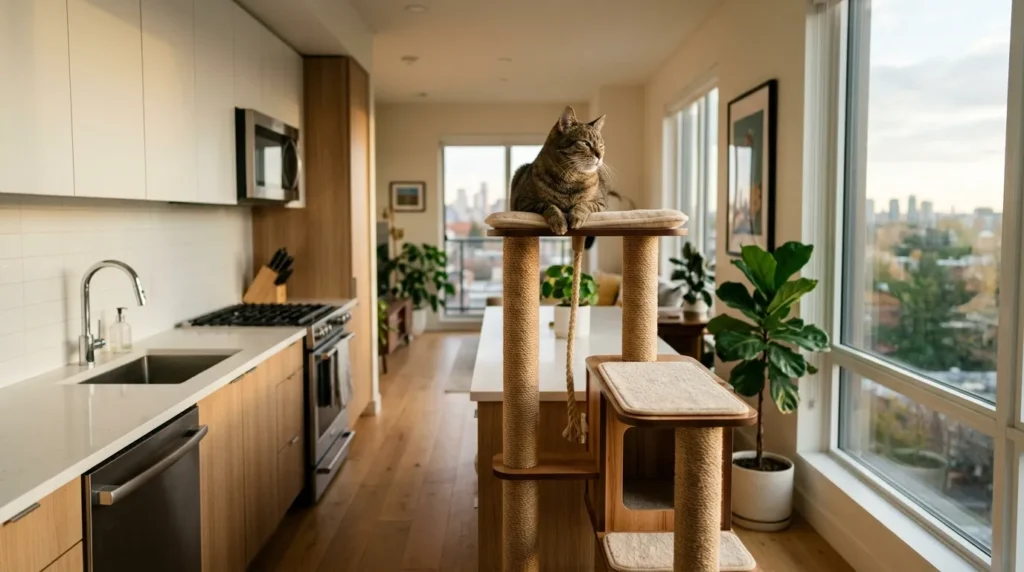
The alternative perch method works because it deals with the underlying need instead of just blocking access, and that is why it holds up long term while deterrents alone do not. Place a tall cat tree or wall-mounted shelf at counter height in the kitchen or wherever counter jumping happens most. The alternative has to be at least as high as the counter and positioned where your cat can still see and take part in whatever was drawing them to the counter in the first place.
The positioning detail is where most owners go wrong. They put the cat tree across the room or out in the hallway, then wonder why the cat still prefers the counter. A cat jumping on the counter while you cook wants to be near you and near the activity. The alternative perch needs to sit inside that same visual zone, not get exiled to a corner.
Setting up the perch, step by step:
- Measure your counter height. Most kitchen counters sit around 36 inches. Match the new perch as closely as you can.
- Place it within a few feet of where you actually stand to cook, not just somewhere in the kitchen.
- Add a blanket or something with your scent on it for the first few days so it feels familiar faster.
- Reward every voluntary visit with a high-value treat, said in a calm voice, right when it happens.
- Keep the counter empty and scent-free at the same time so the comparison favors the perch.
- Give it one to two weeks of consistent reinforcement before judging whether it worked.
Once the alternative is in place, treat every voluntary use of it with a high-value reward right away. This is positive reinforcement at its most effective, because the cat learns the new surface produces treats while the counter produces nothing, or produces an unpleasant texture. Most cats shift their preference within one to two weeks when the reinforcement stays consistent.
For a full selection of vertical furniture options that work in apartment kitchens specifically, best cat furniture for indoor cats covers height options from wall shelves to freestanding trees with measurements that fit near kitchen spaces.
Surface and Scent Deterrents: What Actually Keeps Cats Off Counters
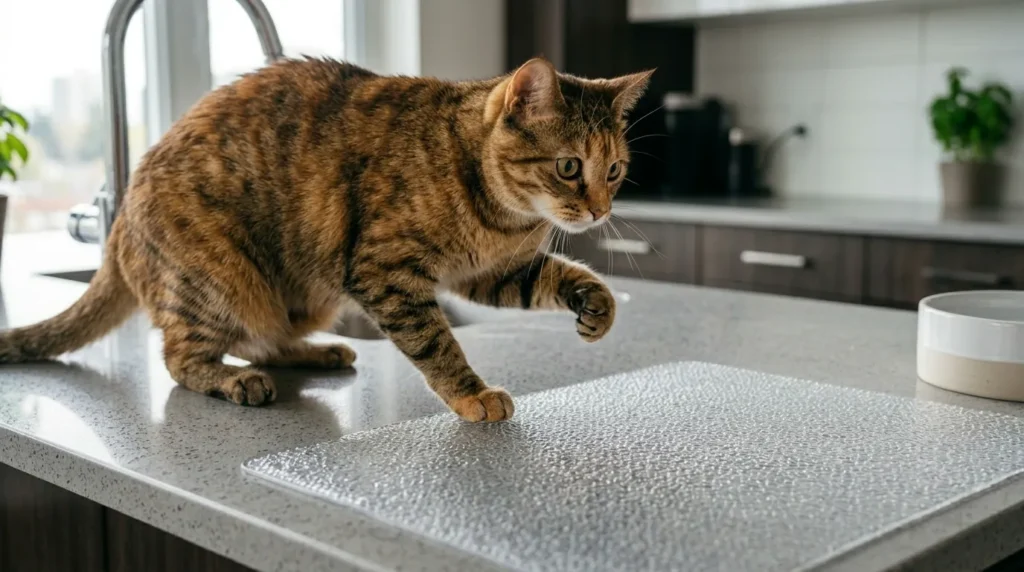
Deterrents work by making the landing zone unpleasant enough that a cat chooses not to repeat the jump. They do not work as a standalone fix, since they only address the behavior and not the underlying need. Paired with an alternative perch, though, they speed up the transition a lot. Here is how the common options stack up.
| Deterrent | How It Works | Cost | Best For | Watch Out For |
|---|---|---|---|---|
| Aluminum foil | Startling sound and texture on landing | Free / very low | Cats sensitive to texture and sound | Some cats walk right across it, unfazed |
| Double-sided tape | Sticky feel on paw pads | Low | Cats that ignore foil | Can leave residue on some finishes |
| Citrus spray (commercial, cat-safe) | Scent cats find unpleasant | Low to moderate | Cats put off by strong smells | Never substitute a real essential oil, see below |
| Motion-activated air or sound device | Startles the cat with a burst of air or noise on approach | Moderate | Persistent cases, larger counters | Can also spook other pets or people in the kitchen |
| Electronic scat mat | Delivers a mild static correction on contact | Higher | Cases where nothing else has worked | Skip this if your cat is anxious or elderly, and check with your vet first |
Aluminum foil is the low-cost option that works for most cats because the sound and texture of landing on it triggers a startle response. Lay it flat on the counter when you are not using it and pull it off during food prep. The limitation is real: some cats are completely unbothered by foil and will walk across it without hesitation, so test it for a few days before committing.
Sticky tape strips along the counter edge create an immediate aversion, since cats intensely dislike adhesive on their paw pads. This works better than foil for texture-tolerant cats, but it can leave residue on some counter finishes, so test an inconspicuous spot first. Use every surface deterrent temporarily, just long enough to lock in the alternative perch habit, then remove it gradually as your cat defaults to the new surface.
Are Essential Oils Safe to Use as a Cat Deterrent?
No. This is worth stating plainly, because a lot of advice online lumps “citrus scent” and “citrus essential oil” together, and they are not the same thing. According to the ASPCA Animal Poison Control Center, essential oils including citrus, tea tree and eucalyptus can cause vomiting, tremors and liver damage in cats, partly because cats lack the liver enzyme needed to break certain oil compounds down. If you want a citrus deterrent, use a commercial spray labeled safe for cats, or a very dilute mix of lemon juice and water. Skip straight essential oils and diffusers in any room your cat has access to.
Removing the Scent and Food Rewards That Keep Drawing Them Back
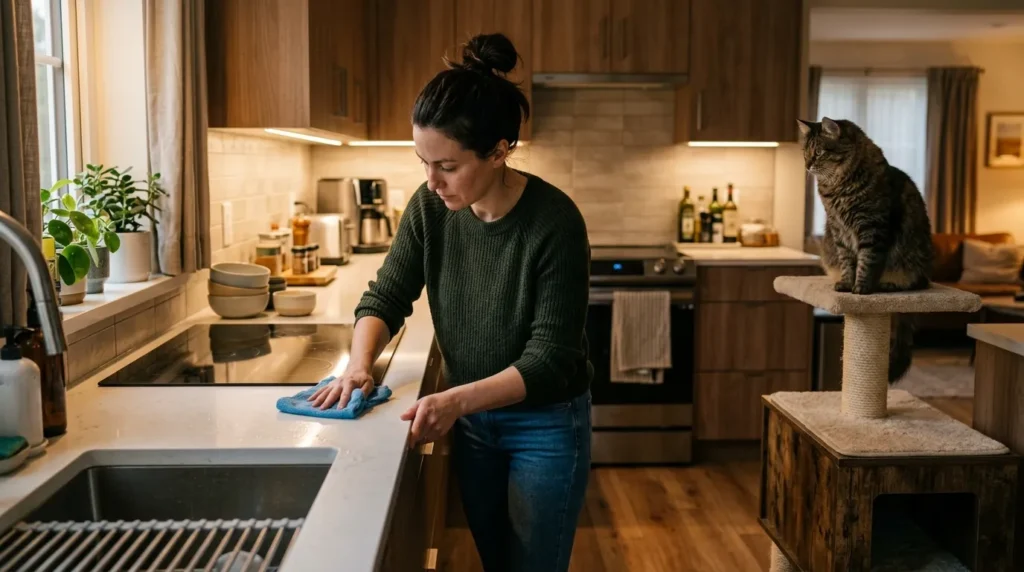
Food smell is one of the most persistent reasons cats return to counters even after you have solved the height problem with an alternative perch. Cats have scent detection estimated at roughly fourteen times stronger than humans, and even invisible food residue left on a counter after cooking is an active lure that pulls them back again and again.
Wipe counters with a dilute white vinegar solution after every cooking session, not just water. Vinegar cuts food residue well, and while its scent is mild to humans, it is mildly off-putting to most cats and fades within minutes as it dries. Keep this up for the first two to three weeks while the new perch habit takes hold, and the counter gets steadily less interesting as a destination.
Keep anything that smells strong stored in containers or in the refrigerator instead of out on the counter. Fruit bowls, bread, meat defrosting on the counter and used cooking utensils left out all attract cats. A counter with nothing edible on it and no lingering food smell is a genuinely boring surface to a cat that has a better option nearby.
Honest Take: Never punish a cat for being on the counter. Squirting them with water, shouting or picking them up and putting them on the floor teaches your cat that you are unpredictable and that the counter is only dangerous when you are watching. The moment you leave the room, they jump straight back up. You have not solved anything. You have taught your cat to wait until you leave.
What If You Have Multiple Cats, or a Cat That Only Jumps at Night?
Multi-cat households need the same fixes applied per cat, not once for the household. One cat might be food-driven and stop the moment you clean up crumbs, while another is territorial and needs its own perch even if a housemate already has one. Watch each cat separately for a few days before assuming one fix covers everyone.
Nighttime counter jumping usually points to boredom or hunger rather than a new habit. Cats are naturally more active at dawn and dusk, and an empty stomach at 2 a.m. sends them hunting for anything that smells like food. A timed feeder for a small meal before bed, plus a play session earlier in the evening to burn off energy, cuts down on nighttime visits far more reliably than a deterrent left out overnight.
What to Do When Nothing Seems to Work
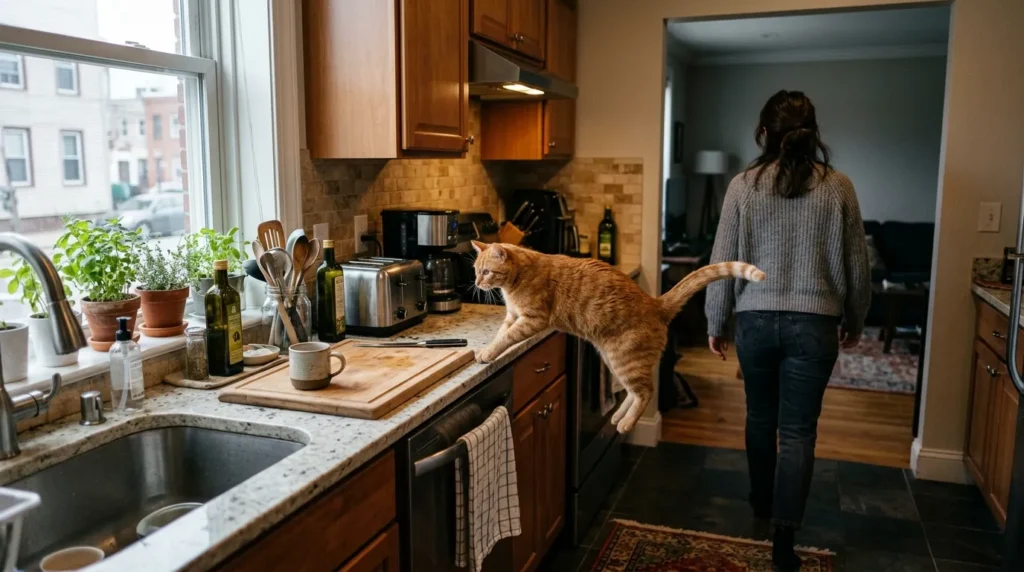
If your cat keeps jumping on counters despite an alternative perch at the right height, the issue is almost always one of three things: the perch is not close enough to where the cat actually wants to be, the food removal is incomplete, or the reward for using the alternative has been inconsistent.
Move the perch physically closer to the counter and to wherever you spend time in the kitchen. What looks close enough from a human’s perspective can still read as too far to a cat, because what they actually want is proximity to you, not just height in general. A perch three feet from the counter may need to sit twelve inches away for your particular cat.
Check whether your cat gets access to counter rewards when you are not watching. A cat that occasionally finds something edible on the counter while you are asleep or in another room is being intermittently rewarded, and intermittent rewards condition behavior more strongly than consistent ones. One accidental counter food discovery can undo a week of deliberate training. Clear the counter completely every night before bed.
If a cat that has never bothered with counters suddenly starts, especially an older cat, mention it to your vet before assuming it is a behavior issue. Increased food-seeking and restlessness can be early signs of hyperthyroidism or diabetes in senior cats, and ruling that out first saves you weeks of training a habit that was never a habit to begin with.
According to the American Association of Feline Practitioners, environmental changes that address a cat’s territorial and behavioral needs produce better long-term outcomes than aversion-based methods alone. For a broader look at structuring your apartment around your cat’s actual behavioral needs, indoor cat enrichment covers the full picture, including vertical space planning.
If you have tried all of this for six to eight weeks with no change, a certified cat behaviorist can watch your specific setup and catch something a written guide cannot, like a subtle territorial conflict with another pet in the home.
The Counter-Jumping Mistake That Makes It Worse
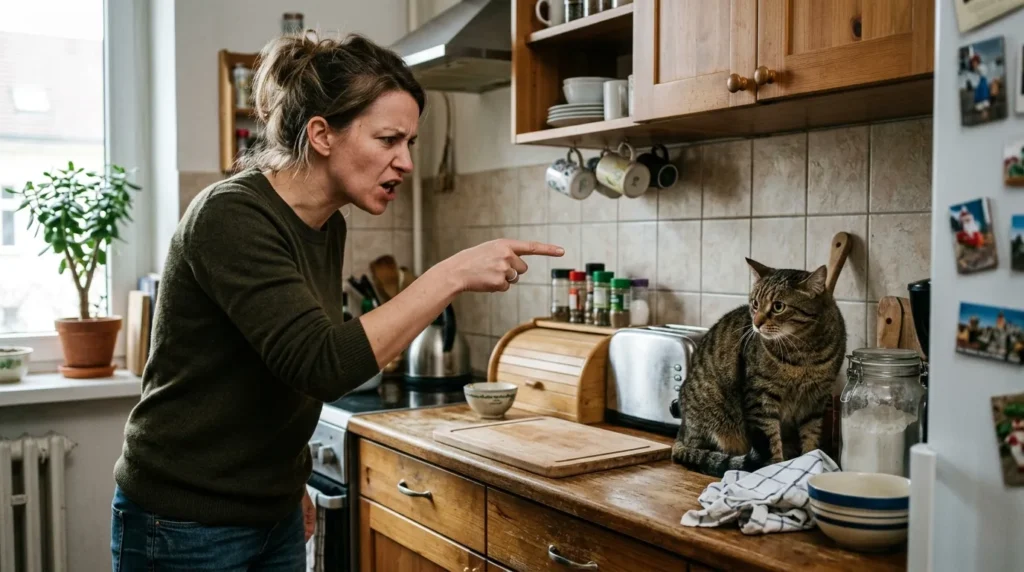
The most common mistake is using deterrents before providing an alternative. Blocking the counter with foil, tape or a motion-activated sprayer without giving the cat somewhere equally appealing to go just pushes the behavior onto a different surface, usually the dining table, the windowsill or whatever elevated spot is next in line.
The second mistake is inconsistency. A deterrent that shows up on the counter three days out of seven teaches the cat that the other four days are fine. A reward for using the alternative perch that only shows up sometimes teaches the cat that the perch only sometimes pays off. Both systems need daily consistency for at least two weeks before the change holds.
The third mistake is pulling deterrents too soon. Most cats need the deterrent in place for four to six weeks before the new perch habit is strong enough to stand on its own. Remove deterrents gradually, one section of counter at a time, rather than pulling everything off at once and expecting the new preference to hold immediately.
FAQ
Why does my cat keep jumping on the counter even after I say no?
Cats do not connect verbal corrections with counter access. The behavior continues because the underlying need for height or food smell is still there and has not been addressed.
Does aluminum foil actually work to keep cats off counters?
It works for some cats but not all. Cats that are not startled by texture or sound ignore it completely. Test it for three days, and if your cat walks across it without hesitation, switch to a stickier deterrent.
How long does it take to train a cat to stay off counters?
With a proper alternative perch and consistent positive reinforcement, most cats shift their preference within two to four weeks. Persistent cases can take six to eight weeks.
Is it okay to spray my cat with water to stop counter jumping?
No. Water spraying only teaches a cat to avoid the behavior while you are watching. It adds stress without addressing why the cat wants to be on the counter.
What height should an alternative perch be to replace a counter?
Match the counter height as closely as you can, typically around 36 inches from the floor, and keep it in the same visual zone where your cat wants to be.
Can I just block the counter permanently to stop the jumping?
Blocking without an alternative just moves the behavior elsewhere. The need for height does not disappear. It redirects to the next best surface in the room.
Is it unhygienic to let a cat sit on the kitchen counter?
It depends on what happens on that counter. A cool, clear surface is low risk. One where you prep raw meat or leave cleaning chemicals to dry is a real cross-contamination concern, since litter box bacteria can transfer from paws to any surface a cat walks on.
Will my cat eventually grow out of jumping on counters?
Rarely on its own. Some cats mellow with age, but most keep the habit unless an alternative and a consistent routine replace the reason they started in the first place.
Why does my cat jump on the counter at night specifically?
Cats are naturally more active at dawn and dusk, and an empty stomach overnight sends them looking for food. A small timed meal before bed and an evening play session usually cut this down.
The path to stopping counter jumping is not blocking access, it is making the alternative more appealing than the counter. Get the alternative perch at the right height, positioned close enough to where you actually stand in the kitchen. Remove food smells consistently, reward the new perch daily, and rule out a medical cause if the behavior appears suddenly in an older cat. Those changes together resolve counter jumping in most cats within a month. For a broader look at designing vertical space throughout your apartment so your cat always has a better option than your furniture, best cat furniture for indoor cats has options at every price point and apartment size.
To stop cat jumping on counters, provide an alternative perch at counter height positioned within the same visual zone where the cat wants to be near its owner. Surface deterrents including aluminum foil, sticky tape and cat-safe citrus sprays discourage counter access but must be paired with a rewarded alternative to produce lasting change. Real essential oils are not a safe substitute for cat-safe citrus sprays and can be toxic to cats. Food smell removal using diluted white vinegar after every cooking session reduces the scent lure, and a raw-meat or chemical-covered counter carries real hygiene risk that a bare counter does not. Consistent daily positive reinforcement on the alternative perch for two to six weeks builds a durable new preference. Sudden counter-jumping in an older cat is worth a vet check before assuming it is behavioral. Punishment-based corrections do not work and add stress without addressing the underlying territorial or height need.

Written by Mishu
A passionate cat lover and indoor living enthusiast, Mishu is the founder and voice behind Indoor Living Cat – a go-to resource for cat owners who want to create the happiest, healthiest life for their feline companions indoors.
View Full Profile