
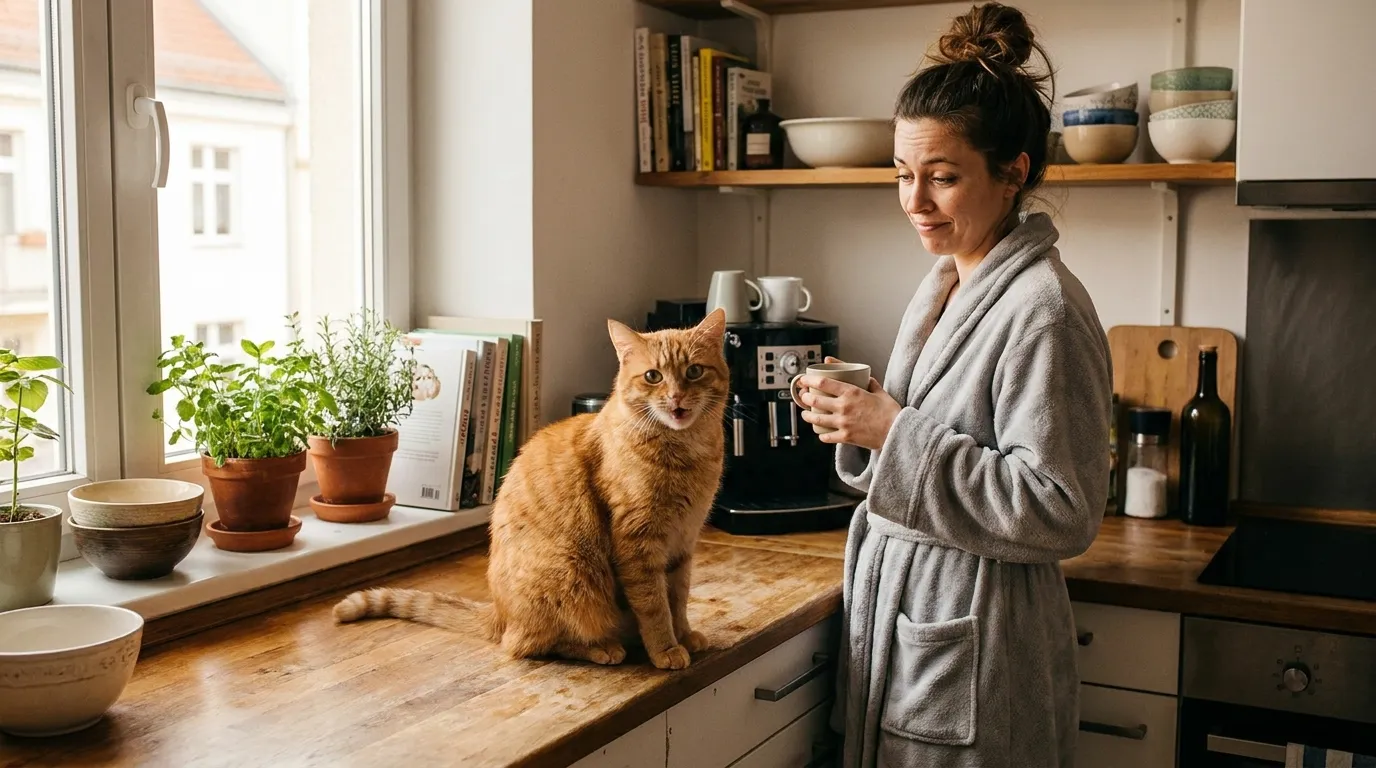
My cat saves his loudest performances for the exact second I sit down to relax. It took me months to notice the pattern: stillness on my end is a starting gun for him. He has opinions about the empty food bowl, the closed bathroom door, and apparently my choice of couch cushion, and he waits until I’m settled to deliver all of them at once.
Here’s the fact that changes how you read all of this: cats almost never meow at each other. Adult cats communicate with scent, posture, and the occasional hiss or chirp. Meowing is a sound cats developed specifically for humans, and indoor cats get more daily practice at it than any other cat, because we are the only audience they have. Every meow you hear has been shaped by what worked on you before.
This guide covers the seven real causes behind excessive meowing in indoor cats, two of which almost never show up in other articles, plus the exact changes that produce a quieter apartment within a week.
Quick Answer: The 7 Real Reasons Indoor Cats Meow So Much
- Crepuscular energy with no outlet – built-up dawn and dusk energy spills into the night
- Barrier frustration – closed doors block territorial patrol
- Learned attention-getting behavior – your past responses trained the volume and timing
- Hunger timing mismatches – meal schedule does not match her internal clock
- Acoustic feedback – hard floors and bare walls amplify and reward the sound
- Medical causes in senior cats – thyroid, kidney, blood pressure, hearing, and cognitive changes
- Under-stimulation – an indoor environment with too little to hunt, climb, or investigate
Each one has a different fix, and treating all meowing as the same problem is why most advice does not work. Below is the fast-reference table, then the full breakdown of each cause.
Cats Evolved to Meow at Humans, Not at Each Other
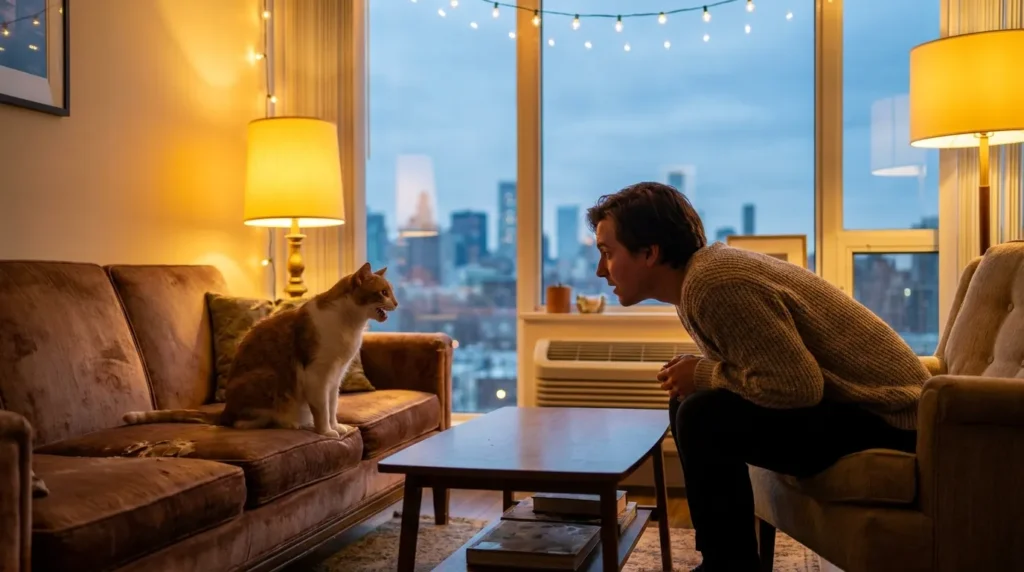
Wild and feral adult cats rarely meow at one another. They rely on scent marking, tail position, ear angle, and facial expression, saving vocal sounds like chirps and hisses for specific, narrow situations. The long, varied meowing your indoor cat aims at you is different. It is a behavior that developed over thousands of years of living alongside humans who kept responding to it, generation after generation, until it became the primary channel cats use with us specifically.
That history matters here because it means every meow carries a purpose based on what has worked before. Your cat has been running behavioral experiments since she was a kitten, and she has learned which pitch, length, and repetition gets which result from you. A short, sharp meow gets you out of bed. A soft chirp gets you to glance up from your phone. A drawn-out yowl gets immediate action, so she uses it when she wants immediate action.
Our full guide to indoor cat behavior is the pillar resource this article sits under, and it breaks down the full range of vocal, postural, and territorial signals your cat sends. Once you can read the pattern behind a specific meow instead of hearing undifferentiated noise, the fixes below get a lot easier to apply. Pairing that with a full daily care routine built around her predictable needs cuts demand meowing significantly on its own, before you change anything else.
The 7 Causes at a Glance
| Cause | What It Looks Like | Fastest Fix |
|---|---|---|
| Crepuscular energy | Loud meowing between 1am and 4am | 15-minute play session, then dinner, 60 minutes before bed |
| Barrier frustration | Scratching and meowing at a specific closed door | Leave interior doors open when you can |
| Learned meowing | Meows that escalate the longer you wait to respond | Zero response to demand meowing, every single time |
| Hunger timing | Meowing that starts at the same clock time daily | Fixed feeding schedule, ideally with an automatic feeder |
| Acoustic feedback | Meowing spikes in the bathroom or hallway specifically | Rugs, a bath mat, and soft furnishings in hard-floored rooms |
| Medical causes | New meowing pattern in a cat over age 8 | Vet visit and bloodwork within two weeks |
| Under-stimulation | General, all-day meowing with no clear trigger | Window perches, puzzle feeders, daily scheduled play |
The Crepuscular Instinct: Why Meowing Peaks Around 3am
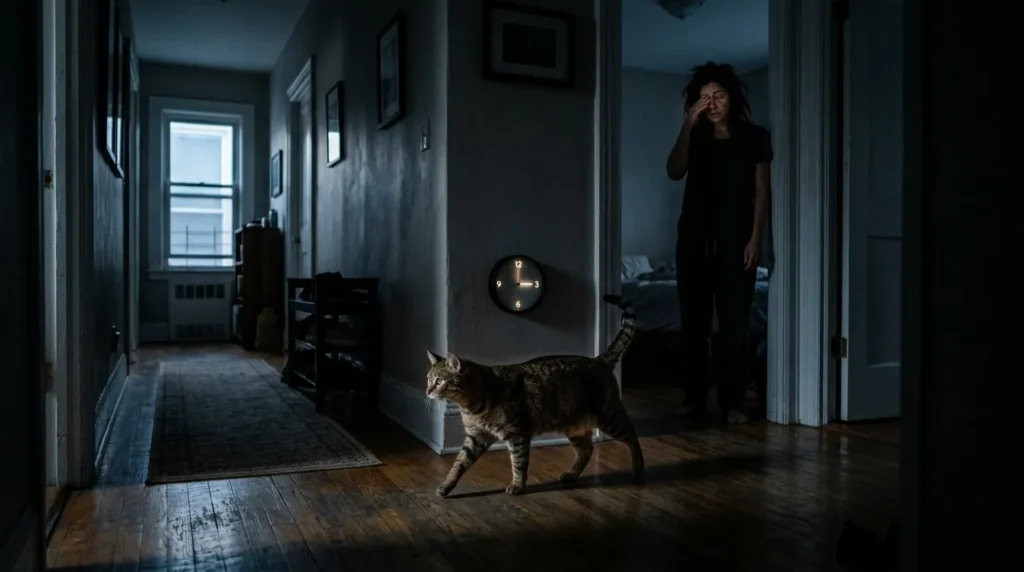
Cats are crepuscular, meaning their natural energy peaks fall at dawn and dusk, not in the middle of the night. An indoor cat who sleeps through most of the day hits her evening peak right when you’re winding down, then still has fuel left over at midnight, exactly when your sleep is deepest. The 3am concert is the tail end of an evening energy cycle that never found an outlet.
Blue light from phones and TVs makes this worse. Research on artificial light exposure shows it disrupts melatonin cycles in ways that extend the window an animal perceives as active time. An apartment lit and busy at 11pm confuses a crepuscular instinct that expects darkness to mean rest, and a confused instinct is more likely to show up as a 1am meow than a quiet one.
The fix is specific, not general. Run a 15-minute wand toy session, then serve the last meal of the night about 60 minutes before your target bedtime. That order matters: it completes the hunt-catch-eat sequence her body expects, and the drowsiness that follows a real meal after a real hunt is not something you can fake with either step alone. Also worth checking: has your work schedule, a new roommate, or a shifted bedtime changed in the last few weeks? Cats track routine closely, and a schedule disruption on your end often shows up as a vocal disruption on theirs a few days later. Owners who run the play-then-feed sequence consistently report a real drop in nighttime meowing within five to seven days.
Barrier Frustration: Why Cats Meow at Closed Doors
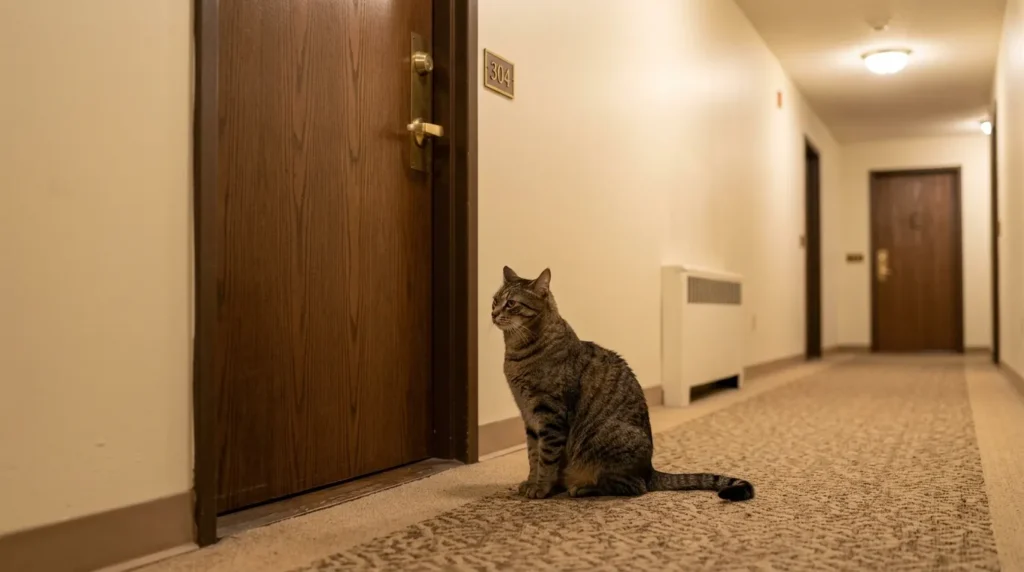
A closed bedroom or bathroom door does not necessarily mean your cat wants inside. It means she cannot verify, patrol, or clear that space as secure, and her instinct treats an unverified room as a gap in her territory. The door is not the destination. It is the obstacle blocking a check she feels she needs to run.
This hits indoor cats harder than cats with outdoor access, because an apartment is already a small, fixed territory. Losing even one room to a closed door is a proportionally bigger loss than it would be in a house with a yard attached. The meowing at that door is a patrol that cannot finish.
Leaving interior doors open whenever you can eliminates most of this category outright. When a door has to stay shut, the right response is complete non-engagement. Any attention, even a scolding, confirms that meowing at doors gets a reaction. Vertical territory from cat trees and shelving also helps here, since it gives her more space she can already claim and check without needing the closed room at all.
Apartment Acoustics: When Your Cat Enjoys Her Own Echo
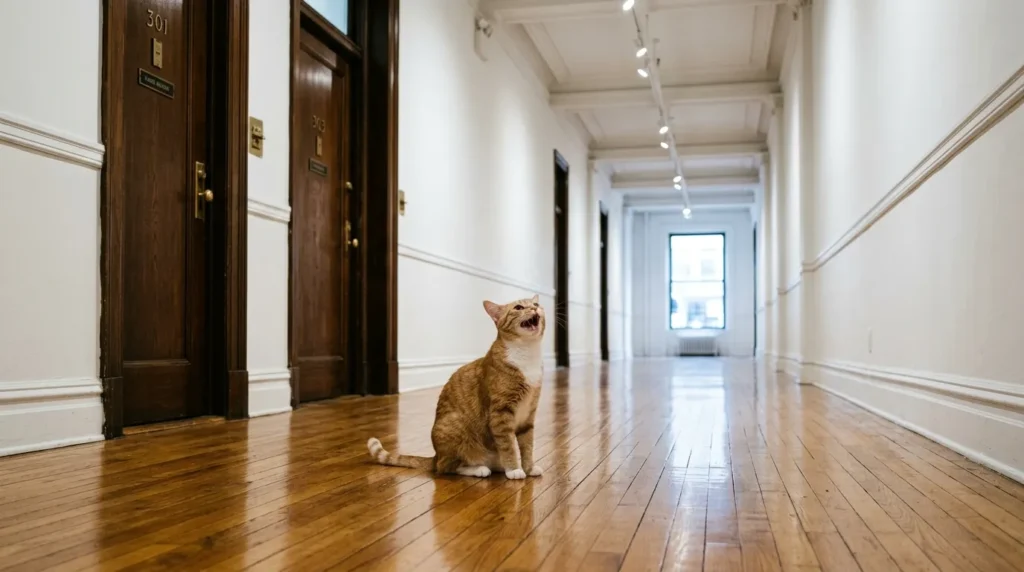
Hardwood floors, high ceilings, and bare walls turn a meow into something closer to a small performance. Sound bounces further in a hard-surfaced room than a carpeted one, and some cats genuinely like the amplified version of their own voice enough to seek out the room that produces it. If your cat is loudest in the hallway or bathroom and quiet everywhere else, this is very likely why.
Real talk: if she goes silent the second you close the bathroom door, she’s not missing you. She’s responding to the tile losing its echo. Bathrooms tend to have the best acoustics in an apartment, and cats find that out on their own. A bath mat and a soft rug often cut this specific behavior down within days.
Rugs, upholstered furniture, and a wall hanging or two absorb sound and remove the acoustic payoff from hard-floored rooms. It sounds like interior design advice because it is, and it also fixes a category of meowing that most owners never trace back to its actual cause. Living with a cat in an apartment means managing sound the same way you’d manage litter box placement or window access.
The Learned Meow: How Your Own Reactions Trained the Volume
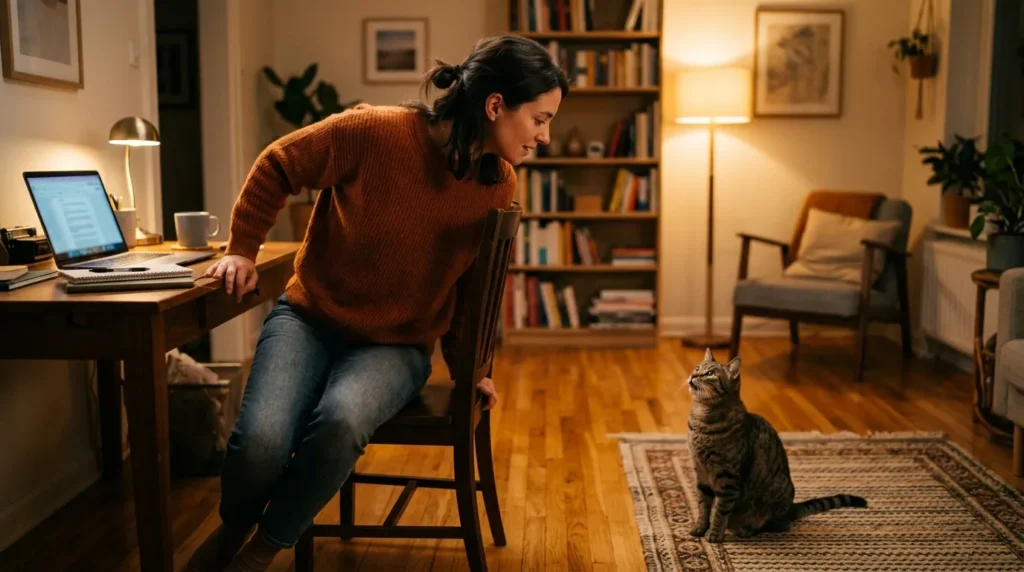
Here’s the uncomfortable part. A good share of excessive meowing exists because you responded to it. Every time meowing produced food, attention, or an open door, it confirmed to your cat that the right pitch and persistence gets the outcome she wants. Cats track cause and effect with real precision, and they do not forget a pattern that worked.

The fix is consistent non-engagement with demand meowing, paired with attention you give on your schedule instead of hers. Reward quiet, settled behavior with interaction. Do not look at, speak to, or move toward a cat who is meowing to make a non-urgent demand. Expect two to four weeks of full consistency before the behavior actually fades.
Daily enrichment on a consistent routine gives your cat a predictable outlet, so the demand pressure has somewhere legitimate to go. A fixed feeding schedule, or an automatic feeder if your mornings are unpredictable, removes hunger as a trigger entirely. Regular health monitoring catches the cases where increased meowing is pain rather than habit. Keeping the litter box clean and accessible removes a legitimate distress cause you should never ignore. Regular grooming sessions add structured contact that satisfies attention-seeking before it turns into meowing.
The Mistake That Makes Meowing Worse Every Week
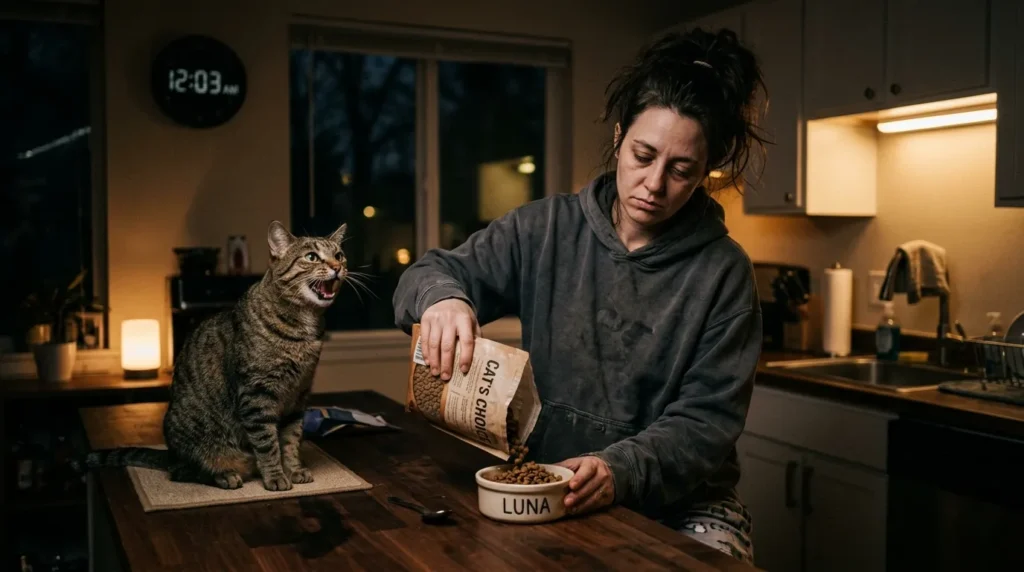
Ignoring a cat for 20 minutes and then giving in does not calm anything down. It teaches her that 20 minutes of meowing is the new price of admission. The response you eventually give does not end the behavior. It resets the baseline for how long she has to keep going next time, usually upward.
Real extinction of demand meowing needs zero responses to that specific sound, held with total consistency until it stops. One slip after 30 minutes restarts the clock from scratch. This is genuinely hard to hold for most households, which is why fixing the root causes through enrichment and schedule changes tends to work better in practice than pure extinction on its own.
Other Triggers Most Owners Never Rule Out
Beyond the seven core causes, a few situational triggers get missed constantly because they don’t show up in general meowing advice.
- Unspayed or unneutered cats yowl during heat cycles or when they sense a mate nearby, even indoors. This is loud, distinctive, and typically resolves after spay or neuter surgery.
- Hearing loss in senior cats makes a cat vocalize louder and more often, simply because she can no longer judge her own volume. This is sensory, not behavioral, and a vet visit is the only way to confirm it.
- A new pet, guest, or major furniture change can spike meowing for one to two weeks while your cat reassesses her territory. This usually settles on its own once the new normal sets in.
- Any change to your schedule, a new job, a new roommate, travel, throws off the routine a cat’s vocal patterns are built around. Meowing often spikes three to five days after the disruption, not immediately.
Not All Meows Mean the Same Thing
Treating every vocal sound as “meowing” hides useful information. Cats use distinct sounds for distinct purposes, and learning to tell them apart makes the causes above much easier to diagnose.
| Sound | What It Usually Means | When You’ll Hear It |
|---|---|---|
| Short, single meow | A greeting or simple request | When you walk in the door |
| Chirp or trill | Friendly excitement, often invitational | Following you room to room |
| Long, drawn-out yowl | Urgent demand, distress, or a mating call | Middle of the night, or an unaltered cat sensing a mate |
| Repetitive, insistent meow | Learned demand behavior | Right before mealtime or by a closed door |
| Low, guttural yowl with disorientation | Possible cognitive dysfunction in senior cats | Late at night, often paired with pacing |
| Sharp, sudden cry | Pain response | While using the litter box, eating, or being touched somewhere specific |
[Image placeholder: a simple graphic showing waveform or icon comparisons of a short meow, a trill, and a yowl, for visual learners.]
Does Breed or Age Change How Much a Cat Meows?
Yes, and the difference is significant enough to change what “excessive” even means for your specific cat.
| Cat Type | Vocal Tendency | Why |
|---|---|---|
| Siamese, Oriental breeds | High | Bred and selected for vocal communication over generations |
| Bottle-fed or early-weaned kittens | High | Missed the developmental stage where feline-to-feline signals normally replace human-directed meowing |
| Senior cats (8+) | Variable, often rising | Thyroid, kidney, hearing, and cognitive changes all increase vocalization |
| Persian, British Shorthair, Russian Blue | Low | Bred with calmer, quieter temperaments as a general trait |
| Average domestic shorthair | Moderate | Vocal level depends mostly on individual personality and training history |
None of this means a naturally quiet breed can’t develop excessive meowing, or that a Siamese is stuck being loud forever. It just means your baseline expectation should account for what your cat’s breed and history bring to the table before you assume something is wrong.
When Indoor Cat Meowing Needs a Vet, Not a Behavior Fix?
A sudden jump in meowing in a cat over age eight needs bloodwork within two weeks, not a wait-and-see approach. Hyperthyroidism, high blood pressure, and early kidney disease all produce increased vocalization as an early symptom, and all three are manageable when caught in time. This kind of meowing sounds more urgent than behavioral meowing and keeps going even when the cat has food, water, and attention already.
Watch for these signs that point toward a medical cause rather than a habit:
- Meowing while using the litter box, eating, or being touched in one specific spot
- A new vocal pattern appearing suddenly, rather than building gradually
- Disoriented, repetitive yowling that worsens specifically at night
- Meowing that continues even right after a full meal, play session, and clean litter box
- Any sign of hearing loss, such as not waking to loud sounds she used to react to
This article is for informational purposes only. Always consult your vet if you have concerns about your cat’s health.
A 7-Day Plan to Reduce Excessive Meowing
- Day 1: Rule out pain or illness. If your cat is over 8, or the meowing started suddenly, book a vet visit before changing anything else.
- Day 1-2: Fix the schedule. Set feeding times and stick to them, even on weekends.
- Day 2-3: Open interior doors wherever it’s safe to do so, and stop closing off rooms unnecessarily.
- Day 3-7: Run a 15-minute wand toy session each evening, followed by the last meal about 60 minutes before your bedtime.
- Every day from now on: Give zero response to demand meowing. No eye contact, no talking, no moving toward her.
- Every day from now on: Reward quiet, settled behavior with attention on your terms, not hers.
- Ongoing: Add a rug or soft furnishing to any hard-floored room where meowing spikes.
Most owners see a real, noticeable drop by day seven if the cause is behavioral. If nothing changes after two full weeks of consistency, that’s a stronger signal to loop the vet back in.
Frequently Asked Questions About Why Indoor Cats Meow So Much
Why does my cat meow so much at night specifically?
Unspent crepuscular energy from the evening combines with a quiet apartment that makes every sound carry further. A 15-minute play session followed immediately by the last meal of the night cuts nighttime meowing within five to seven days for most cats.
Is excessive meowing a sign my cat is in pain?
Sometimes. Meowing during litter box use, while eating, or when touched in a specific spot points to pain rather than attention-seeking. A sudden increase in an older cat warrants a vet check for thyroid, blood pressure, and kidney issues.
Why does my cat meow more in the bathroom or hallway?
Acoustic feedback. Hard surfaces and high ceilings amplify the sound, and some cats genuinely enjoy the reverb. Soft rugs and a bath mat in those rooms reduce the payoff within a few days.
How do I train my cat to meow less?
Stop responding to demand meowing entirely, and reward silence with attention you initiate. Inconsistent responses make things worse, since they teach her a higher threshold of meowing is what actually works.
Do certain cats meow more than others?
Yes. Siamese and other Oriental breeds are more vocal by nature. Senior cats meow more as health and cognitive changes set in. Cats who were bottle-fed or weaned early often meow more because they skipped the stage where feline signals would have replaced human-directed meowing.
Why does my indoor cat meow right after I feed her?
She’s finished the eat phase of the hunt-catch-eat sequence and is asking for the social phase that follows it in the wild, when cats rest and groom together. She’s inviting you into that part.
Is it bad to ignore my cat when she’s meowing?
Ignoring demand meowing is the correct response, as long as you’ve already ruled out pain, hunger, or a dirty litter box first. Ignoring a genuine medical or urgent need is the actual risk, which is why the vet check comes before the behavior plan, not after.
Will getting a second cat stop the meowing?
Sometimes, if boredom or loneliness is the main driver, but it’s not a guaranteed fix and can backfire if the meowing is territorial or attention-based, since now there are two cats competing for the same attention. Address the root cause first before adding a second cat as a solution.
Does spaying or neutering reduce meowing?
Yes, specifically for heat-cycle and mating-related yowling in unaltered cats. It won’t touch demand meowing, barrier frustration, or acoustic-driven meowing, since those have nothing to do with reproductive hormones.
This guide is part of our Indoor Cat Behavior pillar, alongside our cluster guides on daily indoor cat care, enrichment, and indoor cat health. Together they cover the full range of what shapes an indoor cat’s behavior day to day.

Written by Mishu
A passionate cat lover and indoor living enthusiast, Mishu is the founder and voice behind Indoor Living Cat – a go-to resource for cat owners who want to create the happiest, healthiest life for their feline companions indoors.
View Full Profile