
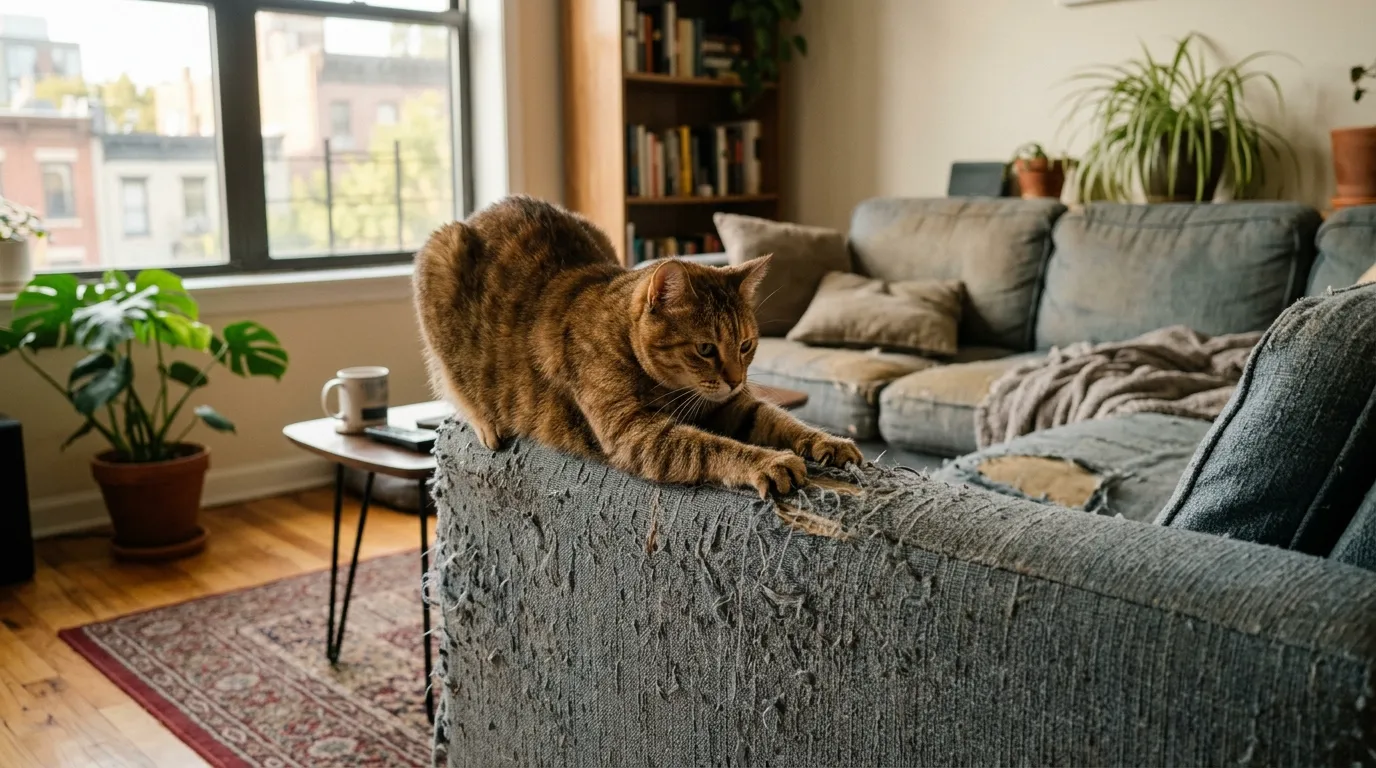
I spent months watching my cat walk directly past a perfectly good sisal post to shred the corner of my sofa. For a while I took it personally. I was wrong. Understanding why does indoor cat scratch furniture changes how you see the whole problem, because the behavior isn’t a complaint about you or your taste in couches. It’s a biological need getting met wherever the cat’s instincts say is the best spot for it. Indoor cats scratch furniture more than outdoor cats do, and the reasons are specific and fixable. Below you’ll find the scratcher comparison table from the research section, a redirection method that actually works when the post keeps getting ignored, and a full breakdown of what to do while you’re retraining the habit.
Why does indoor cat scratch furniture? Cats scratch to leave scent marks, shed dead nail sheaths, stretch their back and shoulder muscles, and relieve stress. Indoor cats target furniture specifically because it’s stable, tall, holds human scent, and sits in the high-traffic areas where scent marking matters most.
The 5 Reasons Why Indoor Cats Scratch Furniture
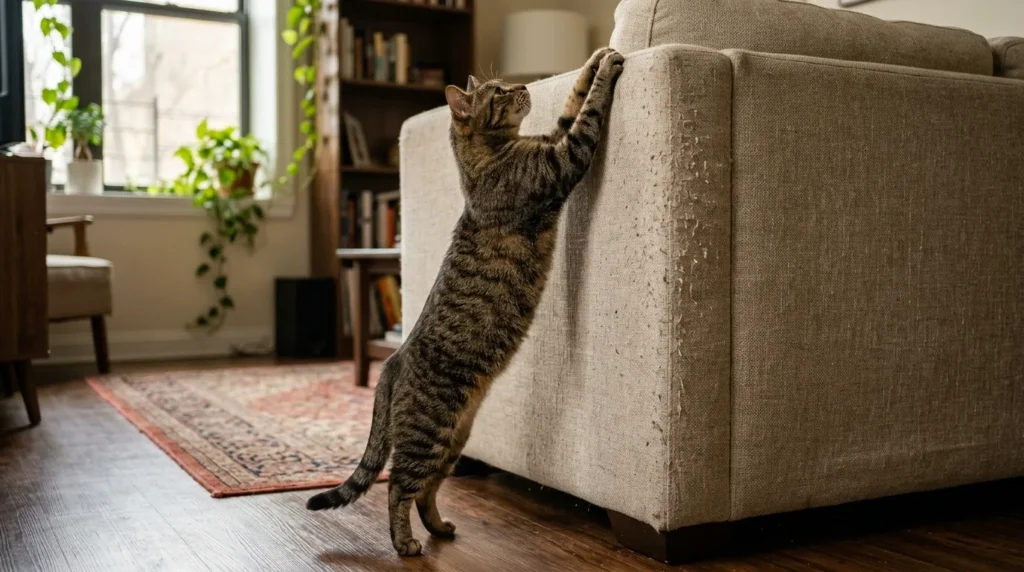
Scent marking is the primary driver. Cats have scent glands between the toe pads that release pheromones onto whatever surface they scratch. When your cat rakes the sofa arm, she isn’t destroying your furniture. She’s signing it. That signature tells her, and any other animal in the space, that this territory is hers, and she’ll come back to refresh the mark on a regular basis.
Shedding outer nail sheaths is the second reason. A cat’s claws grow in layers, and the outermost layer has to be stripped away regularly to expose the sharper layer underneath. Scratching against a resistant surface tears that dead husk off cleanly. Without an appropriate surface to do this on, the furniture provides whatever resistance she needs.
Stretching the muscles along the back and shoulders is the third reason, and it’s genuinely physical rather than behavioral. A cat who hooks her claws into a stable surface and pulls backward gets a deep stretch that engages her whole upper body. The couch delivers that stability every time. A lot of scratching posts fail this test completely because they wobble or tip the second the cat leans her full weight into them.
Stress relief and self-soothing round out the fourth reason. Scratching releases endorphins. A cat who’s anxious, bored, or overstimulated will scratch more to regulate her own emotional state. Indoor cats in apartments without much enrichment tend to scratch more overall, simply because the need is higher and the outlets are fewer.
The fifth reason is aimed at you. Cats scratch more when you’re present, or right after you’ve walked in the door. It’s partly social. They’re inviting you to notice the scent marking and pulling you into their territorial ritual, whether you asked for the invitation or not. Understanding the full range of your indoor cat’s behavior patterns helps you figure out which of these five reasons is driving your specific cat’s furniture scratching.
Why Indoor Cats Target the Couch Instead of the Scratching Post
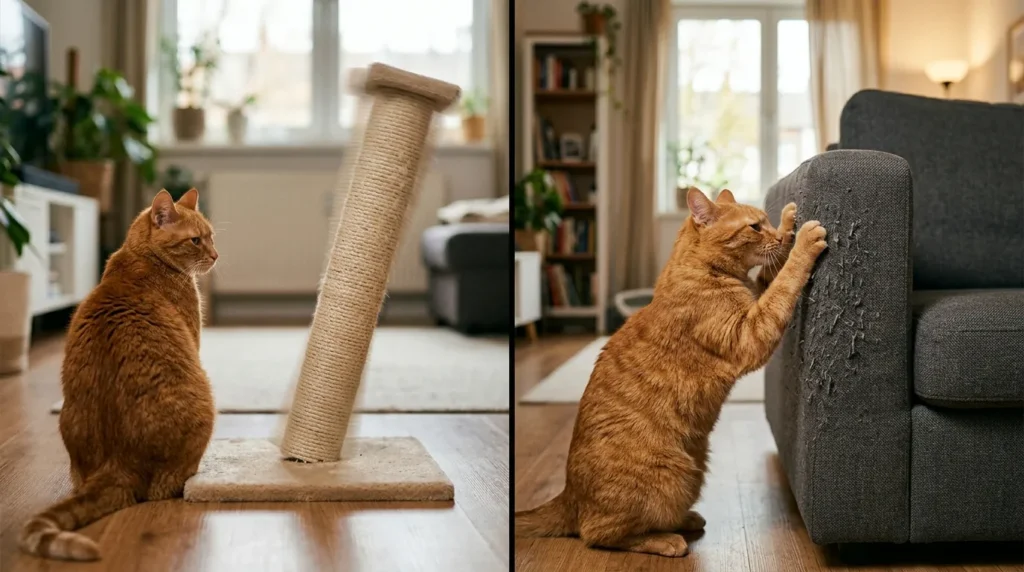
The couch beats most scratching posts for three concrete reasons. It’s stable enough to take a cat’s full pulling weight without shifting. It sits in a high-traffic, high-visibility part of the home, where scent marks actually get noticed. And it carries human scent from daily use, which makes it the single most socially meaningful surface in the apartment.
Most commercial posts fail on at least one of those three factors. A post that tips under pressure tells the cat, immediately, that it can’t be used for a real scratch. A post wrapped in carpet teaches the cat that carpet-textured surfaces are fair game, which just creates a new problem with your rugs. A post shoved in the corner of a back room has none of the territorial visibility that makes the sofa arm worth marking in the first place.
Height gets missed constantly, too. A post that doesn’t let a cat fully extend on her back legs offers no real stretching benefit, and cats will ignore it in favor of a surface that does. Thirty to thirty-six inches suits most adult cats; larger breeds like Maine Coons do better closer to 36 to 40 inches. Finding the right cat furniture for your indoor cat covers this with specific picks for apartments where floor space is tight.
According to ASPCA guidance on destructive scratching in cats, the most effective fix is putting appropriate alternatives in the exact spots where the cat already scratches, not tucking posts into low-traffic corners and hoping she relocates the habit on her own.
Vertical or Horizontal? How to Tell What Your Cat Actually Prefers
Not every cat wants to stretch upward. Some prefer to dig in low and pull sideways across a flat surface, and buying the wrong orientation is one of the quieter reasons a “good” post still gets ignored. You can figure out which type your cat wants without guessing:
- Watch where she already scratches. Sofa arms and door frames point to a vertical preference. Rugs, carpet edges, and cardboard boxes lying flat point to horizontal.
- Watch her body position after a nap. A cat who stands and reaches up when she wakes usually wants a vertical post. A cat who stays low and stretches forward usually wants a horizontal pad.
- Run a two-week test. Put both a vertical sisal post and a horizontal cardboard scratcher near her favorite scratching spot at the same time. Whichever one shows visible wear first is your answer.
- Offer both if she’s split. Plenty of cats use one style for stretching and the other for a quick claw refresh. That’s not indecision, it’s two different needs.
If you already know your cat’s real preference, the comparison table below tells you exactly what to buy.
The Scratcher Type Comparison: Why Your Choice of Post Matters
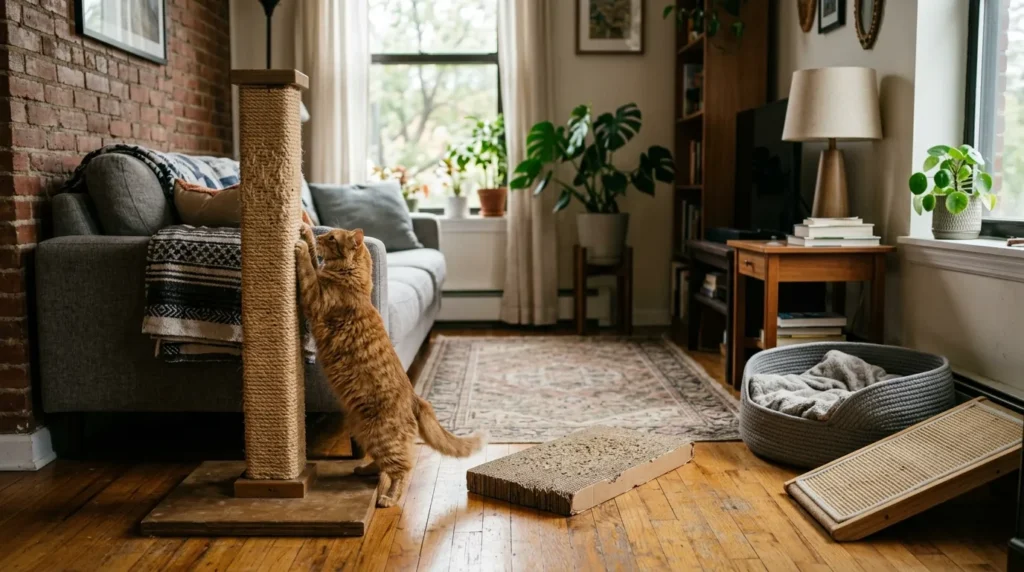
Material and orientation decide whether your cat will actually use a scratcher. Most cats prefer sisal over carpet or cardboard for vertical scratching because it offers better resistance and doesn’t train them to like household fabric textures. Carpet-covered posts are the most commonly bought option and the least effective one, because they teach the cat that pulling on carpet is fine.
| Scratcher Type | Material | Best For Cats Who… | Durability | Limitation |
| Tall vertical sisal post | Sisal rope or woven sisal | Scratch sofa arms and walls | Very high | Takes more floor space |
| Horizontal cardboard scratcher | Corrugated cardboard | Scratch rugs and floor surfaces | Low | Creates messy debris |
| Sisal mat (horizontal) | Woven sisal fabric | Prefer flat surface scratching | High | Less satisfying for stretchers |
| Carpet-covered post | Loop or cut carpet pile | Currently scratching carpet | Medium | Reinforces carpet scratching habit |
| Angled scratcher | Sisal or cardboard | Cats with varied posture preferences | Medium-high | Takes experimentation to find right angle |
The Direct Truth: If your cat is scratching your sofa arm, you need a vertical sisal post placed directly in front of that sofa arm, not a carpeted post stuck in the hallway. Cats will not go looking for a scratcher. You have to make the correct option the most convenient one.
How to Actually Redirect Your Indoor Cat’s Scratching Behavior
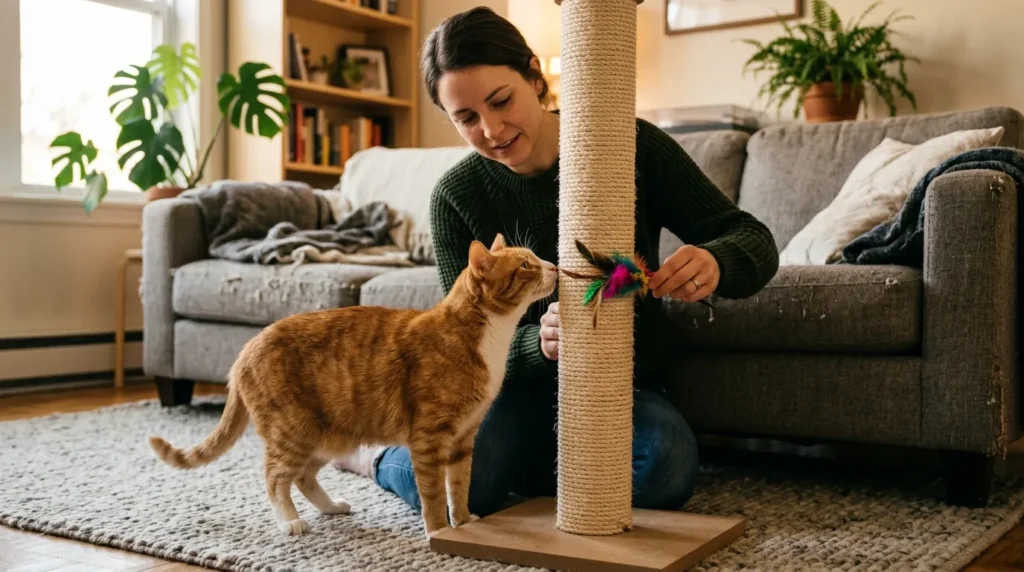
Effective redirection needs three things happening at once: a better scratcher in the right location, the furniture made temporarily less appealing, and the new scratcher made more appealing than the old surface. Skip any one of these and most redirection attempts fail within the first week.
- Place the scratcher immediately beside the damaged furniture. Not nearby. Not across the room. Directly in front of the spot she currently scratches. This is the single rule that matters most, and the one owners skip most often.
- Add a scent incentive. Rub fresh or dried catnip into the sisal, or use a silvervine stick for cats who don’t respond to catnip. About 70 percent of cats respond strongly enough to catnip to investigate a new post within minutes; silvervine works on some of the cats that catnip doesn’t.
- Make the old surface less appealing at the same time. Double-sided tape, aluminum foil, or a citrus-scented spray on the targeted spot (more on each option below) buys the post time to build a positive association.
- Reward every use. A treat or a few seconds of play the moment she scratches the post reinforces the new habit fast.
- Give it two to four weeks. That’s the realistic window for the new habit to stick with consistent daily reinforcement.
- Relocate gradually, if you need to. Once the post is in consistent use, move it two to three inches a day toward wherever you actually want it to live long-term.
Your indoor cat’s overall care routine built around consistent daily play also lowers the baseline urge to scratch by giving her an appropriate outlet for pent-up energy. Daily enrichment and play cuts destructive scratching frequency because it deals with the boredom piece directly. A cat who gets fifteen minutes of active feather-wand play before bed scratches less destructively than one with no physical outlet during the day. Living in an apartment with a cat takes more deliberate enrichment planning, because the environmental stimulation outdoor cats get for free just doesn’t exist indoors without it.
Furniture Protection Methods: What to Use While You Retrain
Redirection takes a couple of weeks to stick, and your couch needs to survive the interim. These methods buy you time without hurting the cat. None of them replace giving her a better scratcher; they just make the old spot less attractive while the new one builds a track record.
| Method | How It Works | Typical Cat Reaction | Watch Out For |
| Double-sided tape | Sticky texture cats dislike underfoot | Avoids the spot almost immediately | Can pull fibers off delicate fabric; leave on 4-6 weeks max |
| Aluminum foil | Unstable feel and noise under the paws | Most cats avoid it, a few adapt within days | Looks bad in a lived-in room; won’t survive vacuuming near it |
| Citrus or diluted vinegar spray | Scent cats find unpleasant | Effective for many, ignored by some | Test on a hidden patch first; can discolor light fabric |
| Furniture covers or throws | Physical barrier, removes the target entirely | Reliable while in place | Cat may just scratch an uncovered edge instead |
| Motion-activated deterrent spray | Startles the cat with a short air burst | Fast learning curve for most cats | More expensive; needs battery upkeep |
Skip essential oil sprays entirely. Oils like eucalyptus, tea tree, and peppermint are toxic to cats even in small amounts, and a DIY deterrent recipe that calls for them isn’t worth the risk. Stick to plain diluted citrus juice, diluted white vinegar, or a commercial spray labeled safe for cats.
Nail Caps and Trimming: Where They Fit In
Nail caps (sold under names like Soft Paws or Soft Claws) are small vinyl sheaths glued over trimmed claws. They blunt the tip so scratching doesn’t shred fabric, but the cat still gets the full motion, the stretch, and the scent marking. Each application lasts four to six weeks, roughly matching the natural shedding cycle of the claw sheath.
A few things worth knowing before you try them:
- They’re not a fix for the underlying need. A cat still scratches for scent marking, stretching, and stress relief with caps on. They protect the furniture; they don’t replace a good post.
- Nails must be trimmed first. Gluing a cap over a long claw lets the nail keep growing inside the cap, which can curl back into the paw pad. Trim, then apply.
- Expect an adjustment day. Most cats shake their paws and act oddly for the first 24 hours, then ignore the caps completely.
- Regular nail trims alone help too. Trimming every one to two weeks reduces the damage from each scratch even if you never touch nail caps at all.
Nail caps and trimming both sit firmly in the “manage the damage” category rather than the “meet the need” category, which is the real reason declawing keeps getting suggested as a shortcut. It isn’t one. Declawing removes the last bone of each toe and causes chronic pain and long-term balance problems. Nail caps, regular trims, and a properly placed post cover the same ground without the surgery.
The Mistake That Keeps Furniture Scratching Going Indefinitely
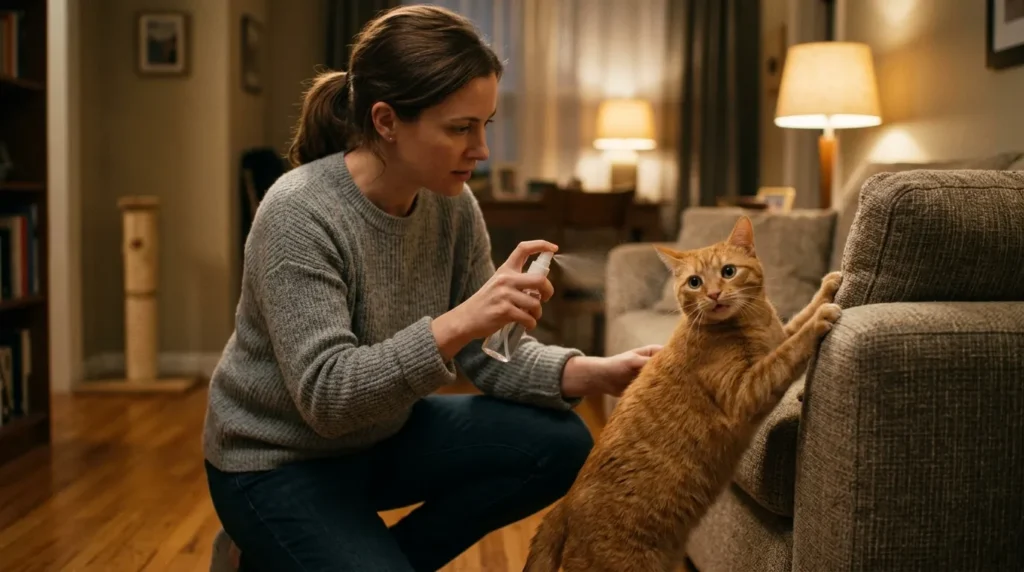
The mistake that keeps furniture scratching going indefinitely is trying to stop the scratching without giving the cat a better option in the right place. Punishment with spray bottles, loud noises, or physical correction doesn’t remove the underlying need. It teaches the cat to scratch when you’re not watching. The need stays exactly the same. The behavior just moves to whenever she feels safe from interruption.
The second, connected mistake is putting the scratching post somewhere that suits the owner rather than the cat. A post in the spare bedroom, nowhere near the sofa, gives her no reason to switch. She scratches where the scent marking actually matters to her. Your living room couch arm isn’t a random pick on her part. It’s a deliberate social statement, and it needs a better option sitting right next to it.
Monitoring your indoor cat’s health supports this indirectly, because cats dealing with skin irritation, anxiety, or physical discomfort scratch more intensely than cats who feel good. Keeping the litter box area clean and low-stress reduces the overall household tension that can amplify scratching. A well-balanced feeding approach supports nail health and physical comfort generally. A regular home grooming routine that includes nail trims cuts down how much damage each scratching session causes while you build better habits underneath it.
When Does Scratching Behavior Signal Something That Needs Attention?
A sudden, dramatic jump in furniture scratching that isn’t explained by a new pet, a new person in the home, or a routine change can point to anxiety that’s gone past the normal range. Cats under chronic stress scratch more often and more intensely than cats who feel secure. If scratching has increased significantly and doesn’t come down with better enrichment and redirection after four to six weeks, it’s worth a vet conversation.
Scratching paired with visible skin irritation, hair loss around the paws, or frequent paw licking right before scratching points to a physical cause rather than a behavioral one. Fungal infections, contact allergies, and dry skin conditions all create discomfort that cats try to relieve by scratching surfaces. Those need treatment, not redirection.
Why is my cat scratching furniture at night?
Cats are naturally more active at dawn and dusk, and a bored cat left alone overnight often scratches simply because there’s nothing else going on. A short, active play session right before bed and a scratcher positioned near where she sleeps usually cuts this down within a week or two. If the nighttime scratching is loud, frantic, or paired with crying, run it past your vet; it can sometimes point to discomfort rather than boredom.
Why does my new cat or kitten scratch everything?
A newly adopted cat or a kitten hasn’t learned the household’s acceptable surfaces yet, and kittens in particular are still building the muscle coordination and confidence that scratching helps develop. Expect more scratching in the first few weeks in a new home. Set up posts in every room she spends time in right away, rather than waiting to see where problems show up first.
This article is for informational purposes only. Always consult your vet if you have concerns about your cat’s health.
Frequently Asked Questions About Indoor Cats Scratching Furniture
Should I declaw my cat to save my furniture?
No. Declawing removes the last bone of each toe and causes chronic pain and balance problems. Redirection with a proper post, nail trims, and nail caps are effective, humane alternatives.
Why does my cat scratch right after I come home?
This is a greeting behavior. Your arrival is exciting, and scratching burns off that energy while marking territory you share. A post near the front door intercepts this almost immediately.
Why does my cat ignore the scratching post?
Almost always because the post is too small, too unstable, or in the wrong location. Move it directly beside the scratched furniture and add catnip. Most cats convert within days.
Is cardboard or sisal better for indoor cats?
Sisal lasts longer and gives better resistance for claw maintenance. Cardboard works well as a supplement for cats who like horizontal shredding, but it creates more debris and wears out fast.
Does catnip on the post actually work?
Yes, for most cats. Rub fresh or dried catnip into the sisal fibers and let it sit. About 70 percent of cats respond strongly enough to investigate and scratch the post within minutes. For the rest, try silvervine instead.
Why does my cat scratch the carpet but not the post?
The post is probably carpeted, which reinforces carpet scratching instead of redirecting it. Switch to sisal and orient the post vertically beside the carpet area she prefers.
Do cat scratching deterrent sprays actually work?
Citrus and diluted vinegar sprays work on many cats but not all, and results vary by individual. They work best combined with a properly placed post, not on their own. Skip anything containing essential oils; several common ones are toxic to cats.
Are nail caps a good alternative to declawing?
Yes. Nail caps blunt the claw tip without altering bone or nerve structure, and they let the cat scratch normally underneath the cap. They need to be reapplied every four to six weeks and paired with a scratching post for the best results.
How long does it take to retrain a cat off the furniture?
Most cats shift their habit within two to four weeks of consistent daily reinforcement: correct post placement, a deterrent on the old spot, and a reward for every use of the new scratcher. Cats with a long-established habit on one piece of furniture can take longer.
This article is for informational purposes only. Always consult your vet if you have concerns about your cat’s health.
Indoor cats scratch furniture to leave scent marks from the pheromone glands in their paws, shed outer nail sheaths, stretch their back and shoulder muscles, and relieve stress. Furniture wins out over posts because it’s stable, sits in high-traffic areas, and holds human scent. The most effective redirection puts a tall sisal post directly beside the scratched surface, makes that surface less appealing with tape or a safe deterrent spray, and rewards post use with treats and play. Nail caps and regular trims reduce the damage in the meantime, but they work alongside a proper post, not instead of one. Give the new habit two to four weeks of consistent daily reinforcement, and check in with your vet if scratching spikes suddenly or comes with signs of skin irritation.

Written by Mishu
A passionate cat lover and indoor living enthusiast, Mishu is the founder and voice behind Indoor Living Cat – a go-to resource for cat owners who want to create the happiest, healthiest life for their feline companions indoors.
View Full Profile