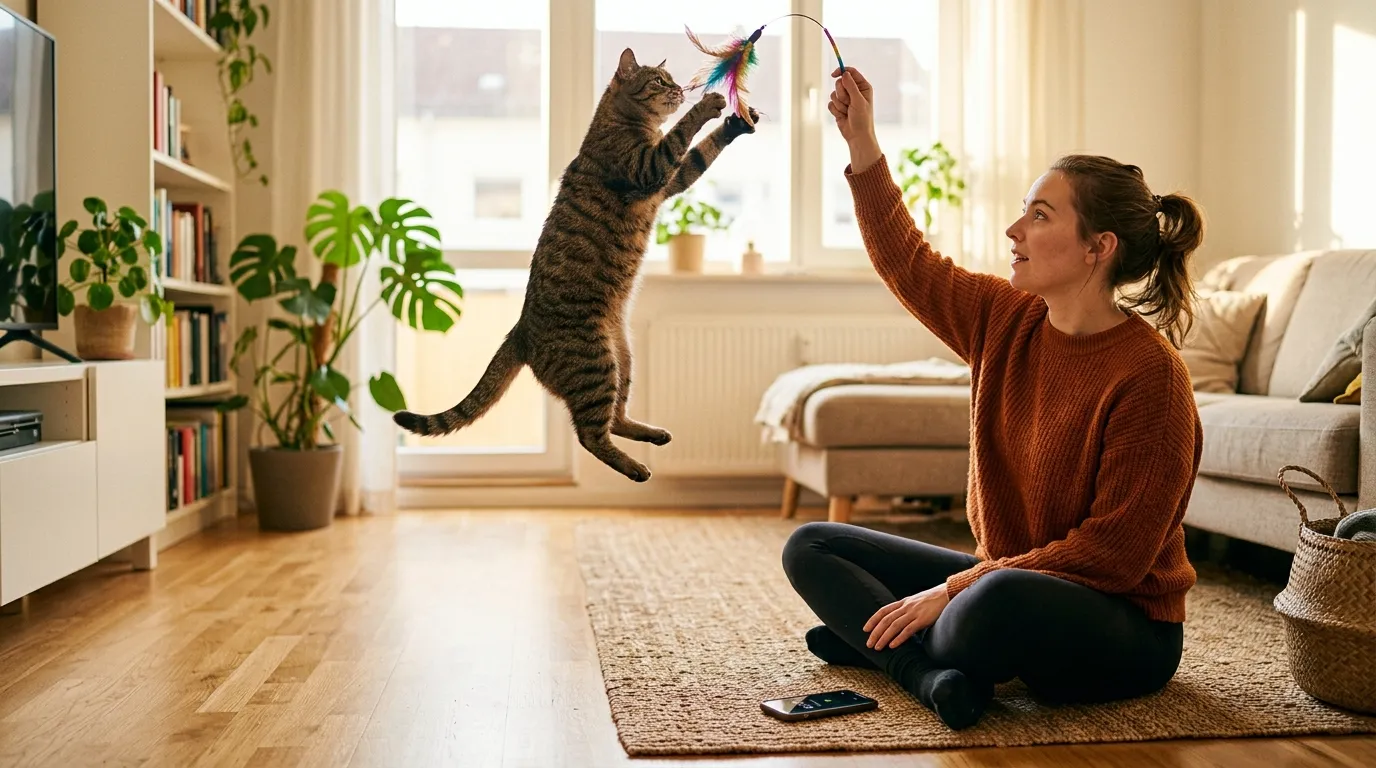
How many hours to play with an indoor cat was something I genuinely got wrong for the first year of cat ownership. I thought longer was better so I would sit down for a forty-five minute session on weekends and skip it entirely on busy weekdays. My cat knocked things off shelves every Tuesday and I could not figure out why until a friend pointed out the obvious: she was not getting consistent daily play and one long weekend session changed nothing. How many hours to play with an indoor cat is actually the wrong question. The right question is how many minutes per session and how many sessions per day. The answer surprises most owners because it is far less time than they assume but only works when it happens every single day. This article gives you the exact numbers along with the daily structure that actually prevents the behavioral problems inconsistent play produces.
Play with your indoor cat for two sessions of ten to fifteen minutes each day. That totals twenty to thirty minutes of active daily play which is enough to prevent obesity, boredom and most behavioral problems. Never replace two short sessions with one long one. Cats are sprint animals not endurance players and they lose interest after about fifteen minutes regardless of session length.
How Many Hours to Play with Indoor Cat?
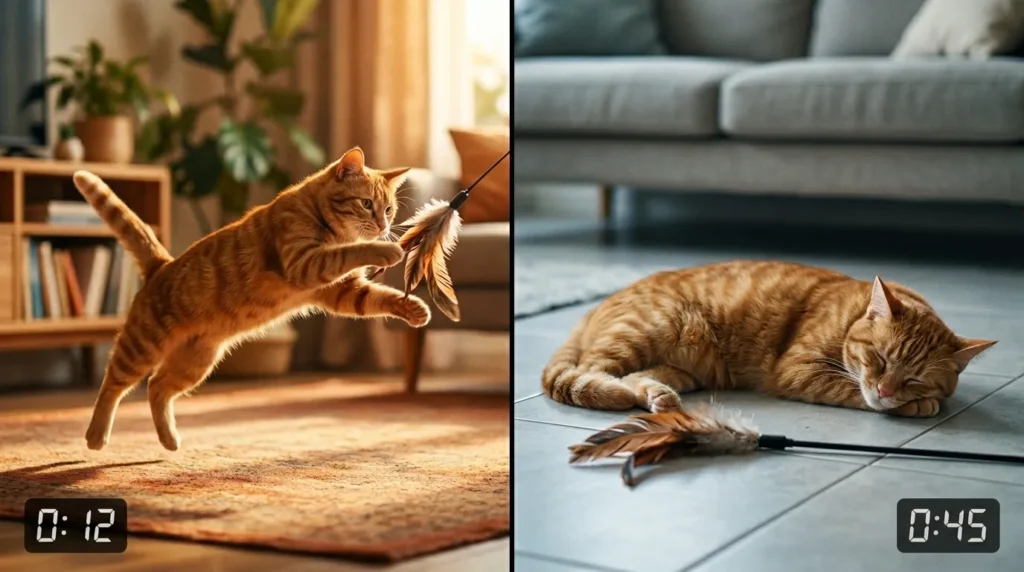
How many hours to play with an indoor cat is not a meaningful measurement because healthy cat play is not measured in hours. According to the American Animal Hospital Association’s cat care guidelines, the recommended target for most adult indoor cats is two to three sessions of ten to fifteen minutes daily. That comes to a maximum of forty-five minutes total and most cats stop engaging after fifteen minutes anyway.
Cats are burst predators by biology. A wild cat does not chase prey for an hour. It stalks for minutes, sprints for seconds and rests between attempts. An indoor play session that mirrors that burst pattern produces genuine physical and neurological satisfaction. A session that drags past fifteen minutes produces a cat that has walked away while the owner is still waving the wand at an empty room.
The number that actually matters is consistency. A cat that gets fifteen minutes of play twice a day every day of the week has a fundamentally different behavioral baseline than one that gets forty-five minutes twice a week. Daily repetition is what prevents the midnight zoomies, furniture destruction and persistent meowing that most owners associate with a difficult personality.
How Age Changes the Daily Play Target?
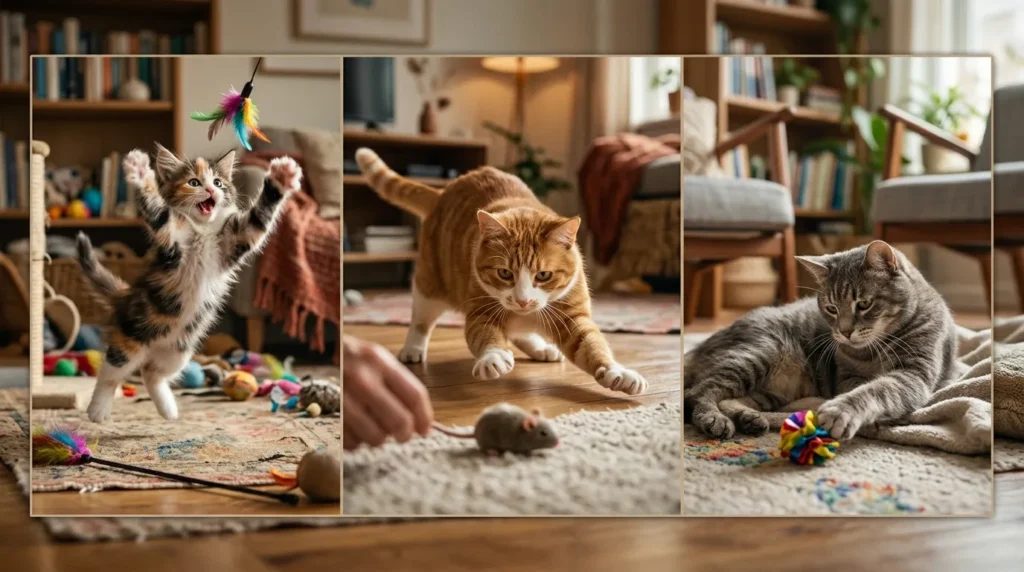
Age is the single biggest variable in how long daily play should last. The daily play target shifts significantly across a cat’s life and using the adult recommendation for a kitten or a senior produces poor results in both directions.
Kittens under six months need three to five short sessions daily of five to ten minutes each because their attention span is genuinely brief but their energy demand is high. They burn through a session faster than any adult cat and need more frequent resets throughout the day. An owner who tries to run one long kitten session usually ends up with a cat that is overstimulated rather than satisfied.
| Life Stage | Session Length | Sessions Per Day | Total Daily Play |
| Kitten under 6 months | 5 to 10 minutes | 3 to 5 sessions | 20 to 40 minutes |
| Junior 6 to 18 months | 10 to 15 minutes | 2 to 3 sessions | 20 to 45 minutes |
| Adult 2 to 10 years | 10 to 15 minutes | 2 sessions | 20 to 30 minutes |
| Senior over 10 years | 5 to 10 minutes | 2 sessions | 10 to 20 minutes |
Senior cats need shorter gentler sessions not because they do not need stimulation but because their joints and cardiovascular capacity change with age. A senior cat that gets the adult session length often shows discomfort signals including panting or walking away early that owners misread as disinterest. Shorter sessions more gently paced keep senior cats engaged and physically comfortable simultaneously.
Why Two Short Sessions Beat One Long One Every Time?
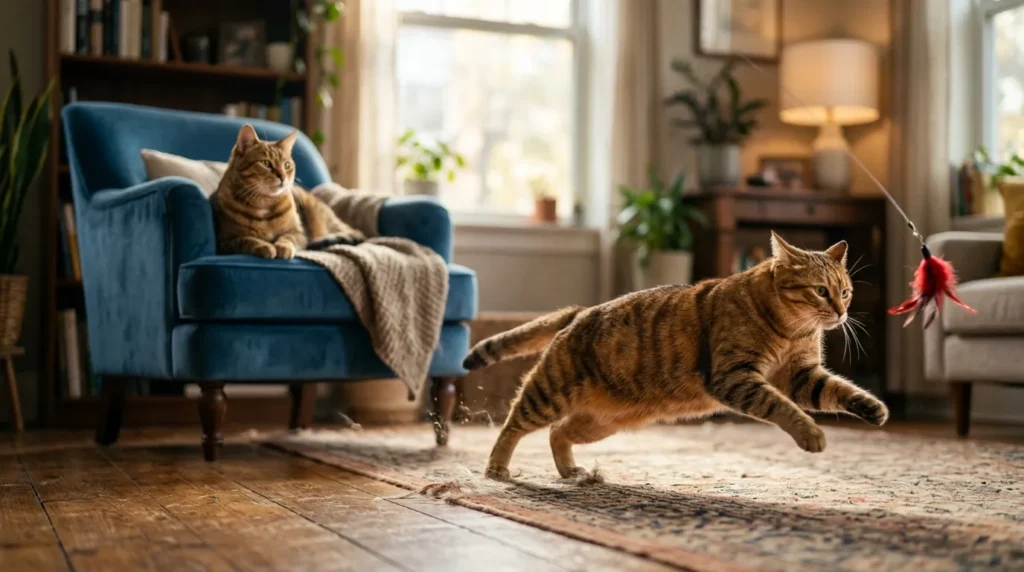
Two short daily sessions work better than one long one for a reason rooted directly in feline hunting biology. A cat hunting in the wild completes a full sequence: stalk, sprint, pounce, catch and rest. That full sequence takes a few minutes. After the catch comes the eating and grooming phase and then rest. Forcing the cat to immediately repeat that sequence without the eating and resting phases is like asking a sprinter to run another hundred meters the moment they cross the finish line.

The two-session structure also maps to something real in feline biology. Indoor cats retain the crepuscular activity pattern of their wild relatives which means they hit natural energy peaks at dawn and dusk regardless of their environment. A play session scheduled at each of those peaks works with the cat’s biology rather than against it. A single midday session misses both peaks and the cat produces midnight restlessness anyway because its actual active windows never got used.
Tying each session to a meal compounds the benefit. Play before the morning meal and play before the evening meal. The cat associates the session with the food reward that follows which completes the hunt-eat-groom-sleep cycle naturally. This single scheduling change resolves the 3am racing and pre-dawn meowing that most owners think is an unfixable personality trait in their cat.
The Signs Your Daily Play Is Not Enough
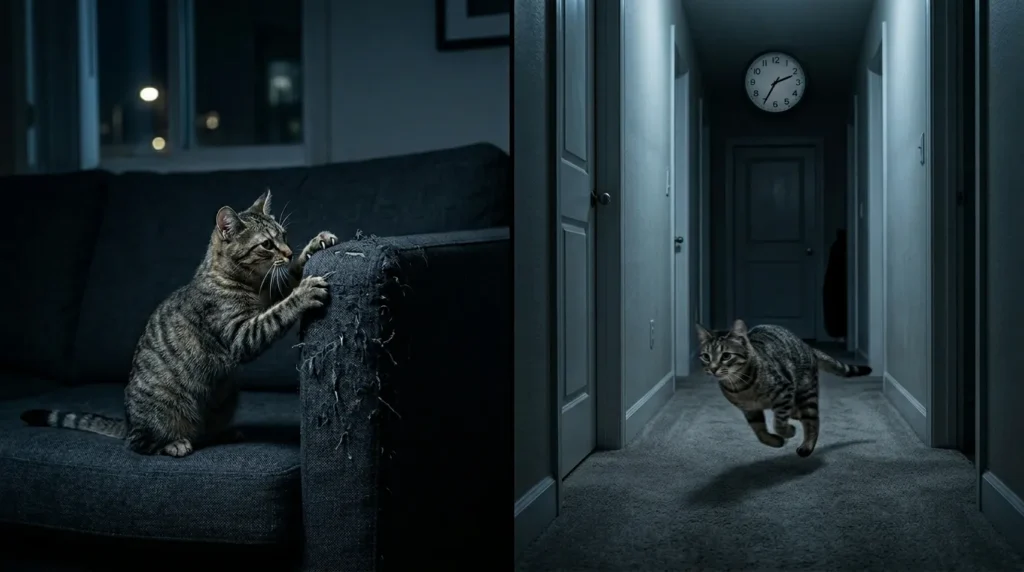
Recognizing when daily play falls short is straightforward once you know what to look for. The behavioral signals appear within forty-eight to seventy-two hours of insufficient sessions and disappear within the same window when consistent play resumes. They are not personality traits. They are predictable responses to an unmet daily need.
Midnight sprinting is the most obvious signal and the one most owners dismiss as normal cat behavior. It is normal only when the cat has genuinely had no daily play outlet. An indoor cat that receives two proper daily sessions almost never produces midnight racing because the physical energy was discharged at appropriate times. Watching your cat race at 2am is not cute quirk. It is a behavioral report card for the previous day’s play schedule.
Persistent furniture scratching that accelerates in the evenings, ankle-biting when you walk through the room and loud unprompted vocalization after dinner all tell the same story. The cat has unspent predatory energy and it is using the nearest available target. What looks like aggression or stubbornness is almost always a scheduling gap. A consistent daily play routine eliminates all three behaviors for the overwhelming majority of indoor cats within one to two weeks.
How a cat uses its environment between play sessions also reflects whether its daily activity needs are met. A well-played cat rests, grooms and engages with its surroundings calmly. A cat with a consistent play deficit paces, investigates restlessly without settling and often develops repetitive behaviors. Adding structured stimulation like indoor cat enrichment activities alongside daily play helps reduce these behaviors and keeps your cat mentally balanced throughout the day.Understanding these as behavioral output of unmet physical need rather than character flaws changes how you approach them entirely and makes the solution obvious.
How to Structure a 15-Minute Session for Maximum Effect?
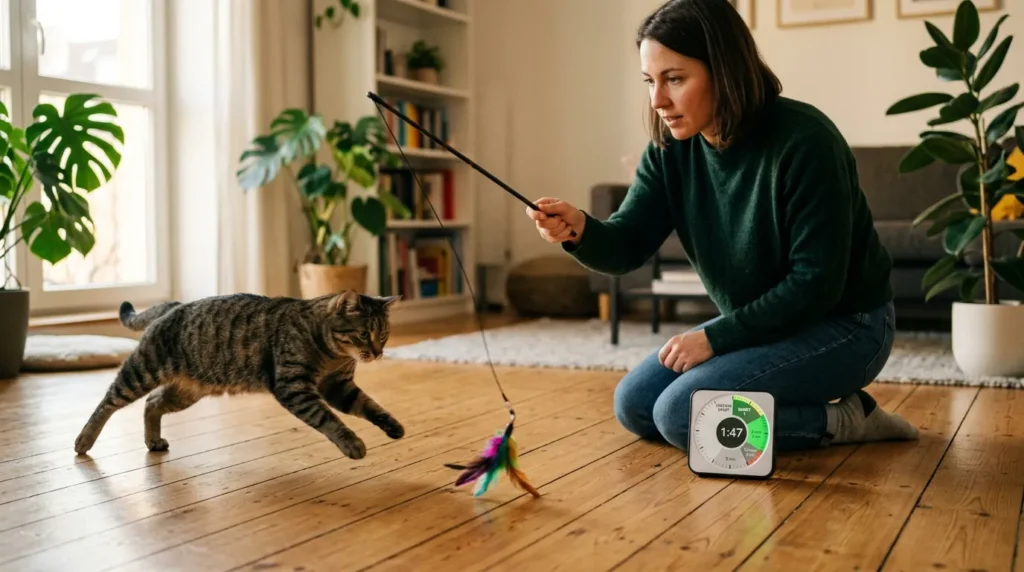
A fifteen-minute session structured correctly produces far more behavioral benefit than the same fifteen minutes of random waving. The structure mirrors the hunting sequence that the cat’s nervous system is built around: two minutes of active movement, thirty seconds of stillness letting the prey appear to hide, another burst of movement, gradual slowdown and then the catch.
Move the toy the way prey actually moves. Short sudden bursts low to the floor, occasional disappearance behind furniture and irregular changes in direction. A wand moved in smooth predictable circles bores most cats within three minutes. The same wand moved unpredictably in short bursts with sudden pauses holds attention for the full session because the cat cannot anticipate what comes next.
End every session with a deliberate catch. Let the cat grab and hold the toy for twenty to thirty seconds. Then immediately offer a small food portion. This closing sequence matters because it completes the psychological cycle the session built toward. A session that ends abruptly without a catch leaves the cat in a state of unresolved arousal that shows up as post-play aggression or immediate renewed pestering rather than the calm settled rest that a completed hunt produces.
The structure of daily life for a cat in a small apartment or a busy household is shaped by dozens of small decisions that accumulate into either a calm well-adjusted animal or a difficult one. Play timing sits at the center of that structure but it connects to everything else: where the cat eats, what climbing space it has access to and how its territory is arranged. The physical environment that surrounds a small-space cat shapes how much daily play is needed to keep behavior stable.
The Mistakes Owners Make With Daily Play
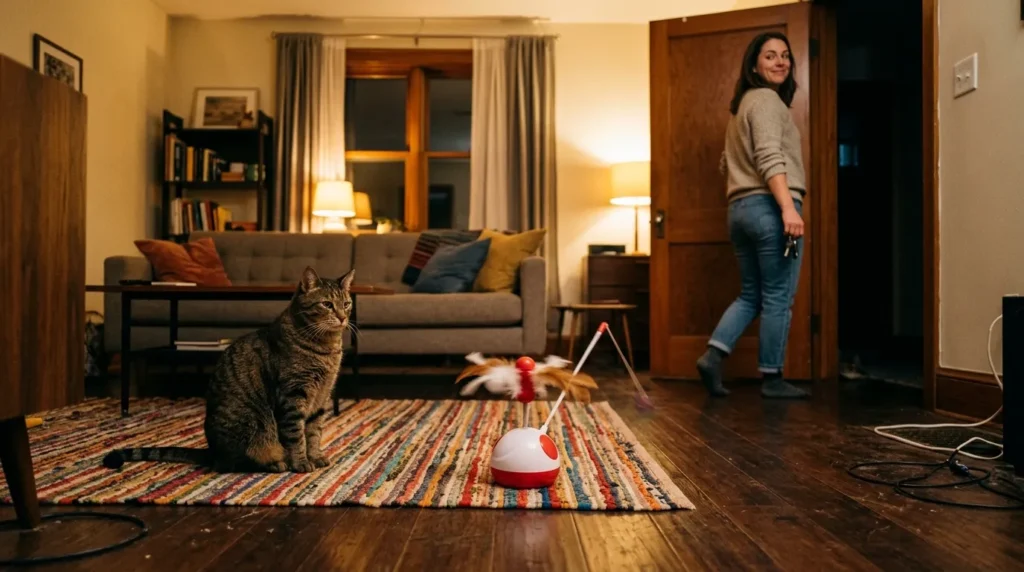
The most common mistake owners make when thinking about daily play is substituting automated toys for interactive sessions and counting them as equivalent. Automated toys have value as supplementary daytime activity but they do not satisfy the social and neurological components of interactive play. A cat that spends twenty minutes with an automated spinner has moved its paws. A cat that spends fifteen minutes in an interactive wand session with its owner has completed a hunting sequence with a social partner and experienced the full neurological reward cycle that resolves behavioral drives.
The second mistake is measuring sessions by clock time rather than cat engagement. A fifteen-minute session where the cat disengages after eight minutes and sits watching is not a fifteen-minute session. It is an eight-minute session with seven minutes of wasted time. When the cat signals disengagement by sitting down, grooming or walking away the session is finished regardless of what the clock says. Forcing continuation past that point does not extend the benefit. It trains the cat to disengage earlier in future sessions.
The third mistake is treating play as optional on busy days. One skipped session produces no visible consequence. Two skipped days begins accumulating a behavioral deficit. Three or more days in a row without sessions produces the full constellation of boredom behaviors: midnight running, furniture destruction and constant attention demands. The deficit compounds faster than it was built and it takes more than one good session to clear it. Consistency on five out of seven days per week produces dramatically better behavioral outcomes than perfect sessions twice a week.
Insight The fifteen-minute session before dinner is the most impactful single change any indoor cat owner can make this week. Most cats who wake their owners at 3am are not broken or demanding by nature. They are behaviorally healthy animals who discharged zero energy before sleep. One consistent evening session before the last meal changes that within four to five days. Start there before changing anything else.
When Insufficient Play Points to Something Else?
Some behavioral problems that look exactly like insufficient play actually signal a medical cause that play alone will not address. A cat that was previously well-adjusted to a consistent play routine and suddenly shows restlessness, aggression or nighttime waking without any change in the play schedule may be experiencing pain, a neurological issue or early cognitive dysfunction syndrome.
A cat that shows no response at all to play despite having normal energy in other respects may have a vision or hearing change that makes interactive toys less perceptible. This is worth a vet conversation especially in cats over eight years old.
If two weeks of consistent twice-daily sessions produces no behavioral improvement in a previously routine-disrupted cat something beyond scheduling is worth investigating.
This article is for informational purposes only. Always consult your vet if you have concerns about your cat’s health.
Frequently Asked Questions
Is 15 minutes a day enough playtime for an indoor cat?
Yes when done twice daily with a toy you actively control. Two fifteen-minute sessions totaling thirty minutes is the daily standard recommended by veterinary associations for adult indoor cats and it is enough to prevent obesity, boredom and most behavioral problems.
How long should each play session with my cat last?
Ten to fifteen minutes per session for adult cats. Kittens need five to ten minute sessions more frequently because their attention spans are shorter but their energy demands are higher. Stop when the cat disengages rather than watching the clock because engagement quality matters more than session length.
Can I play with my cat too much?
Yes. A cat that begins panting, shows pupils that do not return to normal size after play or becomes unable to settle after a session has been overstimulated. Overlong sessions in senior cats also risk joint strain. End sessions when the cat catches the toy and eats the post-play meal and the settling process happens naturally.
What time of day should I play with my indoor cat?
Dawn and dusk match the natural crepuscular activity peaks of indoor cats and produce the best engagement and the best behavioral outcomes. Play immediately before each meal so the cat completes the full hunt-eat-groom-sleep cycle. This timing resolves midnight waking and pre-dawn meowing faster than any other single scheduling change.
Does my cat need playtime every single day?
Yes. The behavioral benefits of daily play do not accumulate and carry forward the way some owners assume. Skipping even two consecutive days begins building a behavioral deficit that shows up as nighttime racing, furniture destruction and persistent attention demands. Consistency on at least five days per week is the minimum for stable behavioral health in an indoor cat.
Conclusion
How many hours to play with an indoor cat is not hours. It is two sessions of ten to fifteen minutes daily timed to natural activity peaks and followed immediately by a meal. That daily structure solves midnight racing, furniture destruction and constant meowing faster than any toy purchase or environmental upgrade ever will. Start tonight with one fifteen-minute wand session before your cat’s dinner. Watch the behavioral shift over the next four days and use that as your baseline for everything else in the daily routine.
Indoor cats need two play sessions of ten to fifteen minutes each per day totaling twenty to thirty minutes of active daily playtime. Sessions should be scheduled at dawn and dusk to match natural crepuscular activity peaks and followed immediately by a meal to complete the hunt-eat-groom-sleep cycle. Kittens require three to five shorter sessions of five to ten minutes daily. Senior cats benefit from two gentle sessions of five to ten minutes. Consistent daily play prevents obesity, boredom-driven destructive behavior, midnight activity bursts and persistent vocalization in indoor cats.