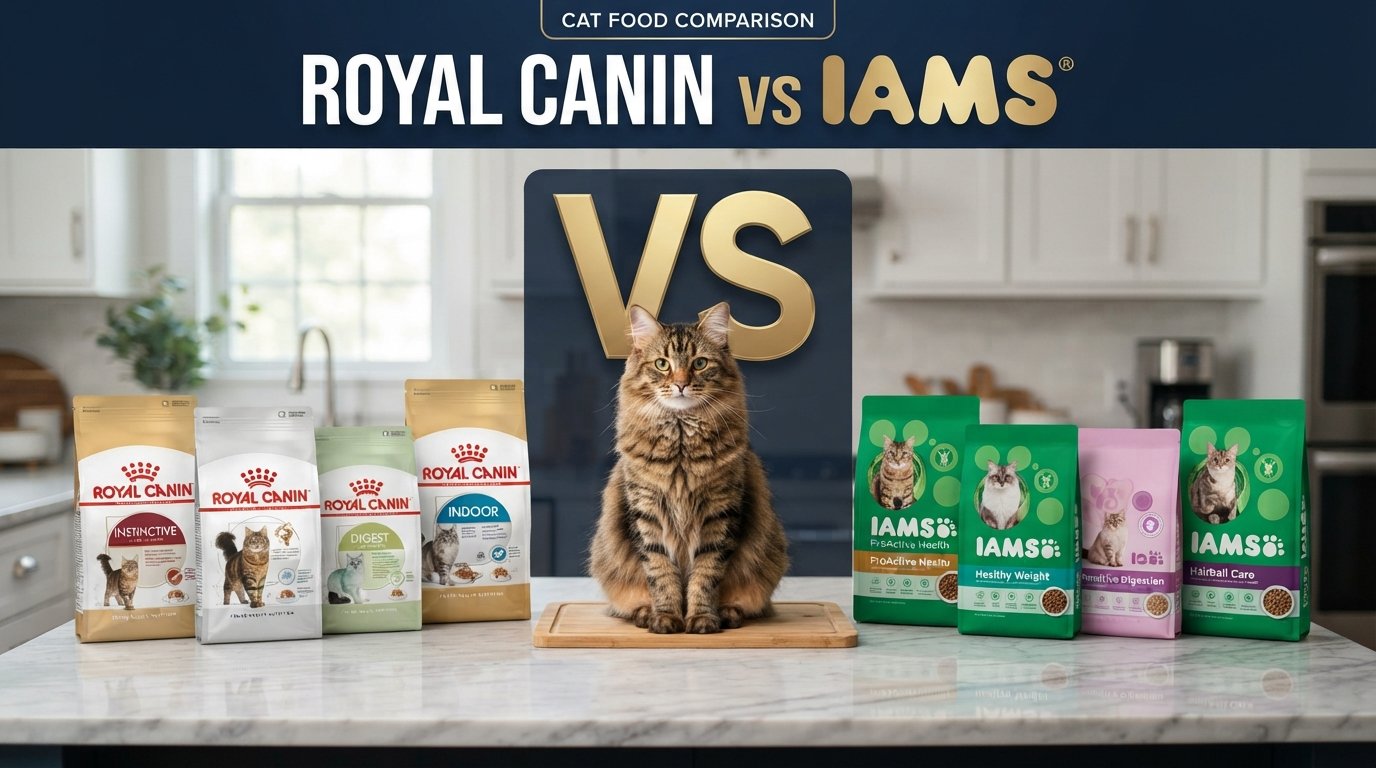
Royal Canin Indoor Adult wins on paper because it stacks dental care, hairball control, and digestion support into one bag. IAMS Proactive Health Indoor Weight & Hairball Care answers back with real chicken as the first ingredient and a lower price tag. I fed both, read every line on both bags, and here’s how they actually stack up.
Royal Canin vs IAMS cat food. Or IAMS vs Royal Canin, depending on which order you typed it into Google. Either way, it’s one of the most searched match ups among indoor cat owners, and for good reason. Both brands sell a dedicated indoor formula built to fight hairballs, weight gain, and slower digestion, but the ingredients and priorities differ enough to matter for your cat’s bowl. Below, I break down each formula, compare them side by side, and share which one fits specific households best. If you’re still working out a full daily routine, our guide on how to feed an indoor cat properly covers portioning and meal timing in more depth.
⚡ Royal Canin vs IAMS Cat Food: Quick Verdict
Short answer: Royal Canin Indoor Adult is the better all-round pick if your cat needs dental support, hairball control, and easier digestion in one bag. IAMS Proactive Health Indoor Weight & Hairball Care is the smarter buy if your cat mainly needs help with weight and hairballs and you don’t want to pay a premium for it.
Neither food is wrong for an indoor cat. They just solve the problem from two different directions, and the right one depends on what’s actually bothering your cat: teeth, weight, or both.
Analysis: Royal Canin Indoor Adult Cat Food
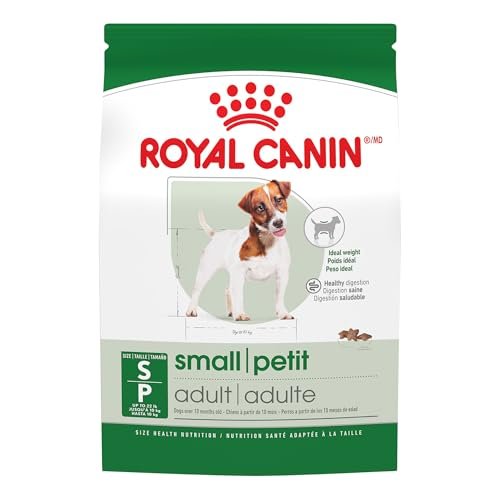
Made for cats one to seven years old, Royal Canin Indoor Adult targets the slower digestion, hairballs, and weight gain that come with staying inside all day. I look at how its protein sources, fiber blend, and dental-shaped kibble hold up in daily feeding.
Royal Canin Indoor Adult lists chicken meal as its main protein, followed by corn, brewers rice, and chicken fat. The formula relies on highly digestible L.I.P. proteins to reduce stool odor and quantity, a common complaint with indoor litter boxes. A moderate fat content suits the lower activity of indoor cats, and a fiber blend built on beet pulp and psyllium helps move swallowed hair through the digestive tract instead of onto the floor. Owners comparing hairball formulas will notice Royal Canin leans on this same fiber-first approach.
The kibble shape and texture are engineered to scrape plaque and tartar with every bite, and green tea polyphenols add extra oral care most indoor formulas skip. Royal Canin also builds in prebiotics (FOS) to support gut bacteria, which pairs with the digestibility focus to cut down on the soft, smelly stools that indoor cats are prone to. For cats already carrying extra weight, the calorie count is adjusted for a leisurely lifestyle rather than an active outdoor one.
Build Quality & Design
The bag lists an AAFCO adult maintenance statement, full ingredient sourcing, and a feeding chart broken down by weight, which keeps portioning simple in multi-cat homes.
Performance & Speed
Most cats adjust within a week. Owners report fewer hairballs and steadier stool quality inside the first month of feeding.
Features & Functionality
Dental-support kibble shape, a hairball fiber blend, prebiotics, and a calorie count tuned for indoor cats cover four common feeding concerns in one bag.
User Experience
Feeding guidelines are printed by weight band, and the kibble size suits cats that graze throughout the day instead of eating in one sitting.
Value for Money
Royal Canin sits at a premium price point, but the combined dental, hairball, and digestion benefits can cut down on separate treats or supplements you’d otherwise buy.
✅ Advantages
✓Highly digestible L.I.P. proteins reduce stool odor and support smoother digestion for full-time indoor cats.
✓Dental-shaped kibble and tartar-fighting minerals clean teeth with every meal.
✓Fiber blend with beet pulp and psyllium moves swallowed hair through digestion instead of onto the floor.
✓Calorie content adjusted for indoor activity levels helps prevent gradual weight gain.
❌ Disadvantages
✗Corn and wheat sit high on the ingredient list, which is not ideal for cats that need grain-free food.
✗Premium pricing runs higher than most chicken-first competitors in the same bag size.
✗Formula is built for cats one to seven years old, so kitten and senior households need a different Royal Canin line.
Analysis: IAMS Proactive Health Indoor Weight & Hairball Care Cat Food
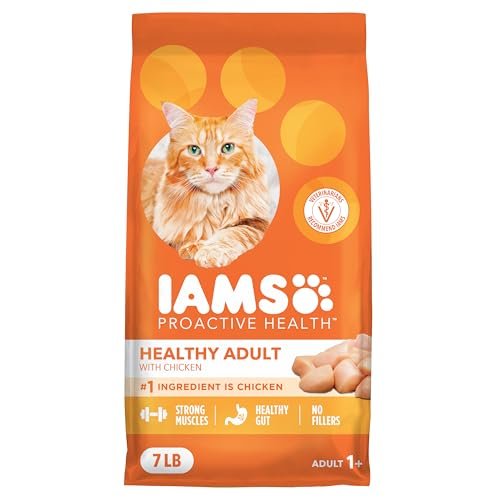
Built around a chicken-first recipe, IAMS Proactive Health Indoor Weight & Hairball Care tackles the same two indoor cat problems from a different angle, using L-carnitine for weight and a proprietary fiber blend for hairballs.
Real chicken leads the ingredient list, followed by chicken by-product meal and corn gluten meal for added protein. IAMS uses L-carnitine to help the body burn fat and maintain a healthy metabolism, aimed squarely at cats prone to weight gain from low activity. The proprietary fiber blend, built on beet pulp, helps reduce hairballs before they start rather than only moving hair through digestion after the fact.
IAMS also adds prebiotics for digestion and an omega 6 to 3 ratio meant to keep the coat soft and shiny. The brand markets this under its Proactive 5 approach, covering muscles, energy, digestion, immunity, and skin and coat in one bag. If you want to see how this chicken-first formula compares outside the indoor line, IAMS vs Blue Buffalo Cat Food covers that match up in detail.
Build Quality & Design
Bag labeling calls out the Proactive 5 benefits directly on the front, with calorie content and feeding amounts by cat weight printed on the back panel.
Performance & Speed
Cats on this formula tend to stay playful without post-meal sluggishness, and hairball frequency often drops within a few weeks of steady feeding.
Features & Functionality
Chicken-first protein, L-carnitine for weight, a proprietary fiber blend for hairballs, and an omega mix for coat health round out the core feature set.
User Experience
Feeding charts are straightforward, and the kibble transitions well when mixed gradually with a cat’s current food over seven to ten days.
Value for Money
IAMS typically costs less per pound than Royal Canin, making it a practical pick for multi-cat households watching the budget.
✅ Advantages
✓Real chicken as the first ingredient supports lean muscle without a premium price tag.
✓L-carnitine actively targets fat metabolism, useful for cats already carrying extra weight.
✓Proprietary fiber blend reduces hairballs before they form rather than only after grooming.
✓Lower cost per pound than most premium indoor formulas, including Royal Canin.
❌ Disadvantages
✗Corn grits and corn gluten meal add carbohydrate filler that grain-sensitive cats may not tolerate well.
✗No dedicated dental-care kibble shape, so tartar control depends on other products.
✗Coat and skin benefits rest on broader claims without the clinical detail Royal Canin provides.
Royal Canin vs IAMS Cat Food: Major Factors to Consider
Choosing between these two indoor formulas comes down to your cat’s weight history, dental needs, and your grocery budget. The factors below show where each brand pulls ahead and where the differences are small enough to ignore.
🎯
Performance
Performance here means how well each formula controls the two biggest indoor cat problems: hairballs and weight gain. Royal Canin leans on fiber and digestibility for hairball control, while IAMS pairs L-carnitine with its own fiber blend for a more direct weight-loss angle. Cats that need extra help managing weight may respond faster to the IAMS approach.
⚡
Speed & Efficiency
Speed & Efficiency covers how fast owners notice changes in stool quality, hairball frequency, and energy. Most owners report hairball improvements within two to four weeks on either formula, though Royal Canin’s added prebiotics can shorten the digestive adjustment period during a food switch.
💰
Price & Value
Price & Value weighs cost per pound against the benefits included. IAMS costs less on average and still covers weight and hairball needs well, while Royal Canin charges a premium for the added dental and digestion support bundled into the same bag. Budget-focused owners may also want to check Purina One vs Royal Canin Cat Food for a third option in the same price bracket.
🔧
Build Quality
Build Quality covers labeling clarity and feeding guidance. Both brands print AAFCO statements and weight-based feeding charts, though IAMS leads with its Proactive 5 claims printed directly on the front of the bag.
🎨
Design & Aesthetics
Design & Aesthetics affects how quickly you spot the right bag on a crowded shelf. Royal Canin uses its signature purple and gold indoor cat packaging, while IAMS keeps a bold red and blue scheme built around the chicken-first claim.
🔋
Durability
Durability describes shelf life and freshness after opening. Both bags use resealable closures, and kibble on either formula holds its crunch for several weeks once stored in a cool, dry spot away from direct sunlight.
How to Switch Your Cat From One Food to the Other
Cats have sensitive stomachs, and a sudden switch between Royal Canin and IAMS, or from either one to whatever your cat currently eats, tends to show up as loose stool or a skipped meal. Don’t mix the two long-term as a regular diet either; pick one formula for your cat’s day-to-day feeding and use the other only during the transition. Here’s the schedule I use with a new bag:
- Days 1 to 2: Mix about 25% new food with 75% of the current food.
- Days 3 to 5: Move to a 50/50 split.
- Days 6 to 8: Shift to about 75% new food, 25% old.
- Days 9 to 10: Feed 100% of the new formula and watch the litter box for a few more days.
- If stools stay loose past day 10: slow the transition down further, or call your vet if it doesn’t settle within a few extra days.
Feature Comparison
The feature table below helps you quickly spot which formula covers the capabilities that matter most for your cat.
| Feature | Royal Canin Indoor Adult | IAMS Indoor Weight & Hairball Care |
|---|---|---|
| Real Chicken as First Ingredient | ✗ | ✓ |
| Dental Care Kibble Shape | ✓ | ✗ |
| L-Carnitine for Weight Loss | ✗ | ✓ |
| Hairball Fiber Blend | ✓ | ✓ |
| Prebiotics for Digestion | ✓ | ✓ |
| Reduced Stool Odor Claim | ✓ | ✗ |
| Omega 6:3 Coat Support | ✗ | ✓ |
| Proactive 5 Health Framework | ✗ | ✓ |
| Formulated for Ages 1 to 7 | ✓ | ✗ |
Specifications Comparison
The specifications table below offers a quick, apples-to-apples view of the core data for each formula.
| Specification | Royal Canin Indoor Adult | IAMS Indoor Weight & Hairball Care |
|---|---|---|
| Price Tier | Premium | Mid-range |
| Package Sizes | 3 lb to 15 lb bags | 3 lb to 22 lb bags |
| First Ingredient | Chicken meal | Real chicken |
| Target Age | 1 to 7 years | 1 year and up |
| Calorie Content | Adjusted for indoor lifestyle | About 302 kcal per cup |
| Weight Management Aid | Controlled calorie content | L-carnitine |
| Hairball Control Method | Fiber blend with psyllium | Proprietary fiber with beet pulp |
| Dental Support | Yes, kibble shape and minerals | Not specifically marketed |
🏆 Winner: Royal Canin Indoor Adult Cat Food
🏆 BEST CHOICE
Score Breakdown
Overall 8.3/10
Performance 8.4/10
Features 8.6/10
Value 7.6/10
Build Quality 8.2/10
User Experience 8.3/10
Royal Canin Indoor Adult edges ahead overall because it bundles dental care, hairball control, and digestion support into one formula instead of focusing on a single benefit. The added cost buys a more complete package for cats that deal with hairballs, tartar, and weight gain at the same time. If the price stretches your budget, Royal Canin vs Hill’s Science Diet Cat Food compares it against another premium option worth a look.
Choose IAMS Proactive Health Indoor Weight & Hairball Care If…
Budget-Conscious Buyers
If dental support is not a priority and you want a lower cost per pound, IAMS covers weight and hairball needs without the Royal Canin premium. This scenario helps budget-focused owners keep multiple cats fed on a set monthly amount.
Specific Use Case
For cats that are already overweight, the L-carnitine in IAMS gives a more direct metabolic push than Royal Canin’s calorie-only approach. Owners managing a weight-loss plan alongside their vet often prefer this targeted angle.
Preference Scenario
Owners who want real chicken listed as the literal first ingredient, not chicken meal, tend to lean toward IAMS. It suits households that prioritize a meat-forward label over broader digestive claims.
Value Seekers
Value-focused buyers weigh cost per pound against the extras included. Since IAMS still delivers weight and hairball benefits at a lower price, it remains a solid pick when the dental and odor-control extras are not needed.
🎯 Final Recommendation
For most indoor households, Royal Canin Indoor Adult is the recommended pick thanks to its combined dental, hairball, and digestion support. Owners on a tighter budget, or managing a cat that specifically needs to lose weight, may still get better results from IAMS Proactive Health Indoor Weight & Hairball Care. Choose based on your cat’s specific needs and what your budget can support long term.
Summary
- Royal Canin Indoor Adult bundles dental care, hairball control, and digestion support, making it the more complete formula for cats that need all three.
- IAMS Proactive Health Indoor Weight & Hairball Care leads with real chicken and L-carnitine, making it a stronger pick for cats that mainly need weight support.
- Royal Canin sits at a premium price, while IAMS typically costs less per pound for a similar bag size.
- Both formulas include a hairball fiber blend and prebiotics, so the difference comes down to dental care and weight-loss support, not basic digestion.
- Neither formula is built for kittens or urinary health, so those needs call for a dedicated Royal Canin or IAMS line instead.
- Transition either food gradually over seven to ten days to avoid digestive upset in cats switching from a different brand, and don’t feed the two as a permanent 50/50 mix.
Royal Canin vs IAMS Cat Food: Frequently Asked Questions
IAMS vs Royal Canin: which is better?
Royal Canin Indoor Adult is better if your cat needs dental care, hairball control, and digestion support in one bag, and you’re fine paying a premium for it. IAMS Proactive Health Indoor Weight & Hairball Care is better if you want real chicken as the first ingredient and a lower price, and your cat’s main issue is weight or hairballs rather than teeth. There’s no single winner for every cat.
Which is better, Royal Canin or IAMS, for indoor cats?
Royal Canin Indoor Adult edges ahead overall because it combines dental, hairball, and digestion support in one bag. IAMS Proactive Health Indoor Weight & Hairball Care remains a strong, lower-cost choice for cats that mainly need help with weight and hairballs.
Does Royal Canin or IAMS handle hairballs better?
Both use a dedicated fiber blend for hairball control, so results tend to be similar. Royal Canin adds psyllium to its mix, while IAMS relies on beet pulp and prebiotics, and either can reduce hairball frequency within a few weeks.
Is IAMS a good budget alternative to Royal Canin?
Yes. IAMS costs less per pound in most stores and still covers weight and hairball control well. You give up the dental-shaped kibble and some of the digestive-support claims that come with Royal Canin.
Does either brand offer a urinary tract formula?
Royal Canin sells a separate Urinary SO formula for cats that need urinary support beyond what the Indoor Adult line offers. IAMS does not currently sell a dedicated urinary care recipe. If your cat has diagnosed urinary issues, ask your vet about Royal Canin Urinary SO instead of the standard indoor formulas compared here.
Which is better for weight loss in indoor cats?
IAMS takes a more direct approach with L-carnitine to support fat metabolism. Royal Canin relies on a controlled calorie count instead, which works well for maintenance but is a slower path for cats that need to lose weight.
Can I feed my cat Royal Canin and IAMS at the same time?
You can mix the two while transitioning from one to the other, but don’t feed them as a permanent 50/50 blend. Pick one as your cat’s regular diet so the calorie count, fiber level, and feeding chart on the bag stay accurate. Use the other only as a short-term bridge during a switch.
What is the biggest difference between the two brands?
Royal Canin bundles dental care into the kibble shape itself, while IAMS puts its focus on a chicken-first ingredient list and L-carnitine for weight. Pick Royal Canin for an all-in-one formula, or IAMS if chicken-first protein and price matter more than dental support.

Written by Mishu
A passionate cat lover and indoor living enthusiast, Mishu is the founder and voice behind Indoor Living Cat – a go-to resource for cat owners who want to create the happiest, healthiest life for their feline companions indoors.
View Full Profile