
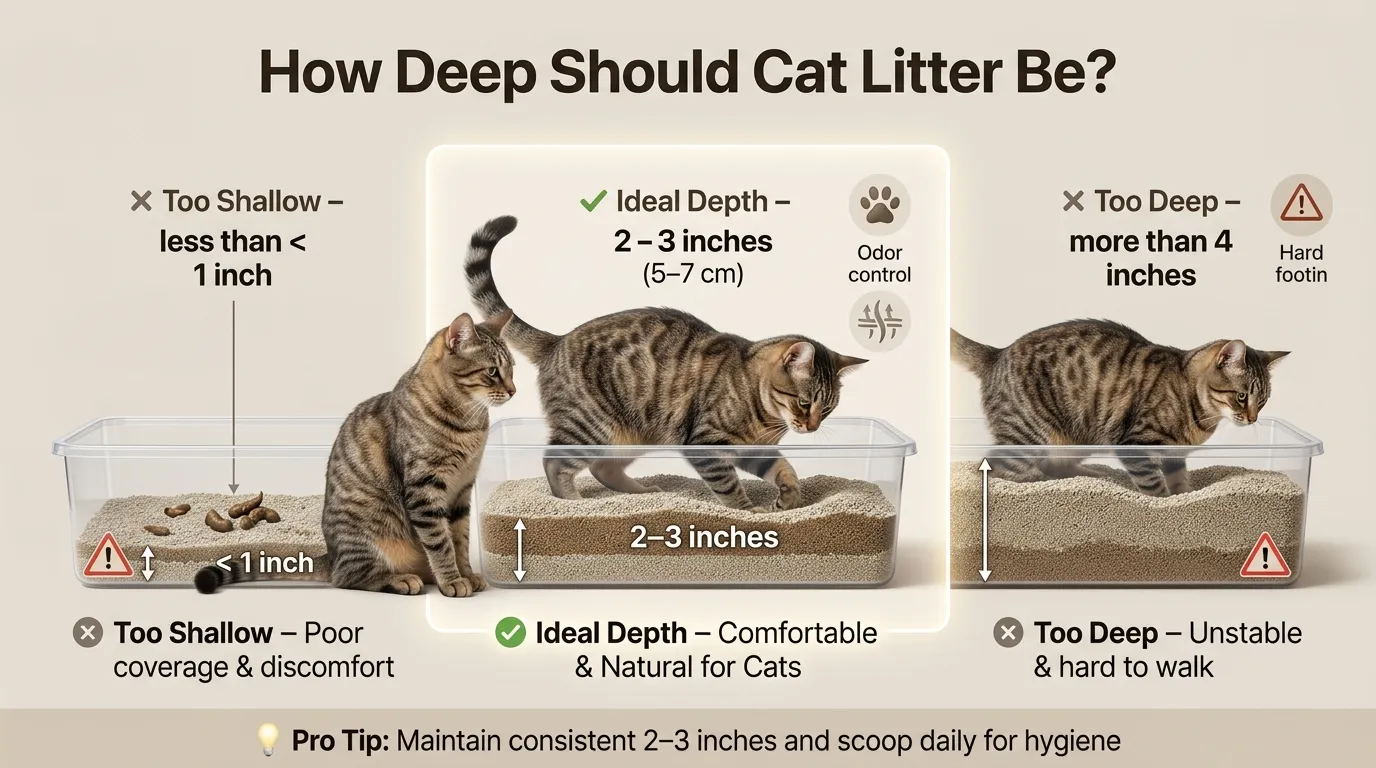
I spent three weeks convinced my cat was being difficult. Then I measured the litter and found I’d been putting in barely an inch. She was hitting the bottom of the box every time she tried to dig, and no cat puts up with that for long. Once I corrected the depth she went back to using the box without a single issue. Depth is a small detail that decides whether a cat uses the box reliably. Below you’ll find the right depth for each litter type and each kind of cat, how to measure it, how much litter that takes for your box size, and how to tell when depth isn’t what’s driving your cat away.
Cat litter should be 2 to 3 inches deep for most adult cats. That gives your cat enough material to dig, cover waste and form proper clumps without hitting the box bottom. Two inches is the floor for most adults, and long-haired cats, kittens and seniors are the exceptions covered below. Three inches is the practical sweet spot, and clumping clay works best at 3 to 4. Go past four inches and you get more scatter and wasted litter with nothing gained.
The short version by situation:
- Most adult cats: 2 to 3 inches
- Clumping clay litter: 3 to 4 inches
- Long-haired cats, kittens and senior cats: 1.5 to 2 inches
- Large, heavy cats and enthusiastic diggers: 3 to 4 inches
- Automatic and self-cleaning boxes: follow the fill line printed inside the box
- Several cats: keep the same depth and add more boxes
Why Litter Depth Matters More Than Most Owners Realize
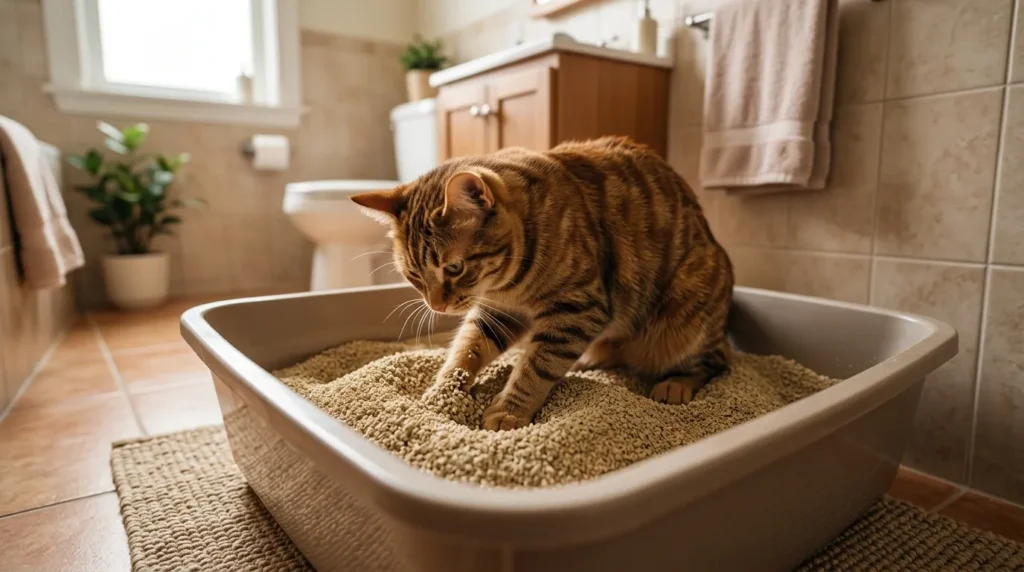
Cats dig and bury waste by instinct. Their wild ancestors buried it to hide their scent from predators and competitors, and house cats kept the habit. When the litter is too shallow to dig in, your cat reads that as a defect in the box.
Litter box avoidance is one of the most common results of incorrect depth. A cat that hits the hard plastic bottom while digging often refuses to use the box again or starts eliminating right next to it. It looks like a behavior problem, yet the cause is physical. The box became uncomfortable to use.
Clumping litter needs depth to work. When urine hits less than two inches of it, the urine reaches the box bottom and forms a flat, nearly unremovable pancake instead of a scoopable clump. That pancake builds up between full changes, concentrates odor and makes the box harder to keep clean. Enough depth stops it from forming.
Not sure what your box holds right now? Jump to how to measure litter depth. It takes under a minute.
How Deep Should Cat Litter Be by Litter Type?
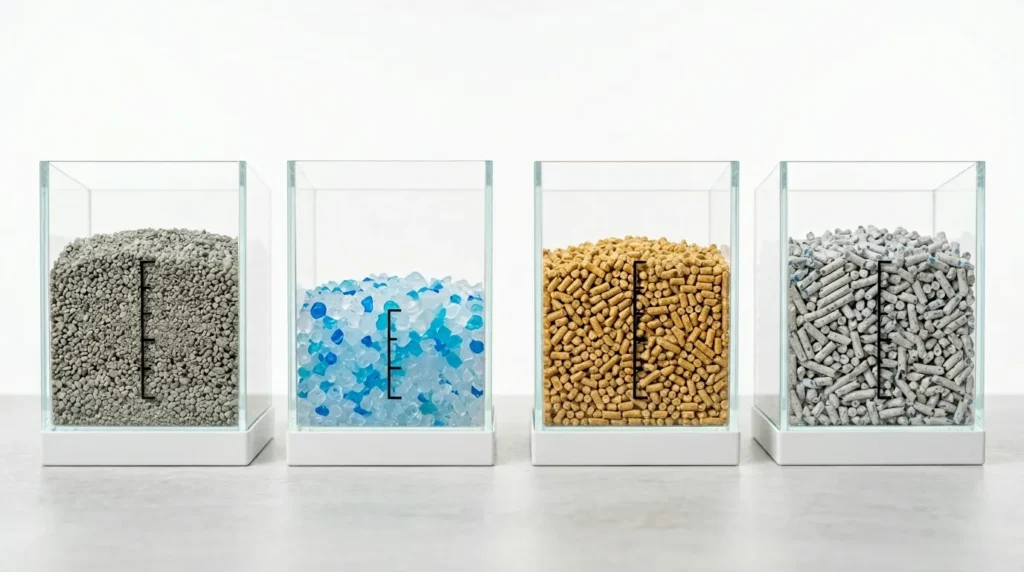
The right depth shifts a little with litter type, because materials clump, absorb and compact at different rates. The 2 to 3 inch baseline covers most types, and each one has an adjustment that improves how it performs.
Clumping clay litter works best at 3 to 4 inches. The deeper fill gives the bentonite enough mass to form firm, complete clumps that lift out without crumbling. At 2 inches the clumps form but often bond to the box bottom, which makes daily scooping much harder. At 4 inches you get strong clumps and good odor control without the scatter that comes with overfilling.
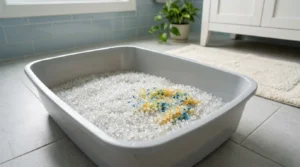 Crystal or silica gel litter performs well at 2 to 3 inches. These larger, smooth crystals absorb urine at the surface and dehydrate it instead of clumping it. Anything past 3 inches wastes expensive litter without improving odor control. The goal is to give urine enough crystal surface to absorb fully before it reaches the box floor.
Natural plant-based litters made from corn, wheat or tofu work well at 2 to 3 inches. They’re softer and lighter than clay, so they scatter more easily above 3 inches. Pellet-style natural litters and paper pellets work at 2 to 2.5 inches because the pellets are larger and hold their structure at shallower depths.
Here’s a quick reference table for litter depth by type:
| Litter Type | Recommended Depth | Key Reason |
| Clumping clay | 3 to 4 inches | Forms firm, complete clumps |
| Crystal / silica gel | 2 to 3 inches | Absorbs urine at surface level |
| Corn or wheat | 2 to 3 inches | Clumps moderately, lighter weight |
| Tofu or paper pellets | 2 to 2.5 inches | Large pellets need less depth |
| Non-clumping clay | 2 to 3 inches | Replaces fully rather than scooping |
Check the bag too. Some brands print their own fill instructions, and they can differ from this table by an inch. When they conflict, start with the brand’s number and adjust based on how your cat digs.
Depth for Automatic and Self-Cleaning Litter Boxes
Automatic boxes are the exception to every number above. Most print a fill line inside the drum or tray, and the sifting or raking mechanism is designed around that level. Fill to the line the manufacturer marks, even when it looks shallower than 3 inches, and skip the extra “just to be safe.”
How Depth Changes for Different Cats: Size, Age and Fur Length
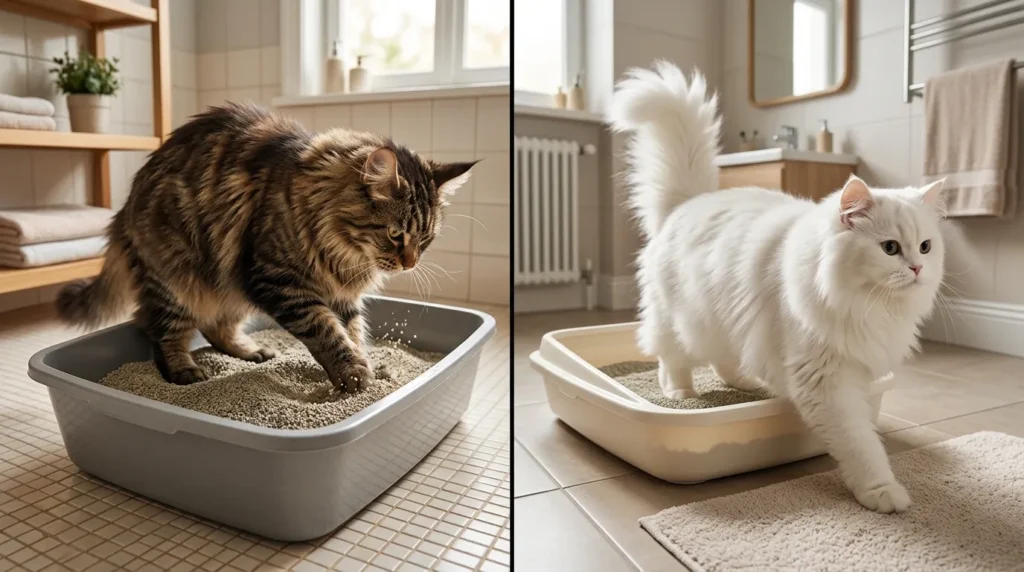
The 2 to 3 inch baseline fits an average adult shorthaired cat. Coat, age and body weight each move the ideal depth enough to change the outcome.
Long-haired cats do better with shallower litter at 1.5 to 2 inches. The thick, flowing coat of breeds like Persians and Birmans acts as a magnet for fine litter particles. Deeper litter puts more particles in contact with more fur during digging and covering, and the litter ends up matted into the coat around the hindquarters. That means daily grooming to pick it out, and often enough discomfort that the cat starts avoiding the box. A shallower fill cuts particle contact and still leaves enough to cover waste.
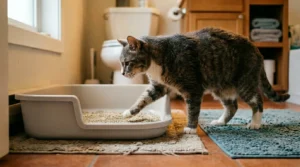
Kittens and senior cats both do better at 1.5 to 2 inches. To a kitten, 3 inches of litter feels like wading through sand, and they often end up covered in it instead of just walking through. Senior cats with arthritis or joint stiffness sink into deeper litter, which makes standing, turning and exiting harder and more painful. Pair the shallower depth with a low-entry box and both problems ease right away. Our roundup of low-entry litter boxes covers the options. One more kitten note: many vets suggest non-clumping litter for kittens that still nibble their litter, since clumping litter swells when wet and you don’t want that inside a small kitten.
Large breeds and other heavy cats need 3 to 4 inches, because their body weight compresses the litter more than a smaller cat’s does. At 2 inches a large cat often digs divots that expose the box bottom, and then it’s digging into nothing. The extra depth makes up for the compression and keeps the surface usable between scoops.
Big cats with long coats, such as Maine Coons and Ragdolls, pull in both directions. Start at 2.5 to 3 inches. If litter starts matting into the fur around the hindquarters, drop toward 2. If your cat digs down to the floor, go back up.
Here is how depth adjusts by cat profile:
| Cat Profile | Recommended Depth | Why It Differs |
| Average adult shorthair | 2 to 3 inches | Standard baseline |
| Long-haired breeds (Persian, Birman etc.) | 1.5 to 2 inches | Prevents fur matting from particle contact |
| Large, heavy cats (British Shorthair etc.) | 3 to 4 inches | Compensates for compression from body weight |
| Large long-haired breeds (Maine Coon, Ragdoll) | 2.5 to 3 inches | Enough for their weight, shallow enough to limit matting |
| Kittens under 6 months | 1.5 to 2 inches | Small body, easier to become overwhelmed by depth |
| Senior cats with mobility issues | 1.5 to 2 inches | Shallower is easier to navigate with stiff joints |
| Active heavy diggers (Bengals etc.) | 3 to 3.5 inches | More material absorbs enthusiastic digging |
Depth for Multiple Cats
Some guides tell you to stack litter 5 or 6 inches deep when several cats share a box. I’d skip that. Past 4 inches you get the scatter and compaction described below, and the extra depth doesn’t fix the real problem, which is too much waste landing in one spot. The widely used rule is one box per cat plus one extra. Keep each box at 3 inches and scoop more often.
For everything about full litter box setup, including box size and placement, see our guide to indoor cat litter box setup and maintenance.
How to Measure Litter Depth
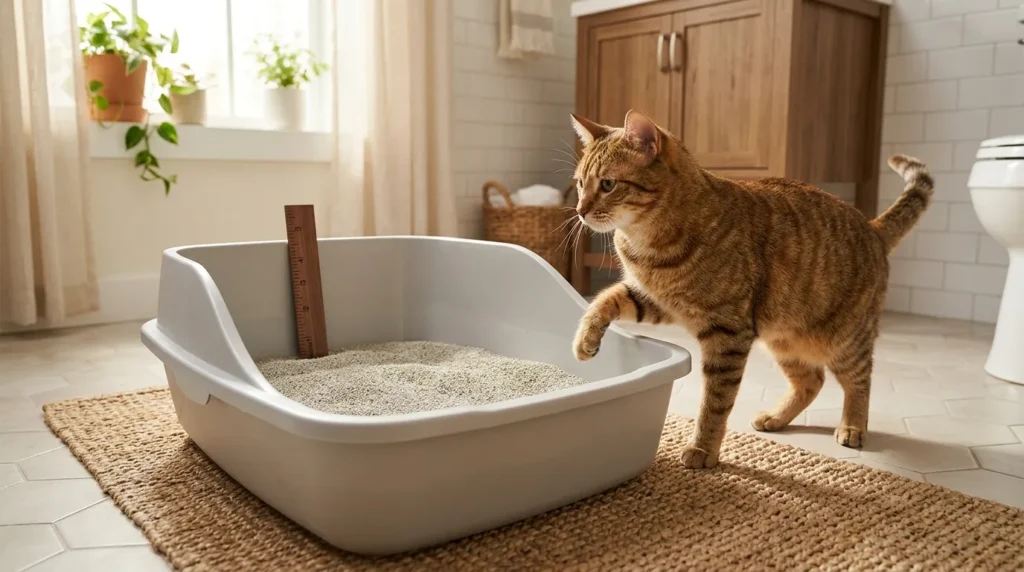
Most people pour litter by sight and land short. In a large box, 3 inches looks like far less than you’d expect. Measure it once and you’ll know what the right amount looks like in your box.
- Level the surface. Smooth the litter flat with your scoop. Piles along the walls hide the real depth in the middle.
- Push a ruler straight down. A ruler, chopstick or skewer works. Stop when it touches the box floor and read the number at the litter surface.
- Check the center and two corners. Digging pushes litter toward the walls, so the middle is usually the thinnest spot.
- Mark your target line. Put a strip of masking tape on the inside wall at your chosen depth. After each scoop, top up to the tape.
Insight No ruler nearby? Push a clean finger straight down. On an average adult hand, the second knuckle from the tip sits roughly 1.5 to 2 inches from the end of the finger, so if you feel the box floor before that knuckle, the litter is too thin. Reaching close to the base of your finger is about 3 inches. Hand sizes vary, so hold your finger against a ruler once to calibrate. After that you can check depth in seconds every time you scoop.
How Much Litter Do You Need to Fill the Box?
Depth is the target. Volume tells you how much litter to pour. Multiply length by width by depth to get cubic inches, then divide by 57.75 for US quarts. A 22 by 17 inch box filled to 3 inches works out to 22 x 17 x 3 = 1,122 cubic inches, or about 19 quarts.
Here are common box sizes at three depths:
| Box Size (inches) | At 2 Inches | At 3 Inches | At 4 Inches |
| 18 x 15 (standard) | about 9 quarts | about 14 quarts | about 19 quarts |
| 22 x 17 (large) | about 13 quarts | about 19 quarts | about 26 quarts |
| 24 x 18 (extra large) | about 15 quarts | about 22 quarts | about 30 quarts |
Treat these as ceilings. Sloped and rounded walls hold less than a perfect rectangle, so pour in a little less than the table says, level the surface, measure, and top up to your target. Litter is sold by weight, and clay, crystal and plant-based litters have different densities, so a single bag-to-depth conversion doesn’t exist. Pour, measure, adjust.
How to Maintain the Right Litter Depth Between Full Changes
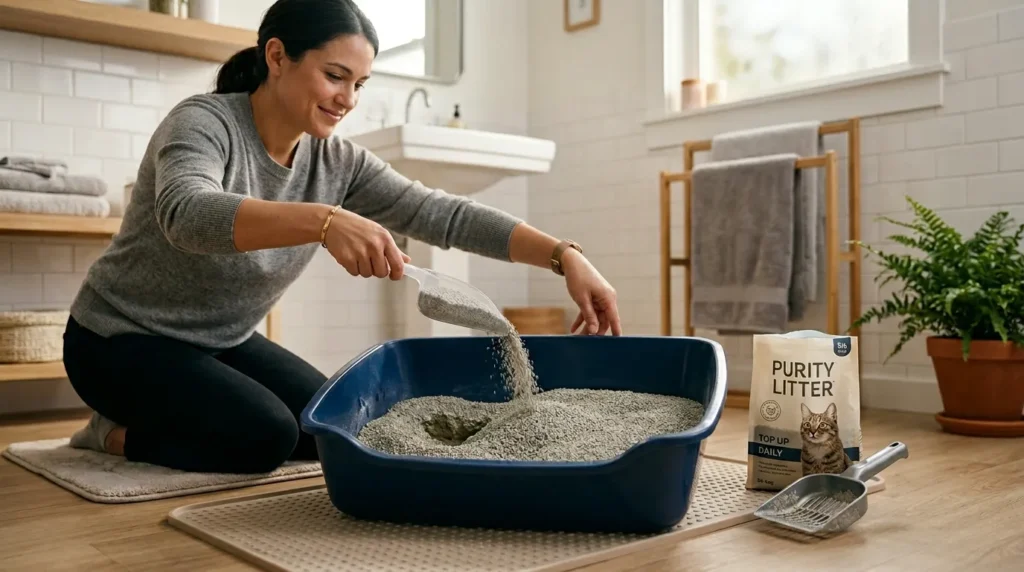
Litter maintenance covers more than scooping. Every scoop removes litter along with waste, so the depth drops daily. A box that started at 3 inches falls to 2 inches after two or three days of scooping without a top-up. At 1.5 inches the box starts failing your cat no matter how clean it is.
The fix is quick. After every scoop, add a small amount of fresh litter to restore the original depth. It takes ten seconds and about a quarter cup of litter, and it means a full change is only needed once every one to two weeks for most cats.
Here is a simple routine:
| Task | How Often | What It Protects |
| Scoop clumps and solid waste | At least once a day | Odor control and a clean digging surface |
| Top up to your tape line | After every scoop | Consistent depth |
| Dump all litter and wash the box with mild soap and water | Every 1 to 2 weeks (clumping); every few days to once a week (non-clumping) | Compacted old litter at the box bottom |
| Replace a plastic box | Every 6 to 12 months | Bacteria trapped in scratches |
Non-clumping litter has no clumps to scoop out, so it needs full changes more often than the 1 to 2 week cycle for clumping types. Plastic boxes pick up microscratches from scooping that trap bacteria cleaning doesn’t fully remove, and the box starts to smell to your cat even when it looks clean to you.
According to the Ohio State University Indoor Pet Initiative, consistent litter box maintenance is directly linked to whether cats keep using their boxes reliably. Depth belongs in that routine. Set it once and it drifts.
Insight One thing I noticed over years of managing a litter box is that depth matters more in warm months. Heat speeds up odor production in the litter, and a thin layer buffers less against it. During summer I keep the depth closer to 3 inches instead of 2, and the box stays fresh noticeably longer between scoops.
The Litter Depth Mistakes That Cause Box Avoidance
1. Not filling the box enough. This is the most common one. Most owners pour by sight and underestimate how much two to three inches looks like in a large box. The cat hits the box bottom while digging and either stops using the box or eliminates just outside it, where the floor feels more stable underfoot.
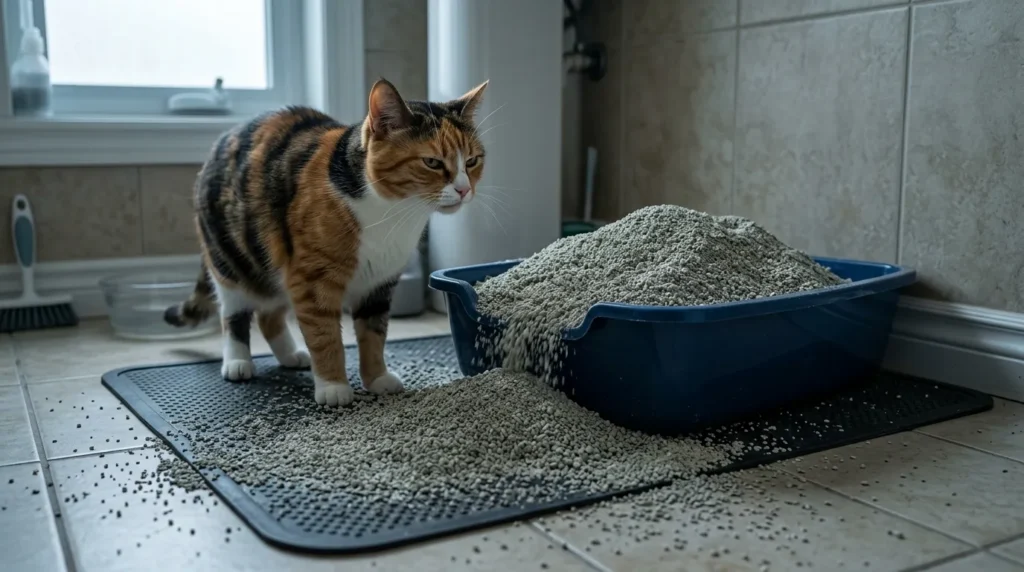
2. Overfilling. Beyond four inches, scatter climbs fast because the cat displaces a larger volume while digging, and the extra litter lands on the floor around the box. The bottom layer also compacts into a dense mass that resists the scoop. Past 4 inches, extra litter buys you mess and a faster-shrinking bag, nothing else.
3. Letting depth drop without topping up. An owner who scoops diligently but never adds fresh litter watches the depth slide from three inches to one over two weeks. The cat lives with a worse box every day, and the owner wonders why the problem showed up when nothing changed. The depth changed.
Signs Your Litter Depth Is Wrong
| What You See | Likely Cause | Fix |
| Divots or bare patches where the box floor shows | Too shallow | Add litter to at least 2 inches |
| Flat urine pancakes stuck to the bottom | Too shallow for clumping litter | Raise to 3 to 4 inches |
| Cat eliminates right beside the box | Often too shallow | Measure and correct depth, then check the other causes below |
| Litter scattered across a wide area of floor | Too deep (over 4 inches) | Scoop out to 3 inches |
| Litter matted into fur around the hindquarters | Too deep for a long-haired cat | Drop to 1.5 to 2 inches |
| Bottom layer packed into a hard mass | Too deep or overdue for a full change | Dump, wash and refill to target |
When Litter Depth Is Not the Problem and a Vet Visit Is
Correct depth doesn’t cure every case of box avoidance. Before you assume a medical cause, rule out the other common ones:
- Box size: the box should be about 1.5 times your cat’s length, nose to base of tail.
- Cleanliness: scoop at least daily and do full changes on schedule.
- A recent litter switch: mix new litter into the old over a week or more instead of swapping overnight.
- Location: the spot should be quiet, easy to reach and away from noisy appliances and food bowls.
- A hooded box: some cats dislike covers because odor stays trapped inside.
- Other cats or household changes: a new pet, a move or a shift in routine can all push a cat off the box.
A cat that keeps avoiding the box after you’ve corrected the depth, cleaned the box and confirmed the placement is quiet and accessible may be showing medical symptoms rather than behavioral ones. At that stage the cause is more likely health than setup. Urinary tract infections, kidney disease, bladder crystals and diabetes all change litter box habits in ways that look like a preference problem from the outside.
Watch for a cat that visits the box frequently but produces very little or nothing each time. In male cats this pattern combined with crying or straining points to a possible urinary obstruction, which can be fatal within twenty-four to forty-eight hours without emergency treatment. Do not adjust the litter depth. Go to the vet immediately.
Blood in the litter, unusually strong-smelling urine or a dramatic change in how much your cat drinks and urinates warrants a vet appointment within the week rather than more home adjustments.
This article is for informational purposes only. Always consult your vet if you have concerns about your cat’s health.
Frequently Asked Questions About Cat Litter Depth
How deep should cat litter be in inches?
Most cats do best with 2 to 3 inches of litter. Clumping clay litter works best at 3 to 4 inches because it needs enough mass to form firm, scoopable clumps. Long-haired cats and kittens do better at 1.5 to 2 inches, which keeps litter from matting into fur and makes the box easier to navigate.
How much litter should I put in a litter box?
Enough to reach 2 to 3 inches, or 3 to 4 inches for clumping clay. In a 22 by 17 inch box that’s roughly 13 quarts at 2 inches and 19 quarts at 3 inches, a bit less in practice because the walls slope. Pour, level the surface, measure with a ruler and top up.
How deep should clumping cat litter be?
Aim for 3 to 4 inches. Below 2 inches, urine reaches the box floor and sets into a pancake that’s hard to lift. Check the bag as well, since some brands print their own fill depth.
What happens if cat litter is too shallow?
A cat that hits the box bottom while digging often stops using the box or eliminates beside it. Shallow clumping litter also forms flat urine pancakes that stick to the box bottom instead of lifting out cleanly, which makes maintenance harder and lets odor build faster.
Can cat litter be too deep?
Yes. More than four inches causes excess scatter as the cat displaces a larger volume while digging. The bottom layer also compacts into a dense mass that scoops poorly. Depth beyond three to four inches does nothing for odor control or clumping and creates more mess than it solves.
How do I measure how deep my cat litter is?
Level the litter, push a ruler straight down until it touches the box floor, and read the depth at the surface. Check the center and two corners. Without a ruler, push a clean finger down. If you hit the floor before your second knuckle, the litter is under about 2 inches.
How deep should cat litter be for kittens?
Keep it at 1.5 to 2 inches in a low-entry box. Deeper litter overwhelms small kittens. If your kitten still nibbles litter, ask your vet about non-clumping litter until the habit passes.
How deep should cat litter be for multiple cats?
Keep the same 3 inches or so and add boxes instead of depth. The usual rule is one box per cat plus one extra. Deeper litter in a shared box just increases scatter and compaction.
How deep should litter be in an automatic litter box?
Fill to the line the manufacturer prints inside the box. The mechanism is built around that level, so it overrides the general 2 to 3 inch rule.
How often should I add fresh litter to maintain the right depth?
Top up after every daily scoop to replace the volume removed. That keeps depth consistent without needing a full change more often than every one to two weeks. Do a full change with a mild soap wash on that schedule regardless of how clean the litter looks. Non-clumping litter needs full changes more often.
Does litter depth affect odor control?
Yes. Litter that’s too shallow can’t absorb urine fully before it reaches the box bottom, where it concentrates and smells stronger than properly absorbed waste. Holding 2 to 3 inches lets the litter absorb and neutralize odor at the right depth. If odor problems persist despite correct depth and regular scooping, consult your vet to rule out a urinary issue.
Conclusion
Most cats need 2 to 3 inches of litter, and clumping clay performs best at 3 to 4. Go shallower for long-haired cats, kittens and seniors, and deeper for large, heavy diggers. Top up after every scoop, mark a tape line on the box wall so you can see the target at a glance, and follow the printed fill line on automatic boxes. Tonight, push a ruler into your current litter. If it reads under 2 inches, add more. For box size, type and placement, see our guide to indoor cat litter box setup and maintenance, and if space is tight, see where to put a litter box in a small apartment.
Cat litter should be 2 to 3 inches deep for most adult cats. Clumping clay litter performs best at 3 to 4 inches to form firm, scoopable clumps. Long-haired cats, kittens and seniors do better at 1.5 to 2 inches to prevent fur matting and make the box easier to enter. Large, heavy cats need 3 to 4 inches to offset the compression from their weight. Multiple cats need more boxes, not deeper litter. Automatic boxes follow the manufacturer’s fill line. Measure with a ruler pushed straight down, and top up after every daily scoop to hold the depth steady. Litter that’s too shallow causes box avoidance and urine pancakes at the box bottom. Litter deeper than 4 inches causes excess scatter without improving performance.

Written by Mishu
A passionate cat lover and indoor living enthusiast, Mishu is the founder and voice behind Indoor Living Cat – a go-to resource for cat owners who want to create the happiest, healthiest life for their feline companions indoors.
View Full Profile