
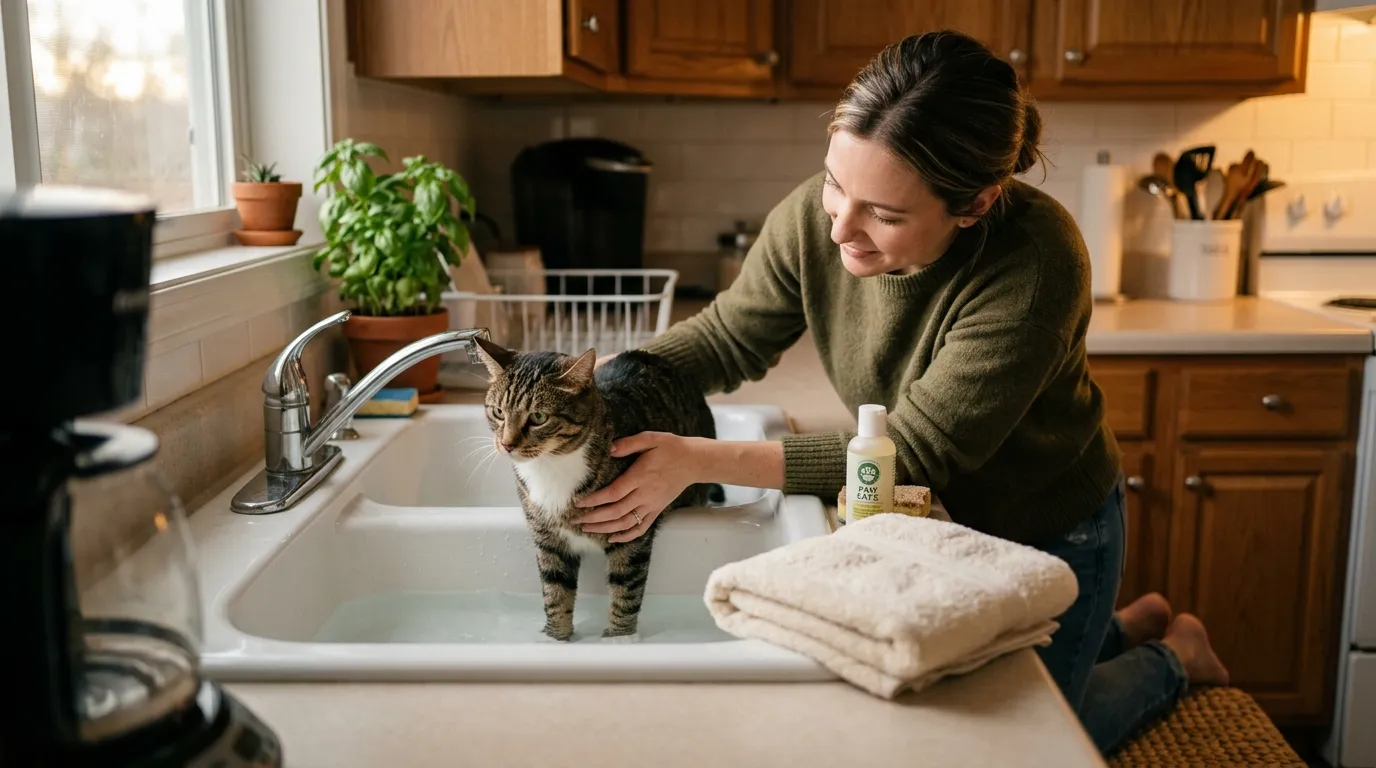
My cat has needed a real bath twice in seven years of living indoors, and both times I made it worse by rushing. Learning how to bathe a cat that hates water comes down to pace. Fill the sink before she comes in. Have everything within reach before you touch her. The water rarely causes the panic. What does is not knowing what happens next. This guide covers the full wet bath method, waterless options that handle most messes, ways to keep a scratchy cat and your forearms intact, and a 21-day desensitization plan for cats who hit threat level red at the sight of a faucet.
Quick answer: To bathe a cat that hates water, fill a sink with two to three inches of lukewarm water (about 100 to 102°F) before she enters the room, put a non-slip mat under her feet, pour water over her body with a cup instead of running the faucet, and wash with cat-specific shampoo. Keep water off her face, rinse until the water runs clear, and dry her fully in a warm room. Most indoor cats need this once or twice a year at most, and many never do. If she screams, freezes or bites, stop and switch to a waterless method.
Bath at a glance
| Detail | Target |
| Water depth | 2 to 3 inches, faucet off |
| Water temperature | Lukewarm, about 100 to 102°F, tested on your wrist |
| Total time | 10 to 15 minutes for a calm cat; stop early if she’s past her limit |
| Prep the day before | Trim nails, brush out tangles |
| Shampoo | Cat-specific only, rinsed until water runs clear |
| Helper | One person holds and soothes, one washes |
Do Indoor Cats Actually Need Baths and How Often?
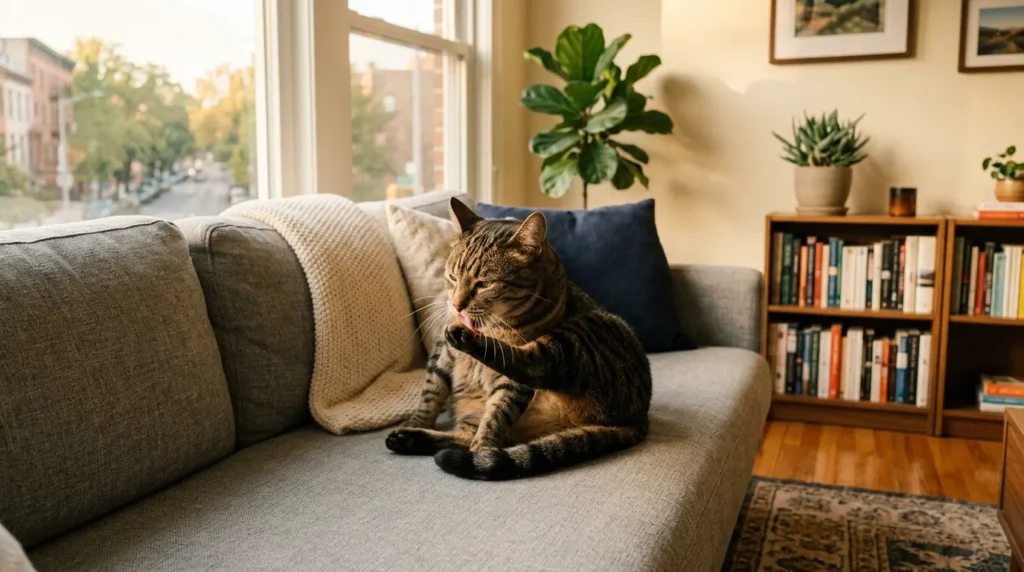
Most indoor cats never need a full wet bath. Their tongues and daily grooming keep them cleaner than owners expect, and an indoor life means no mud, soil or outdoor debris to justify a schedule. According to Cornell Feline Health Center, healthy adult cats are fastidious self-groomers, and bathing them without a reason can strip natural oils from the coat and dry out the skin.
A bath makes sense in a short list of situations:
- Sticky, oily or toxic substances. She’ll lick it off, and that isn’t safe. If you suspect a toxin, call your vet or a pet poison hotline while you wash.
- Senior or overweight cats who can no longer reach their lower back and the base of the tail.
- Long-haired cats with mats. Brush or trim the mats out first, because water tightens them. Then a bath can handle the rest.
- A skin condition where your vet has prescribed a medicated shampoo.
“I just feel like she should be cleaner” doesn’t make the list.
| Situation | How Often |
| Healthy short-haired indoor cat | Once or twice a year at most, and many never need one |
| Long-haired indoor cat | Only as needed, after mats are brushed or trimmed out |
| Senior or overweight cat who can’t reach her back end | Wipes for routine cleanup, a full bath only when wipes can’t cope |
| Cat on a vet-prescribed medicated shampoo | On the schedule your vet gives you |
Understanding your cat’s full indoor care routine shows you what regular grooming already covers, so a bath stays an exception and never becomes a calendar item.
Why Cats Hate Baths (and Why Some Don’t)?
Wet fur gets heavy and cold. A sink floor is slick. Being held in place takes away the one thing cats rely on, which is control. Add the roar of a running faucet and refusing makes sense. Fear of the unpredictable drives most of the panic, and that part is fixable with a set routine, a calm setup and short sessions.
You’ll often read that cats hate water because their ancestors came from dry regions. That’s a common theory, and I haven’t seen it proven. The practical causes above are enough to explain the behavior.
Some cats don’t mind water at all. Veterinarians at Oakland Veterinary Referral Services point out that some cats enjoy it, especially in hot climates, and that arthritic cats sometimes like a warm bath. Turkish Vans and many Bengals are the usual examples of cats that seek water out. If yours has never flinched at a dripping tap, count yourself lucky and still follow the steps below.
| What Bothers Her | What Helps |
| Slippery footing | Non-slip mat or folded towel |
| Running faucet noise | Fill the sink first and shut the water off |
| Heavy, cold wet fur | Lukewarm water, warm room, fast drying |
| Being held down | Gentle support under the chest, no scruffing |
| Not knowing what’s next | Same routine every time, short sessions, treats |
No-Water Alternatives That Work Better Than a Bath
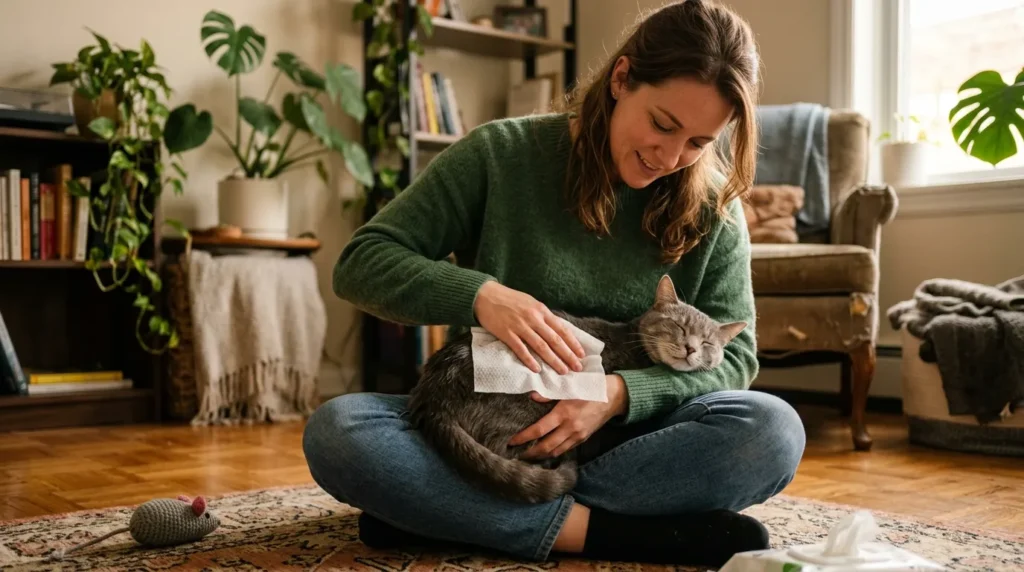
Waterless shampoo in foam or spray form is the most practical tool for most indoor cat cleanups. Work it through the coat with your fingers or a brush, let it sit for a minute, then towel it off. It lifts light dirt, cuts odor and reduces dander with no water involved. Most cats tolerate it far better than a sink bath because it feels like petting, not dunking. Pick a product labeled for cats, and try it on a small patch first.
| Method | Best For | Cat Tolerance | Time Required |
| Grooming wipes | Spot cleaning, paws, rear | Very high | 2 to 5 minutes |
| Waterless foam shampoo | Full coat refresh, light dirt | High | 5 to 10 minutes |
| Grooming glove | Loose fur and light surface dust | Highest | 5 minutes |
| Damp washcloth spot clean | One dirty patch, faces, paws | High | 2 to 3 minutes |
| Wet bath | Oily substances, toxins, heavy soiling | Low | 20 to 30 minutes |
Grooming wipes handle localized messes on paws, ears and rear ends. Grooming gloves pick up loose fur and surface dust with no product at all, and most cats read them as petting. For the bulk of indoor cat situations, one of these ends the cleaning problem without any stress from water.
A thorough brushing routine removes more dead skin, loose fur and surface debris than most owners expect, and it covers a large share of what people would otherwise bathe for. A cat who gets brushed consistently needs a wet bath even less often.
The Real Answer: If you’ve never bathed your indoor cat and you’re wondering whether to start, the answer is almost certainly no. Begin with waterless options and a good brushing routine. Save the wet bath for real necessity.
How to Clean Specific Messes Without a Full Bath?
Most “my cat needs a bath” moments are one dirty patch. Match the mess to the smallest fix.
| Mess | Smallest Fix | Call Someone If |
| Poop stuck on fur or rear end | Soften with a warm damp washcloth, then wipe with cat wipes. Pat dry. | It’s matted into the skin, or she has diarrhea that keeps coming back (vet). |
| Litter on paws and belly | Grooming glove or damp cloth | She won’t stop licking her paws (vet check). |
| Urine on fur | Wipe with a damp cloth, then wipes or waterless foam | She’s straining, going often or has blood in urine (urgent vet visit). |
| Oil, grease or something sticky | Full wet bath is the right tool. Stop her licking it. | You don’t know what it is. Call your vet or a pet poison hotline. |
| Flea dirt (black specks) | Flea comb, then talk to your vet about prevention | Always. Fleas need a treatment plan, not just a wash. |
Getting Ready Before Water Touches Your Cat
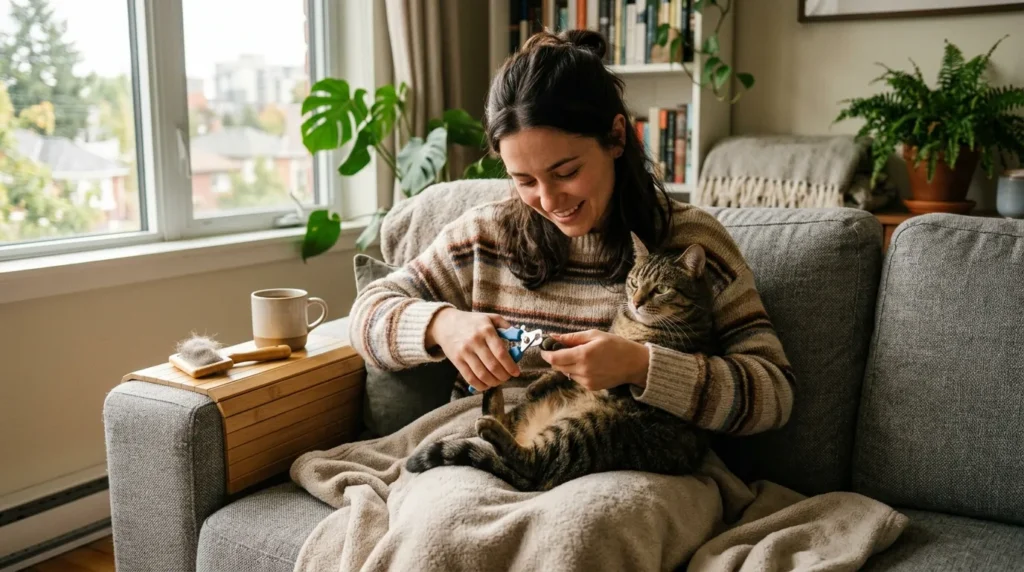
Trim nails the day before the bath, not on bath day. A cat with freshly trimmed nails who grabs your arm in a panic does far less damage than one with full claws. Filing the tips after clipping dulls them further. Brush her before the bath too. Loose fur and tangles tighten into impossible mats once wet, and that turns a manageable coat into a job that takes hours.
Timing matters as much as gear. A cat who just finished a play session and a meal is relaxed and a little sleepy, and that’s your window. A cat who’s been waiting by the door, chattering at birds or stalking a toy is at peak alertness and will treat the bath as a threat to be countered on the spot. Some owners plug a synthetic feline pheromone diffuser into the bathroom an hour ahead. Evidence for these is mixed, so treat it as a bonus and never as the plan.
Reading your cat’s behavioral signals around alertness and relaxation tells you when her body is ready for something mildly stressful, as opposed to when you’d just like to get it over with.
Bath Supplies Checklist
The moment you reach for something with one hand on a wet cat is the moment the bath goes wrong. Lay out all of this first:
- A non-slip mat or folded towel for the bottom of the sink or tub
- A small cup or pitcher for pouring (skip the spray hose)
- Cat-specific shampoo, already open
- A soft washcloth for her face
- Two or three towels: one on the floor, one for wrapping, one spare
- A pile of treats she loves, ready to grab one-handed
- A long-sleeved shirt you don’t mind ruining
- A second person, if you have one
Close the bathroom door before she comes in. A soapy cat loose in the house leaves a trail you’ll be cleaning for a week.
Which Shampoo to Pick and Which to Skip
| Pick | Skip |
| Shampoo labeled for cats | Human shampoo, baby shampoo and dog shampoo |
| Fragrance-free or lightly scented formulas | Anything with tea tree oil, which is toxic to cats |
| A vet-recommended medicated shampoo if she has a skin condition | Dog flea products containing permethrin, which is toxic to cats |
| Cat-safe conditioner if your vet suggests one | Dish soap, except as a one-time emergency wash |
Sink, Tub or Two Basins
| Setup | Works Best For | Watch Out For |
| Bathroom or kitchen sink | Small to medium cats, solo baths | Tight space, faucet hardware, a cat who can leap to the counter |
| Bathtub | Large or heavy cats, two-person baths | Slick surface, more room to bolt, a sore back for you |
| Two basins or buckets | Cats who panic when water is poured on them | Two containers of warm water to fill and carry before you start |
How to Bathe a Cat That Hates Water: The 6-Step Method
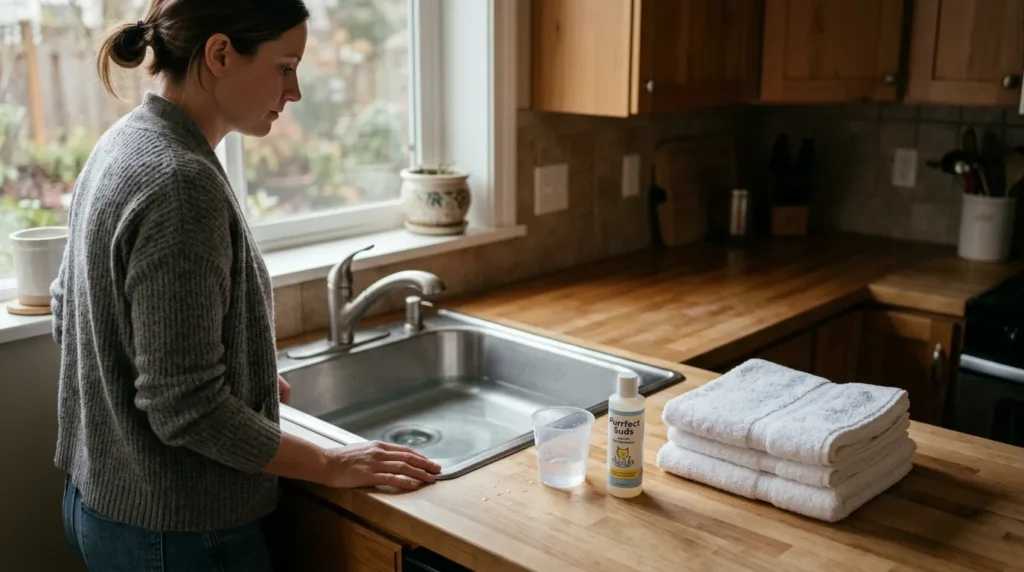
Preparation beats technique. Water already in the sink, shampoo already open, towels already unfolded. Then start.
Step 1: Set up the sink. Put a non-slip mat or folded towel on the bottom, then fill it with two to three inches of lukewarm water before your cat is in the room. Cats hate slick footing, and a mat gives her something to grip. Shut the faucet off completely, because running water alarms most cats. Test the temperature on your wrist. It should feel comfortably warm and never hot.
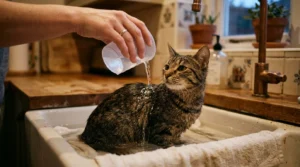
Step 2: Lower her in slowly. Carry her to the sink instead of calling her over, so “come here” never starts to mean “bath time.” Keep one hand on her at all times. Talk quietly and move slowly. Let her feel the water on her paws before anything else touches her.
Step 3: Wet her with the cup. Pour water gradually over her back and sides, working from the base of the neck toward the tail. Don’t forget the belly and under the tail. Never spray at the face and keep water out of her ears. For the face, use a damp washcloth with no soap.
Step 4: Shampoo. Squeeze a small amount of cat-specific shampoo into your palm, then work it through the coat with your fingers. Human shampoo is formulated for a different skin chemistry, and even one use can leave a cat’s skin flaky and itchy for days.
Step 5: Rinse until the water runs clear. Keep pouring with the cup until the coat no longer feels slippery. Leftover residue itches, and she’ll lick it off and swallow it.
Step 6: Wrap and reward. Lift her straight into a warm, dry towel and hold her for a moment. Offer a treat before she leaves the towel. Ending the bath on something good matters more than any other step.
If the water gets cloudy or cool partway through, drain it and refill with fresh lukewarm water for the rinse. Soapy standing water works against you.
How to Dry a Cat After a Bath
Blot with the towel instead of rubbing, especially on long fur, where rubbing creates tangles. Swap to a dry towel once the first one is soaked. Keep her in a warm room afterward, because a damp cat chills fast and kittens lose heat fastest of all.
Use a hair dryer only if she already tolerates the sound. Set it to the lowest speed and low heat, and hold it about a foot from her coat. If she hates it, skip it. Leave her in the warm bathroom with the door closed until she’s dry to the touch, and check the thick fur around the neck, armpits and base of the tail, which stay damp longest.
After the bath
- Let her groom. A cat who licks herself afterward is settling down, so don’t stop her unless you used a medicated product.
- Offer a short play session or a favorite meal to reset her mood.
- Look at her skin the next day. Redness, flaking or scratching points to shampoo residue or a skin issue, so call your vet if it doesn’t clear.
How to Bathe a Cat Who Scratches or Won’t Stay in the Sink
A second person changes everything. One of you holds and talks while the other washes. The holder supports her chest with one hand and steadies her shoulders with the other. Skip the scruff. Feline veterinary groups, including the AAFP and ISFM, discourage scruffing for routine restraint because it adds fear.
Wear long sleeves, and thick rubber gloves if you’re comfortable washing in them. Keep the session short. Watch her body, not the clock, and stop at the first signs in the table further down. If she’s mildly resistant, a towel wrap (the “kitty burrito,” covered in the FAQ) can help for wipes or a partial wash. Solo bathers with a squirmy cat should shorten the plan: wash the dirty area only, and use waterless methods for the rest.
Special Cases: Long-Haired, Senior and Recovering Cats
| Cat | What Changes |
| Long-haired (Persian, Maine Coon, Ragdoll) | Brush out every tangle first. Allow extra rinse time because thick coats hold shampoo. Blot dry in sections. Heavy mats belong with a groomer. |
| Senior or arthritic | Support her whole body, use a deep padded mat and keep it fast. Some arthritic cats enjoy warm water, but ask your vet about joint pain before you start. |
| Kitten | Spot clean with a warm damp cloth. Ask your vet before a full bath, then dry and warm her completely. |
| Recovering from surgery or wearing stitches | Don’t bathe until your vet says the incision can get wet. |
| Sick, weak or underweight | Skip the bath and call your vet. Stress and chilling carry more risk than a dirty coat. |
How to Desensitize a Cat Who Currently Panics at Water
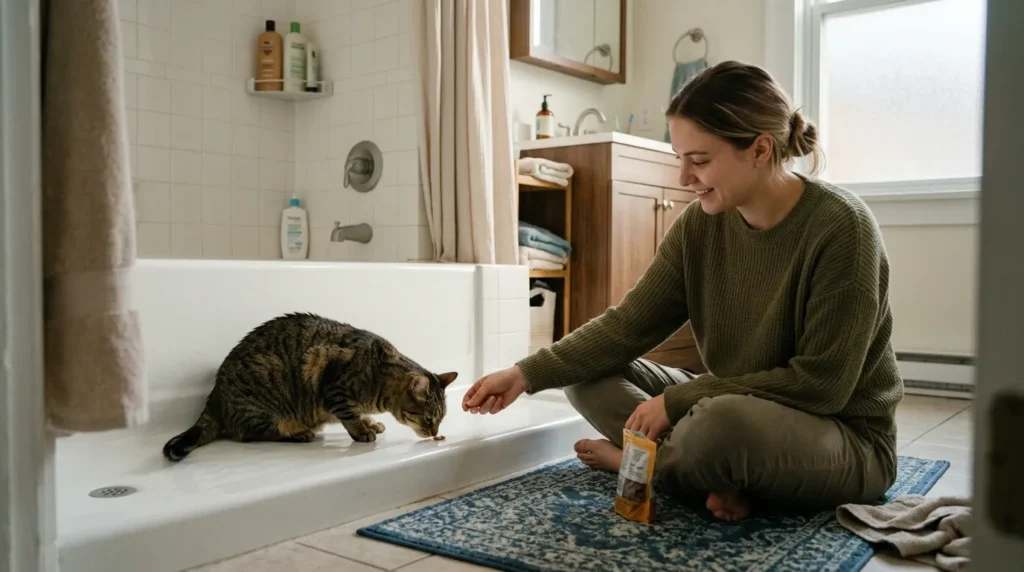
A cat who hides at the sound of a faucet needs desensitization before any bath attempt. This step can’t be skipped or rushed. Forcing a bath on a panicked cat builds a fear response that makes every later bath harder. Keep each session under five minutes and end it while she’s still calm.
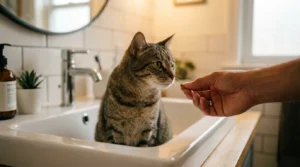
Days one through five: place treats in the dry sink or bathtub and let your cat find them. Do nothing else. You’re teaching her that this space reliably produces good things. Keep the faucet off for this whole phase.
Days six through ten: turn the faucet on at a low flow for a few seconds while she eats nearby. Don’t put her in the water. The goal is to link the sound of running water with the treat session and nothing else.
Days eleven through fifteen: put a small amount of water in the sink, set her paws in it briefly while offering a treat, and lift her out before she resists. Floating a favorite toy in an inch of water can spark curiosity. End every session before she decides she wants to leave.
Days sixteen through twenty-one: try a very shallow full bath with constant treats and calm narration. Twenty-one days is the minimum. Some cats take six weeks, and that’s fine.
Move to the next phase only when she:
- Takes treats within seconds of entering the space
- Keeps a loose body, with ears forward or neutral and a relaxed tail
- Stays put when the faucet runs
If she misses any of those, repeat the current phase for a few more days.
The Mistake That Turns Every Bath Into a Battle
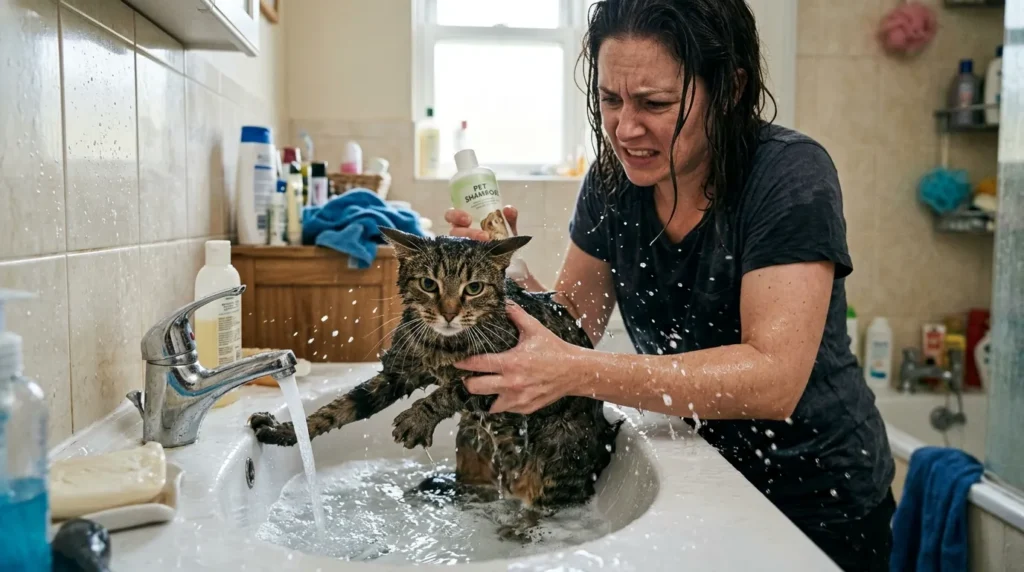
Pushing on when the cat is clearly done wrecks more baths than anything else. A cat who freezes, growls, goes rigid or starts vocalizing has reached her limit. Continuing past that point teaches her that baths are something to fight her way out of, and she’ll remember.
| What You See | What to Do |
| Ears flat, tail thrashing, tense body, tries to climb out | Slow down, lower your voice, offer a treat, and finish the current step only |
| Freezing, growling, or loud sustained yowling | Stop, rinse what you can, wrap her in a towel and end the session |
| Claws out, biting, or flailing hard enough to hurt her or you | Stop now and use waterless methods or a professional |
| Open-mouth breathing or panting | Stop, let her rest somewhere warm and quiet, and call your vet if it doesn’t settle |
The second mistake comes from convenience. People grab human shampoo or dish soap because it’s already under the sink. One use can dry out a cat’s skin and leave it flaking and itchy for days. Cat-specific shampoo is cheap, and your cat’s skin will show the difference.
The third is skipping the prep. Untrimmed nails, no mat, a cold room and a missing towel each add a small stress, and a stressed cat stacks them up fast.
Keeping your cat’s enrichment routine consistent between baths matters more than people expect. A mentally engaged, active cat handles the mild stress of an occasional bath far better than a bored one who treats every surprise as a crisis. Her daily life shapes her tolerance for grooming as much as the grooming itself.
When a Greasy or Matted Coat Points to a Vet Visit, Not a Bath
A coat that turns greasy, dull or matted in a cat who never had coat problems is a health signal. Arthritis, dental pain, obesity and illness can all stop a cat from grooming properly, and the coat shows it first. Good indoor cat health monitoring means watching the coat between baths. Keeping track of what she eats and checking litter box output alongside coat changes gives you a fuller picture. Call your vet if the change lasts more than a few days or comes with appetite or litter box changes.
Adding scratching surfaces and vertical space also helps healthy cats self-groom, since they give her something to rub and stretch against.
When to Stop and Let a Professional Handle It
Some cats aren’t candidates for home bathing no matter how much desensitization you put in. A cat who bites hard, draws blood or injures herself during bath attempts needs professional handling, not more patient repetition at home. Professional groomers have training and equipment for low-stress restraint that most owners can’t replicate.
- Call your vet for medicated baths, skin conditions, a suspected toxin, or a cat whose fear looks like more than stubbornness.
- Call a groomer for heavy mats or a healthy cat who fights at home. Ask whether they groom cats regularly and tell them about her history with baths.
Medical baths with prescription shampoo need more thoroughness than a routine clean. Most require the product to sit on the skin for a set time, and a resistant cat at home rarely allows that. A vet or groomer can make sure the shampoo does its job.
This article is for informational purposes only. Always consult your vet if you have concerns about your cat’s health.
Frequently Asked Questions About Bathing Cats That Hate Water
How often should I bathe my indoor cat?
Most healthy indoor cats need a bath once or twice a year at most, and many never need one. If yours is healthy, self-grooming consistently and staying out of messy substances, waterless wipes and regular brushing cover everything. Bathing more often than necessary strips the coat’s natural oils and dries out the skin.
Why do cats hate water?
Wet fur is heavy and cold, wet floors are slippery, and being restrained removes a cat’s sense of control. Some cats enjoy water, so the dislike isn’t universal. Fear of the unknown does most of the work, which is why routine and short sessions help.
How do I bathe a cat without getting scratched?
Trim her nails the day before, put a non-slip mat under her feet, wear long sleeves and get a helper if you can. Keep the session short and stop at the first hard warning signs. Most scratches happen when a cat can’t get traction or when the bath drags on past her limit.
Can I bathe a cat by myself?
Yes, if she’s only mildly resistant. Set up everything first, use a sink, and keep one hand on her at all times. If she starts to fight, wash only the dirty area and use waterless methods for the rest, or wait until someone can help.
How warm should the water be for a cat bath?
Lukewarm, close to a cat’s own body temperature, which is about 100 to 102°F. Test it on your wrist. It should feel comfortably warm and never hot. Cats don’t sweat like people do, so hot water can overheat them, and cold water leaves them chilled and miserable.
How long does a cat bath take?
About 10 to 15 minutes from lowering her in to wrapping her in a towel, if everything is set up first. Cut it short the moment she hits her limit. A finished short bath beats a perfect long one that ends in a fight.
Can I use dish soap to bathe my cat in an emergency?
Once, yes, in a real emergency such as a greasy or sticky coat with no cat shampoo in the house. Many vets accept a single wash with plain, unscented dish soap, rinsed until no residue remains. It strips skin oils, so don’t repeat it, and follow up with cat-specific shampoo as soon as you can. It also won’t fix fleas, since it washes off adult fleas but leaves the eggs and larvae in your home. Kittens and cats with skin problems need a vet’s okay first.
Can I use baby shampoo or human shampoo on a cat?
Skip both. Human and baby shampoos are made for a different skin pH, and they can leave a cat’s skin dry and itchy. Cat-specific shampoo costs little and avoids the problem.
Can I bathe a cat that has fleas?
A bath removes adult fleas from the cat and does nothing about the eggs and larvae in your carpet and bedding. Use a shampoo labeled for cats, never a dog flea product, since permethrin is toxic to cats. Ask your vet which flea preventive to pair with it, and wash bedding and vacuum regularly.
How do I wash a cat’s face?
Use a damp washcloth with plain warm water and no soap. Wipe gently from the nose outward, and keep water out of her eyes, ears and nose.
My cat screams the entire time I try to bathe her. What should I do?
Stop the bath immediately. Sustained loud vocalization means real distress, well beyond ordinary protest. A cat at that stress level gets more afraid, and the next attempt will go worse. Use waterless alternatives for the immediate need and start the 21-day desensitization program before another wet bath.
What is the kitty burrito method and when should I use it?
The kitty burrito wraps a cat snugly in a thick towel with only one paw or area exposed at a time for grooming. It cuts down the scrambling that makes baths dangerous, and it works for mildly resistant cats. A truly panicked or aggressive cat can hurt herself struggling inside a towel, so use it as a last resort and never as a first step.
How do I dry a cat after a bath?
Blot with a warm, dry towel instead of rubbing, then keep her in a warm room until she’s dry to the touch. Use a hair dryer on low speed and low heat only if she already tolerates the noise. Damp cats chill quickly, and kittens chill fastest.
Should I sedate my cat for a bath?
No. Never give a human sedative or sleep aid, and don’t try calming supplements without asking your vet first. If your cat needs regular medical baths and can’t tolerate them, your vet can discuss options after examining her.
Can I bathe a kitten?
Start with a warm, damp cloth for spot cleaning. Very young kittens lose body heat fast, so ask your vet before giving one a full bath, and dry and warm her completely afterward.
Can I bathe a cat after surgery or with stitches?
Not until your vet says so. Water can irritate an incision or introduce bacteria. Ask about waterless cleaning in the meantime.
Are waterless cat shampoos safe and effective?
Yes, when used as directed. Quality waterless shampoos remove light dirt, cut odor and reduce dander without disrupting the coat’s natural oils the way frequent wet bathing can. They can’t replace a wet bath when your cat has gotten into something toxic or heavily soiled, but for routine freshening and dander control in an apartment, they work very well.
To bathe a cat that hates water, fill the sink with two to three inches of lukewarm water before bringing the cat in, put a non-slip mat underneath her, pour with a cup instead of running the faucet, and use cat-specific shampoo only. Most indoor cats need a full wet bath once or twice a year at most. Waterless foam shampoo, grooming wipes and brushing handle the majority of indoor cleaning needs. Fearful cats need at least 21 days of desensitization before a wet bath, and some take six weeks. Never use human shampoo, and stop the bath if a cat screams, bites or breathes with her mouth open.

Written by Mishu
A passionate cat lover and indoor living enthusiast, Mishu is the founder and voice behind Indoor Living Cat – a go-to resource for cat owners who want to create the happiest, healthiest life for their feline companions indoors.
View Full Profile