
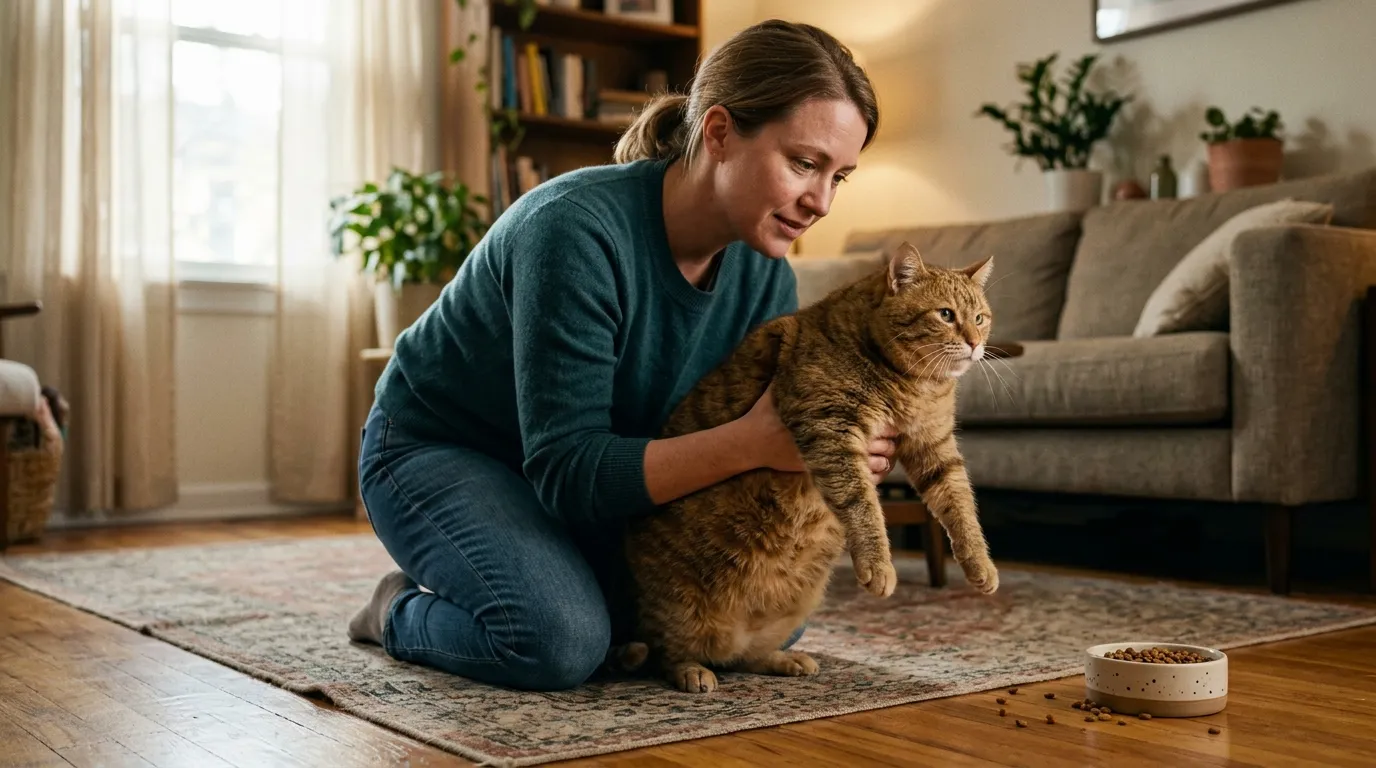
If your indoor cat is overweight, start with a vet visit, swap free feeding for weighed meals, add two short play sessions a day, and aim to lose 0.5 to 1 percent of body weight per week. Don’t cut the food in half overnight. I did, and my cat stopped eating for two days.
Two days was too long to wait it out. A cat that skips food for 24 hours needs a call to the vet, because a cat that stops eating can slide into fatty liver disease fast, and overweight cats are the most exposed. The whole scare was avoidable.
Your cat has probably rounded out over a year or two, slowly enough that nobody noticed until the belly started to sway. This guide covers why indoor cats gain weight, how to check body condition at home, healthy weight ranges by breed, an eight-step plan, calorie and speed targets, what to do when the scale stalls, and when to call the vet.
Quick answer: When your indoor cat is overweight, book a vet check to rule out medical contributors, switch from free feeding to weighed, scheduled meals, move to a higher-protein wet food or a vet-recommended weight-management diet, and play for ten to fifteen minutes before each main meal. Vets work within a range of 0.5 to 2 percent of body weight lost per week. For a home plan, 0.5 to 1 percent is the safer target. Faster than that puts the liver at risk.
Indoor Cat Weight Loss
| Target | What to aim for |
|---|---|
| Safe weight loss rate | 0.5 to 1 percent of body weight per week (vet-supervised plans can reach 2 percent) |
| Time to goal weight | 6 to 12 months for most cats |
| Meals | 2 to 4 measured meals a day, weighed on a kitchen scale |
| Play | Two sessions of 10 to 15 minutes, before meals |
| Treats | Under 10 percent of the daily calories, counted inside the daily total |
| Weigh-ins | Once a week, same scale, same time of day |
| Call the vet | Your cat skips food for 24 hours |
In this guide: Why indoor cats gain weight | Is my cat overweight? | Healthy weight by breed | Health risks | The 8-step plan | How fast to lose weight | Exercise ideas | Seniors and young cats | Common mistakes | Cat not losing weight | When to see the vet | FAQ
Why Indoor Cats Become Overweight More Easily Than Outdoor Cats
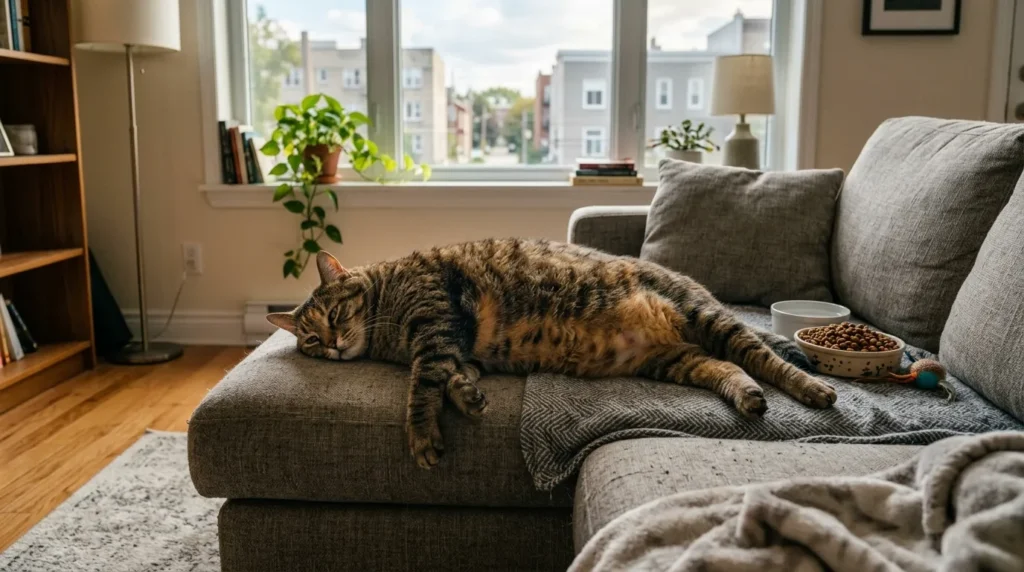
An outdoor cat earns dinner. Stalking, sprinting, climbing and patrolling add up to dozens of short bursts a day, and that adds up to real calorie burn. An apartment cat moves between the sofa, the food bowl and the windowsill, a loop that burns a fraction of what the metabolism expects to process.
Free feeding makes it worse. When dry kibble sits out around the clock, cats eat from boredom and habit, not hunger. An outdoor cat eats after a successful hunt. A bored indoor cat eats because the bowl is there, and the bowl is the most interesting thing in the room.
Neutering or spaying cuts energy needs by roughly 25 to 30 percent, but appetite doesn’t drop with it. Most owners keep pouring the same scoop, and the weight creeps on within months. Stack a sedentary home, the post-surgery drop and a bowl of high-carbohydrate kibble that never empties, and you have the formula behind most overweight indoor cats.
| Cause | What’s happening | Where the fix is |
|---|---|---|
| Free feeding | Constant grazing on calorie-dense kibble | Steps 2 and 4 |
| Spay or neuter | Energy needs drop, portions stay the same | Step 2 |
| Sedentary home | No hunting, patrolling or climbing | Steps 5 and 6 |
| Treats and table scraps | Calories nobody is counting | Step 3 and the Insight box |
| Age | Metabolism slows, the scoop doesn’t shrink | Step 8 and the life stages section |
| Multi-cat household | Sneaking from the other cat’s bowl | Step 7 |
| Boredom and stress | Food becomes the only entertainment in a small space | Steps 4, 5 and 6 |
How to Tell If Your Indoor Cat Is Overweight Without a Scale?
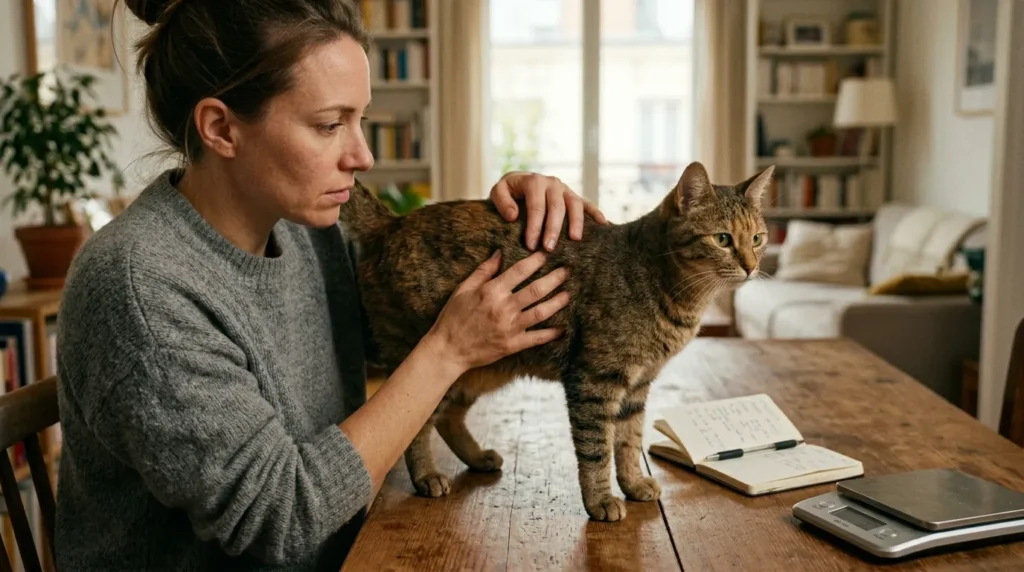
The rib test is the most reliable check you can do at home. Run your fingertips along your cat’s ribcage with light pressure. At a healthy weight you feel individual ribs easily without pressing hard, and you don’t see them sticking out. If you have to press firmly to find ribs through a layer of fat, your cat is overweight. If you can’t find them however hard you press, your cat is obese.
Then look from directly above. A healthy cat has a waist, a visible tuck behind the ribcage. An overweight cat looks like an oval or a barrel. From the side, the belly of an overweight cat hangs lower than the chest instead of tucking up behind the last rib.
Body condition score chart
Vets score cats on a 9-point body condition scale, and the target is a 5, with 4 to 5 counting as healthy. Here’s how the bands look at home.
| Score | Category | What you see and feel |
|---|---|---|
| 1 to 3 | Underweight | Ribs, spine and hip bones easy to see, no fat cover |
| 4 to 5 | Ideal | Ribs easy to feel under a thin layer of fat, clear waist from above, slight belly tuck |
| 6 to 7 | Overweight | Ribs need pressure to find, waist barely visible, rounded belly with a fat pad |
| 8 to 9 | Obese | Ribs can’t be felt, no waist, belly sags, fat over the lower back and face |
In numbers, a cat is commonly called overweight at roughly 10 to 20 percent above ideal weight and obese at 20 percent or more. A cat with an ideal weight of 10 pounds is overweight at 11 to 12 pounds and obese at 12 pounds and up. Your vet sets the real ideal weight, because frame size changes it.
Owners tend to guess low. In the Association for Pet Obesity Prevention’s 2022 survey, 28 percent of owners called their cat normal weight when a vet scored the same cat overweight or obese. If your gut says “maybe a little chunky,” the rib test probably says more.
Belly fat or a primordial pouch?
Many cats carry a loose flap of skin and fat low on the belly that swings when they walk. It’s called a primordial pouch, and it’s normal, even on lean cats. It feels soft and loose. Belly fat feels firm and pads the whole midsection, ribs and hips included. Let the rib test decide: if you find ribs easily and see a waist from above, the pouch isn’t a weight problem. Long coats hide everything, so trust your fingers over your eyes.
Fat, or a swollen belly?
Fat builds slowly, over months. A belly that swells within days, feels tight or fluid-filled, or comes with lethargy, vomiting or poor appetite is a different problem and needs a vet the same day. Pregnancy in an unspayed female is another explanation. Don’t start a diet on a cat whose belly changed fast.
How much should an indoor cat weigh?
Most adult domestic shorthairs are healthy at 8 to 10 pounds, and a big-framed cat can be fine at 12. Frame size matters more than any chart, which is why the rib and waist checks beat a single number. Your vet can set a target weight for your specific cat.
Healthy Weight Ranges by Breed
Breed changes what “healthy” means. A 14-pound Maine Coon can be lean, while a 14-pound Siamese is badly overweight. These are typical adult ranges, and individual cats vary.
| Breed or type | Typical healthy adult weight |
|---|---|
| Domestic shorthair or longhair | 8 to 10 lb (up to 12 lb for a large frame) |
| Siamese | 8 to 12 lb |
| Russian Blue | 8 to 12 lb |
| Persian | 7 to 12 lb |
| British Shorthair | 8 to 12 lb for females, 12 to 18 lb for males |
| Maine Coon | 8 to 12 lb for females, 13 to 18 lb for males |
| Ragdoll | 10 to 15 lb for females, 15 to 20 lb for males |
Ranges are approximate breed averages. The rib test and your vet’s target weight beat any chart.
Weigh your cat at home
Hold your cat and step on a bathroom scale, note the combined weight, then step on alone and subtract. A digital baby scale reads in smaller increments, which matters when you’re tracking ounces. Write down every reading, because a single number tells you nothing and a month of numbers tells you everything.
Why Excess Weight Matters for an Indoor Cat?
According to the Association for Pet Obesity Prevention, about 61 percent of cats in the United States were classified as overweight or obese in its 2022 survey. The health consequences include diabetes, osteoarthritis, hypertension and a shorter lifespan. A published veterinary review estimates that 13 to 18 percent of feline diabetes cases could be eliminated if overweight cats reached a normal weight.
| Risk | What you might notice |
|---|---|
| Diabetes | More drinking and urinating, weight loss despite a big appetite. See the vet the same week. |
| Osteoarthritis | Jumping less, stiffness after naps, hesitating at stairs or the litter box edge |
| Hypertension | Usually silent, found at the vet with a blood pressure check |
| Grooming and skin trouble | Greasy or matted fur over the lower back and tail base |
| Fatty liver (during rapid loss) | Not eating, vomiting, yellow gums. Same-day vet call. |
| Higher anesthesia risk | Vets take extra care with heavy cats during dental work or surgery |
The everyday signs show up earlier than a diagnosis. A heavy cat jumps less, grooms the lower back poorly and sleeps more. Sore joints also change litter box behavior. A high-sided box becomes an obstacle, and some cats start going elsewhere. If your cat hesitates at the edge of the box, a low-entry covered litter box makes it easier on stiff joints. Extra thirst and urination are different: that combination is a same-week vet visit, because it can point to diabetes.
Indoor Cat Overweight? What to Do in 8 Practical Steps
| Step | Action | Time it takes |
|---|---|---|
| 1 | Vet visit: target weight, calorie number, bloodwork | One appointment |
| 2 | Weighed, scheduled meals | 5 minutes a day |
| 3 | Weight-loss food and a treat budget | 7 to 10 day food switch |
| 4 | Puzzle or slow feeders | Replaces bowl time |
| 5 | Play before meals | Two 10 to 15 minute sessions |
| 6 | Add vertical space | One-time setup |
| 7 | Separate feeding in multi-cat homes | Every meal |
| 8 | Weekly weigh-in and adjustments | 5 minutes a week |
Step 1: Vet visit before any dietary changes. A vet check gives you two numbers you can’t guess: your cat’s target weight and a daily calorie allowance for safe loss. Ask for bloodwork too, since it checks blood sugar, kidney values and liver enzymes. Hormone-driven obesity, like an underactive thyroid, is rare in cats, so food and activity are almost always the cause. Joint pain is the more common finding, and it changes how you plan exercise. The calorie target will probably be lower than you expect. Don’t restrict food until you have both numbers.
Bring to the appointment:
- The food brand and the exact daily amount, plus every treat, topper and table scrap
- Side and top photos of your cat standing
- Any weights you’ve logged at home
Ask the vet: What’s my cat’s target weight? How many calories a day? Which food do you recommend? When do we recheck? Are her joints fit for exercise?
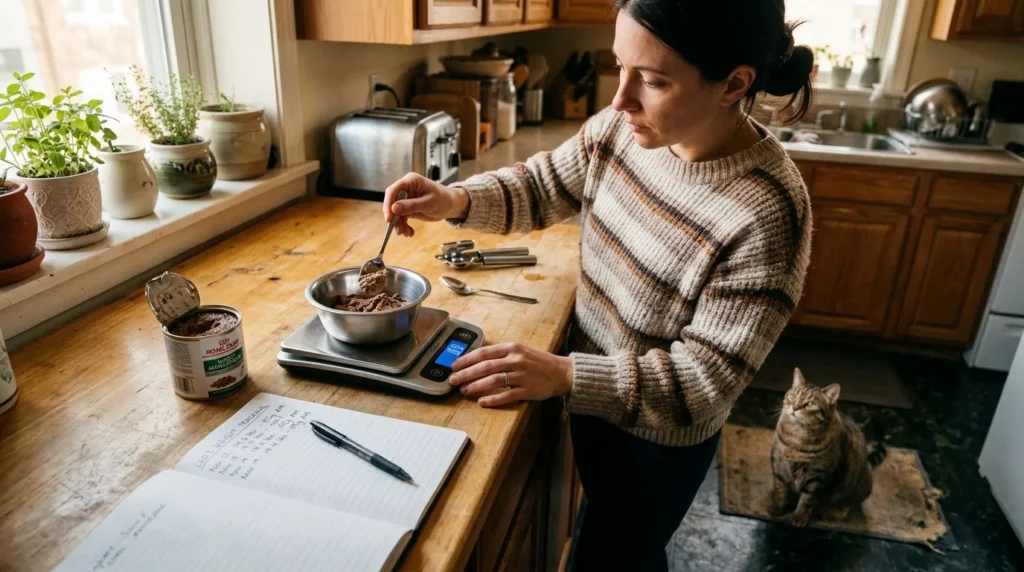
Step 2: Calculate and commit to measured meals. Stop free feeding entirely. Weigh every meal in grams on a digital kitchen scale. Scoops lie: two kibbles with the same “cup” can differ by dozens of calories depending on size and shape. Split the daily amount into two to four meals, since more small meals help a cat that begs. A timed automatic feeder handles the 5 a.m. yowl without you getting out of bed.
How many calories does an overweight indoor cat need?
Most adult indoor cats hold a healthy weight on roughly 180 to 300 calories a day, and the serving size on the bag assumes maintenance, not weight loss. Your vet’s number wins. For a ballpark before the appointment, vets commonly start from resting energy requirement (70 × body weight in kg0.75) for the cat’s target weight, then feed about 80 percent of it.
| Target weight | Resting energy (approx.) | Weight-loss starting point (approx.) |
|---|---|---|
| 8 lb | 185 calories | 150 calories |
| 10 lb | 220 calories | 175 calories |
| 12 lb | 250 calories | 200 calories |
| 14 lb | 280 calories | 225 calories |
These are ballpark figures for a healthy adult cat. Base the plan on your vet’s calorie target, not this table.
Step 3: Choose the right food for weight loss. Wet food delivers more volume per calorie, so a measured meal looks and feels bigger. Higher protein helps a cat hold on to muscle while fat comes off. That’s the case for a high-protein, low-carbohydrate wet food or a vet-recommended weight-management diet over plain adult kibble. For the practical framework of how to combine wet and dry feeding correctly for an indoor cat on a weight management plan, this guide on how to feed an indoor cat properly covers the daily calorie calculations and food type combinations that make the most sense for indoor apartment cats.
| Food option | Why it works | Watch out for |
|---|---|---|
| High-protein wet food | More volume per calorie, adds moisture | Must be weighed, opened cans go in the fridge |
| Weight-management dry food | Convenient, fits puzzle feeders | Calorie-dense, easy to overfeed by the scoop |
| Prescription weight-loss diet (vet only) | Formulated and tested for weight loss, for example Hill’s Prescription Diet Metabolic, Royal Canin Satiety Support or Purina Pro Plan Veterinary Diets OM | Costs more, needs vet approval |
| Regular adult kibble, free-fed | Nothing for weight loss | The setup that caused the problem |
Switch foods over 7 to 10 days by mixing the new food into the old in growing amounts. A cat that refuses the new food for more than a day needs a slower switch, and a cat that refuses all food is a vet call. Count treats inside the daily total and keep them under 10 percent of the calories. A few pieces of the day’s kibble make a perfectly good treat.
Low-calorie treat swaps
| Instead of | Try | Why |
|---|---|---|
| Store-bought treats from the bag | A pinch of the day’s own kibble | Costs nothing extra, already counted |
| Table scraps and licked-clean plates | A small lick of the day’s wet food | Cat gets the reward, you keep the count |
| Dental or cream treats | The same treat, halved or quartered | Check the calories per piece on the label, then subtract them from the meals |
| Food as a greeting or apology | A 60-second wand toy session | Attention without calories |
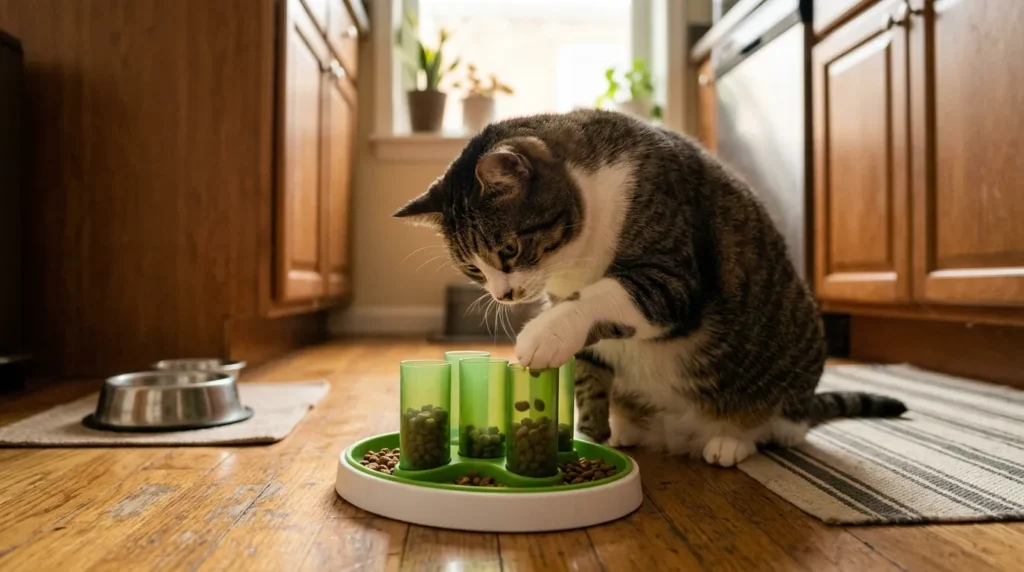
Step 4: Add puzzle feeders and slow feeders. Puzzle feeders do two jobs at once. They slow the eating pace, which cuts the regurgitation that happens when cats eat too fast, and they add mental stimulation and mild activity to every meal. A cat that spends fifteen minutes working a puzzle feeder for the day’s portion has used her paws, her problem-solving instincts and her patience. A thirty-second bowl meal uses none of them.
Start with an easy puzzle. A cat that never solves it quits, so raise the difficulty over a week. Dry kibble suits treat balls and puzzle boards, and wet food spreads on a lick mat. Put the puzzle portion inside the daily total. Don’t add extra food to reward the effort.
Step 5: Add daily structured play before meals. Two sessions of ten to fifteen minutes with a wand toy before each main meal complete the hunt, catch and eat cycle that indoor cats never otherwise get. That sequence produces real post-play satiety instead of the restless between-meal boredom that drives snacking. Play before meals, not after. A cat that just ate has little interest in chasing anything.
A simple session runs like this: two minutes of slow floor dragging to warm up, six to ten minutes of chasing and pouncing, then a slow-down where the toy “tires out.” Let her catch it at the end. Then feed.
Step 6: Add vertical territory to increase daily movement. A cat tree near a window that the cat actually uses daily burns more passive calories than any exercise routine you’ll consciously enforce. Cats that jump, climb and perch move more than cats living entirely at floor level, because vertical movement recruits bigger muscle groups and takes more effort per move. A tree also gives a bored cat somewhere to point her attention besides the kitchen. For specific furniture setups that work well in apartment-sized spaces without overwhelming the room, the guide on best cat furniture for indoor cats covers the configurations that get the most daily use from cats rather than becoming expensive napping shelves.
Step 7: Manage multi-cat households separately. If your overweight cat lives with other cats, feed every meal in separate rooms with the doors closed and pick up the bowls after thirty minutes. Nothing else reliably gets your overweight cat her reduced portion while the others get full maintenance meals. Microchip feeders that open only for the registered cat work if separate rooms aren’t practical. Tell everyone in the household about the plan too, because one person slipping her a handful of kibble undoes a week of measuring.
Step 8: Track progress weekly and adjust gradually. Weigh your cat at the same time every week under the same conditions and write the number down. If the weight holds steady for two weeks on the new ration, the current intake matches her metabolism and isn’t creating a deficit. Cut the daily amount by ten percent and reassess after two more weeks. If she drops faster than 2 percent of her body weight in a week, add back about ten percent of the daily amount and tell your vet. Rapid loss is dangerous for cats, and slower is better.
| Week | Weight (lb) | Change (oz) | Daily food (grams) | Treats given | Notes |
|---|---|---|---|---|---|
| Start | |||||
| 1 | |||||
| 2 | |||||
| 3 | |||||
| 4 |
Sample daily feeding schedule
Here’s one way to spread a 175-calorie day (the 10 lb row in the table above) across four meals. It’s an example, so swap in your vet’s number.
| Time | What happens | Calories |
|---|---|---|
| 7:00 a.m. | Timed feeder or measured wet meal | about 45 |
| 12:00 p.m. | Puzzle feeder with part of the day’s kibble | about 40 |
| 5:30 p.m. | 10 to 15 minutes of wand play, then dinner | about 50 |
| 10:00 p.m. | Small late meal, so she isn’t hungry at 5 a.m. | about 40 |
Insight: The fastest visible change in an overweight indoor cat comes from four weeks with zero extras: no treats, no table scraps, no licked-clean plates, and everything else held constant. Most owners are surprised by how many calories they’d stopped counting. Four weeks of nothing extra alongside measured meals often produces the first steady week-over-week drop without touching the main meals at all.
Your first-week checklist
- ☐ Book the vet visit and note your questions
- ☐ Buy a digital kitchen scale that reads in grams
- ☐ Write down everything your cat eats for three days, treats included
- ☐ Record a starting weight and take side and top photos
- ☐ Take away the free-feed bowl
- ☐ Set up one puzzle feeder
- ☐ Put two play sessions on your calendar
- ☐ Agree on a treat budget with everyone in the house
How Fast Should an Indoor Cat Lose Weight?
Veterinary guidance sits at 0.5 to 2 percent of body weight per week. I’d keep a home plan near the low-to-middle of that range, at 0.5 to 1 percent, and let the vet push it higher if your cat needs it. In pounds, that’s about half a pound to a pound per month for many cats, and a cat that has 3 pounds to lose needs three to six months at minimum. Most cats reach their goal weight in 6 to 12 months.
| Cat’s current weight | 0.5% per week | 1% per week | 2% per week |
|---|---|---|---|
| 10 lb | 0.8 oz | 1.6 oz | 3.2 oz |
| 12 lb | 1.0 oz | 1.9 oz | 3.8 oz |
| 14 lb | 1.1 oz | 2.2 oz | 4.5 oz |
| 16 lb | 1.3 oz | 2.6 oz | 5.1 oz |
| 18 lb | 1.4 oz | 2.9 oz | 5.8 oz |
Look at the middle column. A 12-pound cat losing 1 percent a week drops under 2 ounces, less than a small can of cat food. That’s the pace you’re aiming for, and it’s why a kitchen or baby scale matters. For a cat that weighs 8 to 12 pounds, more than a pound a month is too fast without a vet supervising.
Hepatic lipidosis: the risk of losing weight too fast
Hepatic lipidosis, or fatty liver disease, happens when fat floods the liver faster than it can process it. Cats that eat too little for a few days are at risk, and overweight cats are at the most risk. Call your vet the same day if you see any of these:
- Your cat hasn’t eaten for 24 hours
- Vomiting, hiding or unusual tiredness
- A yellow tint to the gums, ears or whites of the eyes
- Weight dropping faster than 2 percent a week
Exercise Ideas That Work for Overweight Indoor Cats Who Are Not Very Active
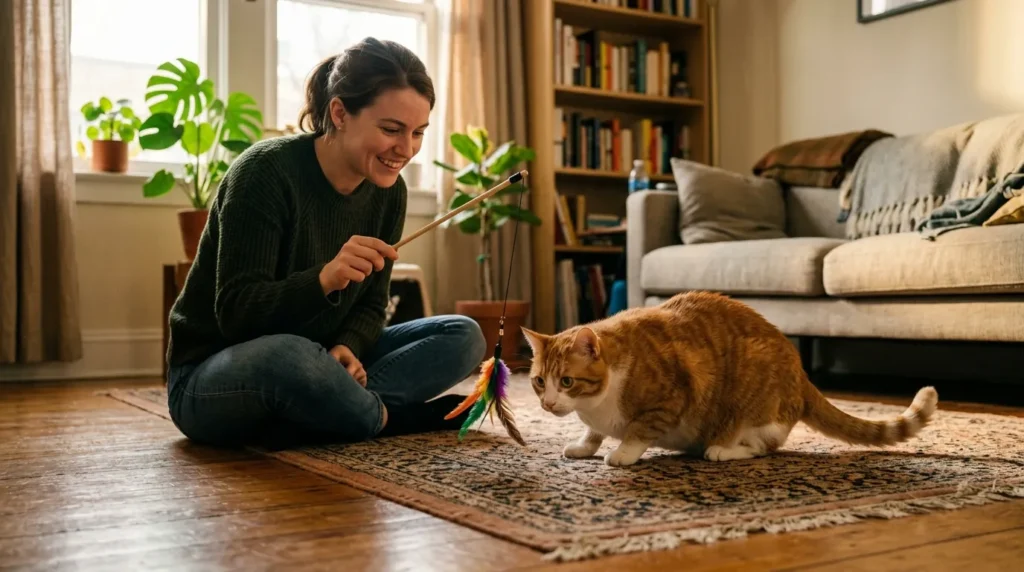
Overweight cats often resist vigorous play at first, because the extra weight makes jumping and running uncomfortable. Start low and build over two to three weeks. A feather wand dragged slowly along the floor triggers crouching and paw-batting. Jumping and running come later, after a few days of that.
| Activity | Effort | How to start |
|---|---|---|
| Slow wand drag | Low | Drag the toy along the floor and let her bat it |
| Scatter feeding | Low | Hide small portions in three spots around the apartment |
| Puzzle feeders | Low | Start with an easy one and raise the difficulty weekly |
| Cat tree and shelves | Medium | Place near a window and put a kibble portion on the top level |
| Wand toy with jumps | Medium | Lift the toy a few inches once she’s chasing well |
| Harness walks | Medium | Weeks of indoor harness practice first |
| Cat wheel | High | Lock it, lure with treats, give her two weeks |
Hiding portions of the daily kibble around the apartment is a zero-effort calorie burner. A cat that walks to three spots to find her meal walks more than a cat fed at one bowl. Scatter small amounts on cat tree platforms, windowsills and low shelves. The movement pairs with the natural foraging pattern, so she gets mental work alongside the physical kind.
Laser pointers burn a lot of energy, but they leave some cats frustrated because there’s nothing to catch. End every laser session by landing the dot on a physical toy or a piece of kibble from the day’s ration.
Cat wheels are the most effective dedicated exercise tool for cats that use them, and plenty of cats never will. Size is the make-or-break spec. Wheels for adult cats run roughly 30 to 50 inches across, and the bigger the cat, the closer you want to be to the top of that range. A wheel that’s too small forces an arched back while she runs, and she’ll either ignore it or strain her spine. Lock the wheel at first, coax her on with treats and expect about two weeks of patience. Skip the wheel entirely until your vet has cleared her joints.
How to exercise a lazy or very heavy cat
A cat who won’t chase anything usually needs a different toy, not more pressure. Try three things before you give up:
- Switch toy types. Some cats ignore feathers and go wild for a crinkly ball on a string, or the reverse.
- Play at dusk or dawn, when cats are naturally most active.
- Keep sessions to three or four minutes at first and add a minute every few days. A cat that quits panting and flopping is done for the day. Open-mouth breathing means stop and call the vet.
Weight Loss for Senior Cats, Young Cats and Kittens
Senior cats. Older cats lose muscle as they age, so a falling number on the scale can mean muscle going and not fat. Keep protein up, weigh every week, and ask your vet to score body condition at each visit. Seniors with kidney disease or diabetes shouldn’t diet without vet supervision.
Young adult cats (1 to 3 years). This is the easiest age to fix. Metabolism is still high and joints are healthy, so play does most of the work. Catch the weight gain before it hits year four.
Kittens. A growing kitten needs enough food to grow, so restriction diets are off the table. If a kitten looks round, ask your vet to score her body condition and adjust portions.
Common Mistakes That Stall Indoor Cat Weight Loss
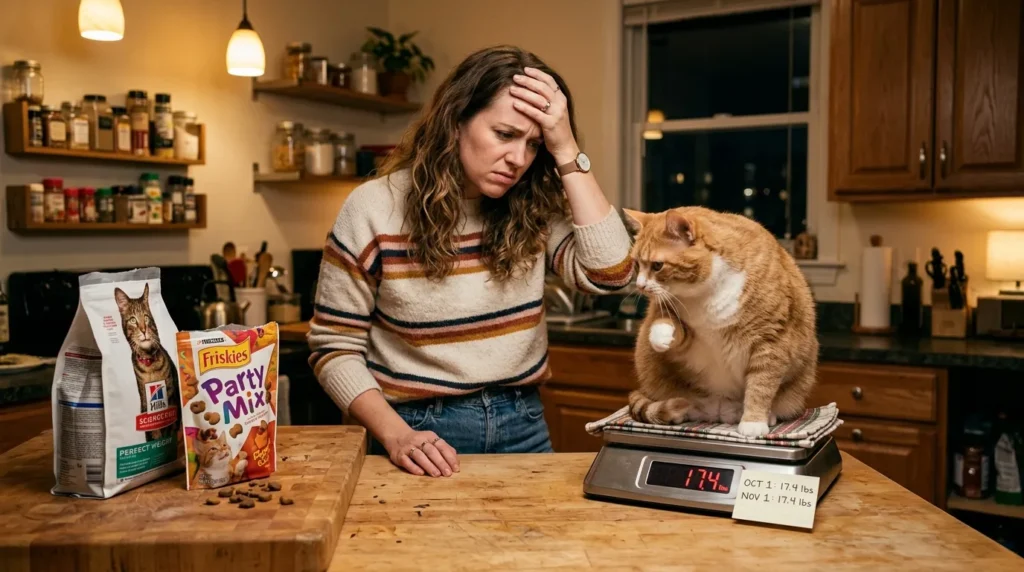
The most common mistake is cutting meal portions while handing out treats freely. Ten treats a day can add fifty to one hundred calories on top of the measured meals, depending on treat size and density. Treats have to count toward the daily total, and their calories come from the packaging, not from a guess.
The second mistake is cutting too fast in week one. Owners who slash portions by thirty to forty percent often trigger food anxiety: the cat fixates on food between meals, begs harder and may refuse the smaller portion in protest. Cut ten to fifteen percent from current intake and give her two weeks to adjust before you decide on more.
The third is expecting progress without more activity. Food restriction alone usually stalls after several weeks, because the body adapts its metabolic rate to the lower intake. Moderate restriction plus daily play produces steadier loss, since the extra calories burned partly offset that adaptation.
Other ways plans stall:
- Measuring by scoop instead of by gram
- Switching foods overnight and getting a food strike
- Letting a partner, kid or neighbor “just give her a little”
- Skipping weigh-ins, so nobody notices the plateau until week eight
- Free-feeding a “light” kibble, which is still free feeding
Cat Not Losing Weight? How to Break a Plateau
| What you see | Likely cause | What to try |
|---|---|---|
| No change after two weeks | Portion still at maintenance, or hidden treats | Weigh food in grams, log every extra for three days, then cut ten percent |
| Loss slows after four to eight weeks | Metabolism adapted to the lower intake | Recheck the calorie target with your vet and add play |
| Weight goes up | Someone else is feeding her, or she’s raiding another bowl | Household agreement, separate rooms at mealtimes |
| Scale drops but she still looks round | Slow fat loss, or muscle loss | Rib test, side and top photos, a vet body condition score |
| Refuses the new food | Switch was too fast | Go slower, and call the vet if she refuses all food |
My cat begs constantly on a diet
Begging is the part that breaks most owners. Smaller, more frequent meals help, so split the daily amount into four. Time the last meal close to bedtime. Use a timed feeder for the early-morning meal so your cat learns that the feeder, not your face, is what produces food. Play before meals and use puzzle feeders to give her something to do besides stare at you. Don’t cave once, because a single reward teaches her to yowl longer next time. If the hunger seems extreme, or she’s losing weight on a normal amount of food, ask your vet about diabetes and thyroid problems.
When an Overweight Indoor Cat Needs a Vet Visit Before Anything Else
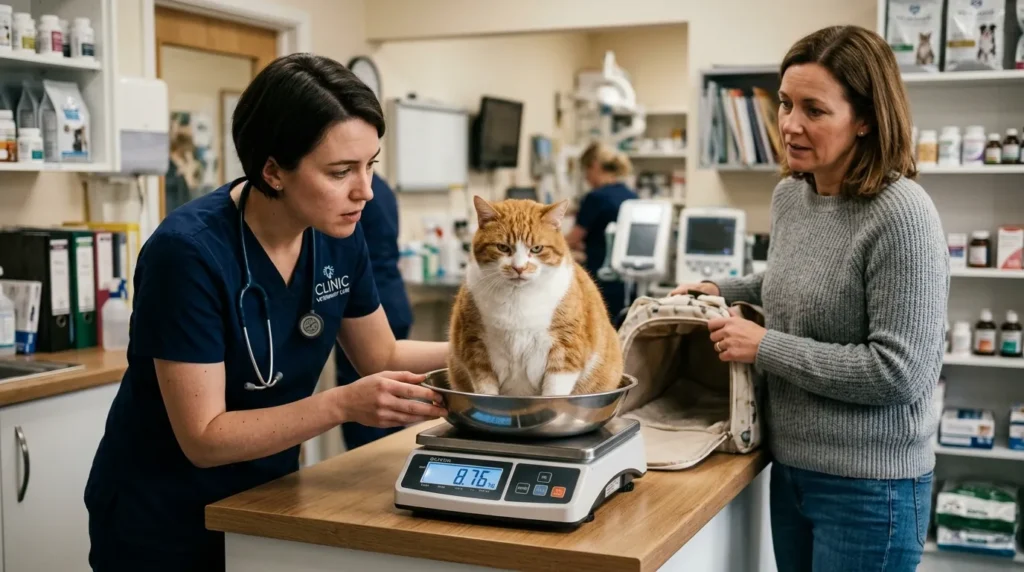
A vet visit before any weight loss plan is non-negotiable for cats that are well past chubby. Cats more than thirty percent above ideal body weight are at risk for conditions that change how the body responds to calorie restriction, including insulin resistance, joint inflammation that makes exercise painful and elevated liver enzymes that show the liver is already under fat-related stress.
The vet assessment gives you the starting data: current weight, target weight, daily calorie goal and any medical conditions that need dietary changes beyond portion control. Senior cats and cats with diabetes or kidney disease shouldn’t go on a diet without that supervision.
A cat that has been heavily overweight for several years also needs bloodwork to check liver and kidney function before any dietary change. Both organs can be affected by long-term excess body fat and may need monitoring while the weight comes off.
See a vet promptly if you notice:
- Sudden weight gain, or a belly that swelled within days
- More drinking and urinating than usual
- Open-mouth breathing or heavy panting after light activity
- Limping, or a sudden refusal to jump
- Any 24-hour stretch without eating
This article is for informational purposes only. Always consult your vet before starting a weight loss plan for your cat, especially if they are heavily overweight.
Keeping the Weight Off After Your Cat Reaches Her Goal
The plan doesn’t end at the goal weight. Once she holds steady for two weeks, raise the daily amount in small steps, about 5 to 10 percent at a time, and weigh her every two weeks until the number stays put. Keep the play sessions. Keep the scale out. Cats that go straight back to a full bowl regain fast, and a second diet is harder than the first.
Frequently Asked Questions About Indoor Cat Obesity and Weight Loss
How long does it take an indoor cat to lose weight safely?
Safe indoor cat weight loss runs at half a pound to a pound per month, so a cat that needs to lose three pounds takes three to six months at minimum. Most cats reach their goal weight in 6 to 12 months. Faster loss is dangerous and risks hepatic lipidosis, where the liver fails from processing too much stored fat too quickly. Patience is the most important quality in a cat weight loss plan.
How much should I feed my overweight indoor cat each day?
Your vet calculates it from your cat’s current weight and target weight, not from the food label, which is written for cats at maintenance. A rough starting point is about 80 percent of the resting energy requirement for your cat’s ideal weight, as in the calorie table above. That means weighing food precisely rather than estimating scoops.
Can I help my indoor cat lose weight without changing their food?
Partly, yes. Ending free feeding, moving to measured scheduled meals and adding daily structured play produces real weight loss even on the same food, because it cuts total daily intake and raises calorie burn at the same time. A higher-protein, lower-carbohydrate food speeds results and improves satiety per calorie, which makes the process less stressful for the cat. This article is for informational purposes only. Always consult your vet before substantially changing your cat’s diet.
Why is my indoor cat overweight even though I feed them the same as before?
Metabolic rate drops as cats age and get less active. An amount that kept a two-year-old active cat lean will slowly add weight to the same cat at five or six if nobody adjusts it downward. Neutering cuts energy needs by roughly 25 to 30 percent, and if the feeding amount didn’t drop at the time, the weight may have been building for years.
Is it okay to put a senior indoor cat on a weight loss diet?
Yes, but with more monitoring than a younger cat, and a vet assessment matters most here. Some senior cats lose muscle instead of fat, so the scale can drop without any real fat loss. Seniors also do better on higher-protein diets during weight loss to keep lean muscle, a change from the lower-protein approach once used for older cats.
How do I know if my cat is overweight or just fluffy?
Trust your fingers over your eyes. You should feel ribs easily under a thin layer of fat, and from above you should see a waist behind the ribcage. If you have to press to find ribs or the body looks like a barrel, it’s weight, not fur. A loose flap low on the belly that sways when she walks is usually a primordial pouch, which is normal.
What is a healthy weight for an indoor cat?
Most adult domestic shorthairs sit between 8 and 10 pounds, and big-framed cats and breeds like the Maine Coon run higher. Use the breed table above as a starting point, then let the rib test and your vet’s body condition score make the call.
What is the best food for an overweight indoor cat?
Ask your vet first. The options that work are a high-protein wet food fed by weight, a weight-management dry food fed by weight or a prescription diet built for weight loss. Wet food gives more volume per calorie, which helps a cat feel full. Regular adult kibble left out all day is the one to drop.
Is wet or dry food better for weight loss in cats?
Wet food has the edge for most cats because it holds more water and fewer calories per bite, so portions look bigger. Dry food works if you weigh it and use puzzle feeders. The bigger factor is measuring, not the format. A weighed bowl of dry food beats a loosely poured can of wet.
How many times a day should an overweight cat eat?
Two to four measured meals. More small meals help a cat that begs, and a timed feeder covers the early-morning one. Skip free feeding entirely.
Do automatic feeders help with weight loss?
They help when you set them to a weighed portion, because they remove the daily argument and the 5 a.m. wake-up. They don’t help if you fill the hopper and let the cat graze. Pick one with portion control and, in multi-cat homes, microchip access.
Why is my cat always hungry on a diet?
Weight loss means less food, and cats notice. Smaller, more frequent meals, a timed feeder, puzzle feeders and play before meals take the edge off. Don’t give in to the early-morning yowl, because one reward teaches her to try harder. If hunger looks extreme, or she’s losing weight on a normal amount of food, ask your vet about diabetes and thyroid problems.
Is a cat wheel worth it for an overweight cat?
Only if the basics are working and your vet has cleared her joints. Pick a wheel roughly 30 to 50 inches across so she can run without arching her back, lock it while she learns to walk on it and give it about two weeks. Plenty of cats ignore wheels for good. A wand toy and a tall cat tree cost less and work for more cats.
Do overweight cats need a different litter box?
Often, yes. A big or stiff cat does better with a larger box and a low entry. A common rule is a box about one and a half times your cat’s body length. Our guide to the low-entry covered litter box covers options for cats that struggle with high sides.
Can a kitten or young cat go on a diet?
A growing kitten needs enough food to grow, so it doesn’t go on a restriction diet. If your kitten or young cat looks round, ask your vet to score her body condition and adjust portions. Adult and senior cats follow the plan above under vet supervision.
Start With One Measured Meal Today
Three changes carry the whole plan: measured portions instead of free feeding, play before meals and a vet-confirmed calorie target. None of it needs expensive gear or a rearranged apartment. Get your cat’s target from the vet, weigh today’s portion on a kitchen scale and serve it in a puzzle feeder tonight. That one move works on the calorie side and the boredom side together. For the daily care that keeps indoor cats healthy from feeding to enrichment to health monitoring, this guide on indoor cat health covers the preventive habits that support long-term healthy weight, so you’re not repeating weight loss cycles.
Sources and Further Reading
- Association for Pet Obesity Prevention: Cat weight loss guide
- Management of obesity in cats, Veterinary Medicine: Research and Reports
- Pet Food Industry: summary of the 2022 APOP pet obesity survey
Indoor cats become overweight mainly from free feeding calorie-dense dry food, the drop in energy needs after neutering and too little daily activity. A cat is commonly called overweight at 10 to 20 percent above ideal weight and obese at 20 percent or more, and the rib test and a 9-point body condition score confirm it at home. Vets recommend losing 0.5 to 2 percent of body weight per week, and 0.5 to 1 percent suits most home plans. Faster loss risks hepatic lipidosis, a serious liver condition, and a cat that stops eating for 24 hours needs a vet call. The plan uses weighed, scheduled meals based on the cat’s target weight rather than current weight, two daily play sessions of 10 to 15 minutes before meals, puzzle feeders and added vertical space. A vet assessment before starting is non-negotiable for cats more than 30 percent above ideal body weight.

Written by Mishu
A passionate cat lover and indoor living enthusiast, Mishu is the founder and voice behind Indoor Living Cat – a go-to resource for cat owners who want to create the happiest, healthiest life for their feline companions indoors.
View Full Profile