
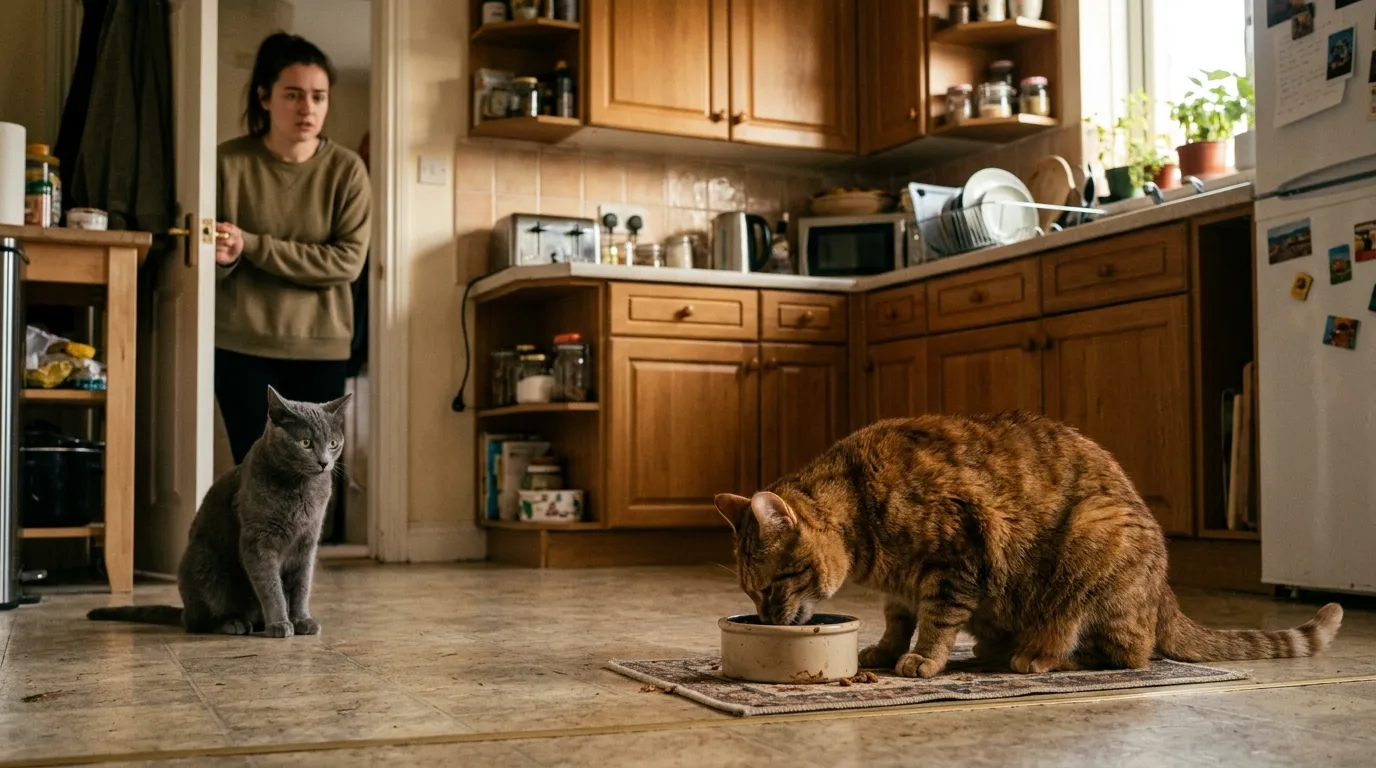
One of your cats always finishes first and walks straight over to the second bowl. You never actually know whether your smaller cat got enough to eat, or whether the confident one just cleaned up both portions again. Learning how to feed multiple cats separately is one of the most practical changes you can make in a multi-cat household, because the fallout from shared bowl feeding goes past the dominant cat eating too much. The quieter cat can end up chronically underfed, and you would have no easy way to spot it until the vet points out a weight problem at a checkup.
I added a second cat to my apartment and quickly found out the first cat had been eating roughly two-thirds of both portions every meal, while the second sat at a polite distance waiting for a turn that rarely came. This guide covers every method that actually works for apartment-sized spaces, from free spatial separation to microchip feeders, plus what to do once mealtime is handled and you still need to keep each cat’s food separate the rest of the day.
To feed multiple cats separately, place bowls in different rooms or set up visual barriers between feeding stations at least five feet apart. Scheduled meals with a pickup after twenty to thirty minutes stop one cat from lingering over another’s food. Microchip feeders that open only for the correct cat work best when cats need different diets.
Why Cats Need to Eat Separately in the First Place?
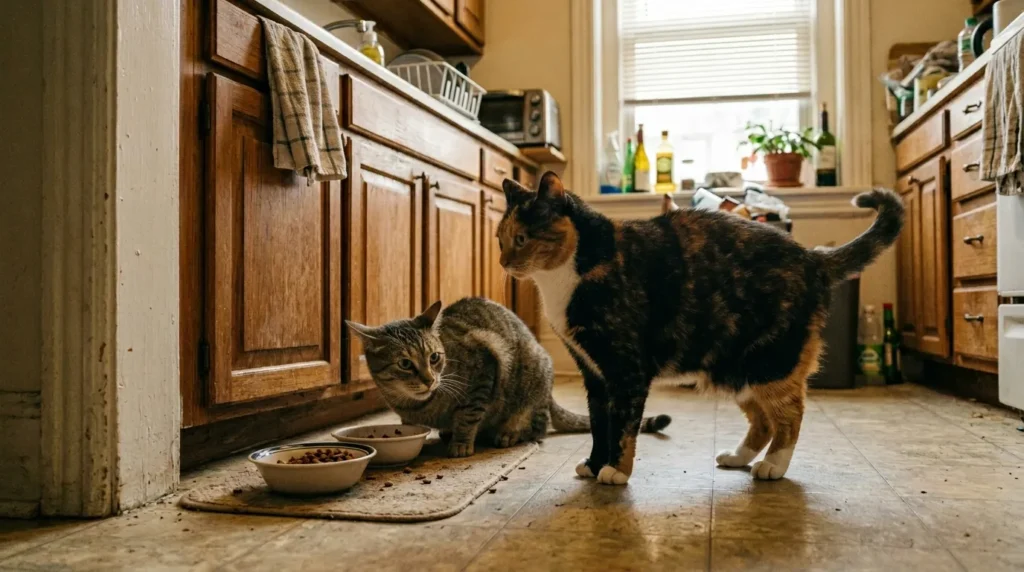
Cats are solitary eaters by design. In the wild they hunt and eat alone, so another animal near their food trips the same instinct that drives territorial defense. Put two cats at adjacent bowls and they feel low-level stress at every single meal, even when nothing looks like a fight. That stress builds over weeks and months into anxiety, inappropriate elimination, and food-obsessive behavior.
Resource guarding is the specific behavior that shows up when cats share a feeding area and one of them controls access to the food. The guarding cat doesn’t need to hiss or swat to be a problem. Eating slowly while parked in front of the bowl is enough to block the other cat from approaching. The guarded cat learns to eat fast whenever they do get access, which leads to vomiting from wolfing food down, or to intake that’s chronically too low to keep them at a healthy weight.
Apartment cats have it worse than cats in bigger homes, because there isn’t enough square footage to put real distance between a feeding area and a resting spot. If you want the fuller picture of how space and resource placement shape multi-cat dynamics indoors, this guide on indoor cat behavior covers resource distribution and how proximity affects stress even in cats that seem to get along fine.
How to Feed Two Cats Separately: The Quick Answer
Most people searching for this only have two cats, and the fix doesn’t need to be complicated. Skip the equipment shopping and try this first:
- Put each cat in a separate room with the door closed at mealtime. A bedroom, bathroom, or home office all work.
- Set a timer for twenty to twenty-five minutes.
- Open both doors at the same time and pick up whatever’s left in either bowl, even if one cat hasn’t finished.
That’s it. No microchip feeder, no baby gate, nothing to buy. It works for two cats on the same diet or two different diets, and it takes about a week for most cats to stop expecting to steal from the other bowl. If your apartment genuinely doesn’t have a second closable room, jump ahead to Method 1 and Method 3 below, both of which work in a single room.
Where two cats get more complicated is when one is a fast, food-motivated eater and the other grazes. In that case, staggering when each bowl goes down, covered further in Method 5, tends to work better than a strict twenty-minute cutoff for both.
How to Feed Multiple Cats Separately? The 9 Methods That Work
The methods below range from no-cost spatial changes to actual hardware, and the right one for you depends on your cats, your layout, and whether anyone in the house needs a different diet. If mealtime separation is only half your problem and you also need to keep each cat’s food separate the rest of the day, jump to the storage section further down.
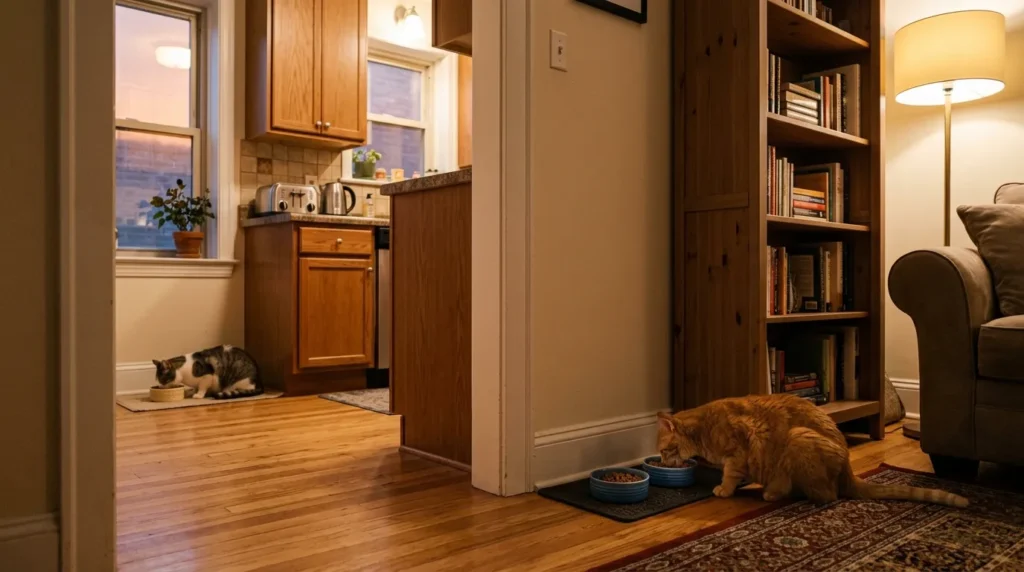
Method 1: Separate feeding stations with visual barriers. Put bowls at least five feet apart in different corners of the same room, with something between them that blocks direct eye contact. A cat tree, a box, even a dining chair positioned between stations removes the visual trigger for guarding. This works for cats that don’t actively steal but just eat at different paces.
Method 2: Feed in different rooms with closed doors. The most reliable fix for cats that consistently steal from each other. Each cat eats alone for the length of the meal, and the doors open again after twenty to thirty minutes, once bowls are picked up. No equipment, and it works for different diets with zero risk of cross-contamination.
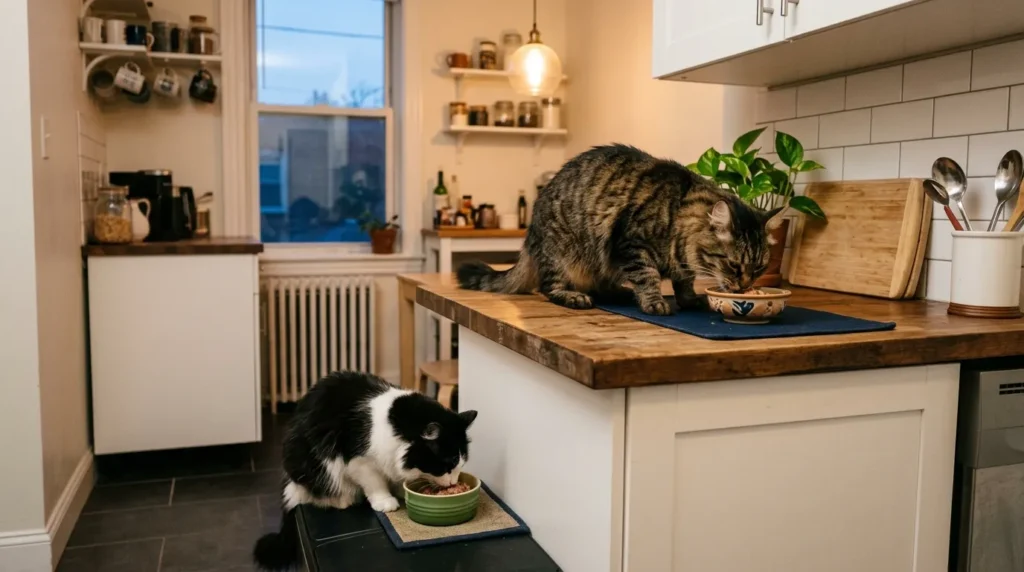
Method 3: Feed on different levels. If one cat is confident on elevated surfaces and the other stays grounded, feed the climber on a countertop or cat tree platform while the other eats on the floor. Most multi-cat households already have one cat who prefers height and one who doesn’t, so this uses a split you probably already have.
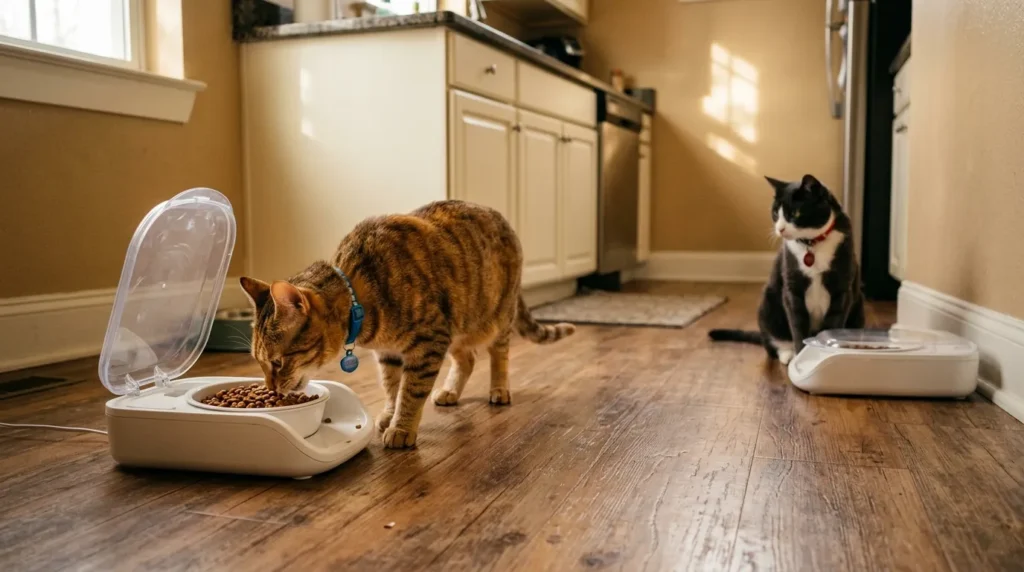
Method 4: Microchip or RFID automatic feeders. A microchip feeder opens only when the registered cat approaches and closes when another cat gets close. This is the most dependable option for cats on completely different diets, say a urinary prescription formula for one and a standard kibble for the other. It’s passive, so it enforces separation whether or not you’re home. The tradeoffs are cost and an adjustment period while cats learn which feeder actually belongs to them.
Method 5: Staggered meal times. Feed cat A first and pick that bowl up completely before feeding cat B in the same space. Works well in small apartments where separate rooms aren’t practical, and it needs nothing beyond consistent timing. The downside is the waiting cat can get anxious about food over time, so this pairs well with a distraction like a puzzle feeder for whoever eats first.
Method 6: Puzzle feeders for the faster eater. If one cat blows through their food and then muscles in on the second bowl, a puzzle feeder slows their meal enough that both cats finish around the same time. It doesn’t physically separate them, but it removes the time pressure that drives the stealing in the first place.
Method 7: Timed automatic feeders for portion control. Each cat gets their own timed feeder that dispenses a measured portion on a schedule. Place the feeders in different rooms or far apart, and the timer itself prevents the continuous access that lets stealing happen. This works best once cats have learned to associate their specific feeder with their own feeding spot, rather than roaming between units.
Method 8: Physical barriers or baby gates with cat flaps. A baby gate fitted with a cat flap lets a smaller or younger cat into a feeding space a bigger cat can’t fit through, or won’t bother pushing through. This only works when the size or age gap is big enough to make the flap naturally selective.
Method 9: DIY feeding boxes. A cardboard box or plastic bin with a cat-sized hole cut in one end makes a feeding enclosure that blocks sight lines and limits access to one cat at a time. Costs next to nothing, and it kills the resource guarding trigger by giving each cat visual privacy while they eat.
| Method | Best For | Requires Space? | Cost | Works for Different Diets? |
| Separate rooms | All multi-cat homes | Yes | Free | Yes |
| Visual barriers | Non-aggressive cats | No | Free or low | Partial |
| Elevated feeding | Height-confident cat | No | Free | Partial |
| Microchip feeder | Different diets, theft | No | High | Yes |
| Puzzle feeder for fast eater | Same diet, pacing issue | No | Low | No |
| Timed feeders per cat | Scheduled households | Yes (space) | Medium | Yes |
| Staggered meal times | Small apartments | No | Free | Yes |
| Baby gate with flap | Size difference | Yes | Low | Partial |
| DIY feeding box | Budget solution | No | Free | Partial |
Insight The separate rooms method sounds simple but fails constantly because people open the door before the slower cat has finished eating. Set a phone timer for twenty-five minutes the moment you close the first door. Your slower cat needs the full window without you hovering. Opening early is where this method falls apart for most multi-cat owners.
Keeping Each Cat’s Food and Bowls Separate Beyond Mealtime
Mealtime separation solves half the problem. The other half is everything between meals: the dry food bag, the bowls sitting in the sink, and the scoop that goes back and forth between two different foods without anyone thinking twice about it.
If your cats eat the same food, this part is low stakes. If one cat is on a prescription or limited-ingredient diet, it isn’t. A few habits keep the separation you built at mealtime from leaking out the rest of the day:
- Store each cat’s dry food in its own airtight container, labeled with the cat’s name. Don’t share a scoop between two different foods, even for a few kibbles.
- Use bowls that look different for each cat, whether that’s color, shape, or a piece of washi tape on the bottom. It sounds trivial, but it stops you from grabbing the wrong bowl when you’re half asleep at 6 a.m.
- Wash each cat’s bowl separately, or at least rinse a prescription-diet bowl before it touches the sponge that touches the other one. Lingering scent and residue is enough to draw a curious cat over.
- Keep prescription or medicated food on a high shelf or in a closed cabinet, not left out on the counter where either cat can reach it between scheduled meals.
- If you free-feed dry food at all, keep it in the same separate locations you use for scheduled meals. One controlled meal a day does nothing if the rest of the day is a shared bowl sitting out.
None of this needs to be expensive. Two dollar-store containers and a set of mismatched bowls you already own will do the job.
Handling Special Situations: Different Diets and Prescription Food
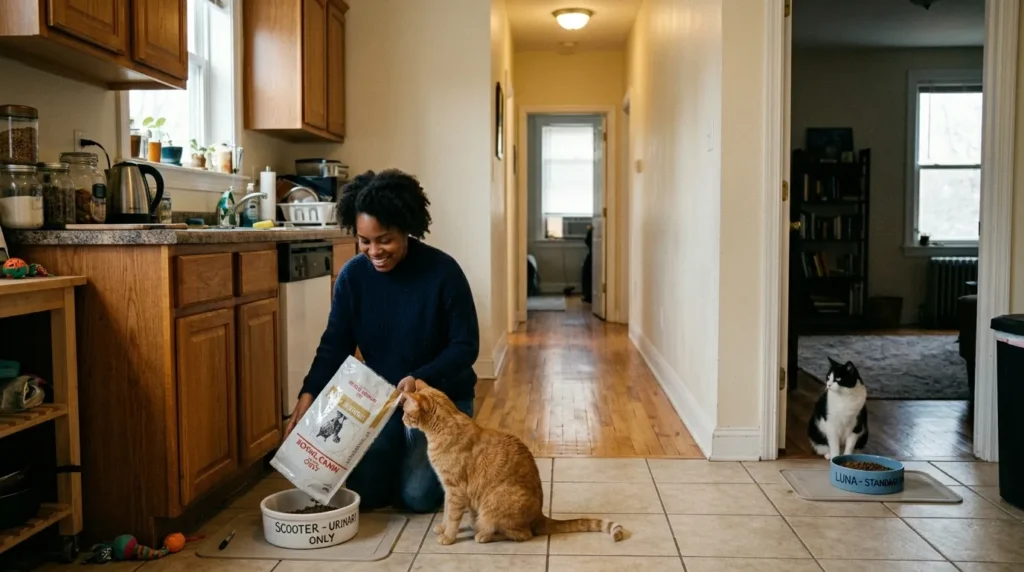
When one cat needs prescription food and the other eats a standard diet, spatial separation on its own isn’t enough. Even a brief taste of the wrong food can undercut the prescription diet’s effect. A cat on a urinary formula who occasionally eats standard dry kibble from the other cat’s bowl loses a real chunk of the dietary benefit that food is supposed to provide.
For different-diet households, a microchip feeder is the most dependable fix, because it physically blocks access whether or not you’re around to enforce it. Completely separate rooms with closed doors work just as well if you’re consistent about pickup timing. The part that actually matters is removing all food after twenty to thirty minutes, so there’s no window for cross-access while you’re not watching. For the full breakdown of how to calculate correct daily portions for each cat on separate diets, including mixed wet and dry combinations, this guide on how to feed an indoor cat properly covers the portion math for cats with different calorie needs.
Senior cats and cats managing a weight condition also do better on separate feeding, because their calorie needs differ from a younger or standard-weight housemate’s. A senior cat on a higher-protein, lower-calorie formula needs guaranteed access to a full measured portion, not half of it eaten by a younger cat who got there first.
Quick checklist for different-diet households:
- Feed in closed separate rooms, or use a microchip feeder per cat
- Remove every bowl in the house after twenty to thirty minutes, not just the prescription bowl
- Store each food in a separate, labeled, airtight container
- Wash bowls separately or rinse the prescription bowl before it touches shared sponges
- Weigh each cat monthly to confirm the diet is actually working as intended
General Feeding Schedule and Portions in a Multi-Cat Home
Separation solves who eats what. Schedule and portion size are a different question, and they matter just as much once you’ve got the setup sorted. Most healthy adult cats do best on two measured meals a day rather than free feeding, which also makes separation easier since there’s a defined start and end to each meal instead of food sitting out all day.
| Life Stage | Typical Meals Per Day | Note |
| Kitten (under 6 months) | 3 to 4 | Smaller stomach, higher calorie need per pound |
| Adult (1 to 10 years) | 2 | Twelve hours apart is the easiest schedule to keep |
| Senior (10+ years) or weight-managed | 2 to 3, smaller portions | Splitting the same daily total into more meals can ease digestion |
Exact portion sizes depend on each cat’s weight, age, and the calorie density of their specific food, which is why a shared bowl makes portion control almost impossible to track. Once each cat has their own bowl and their own schedule, weighing food instead of eyeballing it becomes realistic. For the full math on daily calories and how to split wet and dry food correctly, the indoor cat feeding guide walks through it cat by cat.
Common Mistakes When Trying to Feed Multiple Cats Separately
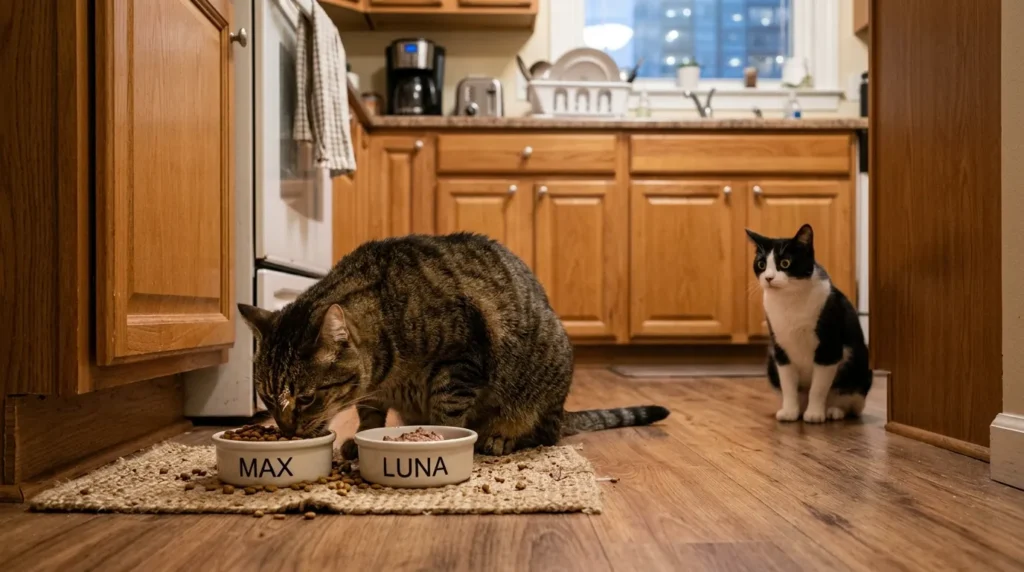
The most common mistake is putting two bowls in the same room a foot or two apart and calling that separate feeding. Five feet with a visual barrier is the minimum for a cat that guards passively. For an active stealer, same-room feeding rarely works no matter the distance, because the motivated cat just walks over once the first bowl is empty.
The second mistake is inconsistent pickup timing. Leave bowls down after a meal ends and you’ve removed the only enforcement mechanism scheduled feeding gives you. The dominant cat simply drifts to the untouched bowl and finishes it at leisure. Twenty to thirty minutes is the outer limit. Set a timer and pick up every bowl in the house at once, regardless of what’s left in them.
The third mistake is separating only one meal and leaving the rest as free-fed dry food in a shared spot. Controlled separation at the wet food meal does nothing if the cats can graze from each other’s dry food bowl all day long. Separation has to hold across every feeding opportunity, not just the one you’re paying attention to.
Frequently Asked Questions About Feeding Multiple Cats Separately
How far apart should cat feeding bowls be in a small apartment?
At minimum five feet, with something between the bowls that breaks the direct line of sight. If your apartment can’t manage five feet of visual separation, feeding in different rooms is the more reliable route. Same-room feeding with inadequate spacing rarely resolves food stealing, even between cats that get along in every other context.
What’s the easiest way to feed two cats separately?
Close each cat in a separate room at mealtime, wait twenty to twenty-five minutes, then open both doors and pick up whatever’s left. It’s the fastest option for two cats specifically, needs no equipment, and works whether or not they’re on the same food.
Can I use one automatic feeder for two cats if portions are different?
No. A single feeder can’t reliably deliver different portions when both cats have access to the same unit. Each cat needs their own feeder placed separately. For portion-controlled multi-cat feeding, two timed feeders in different locations, or a microchip feeder per cat, gives you the individual accuracy a shared device can’t.
How do I keep my cats’ food separate day to day, not just at mealtimes?
Store each cat’s food in its own labeled, airtight container, use a different scoop for each, and keep prescription food in a closed cabinet rather than out on the counter. Give each cat a visually distinct bowl and wash them separately, or at least rinse a prescription bowl before it hits a shared sponge.
How do I know if one of my cats isn’t getting enough food in a multi-cat home?
Weigh each cat separately every three to four weeks. A cat losing weight gradually despite appearing to eat from a shared bowl is most likely being displaced from adequate intake by the other cat. Separate feeding with monitored portions is the diagnostic fix. If the previously underweight cat gains weight after separation, that confirms the shared setup was the problem.
What’s the fastest way to stop one cat from stealing the other’s food right now?
Feed in completely separate rooms with closed doors today. No equipment, and it works immediately. Set a timer for twenty minutes and pick up both bowls at the alarm regardless of what’s left. It’s the fastest zero-cost fix, and it works whether or not the cats are on the same diet.
Do cats eventually learn to eat together without problems?
Most cats that guard resources at mealtime don’t grow out of it without a structural change to the feeding setup. A cat that’s successfully stolen food repeatedly has been rewarded for that behavior every time it worked. Separate rooms or a microchip feeder are more reliable than waiting for the dynamic to fix itself.
This article is for informational purposes only. Always consult your vet if you notice unexplained weight loss or gain in any of your cats.
Separate Feeding Makes Every Cat in the House Healthier
Feeding multiple cats separately protects each cat’s intake, removes the mealtime stress that builds into anxiety and behavior problems, and lets you actually monitor whether each cat is eating normally. Start with separate rooms at scheduled meals, add a twenty-minute pickup, and keep each cat’s food stored and labeled apart between meals. That combination solves most multi-cat feeding problems in apartment homes without buying a single piece of equipment. For the bigger picture of how feeding, behavior, and environment connect for indoor cats, this guide on indoor cat care brings those threads together in one place.
Cats are solitary eaters by nature, and shared bowl feeding causes stress, resource guarding, and unequal intake in multi-cat households. To feed multiple cats separately, place bowls at least five feet apart with visual barriers, or feed each cat in a different room with the door closed for twenty to thirty minutes. For two cats specifically, closing each cat in a separate room at mealtime is usually the fastest fix. Microchip feeders that open only for the registered cat are the most reliable option for cats on different diets, and separation should extend beyond mealtime to food storage, labeled bowls, and washing dishes separately to avoid cross-contamination. Adult cats typically do best on two measured meals a day, kittens need three to four, and seniors often benefit from smaller, more frequent portions. Monitoring each cat’s body weight monthly confirms that feeding separation is working as intended.

Written by Mishu
A passionate cat lover and indoor living enthusiast, Mishu is the founder and voice behind Indoor Living Cat – a go-to resource for cat owners who want to create the happiest, healthiest life for their feline companions indoors.
View Full Profile
I think this is among the most important info for me.
And i am glad reading your article. But want to remark on few
general things, The web site style is great, the articles is really excellent
: D. Good job, cheers
Thank you so much for your thoughtful feedback! We’re really glad you found the article helpful and enjoyed the website as well. We truly appreciate you taking the time to share your thoughts. Thanks again for your support and cheers! 🐱😊
I’m totally moved by this post! It’s essential to take a chance and explore something new.
As J.K. Rowling said, ‘It is our choices, Harry,
that show what we truly are, far more than our abilities.’ Mobile Massage in NJMobile Massage NJ could be
the perfect way to make a choice and show yourself what you’re
capable of.
Thank you for sharing your thoughts! We’re glad the post resonated with you. 😊
Hello, I enjoy reading all of your article. I like to write a
little comment to support you.
Thank you so much for your kind words and support! We really appreciate it. 😊