
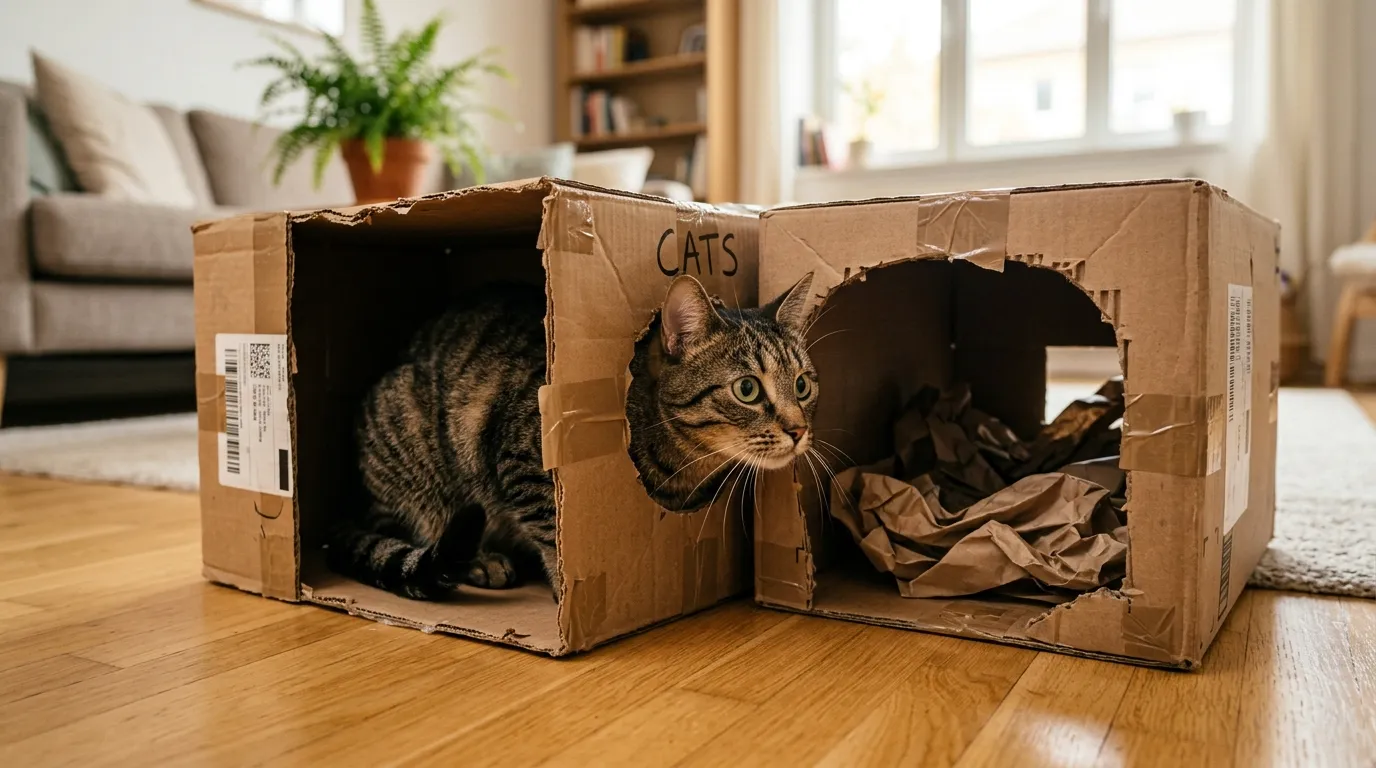
Free cat enrichment ideas at home were the last thing I thought I needed until my cat destroyed a houseplant, shredded a corner of the couch and woke me up three nights in a row inside the same week. I had a decent cat tree and a basket of toys she ignored completely. The solution turned out to be sitting in my recycling bin the whole time. A cardboard box with a hole cut in it kept her occupied longer than any purchased toy had. Free cat enrichment ideas at home are not a compromise on quality. They are often better than what you pay for because they offer novelty, texture and unpredictability that manufactured toys are specifically designed not to offer. This article covers ten things you can build or arrange right now using what you already have.
The best free cat enrichment at home comes from cardboard boxes built into tunnels or mazes, crinkled packing paper stuffed with hidden food, toilet paper rolls folded into treat dispensers and scatter feeding replacing the food bowl. These four alone cost nothing and together provide foraging, hunting, hiding and exploring stimulation that most purchased toys cannot match.
10 free ideas at a glance
| # | Idea | Cost | Setup time |
| 1 | Cardboard box tunnel or maze | $0 | 10 minutes |
| 2 | Scatter feeding instead of a bowl | $0 | 30 seconds |
| 3 | Toilet paper roll treat dispenser | $0 | 45 seconds |
| 4 | Crinkled packing paper pile | $0 | 1 minute |
| 5 | Window perch from stacked boxes | $0 to $15 | 5 minutes |
| 6 | Paper bag exploration | $0 | 1 minute |
| 7 | Towel burrito with hidden kibble | $0 | 2 minutes |
| 8 | Free vertical space from furniture you own | $0 | 5 minutes |
| 9 | Sock or fabric kicker toy | $0 | 3 minutes |
| 10 | Egg carton puzzle feeder | $0 | 2 minutes |
Why Free Cat Enrichment Ideas at Home Often Work Better Than Store Toys?
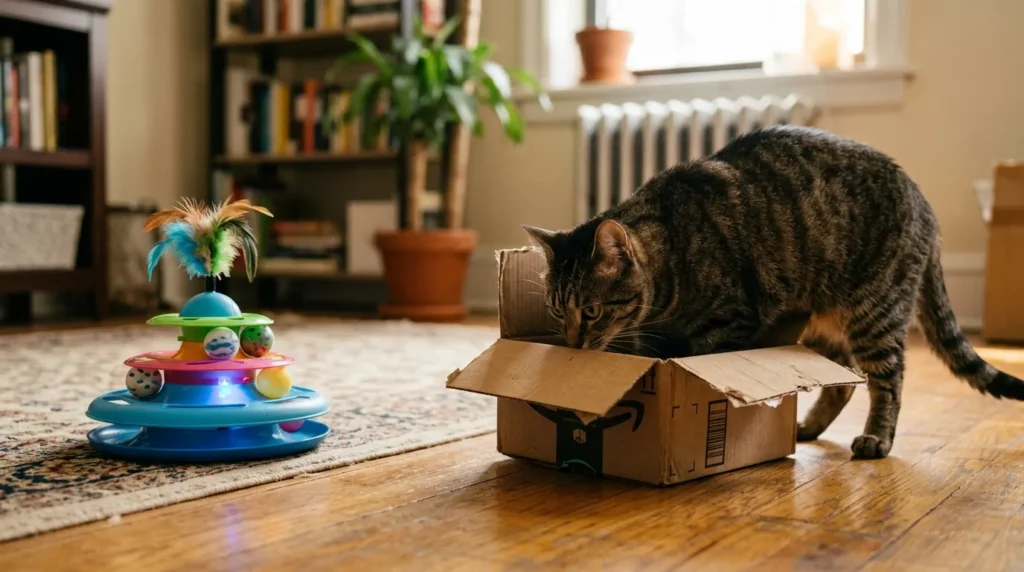
Free cat enrichment ideas at home tend to outperform purchased toys for one reason: novelty. A store toy enters the apartment and gets explored once, filed into spatial memory and ignored within forty-eight hours. A cardboard box from last week’s delivery enters the apartment smelling of cardboard dust, tape adhesive, packing paper and whatever was shipped inside it. That scent profile alone gives a cat fifteen minutes of investigative work before it has even touched the object.
The materials also matter more than owners assume. Cardboard has a texture and a sound when scratched that no foam or plastic toy replicates. Crinkled paper produces a noise that activates the auditory component of the hunting response in a way that electronic chirping sounds rarely do. Packing paper can be burrowed into, batted at and nested inside simultaneously. These sensory properties are exactly what manufacturers try to engineer into toys and they come for free with almost every delivery you receive.
According to the ASPCA’s feline enrichment guidance, recycled household materials satisfy the same hunting, foraging and exploring drives as commercial enrichment products. The key is rotation. A cardboard box that sat in the living room for a week is no longer novel. Rotating it out and bringing it back after five days restores the effect. The principle of rotating free enrichment ideas at home is the same as rotating paid toys: the cat’s brain responds to novelty not to value. This same rotation principle drives most of the fixes in our broader guide on why indoor cats get bored in the first place and what actually reverses it.
Idea 1: Cardboard Box Tunnels and Mazes
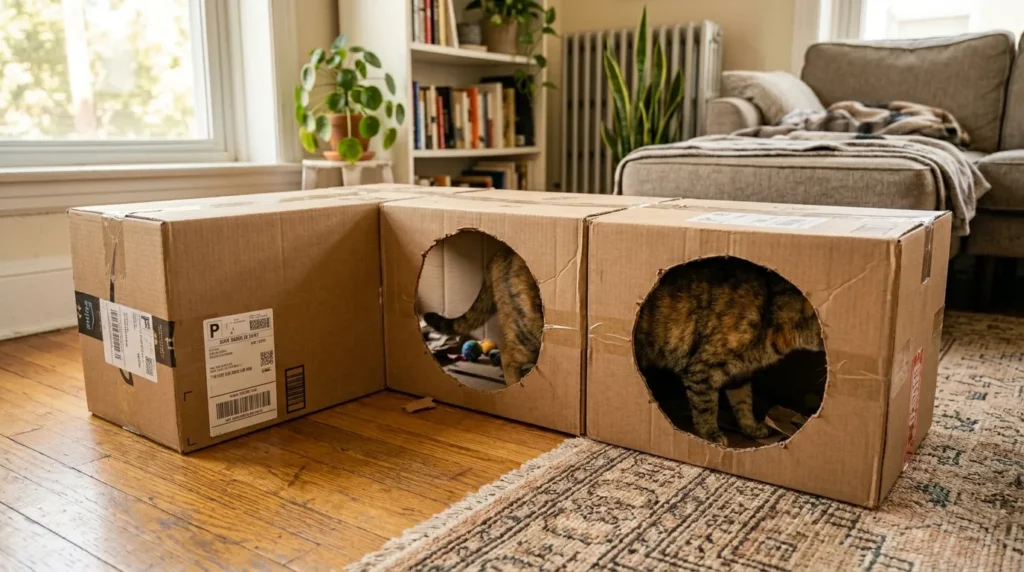
Two or three cardboard boxes taped together with circular holes cut between them create a tunnel system that produces genuine hunting and hiding behavior in most cats. The cat cannot see through the whole structure from any single vantage point which creates the unpredictability that makes exploration genuinely engaging rather than perfunctory. Add a handful of crinkled packing paper inside and the cat has sound, texture and smell working simultaneously.
Cut the holes large enough for the cat to pass through comfortably. A hole roughly the width of the cat’s shoulders works for most adult cats. Cut at least one hole on the end of the tunnel system that the cat exits through rather than having to reverse back out. A dead-end tunnel frustrates rather than engages most cats after the first session.
Replace the tunnel configuration every week or so by rearranging which boxes connect to which or adding a new box to change the shape. A new configuration gives the cat a completely different spatial challenge without costing anything. The enrichment value of a varied physical environment for indoor cats is well established in feline behavioral research and cardboard tunnels deliver it at the exact cost of whatever you ordered online last week.
Idea 2: Scatter Feeding to Replace the Food Bowl
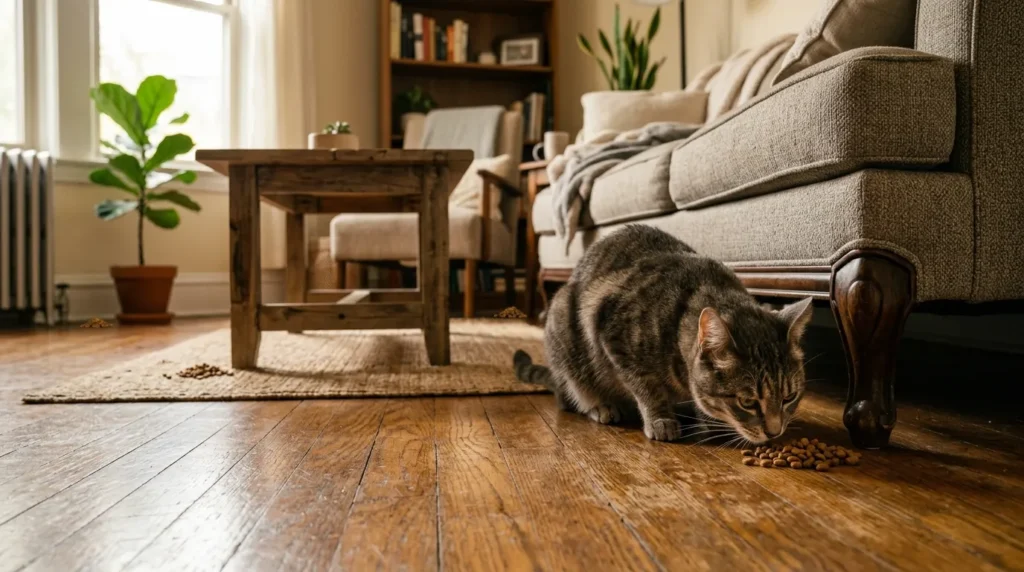
Scatter feeding is the single most impactful free cat enrichment idea for most owners because it requires no construction, no materials and thirty seconds of effort per meal. Instead of placing the full food portion in a bowl hide five to eight small piles in different locations around the apartment and let the cat find them all. A cat that spends ten minutes hunting its breakfast across the apartment has engaged its foraging drive, moved more than it would have walking to a bowl and experienced something approaching the psychological satisfaction of a successful hunt.
The locations do not need to be complicated. Behind a couch leg, on top of a low book, inside an empty cardboard box, under a folded towel edge. The cat uses smell primarily and hearing secondarily to locate the food. Novel hiding spots each time keep the behavior genuinely effortful rather than habitual. Using the same five spots every morning eventually produces a cat that memorizes the route and trots from one to the next without any real cognitive engagement.
Scatter feeding also slows eating, which reduces vomiting in cats that eat too fast from a bowl and distributes caloric intake across a longer period. These behavioral and physical benefits come entirely free and replace the food bowl immediately without any transition period. For portioning guidance so scatter feeding does not turn into accidental overfeeding, our guide on how to feed an indoor cat properly covers how meal structure connects to a cat’s behavioral health, not just its calorie count.
Idea 3: Toilet Paper Roll Treat Dispensers
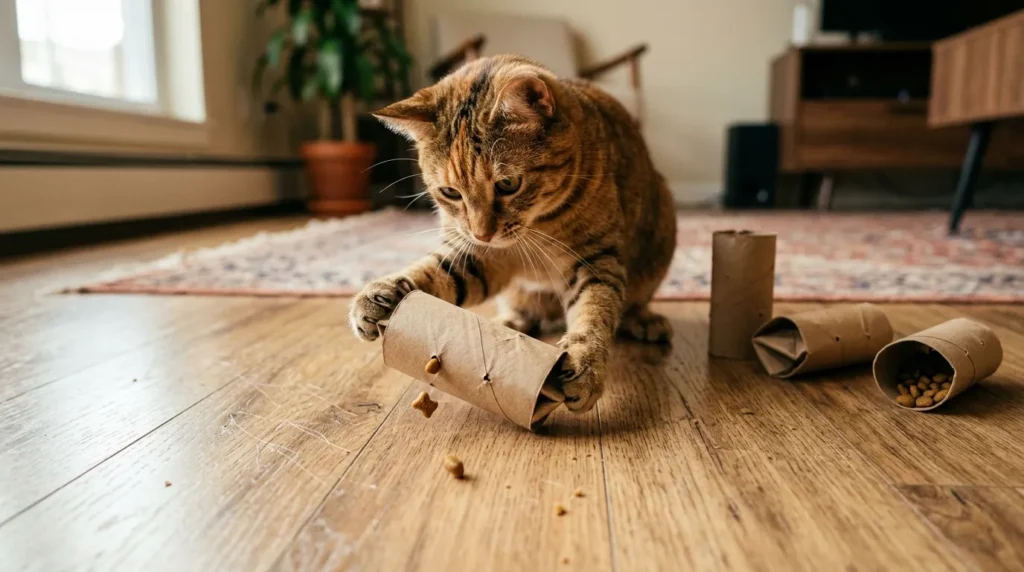
A toilet paper roll with both ends folded shut and kibble inside creates a treat dispenser that takes forty-five seconds to make and engages the cat’s paw-batting and problem-solving behavior for several minutes per session. The roll moves unpredictably as the cat bats it and periodically releases a piece of food that reinforces continued engagement. Make five at a time and leave them in different spots for the cat to find throughout the day.
Cut small slits in the side of the roll if the cat loses interest quickly because the food is not coming out fast enough. The slits increase the reward frequency and maintain engagement for cats that give up easily. Decrease the number of slits for cats that solve the dispenser too quickly and finish the food in under a minute. Adjusting difficulty by changing the number of slits is the same principle that commercial puzzle feeders charge twenty to forty dollars to provide.
Idea 4: Crinkled Packing Paper and Newspaper Balls
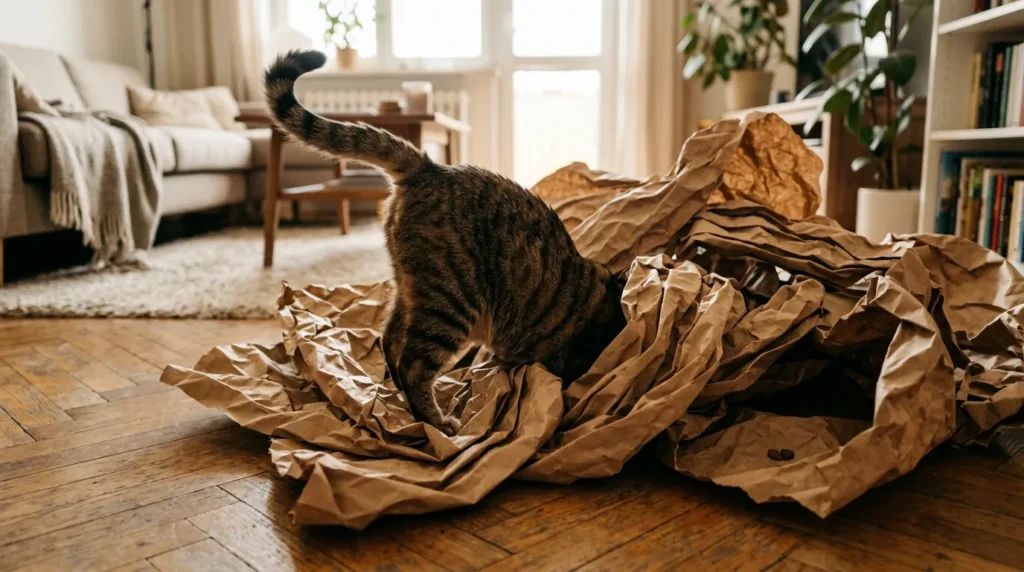
A pile of loosely crinkled packing paper dropped on the apartment floor gives a cat three separate enrichment categories simultaneously: sound from the crinkle as it moves through the paper, texture from the varied resistance the paper offers under paws and hunting engagement when a treat is hidden somewhere inside the pile. Most cats investigate a packing paper pile for at least ten minutes before losing interest and many return to it repeatedly throughout the day.
Hide three or four small treats inside the pile when you set it out. The cat smells them immediately but needs to move through the paper to locate them which combines foraging drive with tactile exploration in a single activity. Newspaper works identically but use only plain sections without colored ink since cats often chew objects they investigate and ink poses a mild ingestion risk. Packing paper from online deliveries is already in your home and costs nothing. The entire pile can go into recycling when you want to recycle it and the next delivery restarts the activity.
Idea 5: Window Enrichment Without Buying Anything
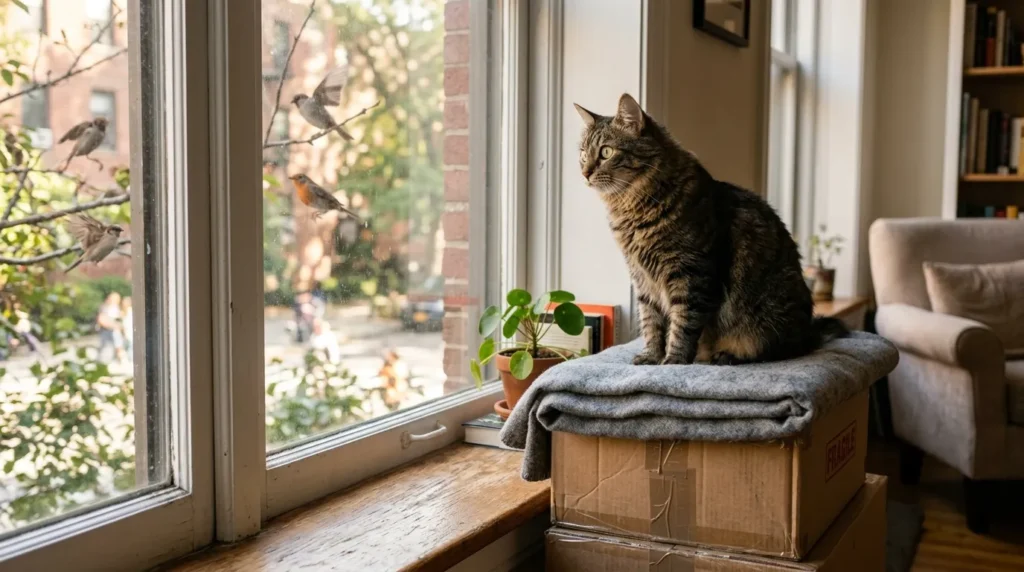
A window perch does not need to be purchased. Two sturdy boxes stacked to window-sill height and covered with a folded blanket create a stable platform that positions the cat at the glass for passive environmental stimulation. The outdoor activity a cat watches from a window provides hours of sensory engagement without any owner participation after the initial setup. Birds, squirrels, leaves, passing humans and weather all change throughout the day providing the environmental novelty that a static indoor environment cannot generate on its own.
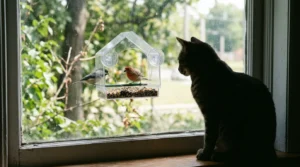
If you want to increase the value of the window view a suction-cup bird feeder attached to the outside of the glass costs under fifteen dollars one time and attracts birds within two to three days of setup. That single purchase amplifies a free setup into an all-day stimulation source. The feeder itself is the only cost. Everything else, the stacked box perch, the blanket, the window itself, is already in the apartment. For the full hardware breakdown, including rental-safe mounting options, see our dedicated guide on setting up a window for an indoor cat.
Cats with access to active windows require noticeably less active owner-led stimulation during the day than cats facing blank walls. Passive enrichment from window viewing reduces the behavioral pressure that builds when an indoor cat has nothing to observe or investigate and shows up as reduced furniture scratching and less persistent vocalization during daylight hours.
Idea 6: Paper Bag Exploration
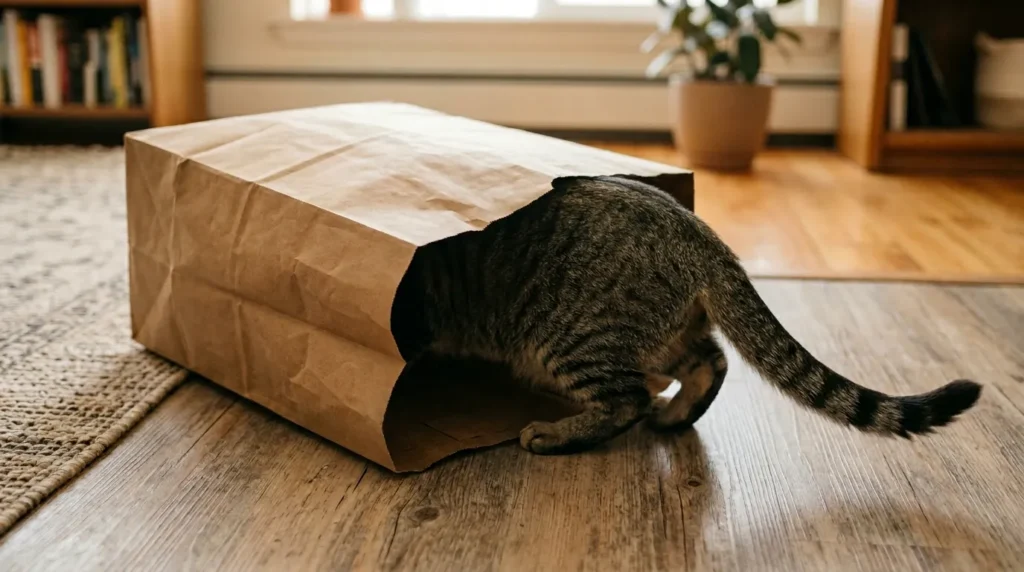
A paper grocery bag with the handles removed and laid on its side produces immediate investigation in most cats. Always remove the handles first. A cat that gets a paper handle looped around its neck panics and the resulting injury risk is real. Beyond that safety step the bag costs nothing and provides a confined space with rustling sound, new scent from wherever the bag was before it arrived home and a hiding option with a narrow exit point.
Toss a small treat inside before leaving the bag for the cat to find. The cat smells the treat immediately but needs to commit to entering the bag to access it which produces the investigation behavior that enrichment is designed to generate. Most cats emerge from the bag, circle it, enter it again and repeat the investigation multiple times even after the treat is gone.
Idea 7: Towel Burrito With Hidden Treats
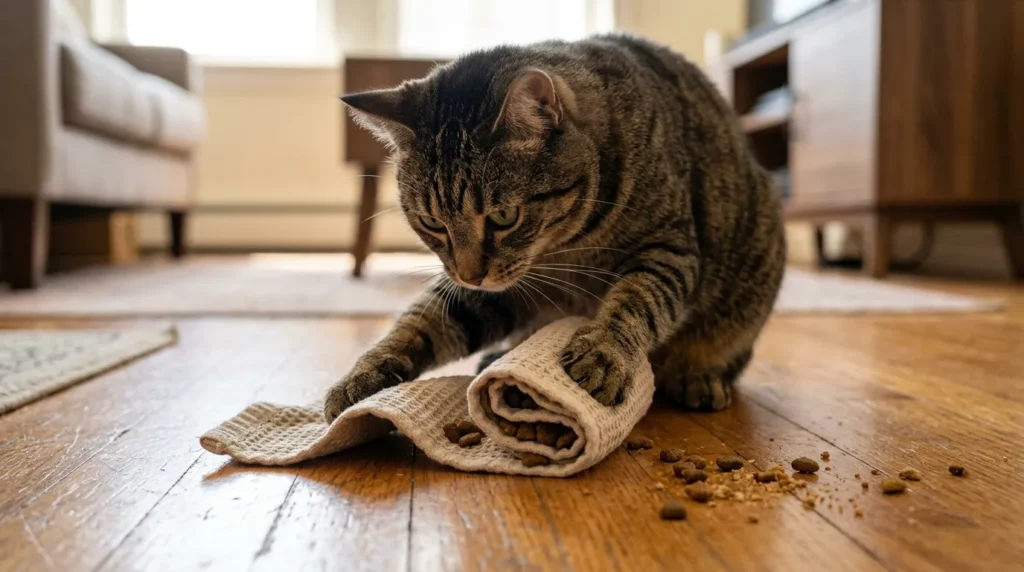
Lay a small hand towel flat, scatter ten to fifteen pieces of kibble across it and roll it loosely into a burrito shape. The cat needs to unroll or dig into the towel to access the food which requires the same paw-pawing and problem-solving behavior that commercial foraging toys are designed around. The towel version is free, washable and adjustable in difficulty by how tightly you roll it.
Roll the towel more tightly for a cat that solves the loose version in under a minute. Leave it loose for a cat that loses interest quickly. The principle is the same as adjusting slot size on a toilet roll dispenser: match the difficulty to the cat’s engagement threshold so the session lasts long enough to produce genuine satisfaction rather than quick frustration or quick boredom.
Idea 8: Free Vertical Space From Furniture You Already Own
A cat tree is not required to give a cat height. A cleared bookshelf top, the flat top of a wardrobe or a sturdy dresser gives a cat the same territorial vantage point a $150 cat tree provides, at zero cost beyond clearing the surface and making sure it can bear the cat’s weight without wobbling. Cats do not care whether the elevated surface was designed for them. They care whether it feels stable.
Build a simple route to the top if your cat cannot jump there directly. A sturdy chair positioned as a midpoint step, or a low bookshelf leading to a taller one, turns an inaccessible surface into a usable one. Test the stability yourself by pressing down firmly before your cat tries it. A wobbly first attempt teaches a cat to avoid that spot permanently, so getting this right the first time matters more than it seems.
Rotate which elevated spot has a blanket or cushion on it every week or two, the same way you would rotate a toy. A previously ignored shelf with a fresh blanket often gets rediscovered as if it were new furniture. For a deeper look at why vertical territory matters this much to an indoor cat’s stress levels, our guide to cat furniture for indoor cats covers when a dedicated cat tree is worth the investment and when free vertical space genuinely does the job.
Idea 9: Sock or Fabric Kicker Toy
An old sock, knotted at the open end and stuffed with a few crumpled pieces of paper or a bit of used catnip if you have any on hand, becomes a kicker toy a cat can grab with her front paws and rabbit-kick with her back legs. This is the same bunny-kick behavior a $12 plush kicker toy is built to trigger, and a sock does it identically because the size and give of the fabric matter more than the branding.
Toss it a short distance so the cat has to chase it down first, rather than handing it to her directly. The chase-then-kick sequence mirrors the pounce-and-subdue phase of real hunting behavior far more closely than a toy that starts already in her paws. Wash and re-stuff the sock weekly if it holds up, or make a new one when it gets shredded. Either way the cost stays at zero.
Idea 10: Egg Carton Puzzle Feeder
A cardboard egg carton with the lid removed and a few pieces of kibble dropped into three or four of the cups turns a two-minute setup into a genuine foraging puzzle. The uneven depth of each cup forces the cat to work a paw in at an angle to fish out each piece, which is more physically demanding than it looks and holds attention longer than a flat scatter would.
Close the lid partway and cut small openings in the top for a harder version once your cat solves the open version quickly. This mirrors the same difficulty-scaling principle used with the toilet roll dispenser and the towel burrito: start easy so the cat learns the game is winnable, then add friction once she has the skill and the confidence to keep trying.
The Mistake That Ruins Free Cat Enrichment at Home
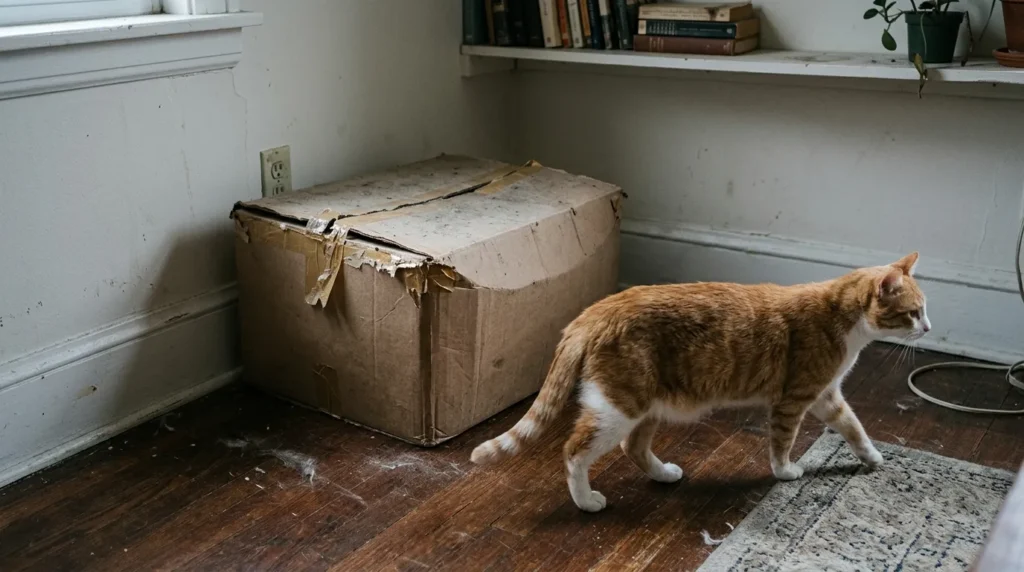
The mistake that cancels every free cat enrichment idea at home is leaving the items out indefinitely without rotation. A cardboard box that has been in the living room corner for two weeks is no longer enrichment. It is furniture. The cat has fully mapped it, extracted all novelty and filed it into the category of permanent uninteresting objects. The box that produced twenty minutes of exploration on day one produces nothing on day fifteen.
The rotation schedule is simple and requires zero additional cost. Put the box away after three to five days. Bring it back after five days. The cat re-investigates it with genuine curiosity because the absence restored novelty. This is the same principle that applies to paid toys and it is the reason why indoor cats lose interest in their toys so quickly despite the toys being technically unchanged.
The second mistake is providing all enrichment ideas simultaneously. A cardboard maze, scatter feeding, three towel burritos and a paper bag pile set out on the same day overwhelm the cat with so many new stimuli that none of them get genuine investigation time. Introduce one new idea per day. Let the cat exhaust that item before adding the next. Sequencing produces more total engagement than simultaneous presentation.
Insight The best free enrichment schedule is the simplest one: Monday is the box tunnel, Wednesday is scatter feeding, Friday is the paper bag, Sunday is the towel burrito. Repeat. Add a new idea only when the current rotation has fully habituated. This four-rotation system produces a cat that always has something novel waiting without any single item losing its freshness completely.
Multiple Cats? How to Adjust These Ideas
Free enrichment works differently in a multi-cat home, and setting out one box tunnel or one scatter-feeding zone for two or three cats creates competition instead of stimulation. Set up at least two separate stations for any idea you try, in different rooms if possible, so a lower-confidence cat is not blocked from the activity by a more assertive one.
Scatter feeding needs the widest spread in multi-cat homes. Hide each cat’s portion in a different part of the apartment rather than mixing all the food into one shared area. Watch the first few sessions to confirm no single cat is following another around and eating both portions, since that pattern defeats the purpose and can lead to one cat gaining weight while another loses access to food.
Frequently Asked Questions
What is the easiest free cat enrichment idea to start with today?
Scatter feeding replacing the food bowl takes thirty seconds and zero preparation. Hide five small piles of your cat’s regular food in different locations around the apartment before the next meal and let the cat find them. Most cats engage immediately and the behavioral benefit shows within days of consistency.
Do cats really prefer cardboard boxes over bought toys?
Many do because boxes offer novelty, smell, sound and texture that manufactured toys are engineered to produce but rarely match. A box from a recent delivery carries multiple new scent layers that a factory-made toy does not. The preference for boxes over purchased toys is well documented by cat owners and behaviorists and it costs you nothing to test it.
How long does free enrichment keep a cat entertained?
A cardboard box tunnel with packing paper inside typically holds a cat’s active attention for ten to twenty minutes on first introduction and then produces shorter reinvestigation sessions throughout the day as novelty fades. Rotating the item out after three to five days restores the effect almost completely. Total daily engagement across all items should reach thirty to forty-five minutes combined for an adult indoor cat.
Is scatter feeding safe or will my cat overeat?
Scatter feeding uses the same portion you would put in the bowl so total calorie intake is unchanged. The cat eats more slowly and moves more which actually reduces the fast-eating vomiting that some owners deal with from bowl feeding. Use your cat’s regular measured daily portion and simply distribute it across multiple hidden locations instead of placing it all in one spot.
My cat ignores all the free enrichment ideas. What am I doing wrong?
Try one item at a time rather than several at once and place it at a different time of day. Cats that ignore enrichment at noon often engage fully at dusk when their predatory drive peaks. Also check whether the item has been out too long: anything that has been in the apartment more than five days has likely habituated and needs to be rotated out and returned later.
Are free enrichment ideas as effective long term as paid toys and cat trees?
Yes, provided rotation stays consistent. The behavioral value of enrichment comes from novelty and outlet, not price. A rotated cardboard box beats a $40 toy left permanently on the floor. Where paid products genuinely add something free options cannot is durability and load-bearing capacity, like a tall cat tree that supports a full-grown cat’s leaping weight far more reliably than a stack of boxes.
Can I use these ideas if I have more than one cat?
Yes, but set up two or more separate stations for each activity rather than one shared setup. A single box tunnel or scatter-feeding zone in a multi-cat home tends to favor the more confident cat and can leave a shyer cat without real access to the enrichment.
Conclusion
Free cat enrichment ideas at home work because they provide novelty, texture and sensory variety that most purchased toys are not designed to sustain over time. Start with scatter feeding tonight and a cardboard box tunnel tomorrow. Rotate each item out after three to five days and bring it back after the same interval. That single habit creates a constantly refreshed enrichment cycle that keeps a healthy indoor cat behaviorally stable without spending a dollar. Consistent free enrichment, properly rotated, produces better long-term behavioral outcomes than an expensive toy left on the floor permanently.
Free cat enrichment ideas at home include cardboard box tunnels and mazes built from recycled shipping boxes with holes cut between chambers, scatter feeding replacing the food bowl by hiding kibble in five to eight apartment locations, toilet paper roll treat dispensers made by folding ends over kibble, crinkled packing paper piles with treats hidden inside, paper bags with handles removed placed on their sides, towel burritos with kibble rolled inside, free vertical space from bookshelves or wardrobe tops, sock kicker toys and egg carton puzzle feeders. All items must be rotated out after three to five days to prevent habituation. Novelty and rotation determine enrichment effectiveness more than cost or complexity. Multi-cat households need separate stations per cat to avoid resource competition.

Written by Mishu
A passionate cat lover and indoor living enthusiast, Mishu is the founder and voice behind Indoor Living Cat – a go-to resource for cat owners who want to create the happiest, healthiest life for their feline companions indoors.
View Full Profile