
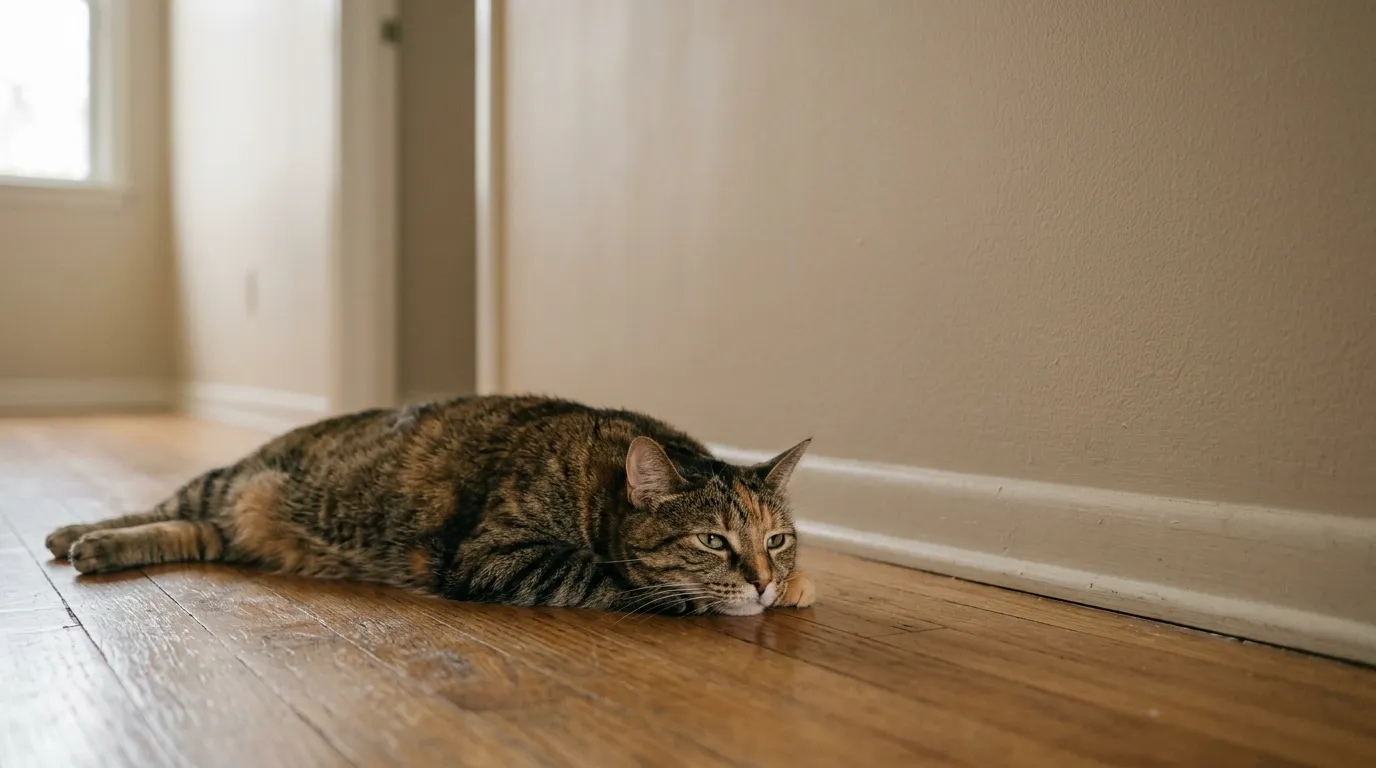
My cat stopped greeting me at the door one week and started spending whole afternoons staring at a blank wall, not sleeping, just staring. That is when I understood signs indoor cat is bored do not look dramatic. They look like a cat being a cat, which is exactly why most owners miss them for months.
Catching these signs early matters. Left alone, boredom turns into overgrooming dermatitis, litter box problems, or aggression that takes months to retrain. This guide covers nine specific signals, what causes each one, how to tell boredom apart from stress or illness, and what to change the same day you spot it.
Quick answer: The clearest signs an indoor cat is bored are excessive meowing with no cause, destructive scratching or knocking items off shelves, overgrooming that leaves bald patches, sleeping past sixteen hours a day, and attention-seeking that turns physical. One sign sustained past a week means it is time for enrichment changes. Several signs at once mean the behavioral needs have gone unmet for a while.
Nine signs at a glance
| Sign | What it looks like |
| 1. Excessive vocalization | Meowing at you with no clear need, food and litter box both fine |
| 2. Destructive behavior | Scratching furniture or knocking objects off shelves, building over weeks |
| 3. Overgrooming | Licking one spot until a bald patch appears, usually belly or thighs |
| 4. Oversleeping | Eighteen-plus hours a day, waking without seeking activity |
| 5. Pacing and zoomies | Frantic racing, often at midnight, with no daytime outlet given |
| 6. Physical attention-seeking | Biting ankles, swatting hands, ambushing you from behind furniture |
| 7. Ignoring toys and surroundings | New toys get one sniff, then get ignored completely |
| 8. Begging or overeating | Constant food requests used as a substitute for stimulation |
| 9. Flat affect and low curiosity | No reaction to new sounds, visitors, or window activity |
Why Indoor Cats Get Bored and Why It Matters
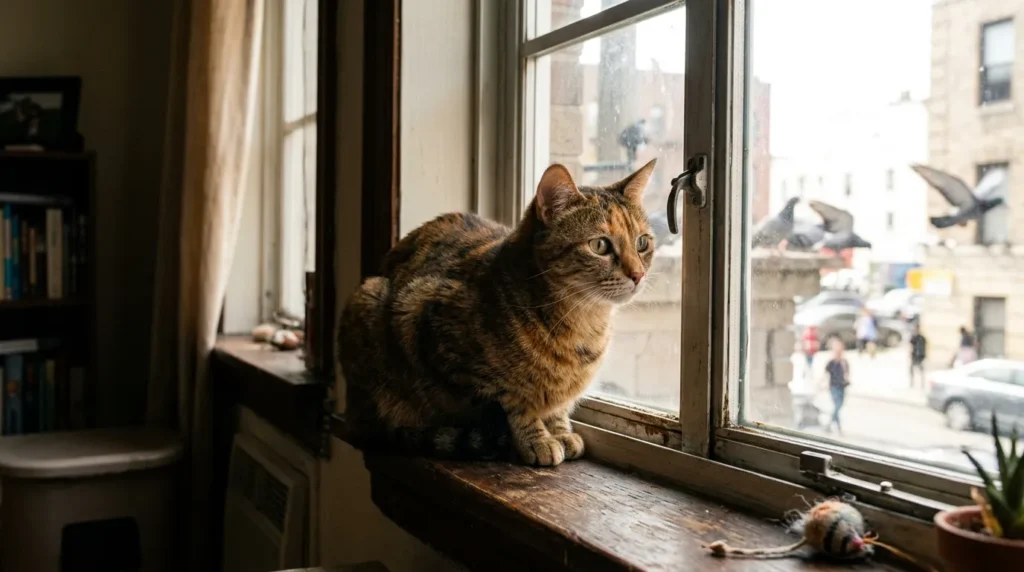
Indoor cat boredom is a real state, and it has physical and behavioral costs when it sticks around. An indoor cat’s world cuts out predatory activity, territory patrol, and the sensory variety that outdoor access provides. Her nervous system is built to hunt, patrol, and investigate daily. When nothing calls for any of that, the unspent drive turns inward and shows up as the habits most owners write off as personality.
Mental stimulation, or the lack of it, sits at the center of every boredom-related behavior. A cat that paces, vocalizes for no reason, or shreds furniture is not misbehaving. She is redirecting energy with nowhere useful to go. The behavior is always a symptom. The environment is the actual problem.
Cats living in smaller spaces feel this fastest, since there is less to explore by default. Our guide on keeping a cat in an apartment covers how square footage and layout affect a cat’s stimulation needs day to day.
Untreated boredom does not stay behavioral. Cats under sustained under-stimulation show higher rates of stress-related illness, including feline idiopathic cystitis, overgrooming dermatitis, and digestive upset. Catching these signs early is not just about comfort. It is about physical outcomes that build quietly over months before anyone connects them to the real cause.
This falls under the broader question of daily indoor cat behavior, and for the full picture of what indoor cats need across daily care, see our guide on indoor cat care.
Sign 1: Excessive Vocalization With No Obvious Cause
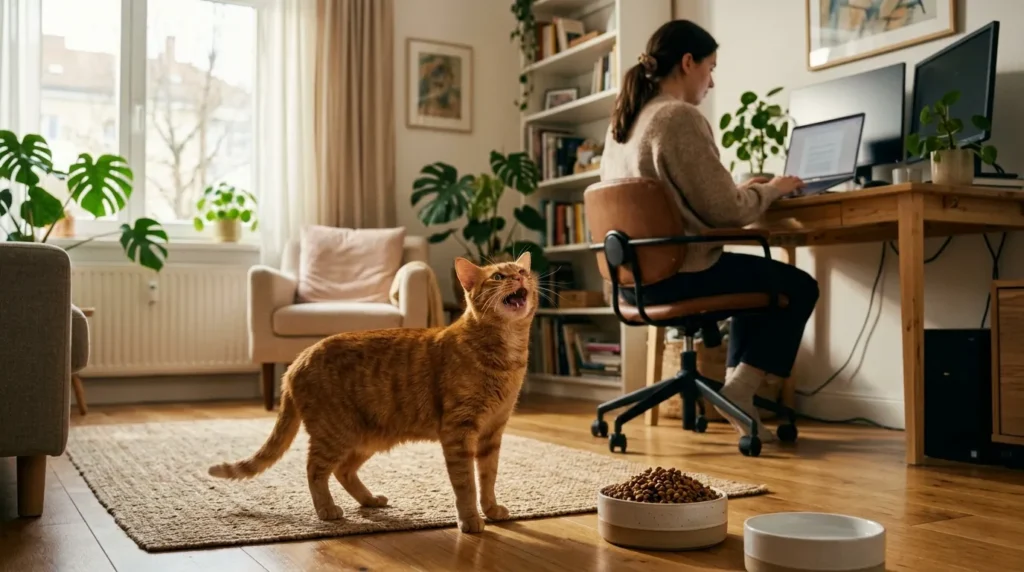
Meowing at you when food, water, and the litter box are all fine is one of the clearest signs your indoor cat is bored, and owners often explain it away as personality. A cat vocalizing at nothing is asking for something. Usually that something is interaction or stimulation.
Boredom meowing and pain-related meowing look different up close. Boredom meowing repeats, follows you room to room, and pauses when you give direct attention, then starts again once you stop. Pain or illness-related vocalization tends to show up suddenly, often at night, without a behavioral pattern, and it does not resolve when you pay attention.
If your cat has started talking to you a lot more over the past two to four weeks, with nothing else in her routine changed, that shift is almost always behavioral. It usually responds to fifteen minutes of interactive play, twice a day.
Sign 2: Destructive Behavior That Appeared Gradually
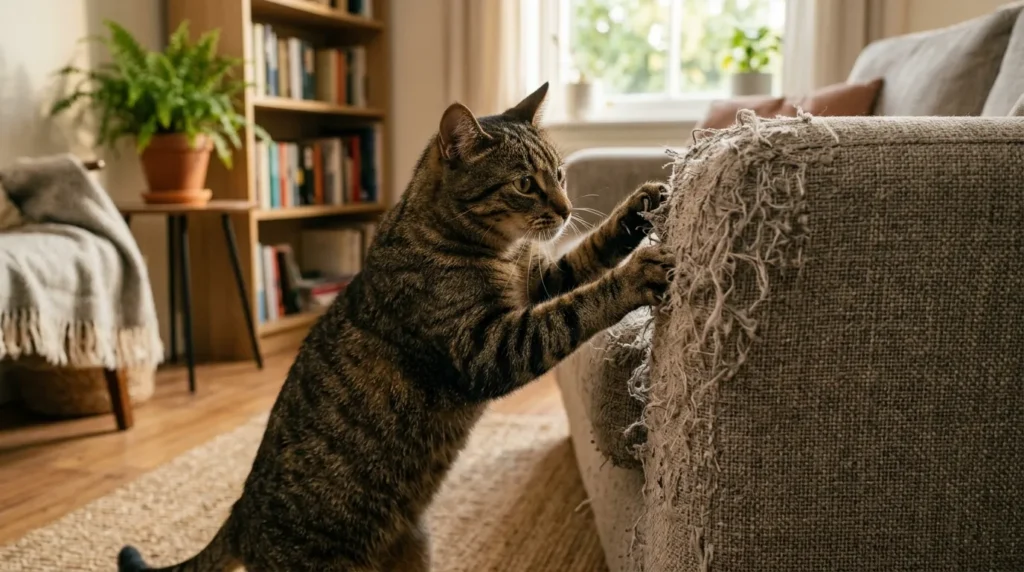
Destructive behavior that builds over weeks is one of the more reliable signs your cat is bored, not stressed by one event. A cat that suddenly scratches after a move or a visitor has a stress trigger. A cat that has slowly ramped up furniture scratching, cord chewing, or item-knocking over a month is showing unspent predatory instinct with no legitimate place to go.
Knocking objects off surfaces is a specific boredom behavior owners often find funny until it becomes constant. Your cat is not being mischievous. She is running the paw-batting part of hunting on the only objects available. A wand toy, used twice daily, gives her the same physical payoff through a real outlet.
Enrichment fixes gradual destructive behavior. Redirection and deterrent sprays do not. Add scratching posts, wand play sessions, and puzzle feeders, and you remove the source of the behavior instead of just blocking one version of it.
Sign 3: Overgrooming and Fur Loss
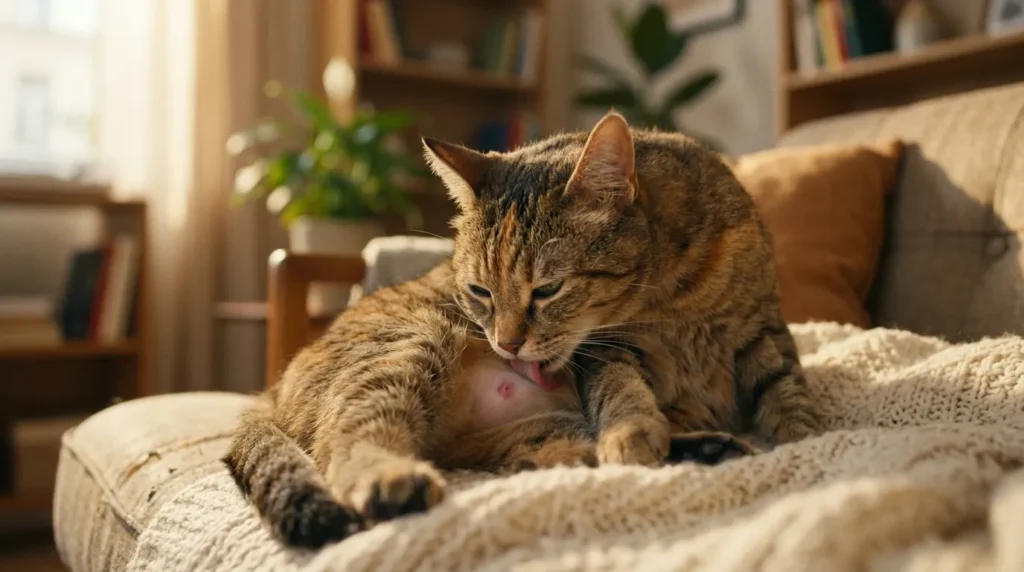
Overgrooming is usually the sign owners notice last, because it starts small. A cat grooming one spot a little more than usual raises no alarm. Kept up daily for two to three weeks, it produces a bald patch, which looks alarming but is preventable when you catch the boredom early.
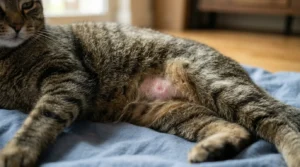
Overgrooming works as self-soothing. When stimulation drops below what a cat’s nervous system needs, grooming produces endorphins as a substitute. She is not malfunctioning. She is managing a stimulation gap with the one tool her body hands her automatically. According to the American Association of Feline Practitioners, environmental enrichment is the main fix for psychogenic alopecia in cats without an underlying skin condition.
Bald patches on the belly, inner thighs, or base of the tail, with no visible skin irritation, almost always point to a behavioral cause rather than medical. Rule out parasites and skin conditions with a vet visit first. Then treat the environment, not the symptom.
Sign 4: Sleeping Far More Than Normal
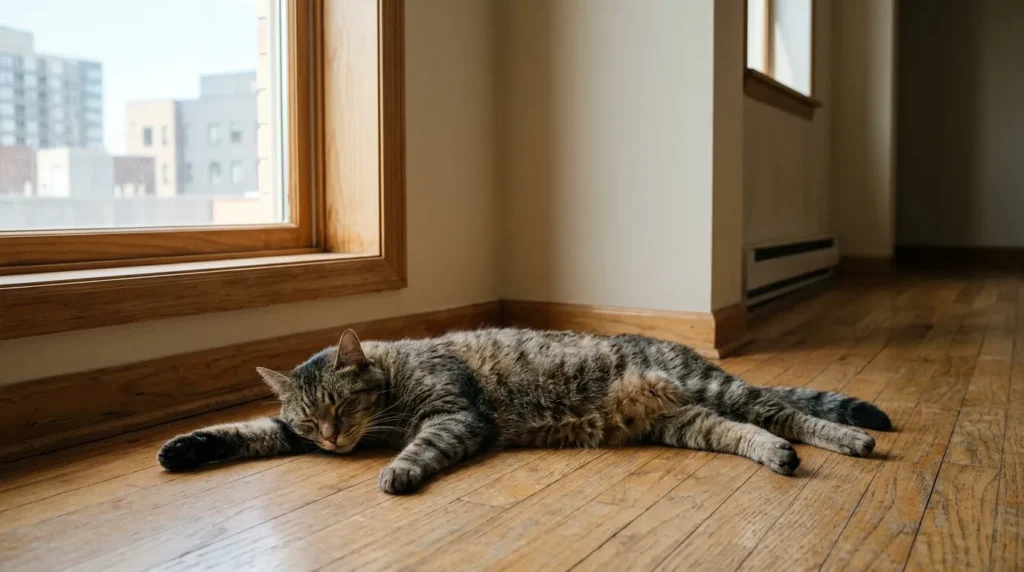
Cats sleep twelve to sixteen hours a day normally. That wide range is exactly why oversleeping gets missed as a boredom sign. A cat sleeping eighteen to twenty hours a day in a flat environment is not resting deeply. She has nothing worth being awake for. Watch how she wakes: a well-stimulated cat wakes alert and often looks for something to do. A bored, oversleeping cat wakes, looks around the unchanged room, and goes back under.
A cat sleeping twenty hours a day is waiting for something to happen. Nothing happens, because the room offers nothing new. Build in two daily interactive play sessions at consistent times, and most cats shift their sleep pattern within a week, because now there is something to anticipate.
Older cats sleep more as a baseline, so the twenty-hour mark means something different at age 12 than it does at age 3. Our guide on indoor cat lifespan covers how activity and sleep patterns shift through each life stage, which helps separate normal senior slowdown from boredom-driven oversleeping.
For enrichment ideas that fit small apartments, see our guide on indoor cat enrichment.
Sign 5: Pacing, Zoomies, and Restless Energy at Odd Hours
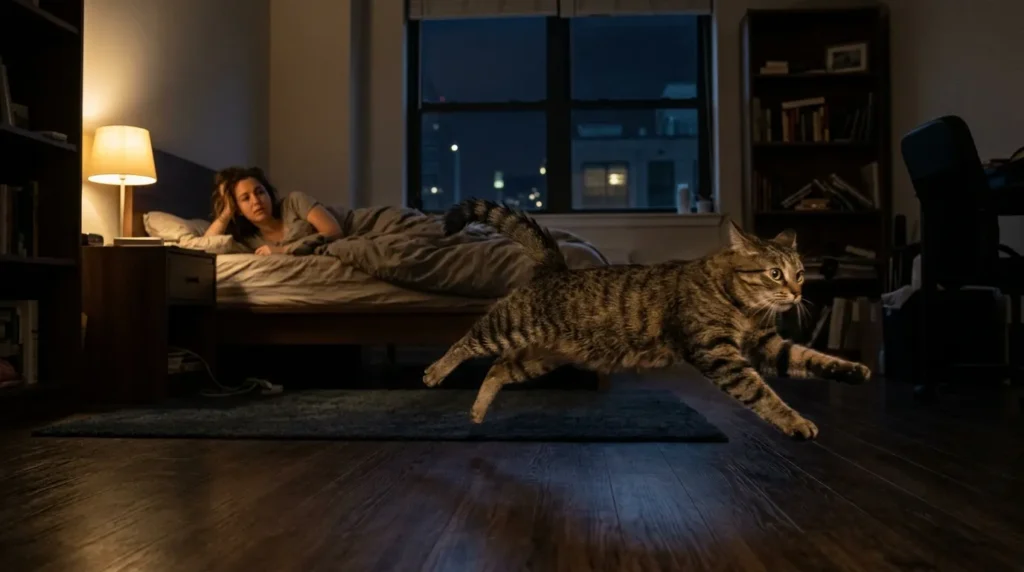
Zoomies are a normal discharge of built-up energy. A cat who gets solid daily interactive play rarely produces midnight zoomies, because she has already spent that energy on real hunting-sequence play earlier. A cat with frantic midnight racing most nights is running on energy nobody gave her an outlet for during the day.
Predatory drive in indoor cats is a fixed amount, and it comes out one way or another. A wand toy that mimics prey movement runs the full hunting sequence: stalk, chase, pounce, catch. When that sequence never finishes, the leftover drive discharges as uncontrolled bursts of activity, usually at dawn, dusk, or midnight.
Two five-minute wand sessions, each ending with a catch and a small food reward, resolve midnight zoomies in most cats within three to five days. The food reward matters. It completes the hunt-eat-groom-sleep cycle her body expects.
Insight: Midnight zoomies are not your cat being difficult. Her nervous system is telling you she did not get enough stimulation during the day. Treat it as a signal, not a behavior to punish. Add an evening play session before bed for five nights straight, and watch what happens to the 2am racing.
Sign 6: Aggression and Attention-Seeking That Gets Physical
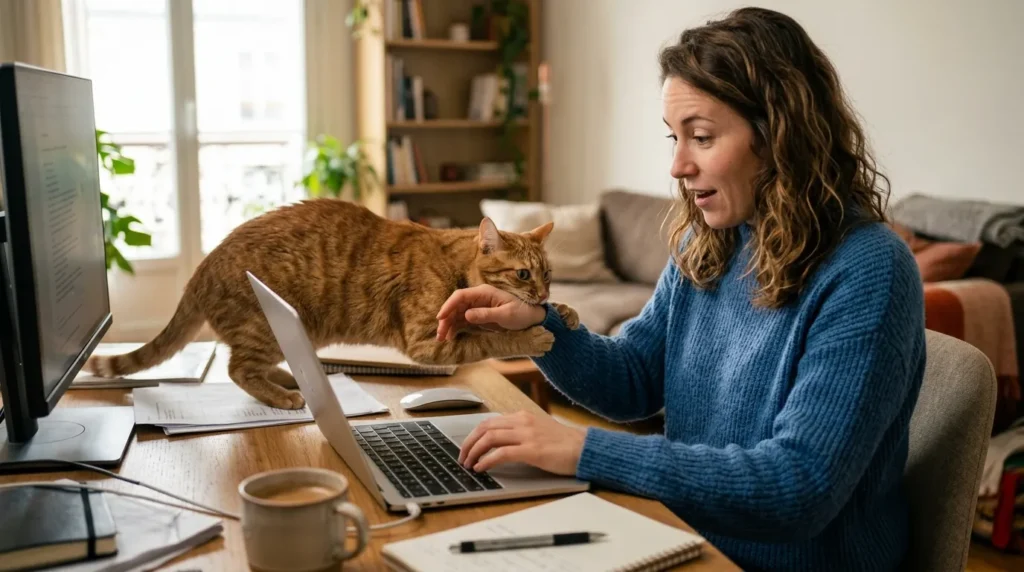
A cat who bites ankles, swats hands while you work, or ambushes you from behind furniture is not aggressive in any clinical sense. She is hunting you, because you are the only moving thing in her world that offers stimulation. Owners sometimes read this as a behavior problem that needs correcting, when it is actually a resource problem that needs enrichment.
Punishment does not fix hunting-type aggression from boredom, and neither does reacting dramatically, since both reinforce it. Redirect immediately to a wand toy, then build a daily play routine that gives the hunting drive a real outlet before it looks for one on your feet.
For more on reading and responding to these patterns, see our guide on indoor cat behavior.
Sign 7: Ignoring Toys and Losing Interest in Her Surroundings
A bored cat does not stay curious about new things. She may sniff a new toy once and never touch it again, or walk past a window perch she used to sit at for hours. This gets missed because it looks like disinterest rather than a behavior problem. Novelty fatigue sets in fast when nothing in the environment ever changes or moves unpredictably.
The fix is rotation, not more toys. Keep two or three toys out at a time and swap them weekly from a small stored collection. A toy that disappears for two weeks and comes back reads as new again. Buying more toys and leaving them all out at once does not solve this. It just adds clutter she has already learned to ignore.
Sign 8: Begging or Overeating as a Stimulation Substitute
Some bored cats redirect toward the food bowl instead of toward destruction. She sits by her dish, meows for food she was just fed, or eats a full bowl in under a minute and immediately asks for more. Eating is one of the few reliably rewarding events in her day, so an under-stimulated cat leans on it harder than she needs to.
This matters beyond the annoyance factor. Cats that use food as their main source of stimulation gain weight fast, and indoor cats already carry a higher obesity risk than outdoor cats. A puzzle feeder turns eating into a task instead of a handout, which slows this down and adds mental work at the same time. Our guide on how to feed an indoor cat properly covers portioning and feeding schedules that reduce this pattern.
Sign 9: Flat Affect and Reduced Curiosity
This is the quietest sign on the list, and the one most owners miss for the longest stretch. A curious cat perks up at a door opening, a bird outside, or a new smell on your shoes. A chronically bored cat stops reacting to most of it. She is not calm. She has stopped expecting anything interesting to happen, so she has stopped checking.
This differs from a naturally low-key cat, who still reacts occasionally, just at a lower intensity. Flat affect from boredom is a drop from her own previous baseline. If your cat used to watch the window and stopped, or used to greet visitors and stopped, that change is the signal, not her personality.
Boredom vs Stress vs Depression: Telling Them Apart
Boredom, stress, and feline depression share several surface signs, and owners often treat all three the same way. They need different fixes, so it’s worth separating them before you act.
| State | Trigger Pattern | Key Distinguishing Sign | What Helps |
| Boredom | Builds gradually with no environmental change | Responds within days to added play and enrichment | Interactive play, toy rotation, puzzle feeders |
| Stress | Follows a specific event: move, new pet, visitor, schedule change | Hiding, appetite loss, sudden litter box avoidance tied to the trigger date | Remove or ease the trigger, add safe spaces, consider pheromone diffusers |
| Depression-like withdrawal | Often follows loss (owner absence, death of a companion animal) or chronic pain | Persistent low mood beyond two to three weeks, little response to play attempts | Vet evaluation first, then gradual re-engagement |
If enrichment changes make no dent after two weeks, you’re likely not looking at simple boredom anymore. That’s the point to loop in your vet rather than adding a fourth toy.
Do Some Breeds Get Bored Faster?
Yes. Energy level varies a lot by breed, and high-drive breeds hit boredom’s physical symptoms faster and harder than low-key ones.
- Bengal: Bred from a wild ancestor, needs the most daily interactive play on this list. Boredom in a Bengal often shows up as destructive behavior first.
- Abyssinian: Highly active and curious; flat affect in an Abyssinian is a bigger red flag than in a naturally mellow breed.
- Siamese: Vocal by nature, which makes boredom-driven meowing harder to spot since some vocalization is just baseline personality.
- Ragdoll and Persian: Lower energy baseline; oversleeping and flat affect are the signs to watch for rather than destructive behavior.
Mixed-breed cats vary individually more than by breed, so watch your specific cat’s baseline rather than assuming her breed tells you everything.
The Mistakes People Make When They Notice These Signs
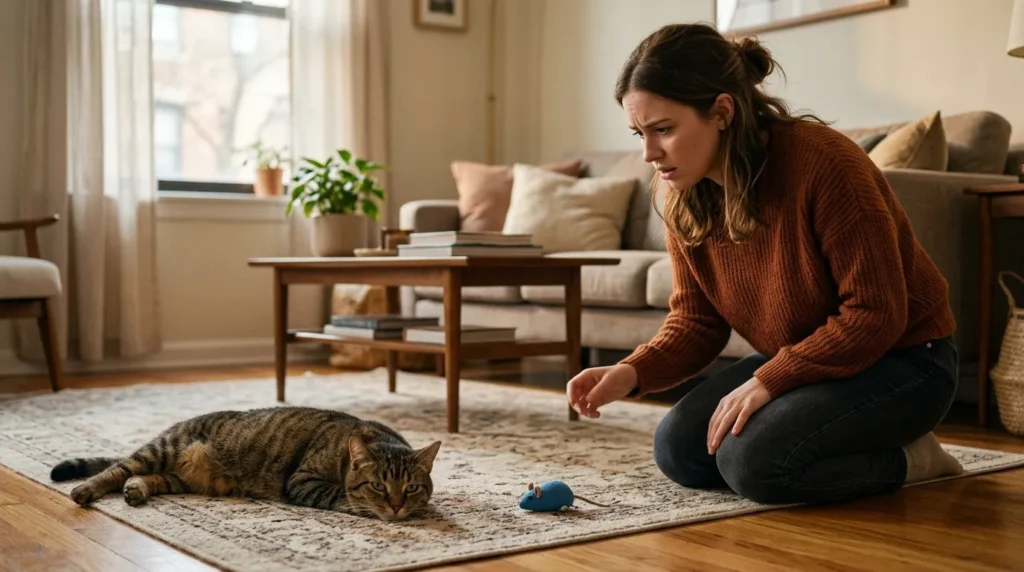
The most common mistake is buying more toys and leaving them on the floor. A bored cat does not self-play reliably. Hunting drive needs an unpredictable moving target to switch on. A toy mouse sitting still on the carpet gives zero stimulation, since it never triggers the stalking response that makes play satisfying. Toys sitting around are not enrichment. Playing with them daily is.
The second mistake is adding a second cat to fix boredom without touching the environment first. Two bored cats in a flat environment do not entertain each other. They compete for the same thin resources and add territorial stress on top of the boredom. Fix the environment first, then decide if another cat would genuinely help both animals.
The third mistake is treating each sign as its own separate problem. Overgrooming, aggression, and midnight zoomies showing up in the same month are not three problems. They are three expressions of one environmental gap. Fix the environment, and all three tend to fade together.
When Boredom Signs Point to Something Medical
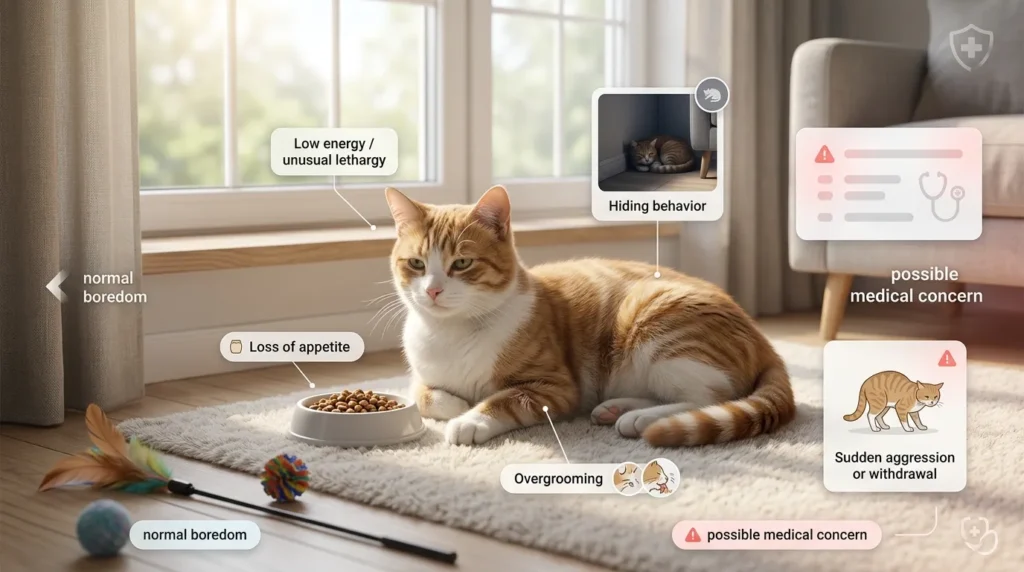
Several boredom signs overlap directly with early symptoms of real medical conditions. Know which one you are looking at before you assume it is behavioral.
| Behavior | Boredom explanation | Medical cause to rule out |
| Eliminating outside the litter box | Stress-related, tied to under-stimulation | Urinary tract infection, feline idiopathic cystitis |
| Overgrooming | Self-soothing from low stimulation | Skin condition, parasites, food allergy |
| Oversleeping | Nothing worth waking up for | Hypothyroidism, anemia |
| Loss of interest in food | Rare on its own from boredom | Dental pain, nausea, systemic illness |
If your cat is eliminating outside her box, our guide on setting up an indoor cat litter box covers box setup issues that mimic stress-driven avoidance, worth ruling out before assuming it is purely behavioral.
Address obvious environmental gaps first when several signs build gradually over weeks. If enrichment changes bring no improvement within two weeks, or any sign appears suddenly in a cat with a previously stable routine, book a vet visit within the week.
Watch specifically for a cat losing interest in food rather than overeating. Loss of appetite paired with lethargy and less grooming is a medical pattern, not a boredom pattern, and it needs a vet call within forty-eight hours. For tracking these changes over time, our guide on indoor cat health covers what a monthly baseline check should include.
This article is for informational purposes only. Always consult your vet if you have concerns about your cat’s health.
Fix It Today: A Quick Enrichment Checklist
You don’t need a full room redesign to start. These are the changes that move the needle fastest, roughly in order of impact:
- Two ten-to-fifteen-minute wand play sessions daily, one of them right before bed
- End every play session with a catch and a small treat, so the hunt-eat cycle actually finishes
- Rotate toys weekly from a stored bin instead of leaving everything out at once
- Add one puzzle feeder to slow down eating and add mental work
- Set up a window perch, ideally facing outdoor bird or street activity
- Add vertical space, like a cat tree or shelf, if you don’t already have one
- Keep a two-week log of which signs you’re seeing and whether they’re improving
Most single-sign cases improve within a week of the first two items alone. Multiple signs together may take the full two weeks before you see a clear shift.
Frequently Asked Questions
How do I know if my indoor cat is bored or just lazy?
A lazy cat rests in a loose, relaxed sprawl and wakes alert when something interesting happens. A bored cat rests flat and disengaged and wakes without seeking activity. The difference shows when you offer a wand toy. A lazy cat plays. A bored cat may not respond right away, since her interest response has dulled from being under-stimulated so long.
Can a single indoor cat get bored without another cat?
Yes. Single cats depend entirely on their environment and their owner for stimulation. With no interactive play, no window enrichment, and no variety, an only cat gets bored faster than a cat in a multi-cat home, since nothing else in the space adds unpredictability. Single cats need more deliberate daily enrichment, not less.
How much playtime does an indoor cat need to avoid boredom?
At least two interactive sessions of ten to fifteen minutes daily, using a wand or feather toy you actively control. Toys left on the floor do not count toward this. Most boredom signs ease within one to two weeks of consistent twice-daily play. If signs continue past two weeks of enrichment changes, talk to your vet to rule out medical causes.
What are the fastest ways to reduce boredom signs in an indoor cat?
Add one fifteen-minute wand session before bed each night. Results show up in three to five days for most cats, as midnight zoomies drop and attention-seeking eases. A window perch with a bird feeder outside adds passive stimulation the rest of the day. Both changes together cost under twenty dollars.
Does a bored cat always show obvious signs?
No. Many bored cats show subtle signs for months before anyone notices: slightly less enthusiasm for play, more time spent in one spot, less vocalization instead of more. Missing enthusiasm matters as much as destructive behavior, but it is far easier to overlook until it shows up as fur loss or sudden aggression.
Can a bored cat overeat even with regular meals?
Yes. Food is one of the few guaranteed rewarding events in an under-stimulated cat’s day, so she can lean on meals and begging as a stand-in for mental stimulation. Regular portions do not stop this on their own. A puzzle feeder that slows eating down and adds effort usually helps more than a diet change alone.
How many hours can I leave a bored cat alone?
Most healthy adult cats handle 8 to 10 hours alone fine if enrichment is already in place before you leave: a puzzle feeder, a window perch, and toys rotated in that morning. A cat already showing boredom signs handles long alone stretches worse, since there’s no stored-up stimulation to draw on during the day.
Is my senior cat bored or just slowing down with age?
Both are possible, and they need different responses. Age-related slowdown is gradual and matches an overall drop in mobility. Boredom in a senior cat still includes signs like flat affect or oversleeping, but it responds to enrichment changes the way a younger cat’s boredom does. If a senior cat perks up with wand play, boredom is at least part of the picture.
Conclusion
Catching signs your indoor cat is bored early changes the outcome for both of you. A two-week enrichment push catches the problem before it becomes overgrooming dermatitis or aggression that takes months to retrain. Start tonight with one evening wand session, and add a window perch this week. Small, consistent changes stack faster than most owners expect, and you will see the shift in days, not months.
Signs an indoor cat is bored include excessive unprompted meowing, gradual destructive scratching or item-knocking, overgrooming that produces bald patches, sleeping past sixteen hours daily, midnight zoomies, redirected physical aggression toward the owner, ignoring toys and surroundings, begging or overeating as a stimulation substitute, and reduced curiosity or flat affect. Boredom differs from stress, which follows a specific trigger event, and from depression-like withdrawal, which persists beyond two to three weeks with little response to play. High-energy breeds like Bengals and Abyssinians show boredom signs faster than lower-energy breeds like Ragdolls and Persians. Most boredom signs in indoor cats ease within one to two weeks of twice-daily fifteen-minute interactive wand play. Single indoor cats need deliberate daily enrichment from their owner, since no other animal adds unpredictability to the environment. Enrichment changes should show visible improvement within two weeks before a medical cause is ruled in.

Written by Mishu
A passionate cat lover and indoor living enthusiast, Mishu is the founder and voice behind Indoor Living Cat – a go-to resource for cat owners who want to create the happiest, healthiest life for their feline companions indoors.
View Full Profile