
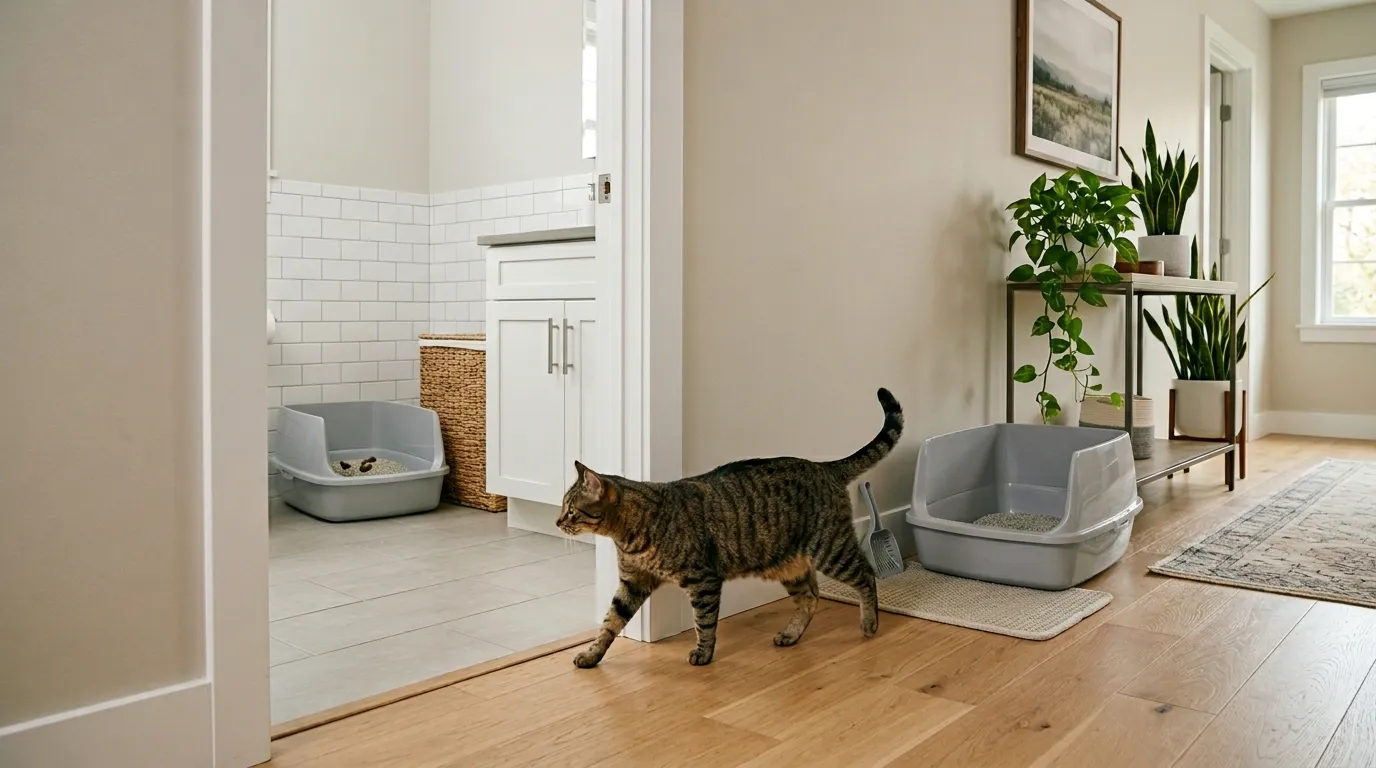
How many litter boxes for one cat do you actually need? Two, not one. Most new owners buy a single box and assume it covers a cat living alone in a small apartment. My own cat used hers without issue for three months, then quit cold and started going on the bathroom mat instead. A second box in a different room fixed it within a day. That wasn’t luck. Vets and feline behaviorists agree on this across the board: one cat needs at least two boxes, kept in separate spots so the cat treats them as real alternatives, not one big option. This guide is part of our full indoor cat litter box setup guide, and it covers why two boxes beats one, how many boxes multi-cat homes need, how to place them so your cat actually uses both, whether self-cleaning boxes change the math, and when a third box makes sense.
Quick answer: One cat needs two litter boxes minimum. This follows the N+1 rule used by veterinarians worldwide: one box per cat, plus one spare. Two boxes give your cat a clean backup, separate spots for urinating and defecating, and a buffer against the stress of having only one option.
How Many Litter Boxes for One Cat: Why the Answer Is Always 2?
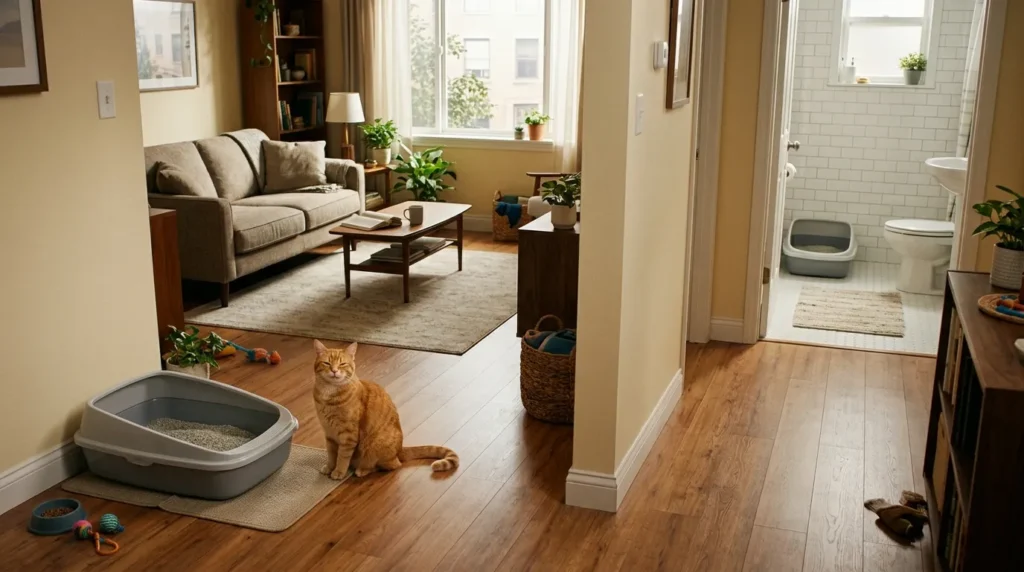
How many litter boxes for one cat comes down to the N+1 rule. It’s the standard from the American Association of Feline Practitioners, the Ohio State University Indoor Pet Initiative, and most certified feline behaviorists. Ohio State calls it the “Golden Rule”: one litter box per cat, plus one. For a single cat, that means two.
This isn’t a multi-cat rule that happens to apply to solo cats too. It was built around how cats experience their bathroom space in the first place. Even one cat without any other pets in the home benefits from a backup, because cats are picky about cleanliness and often reject a box after just one use.
There’s a practical reason two boxes work better than one, and it has to do with elimination habits most owners never think about. Many cats prefer to urinate in one spot and defecate in another. That pattern shows up across domestic cats and wild felids alike. A single box forces both functions into the same spot, which plenty of cats tolerate but don’t actually prefer.
For the full rundown on litter box size, type, and setup that decides whether your cat uses what you give her, see our indoor cat litter box setup guide.
Why One Litter Box Is Never Enough Even for a Single Apartment Cat?
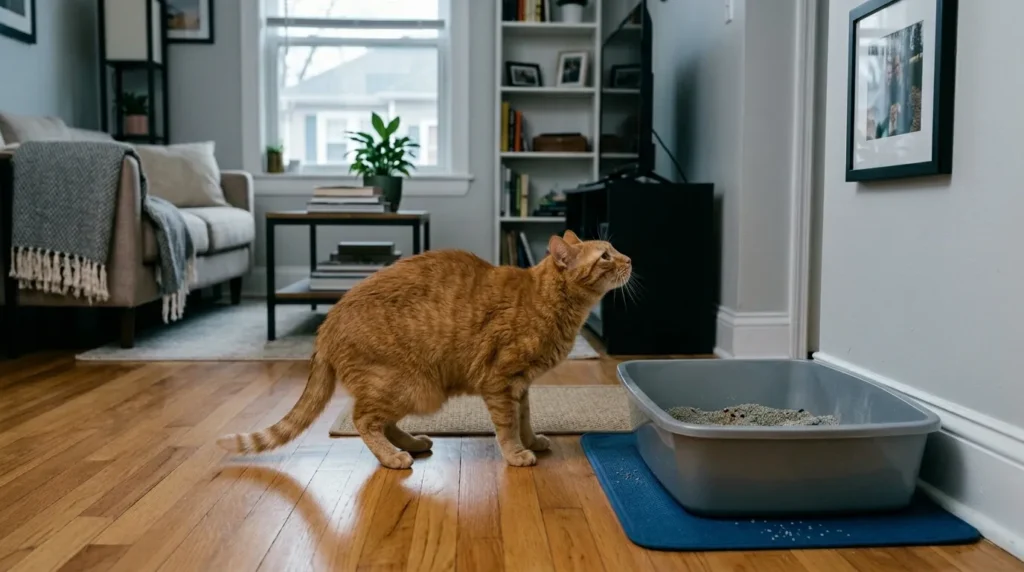
One litter box leaves no room for the small daily changes that decide whether your cat uses it. A box used once already might be unacceptable to a cat who wants a clean space every time. A box mid-cleaning when your cat needs it means no option at all. A box in a spot that turns stressful for a day has no backup.
Litter box avoidance is one of the most common behavior complaints from cat owners, and inappropriate elimination sits near the top of reasons cats end up in shelters. Most of these cats had fine basic care. They just didn’t have enough box access. Getting the count right from day one prevents most of this before it starts. For more on reading your cat’s habits, see our guide to indoor cat behavior.
Feline lower urinary tract disease risk climbs when cats hold urine longer than they should, because no acceptable spot is open. A cat that reaches its one box and finds it too dirty will often wait rather than use it. Repeated waiting adds real strain to the urinary tract. A second box isn’t a luxury here. It’s cheap insurance for your cat’s health.
Insight: think of the second litter box like a spare tire. You won’t use it daily, but the day your main box goes flat, you’ll be glad it’s there. A dirty box, one still being refilled, or a room that turned stressful will send your cat looking for a backup. That backup should be a second box, not your laundry pile.
Signs Your Cat Needs Another Litter Box
Some cats tell you before an accident ever happens, if you know what to watch for. Add a box before things escalate if you notice:
- She stands at the edge of the box instead of stepping fully in, or perches on the rim
- She scratches at the floor or wall next to the box instead of the litter itself
- She sniffs the box, then walks away without using it
- She goes right after you scoop but avoids it a few hours later once it’s “used” again
- You find urine or stool just outside the box rather than inside it
- She meows at you near the litter area, almost asking for something
Any of these on their own could be a one-off. Two or three of them together, especially over the same week, mean your current setup is short at least one box.
One Litter Box vs Two Litter Boxes: Quick Comparison
Here’s how a single-box setup stacks up against the two-box setup vets recommend.
| Factor | One Box | Two Boxes |
| Backup when dirty | None | Always an option |
| Separate spots for urine and stool | No | Yes |
| Risk of avoidance behavior | Higher | Lower |
| Urinary retention risk | Higher | Lower |
| Setup cost | $15 to $40 one time | $30 to $80 one time |
| Daily maintenance time | About 2 minutes | About 4 minutes |
How Many Litter Boxes Do You Need for 2 or 3 Cats?
The N+1 rule scales with every cat you add, and a lot of owners get this wrong once they go from one cat to two. It’s not “one box per cat.” It’s one box per cat, plus a spare, no matter the headcount.
| Number of Cats | Minimum Boxes Needed (N+1) | Notes |
|---|---|---|
| 1 cat | 2 | The standard single-cat setup covered in this guide |
| 2 cats | 3 | Spread across at least two rooms so no cat can guard both |
| 3 cats | 4 | Watch for one confident cat blocking access to a shared box |
| 4 cats | 5 | Space usually matters more than count at this point |
In multi-cat homes, placement matters even more than the count. A dominant cat can guard a hallway and cut a shyer cat off from every box in that direction, so boxes need to sit in rooms that every cat can reach without crossing another cat’s usual path.
Where to Place 2 Litter Boxes in a Small Apartment for One Cat?
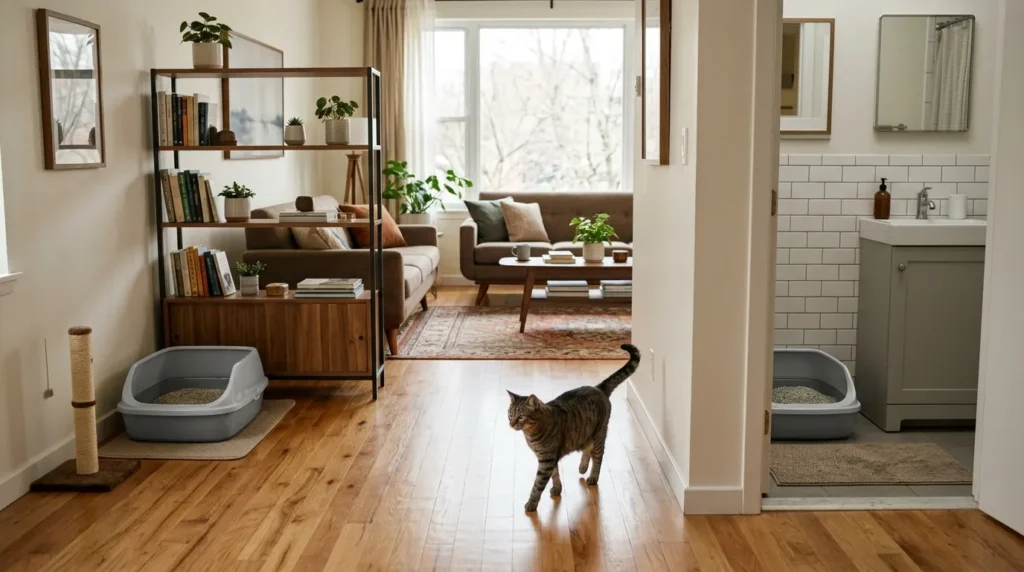
Placement decides whether your cat actually uses both boxes or sticks to one and ignores the other. Two boxes in the same bathroom, side by side, defeat the point of having two. Your cat reads adjacent boxes as one resource, not two separate choices. Together they’re basically one bigger dirty box in her mind.
Put the two boxes in genuinely different spots. A bathroom and a hallway. A bathroom and a bedroom corner. A living area and a spare room. The exact rooms matter less than the distance between them. Your cat should be able to reach one box from anywhere in the apartment without crossing through the other box’s territory. If you’re working with a tight floor plan, our guide to keeping a cat in an apartment covers layout tricks that help.

Each box needs a quiet spot, away from food and water bowls, and away from doors that slam or high-traffic paths. A box near a washing machine creates a startle risk that trains your cat to avoid it over time. A box jammed in a dead-end corner, with no view of the room entrance, creates low-grade stress during use. Give both boxes a clear sightline to the exit.
The Right Size and Type for Your Two-Box Setup
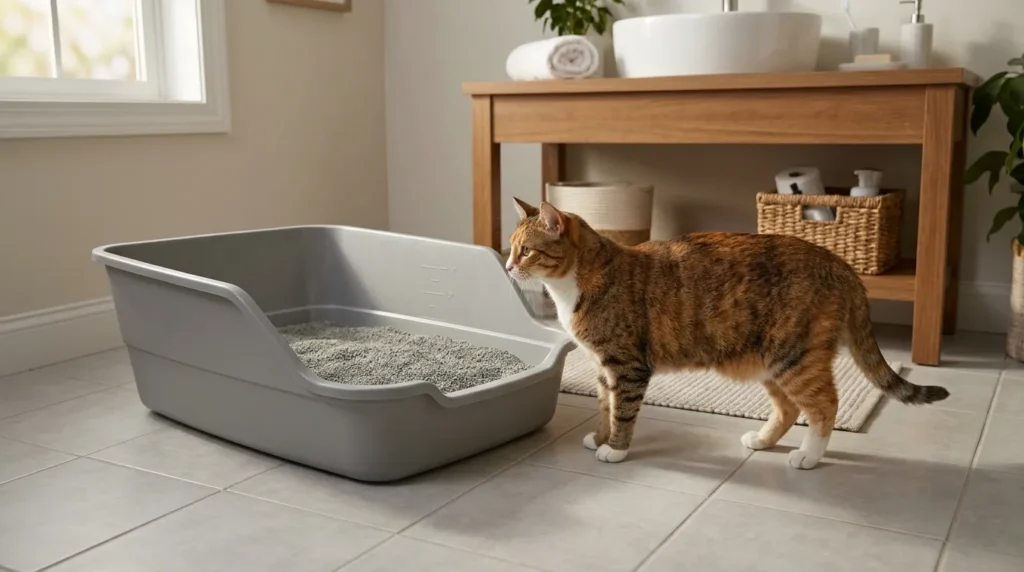
Both boxes need room for your cat to walk in, turn around, and dig without hitting the walls. The standard rule: each box should be at least one and a half times your cat’s length, nose to base of tail. For an average adult cat, that’s 22 to 24 inches long. Large-breed cats, like Maine Coons, often need a box closer to 26 to 30 inches, since most “large” boxes on shelves are still sized for an average domestic shorthair.
Most boxes sold in pet stores are too small for adult cats. Sizes get chosen for shelf space, not cat comfort. A large plastic storage tote with one side cut down to a 3-inch entry often beats a store-bought box, and costs less. That’s not a budget compromise. It’s the better option for most cats.
Open boxes without lids work better than covered ones for almost every cat. Covered boxes trap ammonia inside instead of letting it clear out, so the smell builds up worse than in an open box. A hood also blocks your cat’s view of her surroundings while she’s at her most vulnerable, which is enough to cause avoidance in some cats.
Litter depth matters too. Fill each box 2 to 3 inches deep with unscented clumping litter. Scented litter smells fine to us and off-putting to a lot of cats. Less depth than that and clumps break apart before you can scoop them cleanly.
| Box Type | Works Best For | Limitation |
| Open high-sided | Most adult cats | More visible litter scatter |
| Open low-entry | Senior cats and kittens | Less scatter containment |
| Covered with hood | Owners who prioritize aesthetics | Traps ammonia, many cats avoid |
| Top-entry | Agile young cats in small spaces | Difficult for seniors and large cats |
| Storage tote conversion | Any adult cat | Requires minor DIY modification |
Do Self-Cleaning Litter Boxes Change the N+1 Rule?
Not really, and this trips up a lot of owners who buy one automatic box expecting it to replace both. A self-cleaning box does solve the “dirty box” problem, since it rakes waste out after each use instead of sitting soiled until you scoop. That covers one of the two reasons a backup box matters.
It doesn’t solve the other one. Your cat still benefits from a second, separate location, both for the urinate-in-one-spot, defecate-in-another pattern and as a backup if the mechanism jams, runs out of power, or misreads her weight and refuses to cycle. A common setup that works well: one self-cleaning box as the primary, plus one basic open box in a different room as the true backup. That keeps the convenience of automatic scooping without losing the redundancy that makes two boxes work in the first place.
How Often Should You Clean Litter Boxes for One Cat?
Scoop each box once a day at minimum, twice if you can manage it. A single cat still produces enough waste to make a box smell within 24 hours.
- Scoop solids and clumps daily from both boxes.
- Top up litter after each scoop to keep depth at 2 to 3 inches.
- Dump and wash each box fully every 2 to 4 weeks with mild soap, not bleach or scented cleaners.
- Replace a box entirely once a year, since plastic absorbs odor over time that scrubbing cannot remove.
If both boxes still smell strong right after cleaning, the litter type or box material could be the problem rather than your schedule. Our guide on why a litter box smells after cleaning walks through the common causes.
Common Litter Box Mistakes in Single-Cat Homes
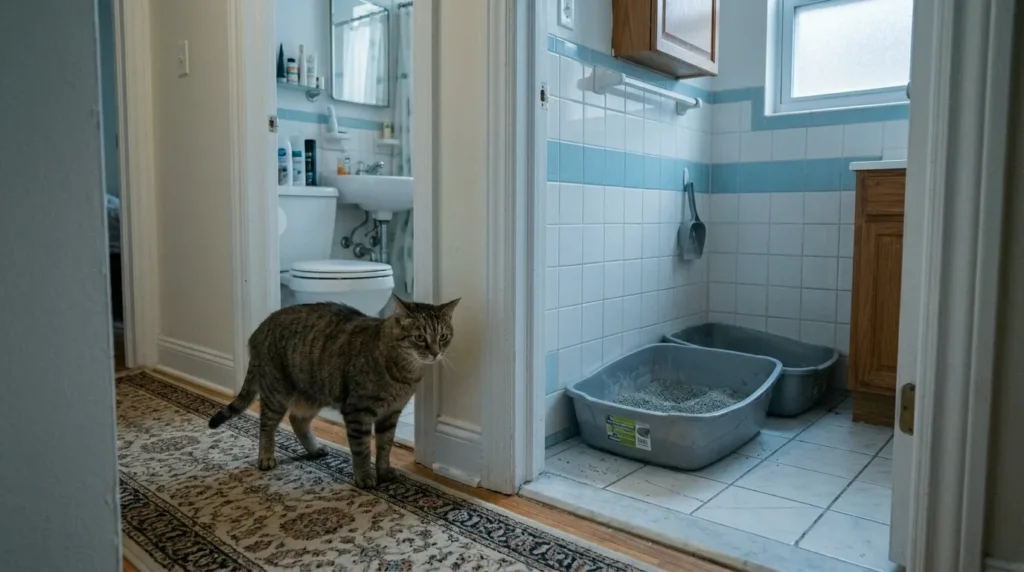
The most common mistake single-cat owners make is placing two boxes in the same spot after hearing they need two. Side by side in one bathroom, they count as one location to your cat. No access advantage, no territory split, no privacy gain. Separate placement is the entire point, not just the count.
The second mistake is waiting for a problem before adding the second box. Avoidance habits form within days once a cat finds an alternative spot. Once she’s used a corner as a bathroom a few times, the scent trail pulls her back. Setting up correctly from day one is far easier than retraining a habit later.
The third mistake is having the right number of boxes but skipping maintenance and the wider environment. Two dirty boxes with shallow, clumpy litter offer no real advantage over one dirty box. Cats with little else to do around a small apartment also tend to fixate more on small changes near the litter box. Our indoor cat enrichment guide has ideas for keeping her occupied and less prone to stress-driven avoidance.
Quick checklist to avoid these mistakes:
- Place boxes in two different rooms, never side by side.
- Set up the second box before problems start, not after.
- Scoop daily and keep litter depth at 2 to 3 inches.
- Watch for sudden changes in bathroom habits and act fast.
When to Consider a Third Box for Your Single Cat?
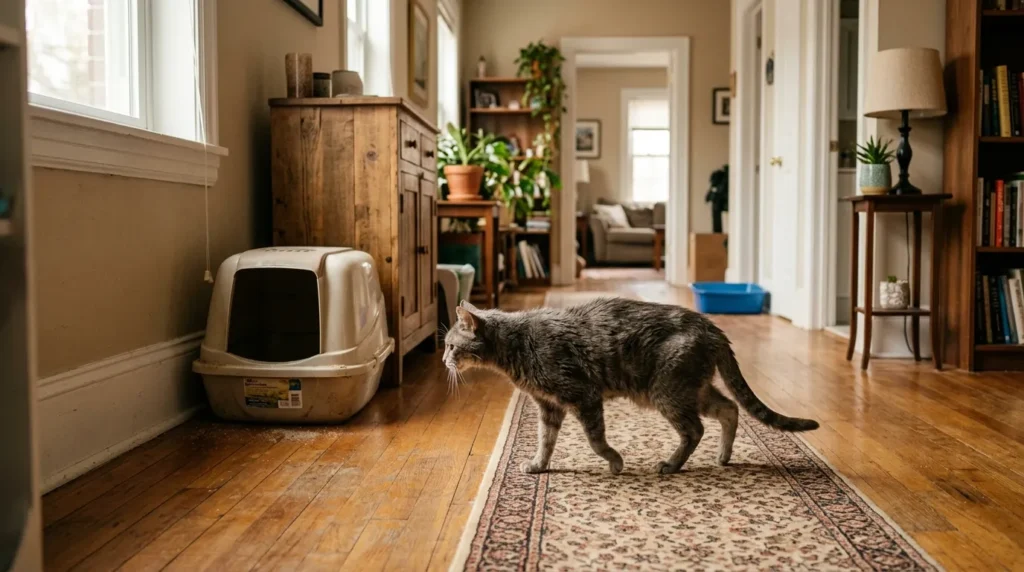
Two boxes cover most single cats in most apartments. Three situations call for a third. First, a large home or multi-story apartment, where two boxes still leave long distances from a resting spot to the nearest one. A cat sleeping upstairs with both boxes downstairs has real access problems at night.
Second, a senior cat with arthritis or joint trouble. Older cats with limited mobility need a shorter walk to the box at night. A third box closer to the sleeping area stops accidents that have nothing to do with behavior and everything to do with physical limits.
Third, a cat recovering from a urinary tract infection or surgery that affects movement. Closer, more frequent box access cuts the effort needed during recovery. A temporary third box during recovery is a welfare move, not a permanent change. If you notice repeated straining, blood in urine, or frequent trips with little output, treat it as a vet visit, not a box problem. Our indoor cat health guide covers warning signs worth watching for.
Do Kittens Need Two Litter Boxes Too?
Yes, though timing matters more than with adult cats. A kitten under 4 months does best with one low-entry box per main living area she has access to, since she can’t always make it far in time. Once she’s fully litter trained, usually by 5 to 6 months, the same N+1 rule applies: two boxes for one kitten, placed apart like you would for an adult cat.
Frequently Asked Questions
How many litter boxes does one cat need?
One cat needs two litter boxes as a minimum. This is the N+1 rule recommended by veterinarians and feline behaviorists. Two boxes give your cat a clean backup when one has been used recently, separate spots for urinating and defecating, and insurance for when one box is temporarily unavailable.
Is one litter box enough for a single cat?
One litter box isn’t enough for most cats, even with just one cat in the home. A single box becomes less appealing right after use for many cats, concentrates all the odor in one spot, and leaves no backup during cleaning. Most avoidance problems in single-cat homes trace back to too little box access.
Can two litter boxes be in the same room?
Two boxes in the same room beat one box, but it’s still not ideal. Your cat reads same-room boxes as a single shared resource, not two separate choices. For the full benefit, put each box in a different room, or at least in separate areas with no line of sight between them.
Does a single indoor cat really need two litter boxes?
Yes. The N+1 rule applies no matter how many cats live in the home. According to the American Association of Feline Practitioners environmental needs guidelines, multiple litter box locations cut stress-related elimination problems in both single and multi-cat households. If your cat shows a sudden change in litter box use, check with your vet first to rule out a urinary condition.
Where should I put two litter boxes in a small apartment?
Put one box in a quiet bathroom corner and the other in a different room, such as a hallway corner, bedroom corner, or behind a room divider. Never place both side by side. The key is real spatial separation so each box reads as its own territory to your cat.
How often should I clean my cat’s litter box?
Scoop each box at least once a day, twice if you can. Wash both boxes fully every 2 to 4 weeks with mild soap. Replace each box once a year, since plastic holds onto odor that scrubbing alone won’t fix.
What’s the best litter box ratio for one cat?
The best ratio for one cat is two boxes, following the N+1 formula. Homes with two cats need three boxes, three cats need four, and so on. The extra box is what keeps the ratio working as a household grows.
Does one self-cleaning litter box count as enough for one cat?
No. A self-cleaning box solves odor and scooping, but your cat still benefits from a second box in a different room as a backup and for separate elimination spots. Pair one automatic box with one basic open box rather than relying on a single automatic unit.
I already have two litter boxes and my cat still avoids them. What’s wrong?
Check placement first. Two boxes in the same room count as one to your cat. Next, check maintenance: a box scooped only every few days will get avoided even if there are three of them. If placement and cleaning both check out and avoidance continues, book a vet visit to rule out a urinary tract issue before assuming it’s purely behavioral.
Conclusion
How many litter boxes for one cat comes down to two, every time. Place them in genuinely separate spots, never side by side, and keep both clean with daily scooping and a litter top-up after each scoop. The second box costs $15 to $40 once and heads off most litter box problems that show up in single-cat homes when access gets handled right from the start. For everything else on setup, from litter type to problem-solving, our full indoor cat litter box guide covers the rest. Set up that second box today, somewhere genuinely apart from the first.
One cat needs two litter boxes as the minimum, based on the N+1 rule from veterinarians, the American Association of Feline Practitioners, and the Ohio State University Indoor Pet Initiative. The same rule scales with more cats: two cats need three boxes, three cats need four. Place the two boxes in genuinely separate locations, never side by side, since cats treat adjacent boxes as one resource. Two boxes allow separate urination and defecation spots, give a clean backup when one box was used recently, and cut stress-related avoidance. Watch for early warning signs like a cat standing at the box’s edge, sniffing and walking away, or eliminating just outside it. Each box should be at least one and a half times the cat’s nose-to-tail length, filled with unscented clumping litter at a 2 to 3 inch depth. Self-cleaning boxes solve odor but not redundancy, so pair one with a basic backup box. Scoop daily, wash every 2 to 4 weeks, and add a third box for seniors, large homes, or cats recovering from illness.

Written by Mishu
A passionate cat lover and indoor living enthusiast, Mishu is the founder and voice behind Indoor Living Cat – a go-to resource for cat owners who want to create the happiest, healthiest life for their feline companions indoors.
View Full Profile