
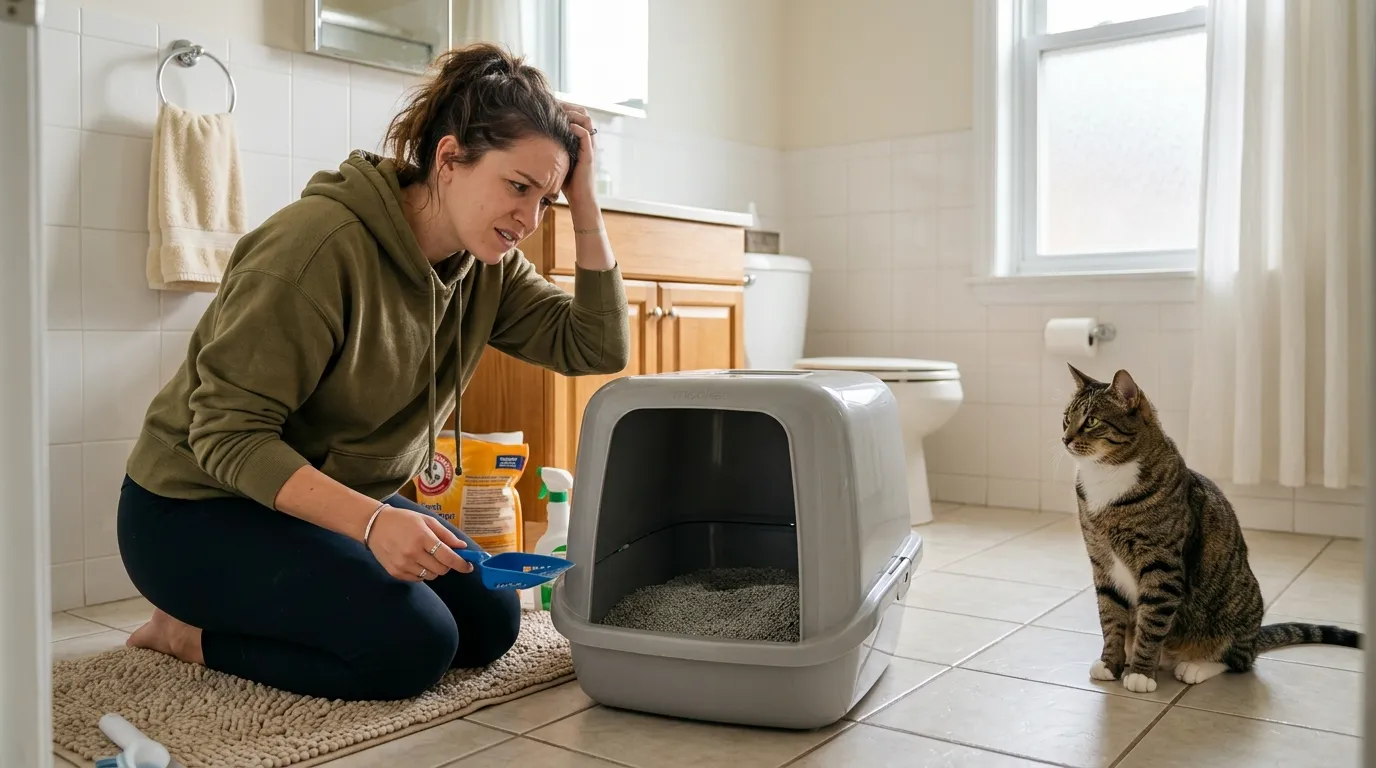
You cleaned the box twenty minutes ago. Scooped everything, topped off the litter, and the smell is already back the second you walk past it. That exact moment is one of the most frustrating parts of owning an indoor cat, and it’s a lot more common than most owners think.
I went through months of this before I figured out the problem wasn’t my litter or my cleaning routine. It was the box itself. Mine kept smelling after cleaning because the plastic had absorbed more than soap could ever reach again. This article walks through the six real causes, ranked by how often they actually show up, with the exact fix for each one.
Quick answer: A litter box smells after cleaning because bacteria living inside microscopic scratches in the plastic keep producing ammonia, no matter how clean the surface looks. Other causes include leftover urine residue, the wrong cleaning products, shallow litter, poor ventilation and too many cats sharing too few boxes. The permanent fix is replacing a plastic box every one to two years and using an enzymatic cleaner for deep washes, not just soap.
Six Causes at a Glance
| Cause | Quick Fix |
| Scratched, porous plastic | Replace the box every 1–2 years, or switch to stainless steel |
| Urine residue at the base | Deep clean with enzymatic cleaner, 15–30 minute dwell time |
| Wrong cleaning products | Skip bleach and scented cleaners; use mild unscented soap |
| Shallow or scented litter | Keep 2–3 inches of unscented clumping litter |
| Poor ventilation | Add airflow; avoid fully sealed enclosures |
| Too many cats, too few boxes | Follow the number of cats plus one rule |
For the full setup, not just the troubleshooting, our guide to indoor cat litter box setup and maintenance covers sizing, placement and litter type from scratch. This article picks up where that one leaves off, for the specific problem of a box that still smells after you’ve already cleaned it.
The Real Reason a Litter Box Smells After Cleaning: Porous Plastic
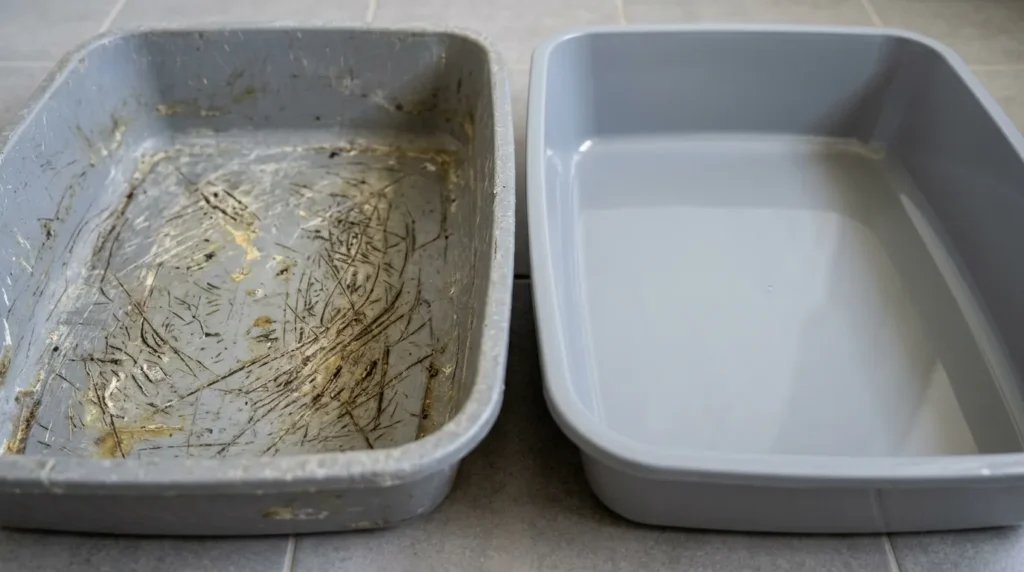
The number one reason a litter box smells after cleaning is scratched, porous plastic. Every scoop drags microscopic grooves into the surface. Your cat’s claws add more. Litter abrasion adds more on top of that. Over months, these grooves trap urine proteins, bacteria and organic residue well past where soap or a brush can reach.
Bacteria living in those scratches keep producing ammonia around the clock. That’s why the box smells clean for about twenty minutes after washing, then starts smelling again. You removed everything visible and reachable. The bacteria in the scratches were never removed, because they can’t be. They live inside the material, not on top of it.
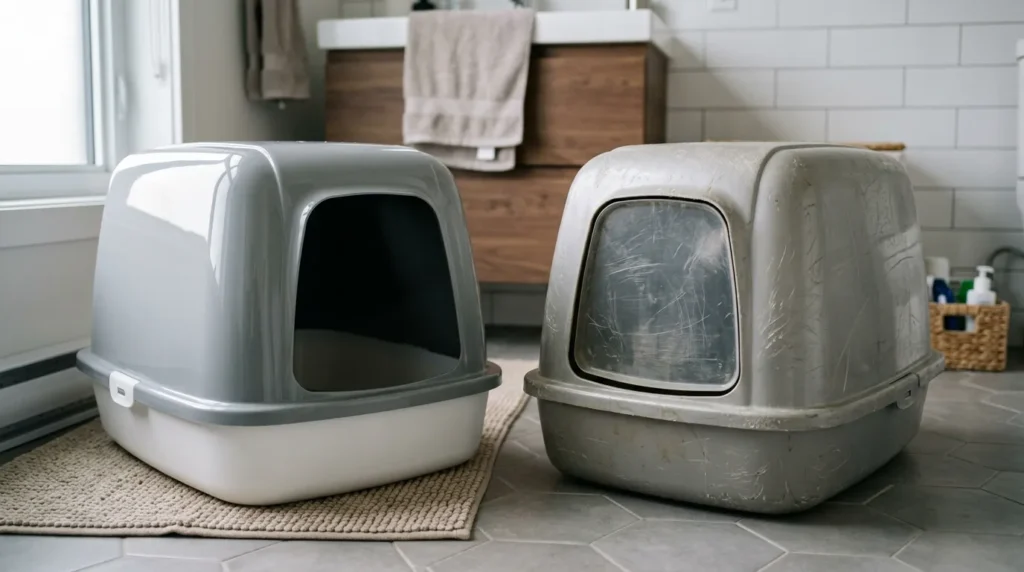
The fix is simple, but a lot of owners resist it because the box still looks fine. Replace a plastic litter box every one to two years, regardless of appearance. If the smell returns within 48 hours of a thorough wash, that’s the plastic telling you cleaning won’t help anymore.
| Material | Odor Resistance | Typical Lifespan |
| Plastic | Scratches and holds odor over time | 1–2 years |
| Stainless steel | Doesn’t scratch or absorb bacteria | 5+ years |
| Ceramic | Resists scratching, but chips can trap residue | 3–5 years |
Stainless steel gets rid of this problem for good. Steel doesn’t scratch the way plastic does, so bacteria never get a foothold on the surface.
Urine Residue Left at the Bottom Is Causing the Smell
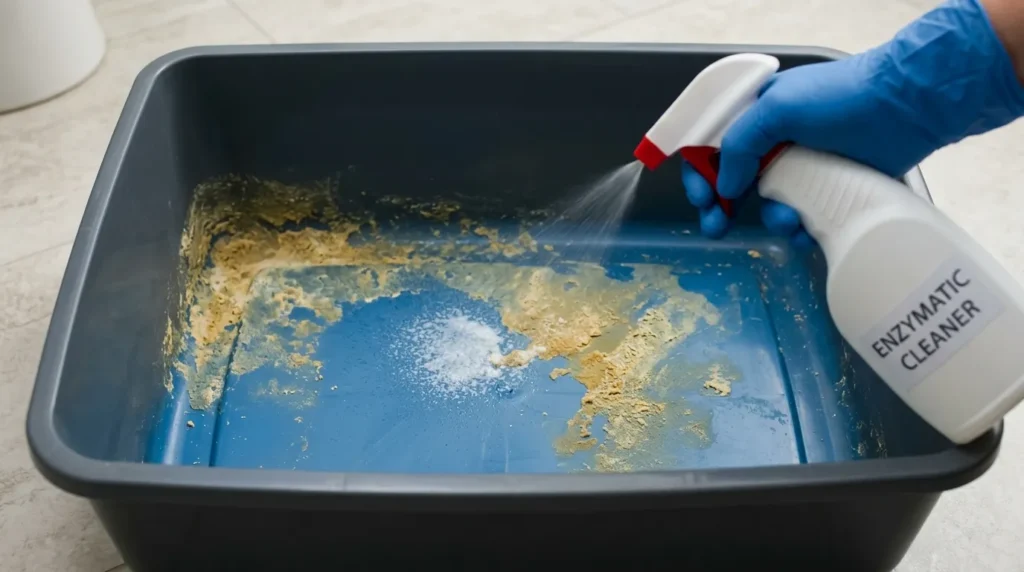
Incomplete residue removal is the second most common cause. Once litter depth drops below two inches, urine seeps straight to the bottom before the litter can absorb it. Over weeks, this dries into a thin, sticky layer on the base and lower walls. Scooping removes the clumps but never touches the residue underneath.
An enzymatic cleaner is the only product that actually breaks this residue down instead of masking it. Dish soap dissolves surface grease and visible dirt, but it doesn’t touch uric acid crystals in dried urine. Enzymatic cleaners use beneficial bacteria to consume uric acid at a molecular level and convert it into odorless byproducts that rinse away clean.
The correct deep-clean process has five steps:
- Empty all the litter completely.
- Rinse the box with hot water to loosen surface material.
- Spray enzymatic cleaner on every interior surface, including walls, rim and base.
- Let it sit for 15 to 30 minutes without drying out.
- Rinse with hot water and air-dry fully before refilling.
A box that still smells after this process has bacteria embedded in the plastic scratches. That box needs replacing, not more cleaning.
Insight: The 15-minute dwell time for enzymatic cleaners isn’t a suggestion. It’s when the actual cleaning happens. Spray and wipe in the same motion and you get almost nothing, since the enzymes never had time to work. I set a timer every time now, and the difference afterward is huge compared to my old spray-and-wipe habit.
The Wrong Cleaning Products Are Making the Smell Worse
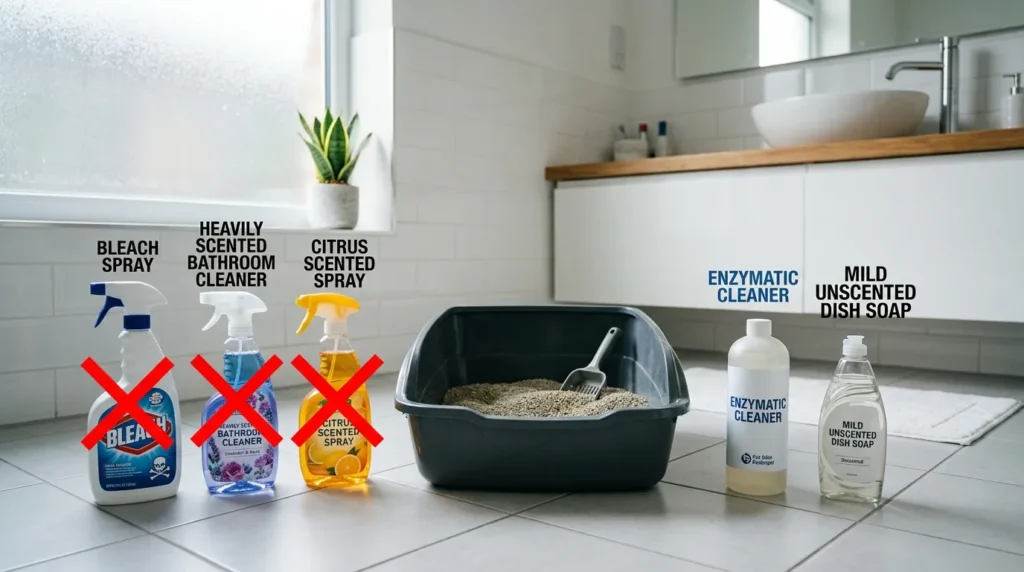
Bleach and heavily scented cleaners are two of the most common reaches for owners dealing with a smelly box, and both make the problem worse over time. Bleach leaves a chlorine residue in the plastic that combines with ammonia from future urine to form chloramine gas. That produces a stronger, more irritating smell than ammonia alone, and it can push cats away from the box entirely, since the chemical smell overwhelms their sensitive nose.
Scented cleaners and air fresheners near the box run on the same broken logic. They lay artificial fragrance over the ammonia, which you smell temporarily but your cat smells straight through. Bacteria keep producing ammonia under that fragrance layer around the clock. Within hours the artificial scent fades, and the ammonia is still there, unchanged. Plenty of cats start avoiding the box once the scent itself becomes something they’d rather steer clear of.
| Product | What It Actually Does | Verdict |
| Bleach | Leaves chlorine residue that reacts with future ammonia into chloramine gas | Avoid |
| Scented cleaners/sprays | Masks the smell for you, doesn’t touch the bacteria, can drive cats off the box | Avoid |
| Mild unscented dish soap | Removes surface grease and visible dirt for routine washes | Use weekly |
| Enzymatic cleaner | Breaks down uric acid crystals at a molecular level | Use for deep cleans |
Stick to mild unscented dish soap for routine washes and an enzymatic cleaner for deep monthly cleaning. Wash with soap and hot water, rinse completely and air-dry before refilling. Never use the box while it’s still damp. Moisture in a partially dried box is a perfect environment for bacterial growth, and it brings the smell back faster than almost anything else on this list.
Poor Litter Depth and the Wrong Litter Type Trap Odors
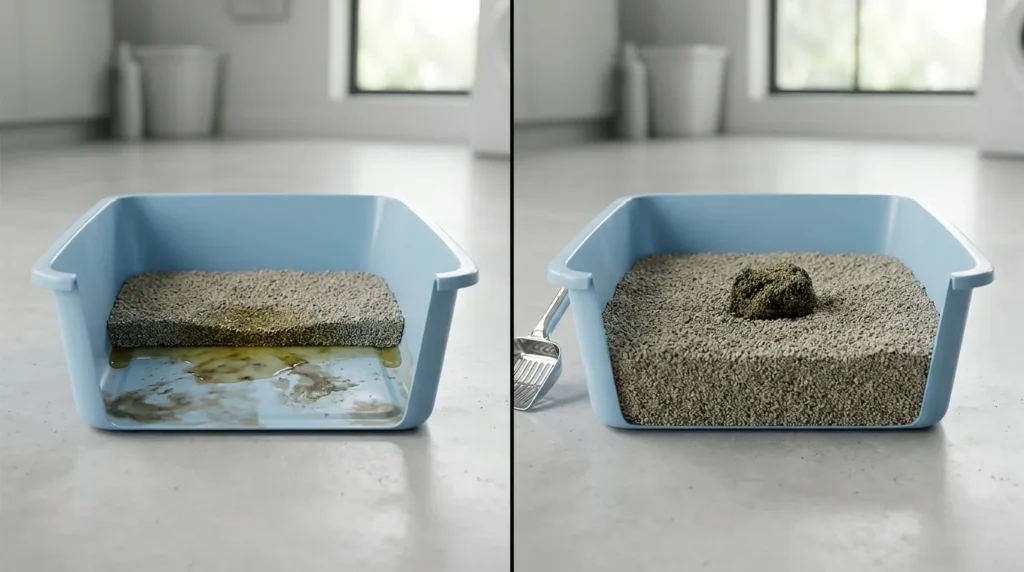
Litter depth under two inches lets urine bypass the litter and hit the box bottom directly. Every urination event then deposits raw urine onto the plastic base, and scooping never removes it. Even after a full clean, this residue has already soaked into the plastic and keeps releasing ammonia. Keeping two to three inches of litter isn’t just a comfort preference for your cat. It’s the mechanism that keeps urine inside the litter where it can actually be scooped out.
Scented litter creates its own version of this problem. Artificial fragrance covers ammonia temporarily, but it doesn’t touch the bacteria producing it. The litter also absorbs ambient odors from around the box on top of waste odors. Over days, scented litter starts smelling like concentrated fragrance mixed with ammonia, a combination that’s often worse than either smell alone. Switching to unscented clumping clay litter clears this layered problem.
Poor clumping performance from budget litter leaves broken clump residue scattered through the litter between scoops. Every broken piece keeps releasing ammonia between cleaning sessions. A high-quality litter that forms firm, complete clumps you can scoop cleanly is the single biggest litter factor for odor control in an apartment.
Do Litter Box Liners Help or Hurt?
Liners sound like an easy fix, and for the box shell they are; less direct contact means fewer new scratches over time. But cats claw at liners while digging, which tears holes that let urine pool underneath the plastic bag instead of soaking into litter. That trapped puddle sits against the box base and smells worse than no liner at all. If you use one, check under it weekly for tears, and skip liners entirely if your cat digs aggressively before or after using the box.
Ventilation and Placement Problems Concentrate the Smell
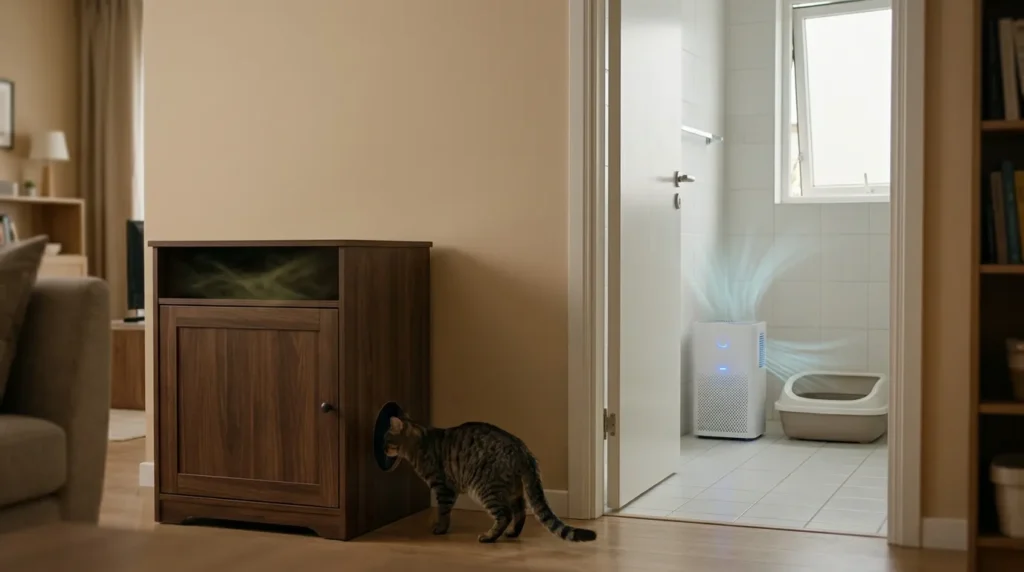
A litter box tucked inside a fully enclosed cabinet or a closet with the door shut can be cleaned correctly and still smell wrong. Ammonia is a gas. In an enclosed space, it concentrates instead of dissipating. Open that door, or walk past the furniture piece, and the accumulated ammonia hits you far stronger than the same box would produce in an open, ventilated spot. The box isn’t dirtier. The air management around it is off.
Odor control in a small apartment needs active ventilation near the box, not more enclosure. A small clip-on fan in a closet litter box location keeps air moving and stops ammonia from pooling. An air purifier with a HEPA filter, placed within three feet of an open box, captures airborne particles continuously. Ten minutes of a bathroom exhaust fan after scooping removes more odor than any scented product on the shelf.
| Setup | Odor Outcome |
| Fully sealed cabinet, no vents | Ammonia concentrates and hits hard when opened |
| Covered box, open room | Odor trapped inside the dome, released in bursts |
| Open box, curtain screen on tension rod | Visual privacy with airflow preserved |
| Furniture enclosure with vent slots and large cat door | Looks concealed, still ventilates reasonably well |
| Fully open box, ventilated room | Best odor control, least visual concealment |
Choosing between hiding the box for looks and giving it real airflow is a genuine tradeoff in apartment living, and it matters even more in a smaller unit, where less air volume means smells build up faster. Our guide on living with a cat in an apartment covers how layout affects this beyond just the litter box. For the best placement options that balance privacy and airflow in small spaces, our detailed guide on where to put a litter box in a small apartment walks through it.
Multi-Cat Households Make Every Odor Problem Worse
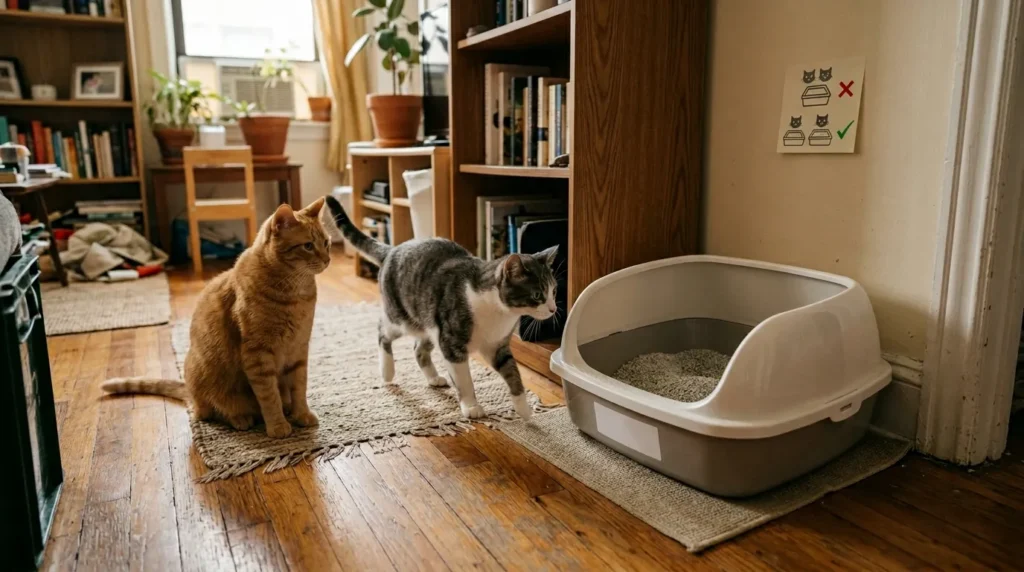
A box that smells after cleaning in a multi-cat household is almost always a volume problem before it’s a cleaning problem. Two cats produce roughly double the waste of one cat in the same box over the same stretch. A box that lasts a single cat three days fills in 36 hours with two cats. The smell outpaces any cleaning schedule built for one.
The number of cats plus one rule applies directly here. Two cats need three boxes at minimum. Three cats need four. Every extra cat adds waste volume one box can’t hold between cleanings, no matter how thoroughly you clean it. Spreading boxes across different rooms also stops a dominant cat from guarding the one clean box and leaving another cat with no good option. Our guide on indoor cat behavior covers this kind of resource guarding and what it signals between cats.
Scooping twice daily instead of once in a multi-cat household directly cuts the ammonia load at any given moment. Each pass removes what’s built up since the last scoop, not since yesterday. The difference in ambient smell in a studio with two cats, once versus twice daily scooping, is noticeable within the first week of switching.
Insight: The most overlooked multi-cat fix is scooping more often, not cleaning harder. Most owners with an odor problem respond by deep-cleaning more thoroughly and less frequently. The real fix is almost always scooping more often while keeping the same deep-clean schedule. Removal frequency matters more than the depth of any one clean.
Self-Cleaning Litter Boxes: Do They Actually Smell Less?
Self-cleaning boxes rake waste into a sealed compartment on a timer, and that reduces exposed ammonia between cycles compared to a standard box. But the compartment itself becomes a concentrated odor source you’re not looking at daily, since it’s out of sight by design. Skip emptying it for three or four days and the smell inside can be worse than a neglected standard box, because waste sits sealed and damp instead of open and drying. Most units also use plastic components that scratch the same way manual boxes do, so the porous-plastic problem from earlier in this article still applies. The compartment needs emptying every two to three days regardless of what the display says, and the mechanism itself still needs a full wash on the same one-to-two-week schedule as a manual box.
Fast Fixes: A Checklist for Getting Rid of the Smell Today
If you need results before your next full deep clean, work through these in order:
- Scoop right now, even if it’s not your usual time. Fresh waste sitting for hours is often the actual source, not old residue.
- Check litter depth. Top up to two to three inches if it’s run low; shallow litter lets urine hit the base directly.
- Open a window or run an exhaust fan near the box for ten minutes. This clears concentrated ammonia faster than any spray.
- Sprinkle a thin layer of plain baking soda under the litter, not mixed heavily into it. It absorbs ammonia without the fragrance problem scented products carry. A tablespoon per box is enough; more doesn’t help and can make some cats avoid the box.
- Move a small fan nearby if the box sits in a closet or corner with no airflow.
- Check for a damp box. If you washed it recently and it’s not fully dry, that moisture is likely your smell. Let it finish drying before adding litter back.
None of these replace a real deep clean if the plastic is old or residue has built up. They buy you a day or two while you plan the actual fix.
When Litter Box Odor After Cleaning Is a Health Warning
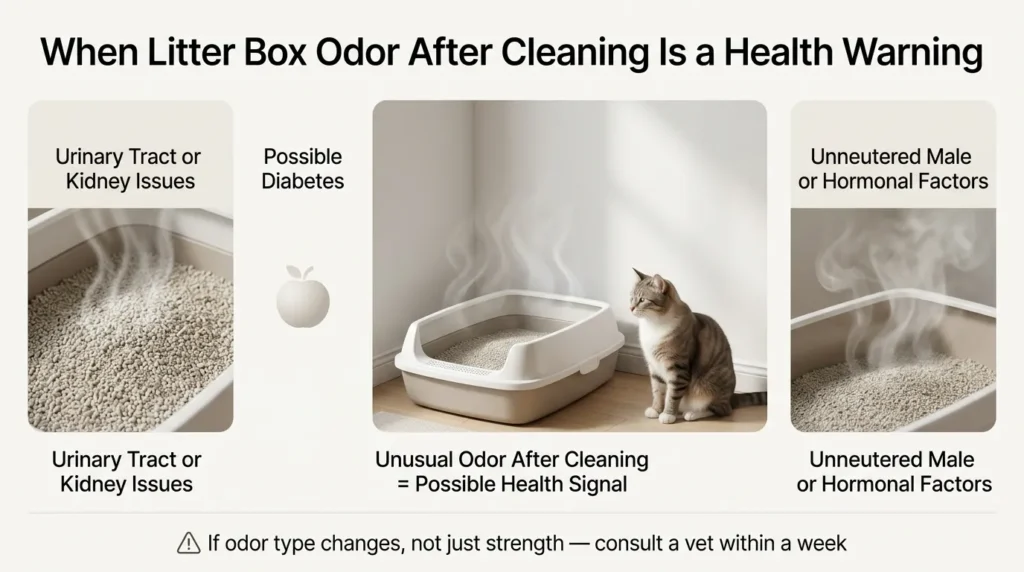
A box that smells unusually strong or different after cleaning, despite a correct routine and a box within its lifespan, can be signaling a change in your cat’s health. Urinary tract infections produce urine that smells far more concentrated than normal. Kidney disease shifts urine chemistry in ways that push ammonia output higher. Diabetes can produce sweet-smelling urine some owners describe as fruity rather than sharp. Unneutered male cats produce urine that’s noticeably stronger and more persistent than neutered cats, regardless of how often you clean.
Diet plays a role too. A cat drinking too little water produces more concentrated urine, which smells stronger even from a healthy cat. Our guide on how to feed an indoor cat properly covers how wet food and water intake affect urine concentration and, by extension, litter box smell.
If the smell type changes, not just the intensity, that shift is worth a vet call within the week. A box that has always smelled like mild ammonia and now smells sharply different points to a chemistry change cleaning can’t fix. According to the Cornell Feline Health Center, changes in elimination behavior and urine odor rank among the earliest observable signs of feline urinary and kidney conditions. Our guide on indoor cat health covers what else is worth tracking as part of a monthly baseline check.
This article is for informational purposes only. Always consult your vet if you have concerns about your cat’s health.
The Cleaning Mistakes That Keep the Smell Coming Back
The most costly mistake is refilling the box before it’s fully air-dried. Moisture inside creates the ideal environment for ammonia-producing bacteria. A box refilled while damp starts generating smell within hours, since the bacteria that survived the wash now have both moisture and fresh litter to work with. Let the box dry completely in open air before adding fresh litter. That takes 30 minutes to two hours, depending on humidity and airflow.
The second mistake is not rinsing the cleaning product out fully. Soap residue left behind reacts with cat urine to produce a smell that’s often worse than urine alone. Rinse with hot water until it runs completely clear with no bubbles, then rinse once more. Incomplete rinsing is one reason a box can smell worse right after a full wash than it did before.
The third mistake is waiting too long between full changes. Scooping daily is maintenance. A complete change, full litter swap and box wash, should happen every one to two weeks for a single cat, and closer to weekly per box in a multi-cat household. An owner who scoops diligently but does a full wash only once a month lets a month of bacterial buildup sit in the litter layer, which no amount of daily scooping removes.
Frequently Asked Questions
Why does my litter box smell like ammonia right after I clean it?
Ammonia smell right after cleaning almost always means bacteria are living in microscopic scratches inside the plastic. These bacteria produce ammonia continuously, regardless of surface cleaning. If the smell returns within 48 hours of a thorough wash, the box is past the point where cleaning helps. Replace it, or switch to stainless steel, which doesn’t scratch and hold bacteria the same way.
Does enzymatic cleaner actually stop litter box smell after cleaning?
Yes, when used correctly. Enzymatic cleaners break down uric acid crystals at a molecular level instead of masking the smell. Let the cleaner sit 15 to 30 minutes before rinsing, so the enzymes can work. One application after a full litter removal and rinse resolves most residue-based odor soap washing misses. Tough buildup may need two or three applications across sessions.
How often should I fully clean the litter box to prevent smell?
Do a complete clean, emptying all litter, washing with enzymatic cleaner, rinsing fully and air-drying, every one to two weeks for a single cat. Multi-cat households often need a full clean weekly per box, given the higher use volume. Daily scooping keeps things fresh between full cleans but doesn’t replace them.
Can the litter itself cause the box to smell after cleaning?
Yes. Scented litters carry artificial fragrance that absorbs environmental odors and combines with ammonia over days into a worse smell overall. Low-quality litters with poor clumping break apart and leave residue through the litter layer between scoops. Switch to a high-quality unscented clumping clay litter, filled two to three inches deep, to stop urine from reaching the box base. If your cat’s urine smells dramatically different than usual, consult your vet before changing the litter.
Does a covered litter box smell more than an open one?
Yes. Covered boxes trap ammonia inside the enclosed space instead of letting it dissipate. The smell builds up inside and hits you harder when you open it than an equivalent open box in the same spot would. If you need to hide the box for looks, use a furniture enclosure with a large cat door and open vent slots rather than a fully sealed cabinet.
Is a stainless steel litter box worth the extra cost?
For most owners dealing with recurring smell, yes. Stainless steel costs more upfront, usually two to four times a basic plastic box, but it doesn’t scratch, doesn’t absorb bacteria and can last five years or more. If you’ve already replaced a plastic box once for odor reasons, steel usually pays for itself by skipping the next replacement.
How do I get rid of litter box smell overnight?
Scoop immediately, top up litter depth to two to three inches, run an exhaust fan or open a window near the box for ten minutes, and sprinkle a thin layer of plain baking soda under the litter. This clears active ammonia fast, but it’s a stopgap. If the smell returns by the next day, the box likely needs the full deep-clean process, or replacement if it’s over two years old.
Are self-cleaning litter boxes less smelly than manual ones?
Only if you empty the waste compartment every two to three days. Left longer, sealed and damp waste inside the unit can smell worse than a neglected manual box. The plastic components still scratch and hold bacteria over time, so the mechanism needs the same wash schedule as a standard box.
Conclusion
A litter box that smells after cleaning has one of six causes: scratched porous plastic, urine residue at the base, wrong cleaning products, shallow litter depth, poor ventilation or too many cats for too few boxes. Start with the plastic. If the box is over two years old, replace it before trying anything else. Add enzymatic cleaner to your next full wash and give it the full dwell time. Most owners who do both steps see the smell resolve within one to two cleaning cycles.
A litter box smells after cleaning primarily because bacteria living in microscopic scratches inside porous plastic keep producing ammonia, regardless of how clean the surface looks. Secondary causes include urine residue at the box base from shallow litter depth, wrong cleaning products such as bleach or scented cleaners, poor ventilation from enclosed placement, torn liners trapping urine, and too few boxes for a multi-cat household. Plastic litter boxes should be replaced every one to two years, or swapped for stainless steel, which lasts far longer. Enzymatic cleaners with a 15 to 30 minute dwell time break down uric acid residue that regular soap leaves behind. Litter depth should stay at two to three inches to keep urine from reaching the box base directly, and self-cleaning boxes still need their waste compartment emptied every two to three days to avoid trapped, concentrated odor.

Written by Mishu
A passionate cat lover and indoor living enthusiast, Mishu is the founder and voice behind Indoor Living Cat – a go-to resource for cat owners who want to create the happiest, healthiest life for their feline companions indoors.
View Full Profile