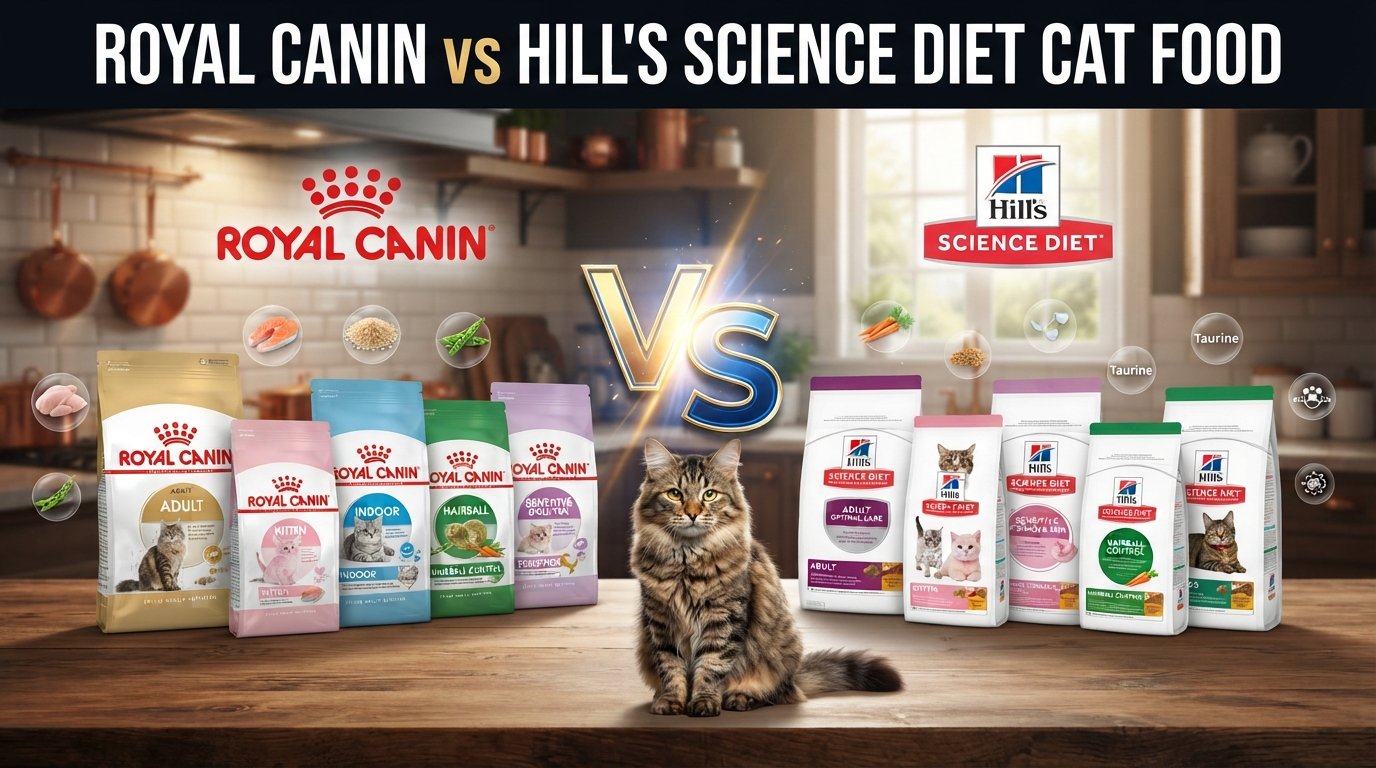
Royal Canin Indoor Adult and Hill’s Science Diet Adult Indoor sit on the same shelf for a reason. Both go after the same problem: an indoor cat that doesn’t burn much energy, sheds constantly, and needs help with digestion. They just solve it differently. Royal Canin leans on a fiber blend built for hairballs and a kibble shape meant to slow tartar. Hill’s leans on fresh chicken, more protein, and a prebiotic blend called ActivBiome+. I compared both labels ingredient by ingredient, looked at how each one handles dental health and food transitions, and pulled together what real owners are still asking after reading the usual reviews.
For a broader feeding plan alongside either brand, see our guide on how to feed an indoor cat properly.
⚡ Quick Verdict: Royal Canin vs Hill’s Science Diet Cat Food
Hill’s Science Diet Adult Indoor is my top pick overall. Fresh chicken as the first ingredient, 31% protein, and the ActivBiome+ prebiotic blend give it an edge for everyday feline health. Royal Canin Indoor Adult is the better choice for cats with frequent hairballs or dental tartar, and it usually costs less per bag. Neither formula is a dedicated dental diet, so if tartar is your main fight, check the note on that further down. The right pick comes down to the specific problem you’re solving for, not which brand name is on the bag.
Analysis: Royal Canin Indoor Adult Cat Food
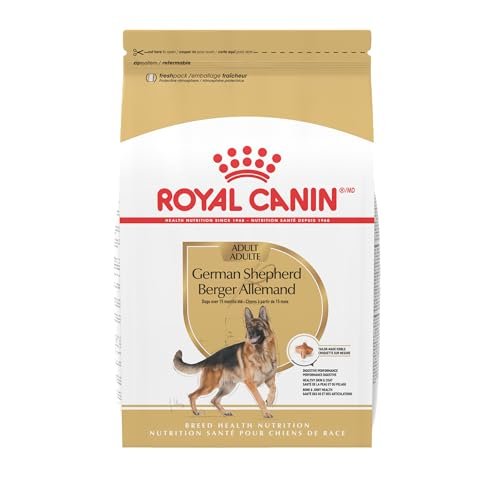
Royal Canin Indoor Adult is built for cats one to seven years old who spend most of the day napping, grooming, and grazing. It targets the three problems that come with that lifestyle: weight gain, hairballs, and litter box odor. If your cat’s biggest issue is digestion rather than raw protein, this formula earns its place on the shelf.
The guaranteed analysis lists 27% minimum crude protein and 11 to 15% crude fat. Chicken meal leads the ingredient list, followed by brewers rice, corn, and wheat. So this is a grain-inclusive recipe, not a fresh-meat-first one. Cats that do poorly on richer, high-protein diets sometimes handle this moderate formula better.
The fiber blend aimed at hairball control is the standout here. It helps move swallowed hair through digestion instead of letting it sit and form a mat. For a deeper look at hairball-specific formulas, our Purina Indoor Cat Food hairball formulas guide covers a third option worth comparing.
Build Quality & Design
The kibble is small, crunchy, and shaped to encourage chewing instead of swallowing whole. That texture supports oral health by slowing tartar buildup. Royal Canin has run in-house veterinary research for close to fifty years, and the recipe reflects that focus on function over flash.
Performance & Speed
Performance here means steady weight control, not muscle-building power. The moderate calorie count is calibrated for a cat that isn’t burning much energy. Litter box odor typically drops within the first two weeks, in line with the brand’s claim about highly digestible protein reducing stool volume.
Features & Functionality
The combined hairball and weight management approach in one bag is the standout feature. Most competing brands make you pick one focus or the other. Royal Canin also sells a matching wet food, Indoor Adult Morsels in Gravy, for owners who want to mix textures.
User Experience
Feeding guidelines are printed clearly on the bag and scale by weight, so portion control isn’t a guessing game. The kibble size stays consistent across bag sizes, so there’s no adjustment period when moving from a 3 lb bag to the 15 lb size.
Value for Money
Royal Canin typically costs less per bag than Hill’s, and the smaller bag sizes make it easier to trial the formula before buying in bulk. If hairballs or dental tartar are your main concern, this is the more budget-friendly route.
✅ Advantages
❌ Disadvantages
Analysis: Hill’s Science Diet Adult Indoor
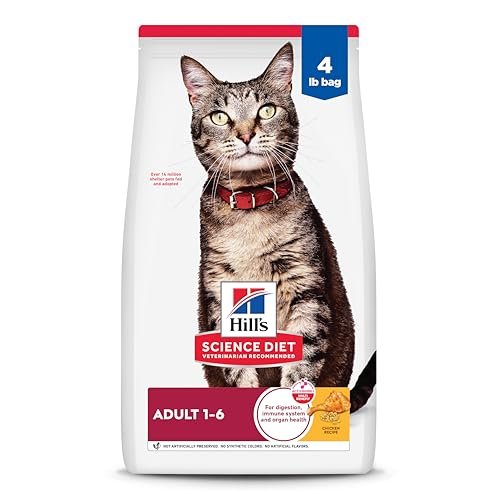
Hill’s Science Diet is a staple in veterinary clinics for a reason. The Adult Indoor formula is built for everyday cats one to six years old, balancing lean protein, digestion support, and skin and coat care in one bag. It’s a no-nonsense, science-backed daily diet rather than a single-symptom fix.
Fresh chicken leads the ingredient list, giving the recipe 31% minimum crude protein and 11.5% minimum crude fat. It’s still grain-inclusive, with whole grain wheat and corn gluten meal further down the list, so it sits between Royal Canin’s moderate profile and a fully grain-free diet.
The ActivBiome+ blend of prebiotic fibers and antioxidants is the standout feature. It supports digestion, immune health, and organ function in one step, and the formula includes natural fiber to help control hairballs too. Owners of older cats can compare this against the brand’s 7+ line in our cat food for senior cats guide.
Build Quality & Design
The kibble is pyramidal-shaped for easy pickup and chewing. Hill’s positions itself as the most recommended brand among U.S. veterinarians, and the manufacturing process follows strict quality control across every batch.
Performance & Speed
Whether your cat naps most of the day or stays active, this food supports steady weight and lean muscle. The higher protein-to-filler ratio compared to Royal Canin means more usable nutrition per bowl and less waste in the litter box.
Features & Functionality
Omega-6 fatty acids and Vitamin E round out the skin and coat support, while the ActivBiome+ blend adds a digestion and immune layer most everyday formulas skip. It’s a fuller feature set aimed at general wellness rather than one specific complaint.
User Experience
Feeding instructions are simple and most cats take to the flavor quickly. Hill’s backs every bag with a satisfaction guarantee, which makes trying it lower risk if your cat is a picky eater.
Value for Money
You pay a bit more per bag than Royal Canin, but you get fresh chicken, higher protein, and an added prebiotic blend for the difference. For an everyday, all-purpose diet, that trade-off is usually worth it.
✅ Advantages
❌ Disadvantages
Royal Canin vs Hill’s for Dental Health: Which Kibble Actually Helps?
This is one of the most common follow-up questions I get on this comparison, so it’s worth its own section instead of a single bullet point. Neither Royal Canin Indoor Adult nor Hill’s Science Diet Adult Indoor is a clinical dental diet. That distinction matters, and it’s the part most reviews skip.
Royal Canin’s dedicated Dental Care formula and Hill’s t/d line both carry the Veterinary Oral Health Council (VOHC) seal, which means an independent panel reviewed evidence that the kibble reduces tartar or plaque. Indoor Adult, from either brand, doesn’t carry that seal. What you get instead is a kibble shaped to encourage chewing rather than swallowing whole, which helps some, but it isn’t the same clinical claim.
| Dental Factor | Royal Canin Indoor Adult | Hill’s Science Diet Adult Indoor |
|---|---|---|
| Kibble shape | Small, crunchy, built for chewing | Pyramidal, built for easy pickup |
| VOHC seal | ✗ (found on Dental Care line instead) | ✗ (found on t/d line instead) |
| Best for | General tartar slowdown, day to day chewing | General wellness, not tartar-specific |
If your vet has flagged actual tartar buildup or gingivitis, ask about Royal Canin Dental Care or Hill’s t/d specifically rather than assuming Indoor Adult will fix it. If you just want a formula that doesn’t make things worse while your cat chews, Royal Canin’s smaller, crunchier kibble is the slightly better everyday pick between these two.
Major Factors to Consider
When comparing indoor cat food, I break it down into these six areas. They cut through the marketing to what actually determines your cat’s day-to-day health. If digestion is your main concern, our Purina One vs Hill’s Science Diet cat food comparison offers another data point.
Protein Source
Fresh meat and rendered meal digest differently. A higher percentage on the label matters less than where that protein actually comes from.
Digestive Support
Prebiotic fibers and digestion-focused blends reduce waste and improve nutrient absorption. This matters more for cats with sensitive stomachs than the protein number alone.
Price & Value
Value is cost over time, not the sticker price. A formula that prevents vet visits for hairballs or weight gain usually earns back the extra dollars.
Formulation Trust
Both brands rely on veterinarians and nutritionists in development. Hill’s leans on its clinical reputation, while Royal Canin leans on decades of feline-specific research.
Kibble Texture
Texture affects palatability and dental health. Royal Canin’s crunchy shape is built for chewing, while Hill’s pyramidal kibble focuses on easy, consistent pickup.
Long-Term Fit
The right food keeps working for years, not just weeks. Track coat condition, stool quality, and weight over a full bag before locking in a long-term choice.
Feature Comparison
This table lines up the key features of Royal Canin Indoor Adult against Hill’s Science Diet Adult Indoor. Use it to spot which formula matches your cat’s specific needs.
| Feature | Royal Canin Indoor Adult | Hill’s Science Diet Adult Indoor |
|---|---|---|
| Fresh Chicken First Ingredient | ✗ | ✓ |
| Hairball Control Fiber | ✓ | ✓ |
| Prebiotic / Antioxidant Blend | ✗ | ✓ |
| Dental / Tartar Control Kibble | ✓ | ✗ |
| VOHC-Certified Dental Line Available | ✓ (Dental Care) | ✓ (t/d) |
| Weight Management Focus | ✓ | ✓ |
| Omega-6 for Skin & Coat | ✓ | ✓ |
| Satisfaction Guarantee | ✓ | ✓ |
| Grain-Free Formula | ✗ | ✗ |
| Vet/Nutritionist Formulated | ✓ | ✓ |
Specifications Comparison
The table below lists the guaranteed analysis and core specifications for both formulas, pulled directly from each brand’s label.
| Specification | Royal Canin Indoor Adult | Hill’s Science Diet Adult Indoor |
|---|---|---|
| Crude Protein (min.) | 27.0% | 31.0% |
| Crude Fat (min.) | 11.0% | 11.5% |
| Bag Sizes | 3, 7, 15 lb | 3.5, 7, 15.5 lb |
| Grain-Free | No | No |
| Primary Focus | Hairball & Weight Control | General Digestive Wellness |
| Life Stage | Adult (1-7 years) | Adult (1-6 years) |
| Key Protein Source | Chicken Meal | Fresh Chicken |
| Formulated By | Royal Canin Veterinarians | Hill’s Veterinarians & Nutritionists |
🏆 Winner: Hill’s Science Diet Adult Indoor
Score Breakdown
Hill’s wins on ingredient quality and breadth. Fresh chicken as the first ingredient, higher protein, and the ActivBiome+ prebiotic blend cover more of a cat’s daily needs than a single-focus formula. Royal Canin still deserves a look if your cat’s main issue is hairballs, dental tartar, or you want to spend less per bag.
Choose Royal Canin Indoor Adult If…
Hairball-Prone Cats
Choose Royal Canin if your cat regularly coughs up hairballs. The fiber blend is built specifically to move swallowed hair through digestion, which is a more targeted approach than Hill’s general digestive support.
Dental Health Focus
Select this formula if tartar buildup is a minor concern. The kibble shape and texture are designed to encourage chewing, which supports oral health between vet dental checks. For a confirmed tartar problem, ask your vet about the VOHC-certified Dental Care line instead.
Budget-Conscious Buyers
Choose this if you want a trusted, vet-formulated diet at a lower price point, with smaller bag sizes to test before buying in bulk. For a third option in the same price range, see our Royal Canin vs IAMS cat food comparison.
Sensitive Stomachs
Opt for this if your cat has struggled with richer, higher-protein diets before. The moderate protein level can be gentler on digestion during a slow transition, and it pairs well with wet food from our best wet cat food for indoor cats list.
How to Switch Your Cat to Royal Canin or Hill’s Without Stomach Upset
Moving from a basic supermarket food to a more clinical, science-formulated diet like these two is one of the most common questions I get, and it’s also where most switches go wrong. A cat’s gut needs time to adjust to a new protein source and fiber level. Dump the new food in cold turkey and you’ll likely see loose stool, vomiting, or a cat that just refuses to eat.
Stretch the transition over seven to ten days, longer if your cat has a sensitive stomach or you’re jumping from a very different formula.
| Days | Old Food | New Food (Royal Canin or Hill’s) |
|---|---|---|
| Days 1-2 | 75% | 25% |
| Days 3-4 | 50% | 50% |
| Days 5-6 | 25% | 75% |
| Day 7+ | 0% | 100% |
A few things to watch during the switch:
- Loose stool in the first two or three days is common. If it hasn’t settled by day five, slow the ratio down instead of pushing forward.
- Keep the feeding schedule consistent. Changing the food and the timing at once makes it harder to tell what’s causing an upset stomach.
- If your cat won’t touch the new food even mixed in, try warming it slightly or adding a small amount of the wet version from the same line.
- Vomiting, diarrhea that doesn’t improve, or a cat that stops eating for more than 24 hours is a reason to call your vet, not push through the transition.
🎯 Final Recommendation
Go with Hill’s Science Diet Adult Indoor if your cat is healthy and you want fresh chicken, higher protein, and prebiotic support in one bag. Go with Royal Canin Indoor Adult if hairballs, mild dental tartar, or budget are your priority. If your cat also throws up frequently, check whether hairballs are the actual cause in our cat food for indoor cats that throw up guide before switching formulas.
Summary
- Royal Canin Indoor Adult carries 27% protein and a fiber blend built specifically for hairball control.
- Hill’s Science Diet Adult Indoor carries 31% protein with fresh chicken as the first ingredient.
- Royal Canin’s kibble shape is designed to encourage chewing and support dental health, though neither Indoor Adult formula carries the VOHC dental seal.
- Hill’s ActivBiome+ blend adds prebiotic fiber and antioxidants for digestion and immunity.
- Both formulas include ingredients for hairball control, weight management, and skin health.
- Switching between brands, or from a basic food to either one, works best over a 7 to 10 day transition.
- The right pick depends on whether your cat needs targeted digestive support or a higher-protein, all-purpose diet.
Frequently Asked Questions
Is Royal Canin better than Hill’s Science Diet for cats?
Hill’s Science Diet Adult Indoor is the stronger everyday food thanks to fresh chicken and higher protein. Royal Canin Indoor Adult is better for cats with hairball or mild dental concerns, and it costs less per bag.
Which is better, Hill’s or Royal Canin, for a cat that’s never had either?
Start with whichever one solves your cat’s actual problem. If they’re gaining weight and shedding a lot, Royal Canin’s hairball-focused fiber is the more direct fix. If they’re generally healthy and you just want a solid daily diet, Hill’s higher protein and prebiotic blend make it the safer default.
Which brand is more vet-recommended?
Hill’s markets itself as the most recommended brand among U.S. veterinarians, though Royal Canin is also widely used in veterinary clinics and prescription diets.
Which food is better for hairballs?
Royal Canin Indoor Adult includes a dedicated fiber blend for hairball control. Hill’s includes natural fiber for hairball support too, but its main focus is broader digestive wellness.
Is Royal Canin or Hill’s better for dental health?
Royal Canin’s crunchy kibble is built to encourage chewing, which gives it a slight edge for everyday tartar slowdown. But neither Indoor Adult formula is VOHC-certified for dental health. For a cat with confirmed tartar or gum issues, ask your vet about Royal Canin’s Dental Care line or Hill’s t/d line instead.
Does either cat food contain grain?
Yes. Both Royal Canin Indoor Adult and Hill’s Science Diet Adult Indoor are grain-inclusive, with wheat and corn appearing in both ingredient lists.
Which offers better value for money?
Royal Canin typically costs less per bag, while Hill’s costs more but delivers fresh chicken and a broader digestive support blend for that difference.
How do I switch my cat from a basic food to a more scientific formula like these?
Mix the new food in gradually over 7 to 10 days, increasing the ratio every two to three days instead of swapping bowls overnight. A sudden switch is the most common reason cats get an upset stomach or refuse the new food entirely. See the transition table above for exact ratios.
What is the main difference between Royal Canin and Hill’s Science Diet cat food?
Royal Canin focuses narrowly on hairball control, weight, and dental health. Hill’s Science Diet takes a broader approach with fresh chicken, higher protein, and a prebiotic and antioxidant blend.

Written by Mishu
A passionate cat lover and indoor living enthusiast, Mishu is the founder and voice behind Indoor Living Cat – a go-to resource for cat owners who want to create the happiest, healthiest life for their feline companions indoors.
View Full Profile