
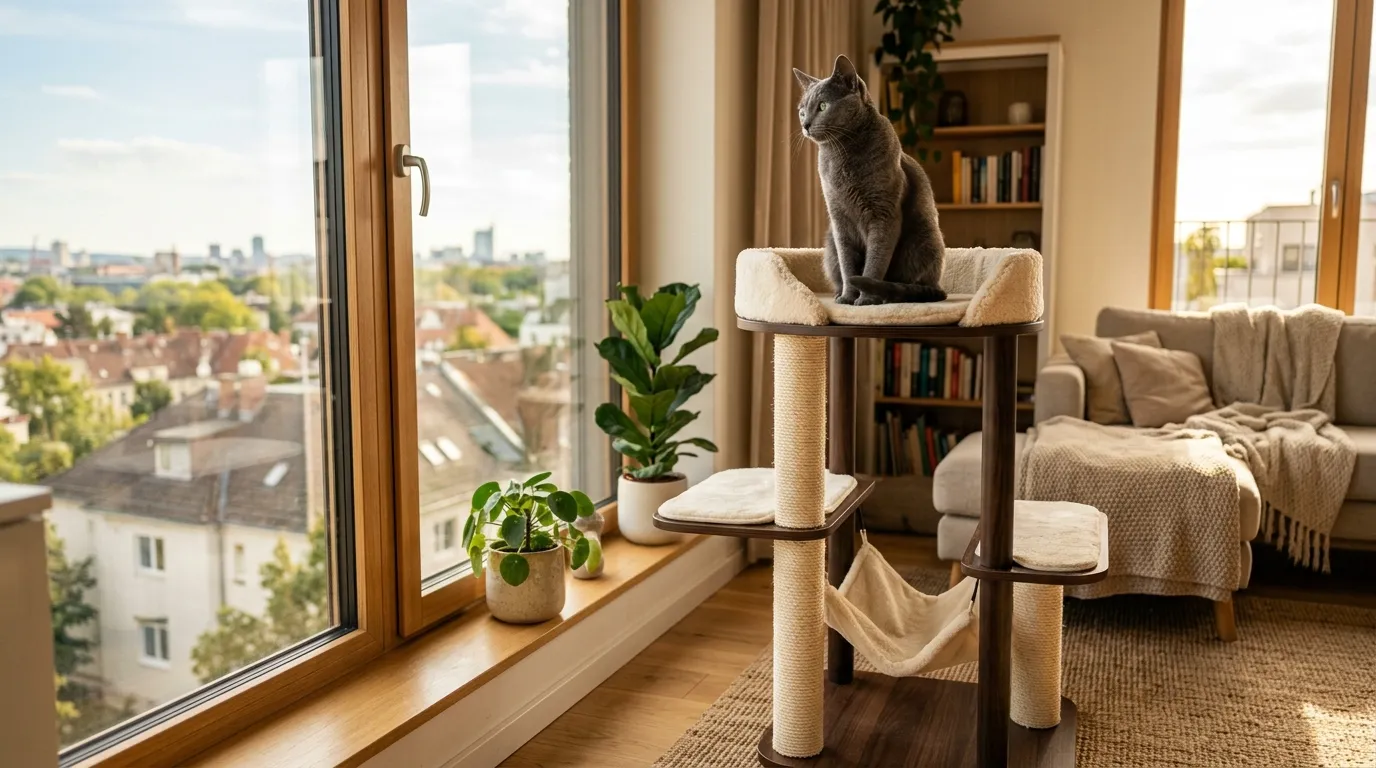
Your cat cost you $80 and has ignored it for three weeks. The cat tree sits in the corner collecting dust while your couch loses another square inch of fabric every morning. Learning how to get a cat to use a cat tree isn’t about luck or waiting it out. It comes down to scent, placement, and understanding what makes a cat feel safe enough to climb. This guide breaks it all down so you can stop watching your cat stare at that tower like a stranger and start seeing them own it.
I once moved a brand-new floor-to-ceiling tree to four different spots before I figured out my cat was avoiding it because it wobbled slightly when she jumped. One wall anchor later, she claimed the top perch within the same afternoon.
Choosing the Right Cat Tree Before You Bring It Home
Half of the “my cat ignores the tree” problem starts at checkout, before scent or placement even come into play. A tree sized wrong for your cat is fighting an uphill battle no amount of training fixes.
| Cat Size | Base Width | Platform Size | Notes |
|---|---|---|---|
| Small/average (up to 10 lbs) | 18 to 22 inches | 14 to 16 inches | Standard trees fit most cats this size |
| Large (10 to 15 lbs) | 22 to 26 inches | 16 to 18 inches | Look for reinforced posts, not just wider platforms |
| Extra-large / Maine Coon type (15+ lbs) | 26+ inches, wall-anchored | 18 to 22 inches | Skip skinny-base trees regardless of height or price |
| Kitten or senior | Standard is fine | Any | Prioritize step spacing under 12 inches, not base size |
A wide base matters more than height in almost every case. A shorter tree that meets your cat’s weight and size needs beats a taller one that wobbles under her. If you’re shopping for a big-bodied breed, a base that looks generous for an average cat is often still too narrow, and a long-bodied cat whose legs hang off an undersized perch will pick the sofa arm every time instead.
Why Your Cat Is Ignoring the New Tower
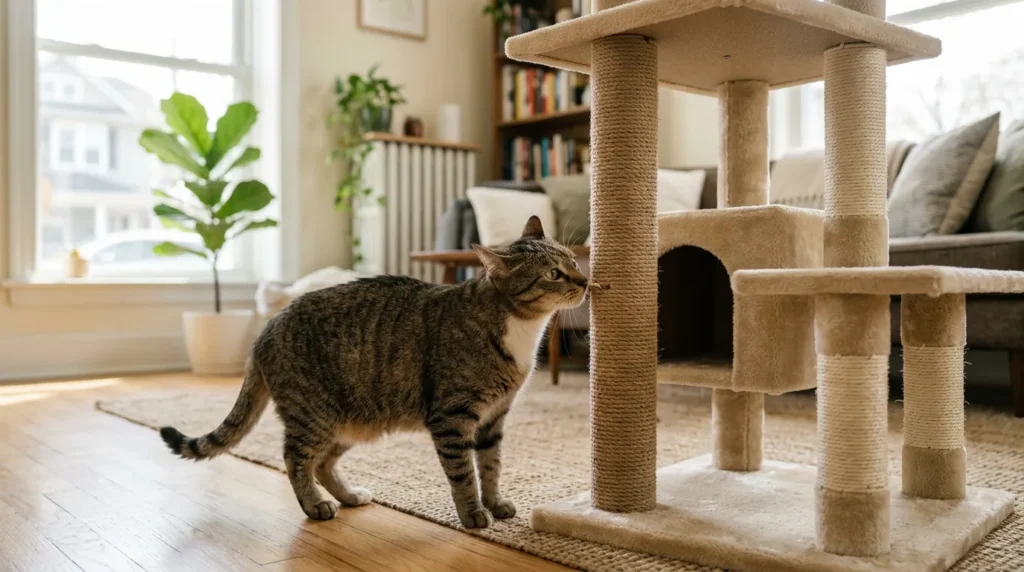
A new cat tree smells like a factory. To your cat, that odor is the scent of a stranger that’s invaded their territory. Every object in your home carries a scent profile, and your cat decides whether it belongs there based almost entirely on whether it smells familiar or foreign.
Stability is the second factor most people miss entirely. Cats are prey animals at heart, and a structure that sways under their weight triggers the same alarm as standing on a branch that might snap. If your tree shifts even a little during a jump, your cat has already decided it’s unsafe.
The third reason is location. A cat tree placed in a spare room or a hallway is invisible to your cat emotionally. Cats want to be near you and near the action. A tree in an empty room is just expensive furniture nobody uses.
The Scent Swapping Hack That Actually Works
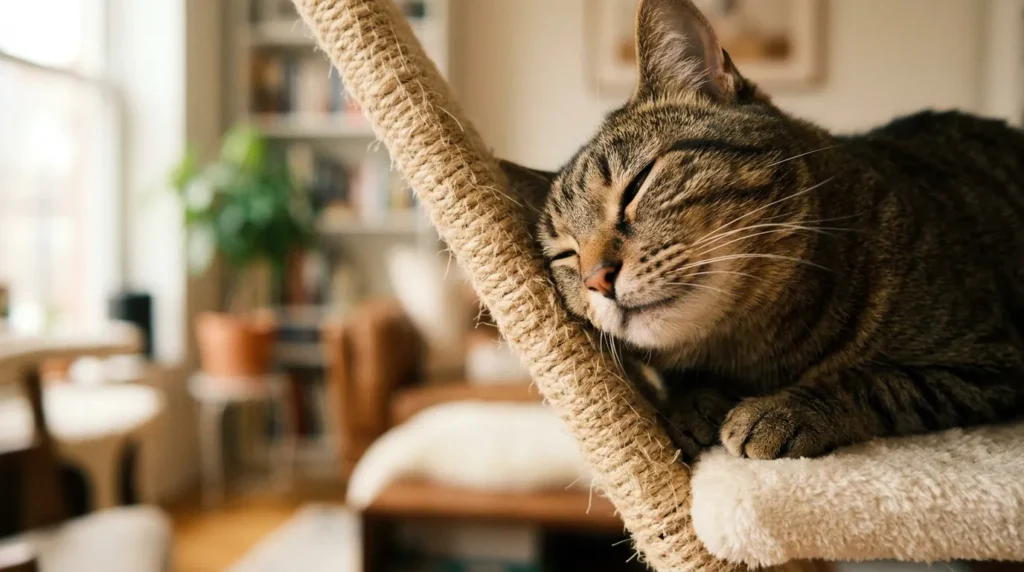
Scent swapping is the single fastest way to make a strange object feel like home to your cat. Take a soft cloth, rub it gently along your cat’s cheeks and chin where their feline pheromone glands are, then wipe that cloth all over the tree’s posts, platforms, and perches. You’re essentially pre-marking the tree so your cat recognizes it as their own territory from the first sniff.
You can also drape one of your worn t-shirts or your cat’s favorite blanket over a middle platform. That familiar combination of your scent and theirs creates a bridge between “scary new thing” and “totally mine.” This is behavioral modification without any treats or training involved.
Do this before you even try to lure your cat toward the tree. Scent prep is step one, and most owners skip it completely.
Placement Is Everything
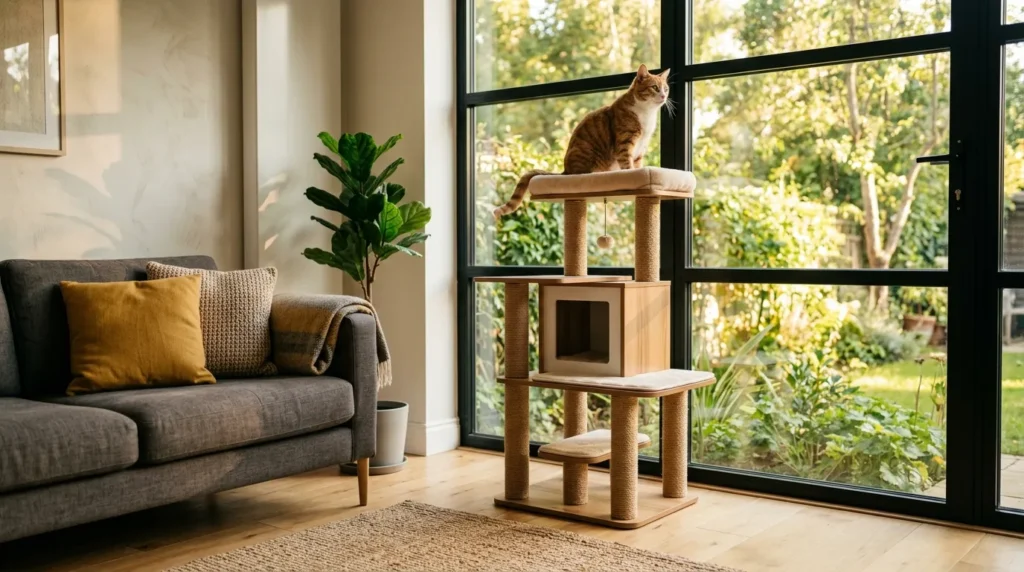
The best spot for a cat tree is wherever you spend the most time. Cats don’t want to be alone with their furniture. They want a vantage point that keeps them in the middle of family life while giving them the elevated spatial awareness they’re wired to need.
According to the American Association of Feline Practitioners, vertical territory is a core environmental need that directly reduces stress, especially in households with more than one cat. This isn’t a luxury item. It’s closer to a mental health tool.
Place your tree near a window in your living room for what I call the Golden Zone: social connection with you plus the visual stimulation of watching birds, squirrels, and passing traffic. That combination makes the tree the most interesting spot in the apartment.
The Window View vs. The Social Hub
If you can only choose one, window or living room, go with the living room. A lonely tree with a great view still goes unused. Your cat wants to watch you first, the birds second. Once the tree is established and loved, then consider moving it closer to a window if the layout allows.
4 Training Steps to Build Vertical Confidence
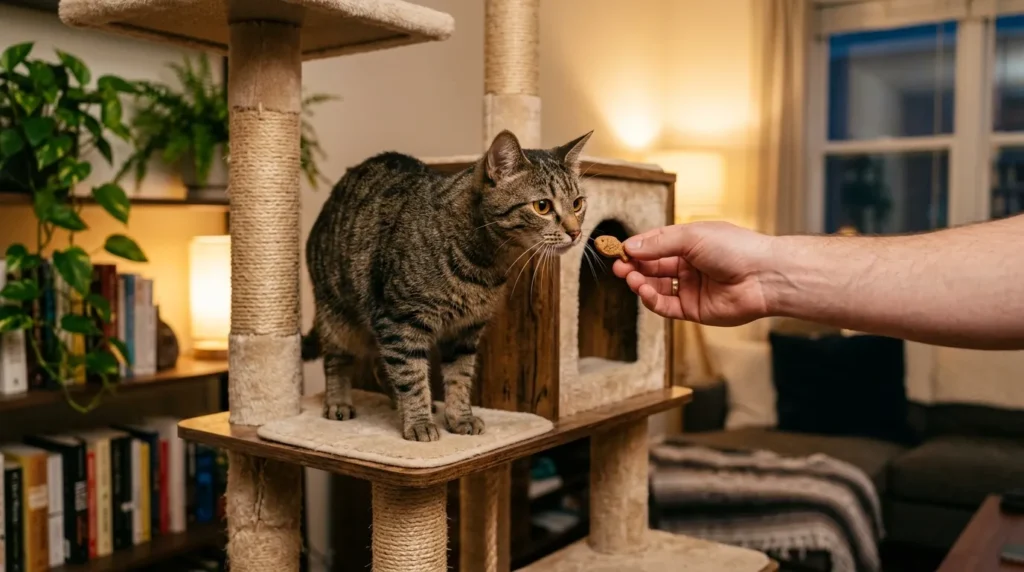
Positive reinforcement training is the only method worth using here. Never pick your cat up and place them on the tree. That teaches your cat that the tree is a place where they lose control of their body, and that association sticks hard.
Start at the base. Drop high-value treats at the foot of the tree and let your cat eat them with no pressure to go higher. Once they’re comfortable near the tree, start placing treats on the first platform. Let them choose to step up on their own.
Use a feather wand to lead your cat’s “prey” up the structure during play sessions. This is how indoor cat behavior experts recommend channeling the predatory instinct naturally. The tree becomes a hunting ground rather than something to avoid.
| Training Step | Action | Goal |
| Step 1 | Place treats at the base | Build positive association with the area |
| Step 2 | Move treats to first platform | Reward first voluntary step-up |
| Step 3 | Use wand toy on upper levels | Encourage active climbing through play |
| Step 4 | Reward calm resting on perches | Reinforce the tree as a safe nap zone |
Introducing a Kitten vs. an Adult Cat to the Tree
The scent-and-treat method above works for any age, but the pace and the setup should shift depending on who you’re training.
Kittens have little fear of new objects but also little judgment about their own limits. They’ll often launch straight for the top platform before they’ve built the coordination to land safely. Keep step spacing tight, under a foot between platforms, for the first few months, and supervise early climbing sessions so a bad fall doesn’t create a lasting fear of the whole structure.
Adult cats, especially ones adopted as adults, tend to need more scent prep and a slower placement transition, since they’re more likely to size up a new object as a threat before deciding it’s furniture. Give an adult cat a full week of scent swapping and base-level treats before expecting any real interest in climbing higher.
Structural Trust: The Stability Audit Most Owners Skip
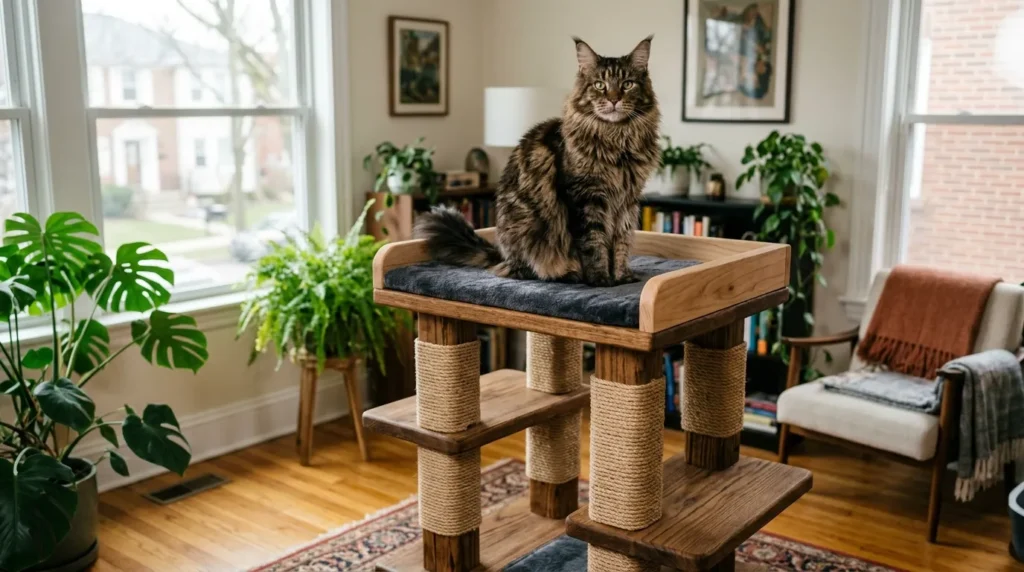
A wobbling tree is a rejected tree. This is especially true for larger breeds like Maine Coons or Ragdolls, whose weight actually tests the base on every landing. If your tree rocks even slightly when you push it with one hand, your cat already knows and wants nothing to do with it.
Check the base plate size first, it should extend well beyond the widest platform above it. Tighten every bolt before your cat gets near it. For tall trees, use a furniture anchor strap to secure the top to a wall stud. This costs about four dollars and takes five minutes. It’s one of the most overlooked parts of indoor cat care that makes a real difference.
Owner’s Note: if you have a large cat, skip trees with skinny bases regardless of how good they look in photos. The wide, heavy base isn’t optional, it’s the whole reason your cat will trust the structure enough to sleep on it. Buy once, anchor it properly, and you won’t revisit this problem.
Troubleshooting: When They Still Prefer the Sofa
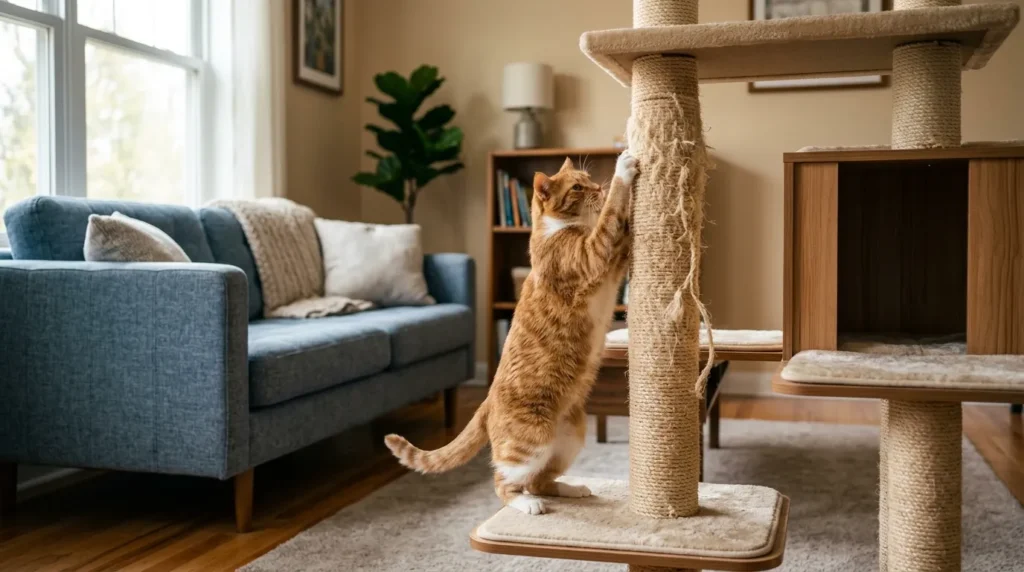
If your cat still gravitates to the sofa after all of this, look at the scratching surfaces on the tree. Many cats have a texture preference, and it’s worth testing rather than guessing.
| Material | Feels Like | Best For |
|---|---|---|
| Sisal rope | Coarse, grippy vertical texture | Cats who scratch furniture arms and vertical surfaces |
| Sisal fabric (flat weave) | Smoother, still fibrous | Cats sensitive to rope’s rougher texture |
| Carpet | Soft, plush | Cats who prefer horizontal or gentle scratching, though claws can snag |
| Cardboard | Corrugated, satisfying to shred | Cats who scratch flat surfaces like rugs or boxes |
| Bare wood | Natural grain | Cats who scratch doorframes or wood furniture |
You can test this cheaply by leaning a piece of cardboard scratcher against the tree post and watching which one gets used.
Check the exit paths too. In multi-cat homes, trees can become chokepoints where one cat traps another on a high perch. If your dominant cat sits at the base, the other cat will avoid the whole structure. Add a second route down, like a nearby chair or bookshelf, to fix this fast.
Catnip spray on the carpet tiers can give an initial nudge for cats who need one. Sprinkle it lightly, too much and some cats become overstimulated rather than curious. For cats who don’t respond to catnip at all, try silvervine, which works on around 80% of cats that ignore catnip.
You can also explore more options by browsing best cat furniture for indoor cats if your current tree turns out to be the wrong fit for your cat’s size or climbing style.
FAQ
How long does it take for a cat to use a new cat tree?
Most cats explore within 48 hours if the tree is scented and placed in a busy room. Shy cats may take up to two weeks.
Can I use catnip to get my cat interested in the tree?
Yes, rub a small amount into the carpet tiers. If your cat doesn’t react to catnip, silvervine works better for roughly 80% of non-responders.
Should I put the cat tree near a window?
A window adds real mental stimulation, but the living room matters more. Prioritize being near you first, then move it toward a window once your cat is using it.
What if my older cat can’t climb to the high perches?
Place a sturdy footstool or low chair beside the tree as a midway step. Senior cats still want vertical space, they just need a gentler route to get there.
Why does my cat sit next to the tree but not on it?
That’s actually progress. They’re scoping it out. Keep placing treats on the lowest platform and use wand toy play near the tree daily. First contact usually follows within a day or two.
Is it normal for a cat to ignore a cat tree for weeks?
Yes, especially with factory-new materials. Scent swap the tree immediately, reposition it to a social area, and most cats change their mind within a week.
What size cat tree does a Maine Coon or other large breed need?
Look for a base of at least 26 inches on the short side, platforms 18 to 22 inches across, and posts thick enough that they don’t flex under the cat’s weight. Wall-anchor anything over about 5 feet tall regardless of base size, since large breeds test the top of a tree hardest during landings.
Should I get a different cat tree for a kitten than for an adult cat?
Not necessarily a different tree, but different expectations. A kitten benefits from tighter step spacing and supervised early sessions, since they’ll attempt jumps before they’ve built the coordination to land them safely. Most standard trees work fine once the kitten grows into them.
Bottom Line
Learning how to get a cat to use a cat tree comes down to four things: the right size tree for your cat, scent, stability, and placement. Strip away the factory smell with scent swapping, anchor the base so it doesn’t shift, and put the tree where your cat can see you. Add consistent treat rewards and wand play, and most cats come around within a week. Start with the scent swap today, it costs nothing and works faster than anything else.
For cats in smaller spaces, the same logic applies with some layout adjustments covered in detail in our cat in apartment guide.
Getting a cat to use a cat tree requires the right size tree, scent preparation, a stable structure, and strategic placement. Cats reject new towers because of unfamiliar factory odors, structural instability, or a size mismatch for their body. Rubbing a cloth along the cat’s cheek glands and wiping it across the tree’s surfaces deposits feline pheromones that signal territorial ownership. Trees placed in living rooms near windows where owners spend time see the highest usage rates. Positive reinforcement using high-value treats and feather wand play builds vertical confidence without force. Most cats adopt a properly prepared, correctly sized tree within 48 to 72 hours.
This guide is one piece of the larger indoor cat enrichment picture, and it connects closely with best cat furniture for indoor cats for choosing the right piece in the first place. For related setup guidance, see our guides on indoor cat behavior, indoor cat care, and cat in apartment living.

Written by Mishu
A passionate cat lover and indoor living enthusiast, Mishu is the founder and voice behind Indoor Living Cat – a go-to resource for cat owners who want to create the happiest, healthiest life for their feline companions indoors.
View Full Profile