
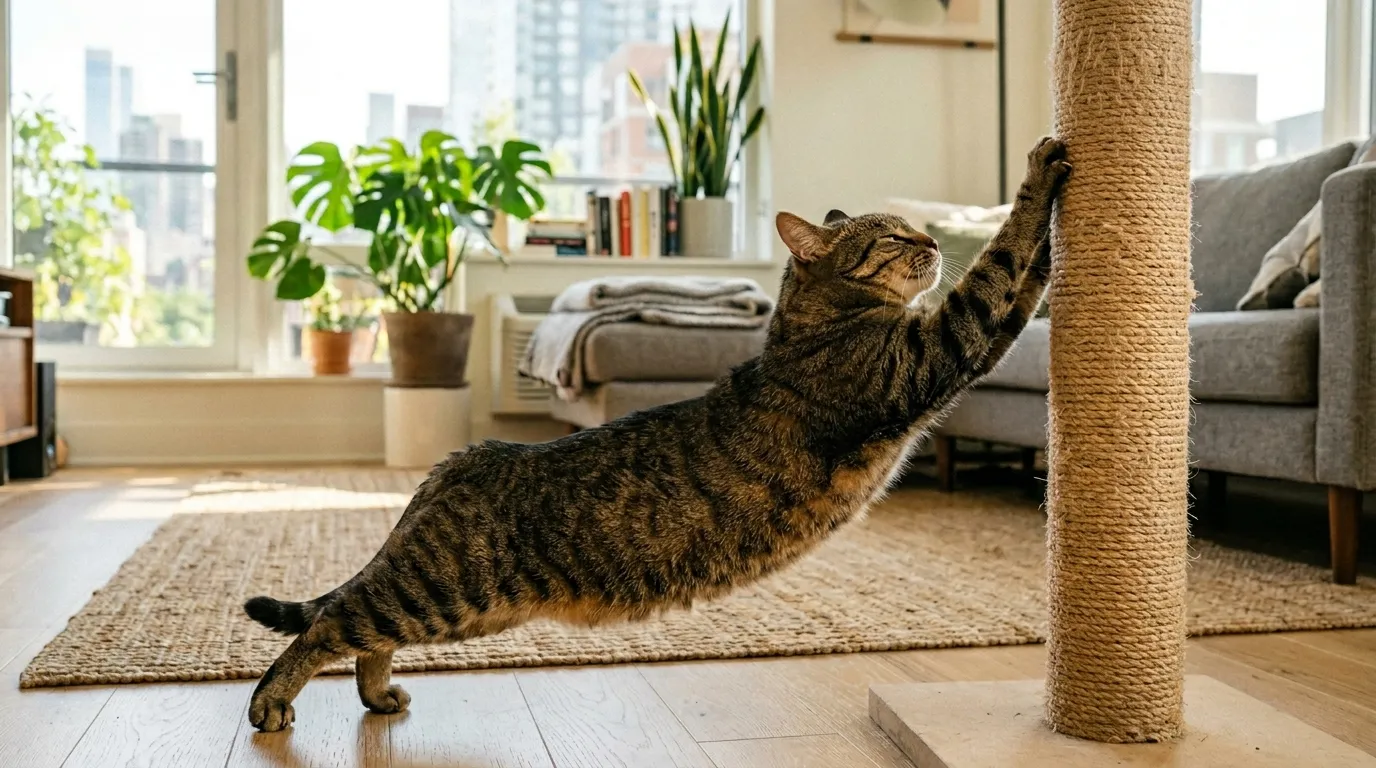
My cat ignored every scratching post I bought for six months. Then I watched where she actually scratched. She went for horizontal surfaces, never vertical ones. I put a flat cardboard scratcher on the floor and she used it within twenty minutes.
Do cats need a scratching post? Yes, but the useful answer goes further than that. They need a surface that matches how they naturally scratch, placed where they already spend time, and long or tall enough for a full stretch. Get any one of those wrong and the post sits untouched while your sofa takes the damage.
This guide covers the three biological reasons scratching isn’t optional, how to spot your cat’s scratching style before you buy anything, and the exact placement rule that decides whether a post gets used or ignored.
Quick answer: Cats need a scratching post for claw health, spinal stretching and territorial scent marking. Match the material and orientation to how your cat already scratches, then put the post exactly where she currently scratches your furniture.
Do Cats Need a Scratching Post? The 3 Biological Functions Behind It
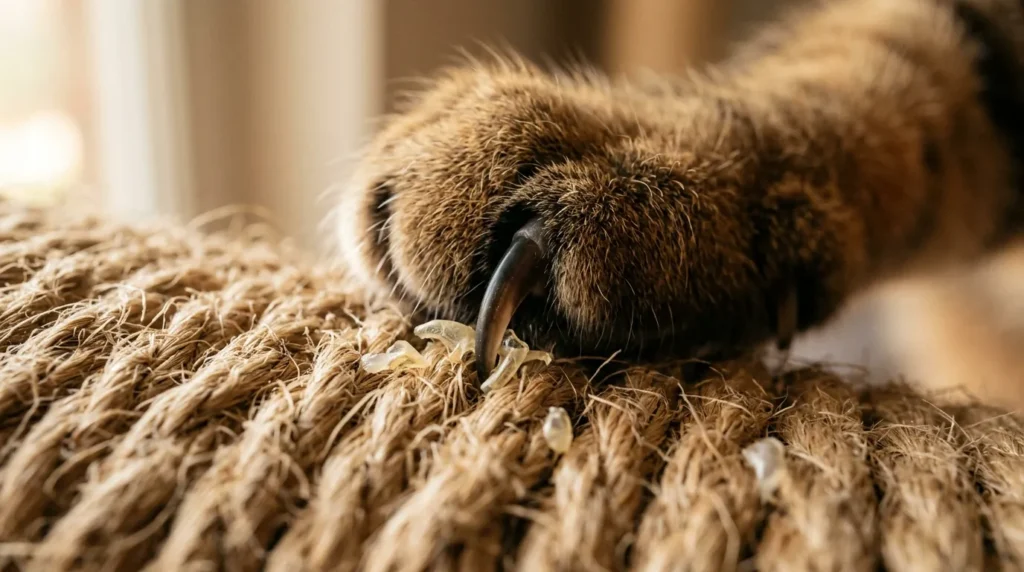
Scratching does three things at once for a cat. It sheds dead nail sheaths, stretches and tones the spine and shoulders, and marks territory with scent from the paw glands. A cat without a proper surface for this doesn’t stop scratching. She just moves the behavior to your furniture.
- Claw maintenance: pulls away the dull outer sheath to expose a sharp new claw
- Spinal and muscle health: a full-body pull decompresses the vertebrae and tones the shoulders and back
- Scent marking: paw glands deposit pheromones that signal territorial security
The first function, claw maintenance, matters more than most owners realize. A cat’s claw grows in layers, and the outer layer goes dull and dead over time. Scratching pulls that layer away to expose the sharp claw underneath. Skip this and the sheaths build up, get uncomfortable, and in older cats can curl into the paw pad.
The second function is musculoskeletal. When a cat reaches high on a vertical post and pulls her full body weight down against the resistance, she’s doing the feline version of a thoracic stretch. It decompresses her vertebrae and tones the shoulder, chest and back muscles she relies on to jump and land safely for the rest of her life. This isn’t extra exercise. It’s how she stays limber.
The third function is scent. Every scratching session leaves a chemical signature that tells her, and any other animal nearby, that this space is hers. That marking routine has a psychological payoff separate from the physical one. A cat who can’t complete it builds low-grade background stress that adds up over weeks.
Territorial marking behavior connects to a wider set of indoor cat behavior patterns, which is why unmet scratching needs often show up alongside other anxiety signals, not just shredded furniture.
Why Your Sofa Is the Perfect Scratching Surface, and Why That’s the Problem
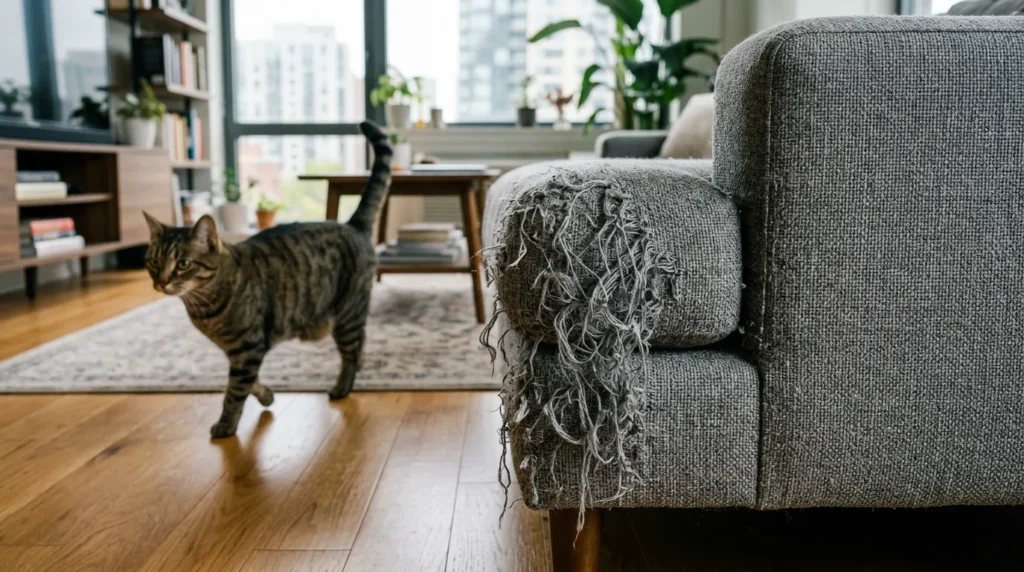
Your sofa works so well as a scratcher because the weave lets claws sink in and pull with real resistance. It’s tall enough for a full stretch, stable enough not to move, and sits in the room where scent marking actually matters to her. Your sofa isn’t being targeted out of spite. It’s simply the best option available in a house that hasn’t offered a better one.
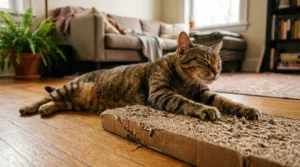
Sisal rope is the standard recommendation because its weave and fiber resistance mimic what makes woven fabric so satisfying to scratch. That resistance lets the claw dig in and pull instead of slip, which is what triggers the full-body muscle engagement a scratching session needs. Cardboard offers a different but equally valid payoff. The fibers compress and shred under the claw, giving both a tactile reward and visible scratch marks that some cats find highly motivating.
According to ASPCA guidance on scratching behavior in cats, giving cats appropriate scratching surfaces ranks among the highest-priority fixes for reducing furniture damage and the behavior problems that come with unmet scratching needs. For the full range of options, including scratchers alongside vertical territory like shelves and trees, see our complete guide to cat furniture for indoor cats. This article focuses specifically on the scratching post piece of that setup, since it’s usually the first thing owners get wrong.
Sisal vs Cardboard vs Carpet: Scratching Post Materials Compared
Material choice is one piece of a bigger indoor cat care plan, and it’s where most people guess wrong. Here’s how the common options stack up.
| Material | Best For | Durability | Watch Out For |
|---|---|---|---|
| Sisal rope | Cats who pull and dig in vertically | High, often lasts a year or more with daily use | Rope can loosen and need re-wrapping over time |
| Cardboard | Cats who prefer shredding and horizontal scratching | Low to medium, flip or replace every few months | Sheds fine cardboard dust around the scratcher |
| Sisal fabric (flat weave) | Cats who currently scratch upholstery | Medium | Texture is close to carpet, which can confuse some cats |
| Bare wood or bark | Cats who scratch trees when they go outside | High | Harder to find pre-made, usually a DIY build |
If your cat already has a favorite illegal target, match the new post to that texture first. A cat scratching a sisal-covered ottoman will take to a sisal post faster than to cardboard, even if cardboard seems like the safer starter choice.
Identifying Your Cat’s Scratch Personality Before You Buy
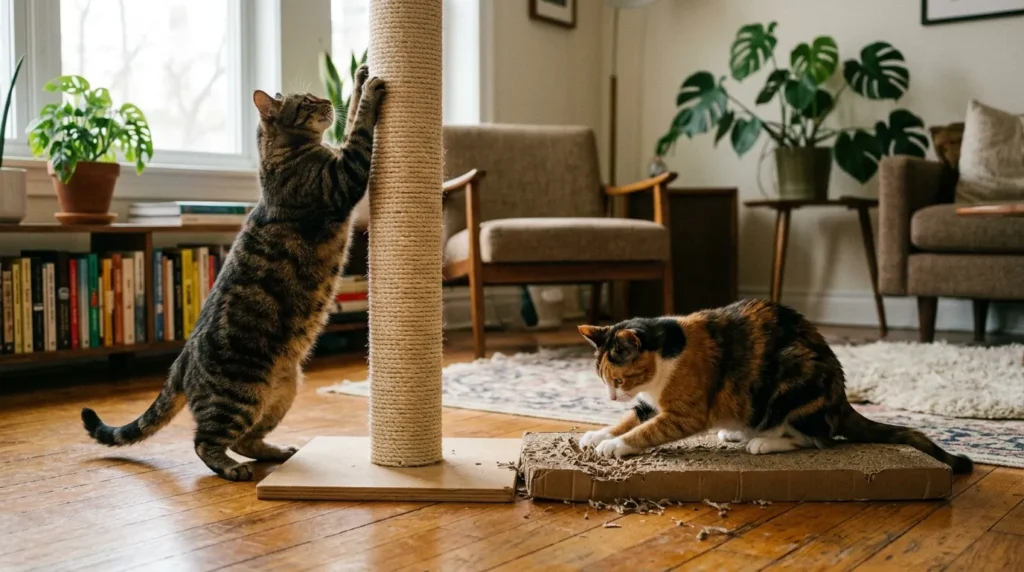
The most reliable way to identify what your cat wants is to watch where she already scratches, not to guess. A cat working the sofa arm or a doorframe wants a vertical surface. A cat working the carpet or a rug wants a horizontal one, and she’ll ignore a vertical post no matter how good the sisal is.
| Vertical Scratcher | Horizontal Scratcher | |
|---|---|---|
| Your cat currently scratches | Sofa arms, doorframes, table legs | Carpet, rugs, floor mats |
| Minimum size | 28 to 32 inches tall | 18 to 24 inches long |
| Best material | Sisal rope | Cardboard or sisal fabric |
| Good fit for | Young and adult cats, full-body stretch | Senior cats, cats with joint pain |
Height is where most posts fail. A cat at full extension needs to reach the top without running out of surface, which for most adults means at least 28 to 32 inches. Anything shorter can’t support a true full-body stretch, and a cat who tries one and finds it too short will abandon it fast and go back to whatever gave her enough room before.
Senior cats and cats with hip or shoulder issues do better with angled or horizontal scratchers. A low wedge scratcher at roughly a 30 degree angle still gives enough resistance for nail shedding and some muscle engagement, without the strain of standing on the hind legs.
Wall-Mounted vs. Freestanding vs. Cat Tree Combo Scratchers
Format matters as much as material once you know whether your cat scratches vertically or horizontally.
| Format | Space Needed | Stability | Best For |
| Freestanding post | Small floor footprint | Depends on base weight; cheap ones tip | Renters, small apartments, single-cat homes |
| Wall-mounted scratcher | No floor space at all | Very high once anchored properly | Tight studios, cats who scratch at an angle rather than straight up |
| Cat tree with built-in posts | Largest footprint | High, built for full-body weight | Multi-cat homes, cats who also want climbing and perching |
A cheap freestanding post with a light base is the single most common reason a cat “refuses” to use a post that’s otherwise the right height and material. Wall mounting solves the stability problem completely, but it’s not always possible in a rental, so check your lease before drilling. A cat tree combo does double duty as vertical territory and scratching surface, which matters more in a small apartment where every piece of furniture needs to earn its floor space.
Nail Caps and Declawing: Do They Replace the Need for a Post?
No, and this comes up often enough to address directly. Nail caps, small vinyl covers glued over trimmed claws, blunt the damage a scratch does to furniture, but the cat still goes through the full scratching motion underneath them. The spinal stretch and scent marking still happen. Nail caps solve a furniture problem, not a behavioral one, and a post is still worth offering alongside them.
Declawing is a different matter entirely. It’s the surgical removal of the last bone in each toe, not just the nail, and major veterinary bodies including the American Association of Feline Practitioners oppose it as a routine procedure because of the pain and altered gait it can cause. A declawed cat still has the full biological drive to scratch. Without claws, she gets the spinal stretch and some scent marking from paw pad contact, but not the claw maintenance function, since there’s no claw left to shed. A scratching post remains relevant even for a declawed cat, mainly for the stretching and marking behavior.
How to Train a Cat to Use a New Scratching Post
Buying the right post solves half the problem. Getting her to actually use it takes a bit of setup.
- Place it in the intercept zone. Put the new post right beside the furniture she already scratches, not across the room.
- Skip the catnip spray on day one. Let her investigate the plain surface first, so she links the texture, not just the scent, to the reward.
- Reward the first scratch. A small treat right when she scratches the post builds the association fast. If you’re working out how many training treats is too many, this guide on feeding an indoor cat properly breaks down daily portions.
- Redirect, don’t punish. If she heads for the sofa, gently move her to the post and reward her there. Scolding her at the sofa just teaches her to avoid you, not the furniture.
- Leave it in place for at least two weeks. Cats build habits slowly. Moving the post too soon resets the whole process.
Training goes faster as part of a wider routine rather than a one-off fix. Enrichment ideas for indoor cats can keep her engaged between scratching sessions and reduce the boredom that drives destructive scratching in the first place.
The Placement Rule That Determines Whether a Scratcher Gets Used
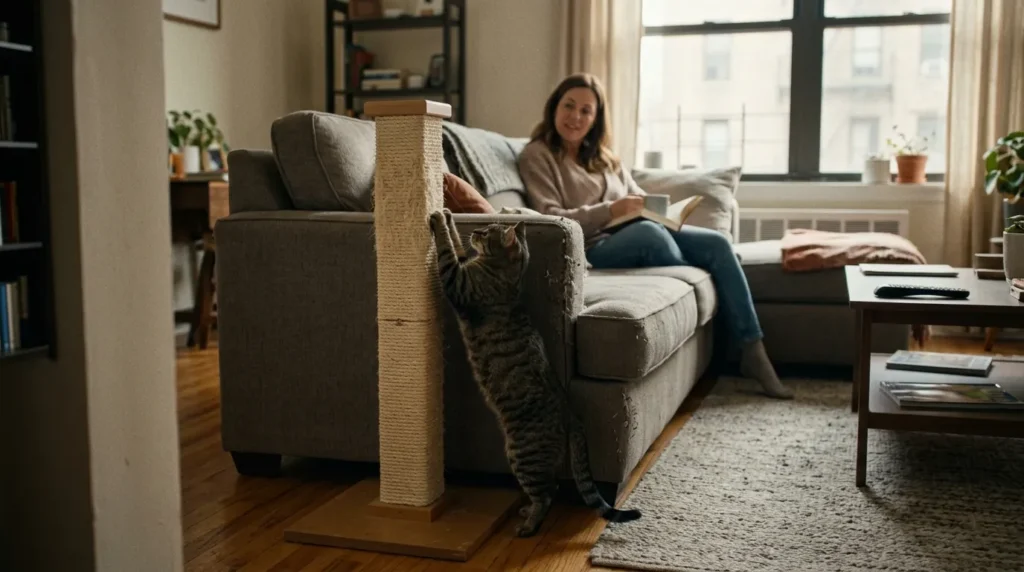
Placement follows the same rule as cat trees and shelves: cats want to scratch where their scent marking has territorial value and where family activity gives it social context. A post stuck in a back hallway or spare room won’t get used, because that space means nothing to a cat whose world is your living room and kitchen.
The most effective first move is placing the post directly beside the furniture she currently scratches. She’s already motivated to scratch that spot, and the post intercepts the behavior before it reaches the sofa. Once she uses it consistently there, you can shift it to a less prominent spot if the original location is inconvenient. If you live in a small apartment, this matters even more, since floor space is tight and fitting cat furniture into an apartment without blocking walkways takes some planning.
Keeping the litter box area separate from the scratching zone keeps her mental map of the room clear; cats don’t want to eat, scratch, or eliminate in overlapping spaces. This is one piece of a bigger indoor cat litter box setup. If the zones are already separated and odor still lingers right after cleaning, the box itself is usually the cause, and this breakdown of why a litter box smells after cleaning covers the common reasons.
The direct truth: the scratching post you bought is probably not failing because your cat is picky. It’s failing because it’s too short, too wobbly, or in the wrong room. A post that reaches 30 inches, doesn’t tip under pressure, and sits next to the sofa will get used. Fix one of those three things today and you’ll see a difference within a week.
What a Good Scratching Post Costs
| Type | Typical Price Range | Note |
| Basic cardboard scratcher | $8–$20 | Replace every 2–4 months with regular use |
| Freestanding sisal post, 28–32″ | $20–$45 | Check base weight before buying; light bases tip |
| Wall-mounted sisal scratcher | $25–$60 | Add mounting hardware cost if not included |
| Full cat tree with scratching posts | $80–$250+ | Price scales with height and number of platforms |
Is a DIY Scratching Post Worth Building?
If you’re handy and want a taller or sturdier post than what’s available at a given price point, yes. A 4×4 wood post wrapped tightly in sisal rope and mounted to a heavy plywood base costs less than a comparable retail cat tree and can be built taller than most off-the-shelf options, which helps with larger cats who outgrow a standard 28-inch post. The two things that make or break a DIY build are the same two that make or break a store-bought one: a base heavy or wide enough to resist tipping, and rope wrapped tight enough that it doesn’t loosen and unravel within weeks.
The Mistake That Makes Every Scratching Post Useless
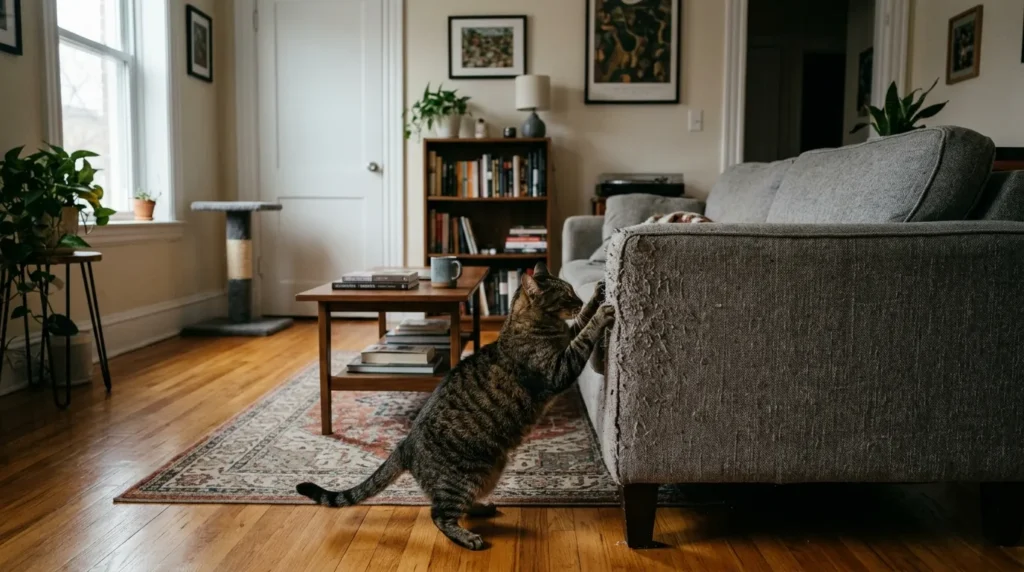
Most useless scratching posts fail for three reasons at once: too short for a full stretch, placed away from where the cat actually scratches, and then written off as “she just doesn’t like posts.” She likes scratching fine. She does it on your furniture multiple times a day. What she doesn’t like is a small surface stuck somewhere with no territorial relevance.
The wobbly base is a specific version of this mistake worth calling out on its own. A post that tips or shifts under her weight gets used once and never again, because the whole point of the motion is pulling against resistance. If the surface moves instead of holding steady, the motion feels wrong and the reward that reinforces scratching there never kicks in. A heavier base or a wall anchor fixes this immediately.
A cat who stops scratching altogether, rather than switching targets, is worth a closer look. Overgrown or ingrown claws can make scratching painful, and that’s worth checking as part of monitoring your indoor cat’s health.
Frequently Asked Questions About Scratching Posts for Cats
Do cats really need a scratching post, or is it just for furniture protection?
Scratching is a biological need for claw health, spinal mobility and territorial marking. A scratching post isn’t extra enrichment. It’s a health requirement that happens to protect your furniture as a side effect.
Why does my cat ignore the scratching post I bought?
Almost always because it’s too short, too wobbly, or in the wrong spot. Check that it allows a full-body stretch, doesn’t tip under pressure, and sits beside the furniture she currently scratches.
How tall should a cat scratching post be?
Most adult cats need 28 to 32 inches to fully extend and stretch. Kittens and smaller cats can start shorter, but check that she still reaches the top without running out of surface as she grows.
Is cardboard or sisal better for a cat scratching post?
Both work well for different cats. Sisal lasts longer and suits cats who prefer vertical pulling. Cardboard suits cats who prefer horizontal shredding. Watch where your cat currently scratches to know which to buy first.
Can I use carpet instead of a cardboard or sisal scratcher?
You can, but carpet scratchers risk mixing signals for a cat who already has carpeted floors or stairs nearby. Sisal fabric gives a similar texture without teaching her that all carpet is fair game.
How many scratching posts does an indoor cat need?
At minimum, one in the main living area and one near sleeping areas. A good rule is one post per room where she spends real time. Multi-cat households need one post per cat plus one extra, to avoid territorial competition over a shared post.
My cat scratches the same spot on the carpet every day. How do I stop it?
Put a flat horizontal cardboard scratcher directly over or beside that exact spot. She’s telling you she prefers horizontal scratching there. Give her a better target at the same location and the carpet damage stops.
Do nail caps mean I don’t need a scratching post?
No. Nail caps blunt the damage to furniture, but your cat still performs the full scratching motion underneath them, including the spinal stretch and scent marking. A post is still worth offering even with caps on.
Do outdoor or indoor-outdoor cats still need a scratching post inside?
Yes. Trees and fence posts outside cover some of the need, but weather, time of day and territory disputes with other cats limit outdoor access. An indoor post guarantees she has a reliable surface available regardless of what’s happening outside.
Cats need a scratching post because scratching does three things at once: sheds dead nail sheaths to expose healthy claw growth, stretches the spine and tones the shoulders through full-body pulling against resistance, and deposits scent for territorial marking. Without a proper surface, cats redirect this need to furniture. Most scratching posts fail for three reasons: height under 28 inches for adult cats, instability that removes the resistance a cat needs, and placement away from the spot where the cat is already motivated to scratch. Nail caps and declawing reduce furniture damage but don’t remove the underlying need for a post, since the stretching and marking behaviors continue regardless. Format matters too: freestanding posts need a heavy base to avoid tipping, wall-mounted scratchers solve stability where drilling is allowed, and cat trees combine scratching with vertical territory for multi-cat homes.

Written by Mishu
A passionate cat lover and indoor living enthusiast, Mishu is the founder and voice behind Indoor Living Cat – a go-to resource for cat owners who want to create the happiest, healthiest life for their feline companions indoors.
View Full Profile