
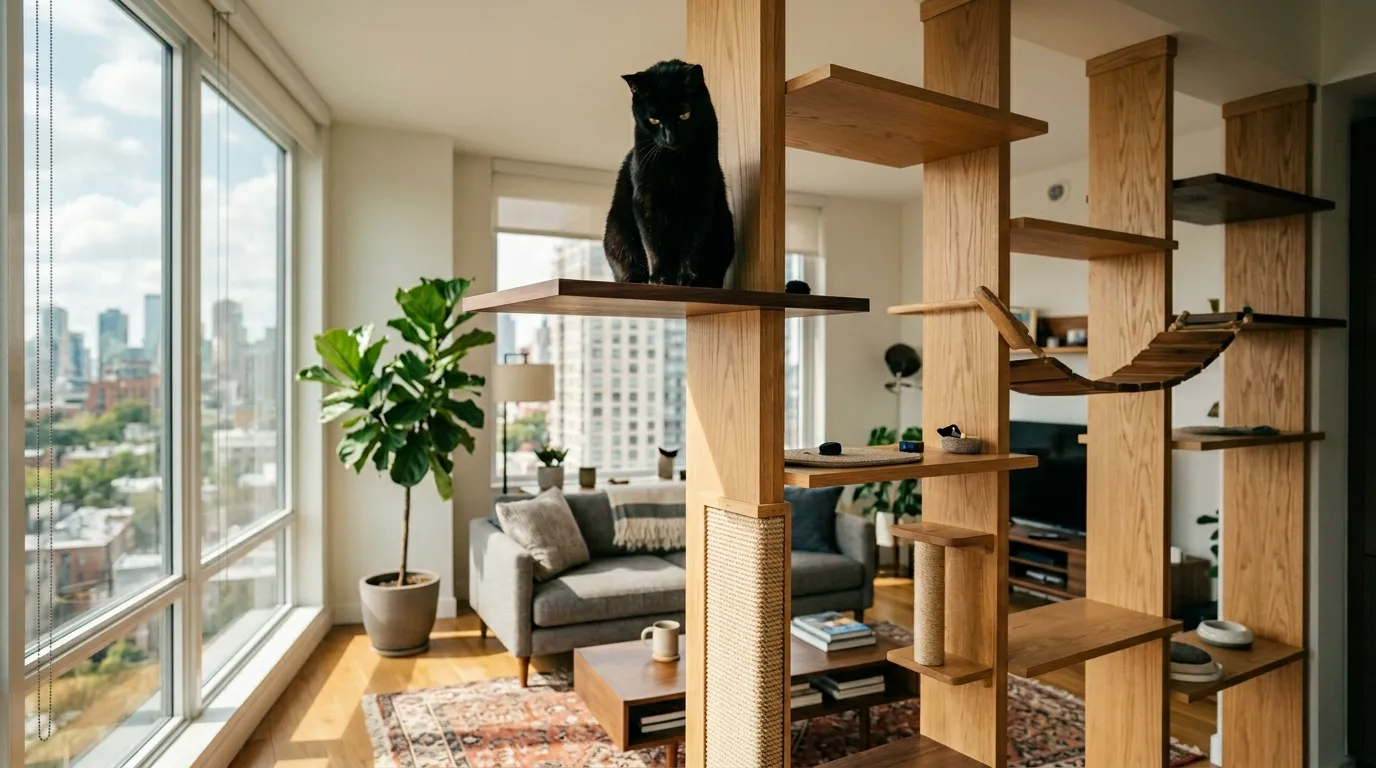
I watched my cat spend three days testing every route back onto the refrigerator after I blocked her spot. She wasn’t chasing something up there. Being up there was the whole point.
Why do cats like to sit up high? Six biological and psychological reasons work together at once, which is why the pull toward elevation looks almost unreasonable until you know what’s driving it. This guide breaks down each reason and explains why apartments with no real elevation above floor level tend to produce cats with higher stress and more behavioral problems.
Here’s the short version. Cats seek height because it gives them:
- Predatory observation of the whole room
- Safety from ground-level threats
- A way to signal status in multi-cat homes
- Warmth, since hot air rises
- A low-pressure way to watch you without joining in
- A position that’s hard to ambush
Cats are mesopredators. They hunt and get hunted, sometimes in the same afternoon. That dual role is why height isn’t optional for them the way a favorite chair is optional for you.
The Predator-Prey Biology That Makes Height Non-Negotiable
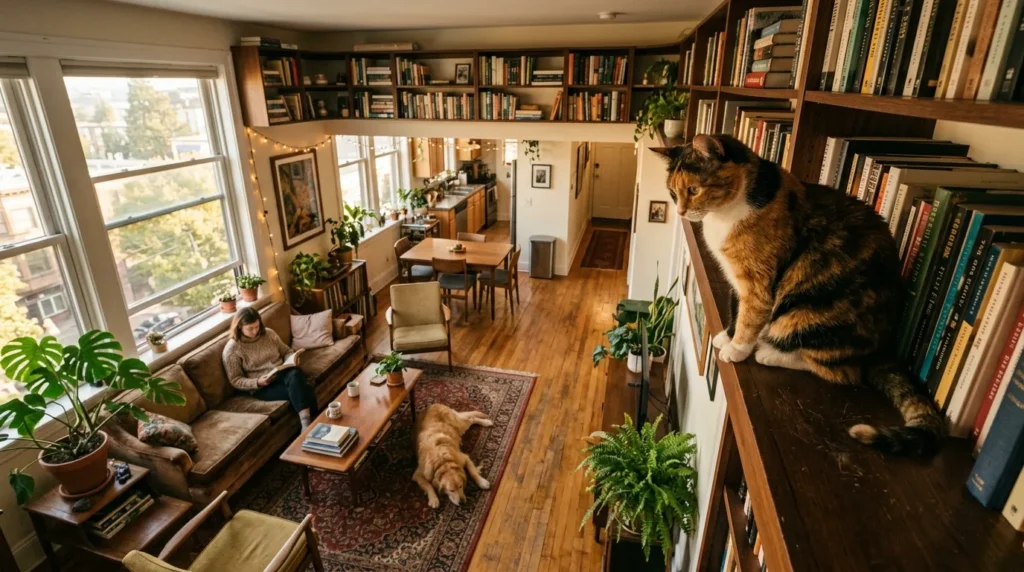
A mesopredator hunts and gets hunted, and a cat’s whole nervous system is built around managing both roles at once. From up high, she sees the full room below her, spots threats from any direction, and tracks movement across the whole floor. From the ground, she sees only what’s in front of her and stays open to an approach from behind.
This is why cats chase height with a persistence that looks baffling from the couch. It isn’t a preference in the way you might prefer one chair over another. It’s a threat management system running whether or not any real threat exists. Her nervous system doesn’t know the difference between a dangerous room and a safe apartment. It just reads the physical setup: high means secure, floor level means exposed.
Our guide to indoor cat behavior covers this drive in the wider context of how cats read and manage their territory. Height seeking isn’t one isolated quirk on that list. It’s a biological requirement to accommodate, the same way food and a clean litter box are, not something to train out of her.
Escape from Floor-Level Chaos: The Stress Relief Function of Height
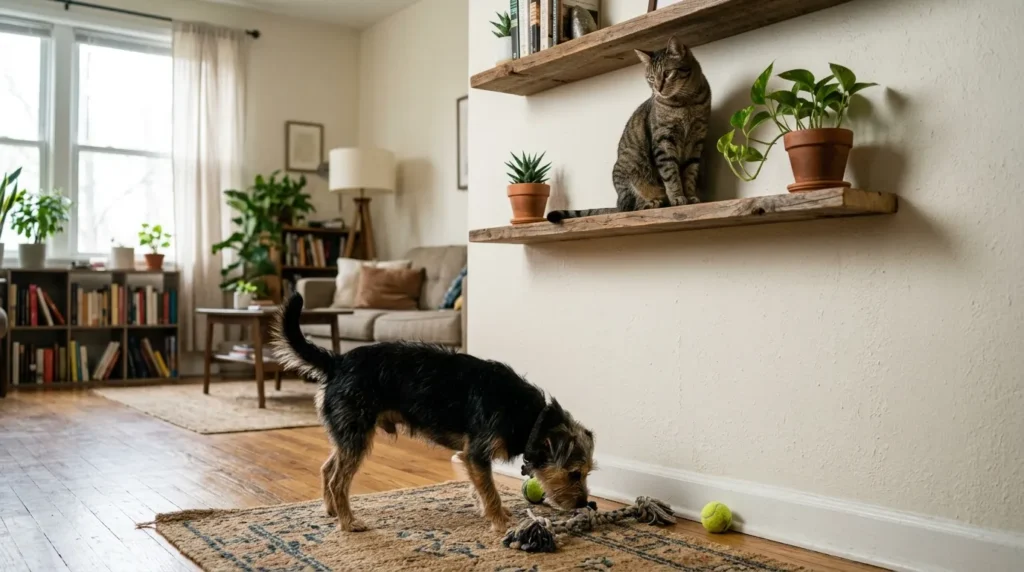
Elevated spots work as decompression zones in busy households. A cat startled by the vacuum, chased by a dog, or overwhelmed by guests doesn’t need to leave the room entirely. She needs a spot where she can stay present and watch everything while staying out of reach. Height gives her exactly that: visible but unreachable, aware but not involved.
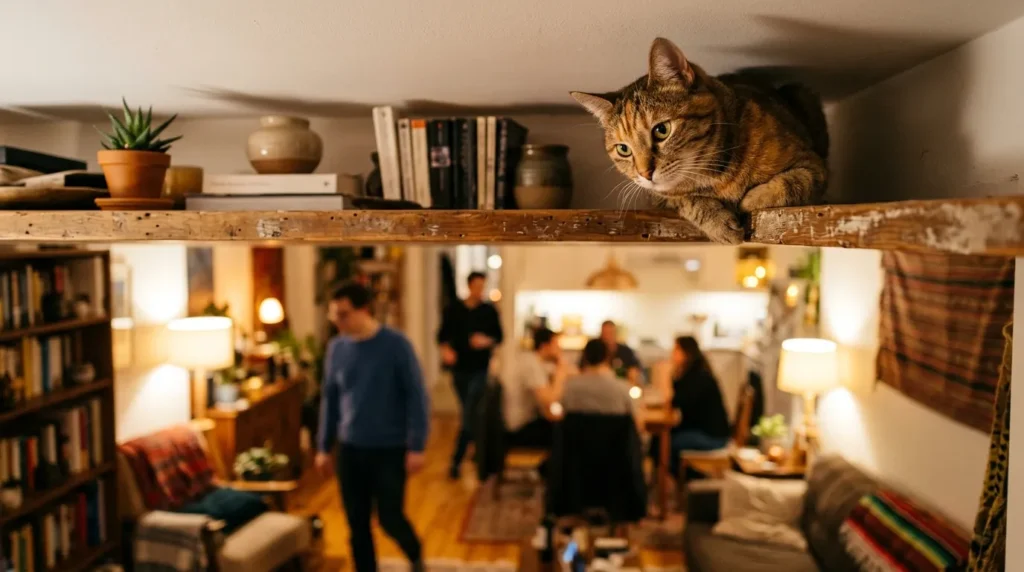
In multi-cat homes, this stress relief extends into social hierarchy. Dominant cats claim the highest spots available, and that’s status signaling more than aggression. Subordinate cats use separate elevated spots to create distance and avoid confrontation. An apartment with only floor-level territory forces every cat into the same spatial tier no matter their relationship, and that’s the main reason multi-cat apartments without vertical space see more fighting.
According to ASPCA guidance on multi-cat households, adding vertical territory is one of the most effective single changes for cutting conflict, since it increases usable territory without adding floor space. Finding the right vertical furniture for your apartment is how you put that into practice.
Do Some Cat Breeds Prefer Height More Than Others?
The mesopredator drive is universal, but individual breeds lean into it differently. Bengals, Abyssinians and other high-energy, athletic breeds tend to seek height aggressively and get frustrated fast without enough of it, since their activity level pushes them to actually use vertical space rather than just occupy it. Ragdolls and Persians, bred for a calmer, more floor-oriented temperament, often settle for mid-height spots and show less drive to reach the absolute top of a room. That doesn’t mean a Persian doesn’t need vertical territory at all. It means her baseline demand for it runs lower, and a shorter shelf setup may satisfy her where a Bengal needs a full-height tree to stay settled.
Kittens and Height: When Does Climbing Instinct Start?
The climbing drive shows up early, usually by six to eight weeks old, well before a kitten has the coordination to land safely from any real height. Kittens climb before they can judge distance accurately, which is why falls are more common in this age range than in adult cats. Keep early climbing options low, under two feet, with a wide, stable base until she’s around four to six months old and her spatial judgment catches up to her instinct. Jumping up onto furniture that’s already there is fine to allow; a tall, narrow cat tree is worth holding off on until she’s a bit older and more coordinated.
Thermodynamics: Your Cat Is Actually Right About Where the Warm Air Is
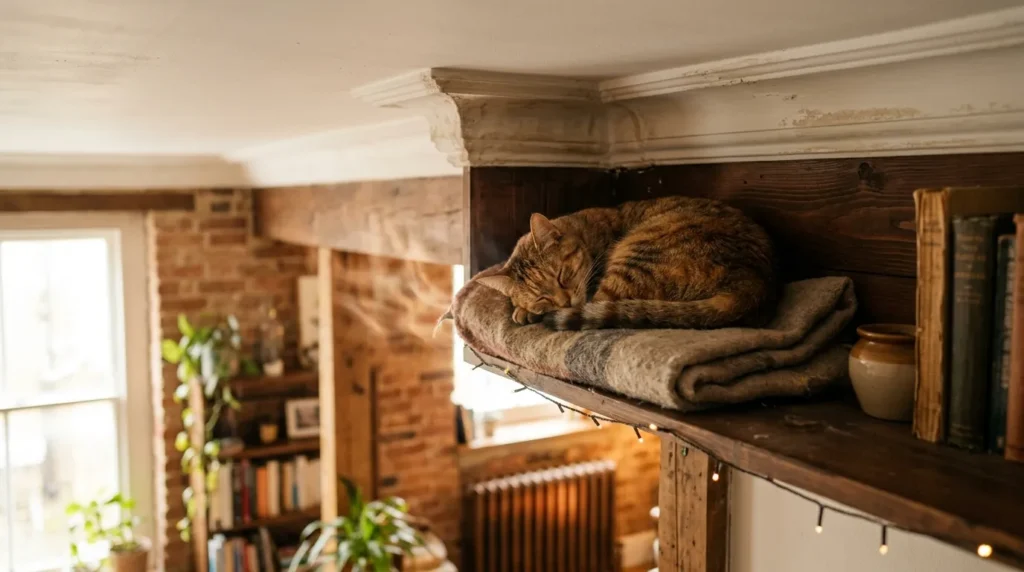
Hot air rises. The air near your ceiling can run three to five degrees Fahrenheit warmer than air at floor level in a heated home. Cats hold a body temperature between 100 and 102 degrees Fahrenheit and look for outside warmth to get there without burning energy. The top of the fridge isn’t just high ground. It’s one of the warmest surfaces in a typical apartment.
A high shelf near a sunny window stacks both warmth sources at once. Rising indoor air gives ambient heat, and direct sun adds more on top of it. That combination supports the deep sleep cats chase for up to 16 hours a day, which is why window-side perches beat almost every other sleeping spot.
The honest reason: the fridge top is warm, elevated, and near the kitchen, where food-related activity happens. From your cat’s view, it checks every box at once. It’s not a quirk. It’s smart territory selection. The fix is giving her something better, not repeatedly pulling her off the one spot that already works for her.
Visual Monitoring Without Participation: The Social Observation Function
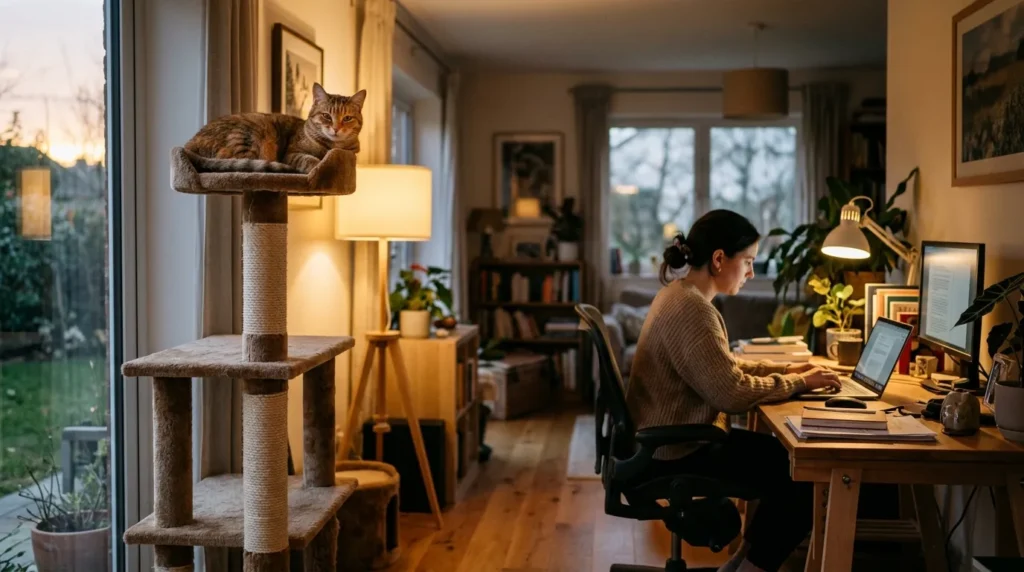
Cats bond with their households, but they aren’t obligate social animals the way dogs are. They need to join in on their own terms, not get pulled into the middle of foot traffic by floor-level furniture. A cat on a high perch stays connected to you while keeping control over how much she engages.
That’s why cats pick high spots in occupied rooms over high spots in empty ones, when both are available. Social observation needs someone to observe. A high shelf in your living room gives her height and an audience. A high shelf in a spare room only gives her height.
Enrichment that pairs vertical territory with a view of the room tends to produce cats who ask for less ground-level attention, since their monitoring needs are already met. Adjusting apartment layout for these spatial needs cuts down on the meowing, climbing and attention-seeking that shows up when cats can’t find good height in the rooms where life happens. Solid day-to-day indoor cat health and care treats vertical access as routine, not a bonus.
Balconies, Open Windows and Fall Risk: What Actually Needs Screening
The height-seeking drive covered so far is about interior furniture, but the same instinct pulls cats toward balconies and open windows, where the stakes are different. High-rise syndrome, the term vets use for cats falling from elevated windows or balconies, happens because a cat’s confidence in her landing ability doesn’t scale down when the drop is four stories instead of four feet. Screen every window she has access to, even ones you don’t think she’d approach, and treat an open balcony door the same as an open window rather than assuming she’ll stay clear of the edge. A cat harness and leash, or a fully enclosed catio, are the only ways to give her real outdoor height access without that risk. Interior furniture like trees and shelves carries no comparable danger; the concern is specific to unscreened openings to the outside.
When Cats Stop Seeking Height: A Health Warning Sign
A cat who used to climb often and suddenly stops is showing a real change worth checking. Arthritis and joint pain are the most common medical cause. A cat with sore shoulders, elbows or hips still wants height. She just can’t handle the impact of jumping up, or landing on the way down.
Watch for these signs of joint pain, not just preference:
- Hesitating at the base of a cat tree before deciding not to jump
- Taking a longer run-up than she used to
- Choosing lower perches she once skipped over
- Stiffness after landing, or a stumble on the dismount
This is different from a cat who simply prefers the floor. She still wants the height and has learned, painfully, that she can’t get it without discomfort. Adding steps or a ramp to her usual spot restores access without moving anything.
This article is for informational purposes only. Always consult your vet if you have concerns about your cat’s health.
Signs Your Cat Needs More Vertical Space
- She hovers on furniture backs and cabinet tops instead of settling anywhere, cycling between the only elevated spots available.
- She’s more vocal or clingy than usual, especially in a busy or multi-pet household with little height to retreat to.
- She guards one high spot aggressively from another cat, a sign there isn’t enough elevated territory to go around.
- She startles more easily at floor level, with fewer options to get above the source of stress.
The Mistake That Amplifies Every Problem a High Position Would Prevent
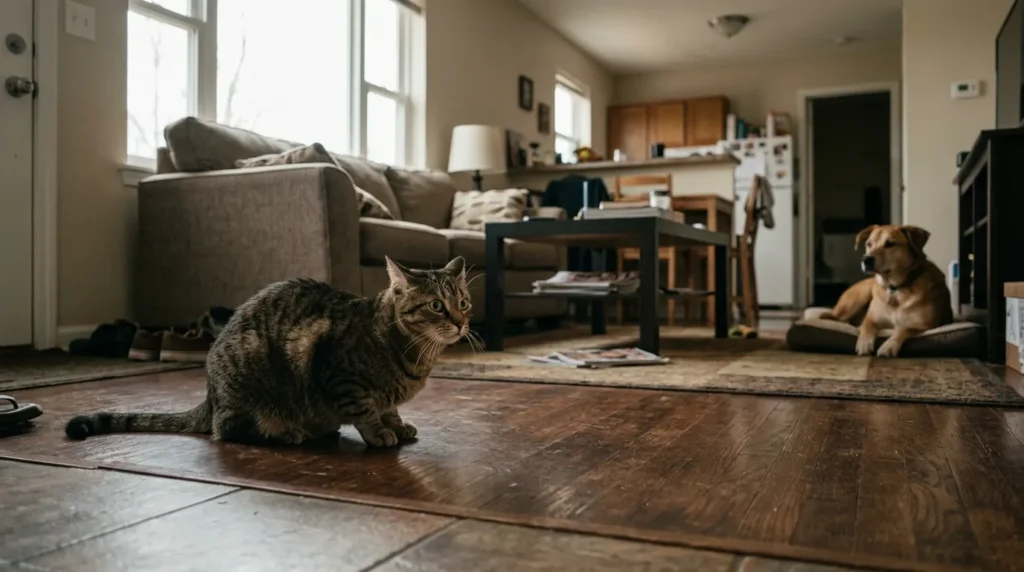
The mistake that makes every one of these problems worse is pulling a cat off her high spots again and again without giving her an approved option. Remove her from the fridge, the bookshelf and the counter with nothing to replace them, and she learns nothing useful. She just gets more frustrated, more anxious about territory, and more likely to scratch, meow or redirect her stress onto something nearby.
Give her something better before you take away what she already has. Set up a cat tree that reaches bookshelf height before you start blocking the bookshelf. Once she has a spot that meets her needs, the competition with your furniture mostly settles on its own.
Checking your indoor cat’s health regularly tells you whether less height-seeking is about a poor setup or a physical limit. Keeping the litter box area clean and separate from her vertical spots keeps territory zones clear and lowers overall household stress. If odor keeps coming back even after cleaning, persistent litter box smell after cleaning is worth checking alongside her behavior. A steady feeding routine cuts hunger-driven restlessness that adds to territorial stress in cats without enough vertical space.
Choosing the Right Height Solution
Not every apartment fits the same setup. Match the option to your space and your cat’s needs.
| Option | Best For | Trade-off |
|---|---|---|
| Cat tree | Multi-cat homes that need separate levels | Takes up floor space |
| Wall-mounted shelves | Small apartments with no floor room to spare | Needs secure wall anchoring |
| Window perch | Cats that want warmth plus an outdoor view | Only works near a stable, screened window |
| Steps or ramp to an existing spot | Senior cats or cats with joint pain | Needs a wall or furniture to attach to |
Our guide on choosing a cat tree for a small apartment goes deeper into height, base stability and material if a tree is the direction that fits your space.
Frequently Asked Questions About Why Cats Like to Sit Up High
Why do cats like to sit up high and look down at us?
Cats monitor their social group from elevated positions because height gives them visual access to the whole room without being accessible to threats. Looking down at you is social observation, not judgment.
Is it safe for my cat to be that high in the apartment?
Yes for shelves and cat trees. The risk only applies near open, unscreened windows or balconies where a cat could fall several stories. All interior elevated positions on stable furniture are safe for a healthy adult cat.
Why does my cat always want to be on the highest point in the room?
The highest point gives maximum visual coverage of the territory with minimum exposure to approach from below. It’s the best threat assessment position, and a cat will seek it out regardless of how comfortable the lower spots are.
My senior cat stopped climbing to her favorite high spot. Should I be worried?
Yes. Reduced height-seeking in a cat who used to climb regularly is usually a sign of joint pain. Add steps or a ramp to her favorite spot, and see your vet if the avoidance continues.
How do I stop my cat from sitting on top of the refrigerator?
Provide a cat tree or shelf that reaches the same height in the same room. Once she has an approved option that meets the same criteria, height, warmth and a view of kitchen activity, most cats move off the refrigerator within a week.
Do all cats like to be up high, or just some?
Most cats show some height preference, but the strength varies. Confident cats often settle for mid-height spots since they feel less threatened at floor level. Anxious or lower-ranking cats tend to seek height more consistently, and breed plays a role too, with high-energy breeds like Bengals pushing harder for full-height access.
How high should a cat tree or shelf be?
Most cats are comfortable up to about five or six feet. A stable surface and a clear jump path matter more than raw height. A wobbly shelf at seven feet is worse than a solid one at four.
Is it a problem if my cat prefers the floor?
Not necessarily. Some cats are naturally more floor-based, especially confident ones in single-cat homes with no competition for space. It’s worth a look if that preference changes suddenly, since that can point to joint pain.
Is it safe to let my cat on a balcony since she likes height so much?
Only with a fully enclosed catio or a harness and leash under supervision. An open balcony gives her the height she’s drawn to along with a real fall risk, since her judgment of a safe jump doesn’t account for the actual drop from several stories up.
Cats like to sit up high because they’re mesopredators, built to manage both hunting and being hunted at once. Height gives them full-room observation, safety from ground-level threats, a way to signal status in multi-cat homes, warmth from rising air that runs 3 to 5 degrees Fahrenheit warmer than the floor, low-pressure social monitoring, and a position that’s hard to ambush. High-energy breeds like Bengals push harder for full vertical access, while calmer breeds like Persians and Ragdolls often settle for mid-height spots. Kittens start climbing by six to eight weeks old but need low, stable options until their coordination catches up around four to six months. Indoor cats without real vertical access show more stress-related problems, including inter-cat conflict, redirected aggression and more attention-seeking, while unscreened windows and open balconies turn the same height-seeking drive into a real fall risk.

Written by Mishu
A passionate cat lover and indoor living enthusiast, Mishu is the founder and voice behind Indoor Living Cat – a go-to resource for cat owners who want to create the happiest, healthiest life for their feline companions indoors.
View Full Profile