
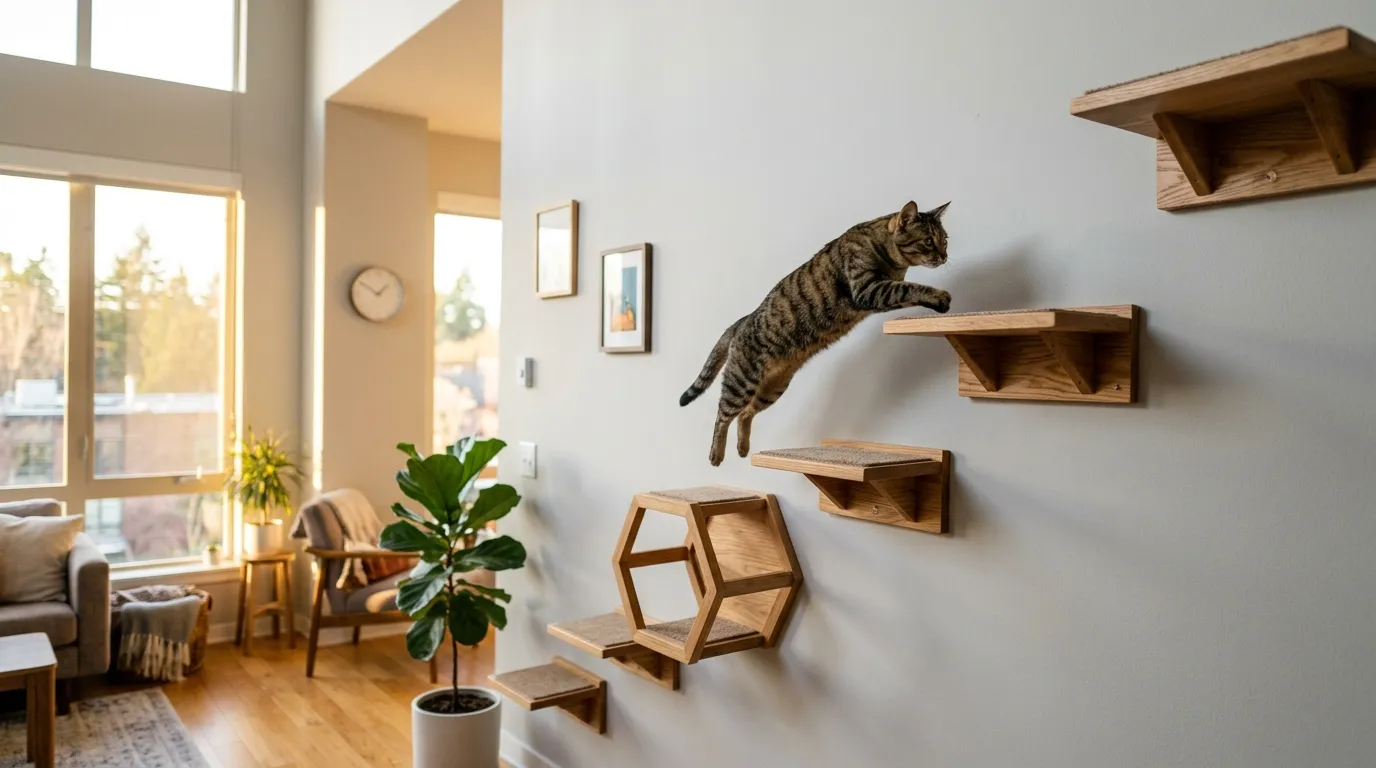
The lesson I learned the expensive way was that installing shelves two feet apart vertically seemed logical on paper but produced a cat who stood at the first shelf, stared up at the second and then walked away to sit on the couch instead. Understanding how high should cat wall shelves be is mostly about understanding the difference between what a cat physically can jump and what a cat will confidently choose to jump every time she passes the wall. This article gives you the specific measurements for vertical spacing, horizontal offset, peak height, headroom, shelf depth and width, weight capacity, and installation steps that produce a wall system your cat uses daily rather than one she uses occasionally when she is feeling ambitious.
How high should cat wall shelves be? Set vertical spacing at 12 to 18 inches between shelves for adult cats and 8 to 12 inches for seniors or kittens. Keep the horizontal offset under 24 inches. Allow at least 16 to 18 inches of headroom above the highest shelf. Set the peak height at 6.5 to 7.5 feet for most apartments. Shelves should be at least 10 inches deep and 10 to 12 inches wide so a cat can turn around without feeling unstable.
Quick Reference: Cat Wall Shelf Measurements
| Measurement | Recommended range | Applies to |
|---|---|---|
| Vertical spacing | 12–18 in | Healthy adult cats |
| Vertical spacing | 8–12 in | Seniors, kittens, arthritic cats |
| Horizontal offset | Under 24 in, staggered | All cats |
| Peak shelf height | 6.5–7.5 ft | Standard 8–9 ft ceilings |
| Headroom above top shelf | 16–18 in minimum | All cats |
| Shelf depth | 10–12 in | Average adult cat, 8–12 lb |
| Shelf width | 10–12 in (16+ in for multi-cat) | One cat resting and turning |
| Weight rating per bracket | 25+ lb dynamic load | Any cat under 20 lb, jumping |
Vertical Spacing: The Number That Determines Daily Use
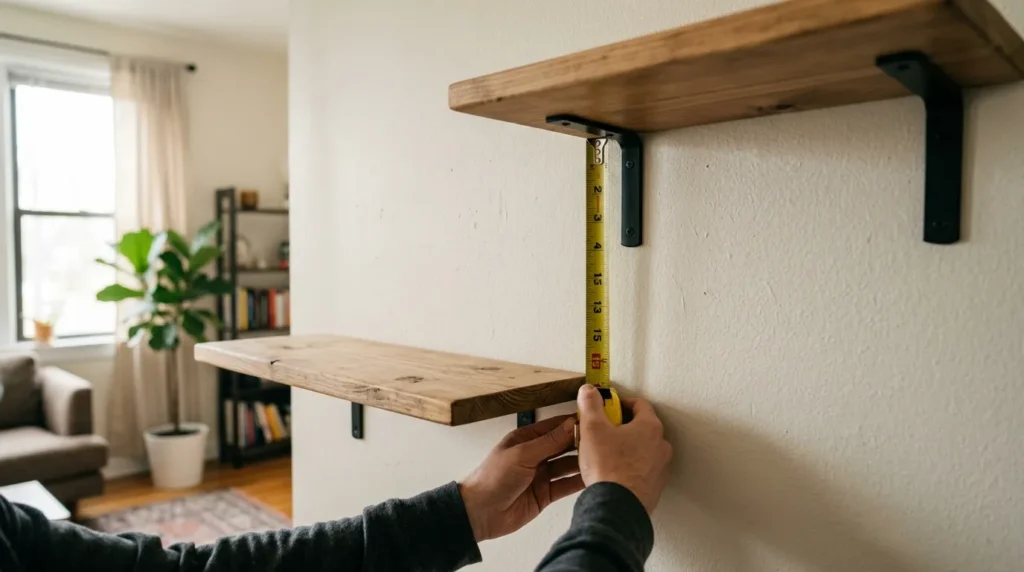
The vertical spacing between shelves is the single measurement that most determines whether a cat uses a wall system confidently every day or treats it as an occasional challenge. Twelve to eighteen inches between shelf levels is the standard for healthy adult cats in their prime because this distance requires a genuine jump rather than a step while still being well within the comfortable jumping range of most cats. A confident daily-use jump and a maximum effort jump feel completely different to a cat, and she will reliably choose routes that stay in the confident range.
The distinction between what a cat can jump and what she will choose to jump daily is one that most installation guides miss entirely. My own cat could clear a two-foot vertical gap with effort, but I had to add an intermediate shelf at twelve inches when she started consistently bypassing the wall and using the couch instead. She was capable of the distance but not confident enough to choose it repeatedly throughout a normal day. The comfortable range, not the maximum range, is what you are designing for.
Understanding the behavioral confidence factors that drive your cat’s territory choices explains why designing for confident daily use matters more than designing for physical capability. A cat who uses her wall system twice a day gets far more territory benefit than one who uses it twice a week on adventurous days.
Spacing for Seniors, Kittens and Cats with Joint Issues
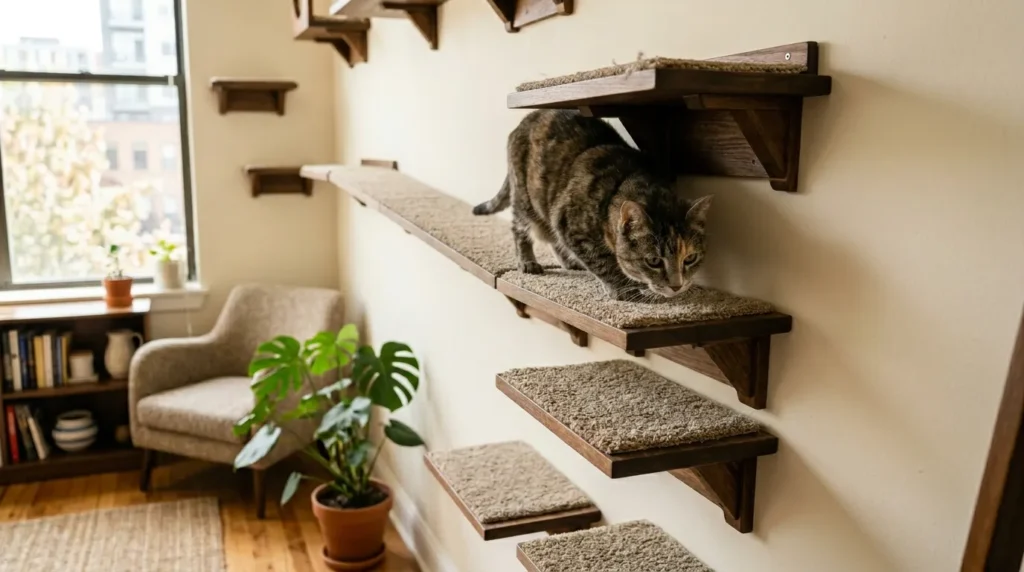
Senior cats and kittens need vertical spacing reduced to 8 to 12 inches rather than the adult standard. This shorter step distance prevents the repeated joint impact that accumulates from jumping 15 or 18 inches down onto a hard shelf surface multiple times daily. For a cat who uses her wall system 20 to 30 times a day, the cumulative joint load from landing height is meaningful, and the spacing you choose directly affects her long-term joint health.
For cats recovering from surgery, cats with diagnosed arthritis or cats showing early signs of stiffness when jumping, the spacing should be reduced to 8 inches, or you should add ramp-style connector pieces between existing shelves rather than reinstalling everything. According to Cornell Feline Health Center guidance on feline musculoskeletal conditions, repeated high-impact landings are a contributing factor to progressive joint deterioration in cats who are already showing early arthritis. Spacing your shelves for your cat’s actual current physical condition rather than her condition when she was three years old is good long-term maintenance.
Signs Your Cat Needs Wider Spacing, Not Narrower
- She hesitates at the edge of a shelf before jumping instead of moving straight through the route.
- She lands hard and shakes it off, or she yowls briefly on landing.
- She uses the bottom one or two shelves and stops climbing higher, even though she used the full system before.
- She takes a longer, flatter path (jumping to furniture first) instead of a direct vertical route.
Any of these is a reason to add an intermediate shelf or a ramp rather than waiting for a vet visit to confirm what the behavior is already telling you.
Horizontal Offset: Why the Stagger Pattern Matters More Than Height?
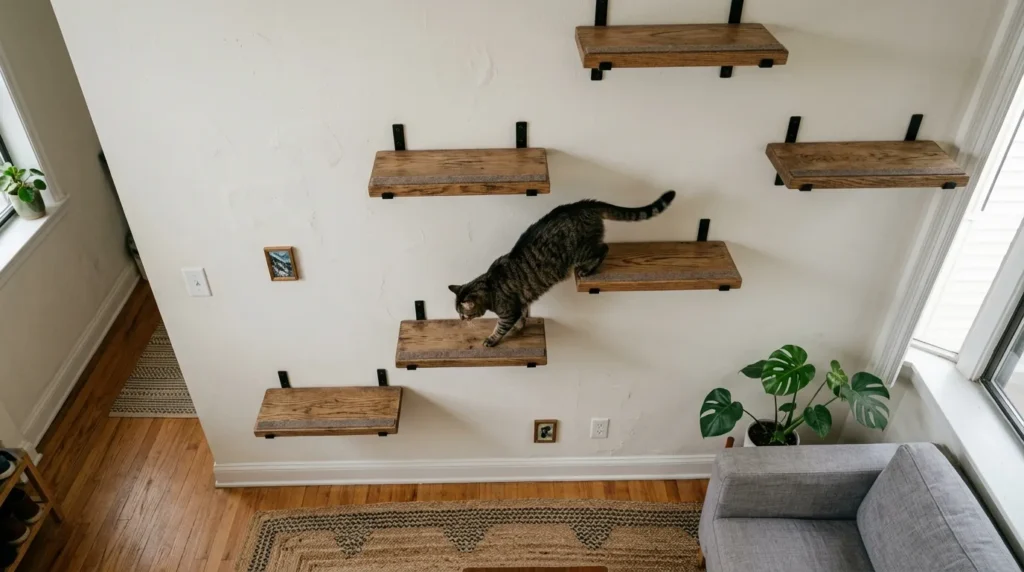
The horizontal offset between consecutive shelves should stay under 24 inches to ensure a confident landing zone every time. When you place a shelf directly above another shelf in a ladder pattern, you create a wall system that is technically functional but spatially inefficient and behaviorally awkward. Cats naturally approach a landing in a forward trajectory, and a shelf directly above requires an almost vertical jump that most cats find uncomfortable and will avoid after the first few attempts.
A staggered layout with each successive shelf offset 12 to 18 inches horizontally to alternating sides creates a diagonal route that matches how cats naturally move through elevated territory. The cat leaps forward and slightly up rather than straight up, which is both easier biomechanically and more engaging behaviorally because she can see her next landing clearly from her current position. This visual preview of the next landing is what eliminates hesitation at gaps.
Building a complete vertical enrichment circuit for your indoor cat that incorporates the stagger pattern with window views and integration to floor-level furniture produces a wall system that your cat actively seeks out rather than just tolerates. Exploring the full range of wall-mounted and freestanding cat furniture options gives you the specific product context to apply these spacing measurements to real installation decisions.
Peak Height and Headroom: Getting the Top Shelf Right
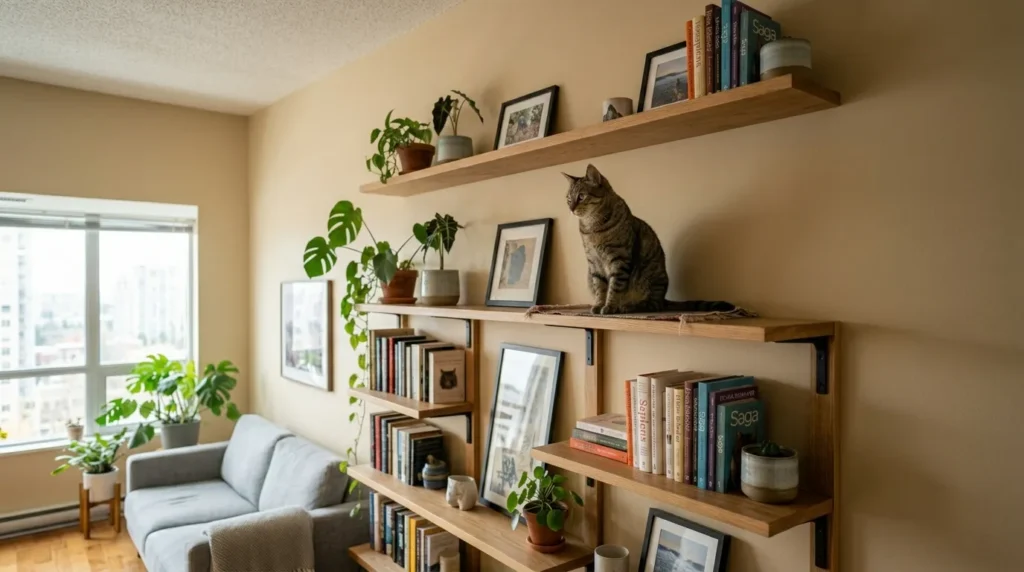
The peak shelf height that produces the highest behavioral value in most apartments falls between 6.5 and 7.5 feet off the floor. This range places your cat above the eye level of everyone in the room, including standing adults, which satisfies the territorial security drive for elevated observation. A shelf at 6 feet places the cat just below human head height and does not fully deliver the above-the-household-activity experience that drives a cat to seek and maintain high positions.
The headroom requirement above the highest shelf is at least 16 to 18 inches. This provides enough space for the cat to stand fully upright, turn around, stretch after a nap and approach the shelf from the lower level without having to duck her head at the last moment of the jump. A cat who hits her head once during a jump to the highest shelf will avoid that shelf permanently.
The Spacing Reality: I installed my highest shelf at 8 feet in a 9-foot ceiling apartment, and the 12 inches of headroom was genuinely not enough. My cat would arrive at the shelf, crouch down awkwardly and leave within two minutes rather than settling in. Moving that shelf to 7.5 feet with 18 inches of headroom solved it. More ceiling clearance almost always matters more than maximum height.
Shelf Width and Depth: How Wide Should Cat Wall Shelves Be?
Height and spacing get most of the attention, but shelf dimensions decide whether your cat actually rests up there or just passes through. A shelf that is too narrow forces her to balance rather than settle, and a cat who cannot fully relax on a shelf will use it as a stepping stone at best.
Depth should be at least 10 inches for an average adult cat weighing 8 to 12 pounds, and 12 inches is safer if you have a Maine Coon, a Ragdoll or another large breed that can run 15 to 20 pounds. Width matters more than most people expect: a shelf 10 to 12 inches wide gives a single cat room to turn a full circle and lie down without her tail or paws hanging over the edge. If you have more than one cat sharing the route, or if your cat likes to stretch out fully rather than curl up, go to 16 inches or wider on at least the top shelf so it can double as a lounging platform rather than just a passing point.
| Cat size / situation | Recommended shelf depth | Recommended shelf width |
|---|---|---|
| Kitten (under 6 months) | 8–10 in | 8–10 in |
| Average adult cat (8–12 lb) | 10–12 in | 10–12 in |
| Large breed (Maine Coon, Ragdoll, 15–20 lb) | 12–14 in | 14–16 in |
| Multi-cat household | 12 in minimum | 16–20 in on top/rest shelves |
| Senior or arthritic cat | 12–14 in (more surface to land on) | 12–14 in |
Weight capacity is a separate number from depth and width, and it is the one people skip until a bracket bends. A single stud-mounted bracket rated for 25 pounds of dynamic load handles almost any single housecat, including the force of a jump rather than just a cat sitting still. If you are running two cats on the same shelf at once, or a large breed plus a startled sprint across the wall, look for shelves and brackets rated to at least 40 pounds combined dynamic load, not just static weight.
Structural Integrity: The Installation Detail That Cannot Be Skipped
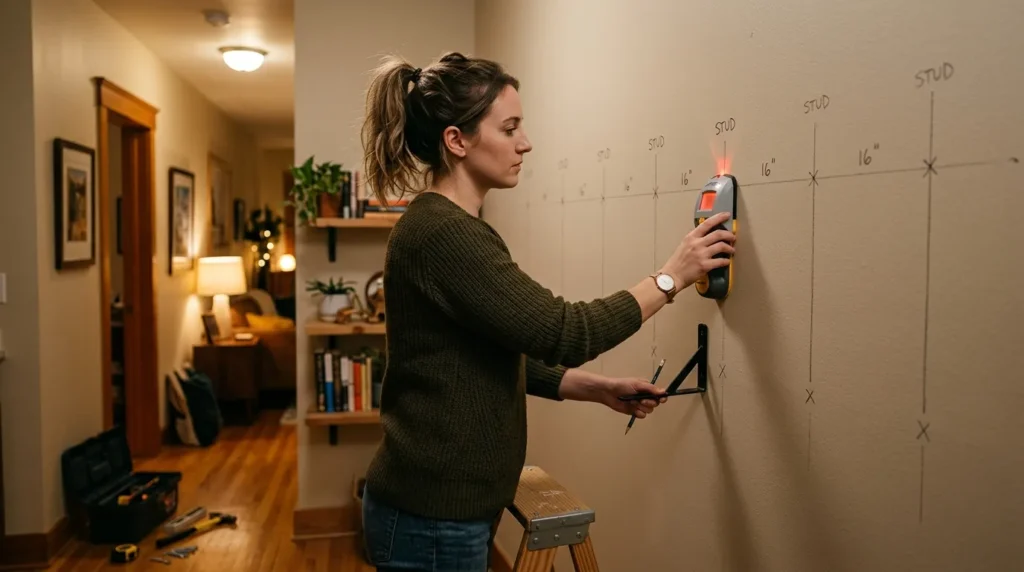
Every cat wall shelf must anchor into a wall stud rather than relying on drywall anchors alone. A 10-pound cat generates over 40 pounds of impact force when landing at full speed from a 15-inch jump, and standard drywall anchors are not rated for dynamic loads of this type regardless of what their static weight rating says. One missed landing, one anchor failure and one shelf pulling from the wall is all it takes to permanently eliminate a cat’s trust in an entire wall system.
Finding studs with a stud finder before marking bracket locations is not optional. Studs in standard US apartment construction are spaced 16 inches apart, and you can almost always reach at least one stud per shelf bracket pair within the width of any reasonable shelf. Screws penetrating at least 1.5 inches into solid wood stud provide the load rating needed for confident use, including zoomie-speed approaches and maximum-effort jumps.
The shake test before your cat’s first use is the most important installation step. Push each shelf laterally and vertically with significant force before you allow your cat to explore the system. Any flex, movement or creak means the mounting is inadequate and needs reinforcement before use. A wobbly shelf that shifts under your cat’s weight will be abandoned and may never be used again regardless of how you correct it later.
Installation Checklist Before Your Cat’s First Climb
- Locate studs across the full wall run and mark them before you touch a shelf.
- Confirm at least one stud per bracket pair, not per shelf. Wider shelves may need two bracket pairs.
- Use screws that penetrate 1.5 inches or more into the stud, not just through the drywall.
- Check spacing against a tape measure, not by eye. Twelve inches and sixteen inches look closer than they are.
- Run the shake test on every shelf, top to bottom, before the cat sees the wall.
- Re-check the shake test after 30 days. Drywall and lumber shift slightly as they settle.
The Installation Mistake That Ruins Most Cat Wall Systems
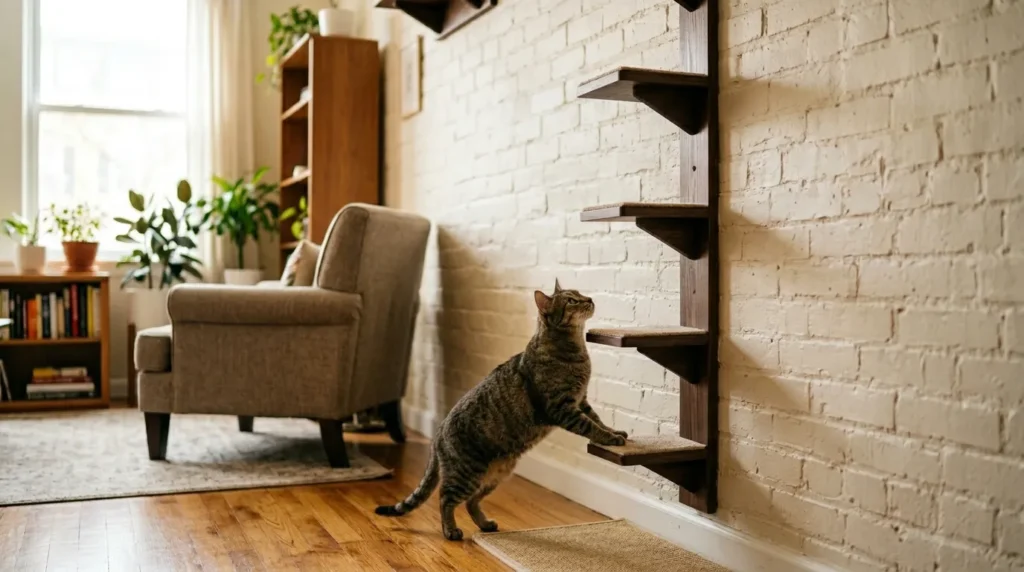
The installation mistake that makes most cat wall systems underused is the ladder layout, where every shelf sits directly above the previous one. This creates a vertical climbing route that requires the cat to jump almost straight up to each shelf, which is biomechanically awkward and visually disorienting for a cat whose natural jumping trajectory is diagonal. The cat can see only the underside of the shelf above her rather than the landing surface ahead, which removes the visual confirmation cats need before committing to a jump.
The second dimension of this mistake is building a dead end rather than a circuit. A cat who climbs to the highest shelf of a dead-end system must either back down the same route she came up or jump to the floor from maximum height. Cats avoid routes that trap them, and a dead-end wall system gradually stops being used as the cat learns that getting down requires either a difficult reversal or a long drop.
Managing the full scope of your apartment cat’s vertical territory and enrichment needs includes wall systems as part of the integrated approach rather than as standalone installations. Good indoor cat care includes periodic inspection of shelf mounting to confirm anchors remain secure as the wall and seasonal temperature changes affect wood and drywall material slightly over time. Monitoring your cat’s health and observing whether she uses her high shelves less frequently as she ages gives you early data on joint condition changes before they become painful. Feeding her near the wall system during the introduction period builds positive associations with the new territory. A clean litter box area separate from the climbing zone keeps territorial zones functionally distinct.
Buying Ready-Made Shelves vs Building Your Own
Ready-made kits give you pre-cut shelves, matched brackets and carpet or sisal covering already applied, which is the fastest route if you want the wall finished this weekend. They typically run 10 to 12 inches deep, which matches the numbers above, and the hardware is already rated for the load. The tradeoff is cost per shelf and less control over exact spacing if the kit is sold as a fixed set.
Building your own is cheaper per shelf and lets you set the exact spacing, depth and stagger this article recommends rather than adapting your cat to whatever a manufacturer chose. At minimum you need: a stud finder, a level, a drill with a countersink bit, L-brackets or floating shelf brackets rated for at least 25 pounds dynamic load, 3/4-inch plywood or a pre-cut shelf board, wood screws at least 2.5 inches long, and carpet, sisal or a grip-friendly finish for the top surface. Cut your boards to the depth and width from the table above, mark stud locations across the full wall, mount brackets first and check level before setting the shelf, then run the shake test before letting your cat near it.
This covers the basics, but a full cat wall shelf building guide with cut lists, bracket types and step-by-step photos is enough material for its own article. If that is what you are after, treat the checklist above as your starting point and look for a dedicated build guide rather than trying to reverse-engineer one from a spacing article.
Frequently Asked Questions About Cat Wall Shelf Height
What is the standard vertical spacing between cat wall shelves?
12 to 18 inches for healthy adult cats and 8 to 12 inches for seniors, kittens or cats with joint issues. This range ensures confident daily use rather than occasional maximum-effort attempts.
How far apart should cat shelves be?
Vertically, 12 to 18 inches for adults and 8 to 12 inches for seniors and kittens. Horizontally, keep the offset under 24 inches and stagger each shelf to alternating sides instead of stacking them in a straight line.
How high should the highest cat shelf be?
6.5 to 7.5 feet provides the best behavioral value in most apartments. Go higher only if you can maintain at least 18 inches of headroom between the shelf surface and the ceiling.
How far apart should cat shelves be horizontally?
Under 24 inches with a stagger to alternating sides rather than a straight-up ladder layout. The stagger lets your cat see the next landing clearly before committing to the jump.
How wide should cat wall shelves be?
10 to 12 inches wide for a single average cat, and 14 to 20 inches on at least one shelf if you want a lounging spot or have more than one cat using the route. Width is what lets her turn around and lie down instead of just balancing.
How deep should cat wall shelves be?
At least 10 inches and ideally 12 inches. Narrower shelves do not give cats enough space to land, turn around and settle into a resting position without feeling unstable.
What are typical cat shelf dimensions overall?
Most household setups land between 10 and 14 inches deep, 10 to 20 inches wide depending on how many shelves double as rest spots, and 12 to 18 inches vertically between levels. Large-breed cats and multi-cat homes should size up toward the higher end of every range.
Do cat wall shelves need to be in studs?
Yes, without exception. Drywall anchors are not rated for dynamic impact loads. A 10-pound cat landing at speed exerts over 40 pounds of force, and only stud-anchored brackets handle this safely over time.
How much weight can a cat wall shelf hold?
Look for brackets rated to at least 25 pounds of dynamic load for a single cat, and 40 pounds or more if two cats might land on the same shelf together. Dynamic load, not static weight, is the number that matters because a jump hits harder than a cat standing still.
Can I build cat wall shelves myself instead of buying a kit?
Yes. You need a stud finder, level, drill, brackets rated for at least 25 pounds dynamic load, 3/4-inch plywood or a cut shelf board, 2.5-inch wood screws and a grip-friendly top surface. Building your own costs less per shelf and lets you match the exact spacing in this guide instead of a manufacturer’s fixed kit.
Cat wall shelves should have vertical spacing of 12 to 18 inches between levels for adult cats and 8 to 12 inches for seniors or kittens. The horizontal offset between consecutive shelves should stay under 24 inches with a staggered zigzag pattern rather than a straight ladder layout. The highest shelf should sit between 6.5 and 7.5 feet with at least 16 to 18 inches of headroom above it. Shelf depth should be at least 10 to 12 inches and width should be 10 to 20 inches depending on whether the shelf doubles as a rest spot or supports more than one cat. Bracket hardware should be rated for at least 25 pounds of dynamic load per cat. All brackets must anchor into wall studs because drywall anchors fail under the dynamic impact force of a jumping cat.

Written by Mishu
A passionate cat lover and indoor living enthusiast, Mishu is the founder and voice behind Indoor Living Cat – a go-to resource for cat owners who want to create the happiest, healthiest life for their feline companions indoors.
View Full Profile