
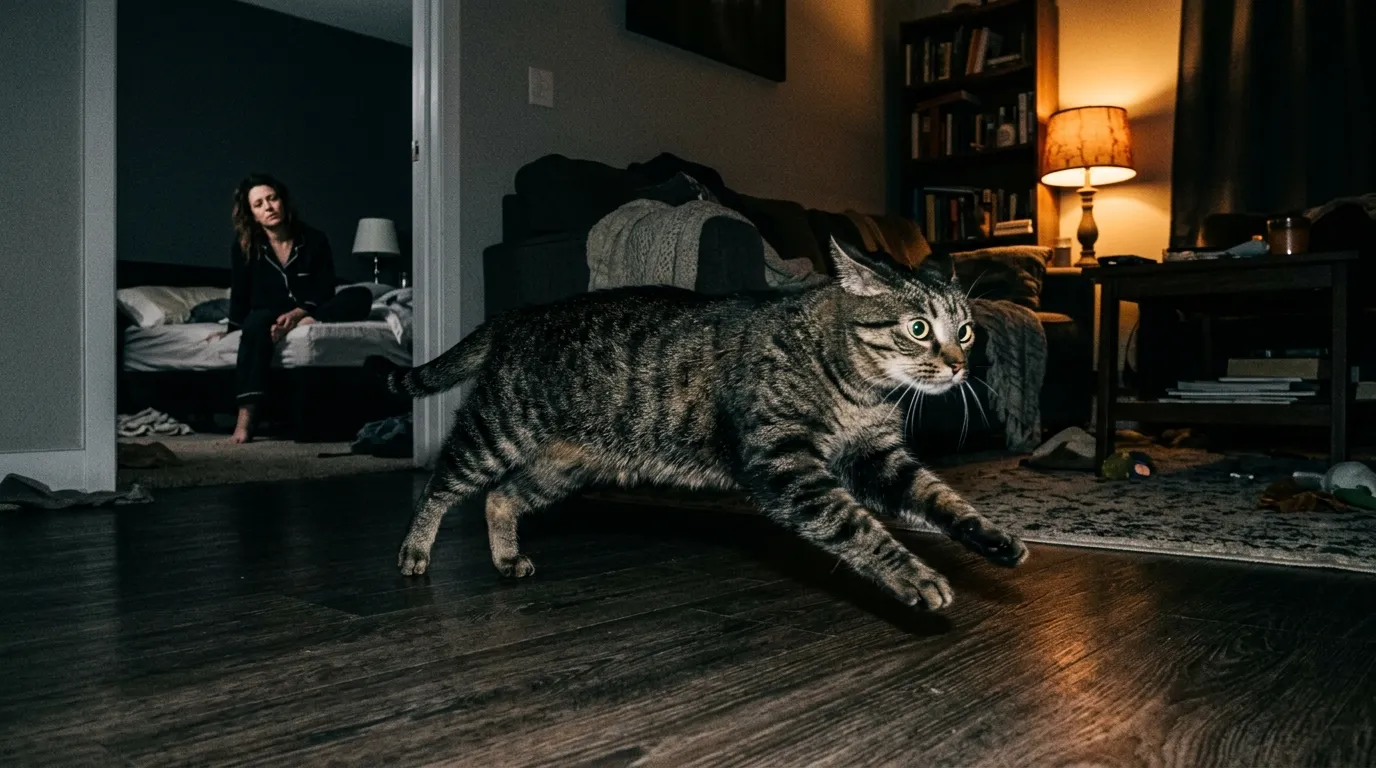
My cat used to sprint the hallway at exactly 2am, every night, for a week straight. I checked her for fleas. I checked the litter box. Nothing was wrong with her body. Something was wrong with her schedule and her environment. Why does a cat run around at night? Most of the time it comes down to one thing: energy that built up all day with nowhere to go, released right when you want to sleep. This guide is part of our indoor cat care series, and it covers the seven real reasons behind the midnight sprint, why apartment cats run harder than cats with a yard, when running is actually yowling in disguise, and the three changes that produce quieter nights within a week or two.
Why does a cat run around at night? Cats are crepuscular, which means they’re built to be most active at dawn and dusk, not midnight. Indoor cats sleep most of the day while you’re at work, then hit that evening energy peak fully rested. Add hunting instincts with no daytime outlet, and you get the midnight sprint. It’s normal. It’s also fixable.
Key takeaways
- Cats are crepuscular, not nocturnal. Dawn and dusk are their natural active hours, and unspent evening energy often spills into the night.
- Seven common triggers cause nighttime running: stored-up energy, unmet hunting drive, zoomies, hunger, dry indoor air, learned attention-seeking, and noise from outside.
- Evening play plus a late meal is the single change most owners see results from, usually within five to ten days.
- A sudden spike in nighttime energy in a cat over age ten deserves a vet visit, especially with weight loss.
- Nighttime yowling in a senior cat is a different problem than nighttime running, and it can point to cognitive decline rather than pent-up energy.
Cats Are Not Nocturnal: The Crepuscular Truth Behind Nighttime Running
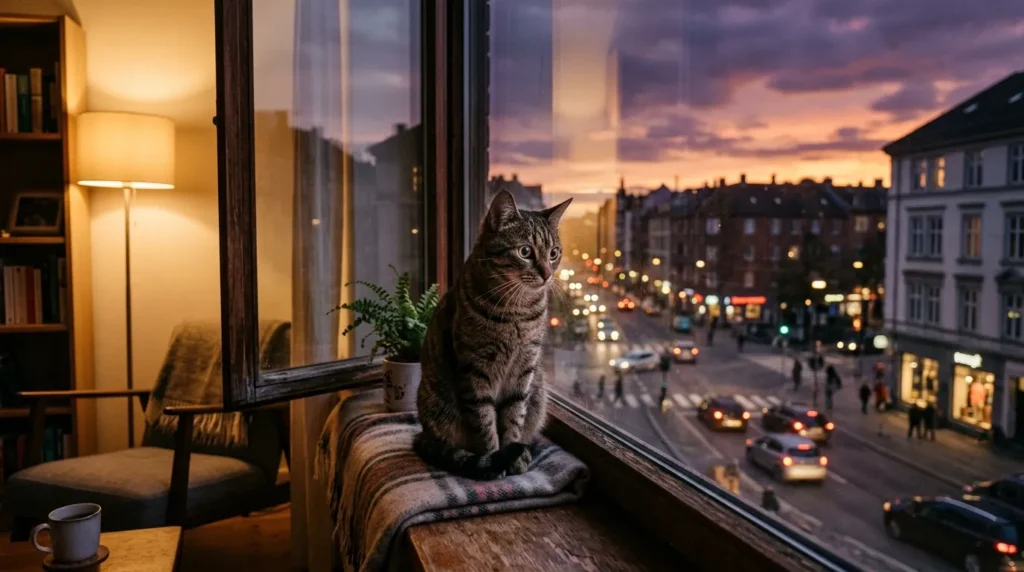
Crepuscular animals are most active at dawn and dusk, not in the dead of night. Cats evolved this way because their prey, mostly small rodents and birds, moves at the same low-light hours. Twilight is also cooler than midday, which matters for an animal covered in fur. This isn’t nocturnal behavior. A cat’s real peak sits at the edges of the day, not the middle of the night. Some owners call this evening burst the “witching hour,” and the name fits. It’s short, intense, and over almost as fast as it starts.
Indoor life shifts that clock. A cat who naps from 8am to 6pm while you’re at work hits her crepuscular peak right as you’re winding down for the night. If she’s still running at midnight, it’s usually because that evening burst never got fully spent between 6pm and 11pm. The midnight sprint is often just the leftover tail of an energy cycle that had nowhere to go earlier.
According to Cornell Feline Health Center, nighttime activity is one of the most common complaints from indoor cat owners, and it’s almost always a scheduling and enrichment issue rather than a medical one. Understanding your cat’s full range of indoor cat behavior across the whole day makes it much easier to fix the nighttime piece.
7 Real Reasons Your Cat Runs Around at Night
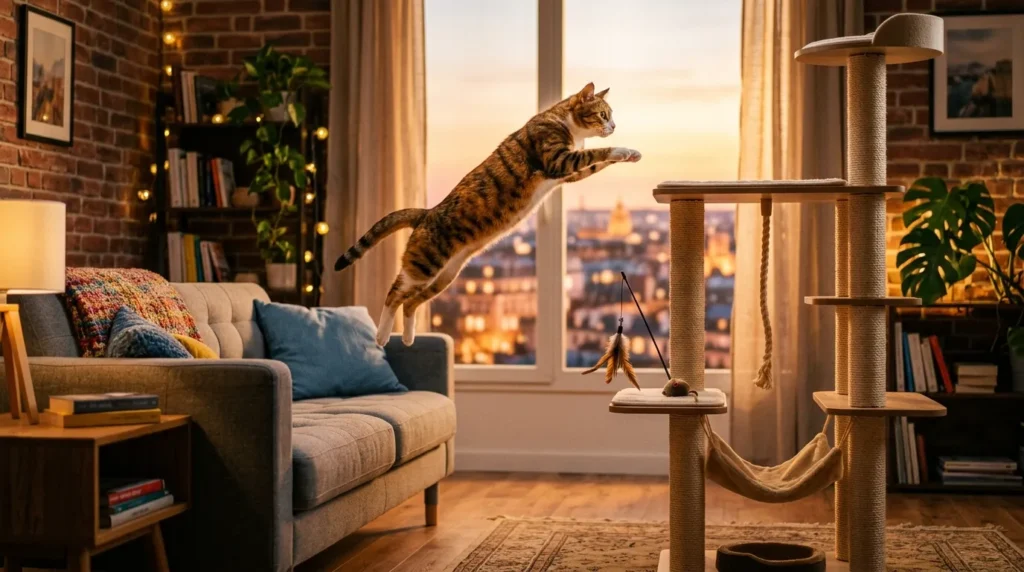
Here’s what’s actually driving the 2am sprint, in order of how often owners run into each one.
1. Pent-up energy from a day of doing nothing. Cats sleep 12 to 16 hours a day, and an empty, quiet apartment gives them no reason to move. That saved-up energy has to go somewhere, and it usually shows up after dark.
2. Hunting instincts with no outlet. Your cat is wired to stalk, chase, pounce, and catch. Indoor life offers none of that without you setting it up on purpose. The nightly sprint is often a hunt with nothing at the end of it.
3. FRAPs, also called zoomies. Frenetic random activity periods are short, explosive bursts of movement. They happen across every age and coat type and are completely normal in a healthy cat.
4. Hunger. A cat who last ate in the early afternoon is running on empty by midnight. Hunger lowers a cat’s tolerance for sitting still and often shows up as pacing, running, or vocalizing.
5. Dry indoor air. HVAC systems pull moisture out of the air, which builds up static in a cat’s coat and can cause mild skin irritation. A cat who’s itchy has a harder time settling down.
6. Learned attention-seeking. If running through the bedroom at 2am gets a reaction, even a negative one, your cat has learned it works. Getting up to yell, feed, or comfort her rewards the exact behavior you’re trying to stop.
7. Noise from outside. Neighbors through the wall, animals outside a window, or wildlife rustling near the building all trigger a cat’s hunting instinct. An alert cat doesn’t sleep through it.
Quick reference: reason and fix
| Trigger | What it looks like | Best fix |
|---|---|---|
| Pent-up energy | Sprinting, bouncing off furniture | Vigorous wand play before bed |
| Unmet hunting drive | Stalking, pouncing on nothing | Wand toy simulating prey movement |
| Zoomies (FRAPs) | Sudden short sprint, then normal again | No action needed if brief and healthy |
| Hunger | Pacing, meowing near the kitchen | Move last meal later, after play |
| Dry air/static | Excess grooming, itchy skin | Humidifier, regular brushing |
| Learned attention | Running straight to your door | Full non-engagement at night |
| Outside noise | Alert posture at windows/walls | White noise, block window views at night |
Why Indoor Apartment Cats Run Harder at Night Than Outdoor Cats
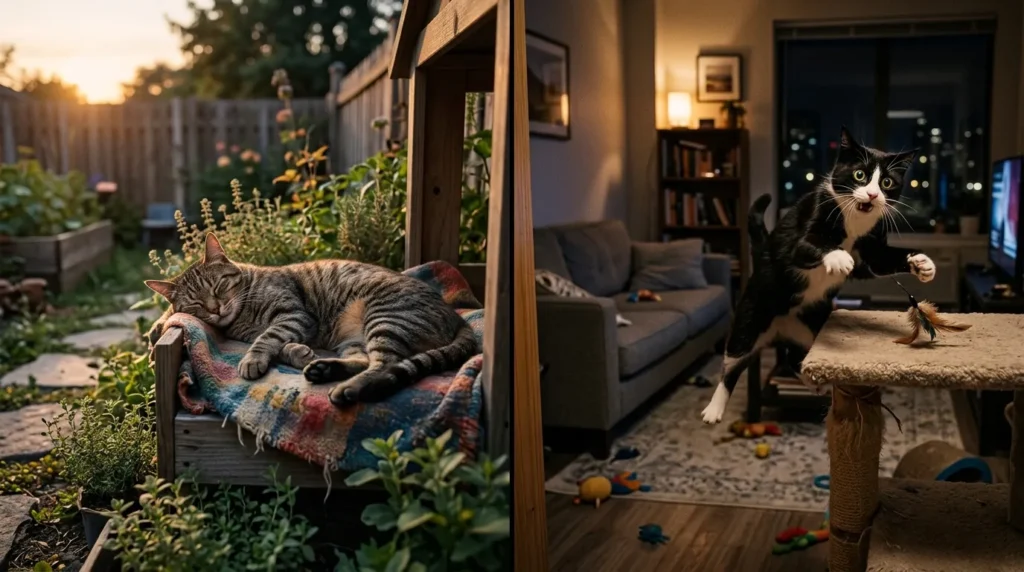
An outdoor cat spends her day hunting, patrolling, climbing, and exploring. By dusk she’s already partly spent, so her crepuscular burst stays moderate. Her indoor counterpart has spent the day doing nothing harder than moving from the sun patch to the cool tile.
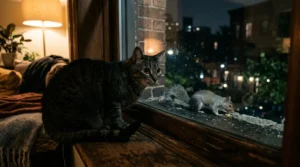
Apartment cats also lose vertical territory. A yard gives height, ground, and hiding spots. An apartment usually gives 600 square feet of flat floor and maybe one cat tree if you’ve invested in furniture. That squeeze compresses a cat’s options down to two: sprint, or sit still.
Multi-cat homes amplify it further. One cat starting a zoomie session reliably sets off every other cat in the house. A single cat who’d burn out in five minutes turns into a two-cat relay that runs an hour.
| Factor | Outdoor cat | Indoor apartment cat |
|---|---|---|
| Daytime activity | Hunting, patrolling, climbing | Sleeping, resting |
| Territory size | Large, varied | Small, mostly flat |
| Evening energy burst | Moderate | Explosive |
| Multi-cat effect | Cats disperse across territory | One cat triggers the whole group |
Adding vertical space and cat furniture around the apartment gives a cat territory to climb and patrol instead of just floor to sprint across. Enrichment built for indoor cats that mimics outdoor variety cuts down the explosive energy buildup that fuels the worst midnight runs. Keeping your cat at a healthy weight matters too. Overweight cats who can’t move efficiently through normal daily activity often make up for it with short, unpredictable bursts instead of steady movement, and you can read more in our guide to indoor cat health.
3 Changes That Produce Quieter Nights
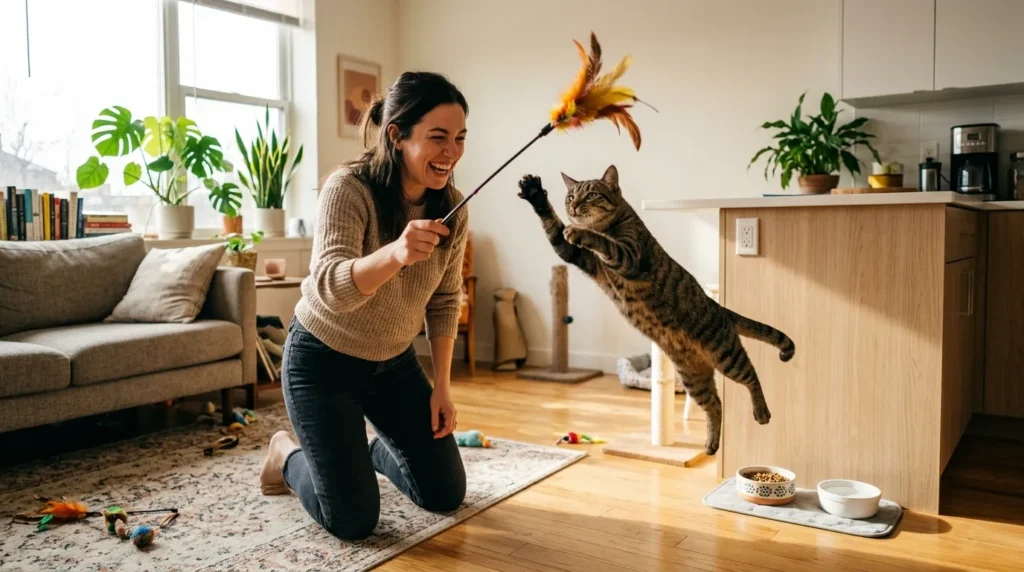
1. Play hard, 30 to 60 minutes before bed. Use a wand toy and keep going until your cat is panting or lies down on her own. You’re aiming to trigger the full hunt sequence, stalk, chase, catch, all the way through to physical tiredness. Ten focused minutes of wand play beats an hour of toys sitting untouched on the floor. Feather wands, ribbon teasers, and anything that mimics erratic prey movement work better than toys that just roll or light up on their own.
2. Feed right after play, not before. In the wild, cats hunt, catch, eat, then sleep, in that order. Playing first and feeding second copies that sequence and triggers the drowsiness that follows a real meal. Most owners who make this one change see a real difference within five to seven days. Our guide on how to feed an indoor cat properly covers portioning this later meal correctly.
3. Build in daytime enrichment. A puzzle feeder instead of a bowl gives your cat 15 to 20 minutes of active work per meal. A window bird feeder set at cat height adds visual stimulation and predatory engagement all day. Both reduce the energy surplus that shows up as a sprint after dark.
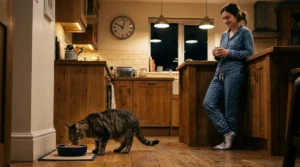
Managing life in an apartment with a cat means treating her energy cycle as a daily task, not something that just happens on its own. Read more in our guide to managing apartment life for your indoor cat. What you feed and when directly shapes the sleep cycle, in ways most owners don’t connect to nighttime behavior until they shift meal timing and see it change. Regular grooming that cuts down static and skin irritation from dry apartment air also reduces the restlessness that adds to nighttime energy.
Sleep reality check: If your cat has been sprinting at midnight for months and you start evening play tonight, give it five to seven days before you notice a real shift. A cat’s internal clock moves gradually, not overnight. Most owners quit after two days and decide it doesn’t work. It works. Give it ten days before you judge it.
Does a Cat’s Age Change How Much Nighttime Running Is Normal?
Age changes the picture a lot. A six-month-old kitten running laps at midnight is closer to expected than concerning. A ten-year-old doing the same thing for the first time is worth watching.
| Life stage | Typical nighttime energy | What to watch for |
|---|---|---|
| Kitten (under 1 year) | High, frequent zoomies | Usually normal; settles with age and play |
| Adult (1 to 7 years) | Moderate, tied to daily activity | Schedule mismatch is the usual cause |
| Senior (8 to 10+ years) | Normally lower than adulthood | Sudden increase, especially with weight loss, needs a vet check |
Neutering and spaying can also lower overall activity and roaming drive, though it doesn’t remove the crepuscular pattern itself. A neutered cat can still sprint at night if the daytime routine leaves her under-stimulated.
The Mistake That Keeps Nighttime Running Going for Years
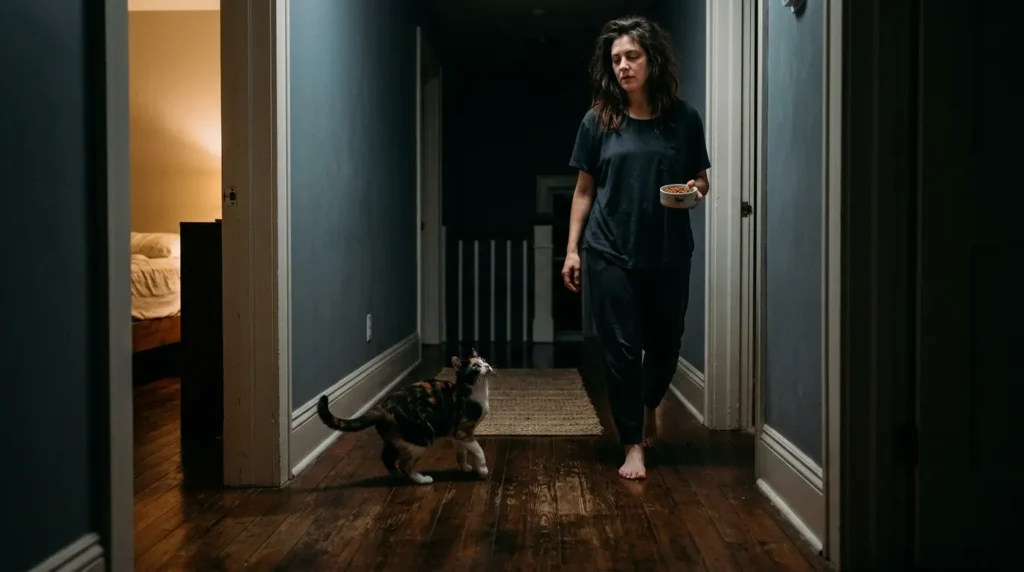
The mistake that turns a manageable evening burst into years of nightly noise is responding to it. Getting up to feed, talk to, or scold your cat all teach her that running at night gets a result. Cats are very good at spotting which behaviors get a reaction, and they repeat exactly what works.
The fix is full non-engagement. Close the bedroom door. Don’t respond to the sounds. No feeding during the night. This is harder than it sounds, because the noise is real and food feels like the fastest way to make it stop. But every response resets the clock on the behavior.
One exception matters here: a dirty litter box is a legitimate reason for nighttime noise, and keeping the litter box clean and accessible overnight removes it from the list of possible causes. If the box smells fresh right after scooping but sours fast, our post on why a litter box smells after cleaning walks through the common causes. A cat who wakes you because the box is dirty has a fair complaint. A cat who’s learned that sprinting the hallway brings company doesn’t.
Running vs. Yowling at Night: Not Always the Same Problem
Everything above assumes the core issue is energy. In older cats, nighttime noise sometimes isn’t running at all. It’s loud, repeated yowling, often paired with pacing, staring at walls, or seeming lost in a room she’s lived in for years. That pattern points somewhere else: feline cognitive dysfunction, sometimes called cat dementia.
The ASPCA reports that cognitive decline affects more than half of cats aged 11 to 15, and over 80 percent of cats aged 16 to 20. It’s common, not rare, once cats reach their senior years. Disorientation and a change in the sleep-wake cycle are two of the hallmark signs, and nighttime vocalizing is one of the most reported symptoms owners bring to their vet. A survey of owners of cats diagnosed with the condition found the vocalizing was most often driven by disorientation or attention-seeking, with hunger and pain as less common causes.
The distinction matters because the fix is different. Evening play and a later meal help a young, healthy cat burn off energy. They don’t do much for a fifteen-year-old cat crying at 3am because she’s briefly confused about where she is. If your senior cat has started yowling at night, especially alongside weight loss, house-soiling, or not recognizing familiar people, that’s a conversation for your vet, not a new wand toy.
Normal Zoomies vs a Problem
| Sign | Normal FRAP/zoomies | Possible medical issue |
|---|---|---|
| Duration | Under 2 to 5 minutes | Repeated episodes, escalating over weeks |
| Body language | Playful, relaxed after | Distressed, agitated after |
| Skin | Normal | Rippling along the back during episode |
| Weight | Stable | Sudden loss alongside energy spike |
| Age pattern | Any age, especially under 8 | New onset in a senior cat |
When Nighttime Running Needs a Vet Conversation
A sudden, dramatic jump in nighttime activity in a cat over age ten is worth a thyroid panel. Hyperthyroidism raises energy levels in older cats and can look like she’s regained the energy of a kitten. That sounds good until it’s happening at 3am, seven nights running. Weight loss alongside the extra energy is the clearest red flag.
Hyperesthesia syndrome causes sudden, frantic running along with skin rippling on the back, tail chasing, and biting at her own skin. This is a neurological condition, not ordinary zoomies, and it needs a vet’s assessment. You can usually tell the difference by her expression during the episode: a cat with hyperesthesia looks distressed, not playful.
Feline cognitive dysfunction, covered above, is the third condition worth ruling out, and it’s specific to senior cats showing disorientation or yowling rather than pure running. All three, hyperthyroidism, hyperesthesia, and cognitive dysfunction, get diagnosed through a vet exam and bloodwork, not by watching your cat from across the room.
This article is for informational purposes only. Always consult your vet if you have concerns about your cat’s health.
Frequently Asked Questions About Cats Running at Night
Is it normal for cats to run around at night?
Yes. It’s a natural mix of crepuscular energy and pent-up energy from a quiet, inactive day indoors. Most healthy cats under age eight do this at least sometimes.
How do I stop my cat from running around at 3am?
Play hard with a wand toy 30 to 60 minutes before bed, then feed right after. This copies the hunt-eat-sleep sequence and moves the energy peak earlier, before you’re trying to sleep.
Are cats really nocturnal?
No. Cats are crepuscular, most active at dawn and dusk. The midnight sprint is usually the leftover tail of an evening energy burst that wasn’t fully spent earlier.
Why does my kitten run around at night?
Kittens have more raw energy and shorter attention spans than adult cats, so frequent nighttime zoomies are common up to about a year old. It usually settles down with age, more daytime play, and a consistent evening routine.
Why does my cat run around right after using the litter box?
This is its own kind of zoomie, separate from nighttime running, though the two can overlap if it happens after dark. Relief, a burst of instinct to cover scent and leave the area fast, or simple excess energy all play a part. It’s normal on its own and doesn’t need a fix unless it’s paired with straining or crying in the box, which points to pain instead.
Should I ignore my cat when she runs around at night?
Yes, as long as the litter box is clean and she’s been fed. Responding, even to scold her, teaches her that running gets your attention, which keeps the habit going.
Can nighttime running be a sign of illness?
In senior cats, a sudden jump in nighttime energy can point to hyperthyroidism. In any cat, frantic running with skin rippling and a distressed expression may signal hyperesthesia syndrome. In older cats, loud yowling rather than running can point to cognitive dysfunction instead. This article is for informational purposes only. Always consult your vet if you have concerns about your cat’s health.
My cat runs around at night and sleeps all day. How do I fix this?
This is a schedule mismatch. Start with evening play and a later meal. It takes five to ten days for the shift to show, but daily sleep and activity timing will move toward your hours.
Does having two cats make nighttime running worse?
Often, yes. One cat starting a zoomie sets off the other, and the session runs longer than either cat would sustain alone. Both cats need the same evening play and feeding schedule to shift together.
What is feline cognitive dysfunction, and could it explain my older cat’s nighttime yowling?
It’s an age-related decline in memory and awareness, similar in some ways to dementia, and it’s common: the ASPCA links it to more than half of cats aged 11 to 15 and most cats over 16. Nighttime yowling, disorientation, and forgetting familiar routines are hallmark signs. Only a vet exam can confirm it, since several treatable conditions cause similar symptoms.
Why does my cat attack my feet under the blanket at night?
Moving feet under a blanket look and feel like prey to a cat with unspent hunting drive, so this usually falls under the “unmet hunting instincts” trigger covered above. A hard wand-toy session before bed, aimed at giving her something real to catch, is the most effective fix.
cats run at night because they’re crepuscular, and indoor life stores up energy that has nowhere to go until dark. Evening wand play, a late meal after that play, and daytime enrichment are the three changes that actually work, usually within five to ten days. A sudden change in an older cat, frantic running with skin rippling, or yowling paired with disorientation is worth a vet visit rather than a new toy.

Written by Mishu
A passionate cat lover and indoor living enthusiast, Mishu is the founder and voice behind Indoor Living Cat – a go-to resource for cat owners who want to create the happiest, healthiest life for their feline companions indoors.
View Full Profile