
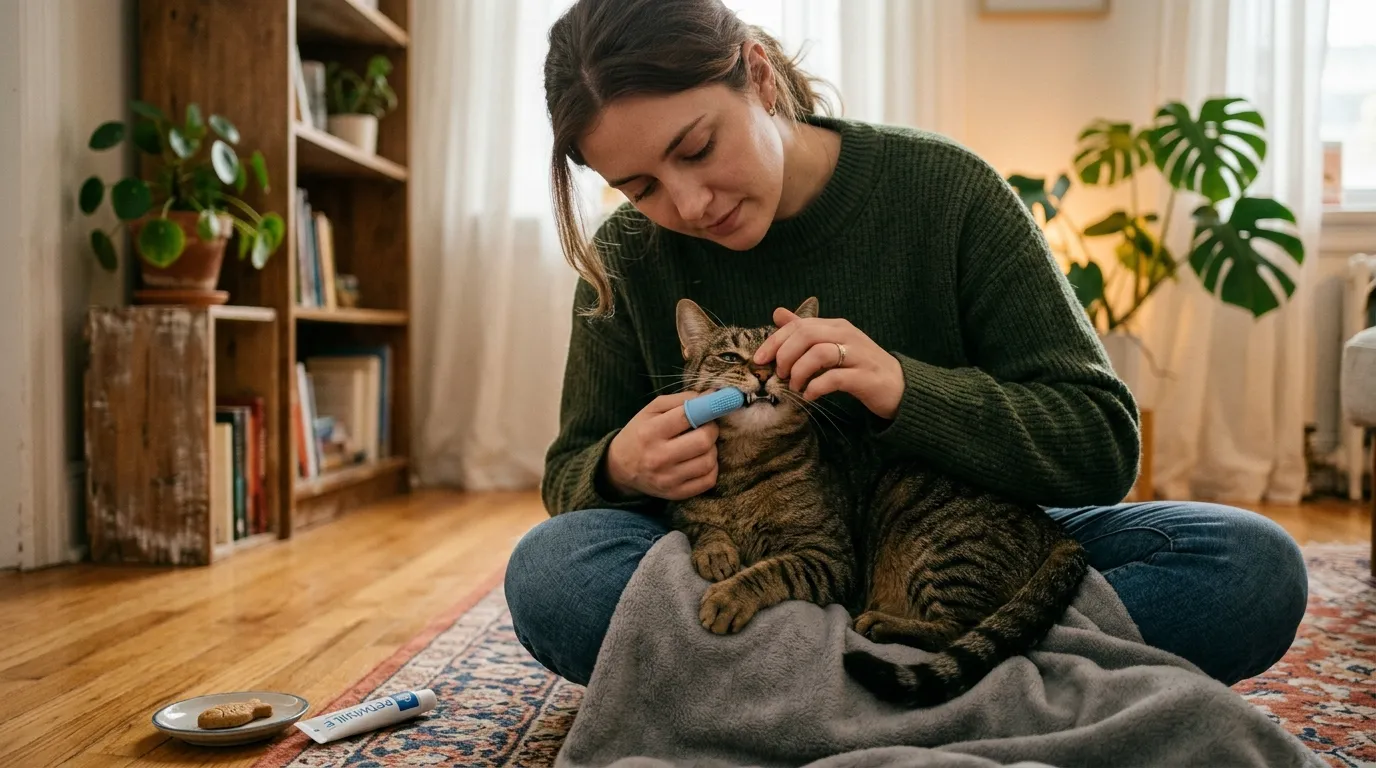
The first time I tried to brush my cat’s teeth she sat perfectly still for about four seconds before launching herself to the top of the bookshelf and refusing to come down for the rest of the evening. Learning how to brush cat teeth at home without the battle comes down to the prep work that happens before the brush ever reaches a tooth. Skip it and you’re just wrestling a cat near a toothbrush. Indoor cats eat processed food, wet or dry, that does little to scrub their teeth, so home care matters more than most owners expect. This guide covers the supplies you need, a seven-step method with a two-week timeline, how often to brush, what to do when your cat says no, and the signs that mean it’s time for a vet.
How to brush cat teeth at home without the battle: let your cat lick flavored cat toothpaste off your finger daily for about a week, then move to a finger brush, then to a soft cat toothbrush. Use small circular motions along the outer gum line for 30 to 60 seconds. Brush daily or every other day. Never use human toothpaste.
Quick answers
- Toothpaste: enzymatic, made for cats, VOHC-accepted if you can find it.
- Prep time: about two weeks of desensitization before real brushing starts.
- Session length: 30 to 60 seconds once your cat is comfortable. Start with 3 to 10 seconds.
- Frequency: daily is best, every other day works, three times a week is the floor.
- Where to brush: outer surfaces of the cheek teeth and canines, along the gum line.
- When to stop and call the vet: bad breath that lasts, drooling, dropping food, red or bleeding gums.
Why Indoor Cats Need Their Teeth Brushed More Than Most Owners Think
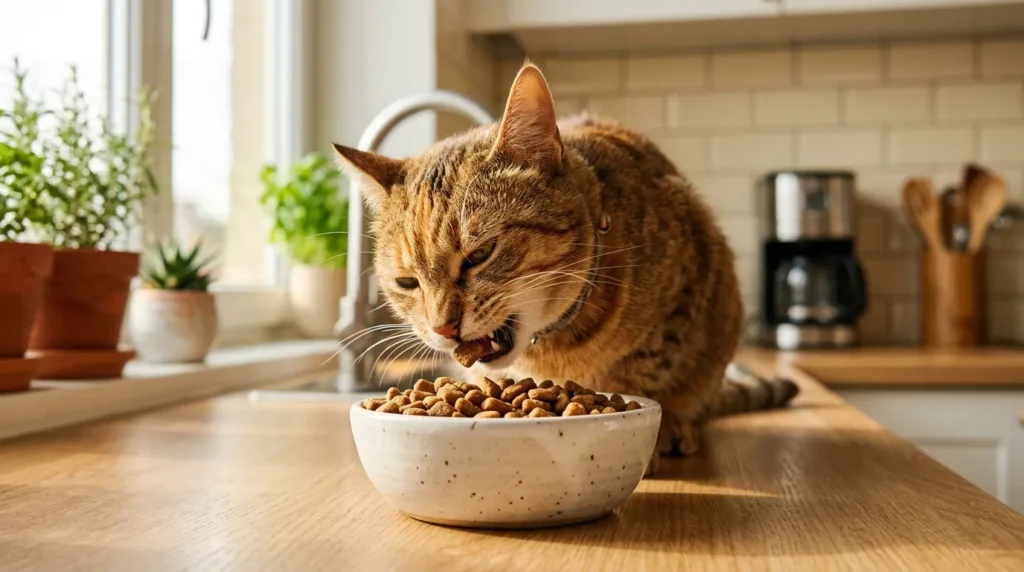
Periodontal disease affects up to 80 percent of cats over age four according to veterinary dental research. Cats hide pain well, so most show no obvious signs until the disease is advanced. By the time you notice bad breath or a cat who drops food while eating, the gum tissue and the bone underneath have often taken real damage.
Indoor cats carry an extra risk. Outdoor and wild cats chew prey, and that chewing scrapes the teeth. An indoor cat eating processed food, whether wet or dry, gets almost none of that. Kibble is often assumed to clean teeth, but it breaks apart quickly and mostly misses the gum line. Plaque management falls to you and your vet.
According to VCA Animal Hospitals’ dental care guidelines, brushing is the single most effective method for preventing feline dental disease at home, with daily brushing giving the best results. Your cat’s overall indoor health ties directly to oral health too, because bacteria from advanced dental disease can travel to the heart, kidneys and liver.
Do indoor cats really need their teeth brushed?
Yes. Brushing is the best home method for slowing plaque, and plaque is what turns into tartar and gum disease. Indoor cats don’t get the natural abrasion that outdoor cats get from chewing prey, so they rely on you and professional cleanings.
What early gum disease looks like
Gingivitis is the early stage and it’s reversible. The gum line looks red or slightly swollen, and a healthy pink line turns angry. Periodontitis is the later stage, where infection reaches the bone and ligaments that hold the tooth, and that damage doesn’t reverse. Brushing works best when you start before the second stage.
What You Actually Need to Brush Cat Teeth at Home
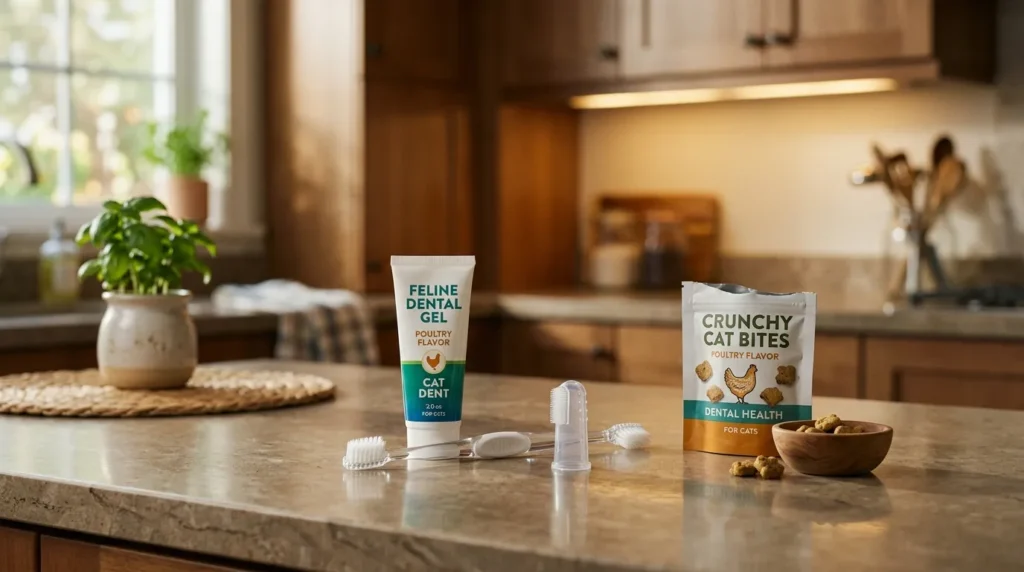
The one item you can’t skip is enzymatic cat toothpaste. Human toothpaste isn’t made to be swallowed, and cats can’t spit. It usually contains fluoride and foaming agents, and some brands add sweeteners such as xylitol. Enzymatic cat formulas break plaque down chemically instead of relying only on scrubbing, which helps because your cat won’t hold still for a long scrub.
| Supply | What to Get | Why It Matters |
| Cat toothpaste | Enzymatic formula, VOHC-approved if possible | Safe if swallowed; breaks down plaque chemically |
| Finger brush | Soft silicone, fits over your fingertip | Best control for beginners |
| Cat toothbrush | Soft-bristled, angled head | Better reach for experienced brushers |
| Gauze square (backup) | Small, wrapped around your finger | Gentle option for cats who hate bristles |
| High-value treats | Whatever your cat loves most | Reward immediately after every session |
A VOHC seal (Veterinary Oral Health Council) on a toothpaste or dental product means independent testing showed it reduces plaque or tartar. It isn’t mandatory, but it’s a reliable quality marker. Toothpastes come in poultry, seafood and malt flavors. Flavor matters a lot here, because a cat who enjoys licking paste off your finger will eventually tolerate you applying it.
Finger brush, cat toothbrush or gauze: which should you pick?
| Tool | Best For | Trade-off |
| Finger brush | Beginners and nervous cats | Less reach to the back teeth |
| Cat toothbrush | Cats who already accept a finger brush | Feels foreign at first |
| Baby toothbrush | Budget-friendly starter with soft bristles | Straighter head, harder to angle at the gum line |
| Gauze on a finger | Cats who reject bristles | Less cleaning action under the gum edge |
What to avoid
- Human toothpaste, including “natural” and whitening formulas.
- Medium or hard bristles, which can irritate gums.
- Baking soda and homemade pastes. Cats dislike the taste, and they swallow it.
- Brushing a cat who already has visibly painful gums. See your vet first.
The 7-Step Method: How to Brush Cat Teeth at Home Without the Battle
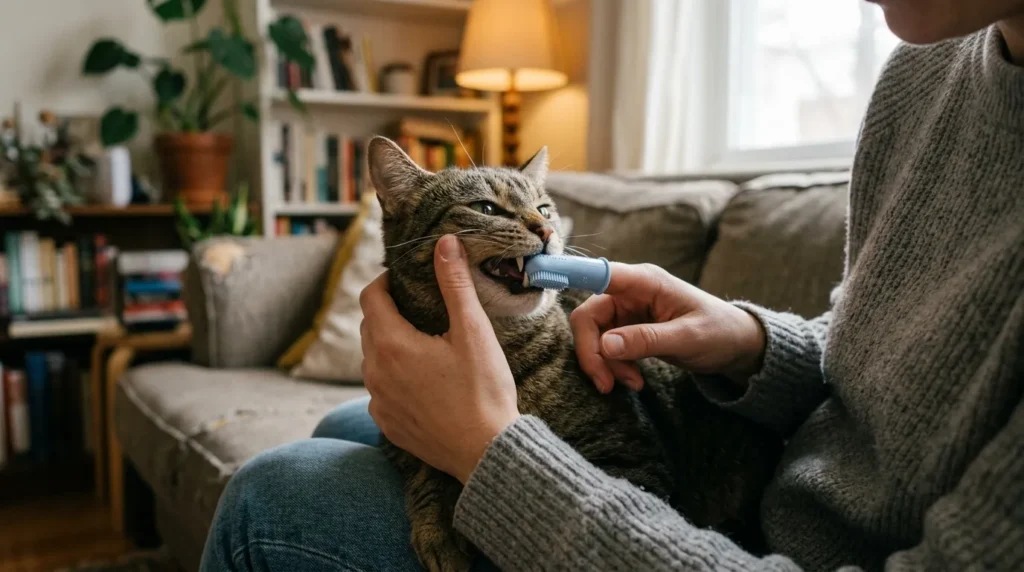
This method works because it builds tolerance in small stages. Cats who resist brushing almost always had an owner who rushed the early steps. The build-up takes about two weeks, and those two weeks pay back in years of cooperative sessions.
Before each session, check:
- Your cat is relaxed, fed or about to be fed, and not in play mode.
- Toothpaste, brush and treat are within reach before you pick the cat up.
- You’ve got a quiet room and about two minutes.
- You’re calm. Cats read tension in your hands.

- Choose a calm moment. After a meal or a long play session works well, when your cat is relaxed. Skip it when she’s alert, in hunting mode or already tense.
- Offer toothpaste off your finger for five to seven days. No brush. No lifting of the lip. Just paste on a fingertip, offered like a treat. This teaches your cat the flavor means something good is coming.
- Rub the front teeth and gums with your finger. After a week, put paste on your finger and gently rub the front teeth and gums without lifting the lip. Keep it under ten seconds. Treat right away.
- Introduce the finger brush. Put paste on the brush and let your cat lick it. Then gently massage the outer surface of two or three teeth. That’s enough for this stage.
- Graduate to the cat toothbrush. Do this once your cat accepts the finger brush without protest. Apply paste and use small circular motions along the gum line at roughly 45 degrees to the tooth.
- Focus on the cheek teeth and canines. Plaque builds fastest on the outer surfaces here. You can skip the inner surfaces, since the tongue keeps that side cleaner.
- End on a reward and quit early. Stop the moment your cat shows obvious discomfort. A session that ends well trains her to come back. A session that drags on trains her to hide when the toothbrush appears.
Your two-week timeline
| Days | What You Do | Target Time |
| 1 to 7 | Cat licks paste off your finger. Treat after. | Under 30 seconds |
| 8 to 10 | Rub front teeth and gums with your finger. | 5 to 10 seconds |
| 11 to 14 | Finger brush on two or three outer teeth. | 10 to 15 seconds |
| Week 3 and on | Cat toothbrush, add teeth until you cover both sides. | Build toward 30 to 60 seconds |
Some cats move faster and some need an extra week or two at a single stage. If your cat backs off, go back one step. That’s normal.
How to hold your cat and lift the lip
Sit on the floor or couch and let your cat settle beside you or in your lap, facing the same direction you are. Cats tolerate this better than face-to-face. Rest one hand on the top of her head, and use your thumb to lift the upper lip at the side of the mouth. You don’t need to pry the mouth open. Cheek teeth are reachable with the jaw closed.
Your complete home grooming routine for your indoor cat gives you a framework for building teeth brushing into an existing daily care habit, so it doesn’t turn into a separate chore your cat has to endure.
What to Do When Your Cat Won’t Let You Brush
Resistance usually means a step moved too fast. Match the symptom to the fix.
| What Your Cat Does | Try This |
| Runs when she sees the toothpaste | Go back to licking paste off your finger for a few more days, and keep the tube out of sight until you’re ready. |
| Spits out or ignores the paste | Try a different flavor. Poultry, seafood and malt all behave differently with different cats. |
| Bites or mouths the brush | Switch to a finger brush or gauze, and shorten the session to a few seconds. |
| Squirms or scratches | Change location and time. A lap in a quiet room after dinner often beats a counter before it. |
| Flinches when you touch one spot | Stop brushing that area and book a vet exam. Mouth pain is a possible cause. |
Brushing a kitten’s teeth
Kittens can start the paste-on-finger step at any age. It builds the habit while the stakes are low. Baby teeth fall out and adult teeth are in by about six months, so early sessions are about getting used to mouth handling, not cleaning.
Brushing a senior cat’s teeth
Older cats are more likely to have existing gum disease, so get a vet check first. Brushing can’t remove hardened tartar, and brushing over inflamed gums can hurt. Once the vet clears the mouth, the same seven steps apply, just slower.
How Often to Brush Cat Teeth and What Frequency Does

Plaque begins hardening into tartar within 24 to 48 hours of forming on the tooth. Once it mineralizes into tartar, brushing at home can’t remove it, and the fix is a professional scaling under anesthesia. That timeline is why frequency matters more than session length.
| Frequency | What You Get |
| Daily | Gold standard. Best protection against tartar. |
| Every other day | Meaningful protection and a realistic goal for most owners. |
| Three times a week | The minimum. Below this, the benefit drops sharply. |
| Once a week or less | Almost no measurable protection against plaque progression. |

Brush right before a meal. A slightly hungry cat links the brushing to dinner and pays less attention to the odd feeling of a mouth being touched. The meal that follows motivates far better than a treat handed over later. Monitoring what your indoor cat eats also connects to dental health, since food quality affects how fast plaque forms.
When Home Brushing Is Not Enough: Alternatives and Add-Ons
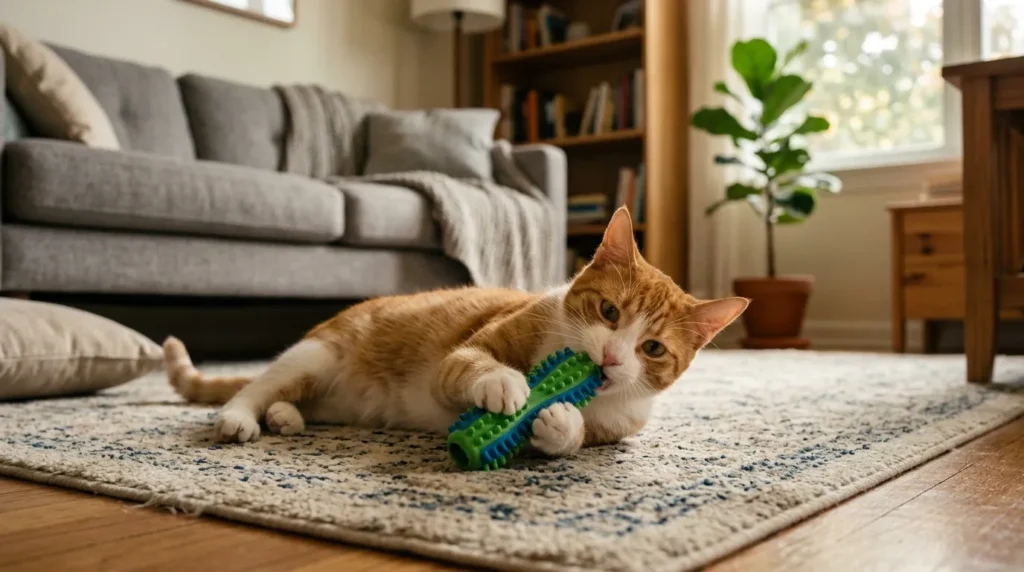
Alternatives fill in on the days you can’t brush. None of them replaces brushing as the primary tool.
| Option | How It Helps | Limit |
| VOHC-accepted dental treats | Mechanical cleaning through chewing | Only cleans the part of the tooth that touches the treat, which misses the gum line where damage starts |
| Enzyme water additives | Passive daily reduction in mouth bacteria | Far less cleaning power than brushing, and needs daily use |
| Dental wipes or gauze | Light wiping for cats who refuse a brush | Less thorough than a brush |
| Dental diets | Kibble designed to scrub as the cat chews | Ask your vet; look for the VOHC seal |
| Professional cleaning | Removes hardened tartar | Done under anesthesia, so it’s a treatment, not daily care |
Water additives suit cats who won’t tolerate any mouth contact during the training period. They’re a stopgap, not a finish line.
Interactive enrichment toys and climbing structures that encourage chewing give a minor dental benefit as a side effect. Providing your cat with appropriate vertical space keeps her active, which helps overall health including her mouth. Understanding your cat’s behavioral signals around food and mouth discomfort helps you catch dental problems before they need emergency treatment.
The Mistakes That Make Cat Teeth Brushing Fail
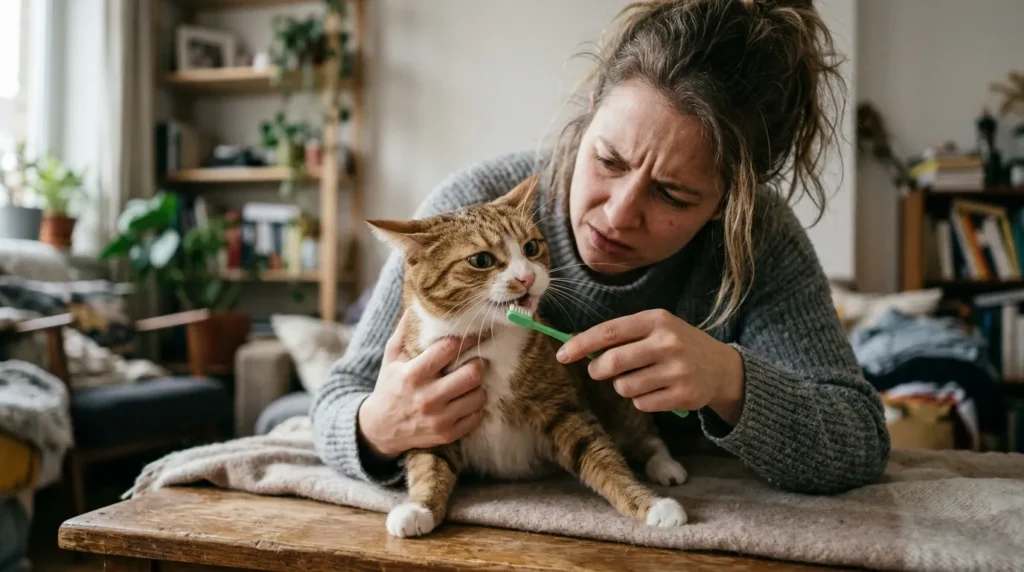
The mistake that ends most owners’ attempts in week one is skipping straight to the toothbrush. A cat forced into brushing without prep links the brush with a bad experience, and each later attempt gets harder. She learns the cues earlier and earlier, until she hides the moment the toothpaste tube comes out.
Session length is the second one. Enthusiasm tempts owners into a thorough first session, and a thorough first session stresses the cat far more than three seconds of brushing that ends in a treat. Build length over weeks.
The third is inconsistency. Three good days followed by a week off lets plaque harden again and resets your cat’s comfort level. A short daily session beats a long weekly one.
Keeping track of your cat’s litter box patterns and general indoor cat care habits gives you a baseline. When dental disease changes behavior, such as reduced appetite or odd eating habits, you’ll spot the shift against it.
From Experience: The thing nobody tells you before you start is that the first few sessions will feel completely pointless. You’re not cleaning teeth yet. You’re building an association. Keep going anyway. The cat who sits still at week three is the direct result of the pointless-feeling sessions in week one.
When Dental Symptoms Need a Vet Visit, Not More Brushing
Bad breath that doesn’t improve after two to three weeks of consistent brushing points to tartar or infection that home care can’t handle. “Cat breath” is a myth. Treating it as normal makes owners wait too long.
Book a vet visit if you see:
- Persistent bad breath after two to three weeks of brushing
- Drooling or dropping food while eating
- Chewing on only one side of the mouth
- Approaching the bowl, sniffing, then walking away
- Reduced appetite or weight loss
- Pawing at the mouth or pulling away when touched near it
Treat these as pain signals that need a professional exam, even if they look like pickiness.
Red or bleeding gums, yellow or brown deposits on the teeth, and any swelling around the jaw or under the eye call for a same-week appointment. Dental abscesses in cats can develop fast and cause serious illness if they go untreated.
What a professional dental cleaning involves
Vets clean cat teeth under general anesthesia. That lets them scale tartar above and below the gum line, polish the teeth and check the mouth properly. Many clinics take dental X-rays too, because much of the disease sits below the gum where you can’t see it. If a tooth is badly damaged, the vet may remove it. Ask your clinic about pre-anesthetic bloodwork, what the estimate covers, and when you can restart brushing. Prices vary widely by region and clinic, so get a written estimate.
This article is for informational purposes only. Always consult your vet if you have concerns about your cat’s health.
Frequently Asked Questions About Brushing Cat Teeth at Home
Can I use human toothpaste on my cat?
No. Human toothpaste isn’t made to be swallowed, cats can’t spit, and it often contains fluoride, foaming agents and sometimes xylitol. Use enzymatic toothpaste made for cats.
How long does it take to train a cat to accept teeth brushing?
Most cats become tolerant within two to three weeks of gradual desensitization. Some take longer. Consistency beats speed.
How often should I brush my cat’s teeth?
Daily is ideal. Every other day is a solid, realistic goal. Three times a week is the minimum that still gives a real benefit.
How do I brush my cat’s teeth if she hates it?
Slow down and go back to the paste-on-finger step. Keep sessions to a few seconds, brush before a meal, and reward every time. Try a different paste flavor or a finger brush before you give up.
Is it too late to start brushing my senior cat’s teeth?
It’s never too late, but have your vet check for existing gingivitis or tartar first. You can’t brush away tartar that has already hardened.
Can I use a baby toothbrush instead of a cat toothbrush?
Yes. A soft-bristled baby toothbrush works well for beginners. A cat toothbrush has a better angle for the back teeth, but a baby brush is a fine start.
Can I brush my cat’s teeth without a toothbrush?
Yes. Wrap a small piece of gauze around your finger, add cat toothpaste, and rub the outer surfaces of the teeth along the gum line. It cleans less than a brush, but it beats skipping the day.
Do dental treats or water additives replace brushing?
No. They’re add-ons. Treats only clean where they touch the tooth, and water additives have much less cleaning power than brushing. Choose products with a VOHC seal when you can.
Can I use coconut oil or baking soda?
Neither replaces cat-formulated enzymatic toothpaste. Baking soda tastes bad and cats swallow it. Talk to your vet before using home remedies in your cat’s mouth.
What if my cat refuses absolutely everything?
Use water additives and VOHC-accepted dental treats as a baseline while you work on desensitization very slowly. If the resistance is extreme, talk to your vet about options.
Will brushing fix my cat’s bad breath immediately?
No. Bad breath from established tartar or infection needs a professional cleaning first. Brushing prevents new buildup but doesn’t remove existing calculus.
This article is for informational purposes only. Always consult your vet if you have concerns about your cat’s health.
How to brush cat teeth at home without the battle takes enzymatic cat toothpaste, a soft finger brush or cat toothbrush, and about two weeks of desensitization before real brushing starts. Plaque hardens into tartar within 24 to 48 hours, so daily brushing is ideal and every other day is a realistic minimum. Never use human toothpaste. Focus on the outer gum line of the cheek teeth and canines, and stop the moment your cat shows discomfort. Persistent bad breath, drooling or reduced appetite point to dental disease that needs a vet, not more brushing.

Written by Mishu
A passionate cat lover and indoor living enthusiast, Mishu is the founder and voice behind Indoor Living Cat – a go-to resource for cat owners who want to create the happiest, healthiest life for their feline companions indoors.
View Full Profile