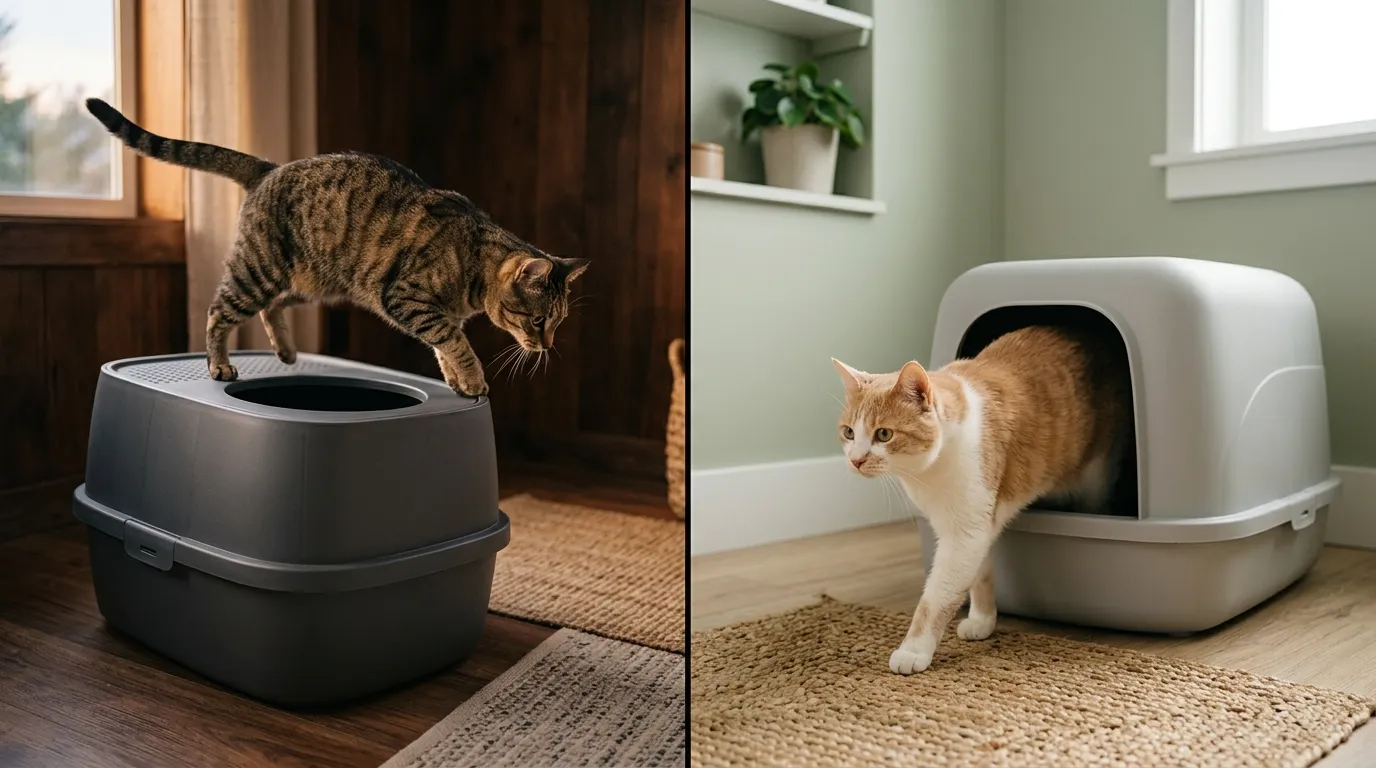
Top entry vs front entry litter box is a comparison that trips up almost every cat owner who has been dealing with tracked litter across the floor or a cat that started refusing the box after months of reliable use. The answer depends entirely on your specific cat and not on which design looks better on a shelf. I switched my cat to a top-entry box to solve a litter scatter problem and found a different problem waiting on the other side: she started going outside the box three times a week. Switching back to a front-entry box with higher sides fixed both issues simultaneously. Top entry vs front entry litter box decisions come down to your cat’s age, mobility and personality. This article gives you the honest comparison with a clear verdict.
Front entry litter boxes win for most cats because they work for every age group and mobility level without requiring jumping or climbing. Top entry boxes win specifically for containing litter scatter and blocking dog access. If your cat is a kitten, senior or has any mobility limitation choose front entry. If your cat is young, agile and tracked litter is your biggest problem top entry is worth testing.
What Is a Top Entry Litter Box and Which Cats Actually Use It?
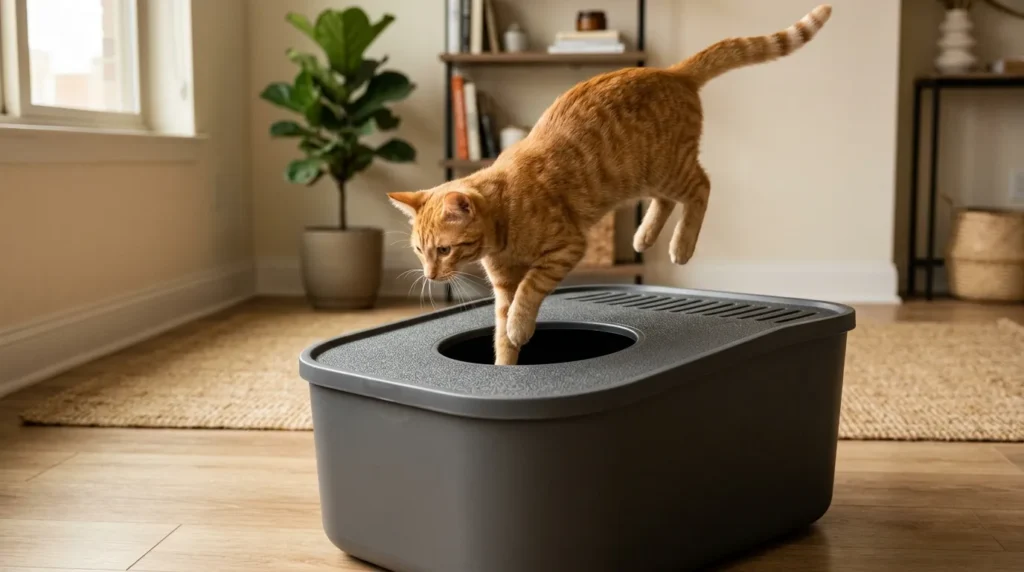
A top-entry litter box is an enclosed box where the cat enters through a hole in the lid rather than through a side opening. The cat steps onto the top of the box, drops into the hole and lands inside to eliminate. Many top-entry boxes have a textured or perforated lid surface that scrapes excess litter off paws as the cat exits which is the primary reason owners choose them.
Litter tracking reduction is the genuine advantage of top-entry design. A cat exiting through the top drags litter across the textured lid rather than directly onto the floor and most of it falls back into the box rather than distributing across your apartment. For owners dealing with litter across the kitchen or bathroom floor this feature delivers a noticeable improvement from day one.

Top-entry boxes work best for young, agile and healthy adult cats that have no mobility limitations. A cat that can jump comfortably and consistently finds top-entry access straightforward after a one to two week adjustment period. The same box becomes a serious problem for a cat that develops arthritis, gains significant weight or reaches senior age and loses the easy jumping ability it had when it first learned the box.
What Is a Front Entry Litter Box and Why Most Cats Prefer It?
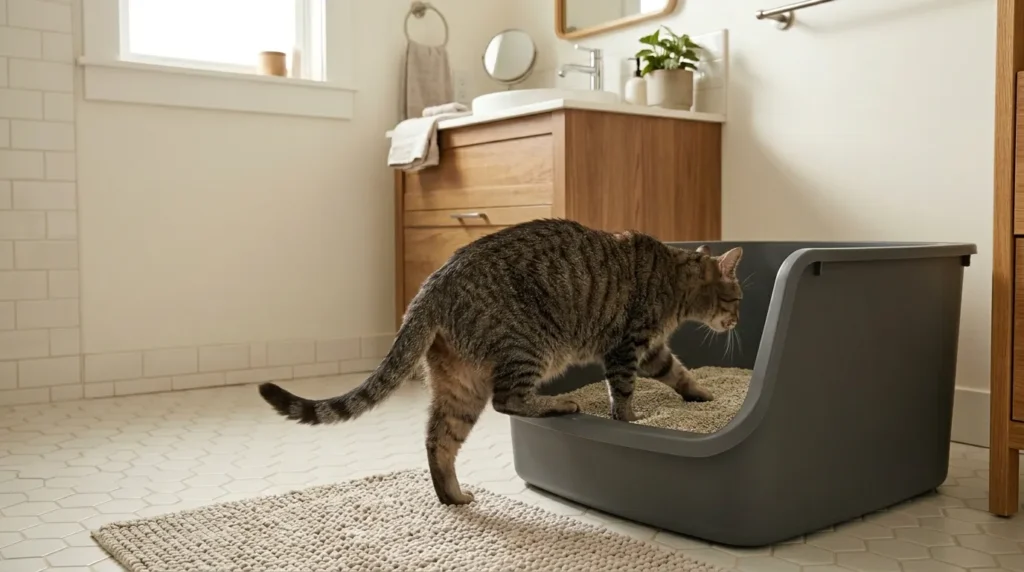
A front entry litter box is any box where the cat enters through an opening on the front or side at ground level. This category includes fully open boxes without any cover, high-sided open boxes and enclosed boxes with a front door. The defining characteristic is ground-level access that requires no jumping, no climbing and no vertical movement beyond the normal step-in height.
Front entry boxes represent the default design recommended by veterinarians and feline behaviorists for most cats in most situations because they place no physical demand on the cat beyond walking. A front entry box works identically well for a sixteen-week-old kitten, a healthy three-year-old adult and a fourteen-year-old arthritic senior without any modification. That universal accessibility is the reason they remain the standard despite the tracking problem they do not solve as effectively.
Litter box avoidance is the primary risk of front entry design when the box is not maintained correctly. An open front entry box that is not scooped daily accumulates odor faster than a covered or top-entry box because the interior is not enclosed. For owners who scoop daily this is a non-issue. For owners who let the box go two or three days between scoops the front entry box becomes increasingly unpleasant for the cat faster than a top-entry equivalent would.
For the complete guide on choosing the right box size regardless of entry style check our resource on indoor cat litter box setup.
Top Entry vs Front Entry Litter Box: The Honest Comparison
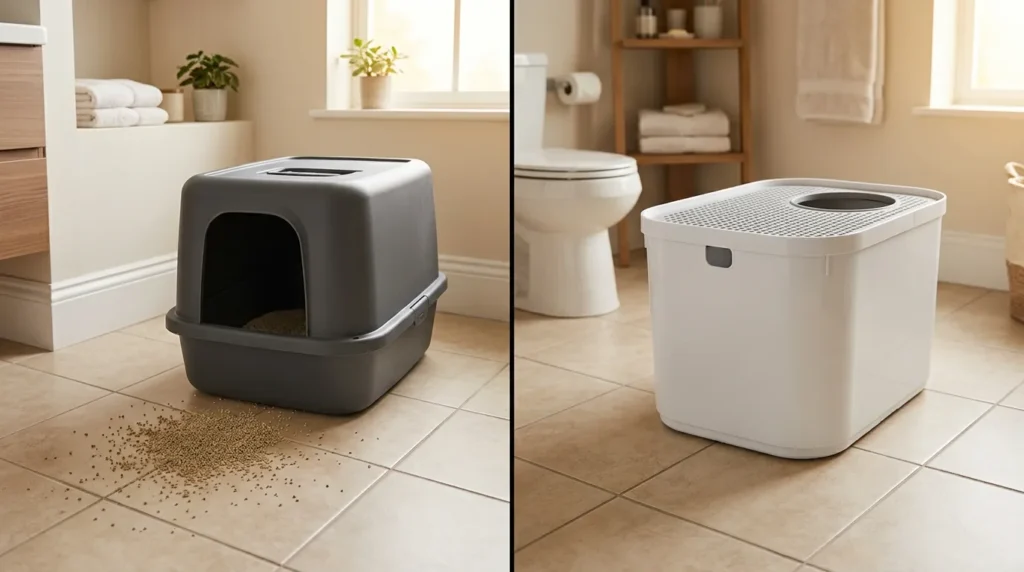
Here is the direct honest comparison across every factor that matters for apartment cat owners:
| Factor | Top Entry | Front Entry |
| Litter tracking control | Excellent | Moderate |
| Odor containment | Good | Fair to good when scooped daily |
| Cat accessibility | Young agile adults only | All ages and mobility levels |
| Urine spray containment | Excellent | Depends on side height |
| Dog-proofing | Excellent | Poor |
| Cleaning ease | Moderate (lid removal required) | Easy (direct scoop access) |
| Senior cat suitability | Poor | Excellent |
| Kitten suitability | Poor | Excellent |
| Overweight cat suitability | Poor | Good |
| Privacy and enclosure feeling | High | Low to moderate |
| Risk of avoidance after illness | High | Low |
The table makes the tradeoff visible. Top entry wins on mess containment and dog-proofing. Front entry wins on everything cat-centric including accessibility, cleaning ease and avoidance risk reduction. The top entry vs front entry litter box debate is ultimately a question of whose comfort you are prioritizing.
According to the Ohio State University Indoor Pet Initiative, cats strongly prefer boxes they can enter and exit easily without physical effort. Top-entry boxes add physical effort that most cats tolerate when healthy but reject when any mobility change occurs.
Insight The tracking problem that drives most owners toward top-entry boxes is almost entirely solvable with a large litter mat placed in front of a front entry box. A mat with textured pockets catches litter from paws in the same way a perforated lid does. You get the accessibility benefits of front entry and the tracking control of top entry without committing to a design your cat may reject as it ages. The mat costs ten dollars. The behavioral fallout of the wrong box costs significantly more in cleanup.
Which Is Better for Your Specific Situation? Top Entry vs Front Entry
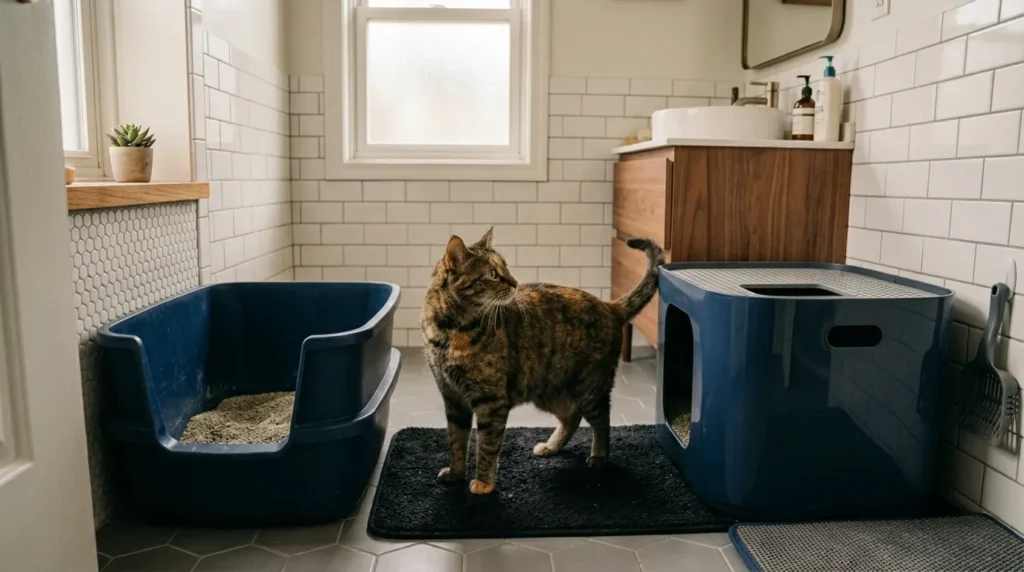
The top entry vs front entry litter box decision simplifies to four situations. Knowing which one applies to you removes all the ambiguity.
Choose a top-entry box if your cat is a healthy adult under eight years old with no history of litter box avoidance, your biggest daily frustration is litter on the floor and you have a dog in the household that raids the litter box. These three conditions together make top entry the right call and the benefits are genuine.

Choose a front entry box in every other situation. Your cat is a kitten or under six months old. Your cat is over seven years old regardless of how healthy they appear now. Your cat has ever shown any history of litter box avoidance regardless of the cause. You have an overweight cat. You are unsure of your cat’s preference and do not want to risk avoidance during a trial period. Front entry covers all of these scenarios without risk.
Choose both by running one of each as part of your two-box N plus one setup and observing which your cat uses more frequently. Most cats that will tolerate a top-entry box show a preference within the first week. A cat that consistently avoids the top-entry box in favor of the front-entry box is telling you directly which design works for it.
Insight If you already have a top-entry box and your cat has started avoiding it without any obvious hygiene cause the first thing to check is whether your cat has been sick or injured recently. Even a mild urinary tract infection that is now resolved can leave a behavioral association between the physical effort of the top-entry exit and the pain that was present during that period. Switching to front entry for two weeks often resolves post-illness avoidance that no amount of cleaning the top-entry box would fix.
The Mistake People Make When Choosing Between These Two Designs
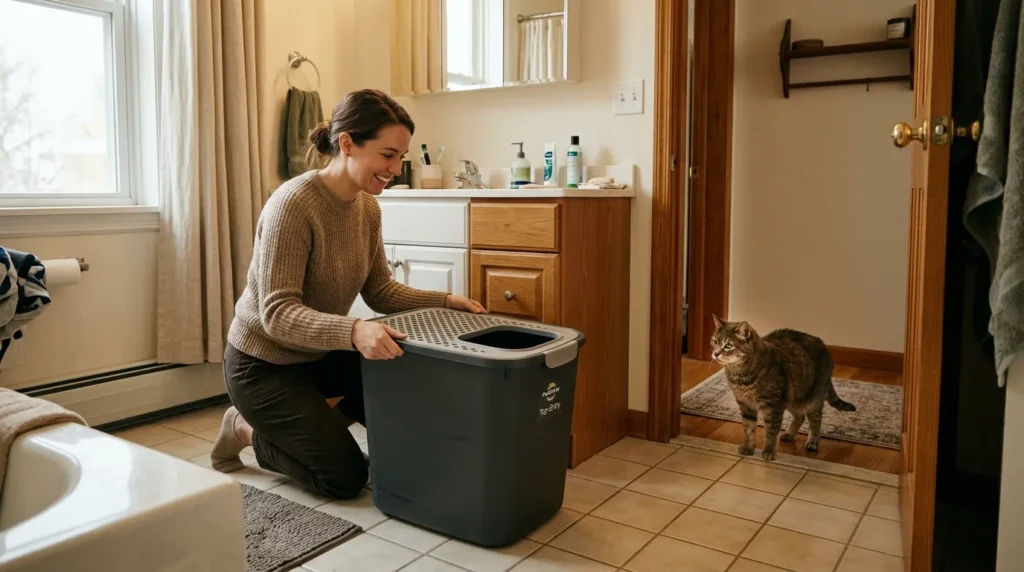
The most common mistake in the top entry vs front entry litter box decision is choosing based on what solves the owner’s problem rather than what fits the cat’s physical reality. Litter tracking is the owner’s problem. The cat does not care about litter on the floor. The cat cares about whether elimination is comfortable, accessible and free from physical effort or stress.
Every cat owner who has switched to top entry to solve a tracking problem and then spent three weeks trying to figure out why the cat started going on the bathroom rug has made this mistake in one form or another. The tracking problem was real. The solution was wrong for that specific cat. A textured litter mat and a high-sided front entry box would have solved the tracking problem without creating the avoidance problem.
The second mistake is buying a top-entry box for a cat that is currently fine but treating it as a permanent solution without any plan for when the cat ages. A five-year-old cat that uses a top-entry box perfectly well today will likely need to transition to front entry somewhere between ages eight and twelve as joint changes accumulate. Planning that transition before problems develop is significantly easier than retraining a cat that has already started avoiding the box.
Our Verdict
Front entry litter boxes are the better default choice for most apartment cat owners. They work for every cat at every life stage and the primary disadvantage of litter tracking is fixable with a mat. Top entry boxes are the better choice specifically for households with dogs that raid the litter box or owners whose cats are young adults with severe litter scatter habits who have shown no avoidance tendencies at any point.
If you are starting fresh choose a large high-sided front entry box as your primary and consider a top-entry box as the second box in your two-box setup. Use the comparison period to let your cat show you which design it prefers. Start by sizing both boxes correctly using our guide on how to choose the right litter box for your indoor cat to make sure the design comparison is not complicated by the wrong size.
Frequently Asked Questions
Is a top entry or front entry litter box better for cats?
Front entry is better for most cats because it works at every age and mobility level without requiring jumping. Top entry is better specifically for young agile cats in households where litter scatter or dog access is a significant problem. When in doubt choose front entry and add a litter mat to address tracking.
Will my cat use a top entry litter box?
Most young healthy adult cats accept a top-entry box within one to two weeks when it is introduced alongside their existing front-entry box rather than replacing it immediately. Cats with any history of litter box avoidance, mobility limitations or senior age often reject top-entry boxes. Never remove the original box until the cat shows consistent use of the new one.
Do top entry litter boxes actually stop litter tracking?
Yes significantly. The perforated or textured lid catches most of the litter from the cat’s paws during exit. Most owners report a dramatic reduction in floor litter after switching. However the same result is achievable with a large textured litter mat in front of a front-entry box at a fraction of the cost and without the accessibility tradeoffs.
Can senior cats use top entry litter boxes?
Most senior cats cannot reliably use top-entry boxes. Age-related joint changes reduce jumping comfort before they become visibly obvious in a cat’s daily movement. A senior cat that appears mobile may still experience enough discomfort during the top-entry jump to start avoiding the box. Front entry with a low lip is always safer for cats over seven years old.
Is a top entry litter box good for small apartments?
Top-entry boxes have a similar floor footprint to equivalent front-entry boxes and offer no meaningful space advantage in a small apartment. They do reduce the litter scatter zone around the box which can feel cleaner in a tight space. However the front-entry high-sided box with a litter mat achieves the same cleanliness benefit without the accessibility limitation.
Conclusion
Top entry vs front entry litter box is a decision your cat makes through its behavior not one you make by logic alone. Default to front entry, add a litter mat for tracking and watch your cat’s behavior for two weeks. If tracking remains a serious problem and your cat is young and agile trial a top-entry box as the second box in your two-box setup without removing the front-entry option. Let behavior rather than aesthetics drive the final decision.
Top entry litter boxes reduce litter tracking and dog access effectively but require jumping and climbing which creates accessibility problems for kittens, senior cats, overweight cats and any cat with mobility limitations. Front entry litter boxes work for cats at every life stage and mobility level with the primary disadvantage of greater litter tracking on the floor. Front entry is the safer default choice for most cat owners. A textured litter mat placed in front of a front-entry box resolves most tracking issues without the avoidance risks associated with top-entry designs. Young agile healthy adult cats in dog-sharing households are the primary population for whom top-entry boxes represent a genuine improvement.