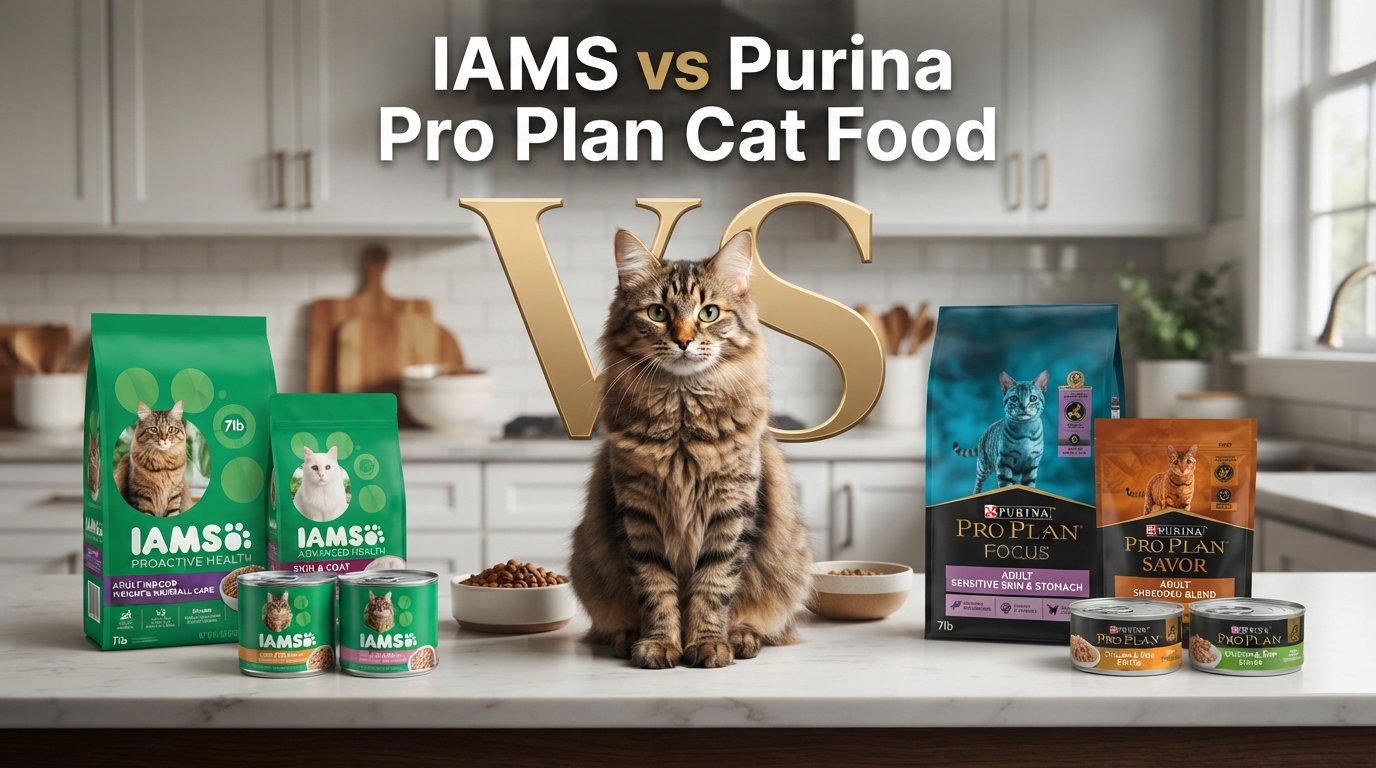
IAMS Proactive Health Indoor Weight & Hairball Care runs 30% protein and 8.3% fiber at about 302 calories per cup. Purina Pro Plan Complete Essentials Chicken & Rice runs 36% protein and 2% fiber at roughly 490 calories per cup. That calorie gap is the real story in the IAMS vs Purina Pro Plan cat food debate, and almost nobody mentions it. One bag is built to keep a lazy indoor cat full on fewer calories. The other is built to pack more nutrition into every bite for a cat that burns it off.
Both brands are vet-recommended. Both put real meat first. Both use by-product meal and grains. So the choice isn’t about which brand is “better,” it’s about which specific formula matches your cat’s problem: hairballs, weight, loose stool, a dull coat, or a food bill that keeps climbing. Below I compare the two flagship bags line by line, then show you the indoor formulas most people miss, the cost-per-day math, and how to switch without a week of vomiting.
Discover our top IAMS vs Purina Pro Plan Cat Food comparisons to find the best food for your cat’s needs and budget.
How this comparison was put together: every protein, fat, fiber, and calorie figure below comes from the guaranteed analysis panels published by IAMS and Purina and mirrored on retailer product pages (Petco, PetSmart, Chewy, Purina’s own site). Ingredient lists are quoted in label order. I feed indoor cats and I’ve run both of these bags in a multi-cat house. Where I’m giving an opinion rather than a spec, I say so. Prices move constantly, so I give cost math in calories per bag instead of dollar figures that go stale.
Last reviewed: September 2026. This article is general nutrition information, not veterinary advice. If your cat is losing weight, vomiting often, or straining in the litter box, see your vet before changing food.
⚡ IAMS vs Purina Pro Plan Cat Food: Quick Verdict
Buy Purina Pro Plan if your cat has loose stool, throws up regularly, or needs more protein. It carries 36% crude protein and guaranteed live Bacillus coagulans at 600 million CFU per pound. Buy IAMS Proactive Health if hairballs or a widening waistline are the problem. Its beet pulp and cellulose fiber blend hits 8.3% fiber and it feeds at 302 calories per cup, so a heavy eater can have a full bowl without blowing past its calorie budget.
One correction to most comparisons you’ll read, including my earlier version of this one: Purina Pro Plan does make an indoor hairball formula. It’s called Adult Indoor + Hairball Turkey & Rice, and it competes with IAMS head-on. Skip to the indoor section below if that’s what you’re shopping for.
The 30-Second Answer
| If your cat… | Pick this |
|---|---|
| Coughs up hairballs weekly | IAMS Indoor Weight & Hairball Care (8.3% fiber) |
| Has soft stool or vomits after meals | Pro Plan Complete Essentials (live probiotics) |
| Is overweight and sedentary | IAMS (302 kcal/cup, L-carnitine) |
| Is underweight or a fussy nibbler | Pro Plan (roughly 490 kcal/cup) |
| Is indoor-only with hairballs and a sensitive gut | Pro Plan Indoor + Hairball Turkey & Rice |
| Shares a house with three other cats | IAMS 22 lb bag (lowest cost per calorie) |
| Has a diagnosed condition (urinary, kidney, IBD) | Neither. Ask your vet about a therapeutic diet. |
Analysis: IAMS Proactive Health
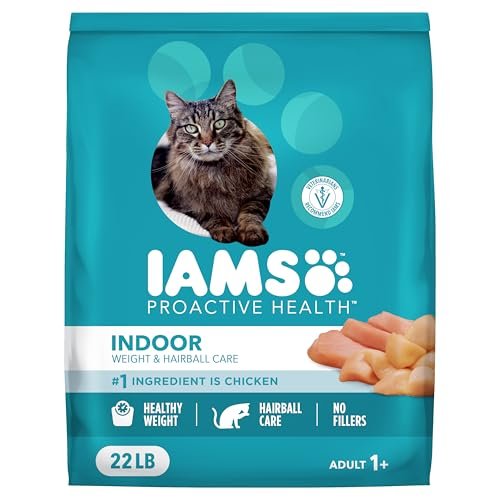
IAMS Proactive Health Indoor Weight & Hairball Care is built for cats that sleep 16 hours a day and groom the rest. It trades protein density for fiber, which is exactly the right trade if hair and weight are your two problems.
The label starts with chicken, then chicken by-product meal, then corn grits, corn protein meal, whole grain corn, and whole grain sorghum. Beet pulp and turkey follow. That’s a grain-inclusive recipe and IAMS doesn’t hide it. Corn gets a bad name online, but corn protein meal is a real protein source, not sawdust, and cats digest cooked corn starch fine. If you want a grain-free bag, neither of these two formulas is it.
What I actually notice feeding it: the hairball difference is real but slow. My cats went from two or three hairballs a week down to maybe one every ten days, and that took about a month. Powdered cellulose and beet pulp do the work, with fructooligosaccharides (FOS) acting as a prebiotic further down the list. There are no live probiotics in this bag. IAMS feeds the gut bacteria your cat already has. It doesn’t add new ones.
L-carnitine shows up at a minimum of 80 mg/kg. It helps the body move fat into cells to be burned, which is why IAMS markets this line for weight control. Paired with the low 302 calories per cup, it’s a sane pick for a cat your vet has flagged as chunky. I still reach for it first in a multi-cat indoor household where one cat guards the bowl and everyone else grazes.
Nutrition and Ingredients
Guaranteed analysis on the 22 lb Indoor Weight & Hairball Care bag: 30% crude protein minimum, 11% fat minimum with a 13.5% max, 8.3% crude fiber max, 10% moisture max, taurine at 0.13%, omega-6 at 2.0% and omega-3 at 0.2%. Calorie content is 3,314 kcal per kg, or about 302 kcal per cup.
One thing worth flagging, since it trips people up: the smaller 3.5 lb bag of the same line has published a different panel (28% protein, 6.5% fiber) at various times, and the separate IAMS Healthy Weight formula runs 35% protein. Check the panel on the bag in your hand rather than trusting a number you read on a shelf tag.
Kibble, Bag, and Storage
The kibble is a flat disc, bigger than Pro Plan’s, and it makes cats chew instead of inhale. Cats that gulp and then bring their dinner back up often do better on it for that reason alone. The 22 lb bag has no resealable zipper on most runs, so decant it into a sealed bin. Kibble fat goes rancid once air gets at it, and a bag that size takes a single cat months to finish.
Results Over Time
Give it four to six weeks before you judge hairball performance. Weight change is slower still. IAMS points to an internal 2024 study showing weight loss over two months on its Healthy Weight line, and that timeline matches what I’ve seen: a pound off a 14 lb cat in about eight weeks, assuming you actually measure portions instead of topping up the bowl.
Standout Features
The fiber system is the whole reason to buy this bag. Secondary benefits worth knowing about: an omega 6:3 ratio tuned for coat condition, vitamin E for immune support, and added potassium and calcium for heart health. IAMS sells this as an all-in-one indoor maintenance diet and the label backs that up.
Palatability
Acceptance is decent but not universal. Cats coming off a rich, high-fat food sometimes stall on IAMS for the first few days because it’s leaner. If yours does, warm a spoon of wet food and stir it through rather than giving up on day two.
Value
The 22 lb bag is where IAMS wins. Run the numbers on total calories per bag rather than price per pound and the gap gets clearer. I break that math down in the cost section further down the page.
✅ Advantages
✓8.3% fiber from beet pulp and cellulose measurably cuts hairball frequency.
✓302 kcal per cup lets a hungry cat eat a full bowl on a calorie deficit.
✓L-carnitine at 80 mg/kg minimum supports fat metabolism.
✓The 22 lb bag holds roughly 33,000 calories, more total food than Pro Plan’s largest.
✓Larger kibble slows down gulpers.
❌ Disadvantages
✗No live probiotics. Prebiotic FOS only.
✗30% protein is 6 points below Pro Plan, and corn appears three times in the first six ingredients.
✗Chicken by-product meal sits second on the label.
✗Caramel color is in the recipe purely for how the kibble looks to you.
✗The big bag usually isn’t resealable.
Analysis: Purina Pro Plan
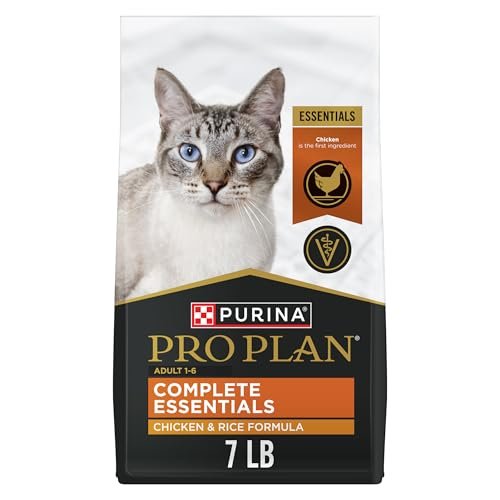
Purina Pro Plan Complete Essentials Chicken & Rice is the denser, richer bag. More protein, more fat, live probiotics, and far fewer calories worth of fiber. It suits cats that need to absorb more from every mouthful.
The headline ingredient is dried Bacillus coagulans fermentation product, guaranteed at 600 million CFU per pound. Bacillus coagulans forms spores, which is why it survives extrusion, bagging, and months on a shelf when most probiotic strains don’t. That guarantee is printed on the panel, not just claimed in marketing copy, and Purina is one of the few mass-market brands that puts a CFU number in writing.
Label order runs chicken, rice, corn protein meal, poultry by-product meal, wheat flour, dried egg product, beef fat, soy protein concentrate, natural flavor, fish meal, then dried chicory root. Chicory root is inulin, a prebiotic fiber that feeds the probiotic strain. Pairing the two in the same bag is smart and still uncommon at this price. Note the wheat and soy, though, because a cat with a suspected grain or soy sensitivity has no business on this formula.
Vitamin A and linoleic acid at 1.4% minimum handle skin and coat. If your cat also struggles with throwing up after meals, this probiotic and prebiotic pairing is worth eight weeks of your patience before you spend money on a prescription diet.
Nutrition and Ingredients
Complete Essentials Chicken & Rice delivers 36% crude protein minimum, 16% crude fat minimum, 2% crude fiber max, 12% moisture max, taurine at 0.15%, omega-6 at 1.5%, and that 600 million CFU/lb probiotic guarantee. Independent reviewers put it around 492 calories per cup. Purina uses a 113 g cup as its reference measure.
The Shredded Blend version of the same formula shares that panel. Some retailers list a 40% protein variant of Complete Essentials, so protein on your bag may read higher than 36% depending on the run. Low fiber is the flip side of high protein. This bag is built for nutrient density, and that’s exactly why IAMS still wins on hairballs.
Kibble, Bag, and Storage
Smaller, harder kibble than IAMS. Senior cats with dental disease sometimes struggle with it, and gulpers will hoover it. The 16 lb bag holds about 64 cups. Keep it sealed, because probiotic viability drops with heat and humidity exposure. Storing the bag in a hot garage undoes the main thing you paid extra for.
Results Over Time
Stool quality is the first thing to change, usually inside two to three weeks. Smaller, firmer, less smelly. Coat shine takes six to eight weeks because you’re waiting on new hair growth. If nothing has improved after two months, the problem probably isn’t diet and it’s time for bloodwork.
Standout Features
Guaranteed live probiotics plus chicory root prebiotic in one bag. Add the 36% protein floor and you have a formula that does more than keep a cat alive at maintenance. Pro Plan also runs feeding trials using AAFCO procedures rather than formulating to the profile on paper, which is a meaningful step up in evidence.
Palatability
This is the better-tasting bag of the two, and it isn’t close. The 16% fat minimum and beef fat coating do most of that work. Picky cats that snubbed three other foods often take to it on day one.
Value
Bags top out at 16 lb and cost more per pound than IAMS. The honest counterpoint: at roughly 490 calories per cup you feed less volume, so the per-pound gap shrinks once you account for portion size. It doesn’t disappear, but it shrinks.
✅ Advantages
✓Guaranteed live Bacillus coagulans at 600 million CFU/lb, printed on the panel.
✓36% protein minimum and 16% fat minimum for lean muscle and steady energy.
✓Chicory root inulin feeds the probiotic strain in the same bowl.
✓Substantiated by AAFCO feeding trials, not formulation alone.
✓Strongest palatability of the two with picky eaters.
❌ Disadvantages
✗Higher price per pound than IAMS, and no bag past 16 lb.
✗2% fiber max does nothing for hairballs.
✗Roughly 490 kcal per cup is easy to overfeed if you eyeball portions.
✗Wheat flour and soy protein concentrate rule it out for some sensitive cats.
✗Small kibble is a poor fit for gulpers and some senior mouths.
Which Formulas Are You Actually Comparing?
Most “IAMS vs Purina Pro Plan” arguments fall apart because the two people arguing are holding different bags. IAMS Proactive Health and Pro Plan are product families, not single products. Here’s how the main dry lines match up so you can compare like for like.
| The job | IAMS Proactive Health | Purina Pro Plan |
|---|---|---|
| Everyday adult | Healthy Adult Original with Chicken | Complete Essentials Chicken & Rice |
| Indoor + hairball | Indoor Weight & Hairball Care | Adult Indoor + Hairball Turkey & Rice |
| Weight loss | Healthy Weight (35% protein) | Weight Management Chicken & Rice |
| Sensitive stomach | Sensitive Digestion & Skin | Sensitive Skin & Stomach Lamb & Rice |
| Urinary support | Urinary Tract Health | Urinary Tract Health Chicken & Rice |
| Kitten | Kitten Healthy Kitten | Kitten Chicken & Rice |
| Senior 7+ / 11+ | Healthy Senior / Mature Adult | Prime Plus 7+ / Vital Systems |
The rest of this article compares the two bags most shoppers land on: IAMS Indoor Weight & Hairball Care and Pro Plan Complete Essentials Chicken & Rice. If your cat’s needs sit in a different row, jump to that pairing instead.
IAMS vs Purina Pro Plan for Indoor Cats
Side-by-side photo of the IAMS Indoor Weight & Hairball Care bag next to the Purina Pro Plan Adult Indoor + Hairball Turkey & Rice bag, guaranteed analysis panels facing the camera.
Suggested alt text: “IAMS Indoor Weight and Hairball Care compared with Purina Pro Plan Indoor Hairball Turkey and Rice”
Here’s where most comparisons get it wrong. Complete Essentials isn’t an indoor formula, true. But Purina does sell one: Pro Plan Adult Indoor + Hairball Turkey & Rice, which used to be called FOCUS Indoor Care. It has natural fiber for hairball control, chicory root prebiotic, guaranteed live probiotics, and roughly 10% less fat than Complete Essentials. It runs 445 calories per cup.
So if you specifically want an indoor cat food, the fair fight is IAMS Indoor Weight & Hairball Care against Pro Plan Indoor + Hairball. And that fight is closer than the one at the top of this page.
| Indoor formula | IAMS Indoor Weight & Hairball | Pro Plan Indoor + Hairball |
|---|---|---|
| First ingredient | Chicken | Turkey |
| Calories per cup | 302 | 445 |
| Hairball fiber | Beet pulp + cellulose | Natural fiber blend |
| Live probiotics | ✗ | ✓ |
| Weight-loss additive | L-carnitine | Lower fat vs Complete Essentials |
| Largest bag | 22 lb | 16 lb |
My read: Pro Plan’s indoor bag is the better formula, and IAMS is the better buy. If your indoor cat has hairballs plus a touchy gut, Pro Plan Indoor + Hairball covers both problems in one bag and IAMS can’t. If your indoor cat just needs to stop eating so much and shed a pound, IAMS at 302 calories per cup gives you 143 fewer calories in every cup you scoop, which matters more than any ingredient on either label.
Major Factors to Consider
When I judge a cat food I start with the guaranteed analysis and the first six ingredients, then check whether the calorie density matches the cat in front of me. Marketing claims come last.
🔥
Calorie Density
The single most useful number on any bag, and the one nobody reads. A typical 10 lb indoor cat needs somewhere around 180 to 250 kcal a day. At 302 kcal per cup that’s roughly two-thirds of a cup of IAMS. At 492 kcal per cup it’s under half a cup of Pro Plan. Feed both by the same scoop and you’ll fatten the cat on Pro Plan.
🎯
Protein Quality, Not Just Quantity
36% on a panel can include plant protein from corn protein meal, soy concentrate, and wheat. Both of these foods do that. Look at how many animal sources appear in the first six ingredients: IAMS has two, Pro Plan has two. Neither is a boutique high-meat recipe, and neither pretends to be.
⚡
Digestive Support
Prebiotics feed existing gut bacteria. Probiotics add new ones. IAMS gives you the first (FOS, beet pulp). Pro Plan gives you both (chicory root plus Bacillus coagulans). If your cat’s stool is already firm, the probiotic premium buys you very little.
💰
Cost Per Calorie, Not Per Pound
Price per pound flatters low-calorie food and punishes dense food. Divide the bag price by total calories in the bag instead. I run that math in the next section.
🔧
AAFCO Substantiation
Check the small print near the feeding chart. “Formulated to meet” means the recipe was calculated on paper. “Animal feeding tests using AAFCO procedures substantiate” means cats actually ate it under observation. IAMS Indoor uses the first wording. Pro Plan Complete Essentials uses the second.
🎨
Storage and Freshness
Live cultures die with heat, air, and moisture. Pro Plan lists a shelf life around 18 months unopened. Once open, both bags should be finished inside six to eight weeks, which is a real argument against buying 22 lb for one cat.
Cost Per Day: The Math Nobody Runs
Prices change weekly, so I’ll give you calories instead. Calories are what your cat eats. Pounds are what you pay for.
| Bag math | IAMS 22 lb | Pro Plan 16 lb |
|---|---|---|
| Calorie density | 3,314 kcal/kg | ~4,350 kcal/kg |
| Total calories in the bag | ~33,000 | ~31,600 |
| Days of food, one 10 lb cat at 220 kcal/day | ~150 | ~143 |
| Days of food, three cats | ~50 | ~48 |
That result surprised me the first time I worked it out. A 22 lb IAMS bag and a 16 lb Pro Plan bag hold nearly the same number of calories, about a 4% difference, because Pro Plan is so much denser. So the six-pound size gap on the shelf is mostly an illusion. Compare the two bag prices directly and you’re comparing close to the same amount of actual feeding.
IAMS still comes out cheaper, because that 22 lb bag typically sells for less than the 16 lb Pro Plan bag. The gap just isn’t the 40% that price-per-pound comparisons suggest. Divide each bag’s current price by the calorie totals above and you’ll get a cost-per-1,000-calories figure you can actually compare across any brand.
Quick portion checklist
- Weigh your cat, or get the number at the next vet visit.
- Use the bag’s feeding chart as a starting point, not a rule.
- Measure with a proper dry measuring cup or a kitchen scale, never a mug.
- Subtract treat calories from the daily total. Ten treats can be 30 calories.
- Reweigh in four weeks and adjust by 10% either way.
Feature Comparison
This breakdown covers the two specific bags under review: IAMS Proactive Health Indoor Weight & Hairball Care and Pro Plan Complete Essentials Chicken & Rice.
| Feature | IAMS Proactive Health | Purina Pro Plan |
|---|---|---|
| Real Chicken #1 Ingredient | ✓ | ✓ |
| Guaranteed Live Probiotics | ✗ | ✓ |
| Hairball Control Blend | ✓ | ✗ (✓ in Pro Plan Indoor + Hairball) |
| Natural Prebiotic Fiber | ✓ (FOS) | ✓ (chicory root) |
| Omega-6 Fatty Acids | ✓ (2.0% min) | ✓ (1.5% min) |
| Indoor-Specific Formula | ✓ | ✗ (separate line exists) |
| L-Carnitine for Weight Control | ✓ | ✗ |
| High Protein (35%+) | ✗ (30%) | ✓ (36%) |
| AAFCO Feeding Trial Substantiated | ✗ (formulated to meet) | ✓ |
| Vet Recommended Brand | ✓ | ✓ |
| Grain-Free Option in This Formula | ✗ | ✗ |
Specifications Comparison
Here are the basic specs side by side, including the first five ingredients in label order.
| Specification | IAMS Proactive Health | Purina Pro Plan |
|---|---|---|
| Formula Reviewed | Indoor Weight & Hairball Care | Complete Essentials Chicken & Rice |
| Primary Focus | Indoor / Hairball / Weight | Digestive / Immune |
| First Five Ingredients | Chicken, chicken by-product meal, corn grits, corn protein meal, whole grain corn | Chicken, rice, corn protein meal, poultry by-product meal, wheat flour |
| Probiotics | No | Yes, 600M CFU/lb |
| Bag Sizes | 3.5, 7, 16, 22 lb | 3.5, 7, 16 lb |
| Key Fiber Source | Beet pulp + powdered cellulose | Dried chicory root |
| Protein Sources | Chicken, turkey, egg | Chicken, poultry, egg, fish meal, soy |
| Grain-Free | No (corn, sorghum) | No (rice, wheat) |
| Age Range | Adult 1+ years | Adult 1+ years |
| Made In | USA | USA, Purina-owned facilities |
| Parent Company | Mars Petcare | Nestlé Purina PetCare |
Nutrition Facts: Protein, Fat, Fiber and Calories Side by Side
Guaranteed analysis numbers come straight from each brand’s label. If your cat has a weight or digestion problem, these are the rows that decide the purchase.
| Nutrient | IAMS Proactive Health | Purina Pro Plan |
|---|---|---|
| Crude Protein (min) | 30% | 36% |
| Crude Fat | 11% min / 13.5% max | 16% min |
| Crude Fiber (max) | 8.3% | 2% |
| Moisture (max) | 10% | 12% |
| Calories per cup | ~302 kcal | ~492 kcal |
| Taurine (min) | 0.13% | 0.15% |
| Omega-6 (min) | 2.0% | 1.5% |
| L-Carnitine (min) | 80 mg/kg | Not listed |
| Probiotic Strain | None | Bacillus coagulans, 600M CFU/lb |
The high fiber, lower protein, low calorie profile in IAMS is deliberate. Fiber bulks up the meal, moves swallowed hair along, and dilutes calories so a big eater can have a full bowl. Purina flips that trade, spending the same space on protein, fat, and probiotics.
Simple bar chart comparing protein, fat, and fiber percentages for both foods, plus a second bar for calories per cup.
Suggested alt text: “IAMS vs Purina Pro Plan protein fat fiber and calorie comparison chart”
Ingredients Under the Microscope: Corn, By-Products, and Grain
Both labels contain the ingredients cat forums argue about most. Rather than dodge that, here’s what each one is actually doing in the bag.
Chicken by-product meal and poultry by-product meal
By-product meal is rendered organ meat and bone: liver, kidney, spleen, lung. It isn’t feathers, hooves, or hair, which AAFCO excludes by definition. Nutritionally it’s dense in taurine and minerals, and wild cats eat exactly these parts first. The fair criticism isn’t that it’s junk, it’s that the quality varies batch to batch in a way that a named cut like “chicken breast” wouldn’t. Both brands use it. Neither hides it.
Corn, rice, wheat, and sorghum
Cats are obligate carnivores, so grain isn’t what they evolved to eat. But cooked, ground grain is digestible to them at well above 90%, and it supplies the starch that lets kibble hold its shape at all. Every dry food has starch from somewhere, grain-free bags included, where it usually comes from peas or potato. If you object to corn specifically, IAMS is the wrong bag: corn grits, corn protein meal, and whole grain corn all appear in its first six ingredients. Pro Plan uses rice and wheat flour instead.
Caramel color
IAMS includes it. Purina lists it on some formulas too. It does nothing for your cat and exists to make brown kibble look like meat to human shoppers. It’s approved and considered safe at these levels, but I’d rather it weren’t there.
Powdered cellulose
This is purified plant fiber, and it’s the ingredient doing heavy lifting on IAMS’s 8.3% fiber number. It passes through undigested, which is the whole point when you’re trying to sweep hair out of a stomach. It’s also why IAMS stools are bulkier than Pro Plan stools. That’s expected, not a problem.
Which One for a Cat That Vomits or Has Loose Stool?
This is the question I get asked most, and the answer depends on what kind of vomiting you’re dealing with. Sort it first.
- Tube-shaped, hair in it, once or twice a week: that’s a hairball. Go IAMS, or Pro Plan Indoor + Hairball. Add a grooming routine and a brush.
- Undigested kibble within 20 minutes of eating: that’s eating too fast. Bigger kibble (IAMS), a slow feeder bowl, or splitting meals into four small portions fixes most of these.
- Yellow bile in the early morning: the stomach has been empty too long. Feed a small portion at bedtime. Neither brand fixes this by itself.
- Soft or mucousy stool, gas, general gut upset: this is where Pro Plan’s live probiotics earn their price. Give it a full eight weeks.
- Weight loss, blood, vomiting more than weekly, or a cat that’s off food: stop shopping and call your vet. Diet changes can mask conditions that need treatment.
One honest caveat on probiotics: the evidence for Bacillus coagulans in cats is decent but not overwhelming, and plenty of cats do fine without any. If Pro Plan hasn’t changed anything after two months, the probiotic isn’t the missing piece and you should look at protein source instead.
🏆 Winner: Purina Pro Plan
🏆 BEST CHOICE
Score Breakdown
Overall 9.0/10
Nutrition Panel 9.5/10
Digestive Support 9.5/10
Value 8.0/10
Hairball Control 6.0/10
Palatability 9.5/10
Pro Plan takes it on the strength of a 36% protein floor, guaranteed live probiotics, and AAFCO feeding trial substantiation. It loses the hairball category outright, and that 6.0 score is honest: if hairballs are your problem, this is the wrong bag and IAMS is the right one.
Choose IAMS Proactive Health If…
Hairball-Prone Cats
Pick IAMS if your cat brings up a hairball more than once a week. The 8.3% fiber from beet pulp and cellulose is built for that job, and most owners see the frequency drop inside a month. Brush your cat twice a week alongside it and you’ll do better than either change alone.
Multi-Cat Households on a Budget
Three cats burn through roughly 33,000 calories in about 50 days, which is one 22 lb IAMS bag. It’s the cheapest way to feed a full house without dropping below AAFCO adult maintenance minimums.
Weight Management Priority
Go IAMS if your vet flagged your cat as overweight. At 302 kcal per cup versus Pro Plan’s 492, you can give a food-obsessed cat a visibly full bowl and still run a deficit. L-carnitine at 80 mg/kg helps on the metabolic side.
Fast Eaters and Gulpers
The larger, flatter kibble forces chewing. If your cat inhales dinner and returns it whole five minutes later, this alone can solve it.
A Simple Diet You Can Stick With
It’s widely stocked, the formula rarely changes, and it’s easy to find in a pinch. Consistency beats chasing the perfect bag, and cats punish frequent switching with loose stool.
Choose Purina Pro Plan If…
Sensitive Digestion
Go Pro Plan if stool quality is your complaint. Bacillus coagulans at 600 million CFU per pound, fed by chicory root inulin in the same bowl, is the most direct gut intervention you can buy off a supermarket shelf.
Cats That Need More Protein
Pick this for active cats, cats recovering condition after illness, or older cats losing muscle. The 36% floor and 16% fat minimum do work that IAMS’s 30% can’t match.
Skin and Coat Problems
Vitamin A and 1.4% linoleic acid target dull fur and flaky skin. Give it six to eight weeks, since you’re waiting on new hair to grow in rather than fixing the coat that’s already there.
Picky Eaters
This is the more palatable bag, thanks to the beef fat coating and higher fat content. Cats that have refused three other foods often eat this one on the first day.
You Want Feeding-Trial Evidence
Complete Essentials carries the AAFCO feeding trial statement rather than the formulated-to-meet wording. Real cats ate it under observation. That’s a higher bar and worth paying a little for.
How to Switch Your Cat to a New Food
Switching too fast is the main reason cats reject a new food or end up with diarrhea. Follow this schedule with either brand.
- Days 1 to 2: Mix 25% new food with 75% old food.
- Days 3 to 4: Move to a 50/50 split.
- Days 5 to 6: Shift to 75% new food, 25% old food.
- Day 7 and beyond: Feed 100% new food, and watch stool quality for another week.
The two brands disagree on timing. IAMS says four days is enough. Purina asks for seven to ten. Take Purina’s advice regardless of which bag you’re opening, and stretch it to fourteen days if your cat already has a sensitive stomach.
Transition checklist
- Buy the smallest bag first (3.5 lb) in case your cat refuses it.
- Mix the two foods thoroughly instead of layering them, or your cat will eat around the new one.
- Keep everything else the same: same bowl, same spot, same times.
- Skip new treats during the switch so you know what caused any reaction.
- Check the litter box daily and note stool firmness on a 1 to 5 scale.
- If stool goes loose, drop back one step for three days, then continue.
- Stop and call your vet if your cat refuses all food for more than 24 hours. Cats can develop liver problems from short fasts.
For a broader plan covering meals, treats, and portion sizes, see our guide on how to feed an indoor cat properly.
🎯 Final Recommendation
Hairballs and a heavy cat point to IAMS Proactive Health Indoor Weight & Hairball Care. Loose stool, vomiting, a dull coat, or a cat that needs more protein point to Purina Pro Plan Complete Essentials. If your indoor cat has both problems at once, Pro Plan Adult Indoor + Hairball Turkey & Rice is the formula that covers both, and it’s the one most of these comparisons forget to mention. Whichever you pick, measure portions by calories and give it eight weeks before you judge it.
Summary
- IAMS Indoor Weight & Hairball Care runs 30% protein, 8.3% fiber, and 302 kcal per cup. Pro Plan Complete Essentials runs 36% protein, 2% fiber, and roughly 492 kcal per cup.
- The calorie gap matters more than the protein gap for most indoor cats. Same scoop, 63% more calories on Pro Plan.
- Only Pro Plan guarantees live probiotics: Bacillus coagulans at 600 million CFU per pound.
- Only IAMS in this pairing has a hairball fiber system and L-carnitine. Purina’s hairball answer is a separate line, Adult Indoor + Hairball Turkey & Rice at 445 kcal per cup.
- A 22 lb IAMS bag and a 16 lb Pro Plan bag hold nearly the same total calories, about 33,000 versus 31,600.
- Both foods use by-product meal and grain. Neither is grain-free, and neither claims to be.
- Pro Plan carries an AAFCO feeding trial statement. IAMS Indoor is formulated to meet the profile.
- Transition over 7 to 10 days, or 14 if your cat has a history of stomach trouble.
Frequently Asked Questions
Is IAMS or Purina Pro Plan better for cats?
Purina Pro Plan has the stronger nutrition panel: 36% protein, guaranteed live probiotics, and AAFCO feeding trial backing. IAMS wins for hairball control and for keeping a heavy indoor cat full on fewer calories. Neither is a bad food.
Do vets recommend IAMS or Purina Pro Plan?
Both. Pro Plan tends to come up more often in vet clinics, partly because Purina runs feeding trials, employs board-certified veterinary nutritionists, and manufactures in its own plants. IAMS is also widely recommended for routine adult maintenance.
Does Purina Pro Plan make an indoor cat food?
Yes. Pro Plan Adult Indoor + Hairball Turkey & Rice, previously sold as FOCUS Indoor Care, has hairball fiber, chicory root prebiotic, live probiotics, and about 10% less fat than Complete Essentials. It runs 445 calories per cup and comes in bags up to 16 lb.
Which is cheaper, IAMS or Purina Pro Plan?
IAMS, in nearly every store. The gap looks bigger than it is, though: the 22 lb IAMS bag holds only about 4% more calories than the 16 lb Pro Plan bag because Pro Plan is far denser. Compare bag price against total calories to see the real difference.
How much IAMS or Pro Plan should I feed my cat per day?
A typical 10 lb indoor cat needs roughly 180 to 250 calories a day. That’s about two-thirds of a cup of IAMS at 302 kcal per cup, or a little under half a cup of Pro Plan at roughly 492. Start from the bag’s chart, weigh your cat after four weeks, and adjust by 10%.
Which is better for a cat that throws up?
Depends on the vomit. Hair in it means hairballs, so go IAMS. Undigested kibble right after eating means gulping, and IAMS’s bigger kibble helps there too. Yellow bile or soft stool points to gut upset, and that’s Pro Plan’s probiotic territory. Frequent vomiting with weight loss needs a vet, not a new bag.
Do both foods contain by-product meal?
Yes. IAMS lists chicken by-product meal second, right after real chicken. Purina lists poultry by-product meal fourth. By-product meal is rendered organ meat and bone, not feathers or hooves, and it’s dense in taurine. Neither food is muscle meat only.
Is either one grain-free?
No. IAMS uses corn grits, corn protein meal, whole grain corn, and sorghum. Pro Plan uses rice and wheat flour. If you need grain-free, look at a different line from either brand or a different company entirely.
Is corn in cat food actually bad?
Cooked, ground corn digests at over 90% in cats and corn protein meal is a real protein source. The reasonable objection is that corn protein is less complete for an obligate carnivore than animal protein, so a food leaning heavily on it needs animal sources up front. IAMS puts chicken first and by-product meal second, which covers that.
Can I mix IAMS and Purina Pro Plan in the same bowl?
You can, and some people do it to soften the cost while keeping the probiotic benefit. Two catches: the calorie densities are far apart, so measure by weight rather than volume, and mixing makes it impossible to tell which food caused a reaction. Run each one alone for eight weeks first.
Which one is better for kittens?
Neither of these two. Both are labeled for adult maintenance only. Use IAMS Healthy Kitten or Pro Plan Kitten Chicken & Rice until 12 months, then switch. Feeding an adult formula to a growing kitten shorts it on calories and calcium.
What about senior cats?
Older cats often lose muscle and need more protein, not less, which favors Pro Plan’s 36%. Pro Plan Prime Plus 7+ and IAMS Healthy Senior are the purpose-built options. Watch for dental issues too, since Pro Plan’s smaller, harder kibble can be a problem for a cat missing teeth.
How long should the switch take?
Seven to ten days for most cats, fourteen for a sensitive stomach. IAMS suggests four days on its packaging, which I think is too fast for any cat that’s been on one food for years.
What are the main differences between IAMS and Purina Pro Plan cat food?
Three things. Protein: 30% versus 36%. Fiber: 8.3% versus 2%. Calories: 302 per cup versus roughly 492. IAMS also adds L-carnitine for weight control, while Pro Plan adds guaranteed live probiotics for digestion.
Should I feed dry food at all, or add wet?
Both brands sell wet food, and adding one can of wet a day raises your cat’s water intake, which helps urinary health. Kibble alone works fine for plenty of cats, but if yours has ever had a urinary issue, wet food is one of the cheapest preventive changes you can make.
Affiliate disclosure: indoorlivingcat.com earns a commission from qualifying purchases made through the Amazon links on this page. That never changes which product wins a comparison. Every figure here comes from the manufacturer’s published guaranteed analysis, and I’ll update this page when either brand reformulates.

Written by Mishu
A passionate cat lover and indoor living enthusiast, Mishu is the founder and voice behind Indoor Living Cat – a go-to resource for cat owners who want to create the happiest, healthiest life for their feline companions indoors.
View Full Profile