
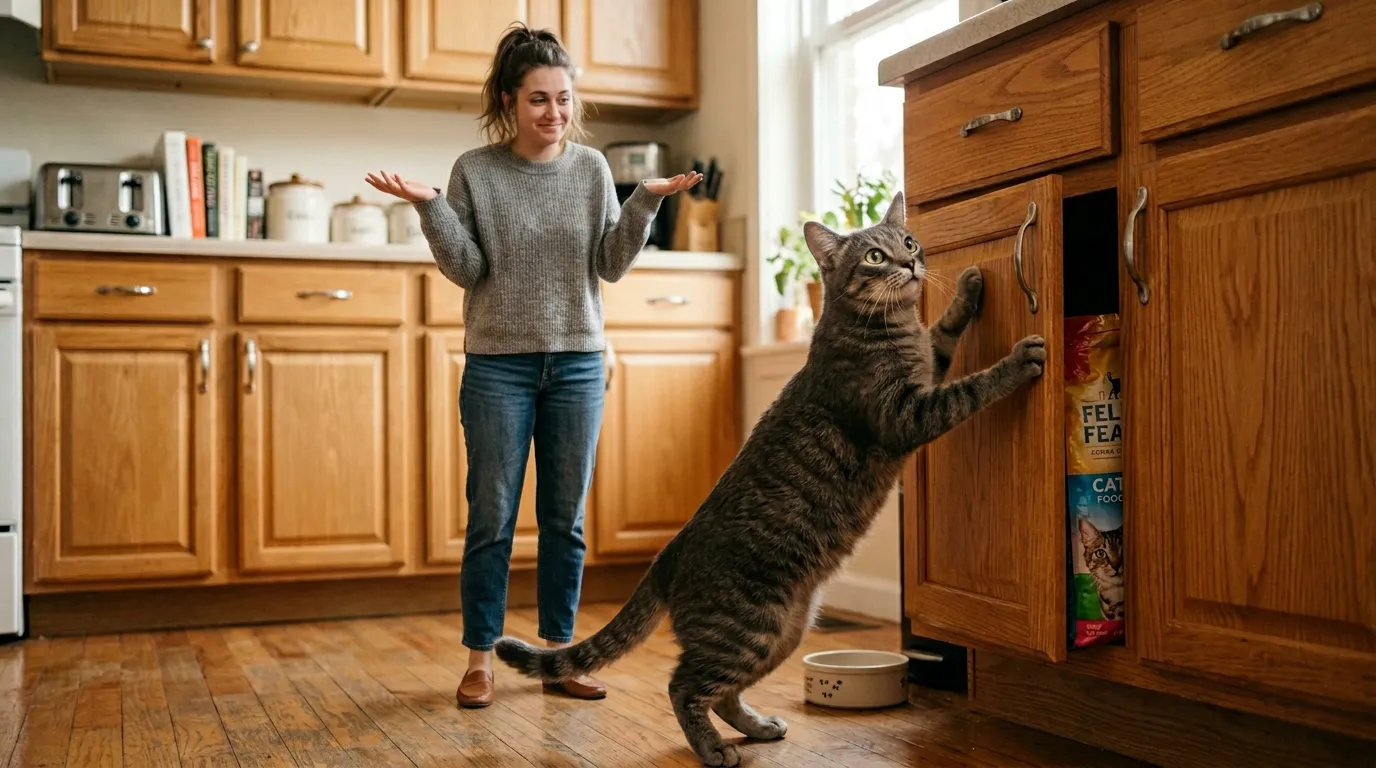
Why is my indoor cat always hungry? Most of the time it’s boredom, a learned begging habit or meals spaced too far apart, not starvation. I found this out the hard way. My cat stopped meowing at the bowl the week I added a ten minute play session before dinner, not the week I fed her more. That one change told me more than months of guessing had. This guide walks through every common cause, from harmless habit to the medical conditions that need a vet visit, so you can work out which one fits your cat.
Quick answer: An indoor cat that always seems hungry is usually bored, begging out of habit, or eating meals that skip the natural hunt-catch-eat cycle. But if the hunger shows up with weight loss, more thirst, or litter box changes, that combination points to hyperthyroidism, diabetes, or intestinal parasites, and it needs a vet visit this week, not next month.
This guide is part of a bigger picture of feline wellbeing. For the full set of daily habits that keep an indoor cat healthy beyond just appetite, see the indoor cat health pillar guide, which this article sits under as part of that cluster.
In This Guide
- How to tell real hunger from behavioral hunger in about five minutes
- Nine causes, split into behavioral and medical, plus one feeding habit that fools owners
- How age, spaying, and neutering change what “hungry” means
- Wet vs dry food, free feeding vs scheduled meals, and a worked calorie example
- A 14 day reset plan, then a list of mistakes that undo it
- The exact signs that mean you should call a vet
Real Hunger vs Behavioral Hunger in Indoor Cats
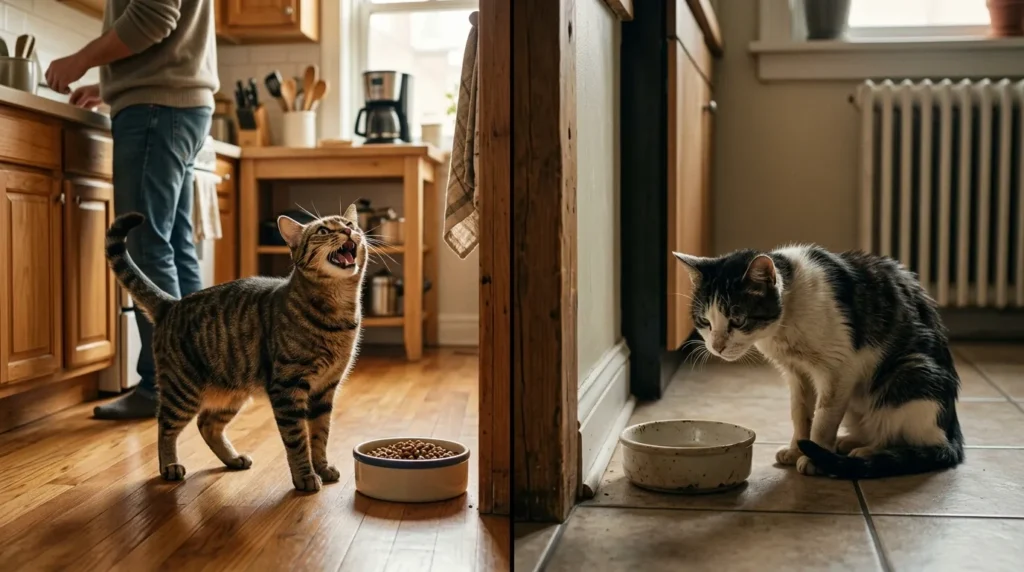
Real hunger and behavioral hunger show up differently once you know what to check. A medically hungry cat carries physical evidence: dropping weight, a dull or greasy coat, low energy, and changes in how much water it drinks or how often it visits the litter box.
A behaviorally hungry cat looks fine on paper. It follows you into the kitchen, cries at the bowl, and acts starved, yet its weight stays steady and its coat stays clean. Most apartment cats fit this pattern, and it responds to routine changes, not medicine.
Run this check before anything else:
| What You Observe | Most Likely Cause | Next Step |
| Begging constantly but weight is stable | Behavioral boredom or habit | Enrichment and schedule changes |
| Eating more than usual and losing weight | Medical, vet visit needed | Book vet appointment within a few days |
| Eating more, drinking more, using litter box more | Medical, possible diabetes or hyperthyroidism | Book vet appointment promptly |
| Eating more but thin despite eating | Medical, possible parasites or malabsorption | Vet visit and fecal exam |
| Begging stops after play or attention | Behavioral boredom or attention-seeking | Enrichment routine changes |
| Gulps food, then vomits or acts hungry again | Eating too fast | Slow feeder, smaller meals |
Is it normal for a cat to be hungry all the time?
Some hunger is normal. A cat that paces and chirps for the half hour before dinner is anticipating a routine, and that’s fine. A cat that works the kitchen all day, ambushes you at the fridge, and cries minutes after finishing a full meal has a problem worth solving, even if the cause turns out to be harmless.
The 30 second body check
Run your hands along your cat’s ribcage. You should feel the ribs under a thin layer of padding, the way you’d feel the back of your hand with the fingers flat. If you have to press to find them, your cat is carrying extra weight. If they stick out sharply, or you can feel the spine and hip bones with no padding, the cat is too thin and the hunger deserves a vet’s attention. Vets call this a body condition score, and a quick check at home gives you something to compare against later.
Why Indoor Cats Act Hungrier Than Outdoor Cats?
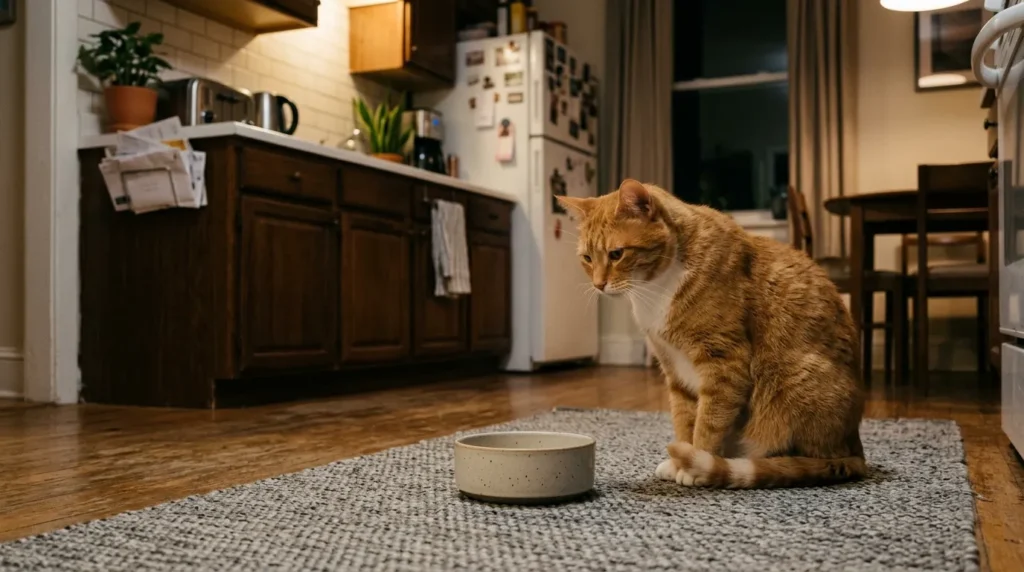
An outdoor or feral cat stalks and pounces on eight to twelve small prey items a day. That effort, not just the eating, is what satisfies a cat’s hunting drive. Your apartment cat skips straight to the bowl. No stalking, no pounce, no chase. The hunt is the missing piece, and without it a cat stays behaviorally unsatisfied no matter how many calories land in the dish.
Boredom makes this worse. In a small apartment where nothing much changes day to day, the bowl becomes the most reliable source of novelty a cat has. It learns fast that the kitchen is where interesting things happen. Add daily play and rotate a few toys, and that fixation on food often fades within days, because the stimulation gap gets filled another way.
That’s why the environment matters as much as the feeding schedule. For specific tools and routines that work in small spaces, see this guide on indoor cat enrichment, which covers what actually replaces food-seeking with real mental activity.
Why Is My Indoor Cat Always Hungry? Nine Causes

The first five causes below are behavioral or environmental. They’re the likely suspects when weight is steady. Causes six through nine involve health or household stress, so read those closely if anything else looks off.
Behavioral and feeding-routine causes
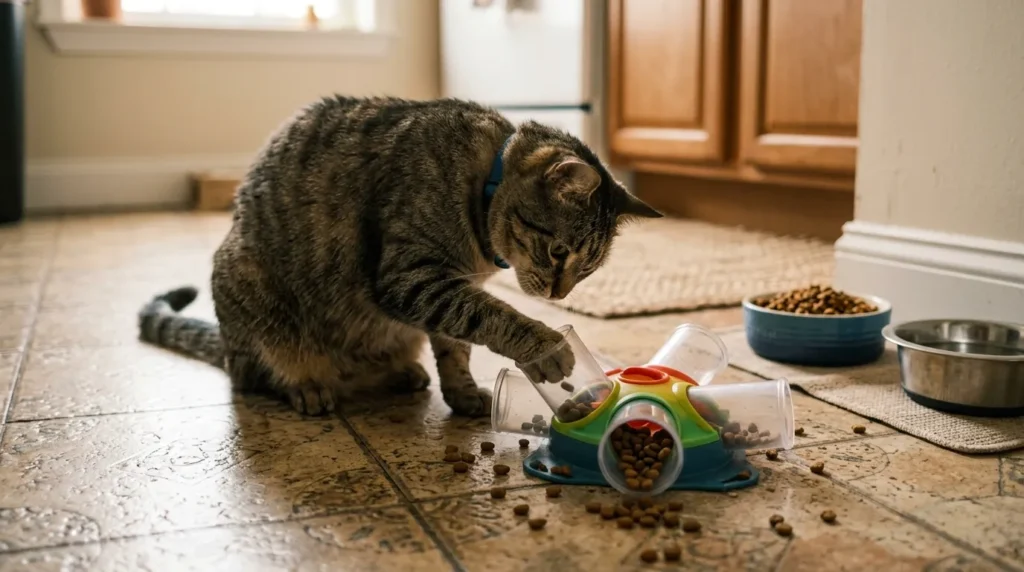
1. Boredom and low mental stimulation. This is the most common cause in healthy cats. With nothing to hunt, food becomes the day’s main event. Puzzle feeders, a ten minute wand toy session, and a window perch with a view all target the cause instead of the symptom.
2. Learned begging. If meowing at the bowl has ever produced food outside of mealtime, your cat learned it works. The crying gets louder over the following days because the cat is testing how much drama is needed. Ignoring it consistently and redirecting to play usually breaks the pattern within one to two weeks. Expect it to get worse before it gets better. That spike is called an extinction burst, and it means the plan is working, so don’t cave on day four.
3. Meals that skip the hunting cycle. Cats are built to hunt, catch, eat, groom, then sleep. Food that just appears in a bowl removes the first two steps, so eating carries less payoff. Play hard for ten to fifteen minutes right before each meal, then feed immediately after. Same calories, calmer cat.
4. Low-quality food. Cheap food loaded with fillers hands your cat calories without the protein and fat their body actually runs on. A cat can hit its calorie target and still act hungry because the macros don’t match what it needs. Wet food or kibble with a named meat as the first ingredient produces noticeably better satiety.
5. Meals spaced too far apart. Cats are built for many small meals, and one meal a day, or meals twelve or more hours apart, creates a real hunger gap that drives food-obsessed behavior. Splitting the same daily total across three meals instead of two often fixes constant begging without adding a single extra calorie.
Eating too fast: the cause owners miss
A cat that empties the bowl in under a minute often vomits some of it back up, then shows up at your ankles twenty minutes later as if nothing was eaten. From the cat’s side, that’s accurate. The food didn’t stay down, and the gulping skipped the slower eating that helps a cat register fullness.
Three fixes work for most cats. A slow-feeder bowl or a puzzle feeder forces pacing. Smaller, more frequent meals cut the pressure to gulp. And in a multi-cat home, feeding in separate rooms removes the race. If a cat vomits after meals more than once or twice a month, bring it up with your vet instead of assuming it’s just speed.
Medical and household-stress causes
6. Hyperthyroidism. This is the most common medical cause in cats over eight. The classic pattern is a cat that eats ravenously and still loses weight, because an overactive thyroid speeds up metabolism faster than food can keep up. Watch for hyperactivity, a rough coat, more thirst, and occasional vomiting. Caught early, it treats very well.
7. Diabetes mellitus. The telltale trio is more hunger, more thirst, more urination, usually with slow weight loss despite eating more. Cats that are overweight or were previously obese carry higher risk. A blood glucose test at the vet confirms or rules this out fast.
8. Intestinal parasites and absorption problems. Even a cat that never goes outside can pick up worms or giardia from soil on shoes, a new plant, or contact with another pet. Parasites steal nutrients before the body can use them, so the cat eats more but stays thin. A fecal exam diagnoses it, and treatment is usually simple. Gut conditions that block nutrient absorption, such as inflammatory bowel disease, can look similar, so a cat that stays thin after a clean fecal test needs further workup.
9. Stress or competition over food. In multi-cat homes, one cat guarding the bowl or eating fast can push another into anxious, food-focused behavior even when portions are fine. Watch for hovering near the bowl, gulping, or a cat that only relaxes once it’s eaten first. Separate feeding stations, or feeding in different rooms at the same time, usually settles this within a week or two.
A note on medication: some drugs raise appetite as a side effect, corticosteroids such as prednisolone being the usual example. If your cat started a new prescription right before the begging began, ask your vet whether that’s the link. Don’t stop the medication on your own.
Insight: The cheapest diagnostic tool you own is a bathroom scale. Weigh yourself, then weigh yourself holding your cat, and subtract. Do this weekly for three weeks. Stable weight with dramatic begging points to a behavioral cause almost every time. Weight loss with more eating points to a medical one. A typical cat weighs 8 to 11 pounds, so a drop of half a pound is a real loss, not scale noise. That data beats guessing.
Is Your Cat’s Age the Reason They’re Always Hungry?
Age changes the baseline before you even get to behavior or illness. A kitten begging at the bowl and a ten year old cat begging at the bowl usually aren’t showing the same thing.
| Life Stage | Typical Hunger Pattern | What It Usually Means |
| Kitten, under 12 months | Frequent, intense begging | Often a real calorie gap, growth needs roughly 2 to 3 times an adult cat’s calories per pound |
| Adult, 1 to 7 years | Steady, occasional begging | Usually behavioral, boredom or habit, unless paired with weight change |
| Senior, 8 years and up | New or worsening begging | Higher chance of hyperthyroidism or diabetes, worth a vet check even without other symptoms |
A kitten’s constant hunger is rarely a habit problem. Growing bodies burn through calories fast, and a kitten fed like an adult cat will act hungry because it is. Talk to your vet about a kitten-specific food and feeding frequency, usually three to four small meals a day, before assuming the begging is behavioral.
A senior cat that suddenly starts begging more after years of steady eating deserves more scrutiny than a young adult doing the same thing. New hunger in an older cat is exactly the pattern that shows up before a hyperthyroidism or diabetes diagnosis, so don’t write it off as “she’s just getting food-motivated in her old age” until a vet has ruled those out.
Is Your Cat Always Hungry After Being Spayed or Neutered?
This is one of the most common triggers owners miss. Spaying or neutering lowers a cat’s resting energy needs, and several studies put the drop at roughly 20 to 30 percent, while appetite often stays the same or even increases after the procedure. Feed the same pre-surgery portion afterward and you get a cat that’s eating enough calories on paper, still begging, and sometimes quietly gaining weight.
The fix is a recalculated portion for your cat’s new energy needs, ideally with your vet’s input, and a weight check every week or two for the next two months to confirm the new amount is right. A cat that seems more food-focused in the weeks after surgery is showing a known hormonal effect, not a personality change.
Wet Food vs Dry Food for a Cat That Always Seems Hungry
Food type changes how full a cat feels, even when the calories match. Wet food is mostly water, so an equal-calorie portion fills a bigger part of the bowl and the stomach. Dry food packs far more calories into each cup, which makes it easy to overfeed by eye and easy to underfeed a cat that eats slowly through the day.
| Factor | Wet Food | Dry Food |
| Moisture | High, adds to daily water intake | Low, cat must drink separately |
| Fullness per calorie | Better, larger portion volume | Weaker, small portion looks tiny |
| Cost per day | Higher | Lower |
| Best use for a hungry cat | Main meals, especially the pre-bed meal | Puzzle feeders and foraging toys, since kibble holds up in them |
A mixed plan works well for many households: wet food for the two main meals, a measured scoop of kibble held back for puzzle feeders. That gives you the fullness of wet food and the enrichment of foraging, at a cost that won’t hurt every month. Count the kibble inside the daily total, or the plan quietly adds calories.
Free Feeding vs Scheduled Meals
If boredom eating is the driver, how food is offered matters as much as how much. Here’s how the two approaches compare for a cat that always acts hungry.
| Approach | Pros | Cons |
| Free feeding (bowl always full) | Low effort, works for some multi-cat homes with no weight issues | Keeps food as constant background stimulus, harder to spot appetite changes, linked to weight gain |
| Scheduled measured meals | Removes food as a constant focus, makes appetite changes easy to catch early, supports steady weight | Needs a consistent routine, some cats beg loudly during the adjustment week |
For most cats begging out of boredom, switching to two or three measured meals a day, timed with play, works better than adjusting the bowl. Exact portion sizes and the calorie math for your cat’s weight are covered in this guide on how to feed an indoor cat properly, which walks through the switch step by step.
Quick Reference: How Many Calories Does My Cat Need?
Before deciding a portion is too small, it helps to know roughly what your cat should be eating. Vets typically start with the resting energy requirement, or RER: 70 multiplied by your cat’s body weight in kilograms raised to the 0.75 power. That number gets multiplied by a factor for activity and reproductive status.
| Cat Type | Typical Multiplier of RER |
| Neutered adult, indoor | Roughly 1.2 |
| Intact adult | Roughly 1.4 |
| Kitten under 4 months | Roughly 2.5 |
| Weight loss goal | Roughly 0.8 to 1.0 |
Here’s the math worked out for a neutered indoor adult at three common weights:
| Body Weight | RER (calories per day) | Estimated Daily Target (RER x 1.2) |
| 3 kg (6.6 lb) | about 160 | about 191 |
| 4 kg (8.8 lb) | about 198 | about 238 |
| 5 kg (11 lb) | about 234 | about 281 |
Compare the target against what you’re actually feeding. Check the calorie count on the food label (listed as kcal per cup or per can) and add up every meal, treat, and puzzle-feeder scoop. Many owners find the real total sits well above the target, which explains weight gain but not hunger, and others find a cat getting less than it needs, which explains both.
These multipliers are general starting points from standard veterinary nutrition guidance, not a diagnosis for your specific cat. Ask your vet to confirm a target for your cat’s actual weight, body condition score, and health history before you change a portion based on math alone.
Why Does My Cat Beg for Food at Night or Early Morning?
Cats are naturally more active at dawn and dusk, so nighttime begging often lines up with real biology, not just bad habits. That doesn’t mean you have to live with a 5 a.m. wake-up call.
- A short play session before bed burns off the crepuscular energy spike that would otherwise turn into pawing at your face for food.
- A timed automatic feeder set to release a small meal in the early morning removes the reason to wake you at all.
- A bigger last meal served right after the bedtime play session gives the cat a longer stretch of fullness overnight.
- Never feed immediately when woken. Even five minutes of delay, or a quick play session first, breaks the direct link between waking you and getting food.
Most cats settle into a new nighttime pattern within one to two weeks of consistent handling. The habit is stubborn at first because it worked for a while. Consistency unwinds it.
A 14 Day Plan to Stop Constant Begging
This plan assumes your cat passed the vet-warning check below: stable weight, normal thirst, normal coat. If any of those are off, see a vet first.
- Days 1 to 3, collect a baseline. Weigh your cat, note the body check result, and write down how much food and how many treats she gets in a normal day.
- Day 4, set the schedule. Move to two or three measured meals at fixed times. Use a kitchen scale or a proper measuring cup, not a guess.
- Days 4 to 14, play before every meal. Ten to fifteen minutes with a wand toy, ending in a “catch,” then feed within a minute or two.
- Days 4 to 14, stop paying for begging. No snacks, no top-ups, no eye contact while she’s crying at the bowl. Redirect to a toy instead.
- Days 7 to 14, add a foraging element. Put part of one meal in a puzzle feeder or scatter kibble across the floor so she works for it.
- Day 14, re-weigh and compare. Steady weight with less begging means the plan is working. Weight loss, or no change in behavior at all, means book the vet visit.
Practical Solutions That Resolve Constant Hunger
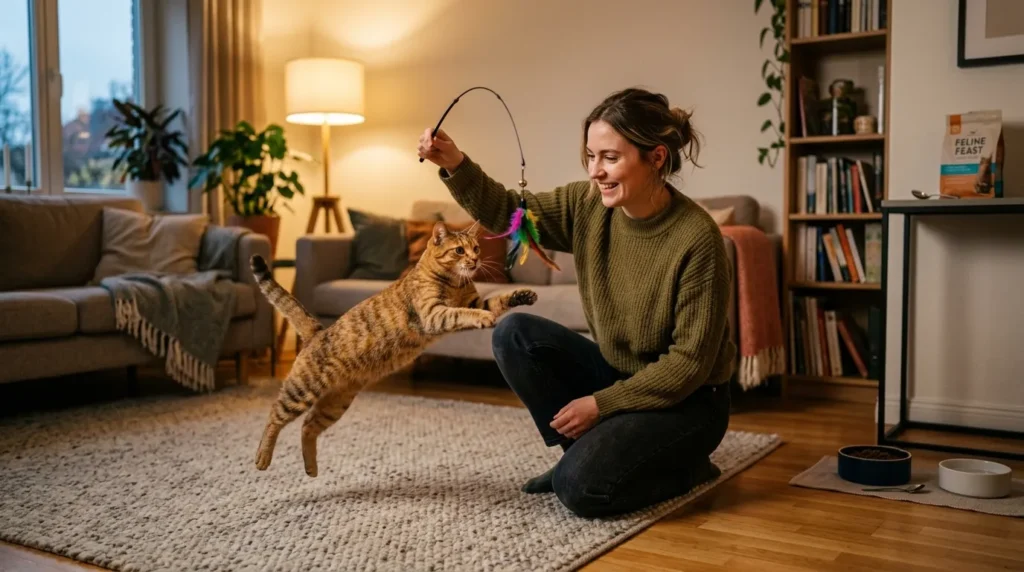
The fastest fix is pre-meal play. Play hard for ten to fifteen minutes right before every meal, then feed the moment play stops. This rebuilds the hunt-catch-eat-groom-sleep cycle a cat’s body expects, and most owners see inter-meal begging drop within five to seven days. A wand toy moved unpredictably across the floor is enough. You don’t need an elaborate setup.

Upgrading food quality helps cats eating a proper portion that still act unsatisfied. Look for a named protein, chicken, salmon, or turkey, as the first ingredient, and check that the guaranteed analysis shows at least 30 percent protein on a dry matter basis. The gap in satiety between a protein-first food and a filler-heavy one shows up within a few weeks.
Cheap foraging setups that work in an apartment:
- A muffin tin with a few kibbles in each cup, topped with tennis balls.
- A cardboard egg carton with kibble tucked into the cups.
- A store-bought puzzle feeder, started on the easiest setting so the cat wins early.
- A handful of kibble tossed down a hallway, so she has to “hunt” each piece.
- A slow-feeder bowl for cats that gulp.
Insight: If your cat only begs in the hour before its scheduled meal, that’s normal anticipation, not underfeeding. The pattern worth fixing is all-day food-seeking that has nothing to do with when the last meal happened. Different cause, different fix.
Common Mistakes That Make Constant Hunger Worse
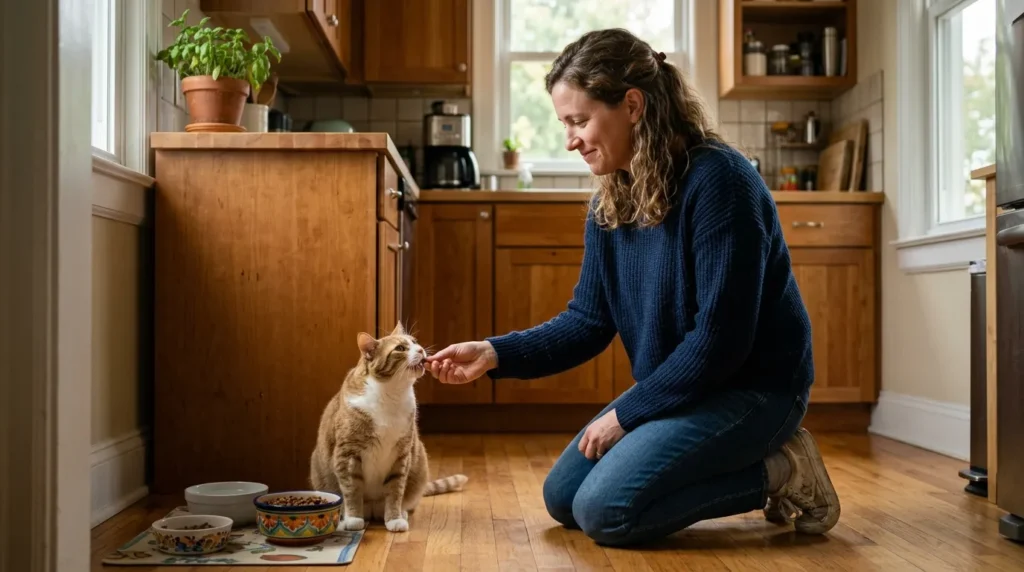
- Feeding outside scheduled times. Every time crying at the bowl gets a response, the behavior gets stronger. What starts as occasional begging turns constant because the cat has proof it works. Ignoring it consistently is hard, but it’s the only thing that breaks the cycle for good.
- Increasing portion size when begging continues. If your cat is a healthy weight and already meeting its calorie needs, more food doesn’t fix the root cause. It just adds calories. A healthy-weight cat that won’t stop begging almost always needs enrichment or a schedule change, not more food.
- Assuming it’s always behavioral. Hyperthyroidism develops slowly enough that increased appetite can build for months before anyone notices it’s abnormal. A cat that has become more food-focused over the past six months, alongside any weight or energy change, deserves a vet check even if you suspect habit.
- Not adjusting portions after spay or neuter. Feeding the pre-surgery amount after a cat’s energy needs have dropped is one of the most common causes of both post-surgery weight gain and ongoing begging.
- Letting treats run wild. Treats add up fast on a 4 kg cat with a daily target near 238 calories. Keep treats to a small slice of the daily total and count them.
- Giving in on day four. Begging usually spikes before it fades. Caving at the peak teaches the cat that louder works.
When Constant Hunger Means You Need a Vet Visit
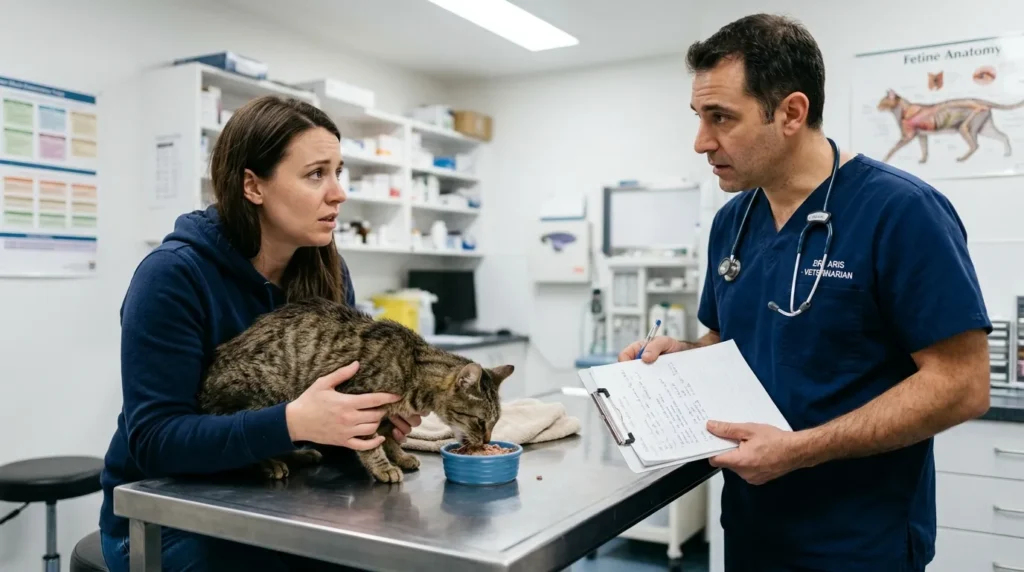
Three combinations call for a vet visit instead of a behavior fix: more hunger with weight loss, more hunger with more thirst and urination, and more hunger with a rough coat or dropping energy. Any one of these points to a medical cause that home changes won’t touch, and early treatment beats delayed treatment every time.
According to the Cornell Feline Health Center, hyperthyroidism affects roughly 10 percent of cats over age ten, making it one of the most common hormone disorders in older cats. It responds well to medication or radioactive iodine therapy when caught before major weight loss sets in. A basic blood panel that includes a thyroid test and a blood glucose reading checks for both hyperthyroidism and diabetes in one visit.
Vets call excessive appetite polyphagia. Paired with any of the warning signs above, it’s a symptom, not a habit. Skip the behavioral fixes and book the vet visit if you see weight loss, more thirst, or coat changes alongside the hunger.
What to bring to the appointment?
- Your weight log, with dates.
- The brand, flavor, and daily amount of everything your cat eats, treats included.
- A rough count of how often the litter box needs scooping, and whether that has changed.
- Any vomiting, diarrhea, or odd stool, with photos if you can.
- A fresh stool sample, if the vet asks for a fecal exam.
- A list of any medications or supplements, including flea and worm treatments.
This article is for informational purposes only. Always consult your vet if your cat shows unexplained weight loss, excessive thirst, or a sudden change in appetite.
Key Takeaways: Quick Checklist for a Constantly Hungry Cat
- Check for weight loss, more thirst, or coat changes first. Any of those means a vet visit, not a behavior fix.
- Weigh your cat weekly for three weeks. Stable weight with heavy begging points to a behavioral cause.
- Add a 10 to 15 minute play session right before every meal.
- Switch from free feeding to two or three measured meals a day if you’re currently leaving the bowl full.
- Check the food label for a named animal protein first and at least 30 percent protein on a dry matter basis.
- Use wet food for main meals and keep kibble for puzzle feeders.
- Slow down a cat that gulps, with a slow feeder or smaller meals.
- Recalculate portions after a spay or neuter, since energy needs typically drop 20 to 30 percent.
- Feed kittens more often and expect higher hunger as a normal part of growth, not a habit to correct.
- Handle nighttime begging with pre-bed play or a timed feeder, and never feed the moment you’re woken.
- Never increase portions just because begging continues in a healthy-weight cat.
Frequently Asked Questions About Indoor Cats That Always Seem Hungry
Why does my indoor cat act starving right after eating?
Usually one of two things: a portion that’s genuinely too small, or learned attention-seeking. Weigh your cat weekly to check the trend. If weight is stable and the portion matches your cat’s calorie needs, the begging is behavioral, and a pre-meal play session usually fixes it within a week.
Is my indoor cat hungry or just bored?
If weight is stable and nothing else looks off, boredom is the likely answer. Add a ten minute wand toy session before the next meal and watch whether begging drops over the following three days. Boredom-driven hunger responds to enrichment. Medical hunger does not.
Why is my cat always hungry but staying thin or losing weight?
This combination is a red flag for a medical cause. Hyperthyroidism, diabetes, and intestinal parasites all cause more appetite alongside weight loss or a failure to gain despite eating more. Bloodwork and a fecal exam are the right first move here, not a diet change.
Is it normal for a cat to be hungry all the time?
Some hunger around mealtimes is normal. Being food-focused all day is not, and it usually means boredom, a learned begging habit, or meals spaced too far apart. If the all-day hunger comes with weight loss, more thirst, or a rough coat, it’s a medical question and needs a vet.
Can poor quality cat food make my indoor cat always hungry?
Yes. High-filler, low-protein food delivers calories without the nutrients a cat’s body actually needs. A cat can hit its calorie total and still act hungry because the amino acid and fat profile falls short. Switching to a high-protein food with a named protein first often helps within two to three weeks.
Does wet food help a cat feel fuller than dry food?
Often, yes. Wet food runs higher in protein and moisture per calorie than most dry kibble, and the extra volume can add to a feeling of fullness. It’s not a guaranteed fix on its own, but paired with pre-meal play, many owners see a real difference.
Should I feed my indoor cat more if they always seem hungry?
Only if a vet has confirmed the current portion is too small for your cat’s ideal weight. For a healthy-weight cat that still begs, more food just adds calories. The fix is almost always enrichment, a schedule change, or better food quality.
Why is my kitten always hungry?
Kittens under a year old need roughly two to three times the calories per pound of an adult cat because they’re growing, not just maintaining weight. Frequent begging in a kitten is often a real calorie gap. Talk to your vet about a kitten-specific food and more frequent small meals rather than assuming it’s a habit to break.
Why is my cat always hungry after being spayed or neutered?
Spaying or neutering lowers a cat’s resting energy needs, often by roughly 20 to 30 percent, while appetite frequently stays the same or increases. Feeding the pre-surgery portion afterward is a common cause of weight gain and ongoing begging. Recalculate the portion, ideally with your vet.
Is it normal for my cat to beg for food at night?
It’s common, since cats are naturally more active at dawn and dusk, but it’s still a habit you can retrain. A play session before bed and a small automatic feeder for early morning usually stop the pattern within one to two weeks.
Why does my cat meow for food all day?
Cats meow at people because it works. If crying has ever produced a snack, your cat learned to repeat it. Stop rewarding it, redirect to play, and feed on a fixed schedule. Most cats drop the habit within one to two weeks if everyone in the house stays consistent.
Why does my cat eat too fast and then act hungry again?
Gulping food skips the slow chewing and pacing that signals fullness, and some cats vomit it back up and go looking for more. A slow feeder, a puzzle feeder, or splitting the portion into smaller meals usually helps. If vomiting happens often, mention it to your vet.
How many calories does my indoor cat need per day?
A rough starting point uses the resting energy formula, 70 times body weight in kilograms raised to the 0.75 power, then multiplied by about 1.2 for a neutered indoor adult. A 4 kg cat works out to roughly 238 calories a day. Ask your vet to confirm the number for your cat’s specific weight and health status.
How many times a day should I feed an indoor cat that’s always hungry?
Two or three measured meals a day works for most healthy adult cats, and splitting the same daily total across three meals often calms constant begging. Kittens need three to four small meals. Ask your vet before changing the routine of a cat with a medical condition.
The Answer Is Usually Simpler Than You Fear
When your indoor cat always seems hungry, the cause is most often boredom, a learned habit, meals that skip the hunting step their biology expects, or a life-stage factor like being a kitten or a newly neutered cat. Start a play session before every meal today, and switch to measured scheduled meals if you’re currently free-feeding. If you notice weight loss, more thirst, or coat changes alongside the hunger, skip the behavioral fixes and go straight to the vet. Most behavioral cases settle within two to three weeks of consistent changes. For the full picture of keeping an indoor cat content in a small space, see this guide on indoor cat health, which covers the daily habits that prevent most of these problems before they start.
Indoor cats that always seem hungry are most commonly dealing with boredom, learned begging, meals that skip the natural hunting cycle, eating too fast, stress around food in multi-cat homes, or a life-stage factor like being a kitten or a recently spayed or neutered adult. Boredom-driven hunger responds to pre-meal play sessions of 10 to 15 minutes and enrichment tools like puzzle feeders. Kittens naturally need 2 to 3 times the calories per pound of an adult cat, and spaying or neutering typically lowers energy needs by 20 to 30 percent, both of which change how much food is appropriate. Medical causes, including hyperthyroidism, diabetes, and intestinal parasites, all produce increased appetite alongside weight loss, increased thirst, or coat changes. A cat losing weight despite eating more needs a vet visit and blood panel within a few days. Switching from free feeding to two or three scheduled measured meals a day, using wet food for main meals, recalculating portions after life-stage changes, and upgrading food protein quality resolves most behavioral hunger cases within two to three weeks.

Written by Mishu
A passionate cat lover and indoor living enthusiast, Mishu is the founder and voice behind Indoor Living Cat – a go-to resource for cat owners who want to create the happiest, healthiest life for their feline companions indoors.
View Full Profile