
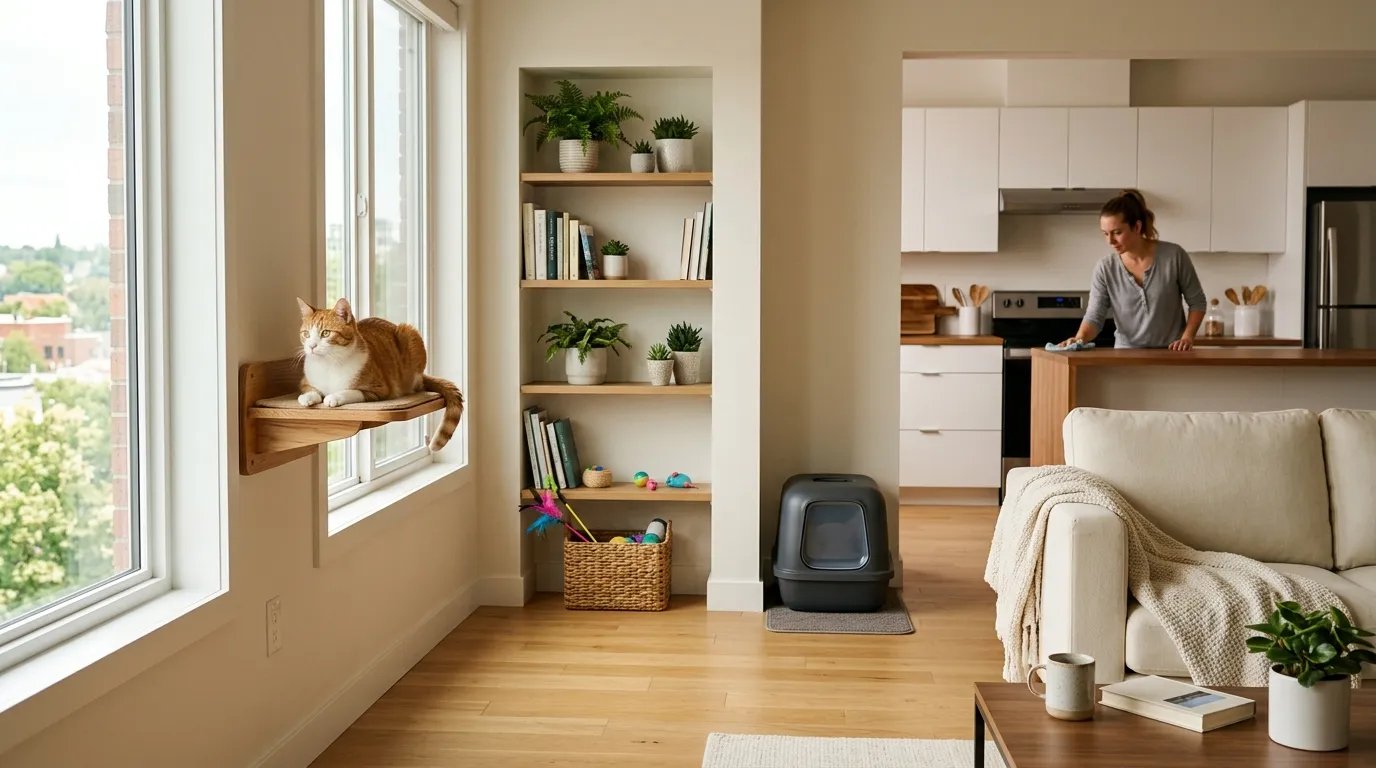
How to keep apartment clean with cat is a problem that sneaks up on you slowly. The first week your cat moves in, everything seems fine. By week three there’s a fine layer of fur on the couch you can’t explain and a smell near the litter box that greets you every time you open the front door. The fur multiplied. The litter scattered. You started noticing the smell only when guests arrived and saw it on their faces before you smelled it yourself. Knowing how to keep apartment clean with cat is mostly a systems problem, not a willpower problem, and the system has four parts: litter management, hair containment, air quality and fast cleanup of accidents. Get all four running and most owners describe their apartments as genuinely clean rather than managed chaos. This guide gives you the full working system, plus the placement, product and troubleshooting questions that come up once the basics are handled.
Keep an apartment clean with a cat by scooping the litter box every single day without exception, brushing the cat two to three times per week to intercept shed fur before it reaches furniture and surfaces, running a HEPA air purifier continuously near the litter station, and treating any accident within minutes with an enzyme cleaner instead of a general spray. Those four habits handle most of the cat-related cleanliness issues that come up in an apartment. Everything else below is maintenance on top of that foundation.
The Litter Box Is the Whole Game — Solve This First
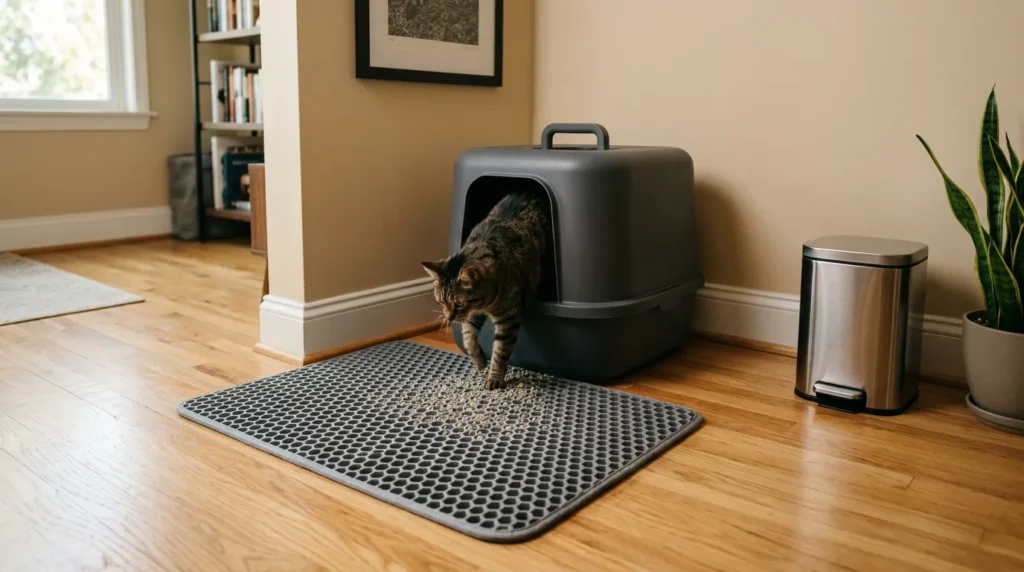
Litter is the main source of both odor and mess in any apartment with a cat, and it builds up faster in a small space than a large one. There’s less air to dilute the smell and less floor distance for scattered granules to disappear into. How to keep apartment clean with cat starts here. Scoop every single day, not most days, not when you notice it. Do it in the morning before anything else. A box scooped daily never develops the ammonia buildup that produces the smell visitors notice before you do.
A large multi-layer litter mat positioned directly in front of the box catches granules on the cat’s paws before they travel. Most cats exit the box and take four to six steps before the mat releases the tracked litter. A mat that extends at least eighteen inches from the box entrance in the direction of travel catches most of what would otherwise reach your floors. Shake it out over the trash every two to three days rather than vacuuming it in place, since embedded granules need agitation to release from most mat surfaces.
Litter type determines how much tracking you deal with daily. Fine clay litter tracks the most because the small granules lodge in paw pads and travel far from the box. Pellet litters made from pine, wood, tofu or compressed paper track far less because the larger granules fall off paws within the first step. The tradeoff: some cats need a transition period before they’ll accept pellet litter over the fine clay texture they’re used to. Mix pellets with existing clay at increasing ratios over two weeks and most cats adapt without much resistance.
Here’s how the main litter types compare if you’re deciding what to switch to:
| Litter Type | Tracking | Odor Control | Cost | Best For |
|---|---|---|---|---|
| Fine clay (clumping) | High | Good | Low | Owners who prioritize easy clumping over tracking |
| Pine or wood pellets | Low | Good | Low to moderate | Small apartments, sensitive noses |
| Tofu or paper | Low | Moderate | Moderate | Multi-cat homes, flushable-litter households (check local plumbing rules first) |
| Silica crystal | Moderate | Very good | Higher | Owners who scoop less often but still want odor control |
How Many Litter Boxes Do You Need in an Apartment?
The standard guideline is one litter box per cat plus one extra, so a single cat still does best with two boxes. In a studio or one-bedroom that can feel impossible, but it doesn’t have to mean two full-size boxes in the open. A second box tucked into a closet, a bathroom corner or a low shelf still counts, and it cuts down on the accidents that happen when a cat won’t use a box that already smells like a full day of use. If you truly only have room for one, the tradeoff is that you can’t skip a single day of scooping, because there’s no backup for your cat to use while it waits.
Where to Put the Litter Box in a Small Apartment
Placement affects how much of this whole problem you create for yourself. A box shoved in a high-traffic hallway or right next to the kitchen makes every smell and every scatter more visible. A few placement rules that hold up in almost any layout:
- Keep it away from food and water bowls. Cats are less likely to eat near a bathroom, and you don’t want litter dust drifting into a food bowl.
- Pick a spot with airflow, even if that just means a cracked door or a small fan, rather than a sealed closet with no ventilation.
- Use furniture with a real access panel, like an end table or bench built for a litter box, instead of a fully sealed cabinet that traps humidity and makes scooping a chore you’ll put off.
- Avoid loud, high-traffic corners like next to a washing machine or a front door. A startled cat during use is a fast way to create litter box avoidance and, with it, accidents on your floor.
For a full breakdown of hidden and space-saving setups, see our guide on indoor cat litter box options.
Brushing the Cat Is Cheaper Than Vacuuming
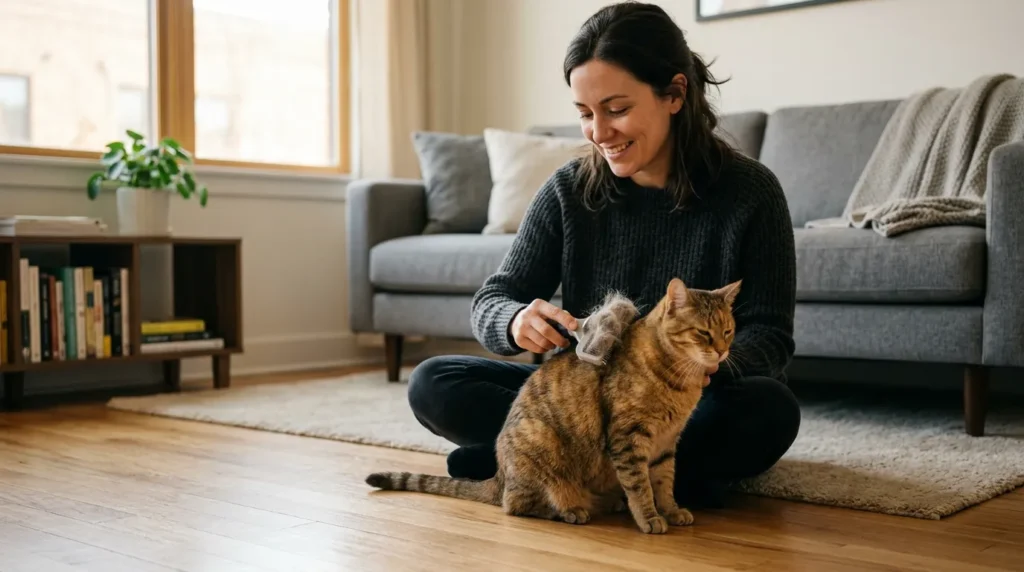
Brushing a cat two to three times per week intercepts shed fur at the source, before it reaches the couch, the floors, the bed and your dark clothing. A single thirty-minute brushing session on a medium-shedding cat removes fur that would otherwise end up spread across the apartment over the following few days. Catching it at the brush is far easier than pulling it out of a dozen surfaces after it has settled into fabric fibers.
Match the tool to the coat, and the same thirty minutes removes noticeably more fur:
- Short-haired cats: a rubber grooming glove or rubber bristle brush grips the undercoat as well as the surface fur.
- Long-haired cats: a wide-tooth comb first, then a deshedding tool to reach the dense undercoat where most loose fur builds up.
- Double-coated breeds (Maine Coons, ragdolls): a slicker brush plus a deshedding tool during seasonal shedding, more often in spring and fall.
Grooming also pays off in ways that connect back to cleanliness. A well-groomed coat sheds less overall, because regular brushing spreads skin oils and cuts down on the matting and breakage that drive loose fur production. It also means you see the cat’s skin often enough to catch early signs of parasites or irritation before they turn into a bigger mess, medically or on your floors.
Air Quality and Ventilation Are the Invisible Half of a Clean Apartment
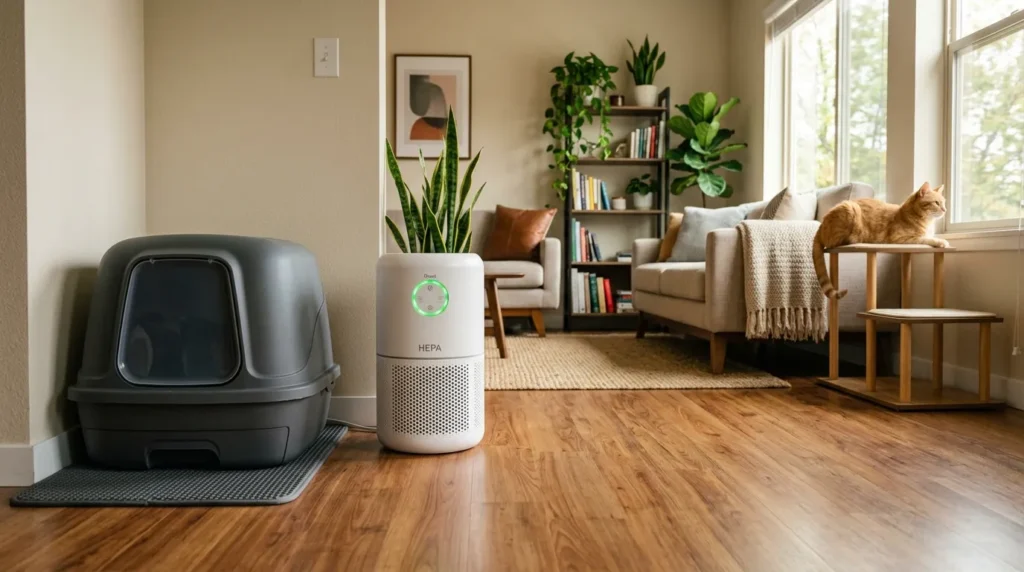
A HEPA air purifier running continuously near the litter station handles dander and odor at the same time, and it does something surface cleaning can’t: it treats the air itself instead of the surfaces the problem has already landed on. In a small apartment, dander circulates through the whole space because there isn’t much air volume to dilute it. A purifier with a HEPA filter captures airborne dander, and a carbon filter layer handles the volatile compounds coming off litter waste. Together they cut the ambient cat smell you’ve stopped noticing but your guests haven’t.
Place the purifier within three feet of the litter station rather than in the center of the room. The litter station is the main point source of both odor and airborne particles, and treating it at the source works better with a smaller unit than trying to clean the whole room’s air downstream. A second unit in the bedroom, where dander settles into bedding overnight, prevents the groggy, stuffy feeling some cat owners notice in the morning without connecting it back to the cause.
Don’t Skip the Windows
An air purifier does the heavy lifting, but plain ventilation still matters. Cracking windows for even ten to fifteen minutes a day exchanges stale, dander-heavy indoor air for outside air, and it costs nothing. Open curtains during the day too. Sunlight through a window doesn’t sterilize a room, but the airflow that comes with an open window helps keep dust and dander from settling back onto the same surfaces you just cleaned. If your building has a bathroom or kitchen exhaust fan, run it for a few minutes after scooping. Moving air away from the litter station is the cheapest odor control tool you already own.
How to Get Cat Urine Smell Out of Carpet, Hardwood and Baseboards
Accidents happen even in a well-run litter system, and how fast you respond determines whether the smell lasts a day or lingers for months. Cat urine contains uric acid crystals that regular soap and water can’t break down. They stay bonded to whatever surface they hit and start smelling stronger with humidity, which is exactly why a spot that seemed fine in winter turns pungent in summer.
- Blot, don’t rub. On carpet or fabric, press paper towels or a clean cloth straight down to pull up as much liquid as possible before it soaks deeper. Rubbing pushes it further into the fibers or the padding underneath.
- Rinse with plain cold water on hard flooring, then blot dry. This dilutes the concentration before you apply anything else.
- Apply an enzyme cleaner made for pet urine, not a general all-purpose spray. Enzyme cleaners break the uric acid crystals down at the molecular level instead of just masking them. Saturate the area, matching the depth of the original accident, and let it sit for the ten to fifteen minutes listed on the bottle. Wiping it off early leaves the odor-causing compounds intact.
- Check for hidden repeat spots with a UV blacklight in a dark room. Old, dried urine glows under UV light even when it’s invisible in normal lighting, which is often why a room “randomly” smells like cat despite a clean-looking floor.
- For carpet with padding underneath, a fresh accident may need a second enzyme treatment injected with a syringe or turkey baster to reach the pad itself, since surface application alone won’t get that deep.
- For baseboards and grout lines, use a small brush to work the enzyme cleaner into the seams, since urine tends to travel along a baseboard and settle in the joint between the floor and the wall.
One caution: never combine an enzyme cleaner with bleach or ammonia-based products. Ammonia is a component of urine itself, and layering it on top can make a spot more attractive to a cat looking for a place to go again, on top of being a harsh chemical mix in an enclosed room.
The Daily and Weekly Cleaning Routine
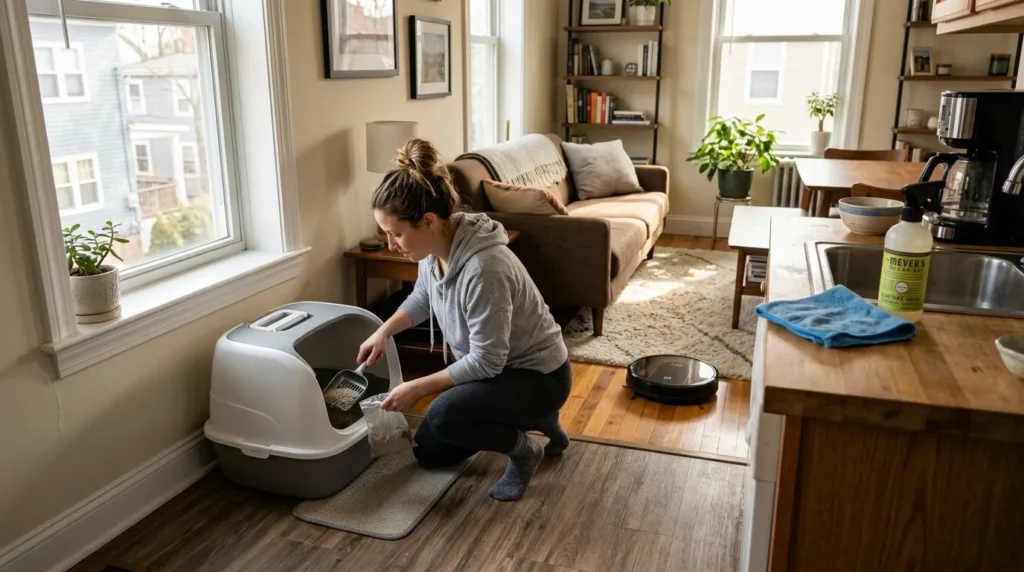
How to keep apartment clean with cat sustainably is a ten-minute morning habit, not a reactive deep clean every few weeks. Run the same circuit every day: scoop the litter box, shake the litter mat over the trash, wipe the kitchen and bathroom counters since cats walk across both, refill food and water, and run a quick vacuum pass along the baseboards where fur settles.
A robot vacuum set to run every morning handles ongoing fur on hard floors without any extra time from you. Its limitation is that it won’t touch fur embedded in upholstered furniture or bedding. A rubber lint roller or grooming glove dragged across the couch once a day takes under two minutes and removes surface fur before it works its way into the fabric, where it gets much harder to pull out.
| Task | Daily | Weekly | Monthly |
|---|---|---|---|
| Litter box | Scoop | Top off litter | Empty, wash with warm water and unscented soap, refill fully |
| Litter mat | — | Shake out over trash every 2–3 days | Hose down or hand wash |
| Floors | Robot vacuum pass | Full vacuum and mop | Check baseboards and corners for missed fur or litter |
| Upholstery and bedding | Lint roller pass on the couch | Wash cat’s bedding on hot | Wash throw blankets, cushion covers |
| Air purifier | Leave running | Check filter indicator | Replace or clean filter per manufacturer schedule |
The monthly litter box wash matters more than it sounds like it should. A box that only gets scooped, never emptied and washed, develops a layer of crystallized waste residue on the interior walls that no amount of scooping removes. That layer keeps producing odor regardless of how fresh the top layer of litter looks. A full wash with warm water and unscented dish soap resets the smell baseline completely. Skip scented soap here too, since strong fragrance mixed with ammonia residue can smell worse than the plain odor it’s replacing.
The Mistake That Keeps the Apartment Smelling Like a Cat
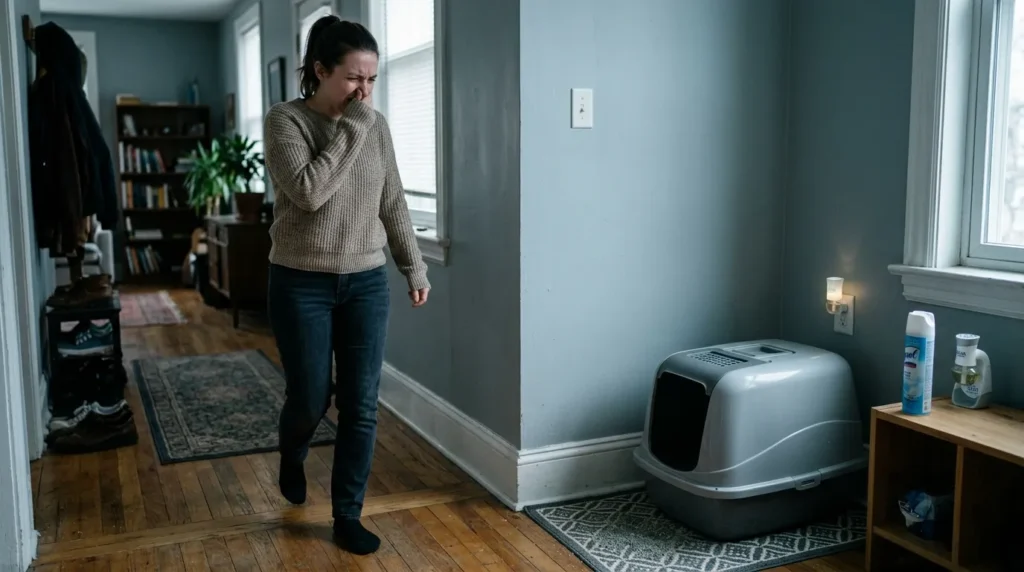
The mistake that keeps apartments smelling like a cat despite real cleaning effort is masking odor instead of eliminating the source. Scented litters, plug-in air fresheners and fabric sprays layer a synthetic smell over the biological odor instead of breaking down the compounds that produce it. In a small apartment, that approach fails within hours, because the source keeps producing more odor while the masking layer wears off faster in a confined space.
Enzyme-based cleaners break down the organic compounds in cat waste at the molecular level instead of covering them up. Apply enzyme cleaner to any surface where an accident happened, not a general-purpose spray. General cleaners lift the visible surface deposit but leave odor compounds sitting in porous surfaces like grout, concrete subfloor and fabric fibers, where they keep producing smell for weeks. Give enzyme cleaner ten to fifteen minutes of wet contact time rather than wiping it off right away, so it has time to fully break the compound down.
A small box of baking soda mixed into the bottom inch of fresh litter, underneath the main layer, adds mild odor absorption between scoops. It’s not a substitute for daily scooping and it won’t fix an unwashed box, but it buys you a bit of margin on a day you’re running late.
Insight The single change that turned my apartment from cat-smelling to just apartment-smelling was a HEPA purifier next to the litter station, with nothing else changed at the same time. I was already scooping daily and brushing regularly, but the air itself was the piece I hadn’t touched. The difference showed up within two days. If you haven’t tried continuous purification near the box yet, that’s where to start before buying anything else.
Cleaning Supplies Checklist
If you’re setting this system up from scratch, here’s what actually earns a place in the closet:
- Metal or plastic litter scoop with fine slots for clumping litter
- Large honeycomb-style litter mat, at least 18 inches deep
- HEPA plus carbon filter air purifier sized for the room, not just the apartment total
- Enzyme cleaner for pet stains (keep a full bottle on hand, not just a travel size)
- UV blacklight flashlight for finding dried accidents
- Deshedding tool matched to your cat’s coat length
- Rubber lint roller or grooming glove for upholstery
- Unscented dish soap for the monthly litter box wash
Frequently Asked Questions
Why does my apartment still smell like cat even after cleaning?
The organic compounds that produce cat odor absorb into porous surfaces like concrete subfloor, grout and fabric fibers, where surface cleaning can’t reach them. Enzyme-based cleaners break these compounds down at the molecular level. Apply enzyme cleaner to every accident site and run a HEPA plus carbon filter air purifier continuously near the litter station. Those two changes handle the sources that surface cleaning misses.
How do I stop cat litter from getting everywhere in a small apartment?
Switch to a larger-granule litter, like pine or wood pellets, which tracks less than fine clay because bigger pieces fall off paw pads within the first step instead of traveling. Add a large honeycomb-style mat extending eighteen inches from the box entrance in the exit direction. Those two changes together cut tracking dramatically compared to fine clay with no mat.
How often should I vacuum when I have a cat in an apartment?
Daily robot vacuum passes on hard floors handle ongoing fur without extra time from you. A manual vacuum of carpets and upholstered furniture twice a week keeps fur from embedding into fabric fibers, where it’s much harder to remove. A lint roller or rubber grooming glove across the couch daily removes surface fur before it works deeper into the upholstery.
Can I use scented litter to manage cat odor in my apartment?
Scented litter masks odor instead of eliminating it, and plenty of cats find heavily scented litters unpleasant enough to avoid the box altogether. If a cat avoids a scented box, the resulting accidents create exactly the odor problem the scented litter was supposed to prevent. Use unscented litter with daily scooping and a carbon filter air purifier instead. That combination controls odor better and doesn’t risk litter box avoidance.
How many litter boxes do I need for one cat in an apartment?
The standard rule is one box per cat plus one spare, so even a single cat does better with two boxes. In a small apartment, the second box can be tucked into a closet or bathroom corner. If space only allows for one, you can’t afford to miss a day of scooping, since your cat has no backup box to fall back on.
How do I get cat urine smell out of carpet or hardwood floors?
Blot fresh urine immediately rather than rubbing it in, then apply an enzyme cleaner made for pet stains and let it sit for the full ten to fifteen minutes the label recommends. For carpet, a second application injected down to the padding may be needed. Use a UV blacklight in a dark room to find older, dried spots that have gone invisible but are still producing odor.
Can I have a clean apartment with a cat if I have allergies?
Cat allergens come mostly from dander and saliva rather than fur itself, so brushing, a HEPA air purifier and frequent bedding washes reduce exposure meaningfully even though they won’t eliminate it. Running a second purifier in the bedroom, keeping the cat off the bed if allergies are severe, and washing hands after handling the cat before touching your face all help. Talk to an allergist about severity before assuming a cat and a small apartment aren’t compatible; plenty of mild allergy sufferers manage fine with this kind of routine.
Conclusion
How to keep apartment clean with cat comes down to four daily and near-daily habits rather than hours of cleaning: scoop the litter box every morning without exception, brush the cat two to three times a week to intercept fur before it spreads, run a HEPA air purifier continuously near the litter station, and treat any accident within minutes with an enzyme cleaner instead of a masking spray. Add a large litter mat, switch to a lower-tracking pellet litter, and keep a second litter box if your layout allows it, and the physical mess drops fast. Start today with the scoop. Nothing compounds faster in a small apartment than a missed scooping day. Managing a litter setup well is the foundation everything else in a clean cat apartment builds on.
Keeping an apartment clean with a cat comes down to four practices: scooping the litter box every morning to prevent ammonia buildup, brushing the cat two to three times per week to intercept shed fur before it reaches furniture and floors, running a HEPA plus carbon filter air purifier continuously within three feet of the litter station, and treating accidents immediately with an enzyme cleaner rather than a masking spray. A large honeycomb litter mat extending eighteen inches from the box entrance cuts litter tracking substantially, and low-tracking pellet litter scatters less than fine clay. The standard guideline is one litter box per cat plus one spare, even in a small apartment. Dried urine that keeps producing odor can be found with a UV blacklight and treated with a second enzyme application. Cracking windows daily and running exhaust fans after scooping adds ventilation on top of purifier use.

Written by Mishu
A passionate cat lover and indoor living enthusiast, Mishu is the founder and voice behind Indoor Living Cat – a go-to resource for cat owners who want to create the happiest, healthiest life for their feline companions indoors.
View Full Profile