
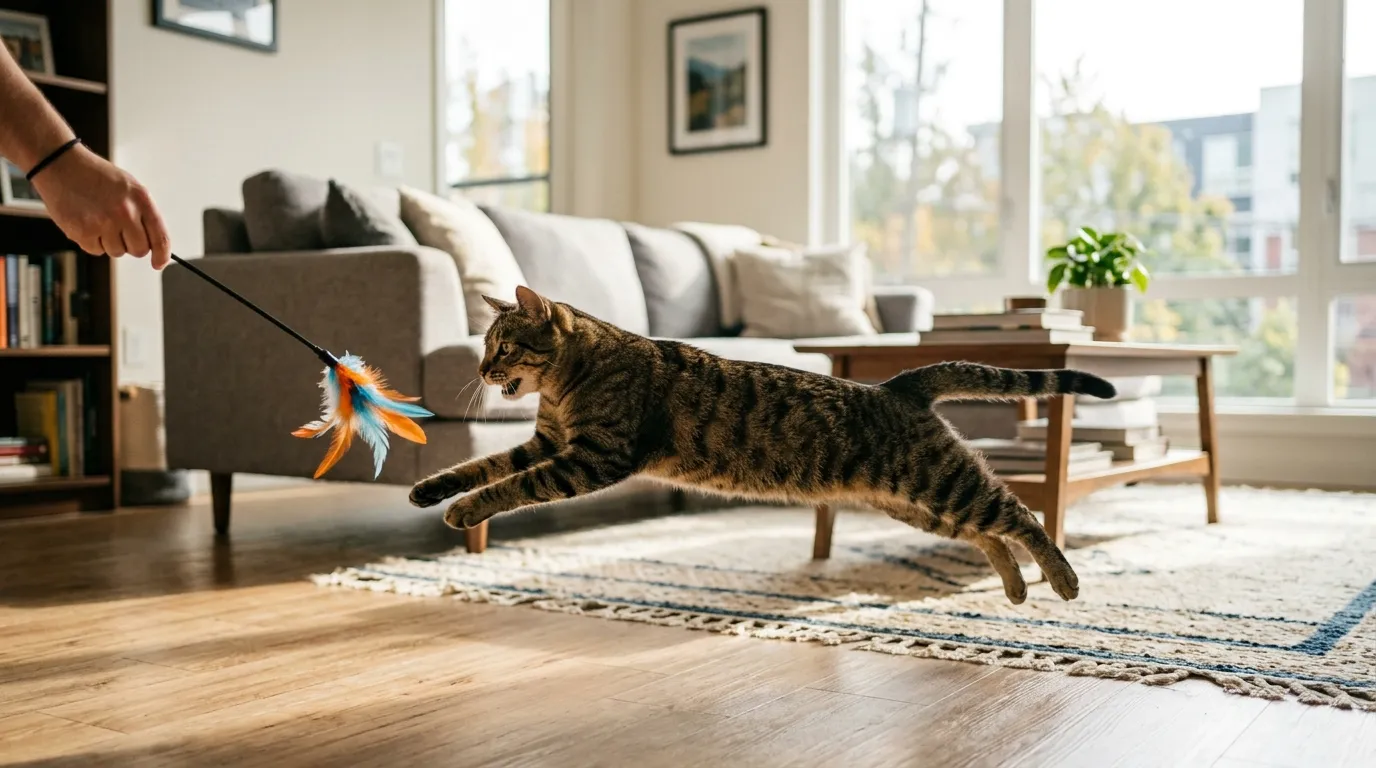
I watched my own cat go from a lean three-year-old to a noticeably round four-year-old without a single diet change, because I never thought of exercise as something I had to provide. That’s the quiet trap with indoor cats. They don’t patrol territory, hunt real prey or flee real threats, so without deliberate daily exercise from their owner the calorie math adds up over months, and a healthy young cat turns into a sedentary middle-aged one before anyone notices. Learning how to exercise an indoor cat is one of the most practical things you can do for its lifespan. This guide covers eight methods that work, how much exercise your cat needs by age, how to fit it all into a small apartment or a long workday, and how to tell when a cat needs a vet instead of another play session.
How to exercise an indoor cat: run two daily play sessions of ten to fifteen minutes each using a wand toy that mimics prey movement. Schedule one session at dawn and one at dusk to match the cat’s natural activity peaks. Add vertical climbing space, hide meals around the apartment and rotate toys weekly. These four habits together are the core of a plan that prevents weight gain and settles most restless behavior.
Why Indoor Cats Stop Moving and Why That Becomes a Problem Fast?
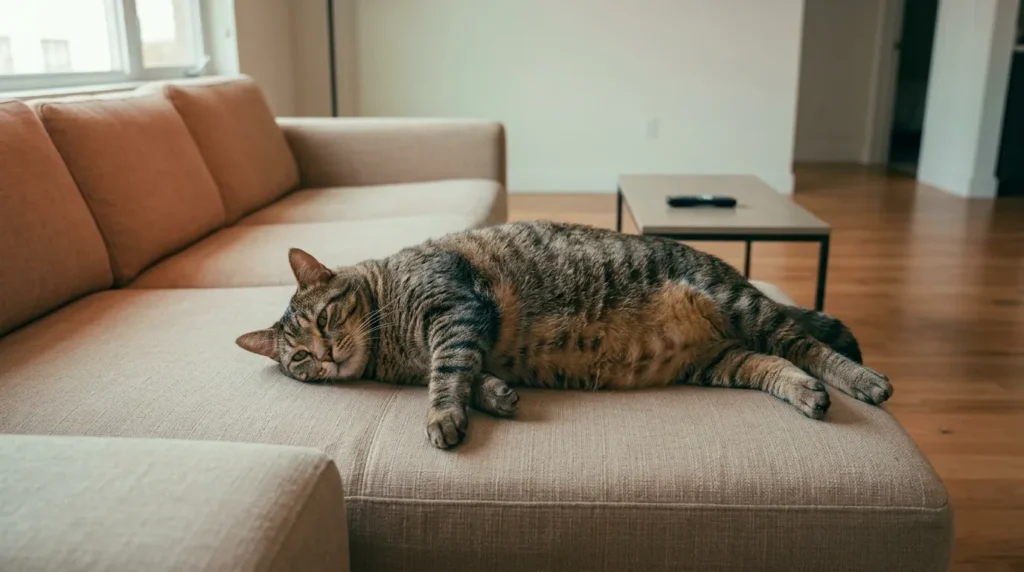
Indoor cats stop moving because the apartment removes every reason their biology gives them for moving. Free-roaming cats cover far more ground, hunt several times a day and deal with constant environmental unpredictability. An apartment provides warmth, consistent food and complete safety. It removes the motivation for physical effort entirely. Without that environmental pressure, only deliberate owner-initiated exercise fills the gap.
Feline obesity is one of the most common preventable health conditions in indoor cats in the United States. Industry surveys have put the number of overweight or obese cats in the US as high as six in ten. A cat carrying even one pound above its ideal body weight places measurable additional stress on its joints, kidneys and cardiovascular system over time. The cumulative effect of years of under-activity shows up first as reluctance to jump, then as joint pain, then as a shortened lifespan. None of it is inevitable, and consistent daily movement starting now addresses all of it.
The secondary problem is behavioral. A cat with unspent physical energy finds outlets for it. Midnight racing, ankle-attacking, destructive scratching and excessive vocalization all tend to show up together when daily exercise falls short. Close the activity gap and most of these problems ease at the same time, without any behavioral training.
For a complete picture of how physical activity connects to your cat’s long-term wellness, weight and disease prevention, read through what indoor cat health actually covers across every dimension of care.
Quick check: is your cat overweight? Run your hands along your cat’s ribs with light pressure. You should feel each rib easily, like the back of your hand, without seeing them. Look down from above: a healthy cat has a visible waist behind the ribs. No waist, or ribs you can’t feel through fat, means it’s time to talk to your vet about a weight and exercise plan, not just add one more toy to the basket.
How Much Exercise Does a Cat Actually Need? (By Age and Life Stage)
There’s no single number that fits every cat, but there is a range for each life stage. Use this as a starting point and adjust based on your own cat’s energy, weight and health.
| Life Stage | Daily Exercise Target | Session Format | What to Watch For |
|---|---|---|---|
| Kittens (under 1 year) | 1 to 2 hours total | Frequent short bursts, much of it self-directed | High energy but poor jumping judgment; supervise around stairs, cords and open windows |
| Adult cats (1 to 10 years) | 20 to 45 minutes total | 2 to 3 sessions of 10 to 15 minutes | Split sessions across dawn and dusk for the best engagement |
| Senior cats (10+ years) | 15 to 20 minutes total | Short, low-impact sessions, floor-level play | Stiffness, reluctance to jump or panting after mild activity; get a vet check before increasing intensity |
| Overweight or obese cats | Start at 5 minutes, build gradually | 2 to 3 very short sessions, low jump height | Combine with scatter feeding; a vet-guided weight plan matters more than exercise alone at this stage |
Breed plays a role too. High-energy breeds like Bengals, Abyssinians and Siamese generally need more stimulation than a laid-back British Shorthair or Persian. Temperament matters as much as the numbers on this table. A cat that’s naturally independent may do better with solo options like puzzle feeders, while a people-oriented cat gets more out of interactive sessions with you.
Kittens deserve one extra rule: never use your hands or feet as toys. A kitten who learns that skin is prey turns into a cat who bites ankles. Hand her a wand or a kicker toy every time the play gets rough.
Eight Ways to Exercise an Indoor Cat, at a Glance
| Method | Daily Time | Equipment Cost | Best For |
|---|---|---|---|
| Wand toy play | 20 to 30 minutes | Low ($5 to $15) | Almost every cat, daily bonding |
| Vertical climbing | Passive, all day | Medium ($50 to $200 for a tree) | Small apartments, muscle and joint maintenance |
| Scatter and puzzle feeding | 10 to 20 minutes per meal | Low to medium | Overweight cats, food-motivated cats |
| Agility course | 10 minutes of play | Free (household items) | Bored, high-energy or destructive cats |
| Laser pointer | 5 to 10 minutes | Low ($5 to $10) | Cats that won’t engage with a wand |
| Scratching post | Passive, several times a day | Low to medium | Spinal flexibility, especially in older cats |
| Leash and harness walks | 15 to 30 minutes | Medium ($20 to $40 harness) | Confident, curious cats |
| Cat exercise wheel | Self-directed, 10 to 40 minutes | High ($60 to $150+) | Highly active or “hyperactive” cats |
Method 1: Wand Toy Play Done the Right Way
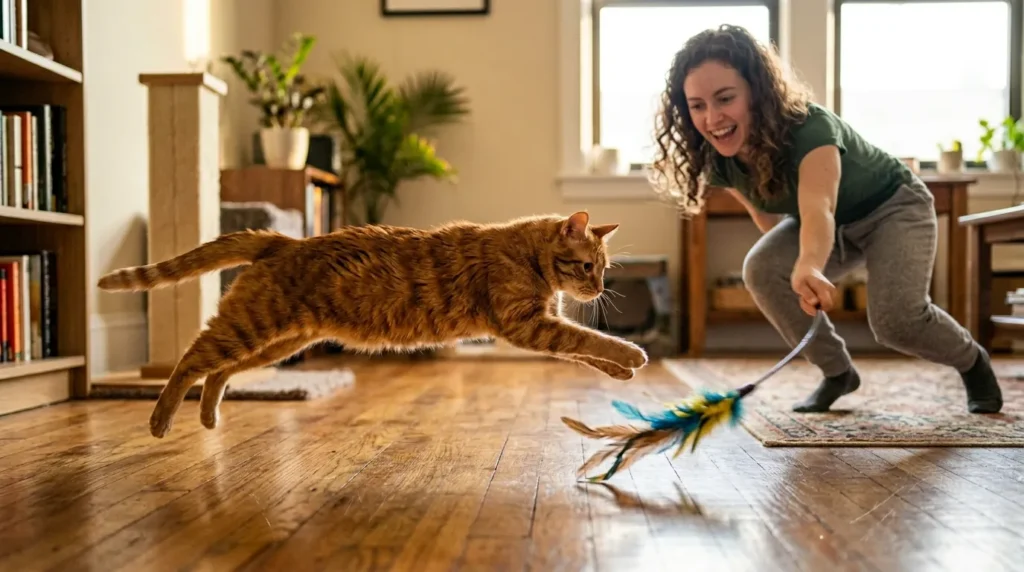
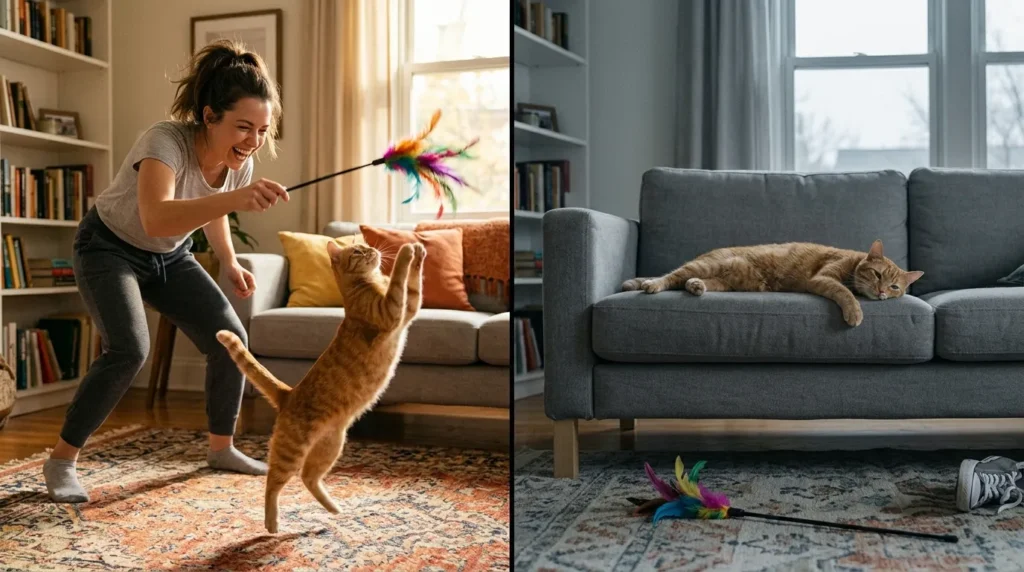
Wand toy play is the most direct method to exercise an indoor cat, because it activates the complete physical hunting sequence: sprinting, leaping, pivoting and pouncing. A wand moved correctly makes the cat work its entire body in a way that no passive toy or automated device replicates. The key word there is correctly. A wand held still does nothing. Move it in short, unpredictable bursts low to the ground, and the cat will sprint, reverse direction and leap within seconds.
Run each session in two-minute bursts with thirty-second rest pauses, rather than fifteen straight minutes of constant movement. Cats are sprint athletes, not endurance runners, and they tire the way a sprinter does: all-out effort followed by a genuine need to rest. The burst-and-pause format matches their physiology and produces more total movement over a session than continuous low-intensity play does.
Always end the session by letting the cat catch and hold the toy for thirty seconds. This completes the predatory sequence and satisfies the reward the cat’s brain has been building toward throughout the session. A session that ends without a catch can leave the cat in a state of frustrated, incomplete arousal that increases agitation instead of reducing it. Feeding a small portion of the daily meal right after the catch completes the hunt-eat-groom-sleep cycle, and it’s what produces the calm, settled behavior most owners want after playtime.
One safety rule: put the wand away after every session. A cat left alone with a string or ribbon can swallow it, and swallowed string can cause serious intestinal injury. Store wands and string toys in a closed drawer or a high cabinet.
Here’s the whole session in order:
- Start with the wand low and moving away from the cat, like prey trying to escape.
- Run a two-minute burst of short, unpredictable moves. Let her miss now and then.
- Pause for thirty seconds. Let the toy go still behind furniture so she can stalk it.
- Repeat for five to seven rounds, which brings you to the ten to fifteen minute target.
- Finish with a catch she can hold for thirty seconds.
- Offer a small portion of her meal, then put the wand away.
Method 2: Vertical Climbing for Daily Muscle Use
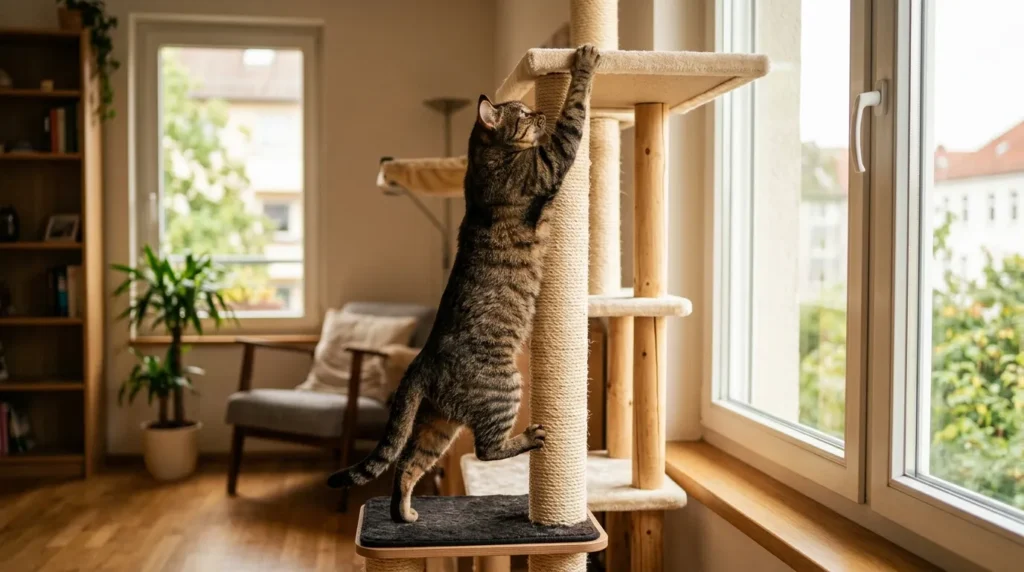
Vertical climbing uses a different muscle group from horizontal sprinting, and it provides the kind of resistance exercise that maintains muscle mass and joint flexibility in cats that don’t run outdoors. A cat that climbs between platforms on a tall tree several times a day is using its shoulders, back, core and hindquarters against gravity in a way flat-floor play never demands. That muscle-maintenance benefit compounds over years, especially as a cat approaches middle age.
Placement of climbing furniture decides whether the cat actually uses it. A cat tree in a quiet corner the cat already avoids gets used less than the same tree placed beside a window with outdoor activity to watch. Position shapes behavior. A tree that gives the cat a reason to be at the top gets climbed repeatedly throughout the day with zero owner involvement.
Choosing climbing structures that genuinely fit a cat’s size, weight and jumping ability matters more than looks. A well-chosen structure feels stable at full weight, has platforms wide enough to sit on comfortably and gives real territory advantage in the room. Understanding what makes cat furniture work for indoor cats specifically saves money and increases usage dramatically compared to buying by appearance alone.
Quick placement tips that raise how often she climbs:
- Put the tallest perch next to a window with a view of birds or street activity
- Space platforms close enough that she can climb in steps, not one big leap, especially for older or heavier cats
- Add a wall shelf or window perch if floor space is short
- Put a treat or a toy on the top platform for the first few days to build the habit
Method 3: Hide-and-Seek Feeding and Puzzle Feeders That Force Daily Movement
Scatter feeding turns every meal into forced movement. Instead of placing the full portion in a bowl, hide five to eight small piles of food in different spots around the apartment before each meal and let the cat find them. A cat that covers thirty feet of floor hunting for ten separate food piles moves a lot more before breakfast than one that walks ten feet to a bowl and sits down. Over weeks, that daily movement adds up to a real caloric expenditure difference.
The method needs zero equipment and zero extra time beyond moving food from bowl to floor in multiple spots. It also satisfies foraging drive, a separate behavioral need from physical exercise that overlaps with it in a way that makes scatter feeding more effective than simple calorie restriction for weight management. A cat that hunts its food eats slower, feels more satisfied and moves more naturally through the meal than one eating from a bowl.
Puzzle feeders do the same job in a smaller footprint, which matters if you don’t have thirty feet of floor to scatter across. A food-dispensing puzzle toy makes the cat paw, roll or nose the device to release kibble a few pieces at a time. They’re worth adding if:
- Your cat eats too fast and vomits or has digestive upset from bolting food
- You have a small studio or one-bedroom apartment where scatter feeding isn’t practical
- You’re managing an overweight cat and want portion control built into the activity
- Your cat is home alone for long stretches and needs a solo activity option
Start with an easy puzzle feeder that releases food with minimal effort, or the cat will lose interest and walk away hungry. Increase difficulty only after the cat has mastered the easy version.
How you structure your cat’s daily feeding routine shapes every other behavior pattern in its day. The relationship between meal timing, portion placement and activity level is something most owners underestimate until they change it and see the results. Getting the specifics of feeding an indoor cat in a way that supports both health and behavior right makes every other exercise effort more effective.
Method 4: Agility Courses From Household Objects
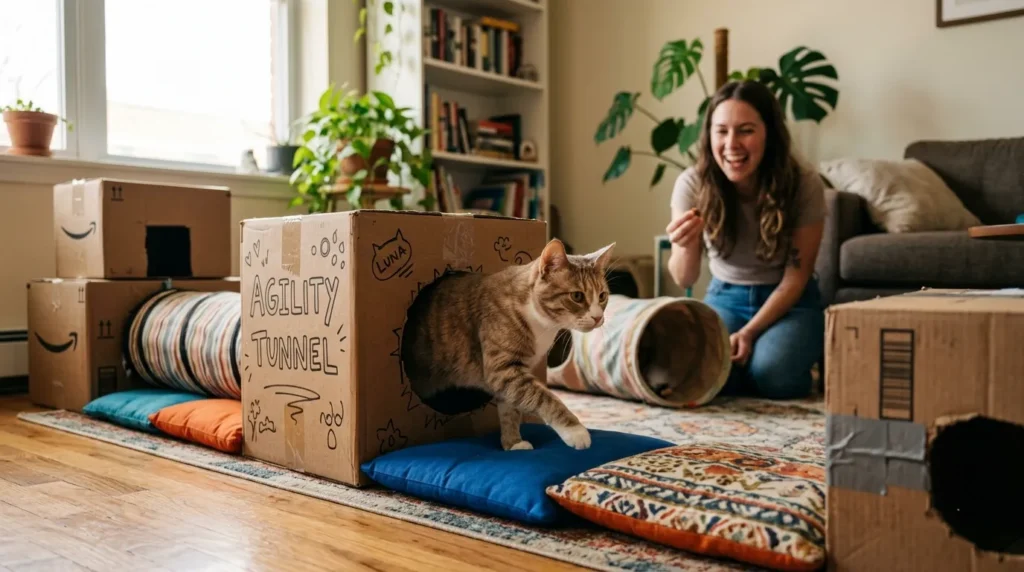
A simple agility course built from household objects gives cats a reason to move in complex patterns that work coordination and balance alongside basic cardio. Three cardboard boxes with holes cut through them, a fabric tunnel laid between two cushion platforms and a treat placed at the end makes a functional agility circuit that takes five minutes to set up and costs nothing. Most cats explore a new environmental arrangement with immediate curiosity, even if they ignore it after twenty-four hours.
Rotate the configuration every two to three days to keep it novel. Move the boxes to different positions, reverse the tunnel direction or add a new element. Novelty drives investigation, and investigation drives movement. A static course gets habituated within a day or two for most cats. A reconfigured one triggers a fresh round of exploration each time. It’s the same habituation principle that makes toy rotation work, just applied to physical space instead of objects.
Small apartments have less floor space for agility setups, but vertical integration helps: a box on the floor, a step up to a low ottoman and a cushion on the couch makes a three-level circuit using surfaces the cat already navigates. Thinking about how apartment cats can use limited floor space effectively changes what feels possible in a small home.
Method 5: The Laser Pointer Done Correctly
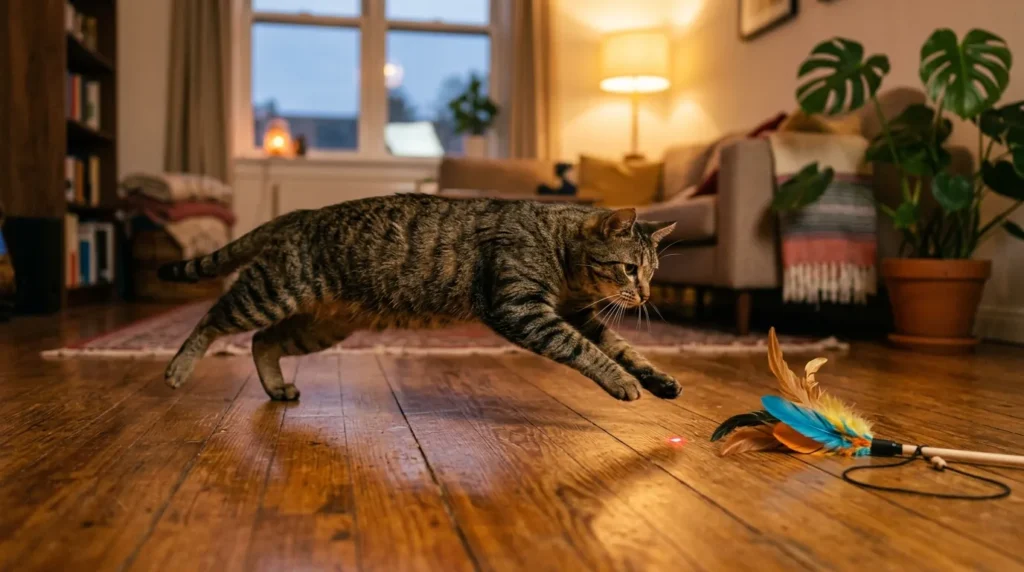
Laser pointers produce some of the most intense sprinting behavior of any indoor exercise tool, because the unpredictable dot movement triggers full predatory chase drive without the cat ever catching or reaching the target. That intensity is the value and the problem at once. The chase is excellent exercise. The endless failure to catch can leave some cats frustrated after repeated sessions without a physical completion.
Always end a laser session by shining the dot onto a physical toy, then switching off the laser so the cat catches and holds the toy. This is not optional. A laser session that ends without a physical catch leaves many cats agitated and frustrated, which produces exactly the behaviors you’re trying to resolve through exercise: vocalization, aggression and restlessness. The toy at the end is what turns the laser from a frustration tool into a genuinely useful exercise tool. Never shine a laser pointer directly into a cat’s eyes; the beam can damage eyesight the same way it would in a person.
Insight Laser pointers work well for cats that won’t engage with wand toys consistently. But they need more owner attention than wand play does, because you have to actively watch whether the cat is genuinely enjoying the chase or showing signs of compulsive arousal. A cat that stops blinking, stares at walls after sessions or can’t disengage from the dot has crossed from play into frustration. Switch that cat to wand play instead.
Method 6: Scratching Posts That Double as Stretching Equipment
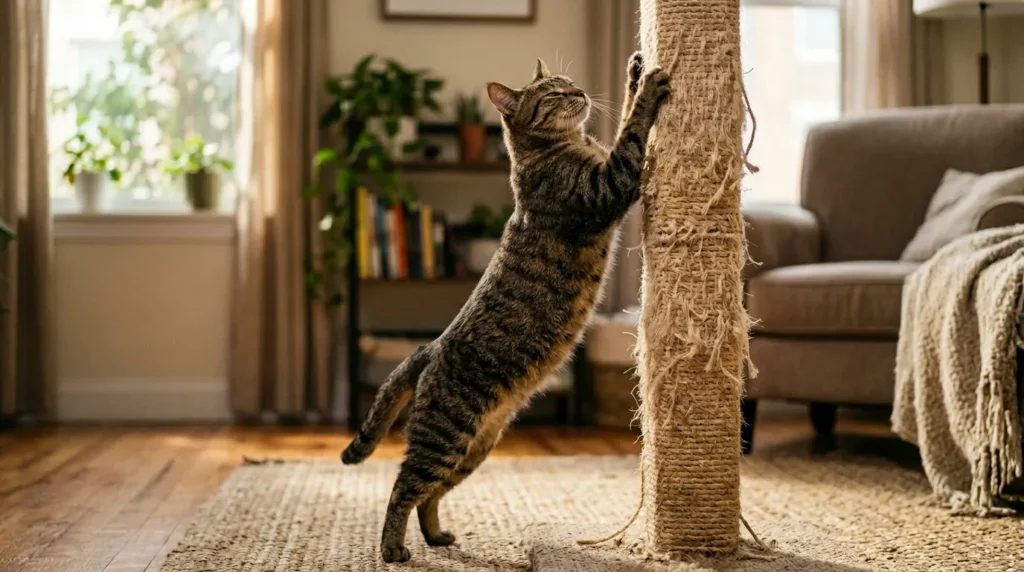
Scratching is the one physical activity indoor cats do reliably without owner intervention, because it satisfies an immediate physical need. A full vertical scratch extends the spine, stretches the back and shoulder muscles and provides isometric resistance through the claws and forelimbs. Done repeatedly on a tall, stable post, it produces meaningful daily stretching that maintains spinal flexibility, especially in middle-aged and older cats.
Height is the critical specification. A scratching post that doesn’t let the cat fully extend from floor to raised forepaws doesn’t deliver the stretch benefit, and most cats will scratch furniture instead, because furniture offers the height the post doesn’t. The post needs to be at least as tall as the cat’s full standing stretch, which for most adult cats means thirty-two to thirty-six inches at minimum.
Place at least one post in the room where the cat spends most of its waking hours. A post in a back hallway gets used far less than one beside the couch. Daily scratching on a proper tall post is one of the simplest exercise contributions you can build into a complete daily cat care routine without adding any active time to your schedule.
Method 7: Leash and Harness Walks

Plenty of cats can learn to walk on a harness. A cat trained this way gets sustained movement, sniffing and environmental stimulation that no indoor toy replicates, and it’s worth trying for confident, curious cats who already investigate open doors. It’s not the right fit for every cat, and it takes real patience to train.
Training goes in stages, and skipping ahead is the most common reason it fails:
- Let the cat wear just the harness indoors for short stretches over several days, rewarding calm behavior with treats.
- Once the cat ignores the harness, attach the leash and let the cat drag it around the house under supervision.
- Pick up the leash and apply slight, gentle pressure while the cat is still indoors, rewarding any forward movement.
- When the cat walks easily on leash indoors, move to a quiet, enclosed outdoor space like a balcony, porch or backyard, keeping the leash loose and following the cat’s lead rather than steering it.
Use a harness built specifically for cats, not a dog harness or a collar; cats can back out of a poorly fitted harness in seconds. Before any outdoor exposure, confirm flea and tick prevention is current, that the cat is microchipped and that a tag with your contact information is on the harness in case it slips free. If your cat seems stressed rather than curious outside, that’s the signal to stop and try again another day, or to skip outdoor walks altogether and stick with a catio, an enclosed and secured outdoor space that gives the same fresh-air stimulation with none of the escape risk.
Method 8: Cat Exercise Wheels

A cat exercise wheel works like a hamster wheel scaled up for a cat: a large carpeted or textured drum the cat runs inside, giving it room to sprint at full speed without needing thirty feet of open floor. For a genuinely high-energy cat, especially one that’s already destructive or wakes you up at 3 a.m., a wheel can absorb energy that wand play alone doesn’t touch.
Not every cat will use one, and that’s the real limitation. Training takes consistency:
- Lure the cat onto the wheel with treats or a favorite toy before expecting it to run
- Start with the wheel locked or barely moving so the motion doesn’t startle the cat
- Keep first sessions under two minutes and end on a positive note
- Expect several weeks of gradual exposure before a cat runs on its own
Cat wheels suit energetic breeds, bored indoor-only cats and cats already carrying extra weight who need more structured cardio than scatter feeding provides. They’re a poor fit for senior cats, anxious or timid cats who find the motion frightening and any cat recovering from injury or surgery; check with a vet before introducing one in those cases. They’re also a real investment, typically $60 to $150 or more for a wheel large enough for an adult cat, and a cat that never takes to it is a common enough outcome that it’s worth trying a friend’s wheel first if you can.
A Sample Daily Exercise Routine for a Working Owner
Methods are easy to list. Fitting them around a job is the hard part. This schedule works for an adult cat and an owner who’s out for the workday, and it adds up to the 20 to 45 minute target from the age table.
| When | What to Do | Time Needed |
|---|---|---|
| Morning, before breakfast | Wand session with a catch, then a scatter-fed breakfast | 10 to 15 minutes plus 2 minutes of setup |
| Before you leave | Fill a puzzle feeder, open the blinds to the window perch | 5 minutes |
| While you’re out | Window perch, cat tree, toys from this week’s rotation | Passive |
| After work | Wand session or a rearranged agility course | 10 to 15 minutes |
| Before bed | Short wind-down play, a small meal, lights low | 5 to 10 minutes |
Toy Rotation: The Weekly System That Keeps Cats Interested
A cat with twenty toys on the floor plays with none of them. Cats lose interest in objects they see every day, and a toy that has been out for a week reads as furniture. Rotation fixes that for almost nothing:
- Gather every toy and split them into three or four groups.
- Leave one group out and store the rest in a closed drawer or bin.
- Swap groups once a week, so toys come back as if they were new.
- Keep wands and string toys in a separate locked spot at all times, and bring them out only for supervised play.
A catnip or silvervine refresh on the returning toys helps too, though not every cat responds to either one.
How to Exercise an Indoor Cat in a Small Apartment?
You don’t need a big room. Cats sprint in short bursts and climb more than they run, so vertical space and clever setups matter more than square footage.
- Go up, not out: a tall tree, wall shelves or a window perch add usable exercise space without using floor area.
- Use the hallway: a straight corridor makes a good wand sprint lane, since the cat can chase in a line.
- Scatter across levels: hide food on the floor, a chair, a shelf and a perch so each meal includes a climb.
- Choose collapsible gear: fabric tunnels fold flat, and cardboard boxes recycle when they get tired.
- Keep sessions short: ten minutes of burst play in a few feet of open space still works.
Solo Exercise Ideas for When You’re Not Home
Long workdays leave a gap, and a bored cat fills it with the behaviors you came here to fix. These options need no owner participation:
- Puzzle feeders and foraging toys: they turn part of her daily food into a movement task.
- A window perch with a view: a bird feeder outside the window gives her something to watch and chatter at.
- A tall tree or wall shelves: she’ll climb them on her own schedule.
- This week’s rotation toys: kicker toys, crinkle balls and track toys she can bat around alone.
- Battery-powered moving toys: supervise the first few uses and never leave any with strings or ribbons attached.
How to Start Exercising an Overweight Indoor Cat?
An overweight cat can’t go from sofa to sprint overnight. Heavy joints take time to adapt, and a cat who gets exhausted in the first session may refuse to play again. Build up over about a month and have your vet set a safe weight goal alongside it.
| Week | Play Sessions | Add This |
|---|---|---|
| Week 1 | 2 sessions of about 5 minutes, wand kept low | Scatter feed one meal a day |
| Week 2 | 2 sessions of 7 to 8 minutes | Add an easy puzzle feeder |
| Week 3 | 2 sessions of about 10 minutes | Add a low platform or step she can climb easily |
| Week 4 | 2 sessions of 10 to 15 minutes | Weigh her every two weeks and share the numbers with your vet |
Stop a session if she pants, lags or lies down mid-play. Heavy panting or labored breathing in a cat is a reason to call your vet, not a cue to push through.
Cat Won’t Play? Troubleshooting Table
| What You See | Likely Reason | Try This |
|---|---|---|
| Ignores the feather wand | The prey type or texture doesn’t appeal to her | Swap to a fur mouse, crinkle ball or kicker toy |
| Loses interest after two minutes | Toy moves too predictably or too fast | Slow down, add pauses, hide the toy behind furniture |
| Too sleepy to play | Bad timing, often right after a meal | Play before meals, and try dusk instead of midday |
| Plays, then bites hands | Arousal with no appropriate outlet | Use a wand, end with a catch, never use hands as toys |
| Hides from the toy | Nervous or recently stressed | Start with a slow, low wand in a quiet room, and keep sessions to a couple of minutes |
How to Stop Night Zoomies With Exercise
Cats are most active at dawn and dusk, and an indoor cat with energy left over saves it for the hours you want to sleep. A short routine before bed takes the edge off:
- Play hard for ten to fifteen minutes in the hour before your own bedtime.
- End with a catch and a small meal, so the hunt feels complete.
- Let her groom and settle, with lights low.
- Don’t respond to 3 a.m. demands. Feeding or playing at that hour teaches her that waking you works.
- Set a timed feeder to release a small portion shortly before you normally wake.
If an older cat suddenly starts yowling or pacing at night, skip the training and call your vet. That pattern can point to pain, thyroid disease or cognitive changes.
The Mistake That Makes All Exercise Efforts Fail
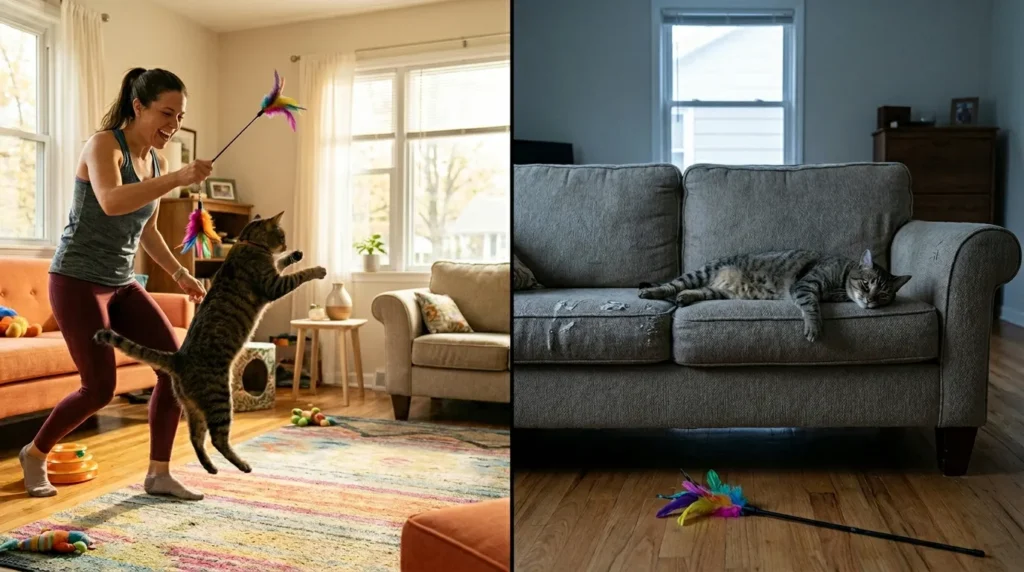
The mistake that cancels every exercise effort for indoor cats is inconsistency. One excellent play session doesn’t carry forward three days. Cats are daily-activity animals, and the benefits accumulate from consistent low-to-moderate daily movement rather than periodic high-effort sessions.
An owner who plays with their cat for forty-five minutes on Saturday and does nothing Monday through Friday ends up with a cat that has worse behavioral outcomes than one who plays fifteen minutes every single day. The missed days create a deficit the one long session can’t make up for. That’s why two ten-minute sessions daily beats one thirty-minute session three times a week, regardless of total weekly minutes.
The signs your cat isn’t getting enough exercise are consistent and visible once you know what to look for:
- Midnight sprinting through the apartment (“zoomies” late at night)
- Unprompted aggression toward human hands and feet
- Persistent, loud vocalization with no obvious cause
- Destructive scratching outside of designated posts
- Steady weight gain with no change in food
Compulsive overgrooming or bald patches can have the same cause, but they also point to stress, allergies, fleas or pain, so book a vet visit before you assume it’s boredom.
Understanding these as behavioral outputs of under-activity rather than personality problems changes how you approach them entirely.
Insight The simplest way to stay consistent is to tie both daily play sessions to something you already do every day: morning coffee and evening dinner. Fifteen minutes of wand play while your coffee brews and fifteen minutes after your own dinner costs almost no extra scheduling effort, and your cat’s behavioral improvement will make the habit self-reinforcing within ten days.
When Exercise Changes Aren’t Enough: Signs to See a Vet
A cat that resists movement it used to enjoy, or shows sudden reluctance to jump, climb or play when it was previously active, may be dealing with joint pain rather than behavioral disengagement. A cat that pants during play it tolerated easily before, walks stiffly after resting or cries when touched on the back or hips needs a vet exam before any exercise program continues.
Cats over ten benefit specifically from a vet conversation about safe exercise intensity given their joint health baseline. Arthritis in cats is underdiagnosed, because cats hide pain well. A vet who knows the cat’s history can identify comfortable exercise ranges that maintain fitness without causing damage.
Red flags checklist:
- Panting or open-mouth breathing after mild play
- Stiffness after rest, or a limp
- New reluctance to jump onto furniture she used to reach easily
- Crying or flinching when touched on the back or hips
- Sudden weight gain or loss with no change in routine
- New nighttime yowling or pacing in an older cat
This article is for informational purposes only. Always consult your vet if you have concerns about your cat’s health.
Key Takeaways: Indoor Cat Exercise Checklist
- Play with a wand toy twice a day for ten to fifteen minutes, at dawn and dusk if you can.
- Run each session in two-minute bursts with pauses, and end every session with a catch.
- Replace at least one bowl meal with scatter feeding or a puzzle feeder.
- Put a tall cat tree or window perch where she already likes to be.
- Rotate toys weekly and store wands and string toys out of reach.
- Use a tall scratching post, at least 32 inches, in the room she uses most.
- Never use your hands as toys, and never shine a laser into her eyes.
- Build exercise up slowly for overweight, senior or recovering cats.
- Call your vet for panting, stiffness, limping or sudden changes in activity.
Frequently Asked Questions
How much exercise does an indoor cat need every day?
Two sessions of ten to fifteen minutes each using a wand toy you actively control, scheduled at dawn and dusk. That total of twenty to thirty minutes is the daily minimum to maintain a healthy weight and prevent behavioral problems from unspent energy. Kittens need closer to one to two hours, and senior cats can often get by on fifteen to twenty minutes of gentler activity.
My indoor cat is overweight. How do I start exercising it safely?
Start with five-minute sessions and keep the wand low to reduce jumping strain on heavier joints. Add scatter feeding or a puzzle feeder at the same time, so the cat moves to find its meals rather than eating from a single bowl. If it pants or walks stiffly after sessions, have a vet check joint health before increasing intensity.
What’s the best exercise for a cat that refuses to play?
Switch toy type before switching approach: cats that ignore feathers often sprint for a crinkle ball rolled fast across the floor. Try play at dusk rather than midday, since predatory drive peaks at crepuscular hours, and a cat that seems lazy at noon often engages fully an hour before dark.
Does a cat tree count as exercise?
Yes, but only when it’s positioned where the cat already wants to be. A tree beside an active window gets climbed multiple times daily, because the cat has a reason to go up. A tree in a quiet corner gets used as furniture.
How do I exercise my indoor cat when I work long hours?
Scatter feeding before you leave gives the cat fifteen to twenty minutes of foraging movement with no owner participation needed. A puzzle feeder works the same way if floor space is tight. The two sessions that matter most are the fifteen minutes before you leave and the fifteen minutes after you get home. Those two anchors, done consistently, are enough to maintain healthy activity levels even on long days.
Do senior cats still need daily exercise?
Yes, though the target drops to about fifteen to twenty minutes and the intensity should come down too. Low jump heights, floor-level wand play and short sessions matter more than duration once a cat is past ten. Skipping exercise entirely in older cats speeds up muscle loss and joint stiffness rather than protecting them from it.
Is it safe to leash train an indoor cat?
Yes, if you train gradually and use a harness made for cats rather than a dog harness or collar. Introduce the harness indoors first, add the leash days later, and only move outdoors once the cat walks calmly on leash inside. Keep vaccinations, flea and tick prevention and microchip details current before the first outdoor trip.
Are cat exercise wheels actually worth buying?
For a highly energetic or bored cat, often yes, but not every cat will use one, and good wheels run $60 to $150 or more. They work best for young, confident, high-energy cats and aren’t recommended for seniors, anxious cats or cats recovering from injury without a vet’s input first.
How do I exercise an indoor cat in a small apartment?
Use vertical space and short bursts. A tall cat tree or wall shelves, a window perch, scatter feeding across different heights, and wand play in a hallway or a few feet of open floor give a cat a full workout without a big room.
Why is my cat so hyper at night, and how do I tire it out?
Cats are most active at dawn and dusk, and an indoor cat with unspent energy often saves it for the hours you want to sleep. Play hard for ten to fifteen minutes before bed, finish with a catch and a small meal, and don’t reward 3 a.m. demands. A sudden change in nighttime behavior in an older cat is worth a vet visit.
Should I play with my cat using my hands?
No. Hands and feet teach a cat that skin is prey, and the habit gets painful as the cat grows. Use a wand toy or a kicker toy so the cat bites and claws the toy instead.
How do I know if my cat is getting enough exercise?
A cat with enough exercise holds a steady weight, with a visible waist and ribs you can feel, settles after play, and sleeps through most of the night. Midnight racing, ankle attacks and destructive scratching are signs she needs more.
What are the best toys for exercising an indoor cat?
Wand toys with feathers or fur top the list because you control the prey movement. Crinkle balls, kicker toys, tunnels and puzzle feeders add variety. Put wands and string toys away after every session, since swallowed string can cause serious intestinal injury.
Conclusion
Knowing how to exercise an indoor cat comes down to daily consistency over intensity. Two ten-to-fifteen-minute wand sessions timed to natural activity peaks, scatter feeding or a puzzle feeder replacing at least one bowl meal, a tall climbing structure beside an active window and weekly toy rotation cover every major exercise need most indoor cats have. If your cat is especially high-energy or overweight, layer in leash training or a cat exercise wheel once the basics are a habit. Start tonight with the evening wand session and add scatter feeding for tomorrow’s breakfast. Weigh her at the start so you have a number to compare against in a month.
Indoor cats need two daily exercise sessions of ten to fifteen minutes each using an actively controlled wand toy that mimics prey movement, with bursts and pauses rather than constant motion. Sessions should be scheduled at dawn and dusk to match natural crepuscular activity peaks. Adult cats need 20 to 45 minutes of total daily activity, kittens need 1 to 2 hours, and senior cats need 15 to 20 minutes of lower-impact movement. Scatter feeding across five to eight locations, or a puzzle feeder in smaller spaces, replaces bowl feeding and forces foraging movement at every meal. A tall cat tree beside an active window provides daily climbing and passive stimulation, and weekly toy rotation keeps play interesting. Laser pointers require a physical toy catch at the end of every session. Leash and harness walks and cat exercise wheels offer additional options for high-energy or bored cats, introduced gradually and with vet input for senior or anxious cats. Overweight cats should build up over about four weeks alongside a vet-guided weight plan. Consistent daily exercise helps prevent feline obesity, joint deterioration and behavioral problems from unspent energy.

Written by Mishu
A passionate cat lover and indoor living enthusiast, Mishu is the founder and voice behind Indoor Living Cat – a go-to resource for cat owners who want to create the happiest, healthiest life for their feline companions indoors.
View Full Profile