
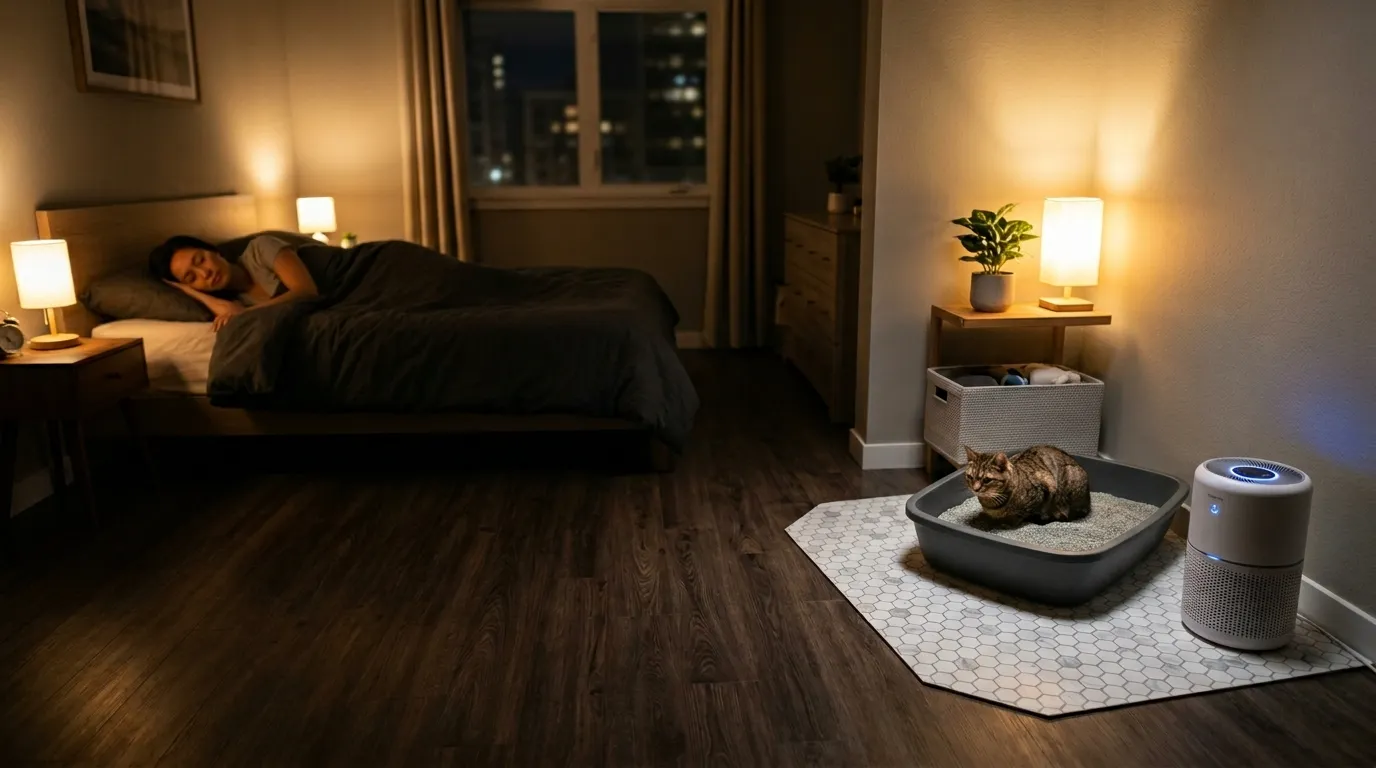
Yes and millions of apartment cat owners already do it every night. The real question isn’t whether it’s possible. It’s whether it wrecks your sleep, affects your health, or pushes your cat to go somewhere else in the apartment instead. I kept a litter box in my own bedroom for three years in a studio with no other option, and it worked once I understood what actually makes the setup safe. This guide covers the honest answer, the four conditions that make a bedroom litter box work, how it stacks up against other rooms, and who should skip it entirely.
You can put a litter box in the bedroom when no better option exists. Keep it at least six feet from the bed, scoop every night, run a HEPA-carbon air purifier nearby, and crack a window for airflow. It’s not the ideal spot, but that setup works for most healthy adults who meet those four conditions. Pregnant people and anyone immunocompromised should not keep a litter box in the bedroom, full stop.
Can You Put a Litter Box in the Bedroom Without Losing Sleep?

Most owners can keep a bedroom litter box without sleep trouble, as long as placement is right and the cat isn’t an aggressive overnight digger. Two problems tend to show up: digging noise during nighttime elimination, and ammonia building up in a closed room by morning. Both are fixable.
Litter digging noise depends almost entirely on your specific cat. Some step in, go, and step out in under thirty seconds. Others spend ninety seconds excavating what looks like a small dig site. A vigorous digger paired with a light sleeper makes bedroom placement much harder to sustain, no matter how far the box sits from the bed.
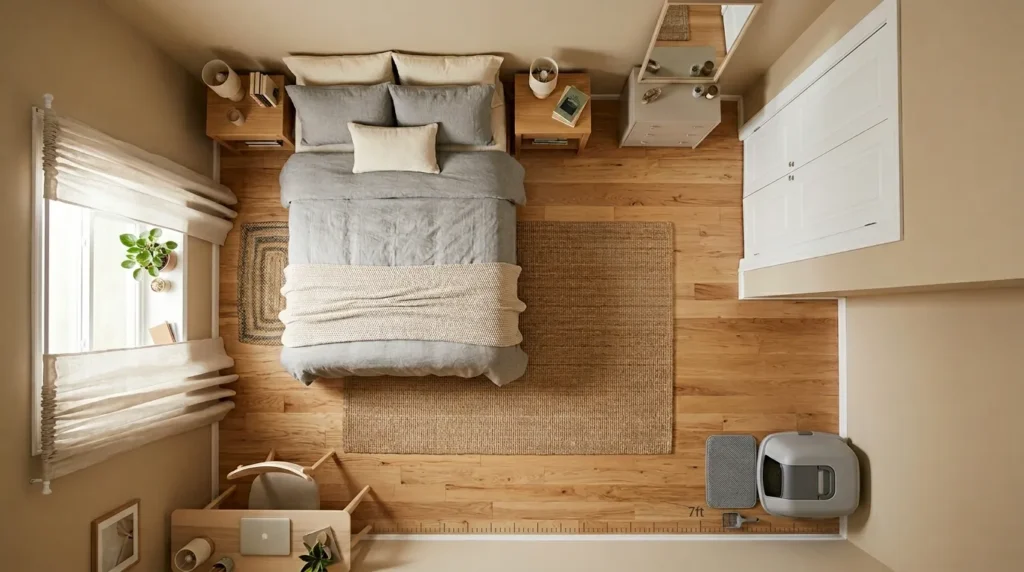
Six feet of distance between the box and your headboard handles the ammonia issue. At that range, ammonia from normal daily use drops below what most sleeping adults notice, given basic airflow in the room. Under three feet, overnight ammonia sits right in your breathing zone for hours. Owners who ask can you put a litter box in the bedroom, then park it next to the nightstand, often end up with morning headaches they can’t quite explain. Box distance is almost always the reason.
Insight: nighttime digging is the harder problem to fix if your cat is a vigorous scraper. Distance from the bed handles odor, but does nothing for sound. If digging wakes you up regularly, that cat and that bedroom aren’t a match, no matter how well you’ve dialed in the rest of the setup. Move the box and get your sleep back.
The Real Health Risks: Who Should Never Keep a Litter Box in the Bedroom?
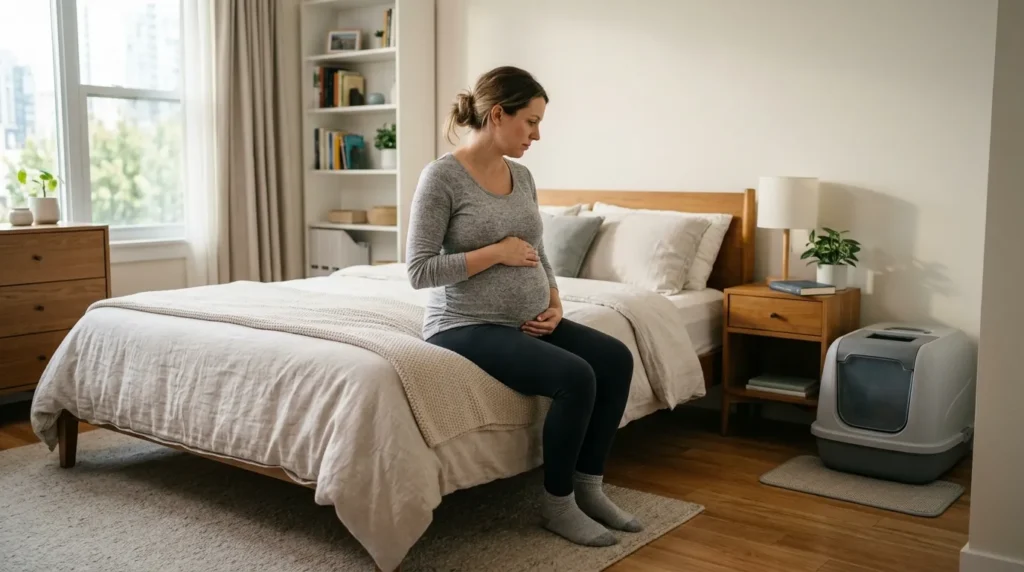
Can a litter box in the bedroom be safe? For most healthy adults, yes. For three specific groups, the answer is a firm no, and knowing which side of that line you fall on matters more than anything else in this guide.
Three real risks come up with bedroom litter boxes: ammonia exposure, airborne bacteria, and Toxoplasma gondii, the parasite behind toxoplasmosis. Healthy adults who scoop daily and keep the room ventilated see minimal impact from all three. The math changes for pregnant people, immunocompromised individuals, and anyone managing asthma or a chronic respiratory condition.
On ammonia, most people first notice the smell around 5 parts per million, while OSHA sets its workplace exposure limit at 50 ppm over an eight-hour shift. A scooped box with airflow stays nowhere near industrial levels, but that 5 ppm detection point explains why a stale, unscooped box in a closed bedroom can trigger a headache before you consciously register the smell. If mild breathing symptoms or headaches show up after a few nights, flag that to your doctor rather than pushing through it, especially if you already manage a respiratory condition. Our indoor cat health guide covers the broader basics worth knowing as an apartment owner.
Toxoplasmosis is the most serious risk tied specifically to bedroom placement, and exposure time is why. You spend roughly eight hours a night in that room. A box in a closed bedroom during those hours means breathing the same air as fresh and disturbed litter for a third of your day. The Centers for Disease Control and Prevention advises pregnant people to avoid litter boxes entirely, or to wear gloves and wash hands thoroughly when handling them. Sleeping in a room with a litter box works against that guidance directly, since it extends exposure time instead of limiting it.
If you’re pregnant and wondering can you put a litter box in the bedroom, treat that as a no regardless of distance or cleaning schedule. Same goes if you’re immunocompromised from HIV treatment, chemotherapy, or organ transplant medication. For everyone else, the risk stays small and manageable with the right setup.
The 4 Conditions That Make a Bedroom Litter Box Work
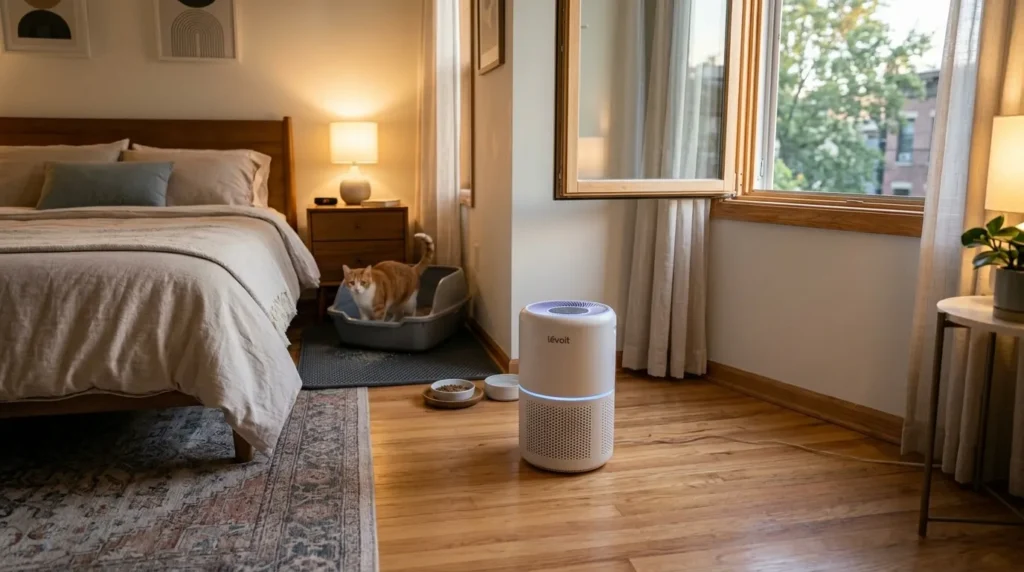
Whether you can put a litter box in the bedroom is only half the question. Whether you can set it up correctly is the other half. Meet these four conditions together and the setup holds. Skip one and the exact problem it was preventing shows up within weeks.
| Condition | What to Do | Why It Matters |
|---|---|---|
| Distance from bed | Minimum six feet from the headboard, ideally the corner furthest from your pillow | Keeps ammonia below the level most adults detect during sleep |
| Scooping schedule | Scoop every night as part of your bedtime routine, not the next morning | An eight-hour-old scooped box releases far less ammonia than one left all day |
| Air purifier | HEPA filter plus carbon filter, running continuously within three feet of the box | HEPA traps particles, carbon absorbs ammonia gas; you need both |
| Ventilation | Crack a window at least one inch overnight | Stops ammonia from pooling in a sealed room while you sleep |
On distance: put the box in the bedroom corner furthest from where you sleep. In a genuinely small bedroom, that sometimes means the foot-of-bed wall opposite your pillow, which still clears the six-foot minimum even when total floor space is tight. This is a familiar constraint for anyone keeping a cat in a small apartment, where every room ends up doing double duty.
On the purifier: the HEPA layer catches airborne particles, and the carbon layer absorbs ammonia gas. They solve different problems, so HEPA alone leaves ammonia unmanaged. Keep the unit within three feet of the box so it pulls air directly from the source rather than from across the room.
One workaround worth knowing: enclosed litter box furniture, the cabinet-style units with a side entry and vented panels, can hide the box visually without sealing in odor the way a plastic hood does. Look for real airflow gaps, not just a solid box with a door on it.
For the full breakdown of litter box size, type, and depth, since all three affect how much odor your bedroom box actually produces, see our guide to indoor cat litter box setup.
The Litter Tracking Problem No One Mentions
Odor and noise get most of the attention, but tracked litter is the third issue that shows up fast once the box lives in your bedroom specifically: it ends up on your sheets. Carpet holds granules deep in the fibers where a quick sweep won’t catch them, so hard flooring or a washable rug under and around the box makes daily cleanup realistic. A textured trapper mat right outside the box catches most of what clings to paws before it reaches the rest of the room. Low-tracking clumping litter, the kind with rounder, heavier granules, also cuts down on the trail considerably compared to standard fine-grain litter.
Bedroom vs. Bathroom vs. Hallway: Where Should the Litter Box Actually Go?
Before committing to the bedroom, it helps to see how it stacks up against the other realistic options in a typical apartment. None of these locations is perfect. Each one trades one problem for another.
| Location | Noise at Night | Odor Control | Health Risk | Best For |
|---|---|---|---|---|
| Bedroom | Highest, depends on your cat’s digging habits | Manageable with purifier and ventilation | Higher exposure time, unsuitable for pregnant or immunocompromised people | Studios, senior cats, mobility-limited owners |
| Bathroom | Low, door usually closes it off | Good, tile floors and exhaust fans help | Low, minimal overnight exposure | Apartments with a spare or guest bathroom |
| Hallway or laundry closet | Low to moderate | Moderate, depends on airflow | Low | One-bedroom layouts with unused closet space |
| Living room corner | Low | Weak without daily scooping, guests will notice | Low | Multi-cat homes needing extra box coverage |
A bathroom or hallway placement beats the bedroom on nearly every metric except one: access. If your cat needs a box within a few steps, whether from age, a medical condition, or a nervous bladder, the bedroom wins on convenience even while it loses on air quality. Cats can also be picky about location for reasons that have nothing to do with cleanliness. Our indoor cat behavior guide explains why some cats avoid boxes placed in rooms carrying the strongest human scent, which is usually the bedroom.
Who Should Actually Use the Bedroom for the Litter Box?
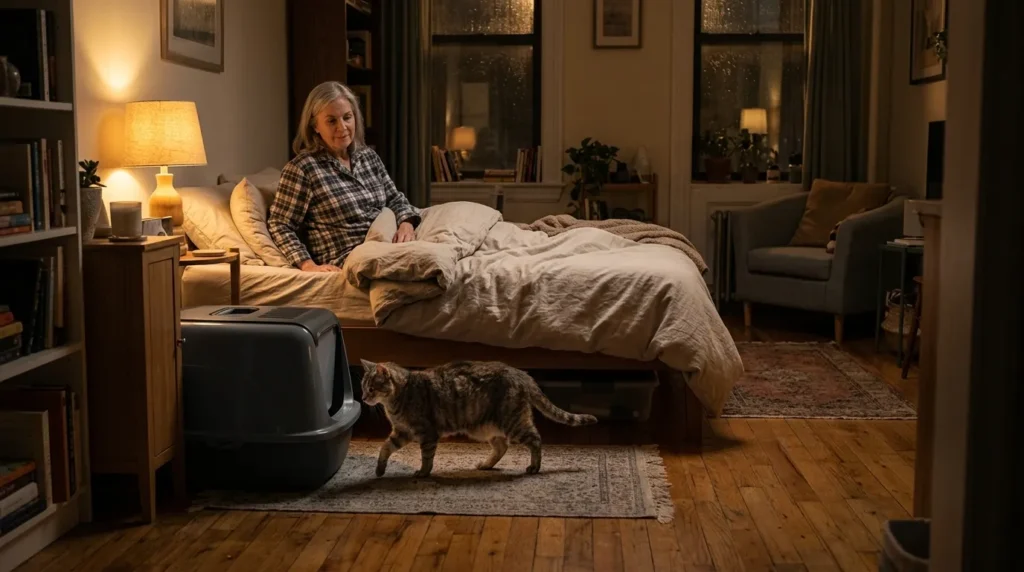
Can you put a litter box in the bedroom when there’s no real alternative? Yes, and in four situations it’s not a compromise. It’s the right call.
- Studio apartment owners often have no separate bathroom space that works, or one so small the box blocks the door from closing. The bedroom is the only open floor space, so the goal shifts from finding a better room to making the bedroom setup work.
- Owners of senior or mobility-limited cats benefit because an older cat with arthritis, or one recovering from surgery, may not reliably reach a distant box during a 3am need. Nighttime accidents go up when reaching the box means crossing the whole apartment. A nearby box removes that risk entirely.
- New kittens under four months old have small bladders and less warning time than adult cats. A bedroom box in those early weeks prevents accidents before the kitten has both the bladder control and the apartment layout memorized well enough to reach a distant box overnight.
- Owners with their own mobility limitations, who can’t move quickly through the apartment at night, face the same practical reasoning. A bedroom box here is a welfare accommodation, not a lifestyle choice.

Kitten owners in particular tend to relax the six-foot rule slightly in the first month, since supervised proximity matters more than distance at that stage. Once the kitten reliably uses the box, shift it further from the bed and bring in the full four-condition setup described above.
What If Your Partner or Roommate Doesn’t Want a Litter Box in the Bedroom?
This comes up more than the health questions do in practice. If you share the bedroom with someone who’s unenthusiastic about the arrangement, the four conditions above are your negotiating tool as much as a health measure. A well-scooped, well-ventilated box with a purifier running is a genuinely different experience than the unscooped, hooded box most people picture when they hear “litter box in the bedroom.” Offering to handle all scooping duties yourself, and showing the setup actually meets the six-foot and ventilation rules, resolves a lot of these disagreements without anyone giving up the arrangement entirely. If it’s still a dealbreaker after a fair trial, the bathroom or a hallway closet, even with the access tradeoff, beats an ongoing conflict over shared space.
Bedroom Litter Box Mistakes That Undermine the Whole Setup
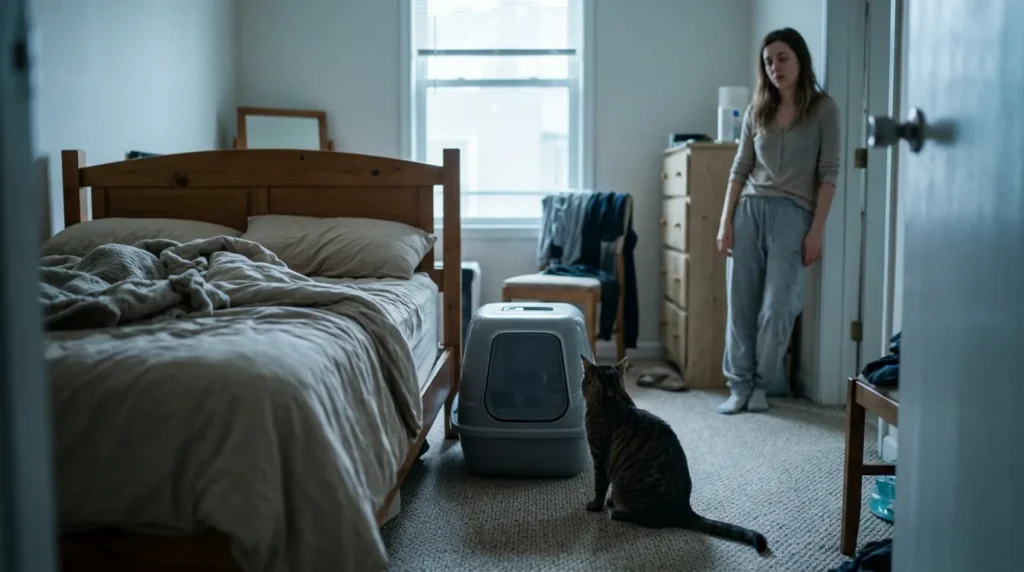
The most common mistake, once someone decides yes on the bedroom question, is choosing a covered box because it looks tidier. Covered boxes trap ammonia inside the hood instead of letting it dissipate where an air purifier can catch it. That trapped gas leaks out slowly all night at a steadier concentration than an open box produces. An open box paired with a running carbon-filter purifier beats a covered box without one in every air quality comparison.
The second mistake is placing the box within three feet of the bed because it fits neatly beside the nightstand or at the foot frame. That choice serves convenience, not air quality. Six feet is the floor, not a suggestion. If your room can’t fit that distance, the honest answer to can you put a litter box in the bedroom in your specific space is no, and the bathroom or hallway deserves a second look.
The third mistake is skipping the air purifier to save money. Most owners who try a bedroom setup without one abandon it within the first month as morning air quality gets worse. The purifier isn’t optional here. It’s what separates a bedroom box that works from one that quietly wears down your sleep for months before you connect the cause. Regular scooping habits also affect how fast odor builds between cleanings, which our guide on why a litter box still smells after cleaning breaks down in more detail.
Frequently Asked Questions
Can you put a litter box in the bedroom safely?
Yes, for most healthy adults, if you follow four conditions: six feet from the bed, nightly scooping, a HEPA-carbon air purifier running continuously, and a cracked window for airflow. Pregnant people and immunocompromised individuals should not sleep in a room with a litter box, regardless of how well it’s managed.
Does a litter box in the bedroom cause health problems?
For healthy adults with a correct setup and daily scooping, the health impact is minimal. Ammonia is the most common issue, and ventilation plus air purification manage it well. The real medical concern is Toxoplasma gondii, which is why pregnant people and immunocompromised individuals should avoid this arrangement entirely. Talk to your doctor if you have a respiratory condition before adding a litter box to your bedroom.
Will my cat use a bedroom litter box?
Most cats use bedroom boxes without issue. Some avoid boxes in rooms that carry heavy human scent, and the bedroom usually carries the strongest scent in the home. If your cat walks past the box to go elsewhere, move it to the bathroom for two weeks and watch whether the avoidance clears up before assuming the problem is cleanliness or size.
How far should the litter box be from my bed?
Six feet minimum between the box and the headboard. That distance keeps ammonia below what most adults detect during sleep, given basic ventilation. Under three feet puts the box in your direct breathing zone for eight hours and is the most common cause of morning headaches owners can’t otherwise explain.
What litter box type works best in a bedroom?
An open, high-sided box without a hood performs best. Open designs let ammonia dissipate into the room where a carbon-filter purifier can capture it, instead of concentrating inside a cover. Use unscented clumping litter at two to three inches deep so urine clumps within the litter and never touches the base of the box.
How many litter boxes does an apartment cat need?
The standard rule is one box per cat plus one extra, so a single cat still does best with two boxes in different locations. If you only have room for one, a well-ventilated bedroom box beats a single box that’s hard for your cat to reach.
Can a litter box in the bedroom trigger allergies?
Litter dust and ammonia can aggravate asthma or existing allergies for some people, especially with poor ventilation. Low-dust clumping litter, a HEPA-carbon purifier, and a cracked window reduce this for most healthy adults. Anyone with diagnosed asthma should check with a doctor before keeping the box in a sleeping room.
What if my partner or roommate doesn’t want a litter box in the bedroom?
Show them the actual setup, six feet of distance, nightly scooping, a purifier running, rather than the unscooped, hooded box most people picture. Taking over scooping duties yourself often resolves the objection. If it’s still a dealbreaker after a fair trial, moving to a bathroom or hallway closet is a reasonable compromise.
Conclusion
Can you put a litter box in the bedroom? Yes, when you meet four conditions: six feet from the bed, nightly scooping, a HEPA-carbon purifier running, and a cracked window for airflow. Pregnant people and immunocompromised individuals should skip this setup no matter how well it’s managed. Start by measuring the actual distance from your planned spot to your headboard. If six feet fits in your bedroom, the rest of the setup comes together fast.
This guide sits alongside our full indoor cat litter box setup guide under our Cat in Apartment pillar, with indoor cat behavior and indoor cat health as further reading for anything box-related that goes beyond placement alone.

Written by Mishu
A passionate cat lover and indoor living enthusiast, Mishu is the founder and voice behind Indoor Living Cat – a go-to resource for cat owners who want to create the happiest, healthiest life for their feline companions indoors.
View Full Profile