
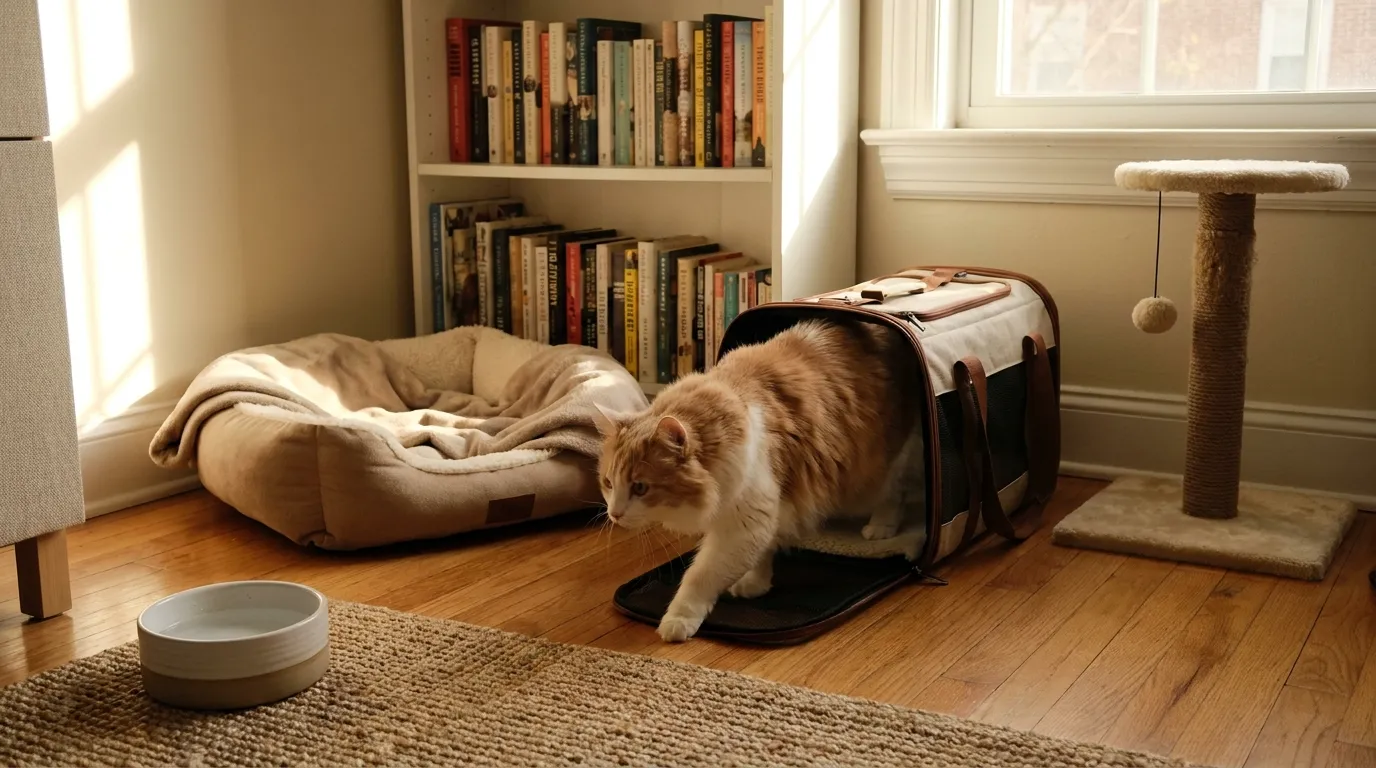
Most people think introducing a new cat to your cat means opening the carrier door and letting the two of them sort it out. Then they spend six months wondering why their cats hiss every time they share a room. A real introduction is a territorial negotiation that happens through scent long before the cats ever see each other, and the whole process lives or dies by how much patience you bring to it. I learned this the hard way after bringing home my second cat too fast. My resident cat stress-marked every doorframe in the apartment within two days. This guide walks through every phase of how to introduce a new cat to your cat and to your home, so you can skip that mistake entirely.
To introduce a new cat to your cat, confine the new cat to a single base camp room for the first three to seven days, then swap scents between the two cats before any face-to-face contact. Work through barrier feeding and visual-only contact before you allow a supervised in-person meeting. The full process takes two to four weeks minimum, and a shy or rescue cat can take longer.
New Cat Meeting Your Resident Cat, or Cat Moving Into a Brand New Home?
These are two different situations, and the fix depends on which one you’re in. If you already have a cat and you’re bringing a second cat into the house, the work is almost entirely about scent and territory between the two animals, which is what most of this guide covers below. If you’re moving a single cat (yours or a new adoption) into a new home with no other pets, the challenge is different: it’s about the cat adjusting to an unfamiliar space, not about negotiating with another cat. That scenario gets its own section further down, with a checklist built for it.
Setting Up the Base Camp First
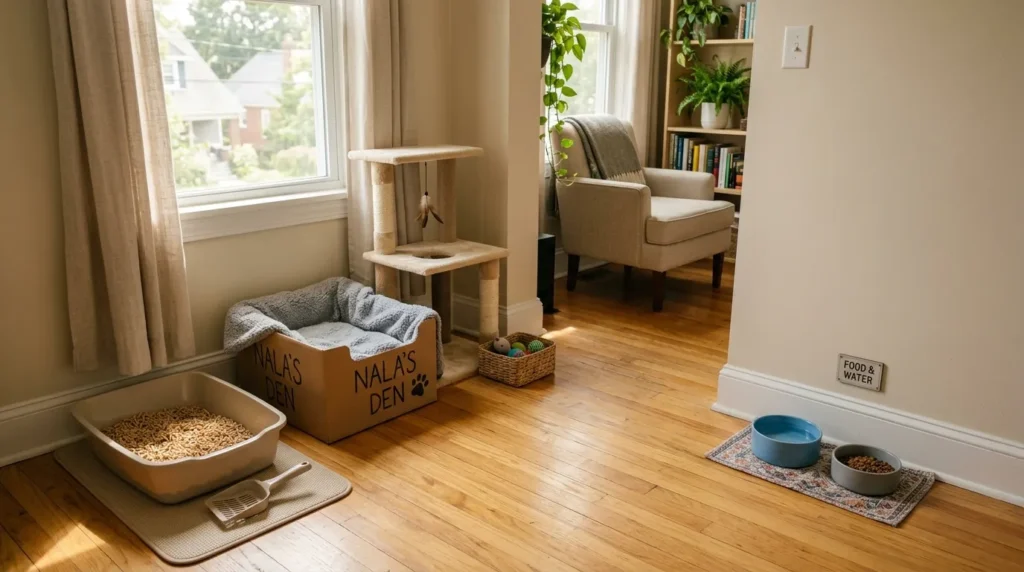
A base camp is a single room where the new cat spends their first days or weeks before they get access to the rest of the home. This is the foundation of the whole introduction, and skipping it is the single most common reason introductions fail. Cats process new environments in small, manageable pieces, not all at once, and a base camp gives your new cat exactly that.
Pick a room your resident cat doesn’t use much. A guest bedroom or a second bathroom works for most apartments. Set it up before the new cat arrives: litter box on one side, food and water on the opposite side from the box, and a hiding spot like a cardboard box with a blanket inside. Add a small cat tree or a shelf too. Vertical space matters for a cat’s sense of security even in a room this small.
Keep the door closed for at least the first three days. This protects the new cat from an overwhelming first look at the whole apartment, and it protects your resident cat’s territory from being invaded all at once. Both cats need that boundary, even if it feels restrictive to you.
Scent Swapping: The Step Most People Skip
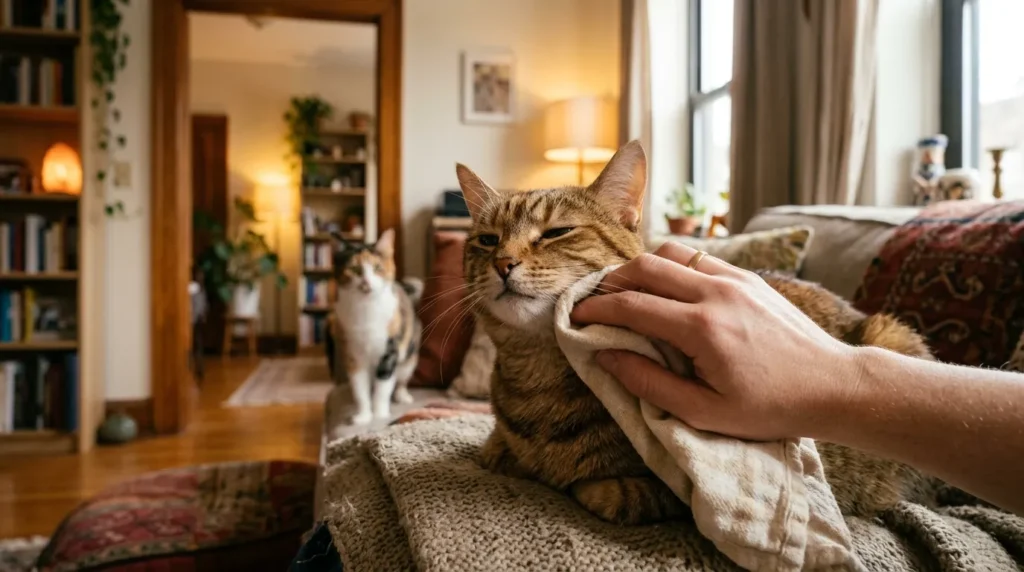
Scent swapping means moving each cat’s scent into the other’s space before there’s any visual or physical contact. Cats read who’s safe and who’s a threat almost entirely through smell. Introducing a scent gradually is a lot less stressful for both animals than introducing a body all at once.
Take a soft cloth or a clean sock and rub it gently along the new cat’s cheeks and chin, where the scent glands sit. Place that cloth in the common areas where your resident cat spends time. Do the same thing in reverse: rub a cloth on the resident cat and leave it in the base camp room near the new cat’s sleeping spot.
Put a small treat on each scented cloth the first time you introduce it. That builds a positive association between the other cat’s smell and something good, and it’s exactly the bridge you need before any face-to-face meeting happens. Swap in fresh cloths every two to three days for the rest of the introduction.
If there’s no resident cat and you’re moving a cat into a new home on its own, the same trick still works. Leave a t-shirt you’ve worn near the new cat’s sleeping spot. It helps the cat connect your scent with the safety of that resting area before you’ve even had much physical contact.
Site Swapping: Let Each Cat Map the Territory Safely
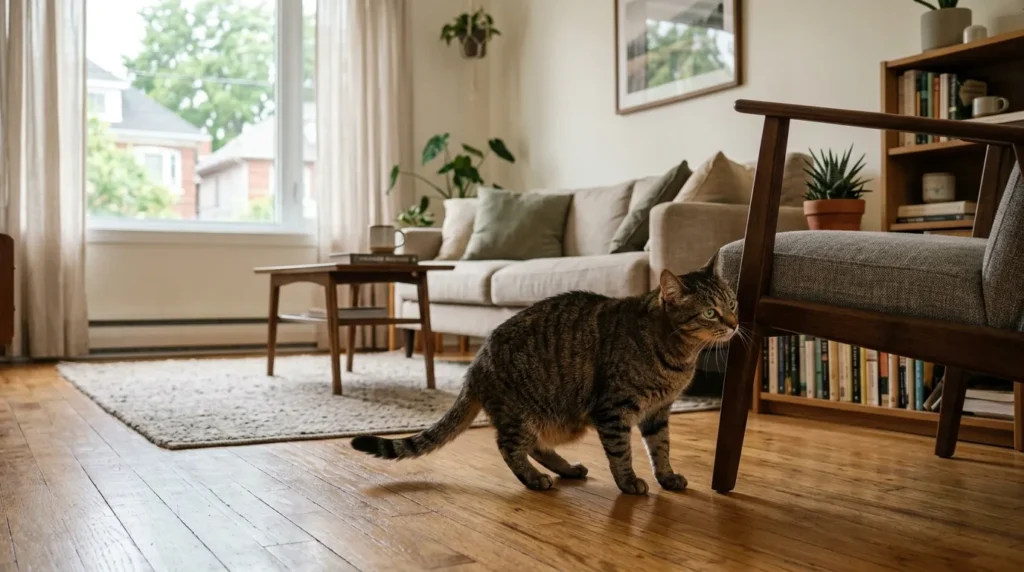
Site swapping means temporarily switching which cat has access to which space. Once your new cat is comfortable in the base camp, usually after three to five days, confine the resident cat to a back room and let the new cat explore the rest of the home for 30 to 60 minutes.
This gives the new cat a chance to sniff every corner of the apartment and leave their own scent there without any risk of a face-to-face run-in. At the same time, it exposes the resident cat to the new cat’s growing scent in what used to be their space alone, while the two stay physically separated. Each swap makes the other cat’s scent more familiar and more tied to ordinary household life.
Run site swapping once or twice a day for two to three days before you move to the next phase. You’ll probably notice the resident cat sniffing the floor hard when they come back from a swap session. That’s them reading the scent trail and updating their mental map of the territory, no confrontation required.
Barrier Feeding: Using Food to Build a Positive Association
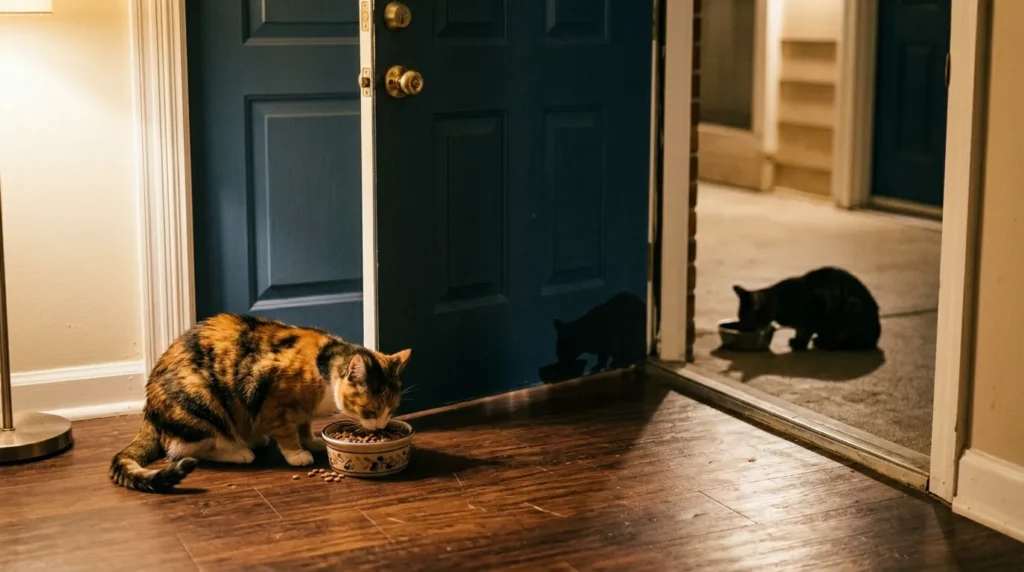
Barrier feeding is the phase where both cats eat on opposite sides of the closed base camp door at the same time. Every time your cats smell each other, they’re also eating something they enjoy, and that pairing shifts their threat response toward neutral, or even positive.

Start with the bowls several feet from the door on each side. If either cat stops eating, growls, or walks away, the bowls are too close. Move them back and try again the next meal. Gradually shift each bowl about an inch closer to the door every day or two until both cats eat calmly right at the door.
Once both cats eat confidently within a few inches of the closed door with no tension, you’ve hit a real milestone. It usually takes three to seven days to get there, depending on how reactive each individual cat is. Don’t rush this phase. It’s doing real work on how each cat’s brain files the other one away.
According to the American Association of Feline Practitioners, barrier feeding paired with controlled scent introduction is the evidence-based protocol for introducing cats in shared indoor environments. A steady indoor cat behavior routine around feeding times makes this phase easier to manage.
Controlled Visual Contact: The Crack-of-the-Door Meeting
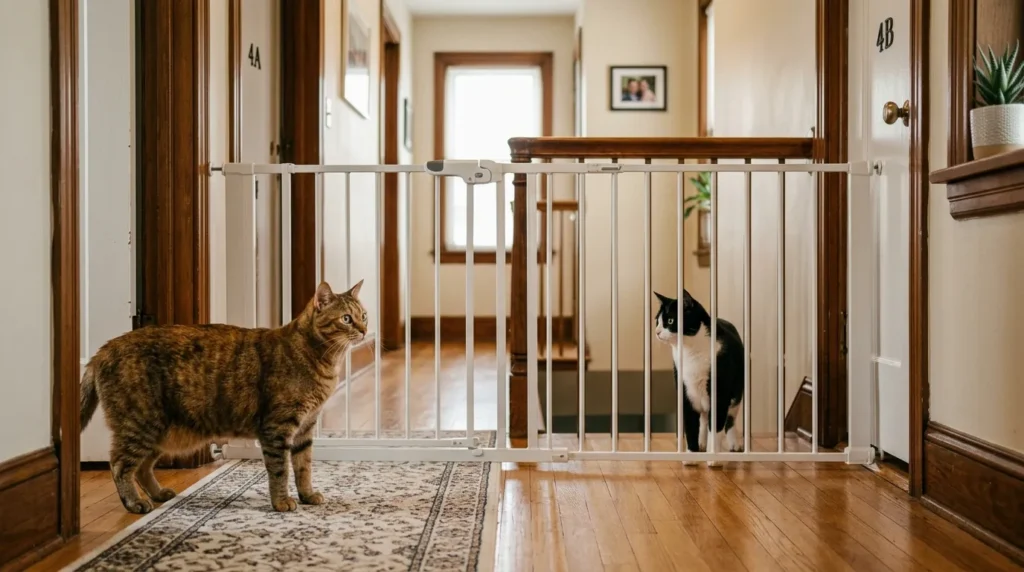
Controlled visual contact happens before the cats share any physical space. Use a baby gate, a door cracked open a few inches and held with a doorstop, or a screen door if your apartment has one. Let both cats see each other for short sessions, two to five minutes, while they stay fully separated.
Watch body language closely during every session. Curiosity looks like a forward-leaning posture, relaxed ears, and a tail held up or gently waving. A threat posture looks like a low crouch, a puffed tail, flattened ears, and a fixed, unblinking stare. If you see threat signals from either cat, close the barrier right away and go back to barrier feeding for another day or two before you try again.
Keep high-value treats on hand during these sessions. The moment either cat glances away from the other cat and toward you, reward it. You’re building the habit that looking away from the other cat pays off, which is the exact pattern you want in place before they share a room.
Real Talk: If there’s hissing during the first visual session, don’t panic and don’t pull back completely. One hiss is communication, not a declaration of war. Separate them calmly, wait a day, and try again with a smaller gap. Two cats that hiss at each other through a baby gate almost always end up coexisting fine, as long as you don’t rush the rest of the process.
The First Face-to-Face Meeting in a Neutral Space
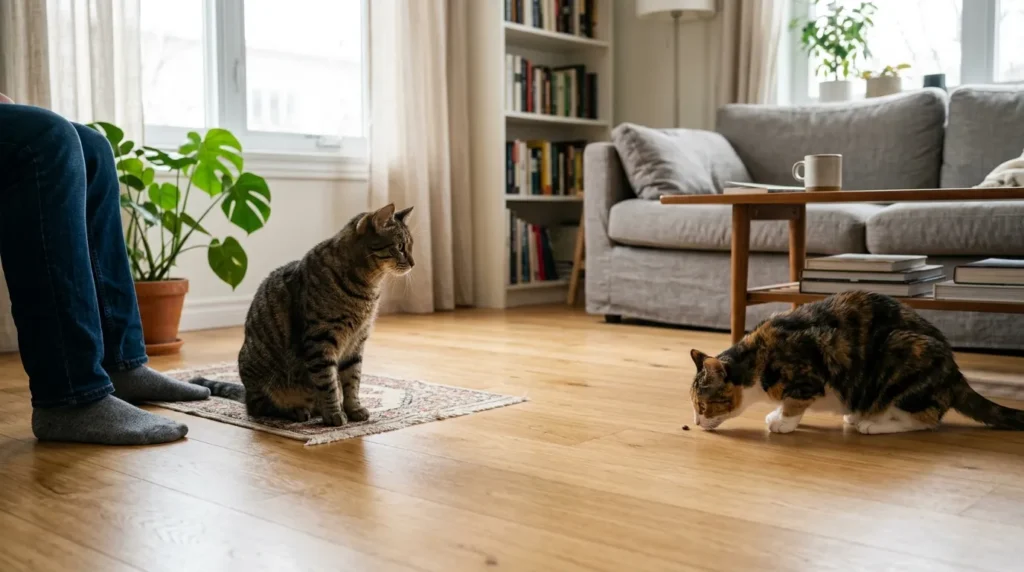
The first in-person meeting should happen somewhere neither cat treats as home turf. In most apartments that’s the living room or a hallway, not the bedroom or the base camp room. Keep it to ten or fifteen minutes, and have a large piece of cardboard within reach so you can slide it between the cats if tension spikes. It breaks their line of sight instantly, no physical contact with either animal needed.
Run a wand toy during the meeting. A cat that’s actively playing has their predatory focus on the toy instead of the other cat, and that redirection keeps the energy in the room positive during the first high-stakes minutes. Short bursts of play also burn off stress energy that might otherwise come out as aggression.
End the session before anything goes wrong. This is the hard part, because it’s tempting to let a calm session run long. Short, positive sessions build more trust over time than one long session that ends in a hiss-fest. Put the new cat back in the base camp, then try again the next day for a little longer.
Real Talk: Keep a second litter box in a common area during the integration phase. A cat under social stress will sometimes avoid a box that smells strongly of the other cat. Two boxes remove that trigger and head off stress-related accidents that owners often mistake for territorial marking.
The Biggest Mistake That Derails Every Cat Introduction
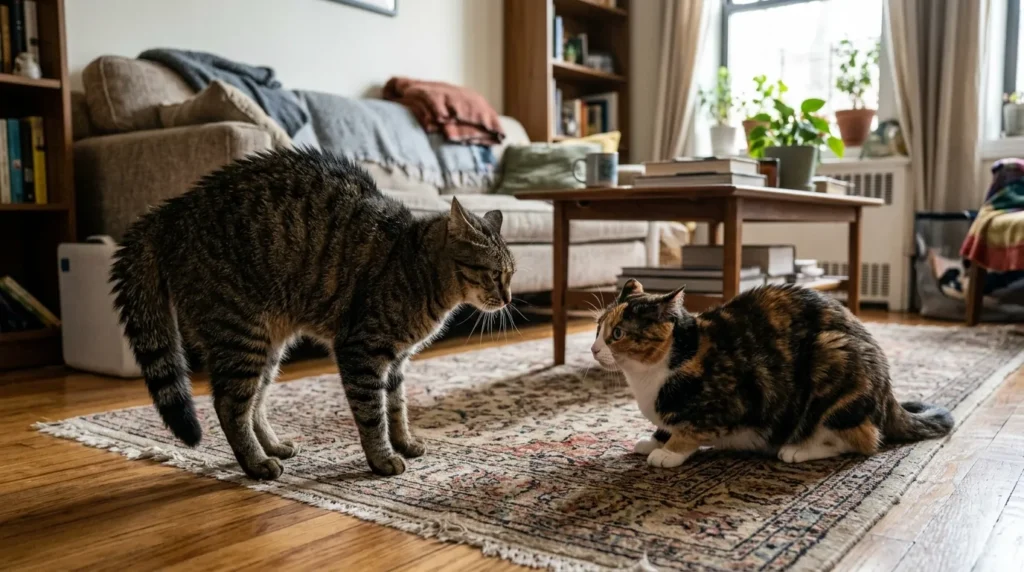
The most common mistake is moving too fast because things seem to be going well. Both cats eat on opposite sides of the door with no hissing, so you open it all the way on day five. One cat chases the other under the bed, and two weeks of progress is gone in thirty seconds.
Introductions almost always go wrong in the forward direction, not from lack of effort. Owners do the work, then skip a phase because the cats look comfortable. Looking comfortable during a managed phase isn’t the same as being ready for the next one. The only real test of readiness is the next phase itself, taken at the right pace, not two steps at a time.
If a fight happens, separate the cats right away and go back to barrier feeding from the start. It feels like failure, but it’s just a reset. The scent familiarity the cats already built doesn’t vanish because of one bad incident, and the second run through the phases almost always moves faster than the first.
| Introduction Scenario | Expected Timeline | Primary Focus |
| Kitten joining adult cat | 1 to 2 weeks | Managing energy mismatch |
| Adult to adult | 2 to 4 weeks | Respecting established territories |
| Shy rescue to any home | 4 weeks or more | Confidence before social exposure |
| Single cat, no other pets | 1 to 2 weeks | Room-by-room expansion, not cat negotiation |
Introducing a Cat to a Brand New Home With No Other Pets
[Image placeholder: a single cat exploring one room of a new apartment on moving day, boxes still in the background]
This is a different job than introducing two cats to each other. There’s no resident cat to negotiate with, so the entire focus is on helping one cat adjust to unfamiliar walls, sounds, and smells without another animal’s territory to worry about. That’s true whether the cat is a brand new adoption or your longtime cat coming into a new apartment with you after a move.
Set up one room first, the same way you would a base camp, with a litter box, food and water, a bed, and a few familiar objects that smell like the cat’s old space (a blanket, a scratcher, a favorite toy). Let the cat stay in that single room, door closed, for the first day or two. A cat that’s dropped into a wide open new home right away often bolts for the nearest gap under a couch and stays there for days.
Expanding the Cat’s Territory Room by Room
Once the cat is eating normally, using the litter box, and coming out to explore that one room on their own, open the door to one adjoining room at a time. Don’t open the whole apartment at once. Give the cat a day or two in each new space before adding the next one. Watch for relaxed body language (a raised tail, normal eating, rubbing against furniture) before expanding further.
Moving Day Checklist
- Set up the safe room with litter, food, water, and bedding before the cat arrives
- Bring at least one item that already smells like the cat, not something brand new
- Keep the carrier in the room for a day or two as an extra hiding spot, rather than putting it away immediately
- Skip the house tour on day one. Let the cat choose when to explore
- Hold off on visitors and loud activity for the first week
- Stick to the cat’s existing feeding schedule if you can. New environment, familiar routine
Most cats settle into a new home with no other pets inside one to two weeks. A cat with a more anxious temperament, or one coming from a shelter with an unknown history, can take three to four weeks to act fully at ease. If a cat is still hiding around the clock and refusing food past 48 hours, that’s worth a call to your vet, not just more patience.
Step-by-Step Introduction Checklist
[Image placeholder: a simple printable checklist graphic listing the phases below in order]
If you want the whole process on one page, here’s the order, start to finish:
- Days 1 to 3: Base camp only. Door closed. No visual contact.
- Days 2 to 5: Scent swapping with cloths, fresh ones every two to three days.
- Days 3 to 7: Site swapping, one to two sessions a day, 30 to 60 minutes each.
- Days 5 to 12: Barrier feeding, bowls moving an inch closer to the door every day or two.
- Days 10 to 16: Controlled visual contact through a gate or cracked door, two to five minutes at a time.
- Days 14 to 21: First face-to-face meeting in neutral territory, ten to fifteen minutes, wand toy in hand.
- Days 21 to 28+: Repeat and extend supervised meetings until the cats can share a room unsupervised.
These ranges overlap on purpose. Move to the next phase when the cats are ready, not because a calendar says so. A cat that’s still hissing through the door on day ten stays on barrier feeding until that stops, even if it takes an extra week.
FAQ
How do I introduce a new cat to my other cat?
Start with a closed-door base camp for the new cat, swap scents with a cloth every two to three days, then move to barrier feeding once both cats tolerate the scent swap. Only add visual contact through a gate once feeding goes smoothly, and save the first in-person meeting for last. Rushing any of those steps is what causes most fights.
How long does it take to introduce a new cat to your home?
For a single-cat home with no resident pet, plan on two to three weeks. With a resident cat already in the house, plan on two to four weeks minimum, longer for a shy or rescued cat.
Can I introduce a new cat without a separate room?
In a very small apartment, use a bathroom as the base camp. Even a small enclosed space works, as long as it has its own litter box and food station kept apart from the resident cat’s setup.
How do I know the cats are ready to meet face to face?
Both cats eat calmly within a few inches of the closed door, and neither one hisses or growls during visual contact sessions through the gate. Those two milestones together mean it’s time.
Is it normal for my resident cat to hiss at a new cat through the door?
Yes. Hissing through a closed door is normal territorial communication, not aggression. It usually fades within a week as the scents get more familiar.
What do I do if the cats fight during introduction?
Separate them right away without stepping between them physically. Use a blanket or a piece of cardboard as a barrier instead. Wait 24 to 48 hours, then restart from barrier feeding. Don’t jump back to visual contact too soon.
How do I introduce a new cat to home with a dog?
Keep the cat’s base camp in a room the dog can’t get into. Run scent swapping the same way you would with another cat. For the first visual contact, keep the dog on a leash and let the cat stay on an elevated surface above floor level, where they’ll feel safer.
What’s different about introducing a cat to a new home versus introducing it to another cat?
Moving a single cat into a new home with no other pets is about that one cat adjusting to unfamiliar space, room by room, on their own timeline. Introducing a new cat to a resident cat adds a second layer: two animals negotiating shared territory through scent before they ever meet. The room-by-room approach in this guide’s new-home section works for the first case. The full base camp, scent swap, and barrier feeding sequence is built for the second.
The most important things to take away: set up the base camp before the cat arrives, swap scents before any visual contact, and use barrier feeding to build a positive association between both cats’ scents. Don’t rush any phase, and don’t read apparent calm as a green light to skip ahead. Follow the sequence and most cats reach comfortable coexistence within a month. Once your new cat is settled in and confident, new indoor cat covers the enrichment routine and daily structure that keeps a multi-cat home running smoothly for the long haul.
Introducing a new cat to your cat or to your home requires a phased approach starting with a base camp room for three to seven days, followed by scent swapping using cloths rubbed on each cat’s cheek glands. Barrier feeding on opposite sides of a closed door builds a positive association between the cats’ scents over three to seven additional days. Controlled visual contact through a baby gate comes before any in-person meeting. Full cat-to-cat introductions in small apartments typically take two to four weeks. A single cat moving into a new home with no other pets follows a different, shorter process built around room-by-room expansion rather than scent negotiation between animals, usually one to two weeks. Rushing any phase by more than one step is the primary cause of aggression and territorial conflict between newly introduced cats.

Written by Mishu
A passionate cat lover and indoor living enthusiast, Mishu is the founder and voice behind Indoor Living Cat – a go-to resource for cat owners who want to create the happiest, healthiest life for their feline companions indoors.
View Full Profile