

Yes, a new cat hiding all day is normal. You set up the food bowls, brought your new cat home, and they were under the bed before the carrier door finished opening. It’s day two now and you haven’t seen them since. That’s not a bad sign. It’s the same instinct that kept wild cats alive in unfamiliar territory, and right now it’s pressing your cat against the back wall of your wardrobe.
My own rescue cat stayed out of sight for five straight days. What worked wasn’t coaxing her out. It was leaving a worn hoodie near her hiding spot and otherwise leaving her alone. This guide covers the full timeline, how to tell healthy hiding from real distress, and what actually helps without slowing things down.
Quick answer: A new cat hiding all day for the first three to seven days is normal feline decompression. If the litter box and food bowl show activity overnight, your cat is adjusting on schedule. Give them one quiet room, stop trying to coax them out, and check for progress once a day instead of checking on them constantly.
New Cat Hiding All Day: Why This Is Exactly What Should Happen

A new cat hiding all day is a biological response to unfamiliar territory, not a personality flaw and not a sign the adoption went wrong. Cats are predator and prey at once, so their nervous system treats a new environment the way it would treat real danger. It gathers information before it commits to anything.
Behaviorists call this feline decompression. Almost every cat goes through some version of it after a move. Your cat isn’t sulking and isn’t rejecting you. They’re running a full audit of your home from the one spot where nothing can surprise them from behind.
The first 72 hours are usually the hardest to watch. Most cats won’t eat, drink, or use the litter box until the apartment goes quiet, often around 3am once every perceived threat has stopped moving. A cat eating and using the box in the middle of the night is adjusting exactly the way nature built them to.
This pattern shows up across almost every area of indoor cat behavior, not just hiding. New cats tend to hold back on eating, playing, and using the litter box until the space feels safe. A slow start in one area usually means a slow start everywhere else too. If you want the fuller picture of what a new indoor cat’s first weeks look like beyond just the hiding phase, our complete guide to bringing home a new indoor cat is the pillar page this article sits under.
The First 24 Hours: What a Normal First Night Looks Like
The first night is the one most new owners remember the most and understand the least. Set the cat up in their room, close the door, and turn the lights down before you leave the carrier open on its side. Most cats won’t move until the house goes quiet.
Here’s what’s normal in that first stretch, hour by hour:
- First 1 to 2 hours: The cat stays in or right next to the carrier. Some cats bolt straight for the nearest gap under furniture. Both are fine.
- Hours 2 to 8: Silence. No eating, no litter box use, sometimes no visible movement at all. This is the cat listening, not sulking.
- Overnight: Once the house is still, most cats make their first move toward food, water, or the litter box. You’ll usually see the evidence in the morning, not the act itself.
- Next morning: Don’t be surprised if the cat is back in the exact same hiding spot as the night before. That’s a repeat of a safe pattern, not a setback.
Skip the temptation to open the door and check every hour. A closed door and a dark, quiet room do more in the first night than any toy or treat will.
New Cat Hiding Timeline: What to Expect Day by Day

Most cats follow a predictable arc through the hiding phase, though the exact timing varies by cat. Knowing what each stage looks like stops you from mistaking normal progress for a problem.

Days one through three are pure decompression. The cat disappears and you may hear nothing at all. New owners often panic here, but everything happening is on track. Your cat listens to your home, maps your routine by sound, and builds a mental picture of the space through scent.
Days four through seven bring what I call the periscope phase. You might catch a head appearing around a doorframe when the room goes still. The food bowl starts coming back empty overnight. The litter box shows use. These are real milestones, even if your cat still stays out of sight during the day.
By week two, most cats start sharing the same room as you while keeping their distance. They may sit in a doorway and watch, or only come out once you’re seated and still. This happens on its own, without any dramatic effort from you.
| Timeframe | Typical Behavior | What It Means |
| Days 1 to 3 | Total disappearance, silent | Normal decompression, do nothing |
| Days 4 to 7 | Peeking, nighttime activity | Confidence is building |
| Week 2 | Sharing a room, watching from a distance | Active adjustment underway |
| Week 3 and beyond | Open-space resting, approaching you | Integration beginning |
Cat Hiding After a Move Versus a New Adoption
Not everyone reading this just adopted. Some of you moved apartments with a cat you’ve had for years, and the hiding caught you off guard just the same. The mechanism is identical: unfamiliar space, same decompression response. The timeline, though, usually runs shorter.
An established cat already trusts you and already knows your voice and your routine. That trust carries over even when the walls don’t look right yet. Most cats who move homes with an existing owner settle within a few days to a week, not the two to six weeks a shelter cat might need.
The setup still matters. Bring the cat’s old litter box, bed, and food bowls into the new place unwashed for the first week. Familiar smells shrink the adjustment period more than any new gear you could buy.
Does Every Cat Hide the Same Amount? Personality, Age, and History Matter
Not every new cat hides the same way, and the timeline above is an average, not a rule. A confident kitten from a calm foster home might explore within hours. A senior cat pulled from a hoarding situation might need six weeks. The difference usually comes down to three things: age, socialization history, and how the move itself happened.
| Cat Type | Typical Hiding Length | Why |
| Confident kitten, well socialized | A few hours to 2 days | Less developed fear response, high curiosity drive |
| Average adult cat, home to home | 3 to 7 days | Standard decompression period |
| Shy or naturally cautious cat | 1 to 3 weeks | Slower to trust new stimuli by temperament |
| Shelter or stray with limited human contact | 2 to 6 weeks | Little prior trust built with people |
| Cat with a known trauma history | Up to 6 weeks or more | Needs a slower, structured introduction |
None of these timelines mean something is wrong. They mean different cats need different amounts of evidence before they decide a home is safe. A shy cat isn’t broken and a fast explorer isn’t automatically better adjusted long term. Slower cats often build deeper trust once it finally clicks.
Kittens Versus Adult Cats: Why the Hiding Phase Looks Different
Kittens usually skip most of the hiding phase entirely, and that surprises a lot of new owners who braced for weeks of no contact. Their fear response isn’t fully developed yet, so curiosity tends to win out faster. A kitten might explore the whole room within a few hours, even if it darts back to a hiding spot the second something startles it.
Adult cats carry more history into the move. An adult cat has learned, correctly or not, that new environments can go badly. That caution is earned, not stubbornness. Senior cats often fall somewhere in between: less driven by curiosity than a kitten, but sometimes faster to settle than a young adult because they’ve been through more moves before and have a template for what “safe” ends up looking like.
Healthy Hiding vs Stress Hiding: How to Tell the Difference

Healthy shy cat behavior and genuine distress hiding look different once you know what to check, and you can check most of it without disturbing your cat at all.
| Sign | Healthy Hiding | Stress Hiding |
| Body position | Loaf position, paws tucked | Flat to the floor, tense |
| Eyes | Slow blinking, half closed | Wide, fixed, unblinking |
| Ears | Relaxed or forward | Pinned flat back |
| Sound | Silent or occasional soft meow | Constant low crying, repeated meows |
| Litter box | Used overnight, daily | No use for 48 hours or more |

The litter box is the single most reliable progress indicator during the hiding phase. If it shows use every day, your cat is adjusting well no matter how little you actually see them. No use at all in 48 hours points to a medically unwell cat, or one too stressed to leave the hiding spot, and either one needs a closer look. Our guide to indoor cat litter box setup mistakes covers placement and cleanliness issues that can slow a nervous cat down even more than the move itself, and it’s part of the same indoor cat behavior sub-pillar as this article.
Any distress vocalizing from the hiding spot, meaning constant low crying or repeated short meows with no clear cause, means the environment is too much right now. Shrink it down to one small room immediately.
According to the ASPCA, confining a new cat to a single room during the first week is one of the most effective ways to lower the stress load driving extreme hiding. Less space means less to process. The Cornell Feline Health Center notes that scent-based familiarity, not visual contact, is what convinces a cat a space is safe. That’s why a worn t-shirt does more work than sitting and staring at the hiding spot.
Room Setup Checklist for a New Cat’s First Week
A good setup does more to shorten the hiding phase than anything you say or do once the cat is already home. Run through this before the carrier comes through the door:
- One small room with a door that closes, not the whole house or apartment
- Litter box placed away from the food and water, at least a few feet apart
- Water bowl and food bowl near the hiding spot entrance, not right next to it
- Under-bed access blocked before the cat arrives, if a bed is in the room
- At least one covered hiding option already in place: a box, a covered bed, or a carrier with the door left open
- A worn piece of your clothing placed in or near the hiding option
- A pheromone diffuser plugged in, ideally a day or two before arrival
- No other pets or unfamiliar people allowed into the room for the first few days
Quick Reference: Do This, Not That
| Situation | Do | Don’t |
| First 72 hours | Give one small, quiet room | Give the run of the whole house |
| Checking on the cat | Glance in once or twice a day | Check hourly with a flashlight or phone |
| Food and water | Place near the hiding spot entrance | Force the bowl right next to the cat |
| Other pets | Wait until eating and litter use are normal | Introduce them on day one |
| Under the bed | Block it, offer a box instead | Leave it as the only option |
The Under-Bed Trap and Why You Should Block It

Under the bed is the default hiding spot for almost every new cat, and it’s also the worst place for bonding. A cat four feet back under a mattress can’t be seen, can’t be checked on easily, and is nearly impossible to interact with during the small windows when they might actually be receptive.
Block under-bed access before the cat arrives, or within the first day, using foam pool noodles, bed risers, or cardboard panels along the base. Then set up approved alternatives in the same room:
- A cardboard box on its side with a soft blanket inside
- A covered cat bed with high sides
- A low-sitting cat tree with an enclosed cubby
- A dark carrier with the door left open
A cat hiding in a box you placed on purpose is a cat you can still bond with. Sit near the box, read aloud nearby, and let them hear your voice from a set distance. A cat under the bed is just gone, and weeks can pass with zero contact.
Straight Talk: Most people feel cruel blocking under-bed access. They think they’re taking away the cat’s only safe spot. They aren’t. They’re trading an inaccessible hiding place for an accessible one. The cat still gets to hide, you just get to be present for it. That difference is what builds the bond over time.
What to Do While Your New Cat Is Hiding All Day

The most effective thing you can do while a new cat hides is be predictably boring nearby. Here’s the routine that actually moves things forward:
- Sit in the same room and read, work, or talk quietly on the phone. Don’t look at the hiding spot or call the cat’s name.
- Leave a worn item of clothing near the entrance to the hiding spot, without blocking it. Your scent on fabric builds a calm association during the hours you’re away.
- Place the food bowl at the hiding spot entrance for the first few days.
- Once your cat eats there consistently, move the bowl two feet toward the center of the room and wait for that to become normal too.
- Repeat the two-foot moves every few days until the bowl sits near where you usually sit.
This gradual repositioning builds confidence without pressure, and it works far better than trying to lure a cat out with treats held in your hand. If you’re unsure how much your cat should be eating during this stretch, feeding an indoor cat properly covers portion sizes and schedules that hold up even during a stressful first week.
For more on building indoor cat enrichment once your cat starts coming out, that guide covers the next steps once the hiding phase winds down.
Straight Talk: The slow blink works from across the room even when you can only half see your cat. Make soft eye contact, narrow your eyes slowly, and look away. Do this every time you catch a glimpse of them. It costs you nothing, and it tells the cat in their own language that you aren’t a threat. Most cats start offering it back within a week.
Does Catnip Help a Hiding Cat?
Sometimes, but don’t count on it as a fix for day one. Around 70% of cats show any response to catnip at all, and kittens under about three months usually don’t react to it yet since the sensitivity is genetic and develops with age. If your cat is already eating and moving around the room, a pinch of dried catnip on the floor a few feet from the hiding spot is worth trying. It’s not a substitute for a quiet room and time.
Introducing a New Cat to Resident Pets During the Hiding Phase
If you already have a cat or dog at home, the timing of that first meeting matters as much as the hiding phase itself. Introduce them too early and you can undo a week of progress in one bad encounter.
- Keep them fully separated behind a closed door until the new cat eats, drinks, and uses the litter box on a normal schedule.
- Swap scents first. Trade bedding or a worn towel between the animals’ spaces before they ever see each other.
- Feed on opposite sides of the closed door once the new cat is eating consistently, so both animals associate the other’s smell with something good.
- Use a baby gate or cracked door for the first visual introduction, and keep it under a minute the first few times.
- Watch resident-pet stress too. A resident cat can hide or act out during this period, even though they aren’t the new arrival.
Cats settling into apartment living alongside existing pets tend to do better when the first meeting waits until the new cat is calm and eating on a normal schedule, not on a fixed calendar date.
Common Mistakes That Slow Down a Hiding Cat
A few well-meaning habits actually add days to the hiding phase instead of shortening it. Watch out for these:
- Pulling the cat out from under furniture to force interaction
- Letting the whole household crowd the hiding room at once
- Giving the cat the run of the whole house on day one
- Checking on the cat every hour with flashlights or phone cameras
- Introducing resident pets before the new cat eats and uses the box normally
- Removing the hiding spot entirely instead of offering a better one
When New Cat Hiding All Day Becomes a Concern
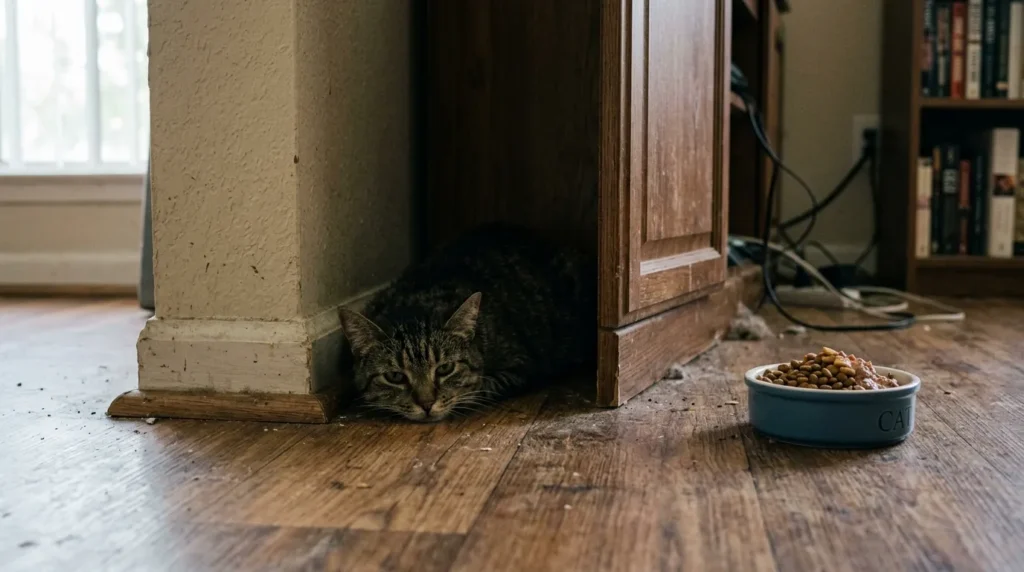
Normal hiding becomes a real concern when it runs past three weeks with no forward progress, or when specific physical warning signs show up alongside the withdrawal. A cat still completely out of sight at the three-week mark, with no nighttime activity, no litter box use, and no food gone, isn’t just adjusting slowly. Something else is going on.
Watch for these signals that call for a vet visit:
- No food eaten for more than 24 hours, which raises the risk of hepatic lipidosis, a liver condition that can develop fast in cats that stop eating
- Vomiting, diarrhea, or audible breathing changes alongside hiding
- Eliminating outside the litter box repeatedly while still hiding
- No movement at all for a full day, even at night
A cat who eliminates outside the box while hiding isn’t being difficult. They’re too stressed to leave the hiding spot even for the litter box. This level of stress usually calls for a pheromone diffuser in the room, and sometimes a talk with your vet about short-term anxiety support. For a broader look at what counts as normal versus concerning, indoor cat health walks through the everyday signs worth tracking beyond just the hiding phase.
Not Eating for 24 Hours: When to Call the Vet the Same Day
A cat that hides is normal. A cat that hides and hasn’t eaten anything in 24 hours needs a same-day call to your vet, not a wait-and-see approach. Cats process fat differently than dogs and people. When a cat stops eating for even a day or two, the liver can start converting body fat too fast for it to process, which leads to hepatic lipidosis. This condition moves quickly and is far easier to prevent than to treat once it starts. If your cat is overweight going into the move, the risk is higher, and the same-day call matters even more.
This article is for informational purposes only. Always consult your vet if you have concerns about your cat’s health.
FAQ
Is it normal for a new cat to hide for days?
Yes. Hiding for three to seven days is normal. Shy or rescue cats may hide for up to three weeks before they regularly come out.
Should I try to get my new cat out of hiding?
No. Pulling or coaxing a cat out of hiding sets back the adjustment by days. Let them come out on their own schedule, since that’s the only approach that builds lasting trust.
How do I know if my cat is okay while hiding?
Check the litter box and food bowl daily. If both show use overnight, your cat is adjusting normally even if you never see them during the day.
How long does the hiding phase last for a rescue cat?
Rescue cats often take two to four weeks before they come out consistently. Cats from high-intake shelters or with a trauma history can take up to six weeks to fully settle.
Is my new cat hiding because they hate me?
No. Hiding is a response to the environment, not to you. A cat that hides is processing novelty, not rejecting the relationship.
What should I do if my new cat won’t come out after 3 weeks?
Call your vet to rule out illness and try a pheromone diffuser in the room. Some cats need a behavioral consult if there is no progress after four weeks of calm, low-pressure management.
Do kittens hide as much as adult cats when they move homes?
Usually not. Kittens tend to explore sooner because their fear response is less developed, though a nervous kitten can still hide for a few days.
Will feeding my cat by hand speed up the hiding phase?
It can help once your cat is already eating near you, but hand feeding too early adds pressure. Let the cat approach the bowl first.
Should I use a pheromone diffuser from day one?
Yes, plugging one in before the cat arrives is fine and often helps. Treat it as background support, not a replacement for a quiet room and a slow introduction.
Why is my cat hiding after moving to a new house, not a new adoption?
The same decompression response applies. An established cat usually recovers faster than a new adoption because it already trusts you, often within a few days to a week.
Should I close the door to my new cat’s safe room?
Yes, for the first few days. A closed door keeps the space small and predictable. Crack it open once your cat is eating and using the litter box on a normal schedule.
Why does my new cat only come out at night?
Nighttime is quiet and the house has stopped moving. Cats read that as low risk. Nighttime activity in the first week is a good sign, not a bad one.
Does catnip help a hiding cat come out sooner?
Sometimes, but not always. About 70% of cats respond to catnip, and kittens under three months usually don’t react to it at all. It’s worth trying once your cat is eating normally, not as a first-day fix.
How do I introduce my new cat to my resident cat while it’s still hiding?
Don’t, yet. Keep them fully separated with a closed door until the new cat eats, drinks, and uses the litter box on a normal schedule. Then start scent swapping before any visual contact.
New cat hiding all day is one of the most normal things that happens after adoption, and one of the most misunderstood. Give your cat a single quiet room, block under-bed access, leave your scent nearby, and check the litter box daily to confirm progress is happening even when you can’t see it. Most cats surprise their owners within two weeks once the pressure to interact is gone completely. For the full picture of what comes after the hiding phase and how to build a confident indoor life from there, our new indoor cat pillar guide picks up exactly where this article leaves off, and indoor cat behavior covers the sub-pillar topics beyond hiding, from litter habits to enrichment.
New cat hiding all day is normal for the first three to seven days after adoption, called the feline decompression period. Shy cats and shelter cats can take two to six weeks depending on history and temperament. An established cat that just moved homes usually settles faster, within days to a week, because it already trusts its owner. Kittens tend to skip most of the hiding phase due to a less developed fear response. Cats hide to gather environmental information from a safe position before committing to exposure. Healthy hiding is confirmed by nighttime litter box use and an empty food bowl each morning. Blocking under-bed access and offering cardboard box alternatives allows bonding to happen during the hiding phase. If a cat shows no litter box use, no eating, and no movement for more than 24 to 48 hours, veterinary assessment is needed to rule out medical causes such as hepatic lipidosis.

Written by Mishu
A passionate cat lover and indoor living enthusiast, Mishu is the founder and voice behind Indoor Living Cat – a go-to resource for cat owners who want to create the happiest, healthiest life for their feline companions indoors.
View Full Profile