
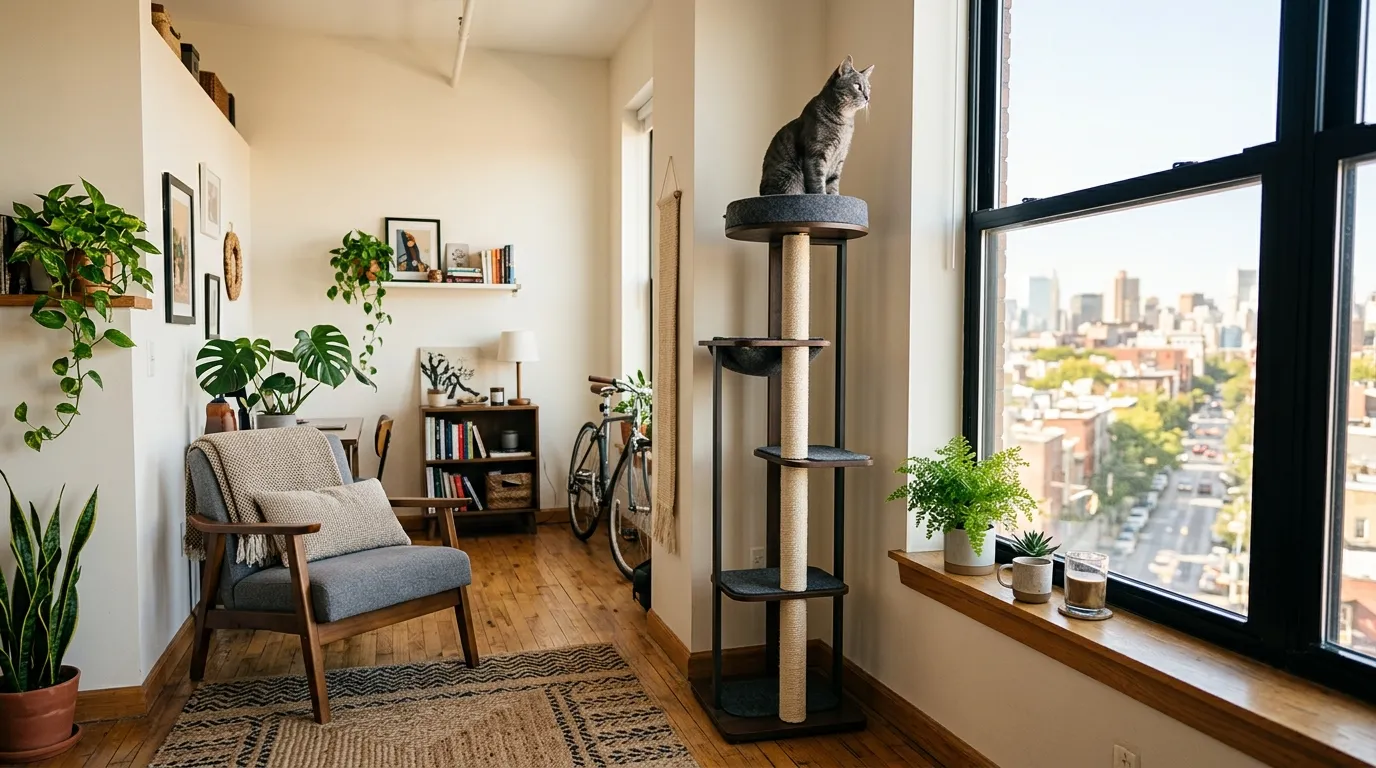
I bought a wide, low cat condo for my studio apartment because it looked substantial and the platforms seemed generous. My cat ignored every level of it for three weeks. Then I figured out why: the highest point sat four feet off the ground, and she already had that same view from the sofa arm, for free.
How to choose a cat tree for a small apartment comes down to one idea: height beats width every time. The features that matter in a tight space aren’t the same ones that matter in a bigger home.
This guide covers five selection rules that prevent the most common buying mistakes, plus the wobble physics behind base width and how to match perch height to a specific window, two details most cat tree guides skip.
Quick answer: Prioritize height over footprint and base stability over platform count. In a small apartment, look for a tree six feet or taller, with a base at least 18 inches wide or a wall anchor, and washable materials like solid wood and sisal instead of carpet.
Rule 1: Height Over Footprint Every Time
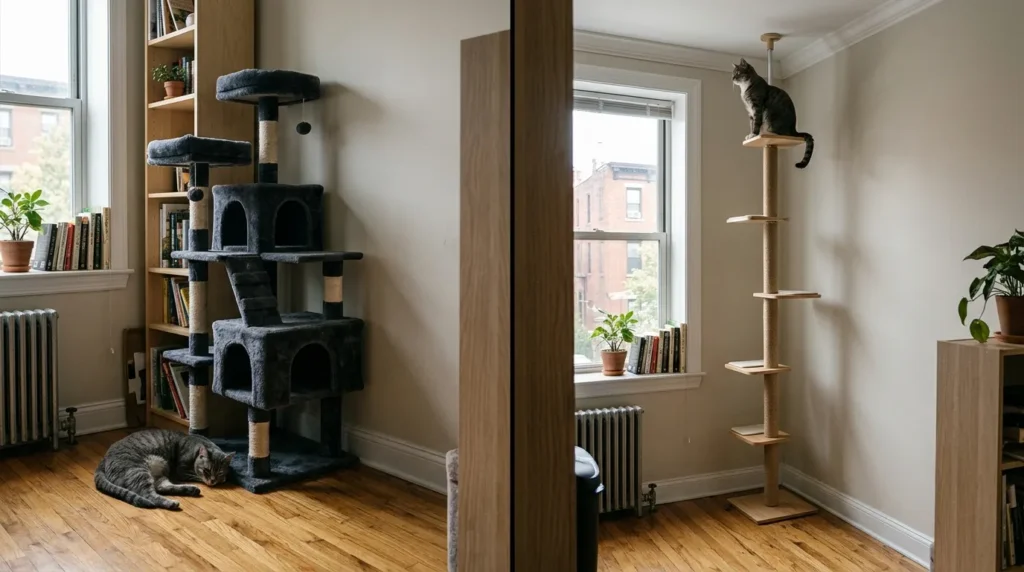
The most common mistake in small apartments is picking a wide tree with a small footprint instead of a tall tree with a small footprint. These sound similar but aren’t the same purchase. A tree that’s 24 inches wide and 48 inches tall gives your cat a platform below most people’s head height. A tree that’s 12 inches wide and 72 inches tall gives her real elevated territory, an actual observation post. The first wastes floor space. The second creates new territory out of thin air.
Vertical real estate is the metric that matters here. You aren’t adding floor space, because you have none to add. You’re turning the empty air between your furniture tops and your ceiling into usable cat territory. A tree that reaches 72 to 84 inches in an 8-foot apartment puts your cat high enough to see the whole room from above, which is the condition that actually satisfies her need for territorial security.
Understanding what your indoor cat’s territorial instincts require explains why this height threshold matters behaviorally, not just practically. The tree isn’t just somewhere to sit. It’s the elevated lookout her nervous system expects to have, and platform height decides whether it actually works as one.
Rule 2: The Stability Test Before You Buy
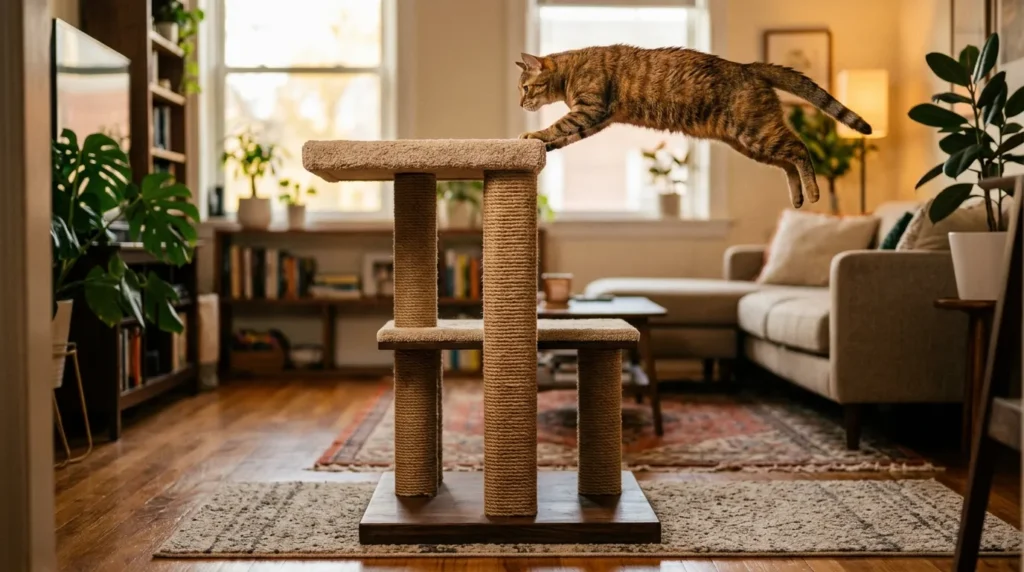
A tree that wobbles when a cat lands on it gets used once and never again. Cats are sensitive to unstable surfaces. One bad tip or a hard wobble is enough to teach a cat the tree isn’t safe. Most apartment cat trees look stable in photos and feel stable when you nudge them by hand. The real test is whether the tree holds steady when a cat jumps from three feet away onto the top platform.
The physics here are simple. Any base narrower than about 18 inches needs extra weight or a wall anchor to resist the sideways force of a jumping cat. This is the wobble factor most guides skip: a base under 18 inches has a center of gravity narrow enough that a cat jumping in from the side, not straight up, can tip the whole tree. If you’re eyeing a slim tree for its small footprint, check whether it has a wall anchor option, and plan to use it.
Tension pole trees sidestep this problem because they press against the floor and ceiling at once, which makes tipping physically impossible. Their downside is that they need a ceiling that can take the compression, and the pole needs retightening every few months as the material settles. Flexible floors or ceilings do better with a weighted base or a wall-anchored design instead.
| Base Type | Tip Risk | Wall or Ceiling Contact | Best For |
|---|---|---|---|
| Weighted base, 18 inches or wider | Low | None | Most apartments, no drilling needed |
| Weighted base, under 18 inches | High without an anchor | None unless anchored | Slim trees paired with a wall anchor |
| Tension pole | None, braces floor to ceiling | Small ceiling pressure mark | Renters who want maximum height |
| Wall-anchored | Low | Small wall holes | Narrow-footprint trees near a wall |
Weight Limits: What to Check for Larger or Senior Cats
Most budget trees list a weight rating somewhere in the specs, and it’s worth actually checking rather than assuming any tree holds any cat. A platform rated for an 8-pound cat can flex or crack under a 15-pound one, especially at the top level where leverage is highest. Senior cats and heavier cats do better on trees with wider individual platforms, at least 15 inches across, since a narrow platform under a big cat feels unstable even on an otherwise sturdy tree. If your cat is on the larger side, skip anything marketed for kittens or “compact” builds and look for trees explicitly rated for cats over 15 pounds.
Rule 3: Material and Washability Matter More in Small Spaces
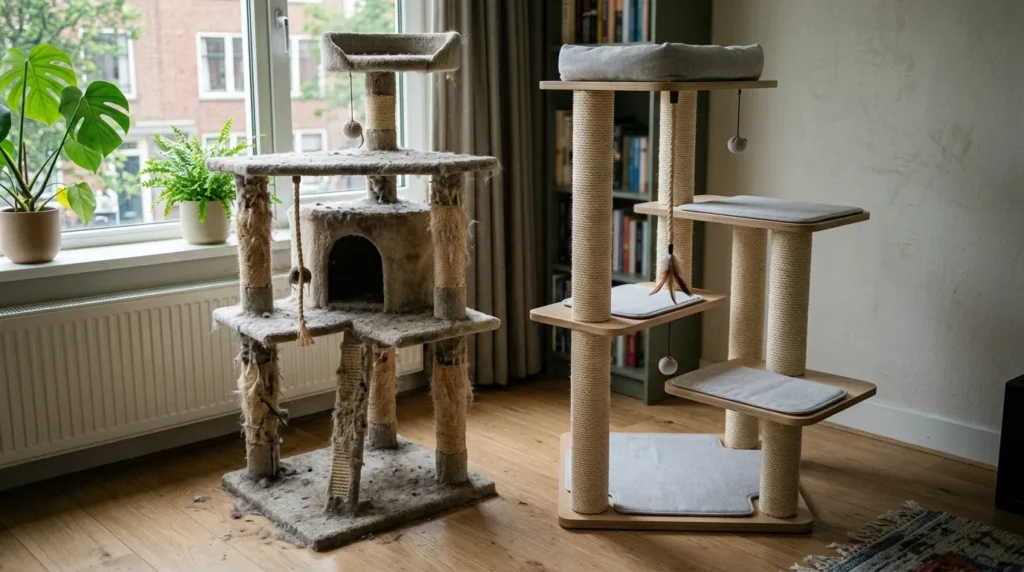
In a large home, a carpeted cat tree collects fur and dander that spreads across several rooms, so you barely notice it. In a small apartment, that same tree sits in your main living area and concentrates all the fur, dander, oils and smell right where you spend most of your time. Carpet-covered trees turn scent-saturated within months in a small space, and the fiber construction makes them close to impossible to clean beyond a quick vacuum.
Solid wood or engineered wood surfaces with sisal-wrapped posts and removable, machine-washable platform pads hold up far better in tight quarters. Sisal actually washes clean and doesn’t trap dander the way carpet does. Wood wipes down with a damp cloth and doesn’t soak up cat oils. Removable cushions that go through a washing machine solve the hygiene problem that makes traditional trees unpleasant in close quarters.
| Material | Cleaning Method | Odor and Dander | Small Apartment Fit |
|---|---|---|---|
| Carpet | Vacuum only | Traps fur and dander fast | Poor |
| Solid or engineered wood | Wipe with damp cloth | Doesn’t absorb oils | Good |
| Sisal rope or fabric | Brush off, spot wash | Low buildup | Good |
| Removable cushion pads | Machine washable | Low once washed regularly | Best |
According to ASPCA guidance on creating clean and enriching indoor environments for cats, keeping your cat’s main territorial furniture clean matters for both feline respiratory health and household air quality. Once you know your height, stability and material needs, browsing our full guide to apartment-friendly cat furniture options is the natural next step, since a tree is only one piece of a wider furniture plan.
Rule 4: Match the Tree Type to Your Cat’s Personality
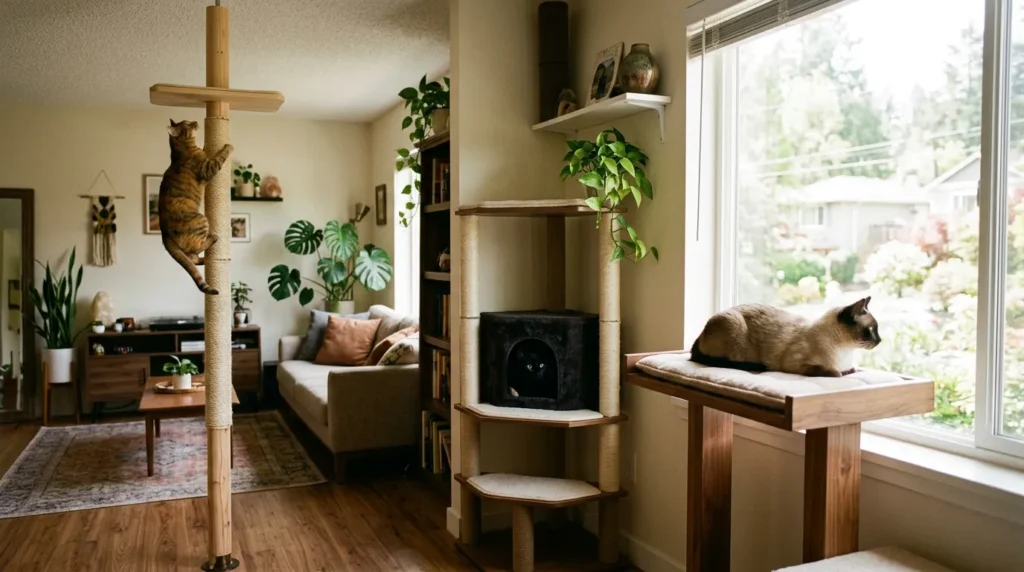
Active climbers need platforms spaced far enough apart to make jumping between them a real challenge, not just a step. Give a climber a tree with levels stacked 12 inches apart and she’ll treat it like a staircase and lose interest within a week. Space the platforms 18 to 24 inches apart and she has to actually jump.
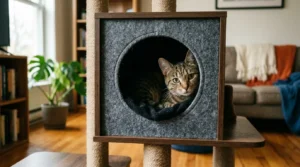
Shy or anxious cats, the kind who hide under furniture, need at least one fully enclosed cubby rather than open platforms alone. An open perch feels exposed when her baseline anxiety already runs high. The enclosed box gives her a sense of protected retreat that an open shelf can’t. The opening should face the room, not a wall, so she can watch her surroundings while still feeling tucked away.
Window watchers need the top perch to match the height of the specific window you plan to put it beside. Measure the sill and buy a tree whose main viewing platform lands within six inches of it. A tree whose top platform sits below the sill leaves her staring at the wall under the window instead of through it.
| Personality | What She Needs | Platform Spacing |
|---|---|---|
| Active climber | Genuine jumping challenge between levels | 18 to 24 inches |
| Shy or anxious | Enclosed cubby, opening facing the room | Not applicable |
| Window watcher | Top perch within 6 inches of the sill height | Not applicable |
How Many Cats Can Share One Tree?
One tree comfortably serves one cat, or two cats who already get along and don’t compete over resting spots. Add a third cat, or two cats with any tension between them, and one tree turns into a source of resource guarding rather than shared enrichment; the highest platform especially becomes contested territory. For two or more cats, a second, smaller tree or a set of wall shelves elsewhere in the apartment gives the lower-ranking cat somewhere to go that isn’t directly under the dominant cat’s watch. Multi-cat households generally do better with more, smaller vertical spots spread through the apartment than one large tree everyone has to share.
Rule 5: Modular and Renter-Friendly Options for Apartment Life
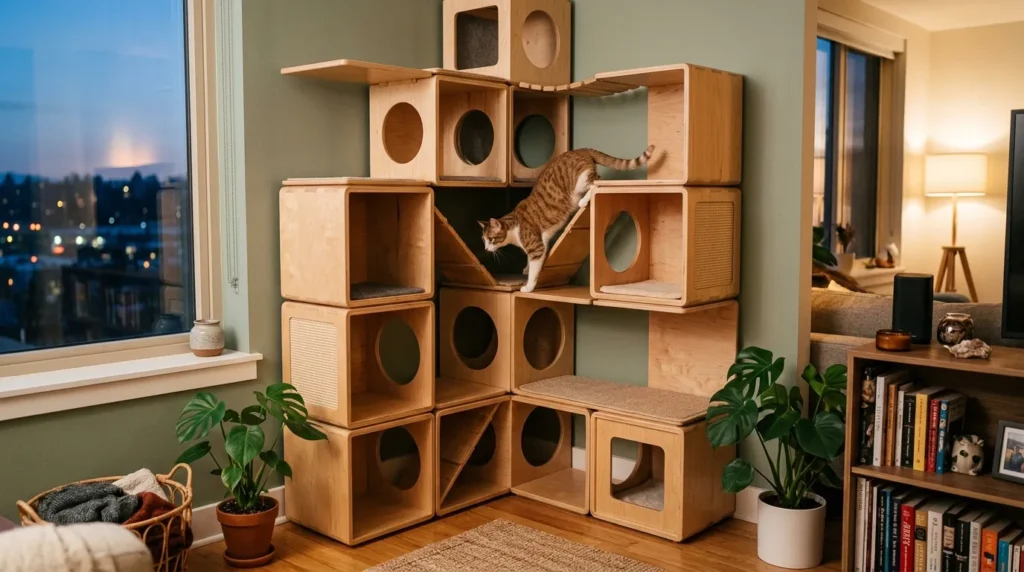
Modular cat trees matter for renters because they solve a problem no single-form tree or tension pole fixes: your apartment size changes when you move. A modular system that runs as a six-unit tower in a tall-ceiling apartment now can reconfigure into a four-unit wide layout in a lower-ceiling place later. That’s a genuinely different value than a fixed tree that might not fit your next home at all.
Tension poles leave small ceiling contact marks, and weighted bases can leave floor impressions. Neither causes real damage in most cases, but both leave a mark. Modular wooden systems on rubber feet, held to the wall with removable adhesive strips, leave nothing behind and break down flat for a move.
If you’re choosing between a tree and wall shelves, the placement rules stay the same either way, and managing apartment life with a cat across lease cycles covers the modular furniture strategy that saves you from starting over at every move.
Keep the litter box zone separate from the tree area so your cat’s mental map of the space stays clear, a rule covered in more depth in this guide to indoor cat litter box setup. If odor lingers near that zone even after regular cleaning, this breakdown of why a litter box smells after cleaning walks through the likely causes.
Cat Tree vs. Wall Shelves: Which Wins in a Small Apartment?
| Factor | Cat Tree | Wall Shelves |
| Floor space used | Small but nonzero footprint | None |
| Renter-friendliness | High if weighted base, no drilling | Lower, usually needs drilling |
| Multiple resting spots | Built in, fixed spacing | Fully customizable spacing and route |
| Includes scratching surface | Usually, sisal-wrapped posts | Rarely, needs a separate scratcher |
| Cost | $80–$250+ depending on height | $15–$40 per shelf, adds up with a full route |
Shelves win on pure floor-space efficiency and route flexibility, since you can wind them around a room in a way no single tree can match. A tree wins on convenience and on bundling a scratching surface into the same purchase. Plenty of apartments end up with both: a tree as the anchor piece near a window, and a couple of shelves bridging it to another perch across the room.
What to Budget: Cat Tree Price Tiers Compared
| Tier | Price Range | What You Get |
| Budget | $40–$80 | Usually carpet-covered, under 48 inches, lighter base; watch the wobble risk |
| Mid-range | $80–$180 | 60+ inches tall, mixed sisal and carpet, moderate base weight |
| Premium | $180–$350+ | 72+ inches, solid wood or engineered wood, washable pads, wall-anchor hardware included |
| Tension pole | $70–$200 | Maximum height for minimal footprint; no base at all |
The premium tier costs more up front, but factor in that a budget carpet tree often needs replacing within a year or two once odor and matting set in. Over a three-year span, one premium tree frequently costs less than two budget replacements.
How to Measure Your Space Before You Buy
A quick measuring session, part of any solid indoor cat care routine, saves you from the mistake I made with my condo.
- Measure ceiling height and subtract 6 inches. That gap gives clearance for assembly and airflow at the top platform.
- Measure the dead corner or wall space you have in mind. Write down width and depth so you’re not guessing in the store or on the product page.
- Measure your tallest existing furniture piece. A tree’s top platform should beat it by at least 12 inches, or your cat gets the same view for free, like mine did.
- Check the window sill height if placing the tree near a window. Match the main perch to that height within six inches.
- Measure your doorway width. Assembled trees over 6 feet sometimes won’t fit through a standard door, so confirm the tree ships flat-pack if your entryway is narrow.
Once the tree is in place, ease her onto it the same way you’d introduce any new furniture. Placing a few meals near the base helps, and this guide on feeding an indoor cat properly covers timing and portions if you want to use mealtime as the hook. Pairing the tree with a wider indoor cat enrichment plan, toys, window perches, play sessions, gets her using it faster than the tree alone ever will.
The Mistake That Causes Most Small Apartment Cat Trees to Fail
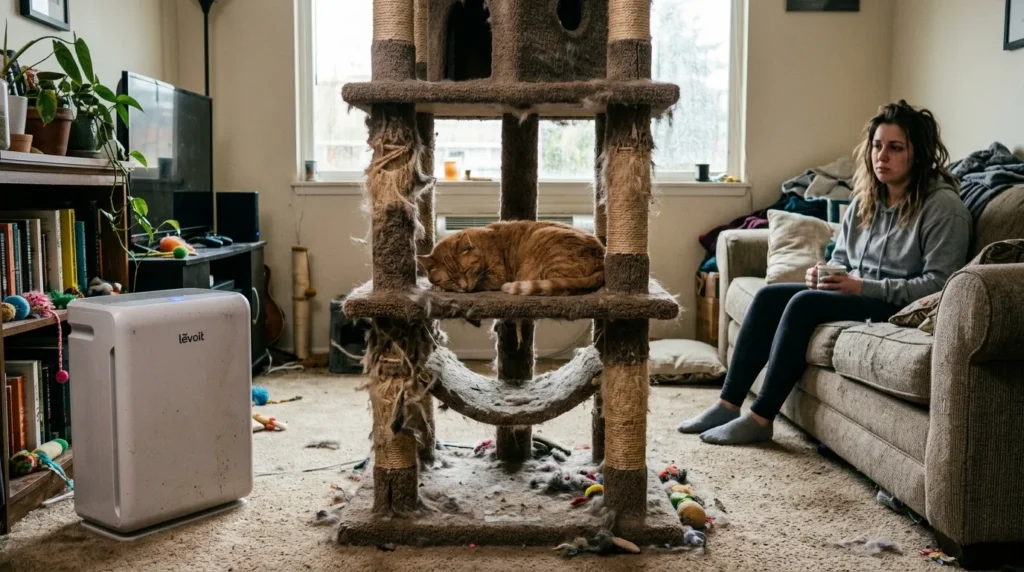
The regret most apartment buyers hit is picking platform quantity over platform height and quality. A tree with six platforms spread across 48 inches looks impressive in a listing, but every platform sits below eye level. Your cat sees nothing from six low platforms that she can’t already see from the floor. The same money spent on a tree with three platforms spread across 72 inches gives her real elevated territory and an actual view of the room from above.
The second half of this mistake is picking carpet to save money, then spending more later on lint rollers, air fresheners and eventually a replacement tree once the carpet becomes unmanageable. In apartments where the tree lives in your main living space, the pricier clean-material tree almost always wins on real cost over time.
If your cat stops using the tree after weeks of regular use, it’s worth checking whether joint stiffness or weight change is making the jump harder, something covered in monitoring your indoor cat’s health.
Frequently Asked Questions About Choosing a Cat Tree for a Small Apartment
How tall should a cat tree be for a small apartment?
At minimum 60 inches, ideally 72 inches or taller. The top perch should put your cat at or above human eye level so she can survey the room from above. Trees under 48 inches rarely deliver the territorial security payoff.
Are tension pole cat trees good for small apartments?
Yes. They give the most height for the smallest floor footprint of any design, and they can’t tip because they brace against both floor and ceiling. The tradeoff is retightening every few months as the pole material settles.
What’s the best material for a cat tree in a small apartment?
Solid or engineered wood with sisal posts and removable, washable platform pads. Carpet-covered trees trap fur, dander and odor fast in a compact space with limited air circulation.
How do I stop my cat tree from wobbling in a small apartment?
Pick a tree with a base at least 18 inches wide, or add a wall anchor if the base is narrower. The wobble on narrow bases comes from sideways force when a cat jumps in from the side. A wall anchor removes that risk.
Can I use wall-mounted cat shelves instead of a floor tree in a small apartment?
Yes, and for the tightest apartments shelves work better since they use zero floor space. The tradeoff is drilling, which can affect a security deposit. Adhesive shelf brackets exist but carry lower weight limits.
Do I need a wall anchor for every cat tree?
No. A tree with a base 18 inches wide or more is usually stable without one. Anchor any tree with a narrower base, and always anchor a tree over 6 feet tall regardless of base width.
How do I get my cat to actually use a new cat tree?
Place it where she already spends time, not in an empty corner. Add a few treats or a meal near the base for the first week. Give it two to three weeks before deciding she’s ignoring it for good.
How much should I actually spend on a cat tree?
For a small apartment, $80 to $180 covers a solid mid-range tree with real height and decent materials. Going below $80 usually means carpet and a lighter, wobblier base. Going above $180 buys better materials and washable components that pay off over a few years rather than an immediate performance jump.
Can two cats share one cat tree?
Two cats who already get along can usually share one tree without issue. Add a third cat, or introduce any tension between two, and the top platform tends to become contested. A second, smaller vertical spot elsewhere in the apartment avoids that competition.
Choosing a cat tree for a small apartment comes down to five factors: height over 60 inches for real elevated territory, base stability that handles a full-speed jump without wobbling (18-inch minimum base or a wall anchor), washable material like solid wood and sisal instead of carpet, platform spacing matched to the cat’s personality, and a renter-friendly design that can be moved or reconfigured. Weight limits matter for larger or senior cats, who need wider platforms rated above 15 pounds. Multiple cats generally do better with several smaller vertical spots than one shared tree, especially past two cats. Tension pole trees give the best height-to-footprint ratio, wall shelves win on pure floor-space efficiency, and modular wooden systems give the best long-term flexibility for renters who move often.

Written by Mishu
A passionate cat lover and indoor living enthusiast, Mishu is the founder and voice behind Indoor Living Cat – a go-to resource for cat owners who want to create the happiest, healthiest life for their feline companions indoors.
View Full Profile