
Updated September 2026.
I spent three weeks watching my cat avoid a perfectly good cat tree before I worked out that I’d put it in the wrong place. It was tucked against a back wall, away from the window and away from where I sat, so it offered her nothing she couldn’t already get from the floor. Placement matters more than the model you buy, because a cheap tree in the right spot beats an expensive one nobody visits. This article covers the five placement rules that decide whether a tree gets used daily or turns into a coat rack, plus the one mistake that leaves most apartment cat trees untouched within a month.
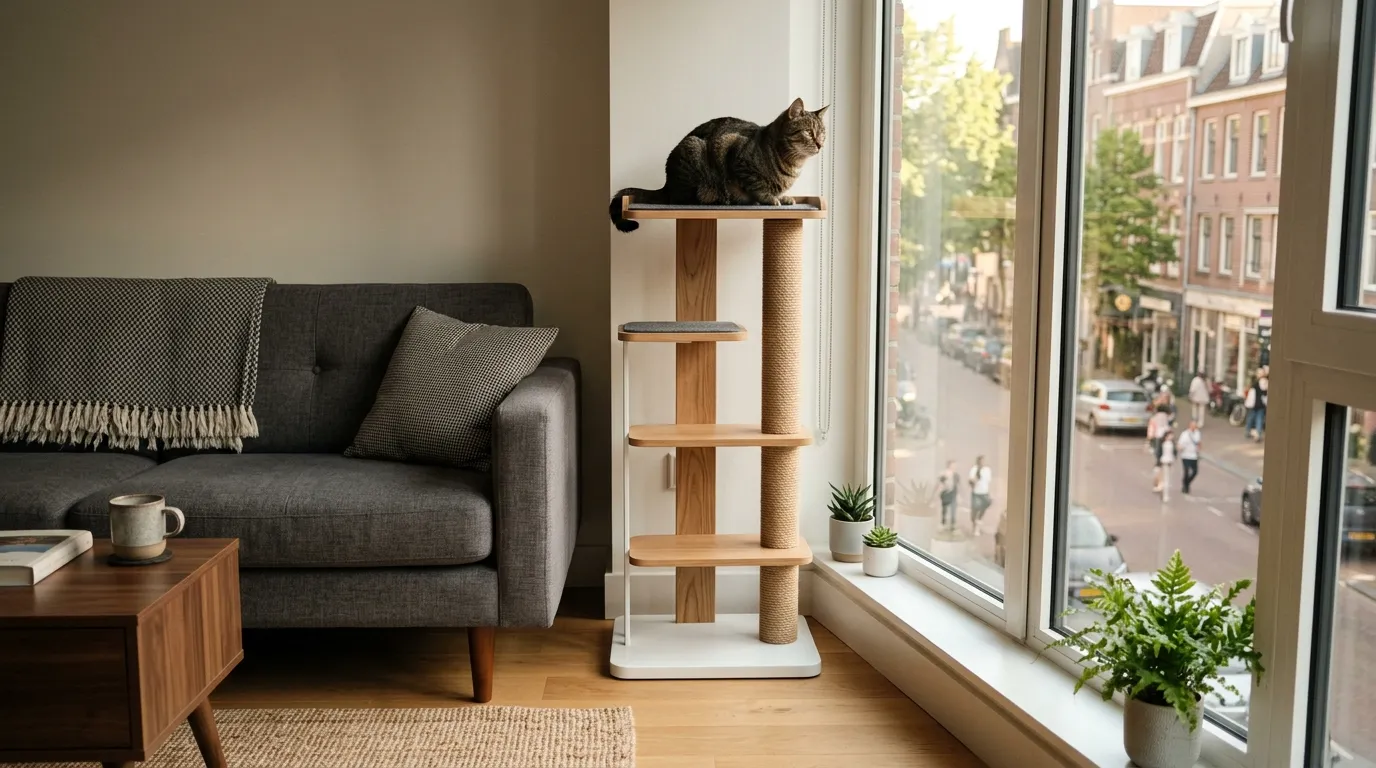
Short answer: put the tree next to a window, in the room where you spend your evenings, close enough to your seating that your cat can see you and the outdoors from the same perch. Give it two ways down, keep it two feet from any heater or vent, and keep it away from the litter box. That covers where to put a cat tree in a small apartment for most layouts. The rest of this guide explains why each part matters and what to do when your floor plan fights you.
Best Places for a Cat Tree in a Small Apartment at a Glance
Six spots cover nearly every layout. Start at the top of the list and only move down if the space isn’t there.
| Spot | Why cats use it | Watch out for |
|---|---|---|
| Beside the sofa or bed, in the main seating area | Height plus your company | Leave a gap so she can step onto the furniture, not only the floor |
| Next to the biggest window | Live view of birds, people and traffic | Redirected aggression if outdoor cats show up; loose screens and blind cords |
| Gap between the sofa and a side wall | Uses floor you weren’t using | Needs a slim tree, and the sofa arm should sit next to it as an exit |
| Beside a bookshelf | A shelf gives her a second way down | Clear breakables from the shelf she’ll step onto |
| Beside your desk | She can watch you work from a raised seat | Don’t block the chair’s rolling path |
| Side of the entryway, clear of the door swing | A perch over the spot where every new smell arrives | A fast door opening can startle her |
The Social Placement Rule: Why the Back Room Is the Worst Spot
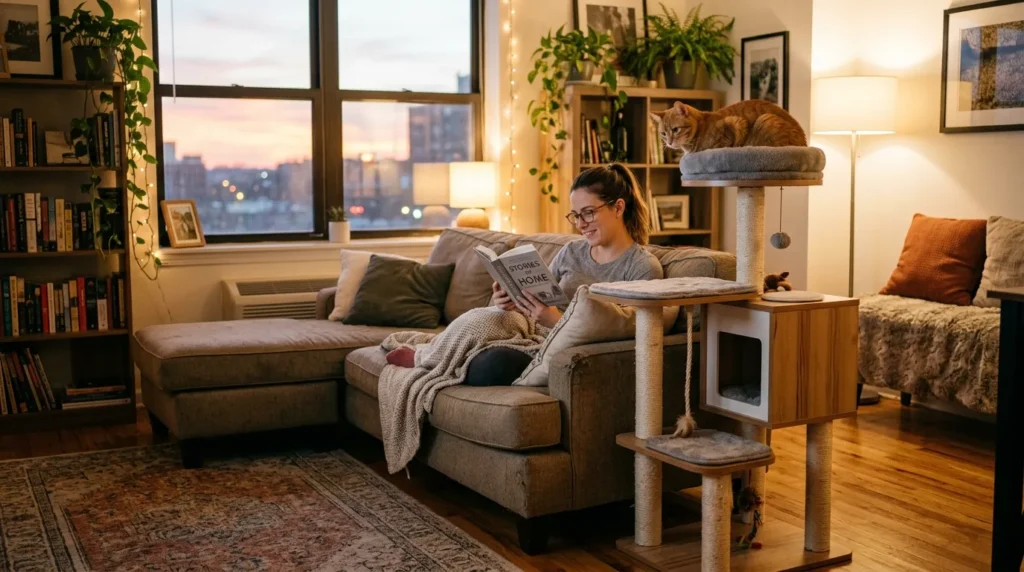
Social placement means putting the tree in the part of the apartment where people actually spend time, not where floor space happens to be free. Cats like to monitor their household from up high, and that only pays off if there’s a household in view. A tree in a spare bedroom gives your cat height and nothing to look at. A tree beside the couch gives her height and you.
It’s why a cat will pick the sofa arm over an expensive tree across the room. The sofa arm wins on two counts, elevation and proximity to you. The tree in the corner wins on one. Move the tree next to the sofa and the tie breaks in its favor, because now it offers both. The same tree gets used far less in a back room than it does in the right spot in a 450-square-foot studio.
Vets back the general idea. The AAFP and ISFM environmental needs guidelines put a safe place first among their five pillars, and they say food, water, litter, scratching, play and resting areas should be separate rather than lumped together. You can read the full framework in the AAFP and ISFM Feline Environmental Needs Guidelines.
Signs your tree is in the wrong social spot:
- She uses it for about ten minutes, then comes down and doesn’t go back.
- She still naps on the sofa arm or your desk chair.
- The tree has started collecting laundry or a spare blanket.
- It sits in a room you only enter to grab something.
Understanding the territorial and social needs that drive your cat’s spatial choices gives you the logic behind all five placement rules in this article. Each one traces back to a specific feline drive, and none of them bends because your apartment is small.
Window Proximity: Get the Top Perch to Window Height
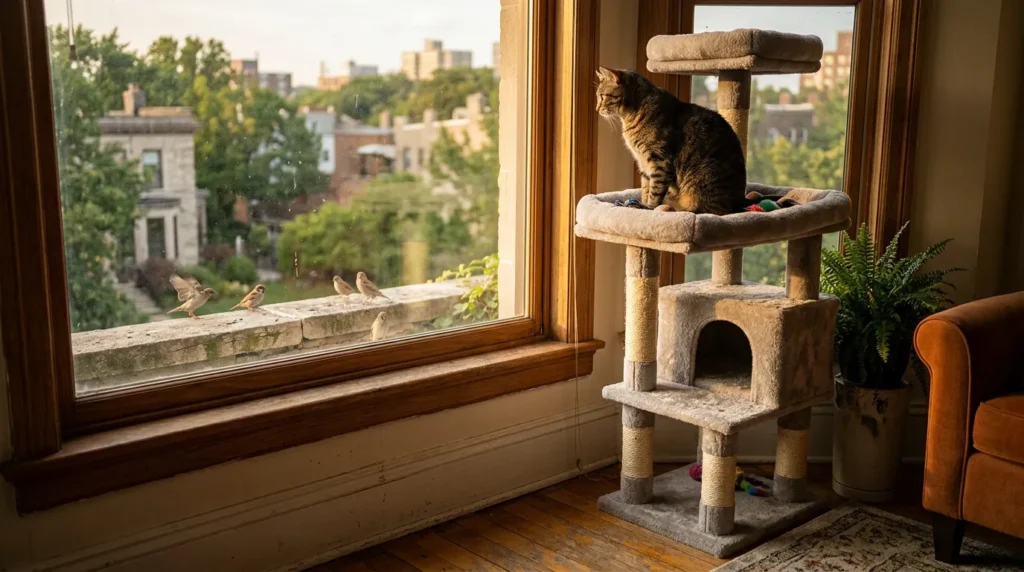
Window proximity is the second rule, and it stacks on top of the social benefit. When the top platform reaches window height, your cat gets a raised seat and a live view of birds, insects, neighbors and traffic. That movement keeps her occupied through the hours you’re at work and the apartment is quiet.

How to set up a window spot:
- Aim the top perch at the sill or a few inches below it, so she can look out without stretching.
- Angle the tree so she can see outside and still see into the room.
- Check that screens and latches are secure. A perch at sill height puts her within reach of a loose screen.
- Tie up or remove looped blind cords near the perch.
One qualifier. If stray or neighborhood cats show up outside, watch for redirected aggression. The ASPCA lists watching another cat or prey through a window as a common trigger. Your cat goes rigid and agitated at the glass, can’t reach the target, then turns on whoever is nearby, sometimes hours after the outdoor cat has left. That’s why the bite can seem to come from nowhere. If this sounds like your cat, a sheer curtain or frosted film on the lower half of the window keeps the light and blurs the trigger. The tree stays window-adjacent. The view just gets filtered.
Finding cat furniture with the right height and footprint for your specific apartment layout is the practical next step once you’ve picked a window spot.
Dead Space: The Spots Most Owners Never Consider
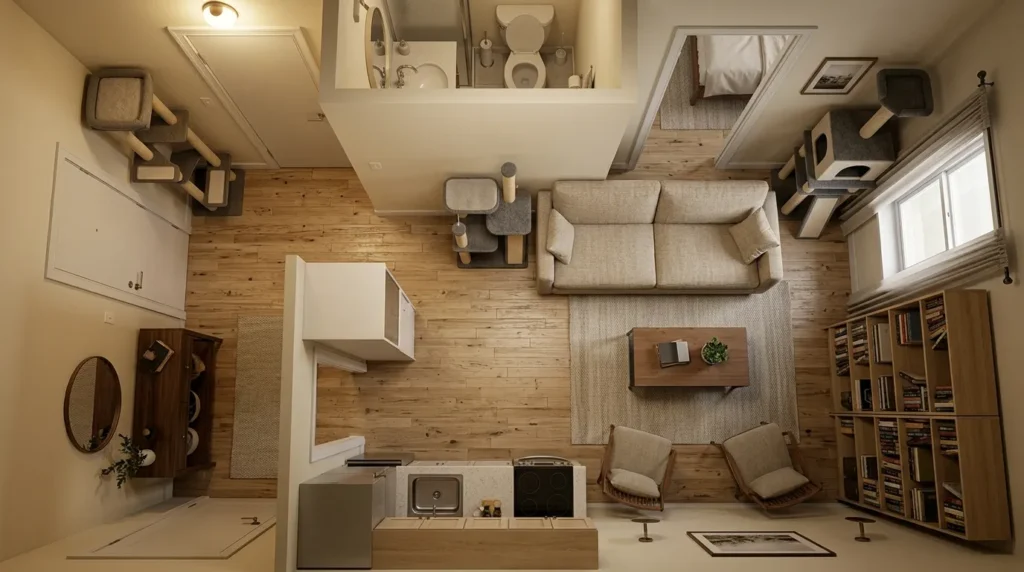
Dead space is floor that people can technically reach but never use. The gap between the sofa and a side wall, the strip beside a bookshelf, the narrow stretch of entryway before the main room opens up: each has room for a slim cat tree without blocking a walking path or adding clutter to the main sightline.
Dead-space spots worth measuring
- The gap between the sofa and a side wall, ideally with the sofa arm next to the tree.
- The wall beside a bookshelf, so she can step onto a shelf as a second exit.
- The space beside your desk, if you work from home. She gets height and your company while you type.
- The edge of the bed area in a studio, when the bed is where you actually hang out.
- The side of the entryway, clear of the door swing.
The entryway deserves its own mention because most guides skip it. Every outside smell and sound arrives there, and some cats prefer to monitor it from a perch instead of meeting each visitor at floor level. The catch is startle risk. A fast door opening can jolt a cat sitting close by, especially in a narrow entry, so set the tree slightly to the side of the door’s swing arc, not against it.
Enrichment solutions that work within the spatial constraints of apartment living include wall-mounted options that extend dead space vertically when the floor is too tight even for a slim tree.
The Dead-End Corner Trap: Why Most Placement Advice Gets This Wrong
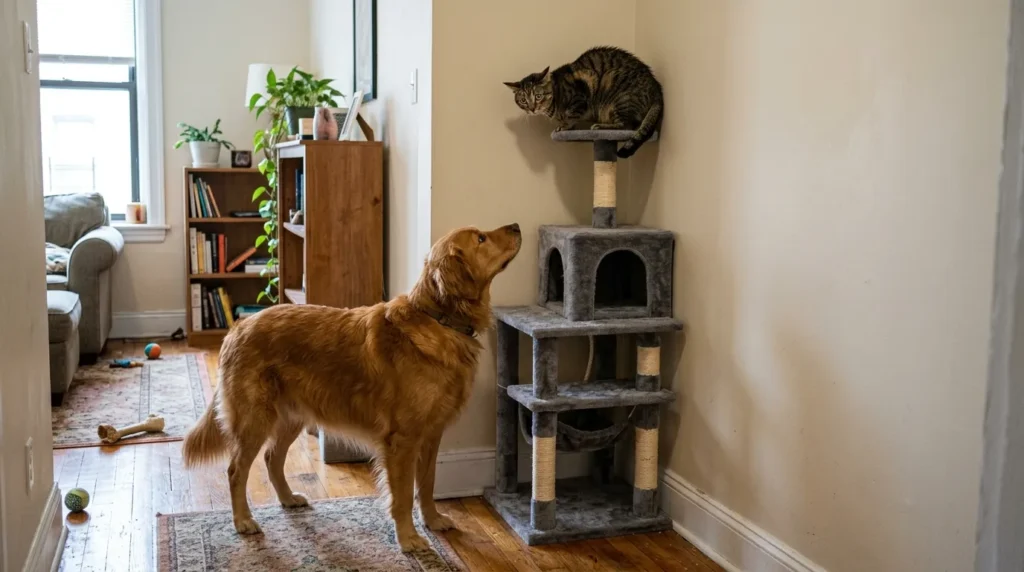
The standard advice for cat trees in small apartments is to use a corner. Corners save space and keep the tree out of traffic, so owners like them. From the cat’s side, a corner is a three-walled dead end with one open direction she can be cornered from. In a home with a dog or a second cat, the tree that should be her safe retreat becomes the most trapped spot in the room.
The fix is a two-exit placement: at least two ways down that don’t drop her at floor level in front of a threat. A tree beside a sofa lets her step onto the cushions if something approaches from the open side. A tree beside a bookshelf lets her move sideways onto a shelf. Exits are part of what makes a perch feel safe, and a tree with two of them gets used daily while a trap gets avoided.
| A corner that works | A corner that traps |
|---|---|
| Tree at the end of a sofa, with the arm as a second exit | Three walls and a single floor-level opening |
| Tree beside a bookshelf with a shelf at perch height | Tree wedged between two large pieces of furniture |
| Corner in the room where you spend your evenings | Corner in a room you rarely use |
Placement Reality: If your cat uses the tree for about ten minutes, then comes down and doesn’t return, blame the address before you blame the tree. Move it three feet toward the window or beside your seating area. Ignored trees usually start getting used within a day or two of a good relocation.
Heaters, Vents and Radiators: Keep the Tree Two Feet Away
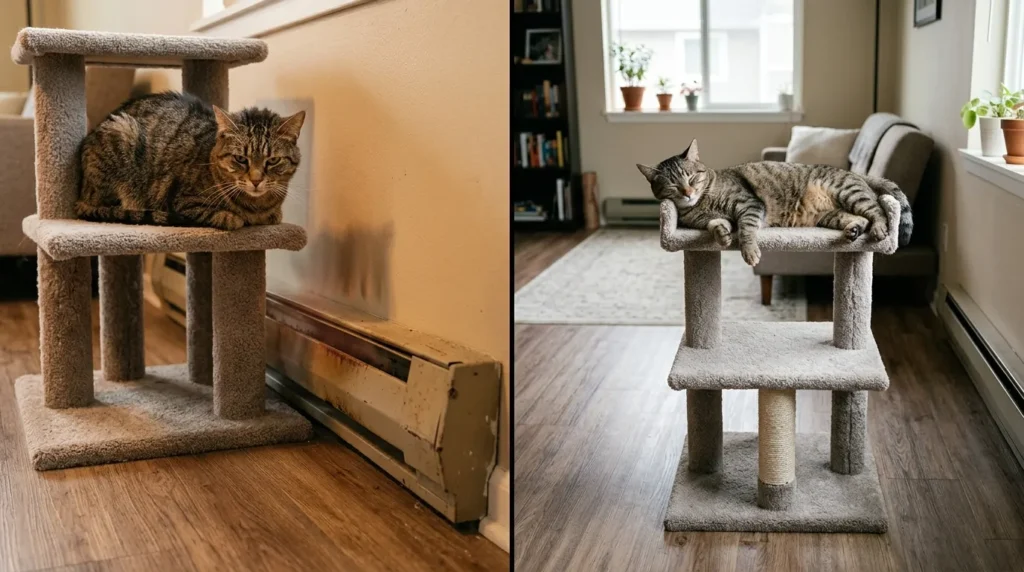
Small apartments pack their heat sources close together, and cats go straight for warm spots. A tree beside a baseboard heater, radiator or floor vent gets used at first for exactly that reason. The trouble is concentrated dry heat. It can dry out her skin and coat, and a hot radiator or heater casing can burn a cat that leans on it or sleeps against it.
Keep at least two feet between the tree’s main perches and any active heat source. That distance lets the ambient warmth of a heated apartment reach the tree without the direct blast from the unit.
| Heat source | Minimum clearance | Problem |
|---|---|---|
| Baseboard heater | 2 feet | Dry, concentrated heat; hot casing |
| Radiator | 2 feet | Burn risk if she leans on it |
| Floor-level HVAC vent | 2 feet | Constant dry airflow across the perch |
| South-facing window in summer | Rotate the tree away in the hottest months | Top platforms overheat in top-floor units |
Managing your indoor cat’s environment in an apartment includes this kind of seasonal adjustment alongside the permanent placement decisions. Monitoring your indoor cat’s coat and skin condition over the winter heating season lets you catch heat-source problems before they change her behavior.
The Placement Mistake That Wastes Most Cat Trees in Small Apartments
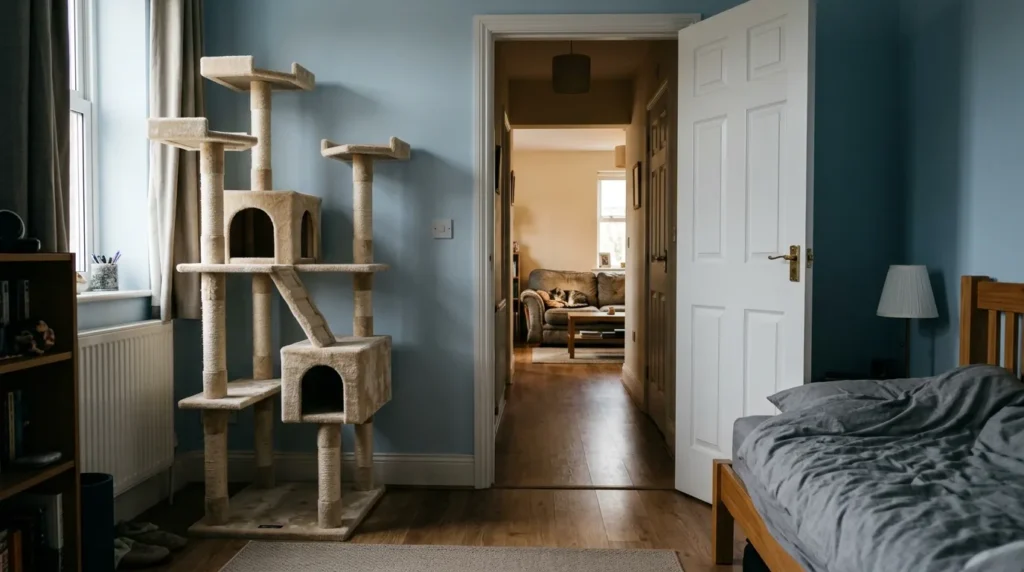
Most unused cat trees sit in a different room from the one the household lives in. Owners do this to hide the tree in the spare bedroom, the home office corner or the hallway. The cat ignores it because nothing happens in that room and she can’t monitor the household from there.
In a small apartment, room labels matter less than where people are and where they aren’t. A tree in a one-bedroom’s bedroom works if that’s where you spend evenings. A tree in the living area works if that’s where you sit. Judge the spot by whether it’s inside your active social territory, whatever the room is called.
Using the full range of cat furniture options appropriate for small spaces helps with the aesthetic objection behind the hiding habit. Wall-mounted shelves and modular climbing systems blend into living areas better than a freestanding floor tree.
Where to Put a Cat Tree in a Studio, One-Bedroom or Living Room
The same five rules produce different answers depending on the layout. Use this table as a starting point, then adjust for where you actually sit.
| Layout | Best spot | Second choice | Avoid |
|---|---|---|---|
| Studio | Wall between your sofa or bed area and the largest window | Beside a bookshelf or dresser | The kitchen corner or any spot away from where you sit |
| One-bedroom | Living room, beside the sofa and near the window | Bedroom window, if you spend evenings there | A spare room or hallway |
| Living room | End of the sofa nearest the window | Side wall next to a bookshelf | Across the room from the seating |
| Bedroom | Beside the bed, near the window, out of the walkway | Next to the dresser | The door path |
| Home office | Beside the desk, with a window view if possible | Next to a shelf behind you | Anywhere the chair rolls |
Pick a Tree That Fits the Spot
In a small apartment the limit is floor area, not ceiling height. Measure the spot first, then shop for a tree that fits it. A compact tree with a 15 by 15 inch base takes about 1.6 square feet of floor, and a tall slim tree can reach window height on the same footprint.
- Match the top perch to your target height. If the window is the goal, the tree needs to reach it. A short, wide tree won’t.
- Do the shake test. A wobbly tree gets avoided. Tall or narrow-based trees should be anchored, and if yours shipped with an anti-tip strap, use it.
- Check the platforms. They should hold her whole body, not just her front half.
| Format | Floor space | Best for | Trade-off |
|---|---|---|---|
| Compact tree | Small | Kittens and small cats | Rarely reaches window height |
| Tall slim tree | Small | Window access on a tight footprint | Needs anchoring |
| Floor-to-ceiling pole tree | Very small | Studios with a solid ceiling | Check your lease before pressing against walls or ceilings |
| Wall shelves | None | Dead space above furniture | Requires drilling |
| Window perch | None | Renters with no floor room | One seat, no scratching surface |
Placing a Cat Tree With Two Cats or a Dog
A shared apartment makes the two-exit rule more important. If two cats share one tree, one of them can end up blocking the only way down. Dogs add a different problem: a tree at nose height turns a perch into a target.
- Give each cat a separate perch at a different height, and don’t make one tree the only vertical space in the apartment.
- Set the tree so the top platform is beyond the dog’s reach and the cat can leave by furniture or a shelf.
- Keep the tree off the path the dog uses to reach the door, the food or the couch.
Kittens and Older Cats
Kittens need a stable tree with low platforms, placed where they can see you. Older cats do best with a step or a low first platform, set beside a sofa or bed so they can step across instead of jumping from the floor. In both cases the social placement rule stays the same.
Where Not to Put a Cat Tree
- Next to the litter box. The AAFP and ISFM guidelines call for separate resource zones, and mixing resting and elimination areas adds territorial stress. Maintaining a clean litter box in a location separate from the cat tree area keeps those zones distinct.
- Inside a door’s swing arc or on the main walking path from bed to bathroom.
- Within two feet of a heater, radiator or floor vent.
- Beside a shelf of houseplants or breakables she can reach from the top perch.
- Under a ceiling fan, if the tree is tall enough to put her near the blades.
- In a room you rarely use.
Placement Checklist: Test a Spot Before You Commit
- Watch where your cat already sits for a couple of days. That’s her vote.
- Pick a spot in that same zone, within sight of where you sit.
- Check whether the top perch can reach window height.
- Confirm two ways down, and that neither drops her in front of a dog or another cat.
- Measure two feet of clearance from heat sources, and keep the litter box out of the area.
- Shake the tree. If it wobbles, anchor it or pick another model.
- Add treats on each level and give the spot a day or two.
- If she ignores it, move it three feet toward the window or your seating.
How to Get Your Cat Using the Tree After You Move It
- Put treats on each level, and use a wand toy to lure her up.
- Hold off on catnip until after the move. It masks whether the placement is working.
- Don’t lift her onto the tree. Let her walk up on her own.
- Set aside a few pieces of her daily food as tree treats instead of moving her bowl. Feeding your cat in the vicinity of the cat tree during the first week of introduction builds a positive association with the new spot without breaking the separate-zones rule.
Keeping your cat’s overall care routine consistent makes her less sensitive to change, including a tree that moved three feet.
Frequently Asked Questions About Cat Tree Placement in Small Apartments
Where is the best spot for a cat tree in a studio apartment?
Against the wall near the largest window in the main living area, positioned so the cat can observe the room and the outdoor view at the same time. In a studio, the sofa-adjacent window wall almost always works best.
Can I put a cat tree in the corner of a small apartment?
Only if the corner has an open side that gives the cat two exit paths without going through a ground-level threat. A wall corner with a sofa beside it works. A tight three-walled corner is a dead-end trap that most cats gradually avoid.
Should I put the cat tree near the litter box?
No. Cats keep their elimination zone separate from their resting and observation zone. Put the tree in the living area and the litter box in a bathroom or separate corner. Mixing them adds territorial stress.
My cat ignores the tree I put in the bedroom. What should I do?
Move it to the room where you spend your evenings, near a window. Hold off on catnip until after the relocation, because catnip masks whether the placement is working. Most ignored trees start getting used within 48 hours of a good move.
Can I put a cat tree near a radiator or heater in winter?
Keep at least two feet of clearance from any active heat source. Cats are drawn to warmth, but direct dry heat can irritate skin and coat, and a hot radiator can burn a cat that leans on it.
How close should a cat tree be to the couch?
Beside it, close enough that she can step from the top perch to the sofa arm and back, with room to walk around the base of the tree.
Where should a cat tree go in a one-bedroom apartment?
In the living room, beside the sofa and near the window. Use the bedroom only if that’s where you spend your evenings.
Do cat trees need to be anchored to the wall?
Tall or narrow-based trees should be. A tree that wobbles when she jumps gets avoided, and one that tips is a safety problem. Use the anti-tip strap if it came with one.
Where should I put a cat tree if I have a dog?
Place it so the top platform is out of the dog’s reach and the cat can leave by furniture or a shelf, not only through the floor. Keep it off the dog’s route to the door and the food bowl.
How long should I wait before moving a cat tree my cat ignores?
Give the spot a day or two with treats on the platforms. If she still won’t use it, move it three feet toward the window or your seating area.
The best placement for a cat tree in a small apartment combines window proximity with social placement, meaning the tree sits beside or near the main window in the room where the household spends its evenings. The top perch should reach window-adjacent height. A corner works only when the cat has two exit paths and can’t be cornered. Dead space beside sofas, bookcases and desks, and at the side of the entryway, often provides both window access and social proximity without blocking traffic. Keep at least two feet of clearance from heaters, radiators and vents, and keep the tree away from the litter box.

Written by Mishu
A passionate cat lover and indoor living enthusiast, Mishu is the founder and voice behind Indoor Living Cat – a go-to resource for cat owners who want to create the happiest, healthiest life for their feline companions indoors.
View Full Profile