
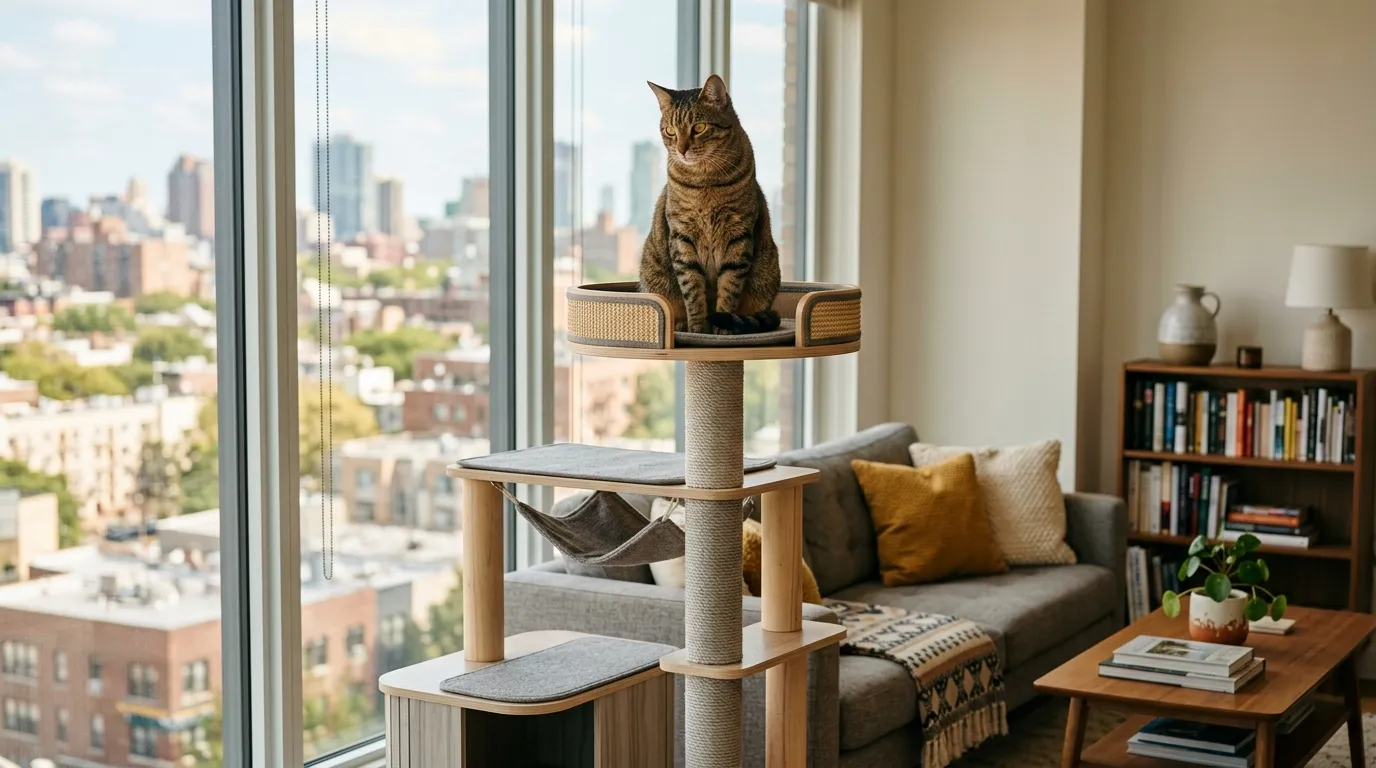
My cat paced the apartment for months. Then I put in a cat tree, and she spent three hours on it the first day, like someone had finally handed her a job description she’d been waiting for. That’s what changed how I think about this question. People treat “do indoor cats need a cat tree” like an optional upgrade, on par with a heated bed or a fancier scratcher. The science says otherwise. A cat tree meets at least five separate needs at once: safety, exercise, claw care, scent marking and a stress-free place to retreat to. This article walks through each one, plus the placement and height details that decide whether your cat actually uses the thing or ignores it forever.
So, do indoor cats need a cat tree? Yes. Cats are built to read a three-dimensional territory, and a standard apartment gives them two dimensions unless you add the third on purpose. A cat tree covers elevated observation, real vertical exercise, claw maintenance, scent marking at the right height, and a calm retreat if you’ve got other pets in the house. None of that shrinks because your apartment is small. If anything, a small floor plan makes vertical space matter more, not less.
Why Indoor Cats Live in 2D When Their Instincts Are 3D
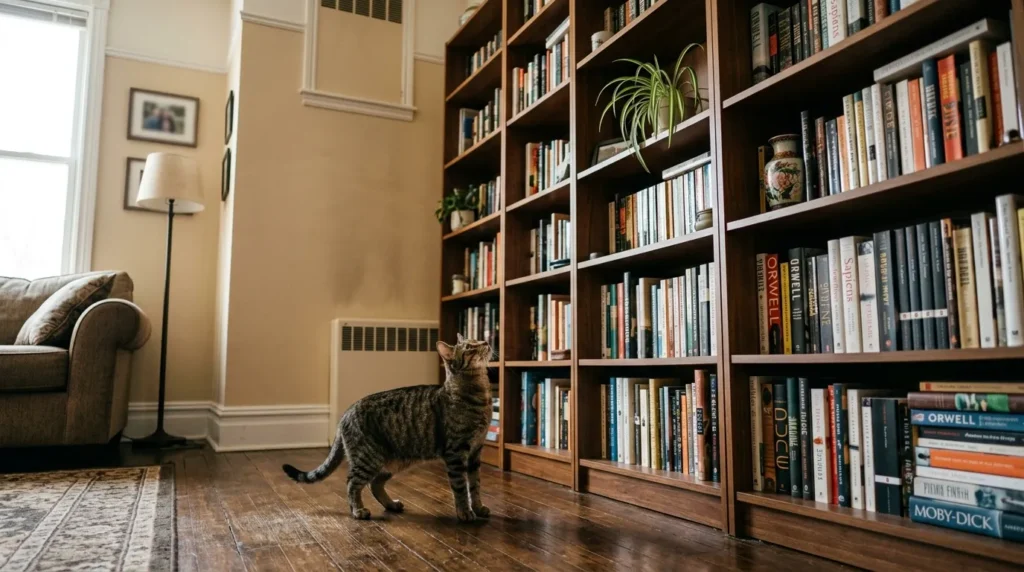
Indoor cats carry the same wiring as their wild relatives, who moved through three layers of territory every day: ground level, mid-height cover, and elevated lookout points, each doing a different job. Ground level was for hunting and getting from place to place. Mid-height cover was for hiding and resting without exposure. High ground was for watching for threats, sizing up rivals, and signaling status to other cats.
Your apartment gives your cat the ground floor and nothing else, by default. A cat who only has floor level in a small space is missing two-thirds of what her nervous system expects. So she improvises. She climbs onto your counters, your bookshelves, the top of the fridge, because the drive for height doesn’t switch off just because the height isn’t provided on purpose.
Vertical territory shapes an indoor cat’s whole behavioral profile, not just where she naps. Add real height to an apartment and you tend to see changes across several behavior categories at once, not a single fix for a single complaint.
The Physical Health Case: Why Vertical Climbing Is Different from Horizontal Play
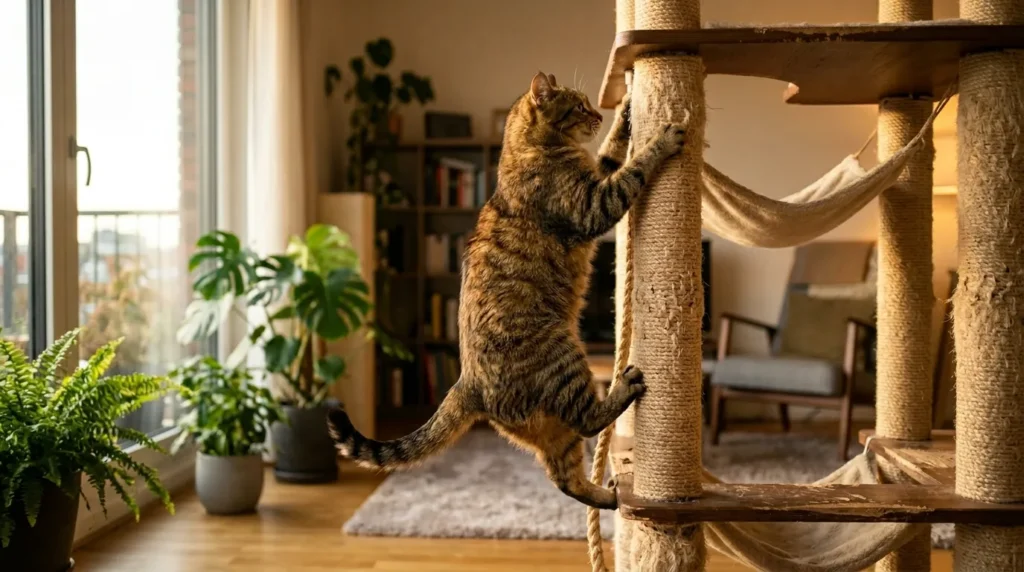
Climbing works the hindquarters, core, and shoulder girdle in a way that chasing a toy across the rug rarely does. A cat sprinting after a wand toy is moving at one height, mostly in a straight line. A cat climbing a tall tree is using the same muscles she’d use leaping branch to branch outdoors, and those are exactly the muscles that go soft fastest in a sedentary indoor cat.
The sisal post does more than take scratches. When a cat digs her claws in and pulls her full body weight upward into a stretch, she’s decompressing her spine and extending her shoulders, and that keeps the thoracic spine mobile. Cats without a tall scratching surface tend to develop stiffness through the shoulders and neck over time. You’ll often notice it first as a smaller grooming range by middle age. She just can’t reach as far.
Claw maintenance matters for a practical reason too. Scratching sheds the dead outer layer of the claw and deposits scent from paw glands at nose height for any other animal in the house. A cat tree does both jobs and pulls that behavior off your sofa. It works best when you put the tree right next to the furniture she’s already scratching, not tucked away in another room where she’ll never find it.
The Psychological Safety Function: Why Height Reduces Household Stress
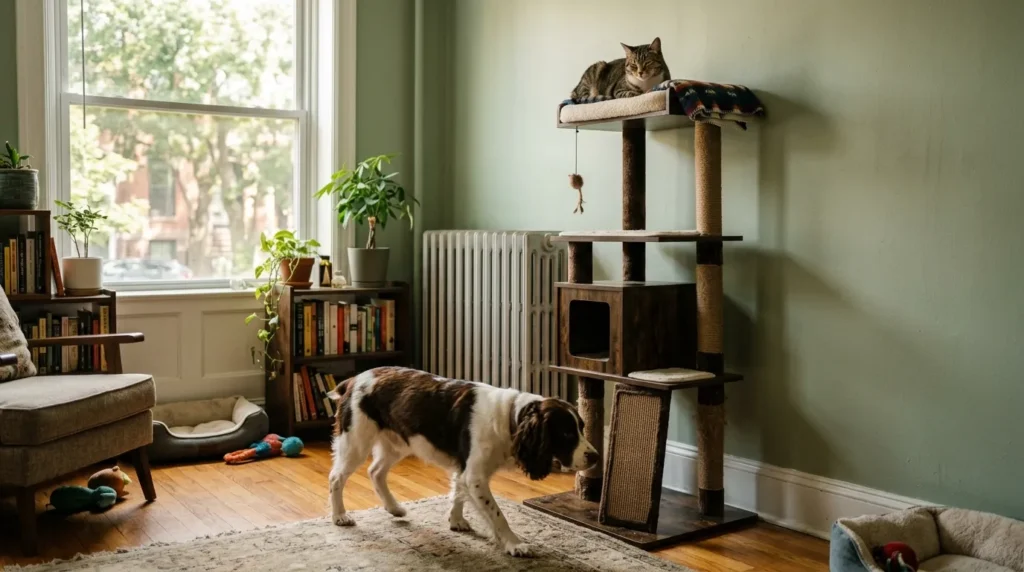
Height lets a cat watch what’s happening below without being reachable from it. A cat who can see a visiting dog, a toddler, the vacuum, or a stranger from above gets her threat-assessment needs met without a fight or a bolt for the door. She knows where the risk is, she can track it, and it can’t get to her. That’s the exact condition under which cats show the lowest stress hormone levels in a confined space.
In multi-cat homes, this matters even more. Without vertical space, every social negotiation happens at floor level, over the same square footage, and that produces near-constant low-grade friction. Give cats height and they’ll spread out across levels on their own, with the more confident cats claiming the higher spots. That sets up a visual pecking order without a single fight breaking out. Adding three feet of height to a room can cut inter-cat tension more than adding the same amount of floor space ever would.
According to ASPCA guidance on environmental enrichment for indoor cats, vertical space and elevated resting spots are among the single most effective changes you can make to cut stress-related behavior. That holds in single-cat homes too. Being exposed at floor level all day is tiring on its own, whether or not another animal is around to make it worse.
Cat Tree vs. Other Vertical Options: Which One Fits Your Apartment?
A floor cat tree isn’t the only way to add height, and for some apartments it isn’t even the best one. Here’s how the main options stack up, since your floor plan and lease terms usually decide the answer before your cat’s preferences do.
| Option | Floor space used | Renter-friendly | Best for | Watch out for |
|---|---|---|---|---|
| Floor cat tree | 2–4 sq ft base | Yes, no drilling | Multi-cat homes, scratching needs, cats who like a stable base | Needs a wide, heavy base or it can tip |
| Wall-mounted cat shelves | None | Only with landlord approval, since it needs drilling into studs | Small apartments, creating a “catwalk” along a wall | Weight limits per shelf, and installation has to hit a stud |
| Window perch (suction or clamp-on) | None | Yes, no drilling for clamp models | Window-watching, sunbathing, budget setups | Weight capacity is usually 15–30 lbs; check before buying for a large cat |
| Cat condo / covered tree | 3–6 sq ft base | Yes | Shy or easily startled cats who want to hide and observe | Bigger footprint, and covered cubbies can trap a cat during multi-cat conflict |
A lot of apartments end up with a mix: a floor tree by the main window, plus one or two wall shelves along a hallway to link separate resting spots into a real path through the room. You don’t have to pick just one.
How Many Cat Trees Do You Actually Need?
For a single cat, one well-placed tree usually covers it, as long as the tree is tall enough and sits somewhere she already spends time. Multi-cat households are different. The common guideline from behaviorists is one resting or perching spot per cat, plus one extra, spread across at least two rooms if your layout allows it. That way no cat has to walk past a rival to reach the only high ground in the house.
- 1 cat: One tree, positioned by a window in the main living space.
- 2 cats: One tree plus at least one more elevated spot (a shelf or window perch), ideally in different rooms.
- 3+ cats: Multiple trees or a mix of trees and shelves, spread out so cats aren’t forced into the same vertical path to reach height.
If two cats are fighting over the same tree constantly, that’s usually a sign you need a second elevated spot, not a bigger version of the one you already have.
Cat Tree Placement: The Factor That Determines Whether It Gets Used
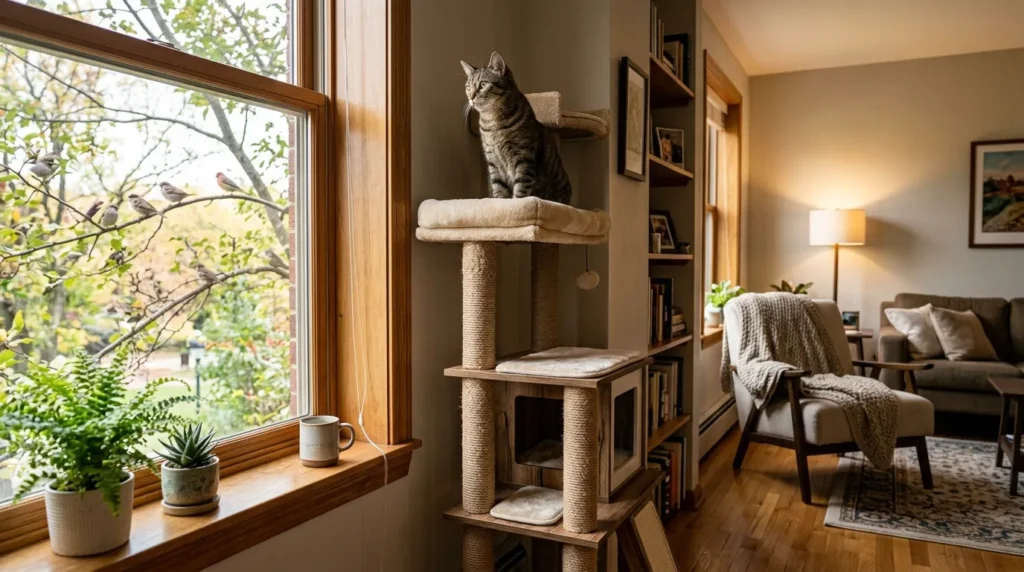
Placement is what decides whether a cat tree earns its floor space or turns into a dust collector. Three things matter: a window view from the top perch, a sightline to wherever the household actually spends time, and closeness to whatever furniture your cat already claims. A tree stuck in a back bedroom gets used far less than the same tree set up where your cat can watch the window and watch you at the same time.
Window placement gives cats what people sometimes call the television effect: a constantly changing feed of birds, bugs, and street activity that keeps her mentally occupied for hours. That only works if the top platform actually reaches window height. A tree whose tallest shelf sits below the windowsill isn’t giving her the view she’s after.
Finding the right cat furniture for your apartment layout is the resource to check next if you want to turn these placement and height rules into an actual product pick for your specific room. A full rundown of indoor cat enrichment strategies that treat the cat tree as the vertical base, with horizontal and interactive enrichment layered on top, tends to produce the biggest behavior changes.
Worth the space: the usual objection is floor footprint. But a tree with a 24-inch base and six feet of height adds roughly 12 square feet of usable cat territory once you count every platform, in exchange for about 4 square feet of floor. That’s more added territory per square foot of floor than almost anything else you could put in the room.
The Mistake That Makes Most Cat Trees Useless
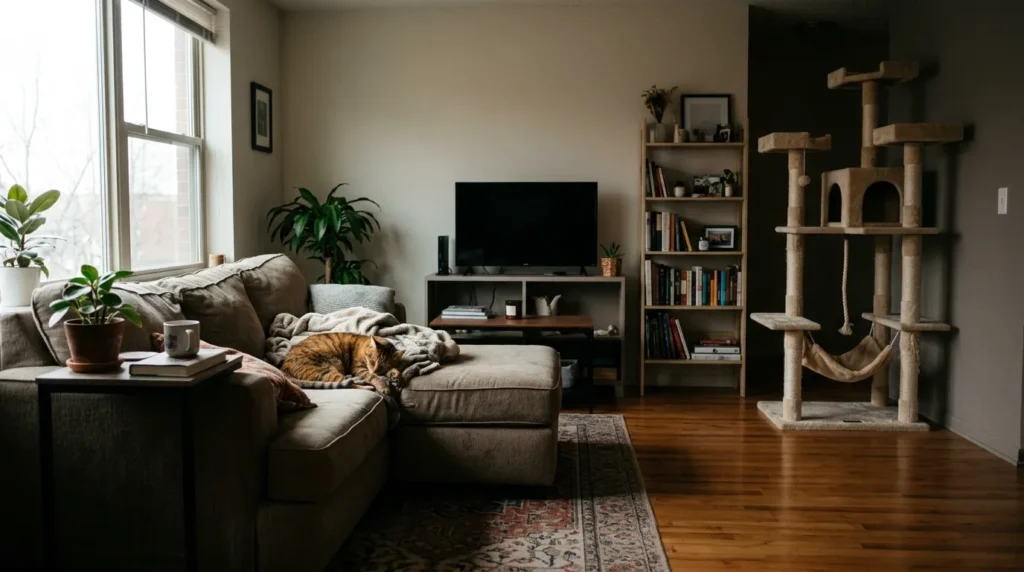
Most cat trees fail for one reason: they get stuck in a low-traffic corner, and the owner decides the cat just doesn’t like cat trees. She likes vertical space fine. She dislikes this specific spot because it doesn’t give her the view or the connection to household activity that makes height worth climbing for. Move the same tree to a window in the main room and an ignored tree can become a daily habit within 48 hours.
The second common mistake is buying a tree that’s too short. A tree topping out at four feet in a room with eight-foot ceilings doesn’t give a cat the psychological lift she’s after, because you can still walk right up and reach her at that height. For the security benefit to kick in, the top platform should sit at or above the height where people move through the room, usually five to six feet up.
Treating the cat tree as part of your indoor care routine, not as optional decor, changes how you think about the purchase. Feeding your cat on or near the tree during the first week builds a positive association fast. Tracking her activity level in the weeks after installation gives you real before-and-after evidence of what the vertical space changed. Litter box placement relative to the tree rounds out a layout that covers all three territory layers a cat needs. Apartment-specific factors, like wall-mounting restrictions and lease terms, will often decide which vertical solution actually works for your unit.
A Quick Buyer’s Checklist: What to Check Before You Buy
Cat trees range from about $40 to well over $300, and price mostly tracks post material, base size, and how the platforms are attached. Before you buy, run through this:
- Base width vs. tree height. As a rough rule, the base should be at least a third of the tree’s total height, or it’s a tipping risk, especially for a cat who jumps down hard.
- Post material. Sisal rope holds up to years of scratching. Sisal fabric (the flatter, carpet-like wrap) wears through faster and needs replacing sooner.
- Weight capacity. Check the top platform’s rated weight, not just the tree’s total capacity. A large or senior cat needs a wider, sturdier top perch.
- Assembly and wobble. Read a few reviews for mentions of wobbly platforms. A cat won’t return to a perch that shakes under her.
- Washable covers. Removable, machine-washable platform covers save you from replacing the whole tree when it starts to smell or shed fabric.
- Stud-anchor option. Many taller trees include a strap to anchor the top to the wall. Use it, especially with kids, dogs, or an enthusiastic jumper in the house.
Kittens and Senior Cats: Does the Advice Change?
Kittens can start using a cat tree as soon as they’re steady on their feet, usually around 8 to 10 weeks, but pick a shorter model with close platform spacing until they’ve built up coordination. A tall tree meant for an adult cat can be genuinely dangerous for a kitten still learning to judge jumps.
Senior cats still need vertical space, but the requirements shift. Look for wide, carpeted steps or a ramp instead of a single tall leap between platforms, keep the top perch lower than you would for a younger cat, and place a tree near a spot she already rests in rather than expecting her to relearn a new favorite corner. Arthritis doesn’t remove the need for height. It just changes how she needs to get there.
Frequently Asked Questions About Cat Trees for Indoor Cats
Do indoor cats really need a cat tree or is it optional?
It’s not optional for a cat who lives entirely indoors with no outdoor territory. It covers vertical space, exercise, claw maintenance, and psychological security that floor-level apartment living doesn’t provide on its own.
Where is the best place to put a cat tree in an apartment?
Next to a window, in the room where your household spends the most time. The top perch should reach window height, and your cat should be able to see both the outdoors and the main activity area from the highest platform.
How tall does a cat tree need to be?
Tall enough that the top platform puts your cat at or above the height people move through the room at, usually six feet or more. Trees under four feet rarely deliver the full security benefit, since a person can still easily reach the cat at that height.
Will a cat tree stop my cat from scratching the sofa?
Yes, if you place it right beside the furniture she’s already scratching and it has a sisal-wrapped post she can do a full-body stretch on. Distance kills the effect. A tree in another room won’t redirect anything.
How do I get my cat to use a new cat tree?
Put it near the window in the main living area, add treats or catnip to the platforms, and set it up beside furniture she already occupies. Don’t force her onto it. Most cats explore and claim a well-placed tree within one to three days.
Is it bad if I never get my cat a cat tree?
She won’t fall apart without one, but she’ll likely find her own vertical spots on your counters, shelves, or fridge instead, since the drive for height doesn’t disappear just because you didn’t provide an outlet for it. A tree, shelf, or perch gives her a sanctioned version of what she’s going to do anyway.
What age can kittens start using a cat tree?
Around 8 to 10 weeks, once they’re steady on their feet. Start with a shorter tree with closely spaced platforms rather than a tall adult model, since kittens are still learning to judge jumps.
How much should I spend on a cat tree?
Budget trees start around $40 to $60 and work fine for a single cat who’s gentle on furniture. If you have a large cat, multiple cats, or a cat who scratches hard, a $100 to $200 tree with a wide base and real sisal rope will hold up far longer.
Indoor cats need cat trees because apartment living only provides ground-level territory, while cats are wired for three-dimensional space with elevated lookout points, mid-height cover, and ground-level room to hunt and move. A cat tree covers vertical territory, delivers real physical exercise through climbing, keeps claws healthy through vertical scratching, lowers stress hormones through elevated security, and sets up a visual pecking order in multi-cat homes without a single fight. Wall shelves and window perches can cover the same need in tighter apartments or rental units. Placement next to a window in the main living area, with the top platform at human height, is what actually determines whether a tree gets used every day or ends up as furniture your cat ignores.

Written by Mishu
A passionate cat lover and indoor living enthusiast, Mishu is the founder and voice behind Indoor Living Cat – a go-to resource for cat owners who want to create the happiest, healthiest life for their feline companions indoors.
View Full Profile