
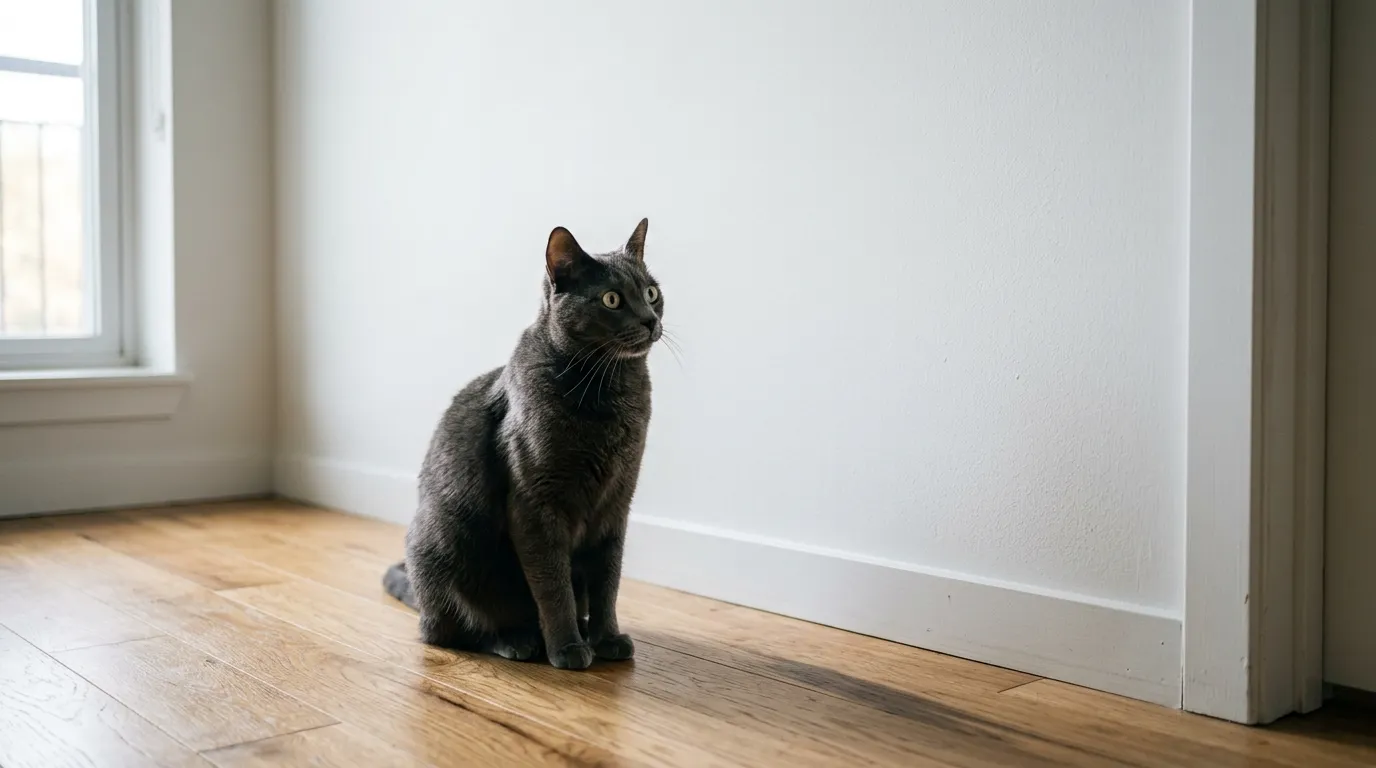
Why does a cat stare at a wall? Almost always because she is detecting something real that you cannot. My own cat once locked onto the same six-inch patch of wall for three evenings straight, with a stillness focused enough that I quietly googled ghost explanations before I found the actual answer. Cats hear up to 64,000 Hz, see into the ultraviolet spectrum and read chemical residue on surfaces that look completely blank to us. This article covers the six science-backed reasons behind wall staring, plus the one variant that has nothing to do with behavior and needs a same-day vet visit.
Your cat is almost certainly picking up on something behind or on the wall that you cannot see or hear. The most common causes are high-frequency sounds from pipes, insects or HVAC systems inside the wall, ultraviolet light revealing residue invisible to humans, and the early stages of a predatory sequence triggered by a tiny movement. It is rarely nothing.
Six reasons at a glance
| Cause | Quick tell | Worth worrying about? |
| Sound inside the wall (pipes, insects, HVAC) | Stare lines up with a specific time of day or appliance cycle | No, normal detection |
| UV-visible residue or old pet marking | Same exact spot, every day, regardless of sound | No, clean with an enzymatic cleaner if it bothers you |
| Predatory trance (assessing prey) | Twitching tail tip, dilated pupils, crouched posture | No, redirect with play |
| Smart home device or ultrasonic pest repeller | Stare centers on an outlet, router or plugged-in device | No, unplug and test for 24 hours |
| Head pressing (different behavior entirely) | No response to her name, vacant expression, reduced blinking | Yes, same-day vet visit |
| Feline cognitive dysfunction in seniors | Blank, unfocused stare in a cat over 15, with other confusion signs | Yes, vet assessment |

What Your Cat’s Senses Actually Detect Behind a Blank Wall?
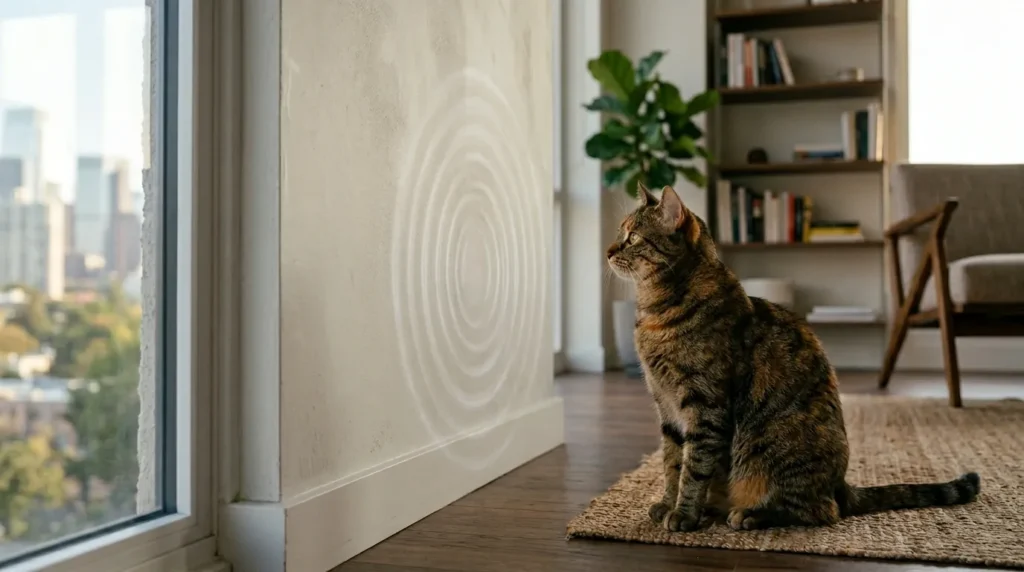
Cats hear up to 64,000 Hz. Humans top out around 20,000 Hz. That gap means electrical hum from wiring, HVAC ticking, water moving through pipes, and insects or rodents inside wall cavities all register to your cat the way a conversation registers to you. What looks like a blank wall to you is an active soundscape to her.
Vision adds a second layer. Behind a cat’s retina sits a reflective layer called the tapetum lucidum, which amplifies light and makes tiny movements visible that your eyes cannot resolve. Dust motes, shifts in air current, faint shadows from outside light, even microscopic insects on the wall surface all read as movement to her. She is not staring at nothing. She is tracking something below your detection threshold. The sensory biology behind indoor cat behavior gives a useful framework here, since the duration, posture and intensity of a stare tell you which sense is driving it, and that distinction tells you when to just watch and when to call a vet.
Here is a quick rundown of what commonly hides behind a wall that a cat can detect and a human cannot:
- Water moving through supply or drain pipes
- Insects or rodents inside wall cavities
- HVAC ducts cycling on and off
- Electrical hum from wiring or outlets
- Dust or light movement invisible at human resolution
Ultraviolet Light: Why a Clean Wall Looks Full of Information to a Cat?
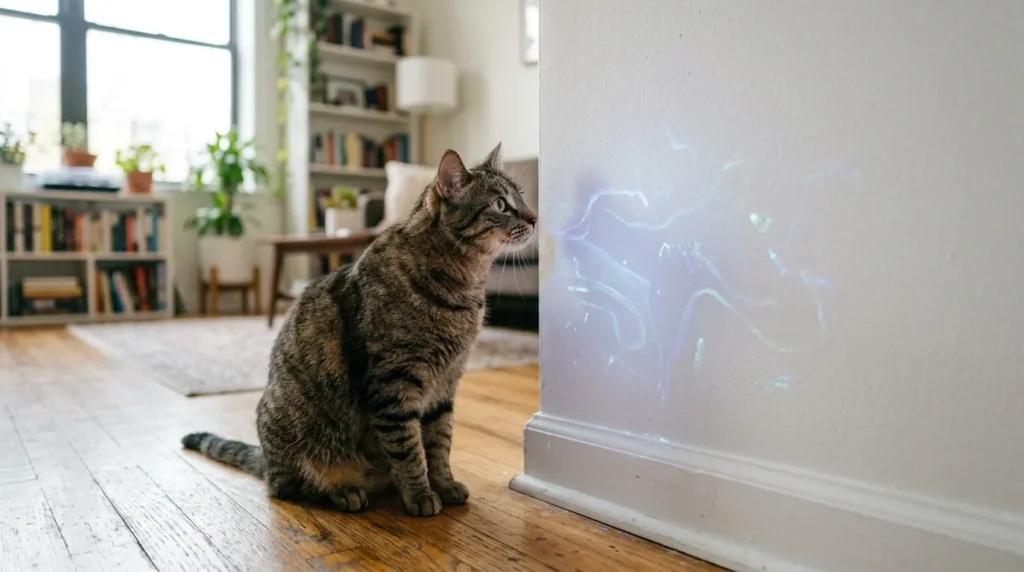
Cats see into the ultraviolet range in a way humans cannot without equipment. Cleaning product residue, soap streaks, old urine marks from a previous pet, dried food splashes and fingerprint oils all stay visible on a wall that looks spotless to you. If a past resident’s cat marked that wall, yours can still detect the pheromone trace years later, even under fresh paint. If old urine odor is the actual source, the same residue chemistry that keeps a cleaned litter box smelling is often what is lingering on the wall too.
This UV detection explains why cats often fixate on one specific patch of wall instead of scanning the whole surface. She is reading a precise piece of chemical or visual information at a spot that means something on her mental map. Moving furniture to block that section, or cleaning it with an enzymatic cleaner that actually breaks down organic residue, often stops the fixation within a day or two.
Modern LED lighting can add another layer. Some LED bulbs emit UV frequencies that make residue and surface irregularities appear highlighted to a cat, even in a room that looks evenly lit to you. If the staring happens specifically near an LED lamp, switching bulb temperature or brand sometimes clears it up completely.
The Predatory Trance: Why Wall Staring Is Often the First Stage of a Hunt?
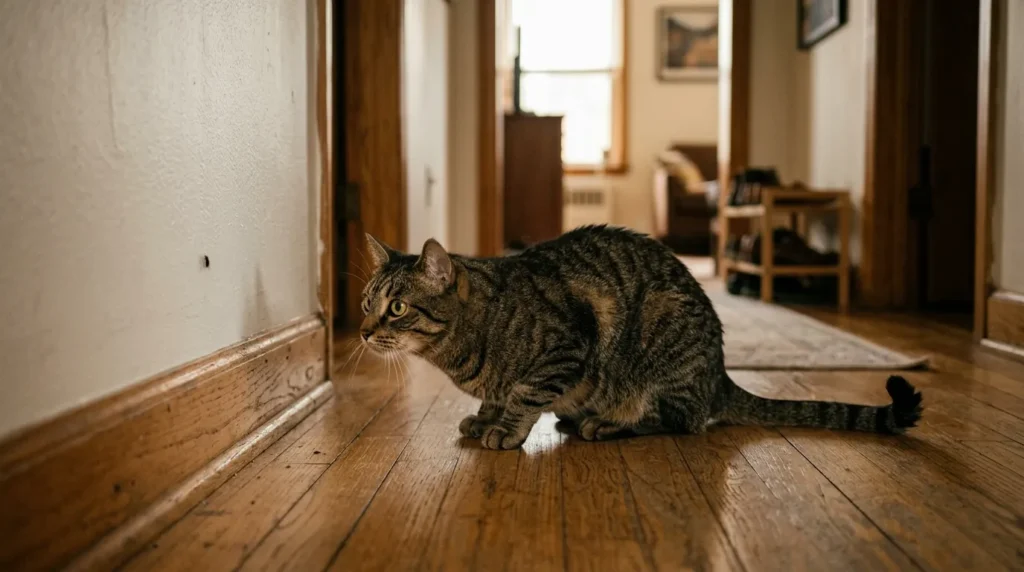
The predatory sequence in cats runs through five stages: detect, assess, stalk, pounce, catch. Wall staring is almost always the assess stage, where your cat has detected something and is calculating distance, movement and timing before she commits. A cat staring at a wall with a twitching tail tip and dilated pupils is not zoning out. She is mid-decision. If the stare ends with her suddenly pouncing at the baseboard or swatting at nothing, that is the sequence completing itself, and it is normal, not a sign of anything wrong.
Indoor cats without enough physical and mental stimulation redirect that predatory sequence onto whatever is available. A wall producing sound or movement from pipes, insects or HVAC activity becomes a legitimate hunt target. A dust mote crossing a sunbeam triggers the same neurological response a mouse crossing the floor would. The predatory brain does not judge scale well when no real prey is around. This is the same unspent-drive mechanism behind other common complaints owners bring up, including why some indoor cats get bored enough to invent hunting targets out of nothing, and why cats run around at night once that stored predatory energy finally has to go somewhere.
Regular enrichment that gives your indoor cat a legitimate outlet for the predatory sequence cuts down wall-directed hunting because it satisfies the detect-assess-stalk-pounce cycle through an appropriate channel instead of a blank wall.
What I Noticed: The staring in my own apartment was always worse between 5pm and 7pm, right when the HVAC ran its evening cycle. Once I traced it to baseboard heating pipes in that wall section, the whole thing made sense. Check whether your cat’s staring lines up with a specific time of day or an appliance turning on.
Smart Home Devices: How Modern Apartments Accidentally Create Wall Staring?
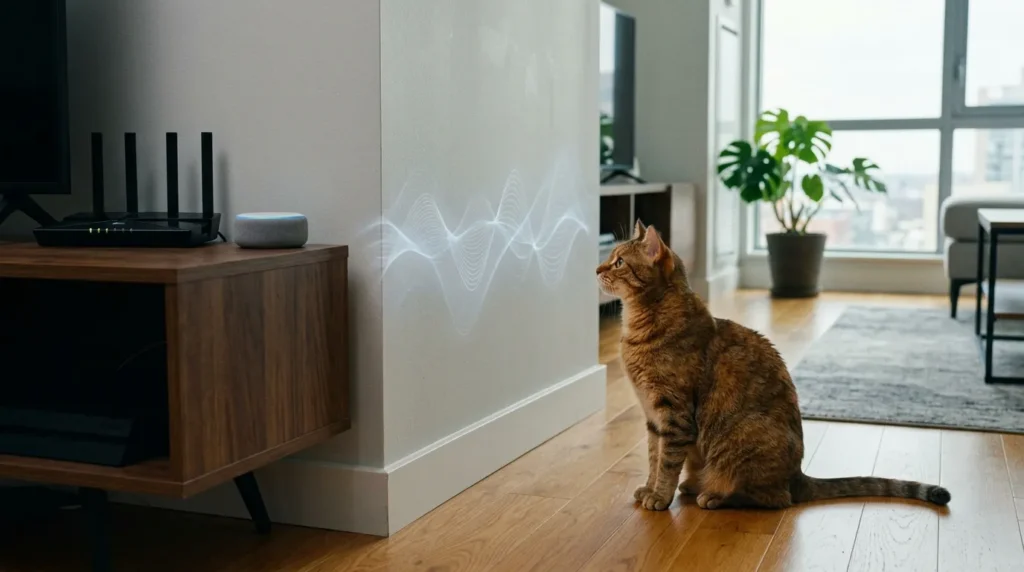
WiFi routers, smart speakers, ultrasonic pest repellers and some smart home hubs give off high-frequency tones in the 20,000 to 65,000 Hz range as part of normal operation. Humans cannot hear any of it. Cats hear all of it. If a router or smart device sits on or near a wall your cat keeps staring at, the device itself may be the actual source, not anything inside the wall.
Ultrasonic pest repellers are frequent culprits. They are marketed as inaudible to humans, which is true, but they put out a sustained high-pitched tone that cats find uncomfortable. A cat staring at the wall where a pest repeller is plugged in is not being mysterious. She is fixated on an annoying sound she cannot escape. Unplug the device and watch whether the staring stops within 24 hours. It is a clean, definitive test.
Managing life in a small unit means accounting for how apartment living affects your indoor cat, including auditing the electronics for high-frequency sources that create background stress your cat can only communicate through behavior like wall staring or restlessness.
Wall Staring vs Head Pressing: How to Tell the Difference
These two behaviors get confused from a distance, but they are not the same thing, and one of them is a medical emergency.
| Signal | Wall Staring | Head Pressing |
| Responds to her name | Yes, turns or looks toward you | No, no reaction |
| Body posture | Alert, tail may twitch | Head pushed into a surface, vacant |
| Blinking | Normal, natural | Reduced or absent |
| What it means | Sensory detection, normal behavior | Neurological emergency, needs a vet same day |
Head Pressing: The Wall Staring Variant That Needs Emergency Veterinary Care
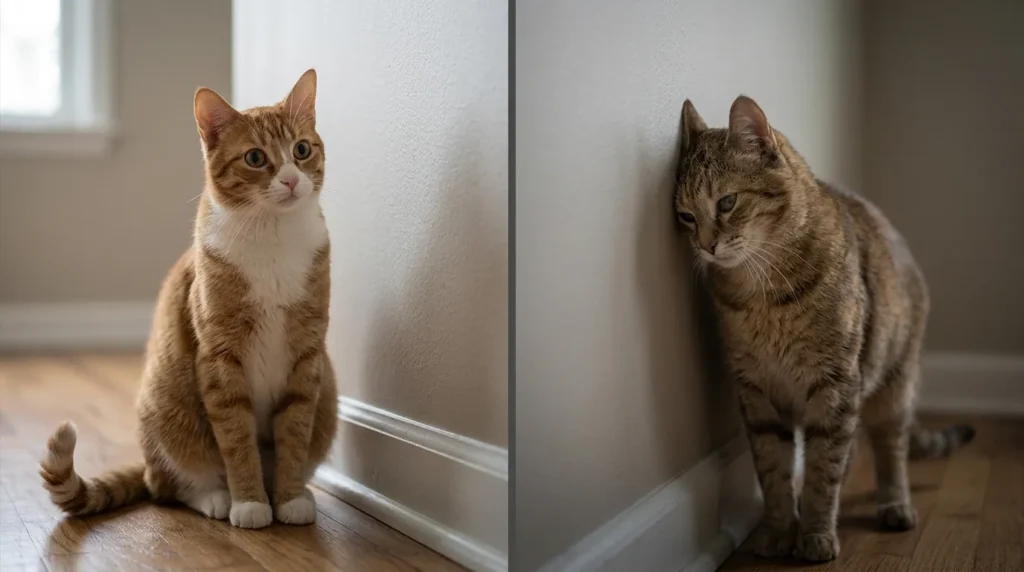
Head pressing is a neurological symptom where a cat pushes the top of her head continuously against a wall, floor or furniture, with no social engagement, no obvious sensory trigger, and no stopping when you approach. From a distance it can look like staring. Up close it is completely different. A cat head pressing is not alert. She is not tracking anything. She looks vacant, confused or distressed.
Head pressing points to elevated pressure inside the skull, from causes that include brain tumors, severe hypertension, liver disease, toxin exposure or trauma. ASPCA emergency care guidance notes that a cat showing compulsive head pressing alongside other neurological signs, aimless circling, altered consciousness or a change in pupil response, needs same-day emergency care.
The tell is posture and response. A cat staring at a wall looks at you when you say her name, blinks, and shifts position naturally. A cat pressing her head against a wall will not respond normally to your voice, will not blink at a normal rate, and will not redirect when you step in. See the second pattern, and you stop reading this and call an emergency vet.
This article is for informational purposes only. Always consult your vet if you have concerns about your cat’s health.
When Wall Staring in Senior Cats Signals Cognitive Decline
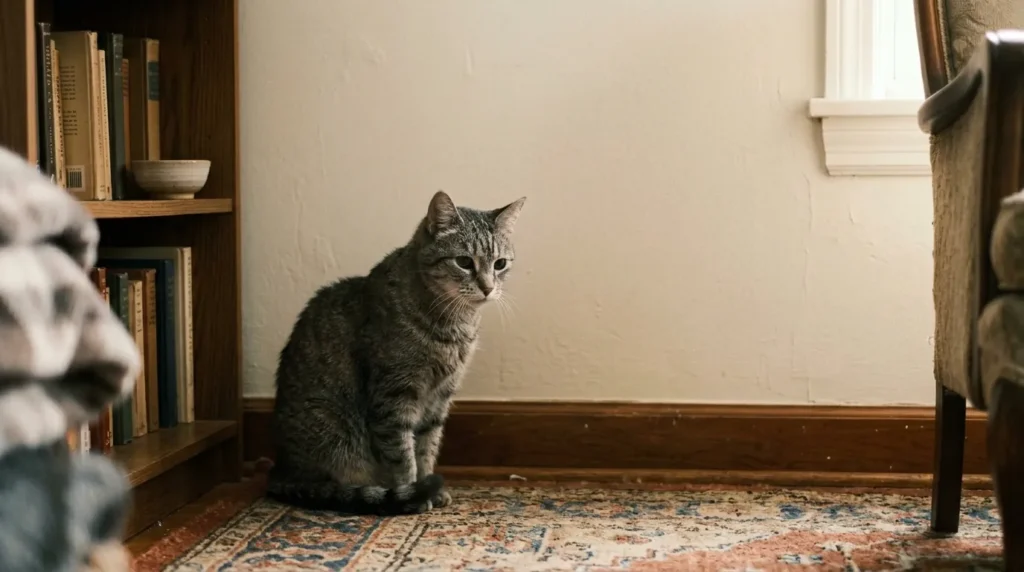
Feline cognitive dysfunction syndrome is the cat version of dementia, and it affects a large share of cats past age fifteen. One of the earliest, most consistent signs is sustained wall staring with a blank, unfocused expression, different from the alert intensity of normal predatory staring. Tracking your indoor cat’s health as she ages helps you catch this early, since a senior cat with cognitive decline is not tracking anything. She has lost her spatial orientation and stares at the wall because she has forgotten how to move away from it, or what she was doing in the first place.
This kind of wall staring shows up alongside other cognitive signs:
- Night-time vocalization when disoriented in the dark
- Forgetting where the litter box is
- Changes in sleep patterns
- Loss of previously consistent habits
A senior cat who starts wall staring without the alert predatory posture needs a vet appointment for cognitive assessment, not enrichment adjustments. Keeping litter box locations consistent and easy to reach matters even more for a senior cat working through spatial confusion, since a familiar, unchanged layout reduces the disorientation that makes cognitive symptoms worse.
Is It Different in Kittens?
Kittens stare at walls more than adult cats, and it means less when they do it. A kitten’s sensory system, hearing, vision and the predatory sequence, is still calibrating through her first year, so she investigates and locks onto stimuli adults have already learned to filter out or ignore. A kitten staring, pouncing at a wall, then wandering off after ten seconds is normal play development, not a concern.
What is worth watching in a kitten: staring paired with stumbling, head tilt, or disorientation. Those signs point to a neurological or inner-ear issue rather than normal sensory curiosity, and a young cat showing them needs a vet visit rather than a wait-and-see approach.
Frequently Asked Questions About Why Cats Stare at Walls
Why does my cat stare at the wall and then run away?
She detected something and entered the predatory sequence at the assess stage. When the sound or movement changed or intensified, it triggered a flight-or-chase response. The run is the end of the hunt, not a fright reaction.
Can cats really see things on walls that humans cannot?
Yes. Cats see ultraviolet light that reveals residue invisible to human eyes. They also detect movement below human visual resolution and hear frequencies inside walls that people cannot perceive at all.
Is it bad if my cat stares at the same wall every day?
Staring at the same spot daily usually means a consistent auditory or UV source. Check for water pipes, HVAC activity, insects, or a smart home device near that section instead of assuming it is harmless repetition.
Should I worry if my cat stares at the wall for hours?
If she is alert, responds to her name, and shifts position naturally, the staring is behavioral. If she is unresponsive, disoriented, or pressing her head against the wall rather than looking at it, call a vet the same day.
Why does my cat only stare at walls at night?
Nighttime wall staring usually points to sound detection. HVAC systems, plumbing and pest activity inside walls often pick up at night, when household noise drops and those sounds become easier for both of you to notice.
My cat stares at the corner where the wall meets the ceiling. Why that spot?
Corners focus and amplify sound from multiple wall surfaces at once. A corner stare suggests she is hearing something in the ceiling cavity or at the junction of two walls, where sound concentrates. Check for insects, rodents or pipe vibration at that joint.
Why does my cat stare at the wall and meow at the same time?
Vocalizing during a stare usually means she wants you to notice the same thing she has, or she is frustrated that she cannot reach whatever she is tracking. Occasional meow-and-stare is normal predatory frustration. If it happens at the same wall nightly and disrupts sleep, treat it the same as any other wall stare: check for a sound source first, then consider whether more daytime play would drain the energy before bed.
Do kittens stare at walls more than adult cats?
Yes, and it is normal. A kitten’s senses are still calibrating, so she notices and reacts to stimuli an adult cat has learned to filter out. Watch for stumbling or head tilt alongside the staring, since that combination points to a medical issue rather than curiosity.
What to Do If Your Cat Keeps Staring at the Same Wall
Most wall staring has a findable cause. Work through it in order:
- Check for a smart device, router or pest repeller near that wall and unplug it for 24 hours.
- Note the time of day the staring happens and check what appliance runs then.
- Clean the wall section with an enzymatic cleaner if a previous pet may have marked it.
- Add a short daily play session to redirect the predatory drive elsewhere.
- Watch her posture and responsiveness. If she stops responding to you or presses her head instead of staring, call a vet the same day.
Wall staring is one of those behaviors that looks strange until you know what a cat’s senses actually pick up. Rule out the medical emergency first, then work through sound, light and enrichment causes in that order. Most cases resolve once you find and remove the actual trigger.
Cats stare at walls because they detect real sensory information invisible to humans, including high-frequency sounds from pipes, insects and HVAC systems at up to 64,000 Hz, ultraviolet-visible residue on wall surfaces, microscopic movement and chemical pheromone information. Smart home devices and LED lighting add further high-frequency and UV stimulation cats respond to. Kittens stare more often than adults as their senses calibrate, and this is normal unless paired with stumbling or head tilt. Head pressing against a wall is distinct from staring and is a neurological emergency requiring immediate veterinary care. Senior cats over age fifteen who stare with a blank, unfocused expression may show early signs of feline cognitive dysfunction syndrome and need veterinary assessment.

Written by Mishu
A passionate cat lover and indoor living enthusiast, Mishu is the founder and voice behind Indoor Living Cat – a go-to resource for cat owners who want to create the happiest, healthiest life for their feline companions indoors.
View Full Profile
Thanks for this informative article!
Thank you for reading and for your kind feedback! We’re happy you found the information helpful. 🐱💛
Hi, i believe that i noticed you visited my blog thus i got here to go back
the choose?.I am attempting to find issues to improve my web site!I assume its ok to
use some of your ideas!!
Thank you for visiting our blog and for your kind words! We’re glad you found some of the ideas useful. Feel free to use the general inspiration and we hope you’ll visit us again! 🐾
I’d like to thank you for the efforts you’ve put in writing this blog.
I am hoping to view the same high-grade content by you in the future as well.
In fact, your creative writing abilities has encouraged me to get my own website now 😉
Thank you so much for your thoughtful comment! We’re really happy to hear that you enjoyed the content and found it inspiring. Wishing you the best with your new website and we hope to see you back on the blog soon! 🐾😊
Having read this I believed it was extremely enlightening.
I appreciate you spending some time and energy to put this
short article together. I once again find myself personally
spending way too much time both reading and commenting. But so what, it was still worth it!
Thank you so much for taking the time to read and share your thoughts! We’re delighted to hear that you found the article enlightening and that it was worth your time. We truly appreciate your support and hope you enjoy our future posts as well! 🐾😊
Wonderful blog! I found it while browsing on Yahoo News. Do you have any suggestions on how to get listed in Yahoo News?
I’ve been trying for a while but I never seem to get there!
Appreciate it
I got this web site from my pal who informed me concerning this site and now this time I am
visiting this web site and reading very informative articles
or reviews here.
Thank you so much for visiting our website! We’re glad you found us through your friend and enjoyed our articles. We really appreciate your kind words and hope you find more helpful information here. 😊
Excellent post. I was checking constantly this blog and I am impressed!
Extremely helpful information specially the last part 🙂 I care for such information much.
I was seeking this certain information for a very long time.
Thank you and good luck.
Thanks a lot! Really happy the last section helped you out. Stay tuned for more and good luck to you too!