
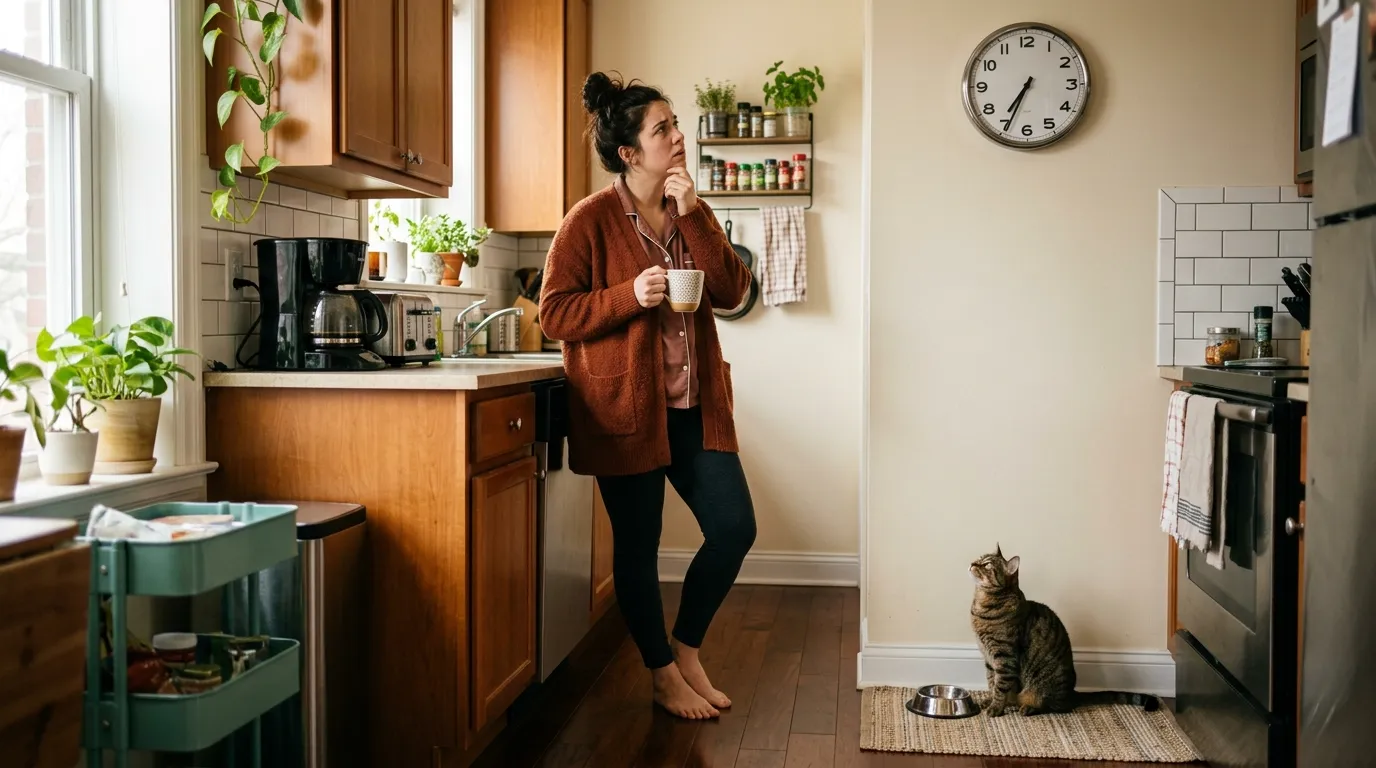
Your indoor cat is staring at you from beside the empty bowl again, and you genuinely can’t tell if you’re late with dinner or if they’re just being dramatic. So, how often should I feed my indoor cat? Two to three times a day for most healthy adults, three to four for young kittens, and two to three smaller meals for seniors, always at set times.
I learned how much the gaps between meals matter by accident. I moved my cat from one large meal to three smaller ones, and the 5am yowling stopped almost immediately. She wasn’t getting more food. The wait between meals was just shorter.
This guide gives you the feeding frequency for every life stage, sample schedules you can copy, how wet and dry food change the plan, how to work out portions per meal, and when a change in appetite means a call to the vet.
Quick Answer: How Often to Feed an Indoor Cat
- Adult cats (1 to 10 years): 2 to 3 meals a day, 6 to 8 hours apart. Never leave more than 12 hours between meals.
- Kittens under 12 weeks: 4 to 6 meals a day, every 3 to 4 hours.
- Kittens 3 to 6 months: 3 to 4 meals a day.
- Kittens 6 to 12 months: 3 meals a day.
- Senior cats (10+ years): 2 to 3 smaller meals a day.
- Free-feeding: skip it unless your vet has confirmed your cat holds a healthy weight with food always available.
Why Feeding Frequency Matters More for Indoor Cats Than Outdoor Cats
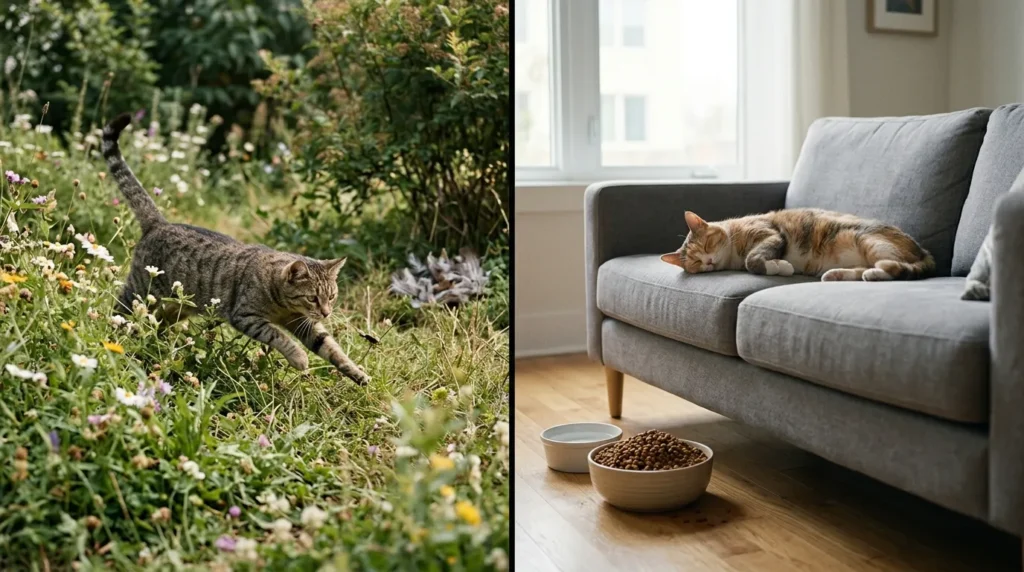
Feeding frequency for indoor cats isn’t a minor detail. A sedentary apartment cat has no hunting to burn off calories or limit how much it eats. An outdoor cat catches small prey throughout its active hours and ends up with roughly eight to twelve small meals a day. Indoor cats get their food delivered, and they’ll eat whenever it’s there, hungry or not.
A cat’s stomach empties about eight to ten hours after a meal. A cat fed once a day goes through a long stretch of real hunger every day, and that drives food-obsessed behavior and stress. Two meals twelve hours apart is the floor. Three meals about six to eight hours apart is better for most apartment cats because hunger stays low all day.
Consistent meal timing pays off in behavior too. Cats on a predictable schedule settle between meals because they learn food is coming. Cats fed at random times, or left with dry kibble out all day, tend to beg more. They don’t need more calories. They just can’t read the pattern.
Hungry or Bored? How to Tell
- Hunger usually clusters in the hour or two before your usual meal time, and your cat heads straight to the bowl and eats with focus.
- Boredom or attention-seeking shows up at random times, often follows you around the apartment, and fades when you play for five minutes.
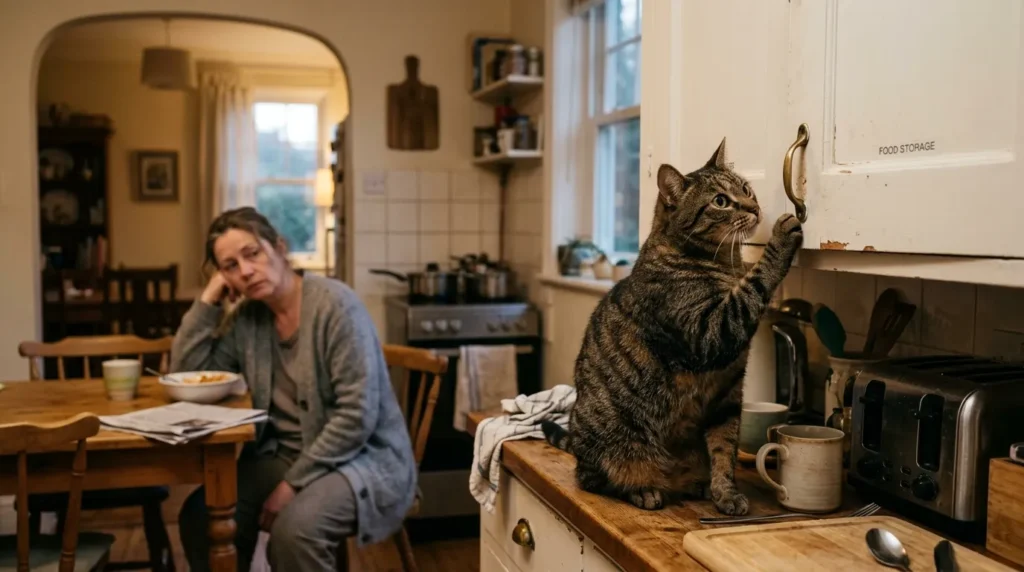
- Anxiety about food looks like guarding the bowl, gulping meals, or pawing at cabinets where food is stored. A shorter gap between meals often helps.
How Often Should I Feed My Indoor Cat by Life Stage?
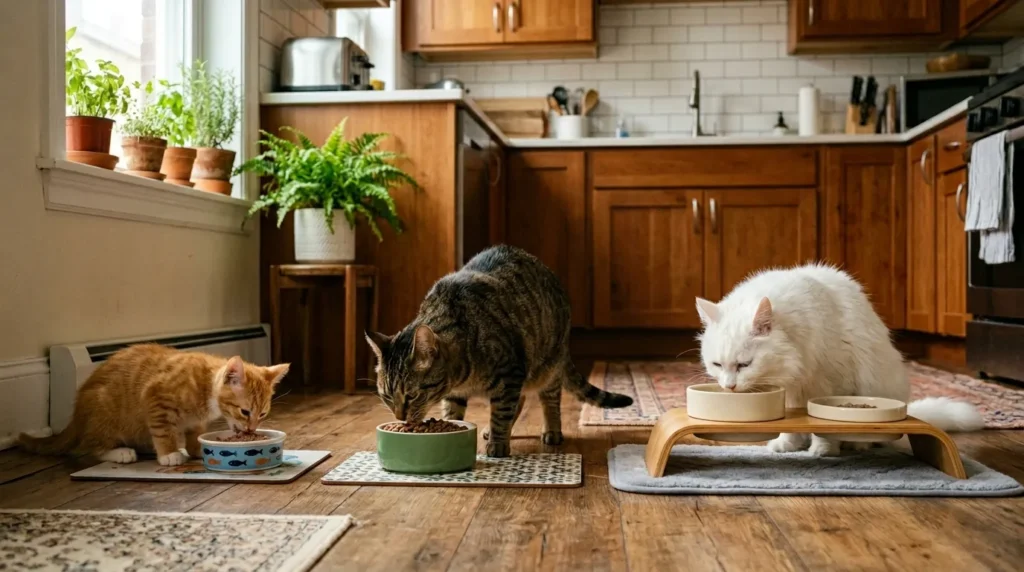
Metabolic needs and stomach capacity change at every stage, so the right frequency does too. Here’s the direct answer for each:
| Life Stage | Age | Meals Per Day | Spacing | Key Reason |
| Young kitten | Under 12 weeks | 4 to 6 | Every 3 to 4 hours | Tiny stomach, very high growth calorie needs |
| Kitten | 3 to 6 months | 3 to 4 | Every 4 to 6 hours | Still growing fast, stomach holds more but not enough for one or two meals |
| Kitten transitioning | 6 to 12 months | 3 | Every 5 to 6 hours | Growth slowing, approaching adult patterns |
| Adult neutered indoor | 1 to 10 years | 2 to 3 | Every 6 to 8 hours | Maintenance and obesity prevention |
| Senior | 10 years and older | 2 to 3 | Every 6 to 8 hours | Easier digestion, muscle maintenance |
How Often to Feed a Kitten
Kittens need frequent meals because their stomachs are small and their calorie needs per pound run two to three times higher than an adult’s. A kitten that eats too rarely can’t take in enough per meal to grow well, and long gaps can cause low blood sugar (hypoglycemia). Plan on at least three meals a day until the first birthday, and four a day through six months. Feed a kitten food made for growth, not adult food, until your vet says to switch. If your kitten is under eight weeks, or skips a meal and seems weak, call your vet the same day.
How Often to Feed an Adult Indoor Cat
Adults need less. They burn fewer calories than kittens and move less than outdoor cats of the same size. Two well-timed meals prevent the hunger behavior that makes indoor cats hard to live with, and they make weight control far easier than free-feeding does. If your cat still begs on two meals, go to three before you cut the portion.
How Often to Feed a Senior Cat
Seniors often do better on three smaller meals than two standard ones. Smaller portions are easier to digest, and energy stays steadier as metabolism becomes less efficient. Weight loss in an older cat that’s eating normally is a reason to see the vet, not a reason to feed more.
Wet Food, Dry Food or Both: Does It Change How Often You Feed?
Yes, a little. The meal count stays the same, but the practical details shift depending on what’s in the bowl.
| Food Type | Typical Meals Per Day | What to Watch |
| Dry only | 2 to 3 measured meals | Weigh portions on a kitchen scale. Scoops vary a lot from person to person. A timed feeder works well here. |
| Wet only | 2 to 3 meals, 3 is usually easier on a hungry cat | Discard what’s left after 30 to 60 minutes at room temperature. Needs a refrigerated feeder if you’re out all day. |
| Wet and dry mix | 2 to 3 meals | Count both toward the daily calorie total. A common split is wet at breakfast and dinner with a small dry portion at midday. |
Free-Feeding vs. Scheduled Meals: Which Works for Indoor Cats?
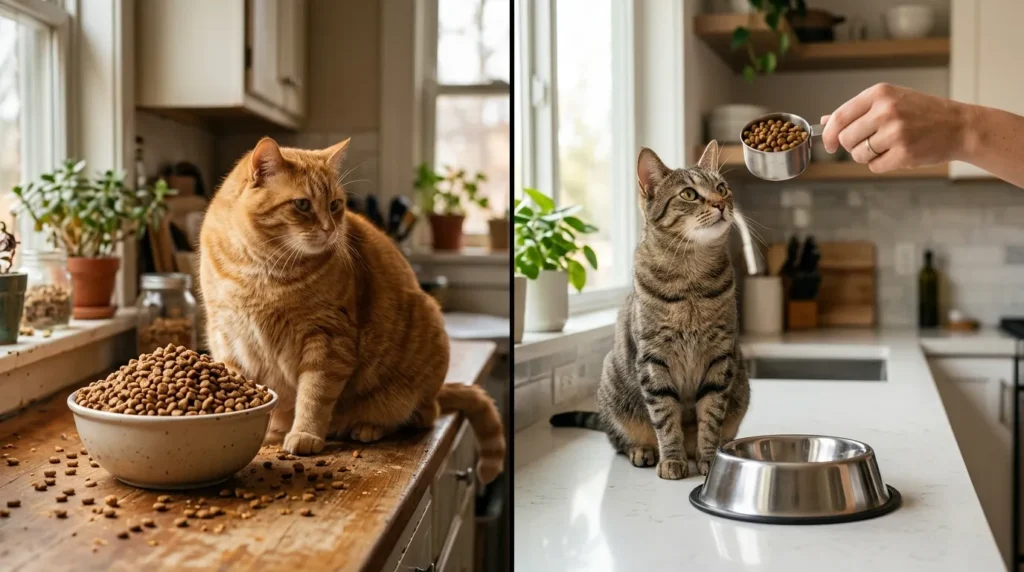
Free-feeding dry food works for some cats and fails badly for others. The difference is whether your individual cat self-regulates. Most indoor cats don’t. In a small apartment where there’s little else to do, plenty of cats eat out of boredom as readily as hunger, and they gain weight slowly without any single meal looking excessive.
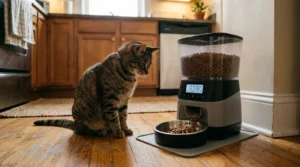
Scheduled meals give you control over total daily calories in a way free-feeding can’t. If your cat is gaining weight on free-fed dry food, change the timing before you change the formula. The structure fixes the overeating, not the brand.
The exception is a cat with a naturally high metabolism that stays lean with food always available. These cats exist, but they’re rarer among apartment cats. If a vet has ever called your cat overweight or borderline, free-feeding is off the table.
| Scheduled Meals | Free-Feeding | |
| Calorie control | Exact | Guesswork |
| Spotting appetite changes | Easy, you see every meal | Hard, the bowl just goes down |
| Begging | Drops once timing is consistent | Common in cats that eat from boredom |
| Effort | Needs set times or a feeder | Low |
| Best for | Most indoor cats, overweight cats, multi-cat homes | Lean cats that self-regulate, confirmed by a vet |
Insight Timed automatic feeders are one of the genuinely useful tools for apartment owners who work long hours. They dispense a measured portion at a set time, so your cat gets consistent meal timing even when you can’t be home at noon. Pick one with a battery backup so a power cut doesn’t cancel a meal. The limit is that most feeders only work reliably with dry food. Wet food needs a refrigerated feeder, which costs a lot more, so budget for that if wet is your main food.
How Much Should You Feed at Each Meal?
Frequency is half the plan. Portion is the other half, and the math is simple once you have a daily calorie number.
- Get your cat’s daily calorie target. Ask your vet, or check the feeding chart on the food label as a starting point. A typical neutered indoor adult around 10 lb (4.5 kg) often lands somewhere near 180 to 250 calories a day, but body condition changes that number.
- Divide by the number of meals. At 240 calories a day over three meals, that’s 80 calories per meal.
- Convert to weight. Find the calories per gram or per can on the label. If a dry food runs 4 calories per gram, 80 calories is 20 grams. Weigh it. Don’t scoop.
- Count treats. Keep treats to about 10 percent of daily calories and take them out of the meal portions.
- Recheck every two to four weeks. Weigh your cat and feel along the ribs. Adjust by small amounts, about 10 percent at a time.
The numbers above are an example. Your food and your cat will differ, so use the label and your vet’s target.
The Best Daily Feeding Schedule for an Indoor Apartment Cat
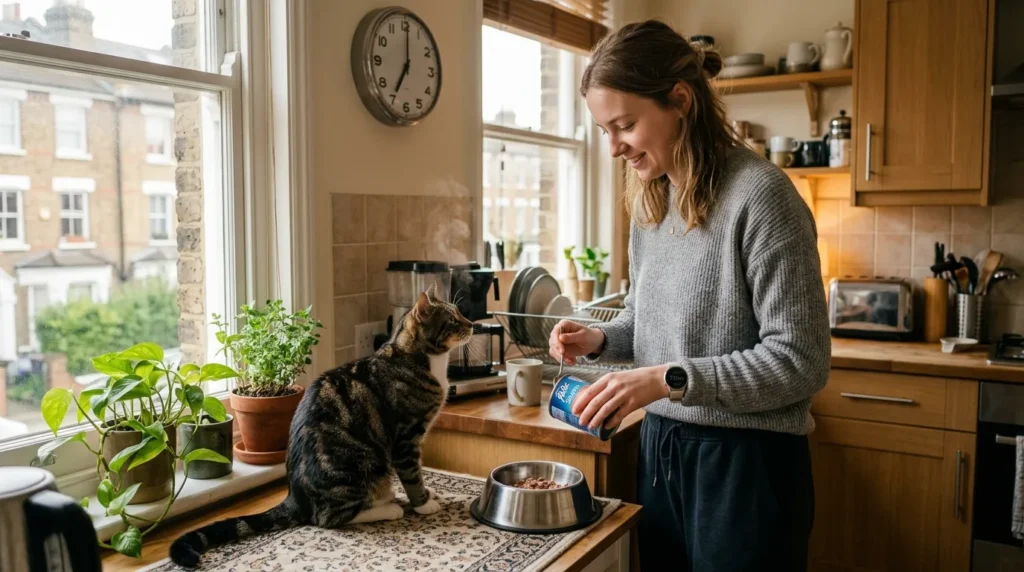
For a typical adult on two meals, feed in the morning when you wake up and again in the evening when you’re home or before bed. Keep the gap under twelve hours. Past that point, most cats start showing real hunger and anxious behavior.
For three meals, the midday feeding fits at lunch if you work from home or have a timed feeder. Morning, early afternoon and evening make roughly six-hour gaps, which keeps hunger low and nearly ends food begging.
| Schedule | Meal Times (Example) | Good For |
| 2 meals | 7:00am and 7:00pm | Healthy adults that don’t beg between meals |
| 3 meals | 7:00am, 1:00pm, 7:00pm | Begging cats, overweight cats, seniors |
| 4 meals | 7:00am, 12:00pm, 5:00pm, 10:00pm | Kittens under 6 months |
The last meal affects sleep on both sides of the bed. Cats are crepuscular, most active at dawn and dusk. A full evening meal close to your bedtime meets the post-dusk activity peak and cuts the odds of a 5am breakfast demand. Ten minutes of active play right before that meal mimics the hunt, catch, eat, groom, sleep cycle wild cats follow, and it calms the overnight hours noticeably. For a deeper look at building a whole routine around feeding times, including portion math and wet versus dry scheduling, see this guide on how to feed an indoor cat properly.
Should You Feed Your Cat at Night?
A small, planned evening meal helps. Random midnight feeding doesn’t, because it teaches your cat that being loud at night works. Set the last meal for an hour or so before you go to sleep, and keep the bowl empty after that.
How to Switch to a New Feeding Schedule
- Keep the daily calories the same. You’re changing the spacing, not the amount.
- Days 1 to 3: split the current portion into two meals if you’re coming from one.
- Days 4 to 10: move to three meals, taking a little from each of the first two to fund the third.
- Hold the times steady. Don’t shift a meal by more than 15 to 30 minutes a day.
- Weigh weekly. Weight should stay flat unless you’re deliberately trying to lose or gain.
If you’re changing the food as well as the schedule, do that separately. Mix the new food in gradually over seven to ten days so the stomach has time to adjust.
Special Situations: Multi-Cat Homes, Fast Eaters and Medical Conditions
- Multiple cats: feed in separate spots, or even separate rooms, so one cat isn’t eating the other’s meal. Free-feeding makes this much harder to manage.
- Fast eaters that vomit after meals: use a slow-feeder bowl, a puzzle feeder, or scatter the kibble across a flat plate. Splitting the same total into smaller, more frequent meals also helps.
- Diabetic cats: follow your vet’s schedule exactly. Meals are usually timed around insulin doses, often about twelve hours apart.
- Kidney disease, hyperthyroidism or other conditions: your vet will set both the food and the frequency. Don’t adjust it on your own.
- Pregnant or nursing cats: calorie needs jump, so ask your vet about plans and food choice.
How Feeding Frequency Connects to Indoor Cat Health and Weight
Feeding frequency affects blood sugar regulation in cats. A single large meal causes a sharp glucose rise followed by a long trough before the next one. Some veterinary research links that pattern to higher obesity risk in neutered indoor cats, though the evidence isn’t settled. Several smaller meals produce a flatter, steadier profile across the day.
Frequency control is also easier on your cat than portion cuts. Cutting daily calories by 20 percent while keeping one meal a day often leaves a visibly hungry, miserable cat. Keeping the same total across three smaller meals leaves a cat that feels satisfied on the same intake.
According to the VCA Animal Hospitals feeding guidelines, a cat’s stomach empties about eight to ten hours after a meal, so a twice-daily schedule leaves a real hunger gap in many cats. Three meals closes that gap almost completely. If your cat spends all day in a small space with little exercise, it’s worth reading about the specific risks in this guide on indoor cat health, which covers how daily feeding structure helps prevent the most common problems.
Quick Body Condition Check at Home
- You should feel the ribs easily under a thin layer of fat, like the back of your hand.
- Looking from above, there should be a visible waist behind the ribs.
- From the side, the belly should tuck up slightly. A hanging belly pad is normal in some cats, but a large saggy one often means extra weight.
- If you can’t feel the ribs at all, talk to your vet about a weight plan.
Common Feeding Frequency Mistakes That Cause Behavior Problems
Mistake 1: One big meal a day. Owners assume the cat will spread the eating over the day. Cats don’t. Most finish a single daily meal within ten to twenty minutes and then spend the next twenty-plus hours getting hungrier. The cabinet pawing, the 4am yowling and the nonstop attention-seeking come from that gap. It’s a hunger response to a thin feeding structure, and scolding it won’t fix it.
Mistake 2: Loose meal times. Feeding at 7am one day and 10am the next removes the one predictable thing in an indoor cat’s day. Cats build internal schedules around when food reliably shows up. Without that, your cat starts monitoring you and asking for food at random hours.
Mistake 3: Feeding in response to begging. That teaches your cat that begging works, and the behavior gets stronger. Redirect with a five-minute play session instead.
Mistake 4: Measuring by scoop or by eye. Scoop sizes vary, and a small overfill at every meal adds up over weeks. Weigh the food.
Insight If your cat wakes you before the alarm every morning to demand breakfast, feeding earlier doesn’t help. It just moves the wake-up call earlier over the next week. Set a timed automatic feeder for your target breakfast time instead. Your cat learns that you getting up has nothing to do with when food appears.
Checklist: Stop the 5am Begging
- Move to a fixed evening meal close to your bedtime.
- Play for ten minutes before that meal.
- Use a timed feeder for the morning meal.
- Don’t respond to yowling or pawing. Wait until the feeder or the scheduled time.
- Keep the schedule the same on weekends.
- Give it one to two weeks before judging the result.
How Long Can a Cat Go Without Eating, and When Is Appetite a Warning Sign?
A cat that suddenly loses interest in meals it ate reliably is telling you something. One skipped meal in an otherwise active, alert cat usually isn’t a concern. Two or more missed meals in a row, or interest in food that drops over several days, needs attention. As a rule, call your vet if an adult cat hasn’t eaten anything for 24 hours. For kittens, seniors and cats with a medical condition, call sooner. Overweight cats that stop eating for even a few days are at risk of hepatic lipidosis, a serious liver condition, which is why waiting it out is a poor plan.
A sudden appetite increase deserves a look as well. Hyperthyroidism in senior cats is among the most common reasons for a cat that wants much more food than usual while losing weight. Diabetes can look similar. Both are diagnosable and manageable, and early treatment helps.
Signs that call for a vet visit rather than a schedule change:
- Visible weight loss over two to three weeks.
- Vomiting after meals more than once a week.
- Changes in litter box habits alongside appetite changes.
- A dull or unkempt coat.
- Lethargy, hiding, or drooling.
- Drinking much more water than usual.
This article is for informational purposes only. Always consult your vet if your cat shows sudden changes in appetite, weight or feeding behavior.
Frequently Asked Questions About How Often to Feed an Indoor Cat
How many times a day should I feed my indoor cat?
Two to three times a day for a healthy adult. Three is better if your cat begs between meals or is overweight. Kittens under six months need three to four meals.
Is it okay to feed my indoor cat just once a day?
No, once a day is below the recommended minimum for most adult cats. The stomach empties in eight to ten hours, so one meal creates a long hunger gap that causes stress and food obsession. Twice a day is the minimum. Three is better for cats that beg.
How many hours should be between cat meals?
Aim for six to eight hours on a three-meal plan and about twelve hours on a two-meal plan. Don’t go past twelve hours between meals for an adult, and keep kitten gaps to three to six hours depending on age.
My indoor cat acts hungry all the time even after I feed them. What does that mean?
Constant hunger behavior in a cat eating enough calories usually points to one of three things. The meals are too far apart, the food has low satiety such as a high-carbohydrate dry food, or the behavior is boredom. Split the same daily total over three meals instead of two and check whether the behavior eases within a week. If it doesn’t, or your cat is also losing weight, see your vet.
Can I leave dry food out all day for my indoor cat?
If your cat holds a healthy weight with constant access, it’s workable. Most indoor apartment cats don’t, and free-feeding leads to slow overeating and weight gain. If a vet has ever called your cat overweight or borderline, don’t free-feed.
How often should I feed my cat wet food?
Two to three times a day, with portions measured by calories. Throw away uneaten wet food after 30 to 60 minutes. If you mix wet and dry, count both toward the daily total.
How often should I feed a kitten?
Four to six meals a day under twelve weeks, three to four from three to six months, and three from six to twelve months. Use a food formulated for kittens.
What is the best time of day to feed an indoor cat?
Morning and evening meals line up with a cat’s dawn and dusk activity peaks. On two meals, aim for twelve hours apart, such as 7am and 7pm. On three, add a midday meal. Consistency matters more than the exact hours.
How long can a cat go without eating?
An adult cat shouldn’t go more than 24 hours without eating. Call your vet at that point, and sooner for kittens, seniors, overweight cats and cats with health conditions.
How often should I feed my indoor cat if they are overweight?
Three smaller measured meals a day rather than two. Frequent small meals keep energy steady and reduce begging while total calories drop to support weight loss. Calculate portions by calorie target, not cup volume, and have your vet confirm a safe target before you start.
Should I feed my cat before bed?
Yes, a planned meal about an hour before your bedtime helps, especially after a play session. It reduces early-morning wake-ups. Don’t give extra food in response to night-time begging.
Set the Schedule and Stick to It
Feed your adult indoor cat two to three times a day at consistent times, and start today by picking specific meal times instead of feeding whenever you remember. Kittens need three to four meals through six months and three meals until their first birthday. The schedule counts as much as the portion size. Consistent timing gives you a calmer cat and a weight you can actually manage.
Most healthy adult indoor cats should be fed two to three times a day at consistent times, about six to eight hours apart, with no more than twelve hours between meals. A cat’s stomach empties in eight to ten hours, so a single daily meal creates a long hunger gap that drives food-obsession behavior. Kittens need four to six meals under twelve weeks, three to four from three to six months, and three from six to twelve months. Senior cats do well on two to three smaller meals. Free-feeding dry food leads to overeating in most sedentary indoor cats. Consistent meal timing produces calmer behavior and easier weight management. See a vet if an adult cat goes 24 hours without eating.

Written by Mishu
A passionate cat lover and indoor living enthusiast, Mishu is the founder and voice behind Indoor Living Cat – a go-to resource for cat owners who want to create the happiest, healthiest life for their feline companions indoors.
View Full Profile