
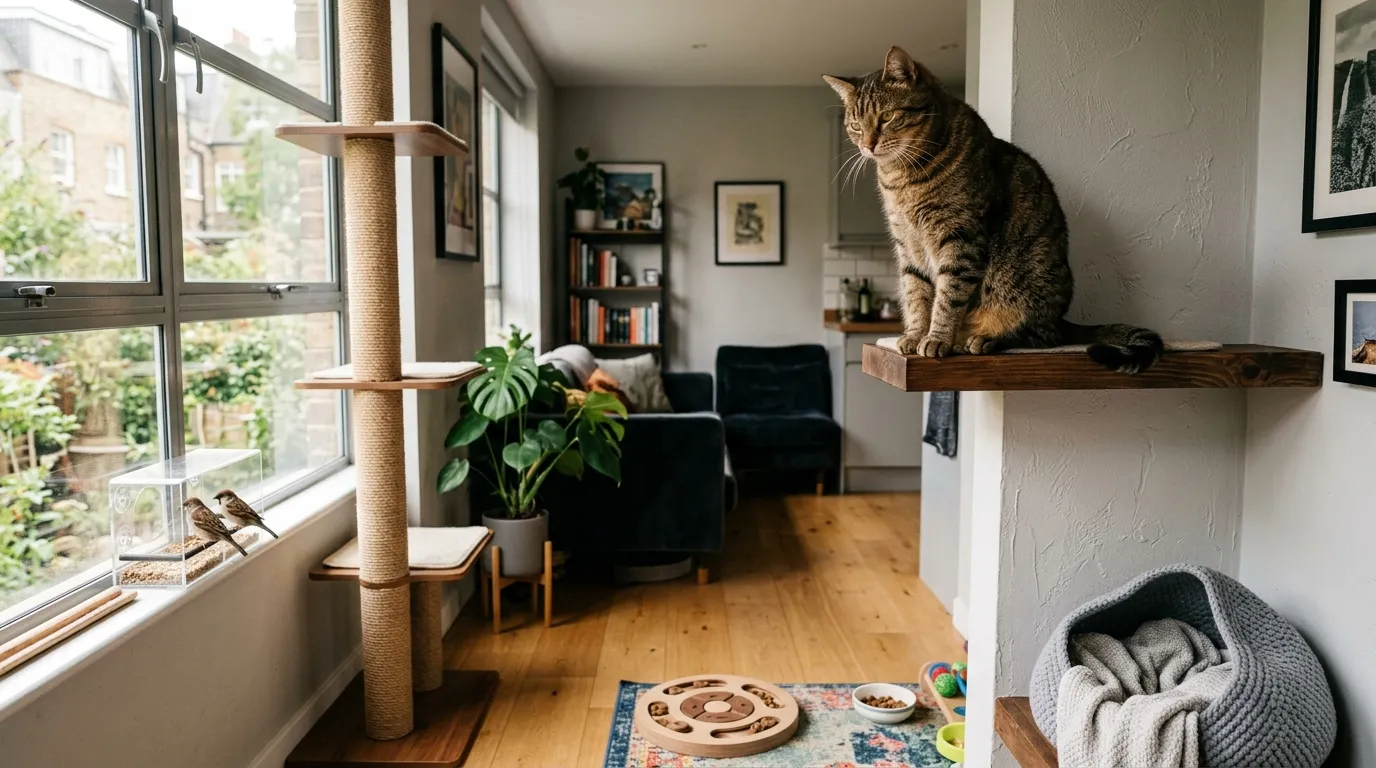
How to keep a cat happy in a studio apartment was a question I had no answer to on the day I signed a lease for a four-hundred-square-foot place and brought home a two-year-old tabby the same weekend. The guilt hit fast. She spent hours on the narrow windowsill pressing her nose to the glass, and I kept thinking she needed more room. What she actually needed was more vertical territory and a real daily routine, and I had neither. Space matters less than people assume. Setup matters more. This guide covers seven methods that turned my small apartment into a place my cat genuinely thrived in, plus the mistakes I made getting there.
Cats do well in a studio apartment when the space uses vertical territory instead of floor space, gets a daily play schedule timed to natural activity peaks, and comes with steady human interaction. A four-hundred-square-foot studio with wall shelves, a window perch, and a bird feeder produces a calmer cat than a thousand-square-foot apartment with bare walls and nothing to do.
Why Studio Size Is Not the Real Problem?
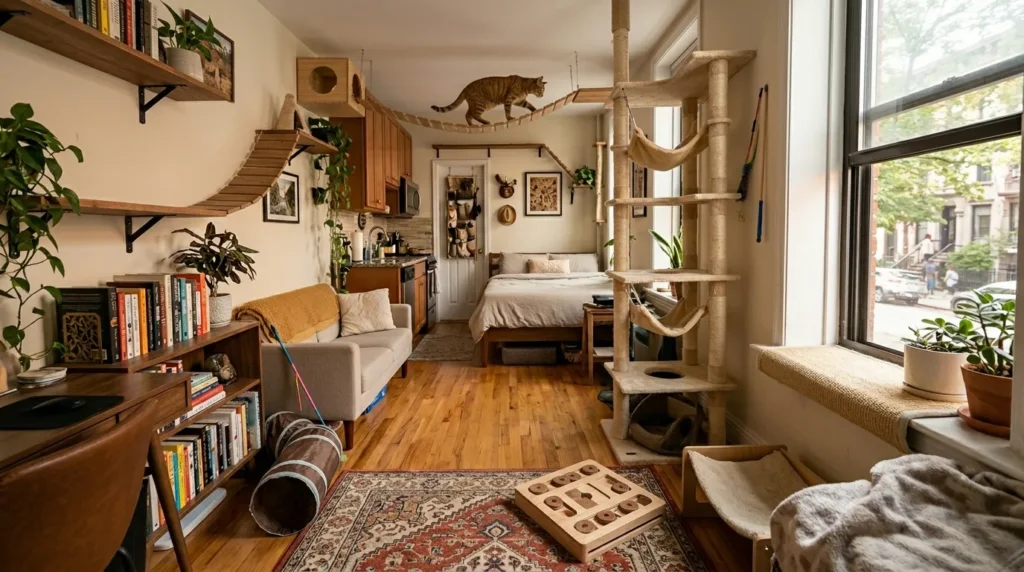
Cats do not measure happiness in square feet. They measure it in distinct territories, in height levels they can reach, and in whether their hunting drive gets used up through daily play. A cat that climbs to five different heights in a four-hundred-square-foot studio has more perceived territory than a cat stuck at floor level in a two-bedroom apartment.
Vertical territory is the single most useful idea in small-space cat care. In the wild, cats share ground-level space with other animals and claim status through height instead. A cat that can watch a room from above has a different stress response than one that lives only at floor level with no lookout point. Two or three wall shelves connected into a path change a studio cat’s daily behavior more than doubling the apartment’s floor space ever would. A well-planned indoor cat enrichment plan starts here, with height, not floor area.
The American Association of Feline Practitioners feline environmental needs guidelines list elevated resting points as a core welfare need, right alongside food, water, and litter. This is not optional decor. It shapes how the cat experiences the apartment every waking hour.
How Much Space Does a Cat Actually Need?
No veterinary guideline sets a minimum square footage for a happy cat. The research points to resource access instead: enough separate spots to eat, drink, use the litter box, rest, hide, and climb without those zones overlapping. A studio can hit every mark if the layout is planned around them, not just around furniture.
| Territory Factor | Why It Matters | Studio Fix |
|---|---|---|
| Height access | Lets the cat observe from above and feel safer | Wall shelves or a tall narrow cat tree |
| Hiding spots | Reduces stress from noise and visitors | A covered box or gap under furniture |
| Separate resource zones | Prevents food, litter, and rest areas from competing | Use corners and vertical layers, not just floor spread |
| Predictable play | Discharges hunting drive daily | Two fifteen-minute wand sessions |
| Outdoor visual access | Provides hours of passive stimulation | Window perch facing a bird feeder |
Once these five factors are covered, extra floor space adds very little. A cat that already has height, hiding spots, separate resources, daily play, and a window view will not behave noticeably better in a bigger apartment.
Signs Your Cat Is Struggling With the Space, Not the Setup
Before you buy anything, check whether the behavior is really a space issue. Some signs point to boredom. Others point to something a vet should look at.
- Pacing the same short path over and over, especially at night
- Overgrooming one spot until the fur thins
- Sudden aggression toward you or a second cat during normal moments
- Hiding for most of the day, even when you are home
- Scratching furniture right after you get home, not throughout the day
Most of these ease off within a week or two once vertical space, play, and a window station are in place. If nothing changes after a real setup fix, treat it as a health question first. Some indoor cat health issues show up as behavior changes before anything else.
Method 1: Go Vertical and Make Every Wall Count
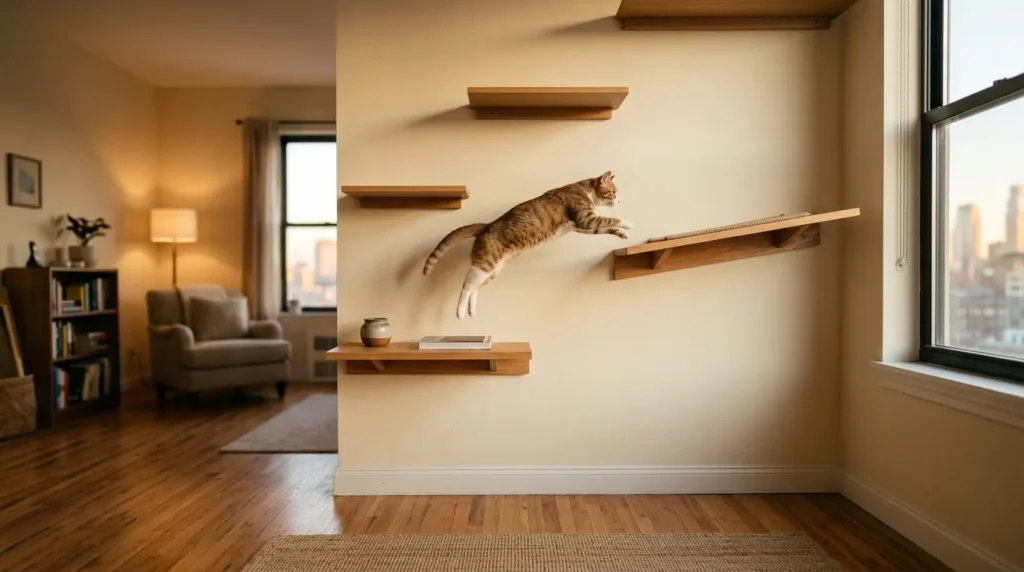
Wall-mounted floating shelves connected into a climbing path give a studio cat a three-dimensional territory that uses zero floor space. Install three to four shelves at different heights along one wall, spaced so the cat can jump between them. That alone builds an exploration route the cat will use several times a day. Renter-friendly adhesive brackets work for lightweight setups. Stud-anchored brackets hold more weight if your landlord allows drilling.
A tall narrow cat tree placed beside the window pairs height with the pull of the outdoor view. Most cat trees sold in stores are too short and too wide for a studio. Look for floor-to-ceiling tension models or slim vertical trees with platforms at several levels, not the wide tiered structures that eat floor space without giving much height back.
Every extra height level is a genuinely separate territory, not just more of the same. A cat with access to floor level, a mid-level cat tree, a wall shelf at head height, and a shelf near the ceiling has four distinct spots to choose from across the day. That variety cuts the restless pacing that turns into scratched furniture in small apartments with no height difference.
Method 2: The Window Is Your Most Powerful Enrichment Tool
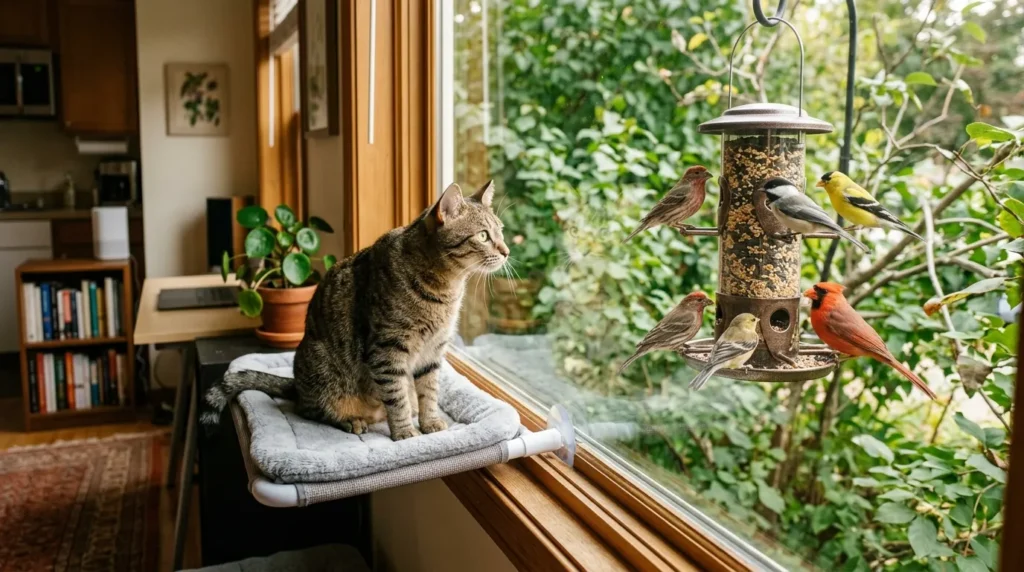
The window in a studio apartment is not just a wall feature. It works as a daily enrichment station that runs on its own once it is set up. A padded perch at the window, paired with a suction-cup bird feeder placed five to eight feet outside the glass, turns a small apartment’s only outdoor connection into five to eight hours of passive stimulation a day. Birds show up without warning. They make sounds. They trigger the tracking response that keeps a cat’s eyes and attention engaged for hours.
Suction-cup feeders stick straight to apartment windows, no drilling and no landlord approval needed. A pole-mounted feeder in a balcony planter gives the same bird traffic from a bit further back, and birds tend to stay longer when they feel less exposed. Either setup costs under thirty dollars once and keeps paying off the whole time you live there. Before you set this up, though, the window itself needs to be secured first, more on that in the cat-proofing section below.
Method 3: Daily Play Schedule Timed to Activity Peaks
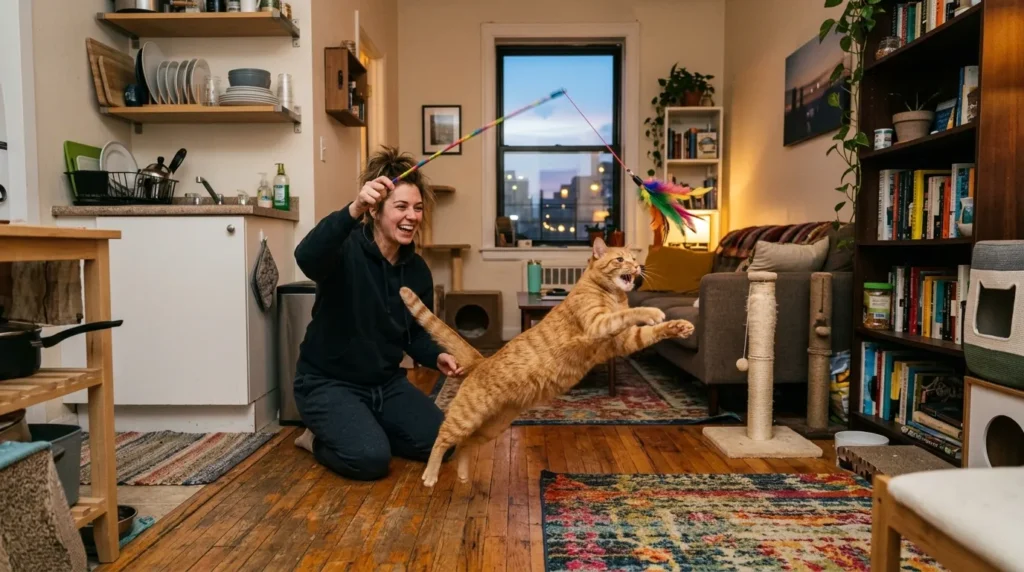
Routine does more for a studio cat than any single piece of furniture. A cat that gets two fifteen-minute wand sessions a day, timed to dawn and dusk and followed by a meal, has its behavioral needs met no matter the apartment size. A cat with no play schedule in a large space still ends up worse off than a cat with a solid routine in a studio.
The timing before meals is what makes the schedule work. Playing right before the morning and evening meal ties each session to a routine the cat already expects, and completes the hunt-eat-groom-sleep cycle its body is wired for. After the catch and the meal, the cat grooms and settles down. That quiet stretch afterward is what makes small-space living comfortable for both of you.
A studio limits running distance during play compared to a bigger apartment, but this matters less than most owners think. A cat chasing a wand toy through four hundred square feet can still sprint, pivot, leap, and pounce through the full sequence that burns off hunting drive. The session does not need a hallway. It needs a toy that moves like prey and fifteen focused minutes from you.
Method 4: Use Every Corner for Hiding and Resting
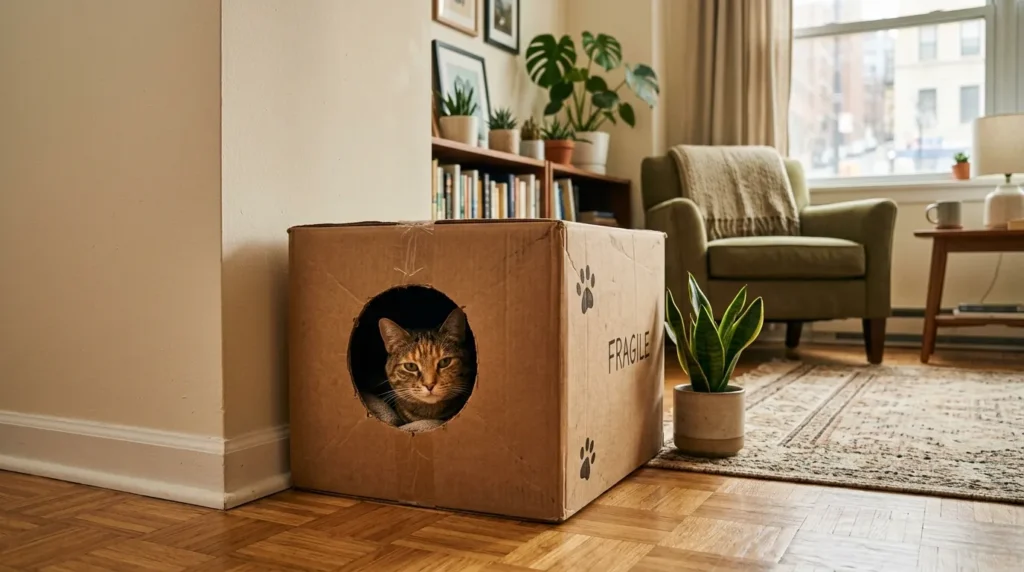
Cats feel secure when they can watch a room from a hidden spot with more than one way out. In a studio, every tucked corner, under-bed gap, and space behind furniture can serve this purpose once it is made accessible and comfortable. A cardboard box with a hole cut in one side, tucked under the desk, gives a cat a hiding spot it will use for years, for free.
The studio layout that works best has several small territories instead of one open stretch of floor: a high lookout near the window, a mid-height resting shelf, a floor-level hiding spot in a quiet corner, and an open area for play in the middle. Each zone does a different job, and together they make a small space feel territorially full instead of just small.
Insight: Studio living pushes you to get creative about cat territory, and that creativity almost always beats buying more space. My best hiding spot cost nothing, a cardboard box from an online order with one hole cut in the front, tucked under my desk where the cat could watch the whole apartment from the dark. She picked it over every bed I ever bought her.
Method 5: Scatter Feeding and Puzzle Feeders Replace Bowl Boredom
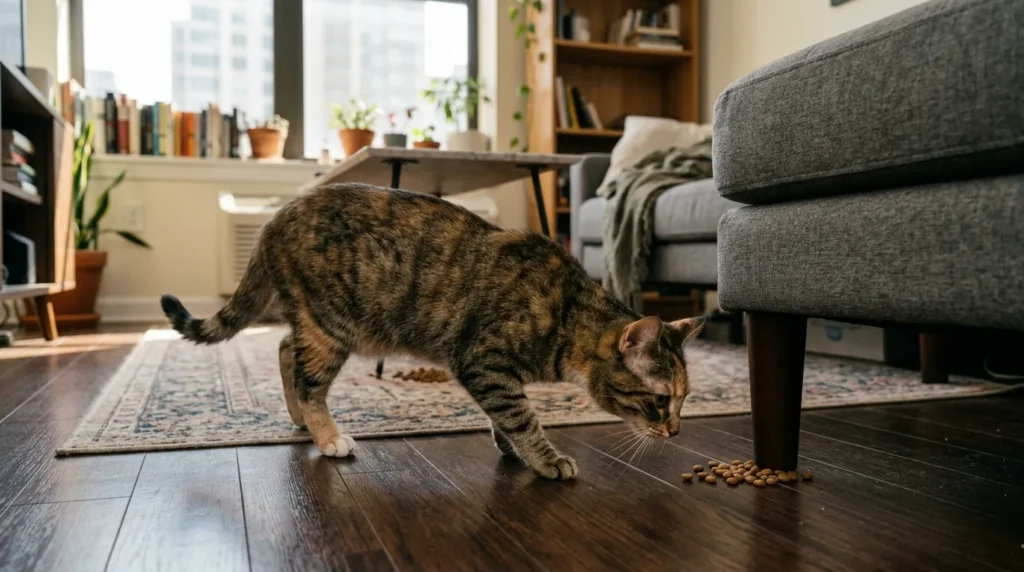
Scatter feeding turns the two daily meals into ten to fifteen minutes of foraging movement that burns off energy before it turns into restlessness. In a studio, even five hiding spots spread across the apartment build a real foraging circuit. The cat covers the whole space hunting for food instead of using that same floor only for zoomies or pacing.
A puzzle feeder at one of the two daily meals stretches thirty seconds of bowl eating into eight to twelve minutes of problem solving. In a small apartment, where the cat spends every hour of its life, a puzzle feeder gives it the midday mental work that a bigger territory would normally supply through exploring. Small space means the owner has to build smarter structure into the day, and puzzle feeding is the easiest upgrade to start with. For a full breakdown of meal timing and portions, see how to feed an indoor cat properly.
How food is offered to a studio cat shapes its whole daily rhythm in a way floor space cannot replace. The link between feeding style and how settled a cat is for the rest of the day is one of the most consistent patterns in small-space cat ownership.
Method 6: Control Litter Box Placement for Stress-Free Access
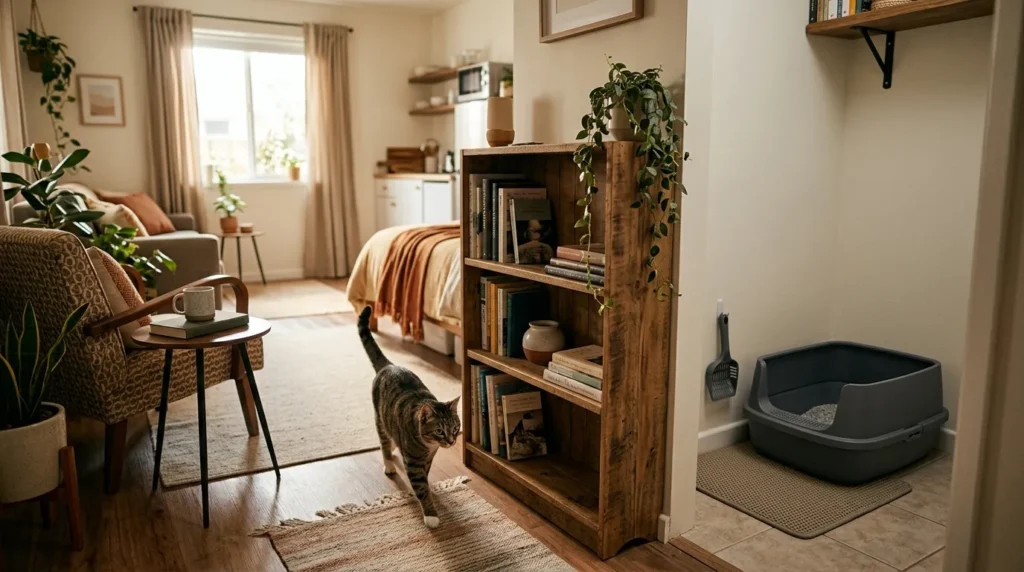
A studio apartment splits its whole square footage between human living and cat bathroom needs, so box placement has to be deliberate, not just wherever it fits. Put the litter box in the spot least tied to human activity and eating, ideally behind a room divider, in a bathroom corner, or tucked beside the fridge. The cat needs a clear path in and, ideally, a sightline to the room entrance so it never feels cornered while using the box. The complete indoor cat litter box guide covers box types, litter choices, and placement rules in more depth if you want the full setup.
A high-sided open box without a cover works better in a studio than a covered one, because open-top airflow moves odor out instead of trapping ammonia inside a closed box. In a small apartment, where you sleep, eat, and work within feet of the litter box, odor control is a daily quality-of-life issue that box design genuinely decides. Scoop every day, no exceptions. In a studio you will smell a missed scoop within hours, not the next morning. If odor keeps showing up even with daily scooping, this guide on why a litter box smells after cleaning walks through the usual causes.
Method 7: Cat-Proof the Space: Windows, Cords, and Toxic Plants
[Image placeholder: open apartment window fitted with a secure mesh screen, cat sitting safely behind it]
This is the method most studio guides skip, and it’s the one with the highest stakes. A studio puts your cat within a few feet of an open window almost year-round, and that’s a real risk, not a theoretical one. Veterinary researchers have a name for it: high-rise syndrome, injuries from a fall out an apartment window or off a balcony. Cats survive these falls at a high rate when they get quick veterinary care, but the injuries, chest trauma, fractured jaws, broken limbs, are serious, and the falls spike in summer when windows stay open and cats are more likely to be young, curious, and quick to lunge at something outside the glass.
A cat doesn’t need to be clumsy to fall. A bird, a gust of wind, or a startle while balanced on a sill is enough. The fix is cheap and permanent: install a snug, cat-proof mesh screen on every window you open, not the flimsy screen that came with the building, since a determined cat can push through a loose or torn one. Secured screens designed for pet safety run about fifteen to thirty dollars per window and take fifteen minutes to install.
Two other studio hazards deserve the same attention:
- Cords and blind pulls. A studio’s compact layout puts charging cables, lamp cords, and blind strings within easy paw reach. Tuck cords behind furniture or use cord covers, and swap looped blind pulls for the breakaway kind.
- Toxic plants. Lilies are severely toxic to cats and can cause kidney failure from just brushing pollen onto fur and grooming it off, so keep any lily variety out of a studio entirely. Pothos, philodendron, and aloe are common houseplants that cause mouth irritation or stomach upset if chewed. If you want greenery, cat grass, spider plants, and Boston ferns are safe options that give your cat something to nibble on instead.
Cat-proofing takes an afternoon once, and it removes the single biggest safety risk that comes with small-space, window-adjacent living.
Vertical Territory Setup Options Compared
Owners usually pick one main height solution first, then add to it. Here is how the three most common studio options stack up.
| Setup | Floor Space Used | Typical Cost | Best For |
|---|---|---|---|
| Wall-mounted shelves | None | $40 to $120 for a 3-shelf path | Renters wanting max floor space |
| Tall narrow cat tree | 2 to 3 square feet | $70 to $200 | Owners who want one all-in-one piece |
| Window perch | None (mounts on glass or sill) | $15 to $50 | Pairing with a bird feeder for passive play |
Most studios end up using all three together. Shelves and a window perch cover the free-floor-space needs, and a cat tree gives one sturdy anchor point near the center of the room.
Studio Living: What Works in Your Favor and What Doesn’t
Small-space cat ownership is not all upside or all downside. Knowing both sides helps you plan instead of guess.
| Works in Your Favor | Works Against You |
|---|---|
| You are close by most of the day, so play stays consistent | Litter box smell and noise are harder to isolate |
| One window station can cover most of the cat’s stimulation needs | Two cats need extra planning to avoid resource competition |
| Vertical setups are cheap and often renter-friendly | Guests and deliveries mean less quiet time for a shy cat |
| Cleaning routines are faster to keep consistent in a small footprint | Fewer places to separate a sick or stressed cat temporarily |
Managing Noise, Visitors, and Alone Time in a Small Apartment
Thin walls are a studio reality, and a lot of cat stress in small units traces back to sound, not space. Hallway footsteps, a neighbor’s door, or a dog barking through the wall register louder to a cat than they do to you, since cat hearing picks up a wider range of frequencies than ours does.
A few adjustments help without any construction:
- Give her a sound buffer. A hiding spot away from the shared wall, paired with a fan or a white-noise machine running low, softens sudden hallway noise.
- Manage visitors deliberately. Set up a closed-door room, even a bathroom with her bed and water, where a shy cat can wait out a party or a repair visit instead of being cornered in the open studio.
- Plan for alone time. A studio means your cat hears you doing everything, cooking, calls, workouts, and that constant awareness of your presence can make actual alone time feel different for her than it would in a bigger home. A puzzle feeder or a short window session before you leave gives her something to do besides waiting by the door.
- Consider a camera feeder for longer absences. A camera-equipped feeder lets you check in and toss a treat remotely, which matters more in a studio where she has fewer distractions to fall back on while you’re out.
Can You Keep Two Cats in a Studio Apartment?
Yes, but resource duplication matters more than total space. Two cats in a studio need separate food and water stations placed apart, two litter boxes (the standard rule is one box per cat plus one extra, though a studio with daily scooping can often work with two boxes for two cats), and enough vertical spots that neither cat has to compete for the best perch.
Bonded cats that already sleep and groom together need less duplication than two cats who tolerate each other but are not close. Watch for one cat blocking the other from the window perch or the litter box. That is the clearest sign the studio needs another resource zone, not more floor space. Ongoing tension between two cats is worth a closer look at common indoor cat behavior problems before assuming it will resolve on its own.
Best Cat Types for Studio Apartment Living
Any healthy cat can adapt to a studio with the right setup, but temperament matters more than breed. A few patterns show up often among owners in small units.
- Lower-energy adult cats settle into a routine faster than kittens under one year old
- Cats already used to indoor-only living adjust with less stress than cats moved from a house with outdoor access
- Breeds known for being people-focused, like Ragdolls and British Shorthairs, tend to do well near constant human presence
- Highly vocal or high-energy breeds, like Siamese or Bengals, need the full play and vertical setup from day one, not as an afterthought
A shelter or rescue can usually tell you how a specific cat handled its last home. That history is a better guide than breed alone.
The Mistake That Makes Studio Life Miserable for Both of You
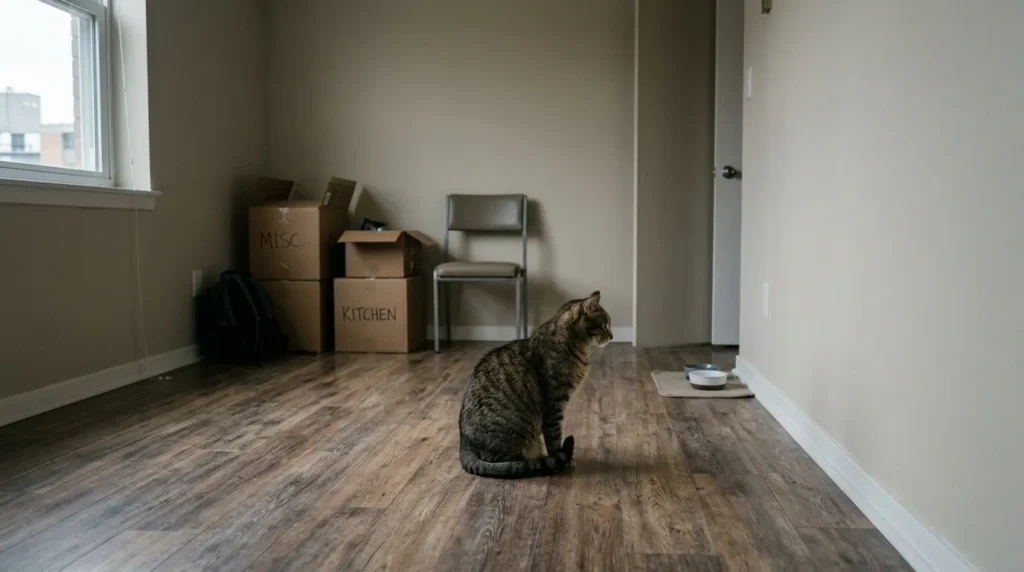
Most studio cat owners blame the small space for behavior problems that have nothing to do with square footage. Scratching, midnight zoomies, constant meowing, and restlessness are not caused by a lack of floor area. They come from not enough vertical territory, not enough daily play, and not enough change in the environment, regardless of apartment size. Two thousand square feet of bare walls with no enrichment causes the exact same problems as four hundred square feet with no enrichment.
The fix is not moving. It is adding one wall shelf, setting one consistent daily play session, and putting up one window bird feeder. Those three changes cost under one hundred dollars combined and usually show visible improvement within a week. A bigger apartment without those changes changes nothing. A smaller one with those changes produces a genuinely settled cat. If the restlessness continues after these changes, it is worth ruling out a health cause through your vet, since some health issues show up first as behavior changes.
Studio Apartment Cat Setup Checklist
Use this list as a starting point, then add to it once the basics are covered.
- Two or three wall shelves installed at different heights
- One tall narrow cat tree near a window
- A padded window perch with a bird feeder five to eight feet outside
- A secure, snug-fitting screen on every window that opens
- At least one hiding spot at floor level, away from foot traffic
- A high-sided open litter box placed away from food and sleeping areas
- One puzzle feeder for a daily meal
- Two wand toys used at dawn and dusk before meals
- Cords tucked away and any toxic plants, especially lilies, removed
| Item | Approx. Cost | One-Time or Recurring |
|---|---|---|
| Wall shelves (3-shelf set) | $40 to $120 | One-time |
| Window perch + bird feeder | $20 to $50 | One-time, plus birdseed refills |
| Pet-safe window screen | $15 to $30 per window | One-time |
| Puzzle feeder | $10 to $25 | One-time |
| Wand toys (2) | $10 to $20 | Replace every few months |
| Litter box + litter | $25 to $60 | Box is one-time, litter is recurring |
Frequently Asked Questions
Is a studio apartment too small for a cat?
No. Cats do well in small spaces when the environment is set up right, with vertical territory, a window enrichment station, and consistent daily play. A studio with wall shelves, a window perch, and a bird feeder produces a more settled cat than a large apartment with no enrichment. Floor square footage matters far less than how the space is designed for the cat’s needs.
What is the most important thing to set up first in a studio apartment for a cat?
Install at least one elevated surface the cat can reach from the floor. A single cat tree by the window, or two wall shelves at different heights, gives the cat a lookout point and a sense of ownership over the space right away. That one change usually shows a measurable difference in settled behavior before anything else gets added.
How do I handle litter box smell in a studio apartment?
Use a high-sided open box without a cover for better airflow, and scoop every single day without skipping. A studio makes a missed scoop obvious in a way a larger apartment can mask. Keep the box away from sleeping and eating areas using a divider or bookshelf. Daily scooping solves most studio litter odor problems, regardless of box type.
Can a single active cat be happy in a very small studio?
Yes, with daily scheduled play. An active cat in a studio, given two fifteen-minute wand sessions at dawn and dusk before meals, burns off its hunting drive through real play and settles down afterward. Studio floor area is plenty for the sprinting and leaping a proper play session needs.
How many cats can comfortably live in one studio apartment?
Two cats usually work well in a studio if resources are duplicated, separate food stations, two litter boxes, and enough vertical spots for both. Beyond two, space and resource competition become harder to manage without a larger footprint or a lot more vertical planning.
Do indoor cats in a studio need outdoor access like a balcony?
No, a window with a view and a bird feeder covers most of the same stimulation a balcony would provide, without the fall risk. A secured catio or window box is a bonus, not a requirement, for a cat to do well in a studio.
How long does it take a cat to adjust to a studio apartment?
Most cats settle within one to two weeks once vertical space, a litter routine, and daily play are in place. A cat moving from a larger home may take longer, closer to three to four weeks, especially if it had outdoor access before.
Are window screens really necessary if my cat has never tried to jump out?
Yes. A cat doesn’t need a history of jumping to fall. A startled lunge at a bird or a bug is enough, and falls from apartment windows spike in summer specifically because more windows are open. A secure screen is a fifteen-minute fix for a risk that’s otherwise impossible to fully predict.
What houseplants are safe to keep in an apartment with a cat?
Cat grass, spider plants, and Boston ferns are generally safe choices. Skip lilies entirely, since even pollen contact can cause kidney failure, and keep pothos and philodendron out of reach if you already own them, since chewed leaves cause mouth and stomach irritation.
How do I keep my cat calm during noisy building hours or when guests come over?
Set up a closed-door retreat room ahead of time, with her bed, water, and a hiding spot, so she has somewhere to wait out the noise instead of being caught in the open studio. A fan or white-noise machine run low also softens sudden hallway sounds that carry easily through thin apartment walls.
Final Thoughts
How to keep a cat happy in a studio apartment comes down to three changes applied consistently: vertical territory through wall shelves or a tall cat tree, a window station with an active bird feeder, and two daily wand sessions before meals. Add a secure window screen and a quick pass for cords and toxic plants, and the safety side is covered too. Those investments cost under two hundred dollars combined and produce a cat whose behavior looks no different from one living in a much bigger space. Start today. Move whatever elevated surface you already own closer to the window, and schedule tonight’s play session before dinner.
Cats live happily in studio apartments when the setup provides vertical territory through wall-mounted shelves or a tall narrow cat tree, a window station with a bird feeder five to eight feet outside the glass, and a daily play schedule of two fifteen-minute wand sessions at dawn and dusk before meals. Floor space below four hundred square feet does not hurt cat welfare when the enrichment is right. A secure window screen matters as much as any enrichment item, since falls from open apartment windows are a real and well-documented risk, especially in summer. Puzzle feeders at one daily meal and scatter feeding at the other replace bowl feeding with foraging movement that uses up energy across the day. Two cats can share a studio when food, water, litter, and vertical spots are duplicated rather than shared.
This guide is one piece of the larger question of what makes small-space living genuinely workable for a cat, and it connects closely with our indoor cat behavior guide for reading the signs your setup is or isn’t working. For the pieces that support the methods above, see our guides on enrichment, litter box setup, feeding schedules, and health monitoring.

Written by Mishu
A passionate cat lover and indoor living enthusiast, Mishu is the founder and voice behind Indoor Living Cat – a go-to resource for cat owners who want to create the happiest, healthiest life for their feline companions indoors.
View Full Profile