
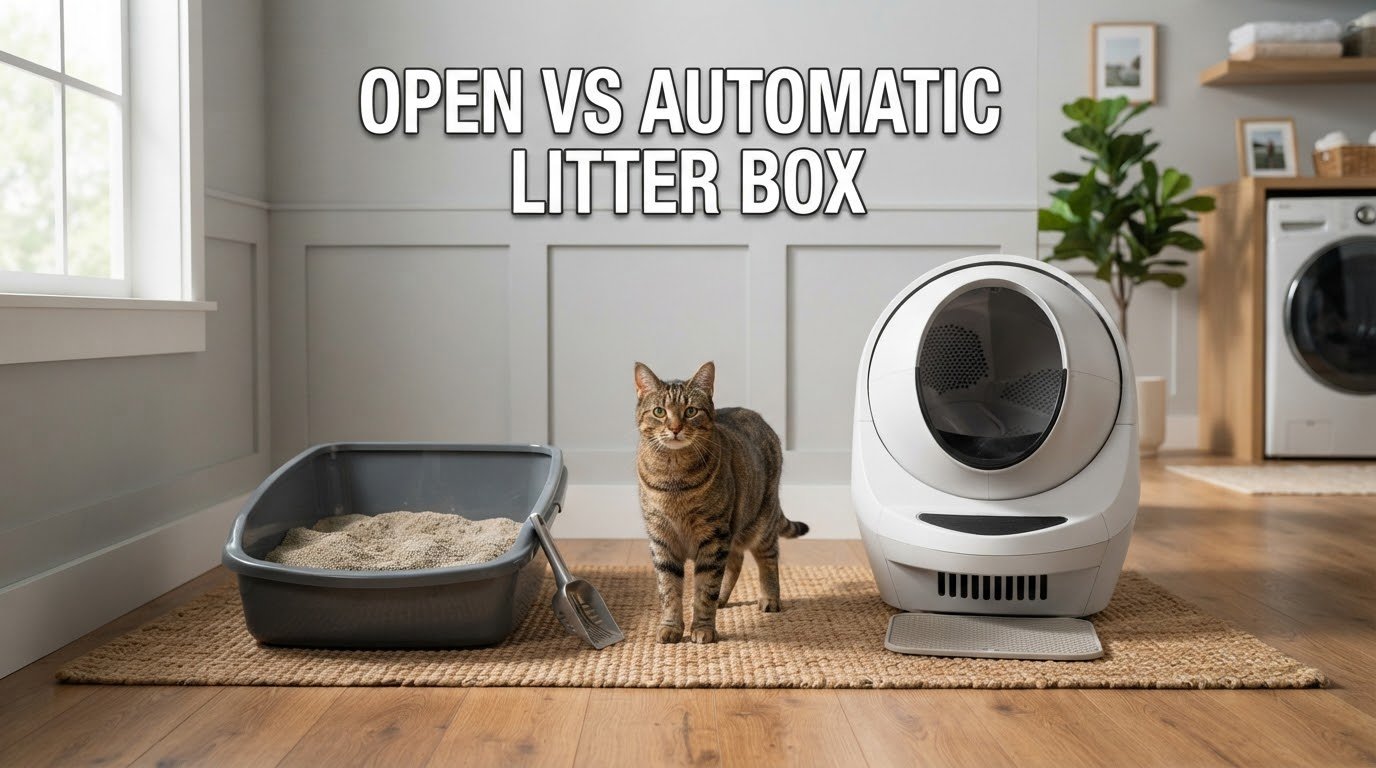
Pick an open litter box if you have one cat, a tight budget and the patience to scoop every day. Pick an automatic one if you have two or more cats, hate the daily scoop, or want a way to spot changes in your cat’s bathroom habits early. That’s the short version of the open vs automatic litter box decision. The details below cover cost, smell, safety, cat acceptance and the middle option most guides skip: the open-top automatic, which is what the Neakasa M1 Plus is.
One housekeeping note. This post originally compared the Neakasa M1 Plus with the KEBE LED Open Sign, because “open” pulled in both. If you landed here looking for a sign, jump to the short KEBE section. Everyone else, keep reading.
This guide is part of our indoor cat litter box guide. If you’re leaning toward a manual box, see our full open litter box guide for every style, size and trade-off.
How this was put together: specs and features come from the manufacturer’s listings and owner-reported behavior, not a lab test. Check current prices and specs on the product page before buying, since they change.
⚡ Quick Verdict
- Best on a budget: a basic open litter box (see our best budget open litter box picks). It’s cheap, it never breaks, and your cat will use it without any training.
- Best for convenience: an automatic box. The Neakasa M1 Plus is our pick because it keeps the open top that many cats prefer.
- Biggest tradeoff: automatic boxes cost far more up front and need power. Open boxes cost you time every single day.
- Skip automatic if your cat is under about 3 pounds, very anxious about noise, or you have nowhere to plug it in.
Open vs Automatic Litter Box: Quick Comparison
“Open” and “automatic” aren’t opposites, which is why this topic confuses people. Open describes the shape (no lid or hood). Automatic describes the cleaning (a motor does the scooping). You can have either, both, or neither. Here’s how the four common types stack up.
| Factor | Open (manual) | Covered / hooded | Automatic (enclosed) | Automatic (open-top) |
|---|---|---|---|---|
| Upfront cost | Lowest | Low | High | High |
| Daily scooping | Yes, by you | Yes, by you | No | No |
| Odor | Spreads fast if skipped | Trapped inside, strong when you open it | Waste sealed away quickly | Waste sealed away quickly |
| Cat comfort | Easy to see out of | Private, but stuffy | Enclosed, some cats refuse | Open view, easier to accept |
| Needs power | No | No | Yes | Yes |
| Things that can break | Almost nothing | Flap, door | Motor, sensors, app | Motor, sensors, app |
| Best for | One cat, tight budget | Shy cats, litter-kickers | Busy owners | Multi-cat homes, cautious cats |
Open Litter Box: Pros and Cons
An open litter box is a pan with sides and no lid. It’s the default for a reason. Cats can see anyone approaching, they can leave fast, and there’s no flap to learn. Vets often point out that cats in a stressful household do better with an open box for exactly that reason. For a deeper breakdown, read our open litter box pros and cons guide.
✅ Advantages
❌ Disadvantages
Automatic Litter Box: Pros and Cons
An automatic litter box (also called a self-cleaning litter box) uses sensors and a motor to separate clumps from clean litter after your cat leaves, then moves the waste into a sealed bin. Most use a rotating drum or a rake. You still empty the bin, but that’s a weekly job instead of a daily one.
✅ Advantages
❌ Disadvantages
Fair concession to the skeptics: an automatic box doesn’t remove the work, it moves it. You still wash the unit, change the litter on a schedule, and keep the bin bags stocked. If you hate all of that, no machine fixes it.
Major Factors to Consider
Cost Over Time
A plain open box is a one-time purchase that’s small enough to ignore. An automatic box is a real purchase, and it adds running costs: bin liners, sometimes branded or recommended litter, and eventually replacement parts. The offset is that some owners use less litter because only clumps get removed, not half-soiled scoops. Whether that closes the gap depends on how much litter you use now. Run your own numbers before assuming it pays for itself.
Odor Control
Smell comes from waste sitting in the box. An open box releases it into the room all day. A hooded box traps it, then releases a burst when you lift the lid. An automatic box moves waste into a sealed bin soon after each visit, which is why owners report the biggest difference here. The bin still needs emptying, though, or you’ve just moved the smell. Staying with a manual pan? Read do open litter boxes smell? and compare our best open litter box for odor control picks.
Cat Acceptance
Your cat gets a vote, and it’s the one that counts. A cat who stops using the box will find another spot, usually your rug. Enclosed globes and hoods are the most common reasons for refusal because they feel like a trap. That’s the main argument for an open-top automatic: you keep the sightlines and lose the scooping.
Safety
Open manual boxes have no moving parts, so there’s nothing to go wrong. Automatic boxes need sensors that stop the cycle if a cat is inside or enters mid-cycle. Look for anti-pinch protection, a weight-based or infrared detection system, and a clear minimum cat weight in the specs. Never use any automatic box with a kitten below that minimum.
Number of Cats
The usual guidance is one box per cat plus one extra. In practice, that’s a lot of scooping, so multi-cat homes get the most out of automation. Some units, including the M1 Plus, are rated for up to three cats, but the extra-box rule still helps with territorial cats, so don’t treat one automatic unit as a license to remove every other box. If you’d rather stay manual, see our best open litter box for multiple cats guide.
Space and Noise
Automatic boxes are bigger than most pans, and they need clearance for the bin and an outlet nearby. Measure the spot before you order. Noise is usually short bursts during a cycle, but light sleepers should avoid placing one next to a bedroom.
Analysis: Neakasa M1 Plus (Open-Top Automatic)
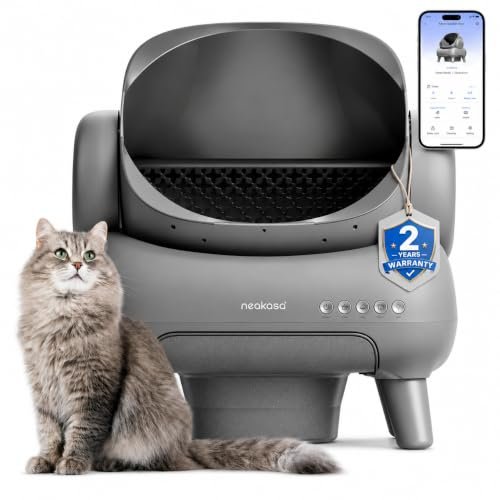
The M1 Plus is the answer for people who want the open-box feel without the open-box chore. It suits multi-cat households, mixed cat sizes and anyone tired of daily scooping.
It has an open-top design, which matches how many cats prefer to eat and eliminate: with a clear view of the room. The listing rates it for cats from 3.3 to 33 pounds and up to three cats, and it includes a kitten mode for smaller pets.
Safety comes from anti-pinch protection and infrared sensors that track a cat’s presence. Waste goes into a sealed bin, and the manufacturer rates the bin for roughly seven to fourteen days between changes, depending on how many cats use it. Bag replacement keeps your hands clean. The app handles remote monitoring.
Build Quality & Design
The body is plastic, and the waste bin seals to stop leaks. The open top improves airflow and keeps the unit from feeling like a cage. It looks plain enough to sit in a living room corner. Check the listing for exact dimensions, because it’s larger than a standard pan.
Performance & Speed
Cycles run after the cat leaves, and the rotation is smooth. The listing says odor control works without carbon filters, which is plausible given the sealed bin, but your results depend on how often you empty it. A battery backup keeps the unit working through a power cut.
Features & Functionality
The app lets you adjust settings and view usage. The listing also mentions health monitoring. Treat that as a tool for spotting changes in frequency, not a diagnosis. If your cat’s visits suddenly double or they strain, call your vet.
User Experience
Setup is assembly plus a Wi-Fi connection. Cats tend to adapt faster to open designs than to enclosed globes, though a gradual switch (see the steps below) is still the safest route. Cleaning the unit itself is occasional work, not daily.
Value for Money
It’s priced well above any manual box, and that’s the honest hurdle. The case for it is strongest in a multi-cat home where it replaces several pans’ worth of scooping. The listing includes a two-year protection plan, which helps with the risk of a motorized product failing. In a one-cat home on a small budget, a good open box wins on value.
✅ Advantages
❌ Disadvantages
Which Should You Buy? A Quick Checklist
Count your honest “yes” answers.
Go automatic if you say yes to three or more:
- You have two or more cats.
- You regularly skip a day of scooping and notice the smell.
- You’d like visit data to spot health changes early.
- There’s an outlet near where the box will live.
- Your cat weighs more than 3.3 pounds and isn’t spooked by noise.
Stay with an open box if you say yes to two or more:
How to Switch Your Cat to an Automatic Litter Box
Don’t swap boxes overnight. Cats punish sudden change, and the punishment shows up on your floor.
- Place it beside the old box. Leave the new unit unplugged for the first few days so your cat can sniff it and step in.
- Use the litter your cat already knows. Switching litter and box together doubles the risk of refusal.
- Move a used clump over. The scent tells your cat this is the bathroom.
- Power it on with the cat out of the room. Let them hear a cycle at a distance first.
- Keep the old box for 1 to 2 weeks. Remove it only after your cat is using the new one consistently.
- Watch for trouble. If your cat starts going elsewhere, bring the old box back and slow down.
Common Mistakes and Quick Tips
- Skipping the extra box. Keep a spare in a different room in multi-cat homes, at least during the transition.
- Ignoring the weight minimum. Below the rated weight, sensors may not register your cat. Use a manual box until they grow.
- Never emptying the bin. A full sealed bin still smells. Set a reminder.
- Using the wrong litter. Clumping litter that sticks to the drum can jam cycles. Follow the manufacturer’s litter guidance.
- Putting it in a noisy spot. Washers and furnace rooms scare cats away from any box.
- Skipping vet advice. Changes in bathroom habits can signal illness, so don’t rely on the app alone.
Specifications: Neakasa M1 Plus
Specs below come from the product listing. Confirm exact dimensions, weight and price on the retailer page before you order.
| Specification | Neakasa M1 Plus |
|---|---|
| Design | Open-top automatic |
| Cat weight range | 3.3 to 33 lb |
| Cats supported | Up to 3 |
| Capacity | 7.2L litter |
| Waste bin interval | About 7 to 14 days (varies by cat count) |
| Safety | Anti-pinch, infrared sensors, kitten mode |
| Power | Plug-in with battery backup |
| Connectivity | Wi-Fi and app |
| Warranty | 2-year protection plan |
| Price | Check current price on Amazon |
🏆 Our Pick: Neakasa M1 Plus
Editor Score Breakdown
Based on spec review and owner-reported use, not lab testing.
It wins because it solves the main objection to automatic boxes, which is cats that hate being enclosed. You keep the open view, lose the daily scoop and get safety sensors plus app tracking. The price is the catch, and for a single-cat home on a budget it’s hard to justify.
Looking for the KEBE LED Open Sign?

This sign has nothing to do with litter boxes, but earlier versions of this post compared it with one, so here’s the short version. The KEBE LED Open Sign is a 19 x 10 inch storefront sign with steady and flashing modes, a stainless-steel hanging chain and a plug-in power supply. It suits bars, shops, cafes and hotels that want to be seen from the street. The listing mentions energy-efficient LEDs and support replies within twenty-four hours.
✅ Advantages
❌ Disadvantages
🎯 Final Recommendation
Buy a basic open box if you have one healthy adult cat and you’d rather spend the money on good litter. Our guide on how to choose an open litter box shows what to check before you buy. Buy the Neakasa M1 Plus if you have several cats, a cautious cat that dislikes enclosed boxes, or a schedule that makes daily scooping a losing battle. Whichever you choose, introduce it slowly and keep the old box around until your cat commits.
Still comparing manual styles? Browse our complete open litter box guide, or go back to the indoor cat litter box guide to see every litter box type.
Summary
- Open describes the shape of a litter box. Automatic describes how it cleans. You can combine them.
- Open manual boxes win on price and simplicity. Automatic boxes win on odor and time saved.
- The Neakasa M1 Plus is an open-top automatic rated for 3.3 to 33 lb and up to three cats.
- Switch gradually: old box and new box side by side for one to two weeks.
- Check minimum cat weight, outlet access and space before buying any automatic unit.
- The KEBE LED Open Sign is a storefront sign and unrelated to pet care.
Frequently Asked Questions
What’s the difference between an open and an automatic litter box?
An open litter box is an uncovered pan you scoop by hand. An automatic litter box uses sensors and a motor to clear waste into a sealed bin after each visit. Some automatic boxes, like the Neakasa M1 Plus, also have an open top.
Do cats prefer open or covered litter boxes?
Many cats prefer open boxes because they can see their surroundings and exit quickly. Some shy cats like the privacy of a hood. Watch your own cat, since their behavior is the real test.
Are automatic litter boxes worth it?
They’re worth it for multi-cat homes, busy owners and anyone bothered by litter odor. They’re harder to justify for one cat on a tight budget, since a manual box does the same job for a fraction of the cost.
Do open litter boxes smell more?
They can, because waste stays exposed until you scoop it. Scooping at least once a day and using a good clumping litter keeps odor manageable. Automatic boxes reduce smell by sealing waste away soon after use. For a full answer, see do open litter boxes smell?
Are automatic litter boxes safe for cats?
Models with anti-pinch protection and sensors that stop a cycle when a cat is detected are generally safe for cats above the minimum rated weight. Always check that weight limit, and don’t use an automatic unit for kittens below it.
Can kittens use an automatic litter box?
Only above the manufacturer’s minimum weight. The Neakasa M1 Plus lists 3.3 pounds and includes a kitten mode. Below that, use a manual box (see our best open litter box for kittens).
Can multiple cats share one automatic litter box?
Yes, many units support two or three cats, and the M1 Plus is listed for up to three. If your cats squabble over territory, keep an additional box in another room.
How long does it take a cat to adjust to an automatic litter box?
Plan on one to two weeks of gradual introduction. Some cats accept it in days, others take longer. Keep the old box available until yours uses the new one consistently.
How often do I still need to clean an automatic litter box?
You empty the waste bin every several days, and you periodically wash the unit and replace the litter. The M1 Plus listing rates the bin at roughly seven to fourteen days, depending on the number of cats.
Is the KEBE LED Open Sign related to litter boxes?
No. It’s a storefront sign for businesses. It appeared in earlier versions of this article because of the word “open.”
Related Open Litter Box Guides
- Open Litter Box Pros and Cons: the full trade-offs of going manual
- How to Choose an Open Litter Box: size, height and entry checklist
- Do Open Litter Boxes Smell?: what causes odor and how to stop it
- Best Open Litter Box for Multiple Cats: setups for shared homes
- Best Open Litter Box for Odor Control: keep the smell down
- Best Budget Open Litter Box: low-cost options that work

Written by Mishu
A passionate cat lover and indoor living enthusiast, Mishu is the founder and voice behind Indoor Living Cat – a go-to resource for cat owners who want to create the happiest, healthiest life for their feline companions indoors.
View Full Profile