
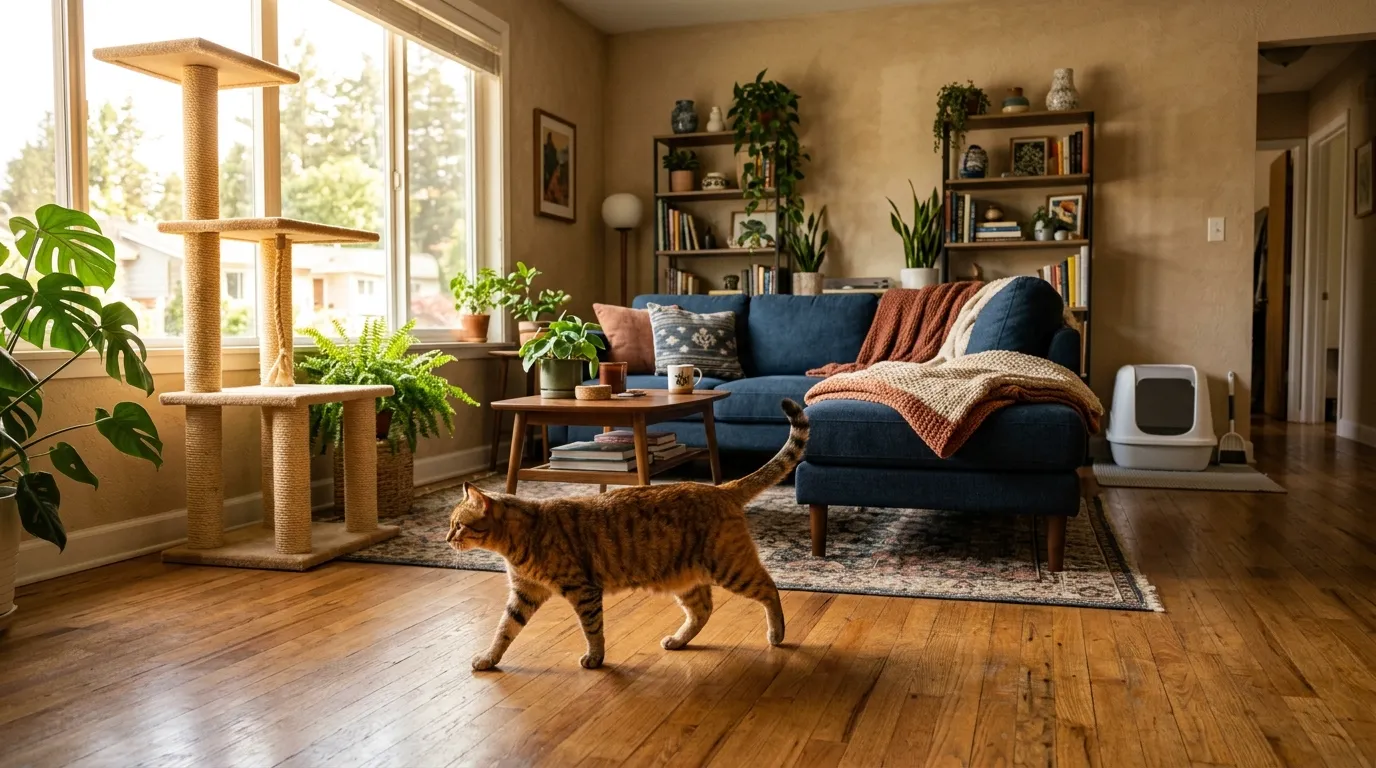
How to make your home cat friendly starts before your cat ever walks through the door. I found this out the hard way. When I brought my cat home, I had already picked my couch, my rug and my plant shelf. She spent the first two weeks hiding behind the couch and I couldn’t figure out why. My apartment gave her nowhere to climb, nowhere to watch and nowhere to feel safe.
Most cat owners make the same mistake. They set up a home for themselves first, then try to fit the cat in around it. This guide works as your setup hub: it covers seven changes that actually work, why each one matters, how to set them up in under an hour, and where an open window, a scented candle or a bare wall can turn into a real hazard. For the daily habits that keep a cat healthy once the setup is right, see our indoor cat care guide, the pillar this whole setup hub sits under.
To make a home cat friendly, you need five things: vertical space for climbing, a window perch with something to watch, a litter box that’s sized and placed correctly, a scratching zone near furniture your cat already likes, and toys you rotate for daily play. Most of these changes cost under $50 and take less than an hour to set up. The rest of this guide breaks each one down, plus a budget table, a hazard checklist covering scents and plants, a no-drill option for renters, and answers to the questions cat owners ask most.
Quick Checklist: Set This Up Before Your Cat Arrives
If you’re bringing a cat home for the first time, do these five things before the carrier ever opens. It takes about an hour and saves weeks of hiding, stress and litter box mistakes.
- Pick one quiet room as the starting base, with food, water, a litter box and a hiding spot already inside.
- Put a tall, stable piece of climbing furniture somewhere your cat can see the room from above.
- Check every plant, cord, candle and cabinet in that room against the hazard list in Step 6 below.
- Set the litter box far from the food bowl, in a corner that won’t surprise your cat with sudden noise.
- Leave a cardboard box or covered bed nearby so your cat has somewhere to disappear on day one.
Once your cat settles into that one room, usually within a few days, you can open the rest of the home gradually.
Step 1: Give Your Cat Vertical Space It Will Actually Use
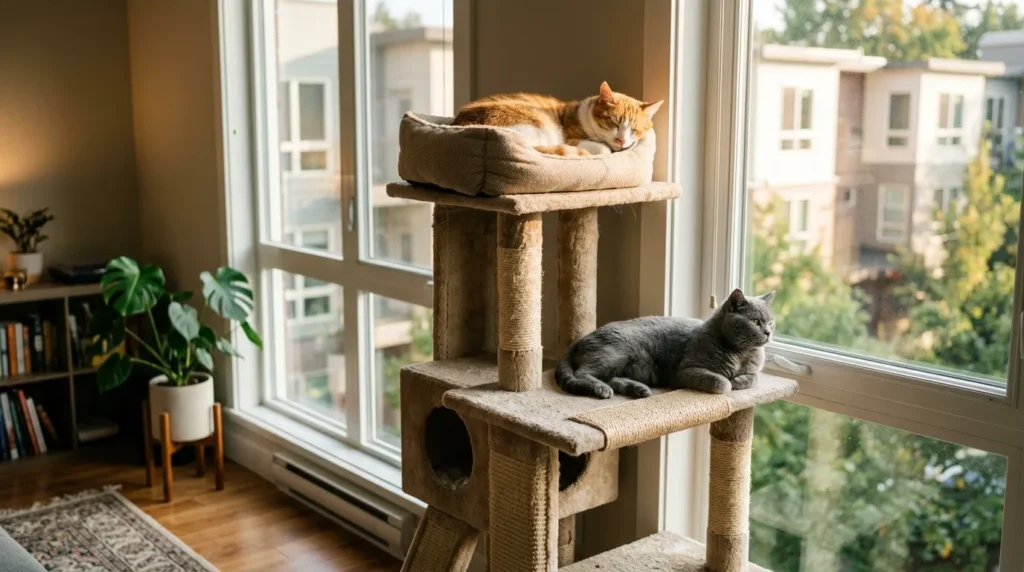
Height is the single biggest change you can make to a cat unfriendly home. Cats aren’t floor animals by nature. Being up high gives them safety, a sense of territory and a place to decompress when a room feels too busy. A cat with no vertical options has nowhere to truly relax.
Start with a tall cat tree near a window. It doesn’t need to be expensive. It needs to be stable, taller than your furniture and placed where your cat already spends time. A tree that wobbles even slightly gets abandoned within a week.
Wall mounted cat shelves work best in small apartments where floor space is tight. A staggered route from low to high lets your cat travel across a room at height. Each shelf needs a non-slip surface. Carpet tape or sisal over smooth wood stops the sliding that makes cats quit using shelves after one bad landing.
In multi-cat households, vertical space isn’t optional. Cats that can’t get away from each other build up tension that never fully resolves. Give each cat its own route to height and its own high-value perch, and a lot of the daily friction disappears on its own.
The mistake I see most often: one small cat tree pushed into a corner the cat never visits. Location matters more than the tree itself. Put it where your cat already hangs out, not where it looks best. If your cat lives on the couch, the tree goes next to the couch. That’s the only placement rule that matters.
Cat Tree or Wall Shelves? How to Choose
Both work. The right choice depends on your floor space and your cat’s age.
| Option | Best For | Setup Time | Watch Out For |
|---|---|---|---|
| Freestanding cat tree | Kittens, senior cats, renters who cannot drill walls | 10 to 20 minutes | Wobbly base gets abandoned fast |
| Wall-mounted shelves | Small apartments, agile adult cats, multi-cat homes | 30 to 60 minutes per shelf | Needs studs or heavy-duty anchors |
| Combination of both | Most households, especially with more than one cat | 1 to 2 hours total | Costs more up front, pays off long term |
Step 2: Set Up a Window Perch With Something Worth Watching
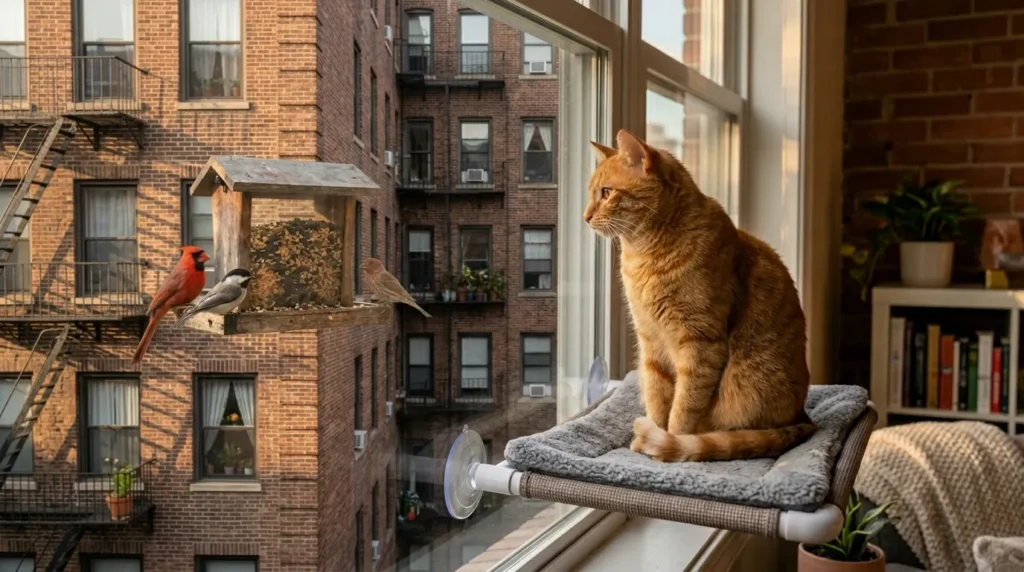
A window perch gives your cat live, moving, unpredictable stimulation without you needing to be in the room. That matters most for cats left alone during work hours. A perch with a real view cuts down on the restless energy that turns into evening zoomies and 2am wake-up calls.
The perch itself can be simple: a suction-cup shelf, a padded window seat or a cat tree set at sill height. What’s outside the window matters more than the perch. If there’s nothing to look at, the perch gets ignored fast. A bird feeder clipped to a balcony rail or hung against the glass gives your cat hours of free daily stimulation once it’s set up.
Place the perch at a window your cat already gravitates to. South-facing windows get the most sun and tend to be the most popular spot in the house. If your windows only face a wall, watching people or traffic still gives a cat something to track. Movement is what holds their attention, not scenery.
Balcony and Open Window Safety: Preventing High-Rise Syndrome
A window perch pulls your cat toward the one spot in the home with the most real risk, so this has to be said next to Step 2, not buried in the hazard list. Vets call the injuries that come from cats falling out of open windows “high-rise syndrome,” and the ASPCA has treated well over 100 cases a year at a single hospital during warm-weather months, when open windows are common. Cats have poor depth perception from a height and don’t recognize an unscreened window as a fall risk the way a person does.
The fix is simple and cheap compared to an emergency vet bill:
- Install snug, sturdy screens on every window your cat can reach, not just the ones you open often. Standard childproof window guards have gaps a cat can slip through.
- Never leave a window tilted or cracked open without a screen. A gap a hand can’t fit through can still be wide enough for a cat.
- Keep balcony doors closed, or add a screen door, unless the balcony itself is fully enclosed.
- Consider a catio or a balcony safety net if your cat spends real time on a balcony or fire escape.
- Move furniture away from any window a cat could reach if a screen ever failed.
If your cat does fall, treat it as an emergency even if she looks fine. Internal injuries from a fall often don’t show right away, so a same-day vet visit is worth it regardless of how she’s walking afterward.
Step 3: Place the Litter Box Where Your Cat Will Actually Use It
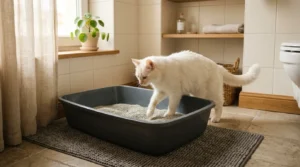
Litter box placement is the most overlooked part of making a home cat friendly. Read our complete guide to setting up an indoor cat litter box for a deeper breakdown, including how many boxes a multi-cat home actually needs, but here’s what matters most.
The box needs a quiet, low-traffic spot where your cat won’t get startled mid-use. Next to the washing machine, in a busy hallway or by the front door are all locations that cause litter avoidance, because cats associate sudden noise with danger while they’re in a vulnerable position.
One box per cat, plus one extra, is the baseline. One cat means two boxes minimum, placed in different rooms rather than side by side. Two boxes next to each other count as one box in a cat’s mind. Any threat that reaches one threatens the other.
| Cats in Household | Minimum Number of Boxes | Recommended Placement |
|---|---|---|
| 1 cat | 2 boxes | Two separate rooms or corners |
| 2 cats | 3 boxes | Spread across at least two floors or rooms |
| 3+ cats | One per cat plus one extra | No two boxes sharing an entry point |
Size is where most owners get it wrong. The box should measure at least one and a half times your cat’s length, nose to tail. Most boxes sold in pet stores fall short of this. A large plastic storage tote with one side cut low makes a better box than most products marketed for the job, and it costs a fraction of the price.
Step 4: Build a Scratching Zone Before Your Cat Builds One Itself
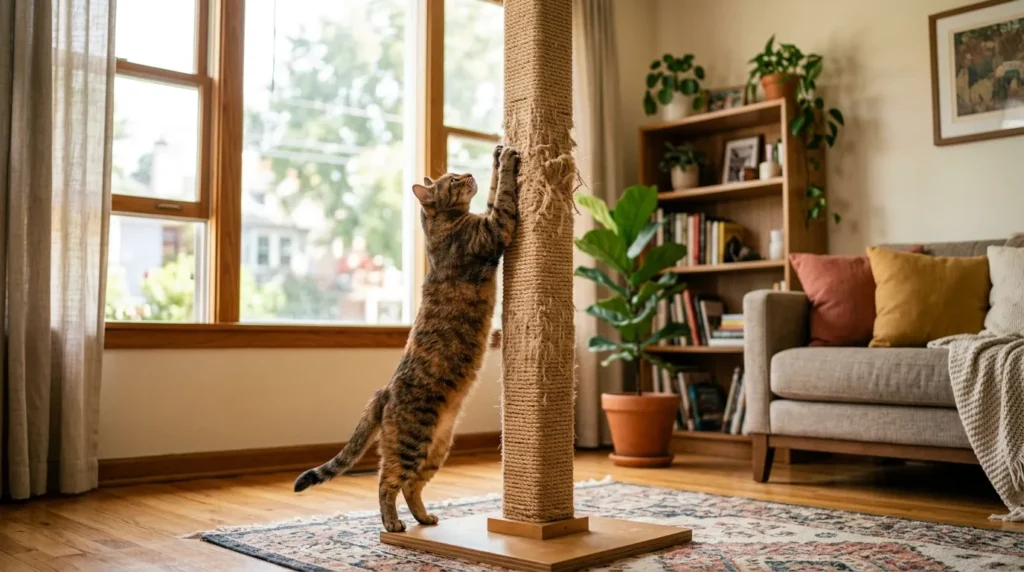
Scratching isn’t destructive behavior. It’s a biological need. Cats scratch to shed old claw sheaths, stretch their spine and leave scent from glands in their paws. Skip a designated spot and your cat will pick one for you. It’ll be your couch.
The post needs to be tall enough for a full upright stretch. Most short carpet-covered posts sold at pet stores are too small for adult cats and get ignored because they don’t allow that stretch.
| Material | Best For | Typical Lifespan | Cost Range |
|---|---|---|---|
| Sisal rope | Cats who dig claws in deep | 1 to 2 years | $15 to $40 |
| Cardboard (flat) | Cats who prefer flat scratching | 2 to 3 months | $5 to $10 |
| Carpet | Cats already used to carpet texture | 6 to 12 months, often ignored sooner | $10 to $25 |
Location matters as much as material. Put the post next to the furniture your cat already targets. The couch and the armchair are usually prime spots because cats scratch high-value areas in their territory first. Once the habit sticks, you can move the post gradually if you need to.
Add a flat scratcher too. Some cats prefer scratching horizontal surfaces and will use the carpet or a doormat instead of any post you provide. A flat cardboard scratcher costs under $10 and lasts a couple of months. Put one near the couch and one near wherever your cat sleeps. Two formats cover almost every preference.
Step 5: Build a Play Zone for Daily Enrichment
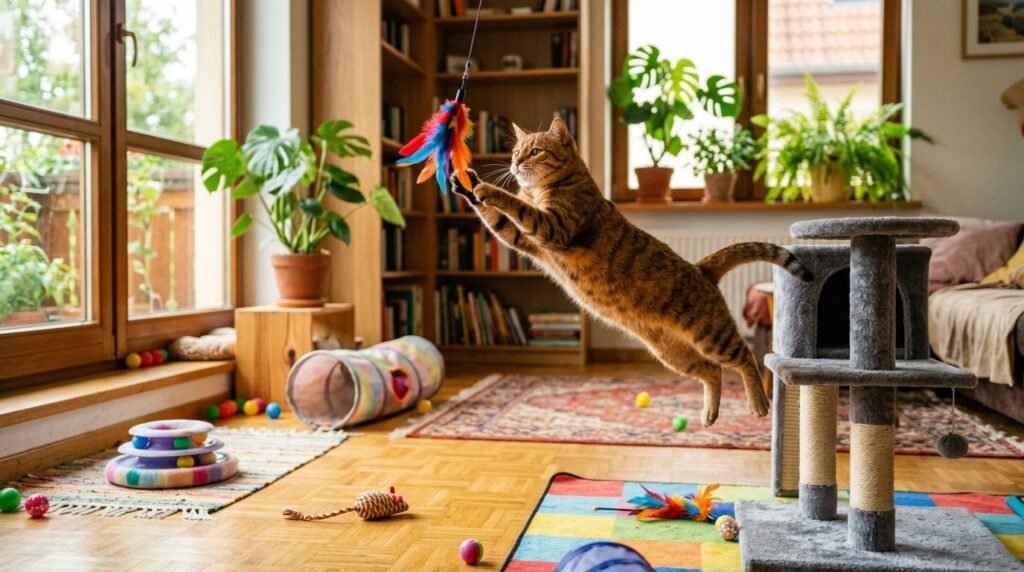
Interactive play separates a cat-friendly home from a cat-tolerated one. A rotating set of toys keeps things interesting because a cat’s brain is wired to track novelty, not repetition. Put three or four toys out at a time and swap them weekly. For a full rotation system, see our indoor cat enrichment ideas for apartments.
According to the ASPCA, cats need daily mental and physical stimulation to maintain healthy behavior patterns. Puzzle feeders satisfy hunting instinct at mealtime by making a cat work for food. Swapping one meal a day for a puzzle feeder adds roughly ten minutes of real mental effort with zero extra work from you.

The play zone doesn’t need its own room. It’s simply the spot where toys live and where play happens on a regular basis. Keeping it consistent helps your cat learn where active behavior is welcome, which also teaches them where it isn’t.
Hiding spots matter as much as active play. Every cat needs at least one enclosed space where it can disappear when it needs to reset. A cardboard box, a covered bed on a shelf or a cave on the cat tree all work. Hiding isn’t antisocial. It’s how cats manage stress and bring their own arousal back down.
Step 6: Remove Every Hidden Hazard Before Your Cat Finds It
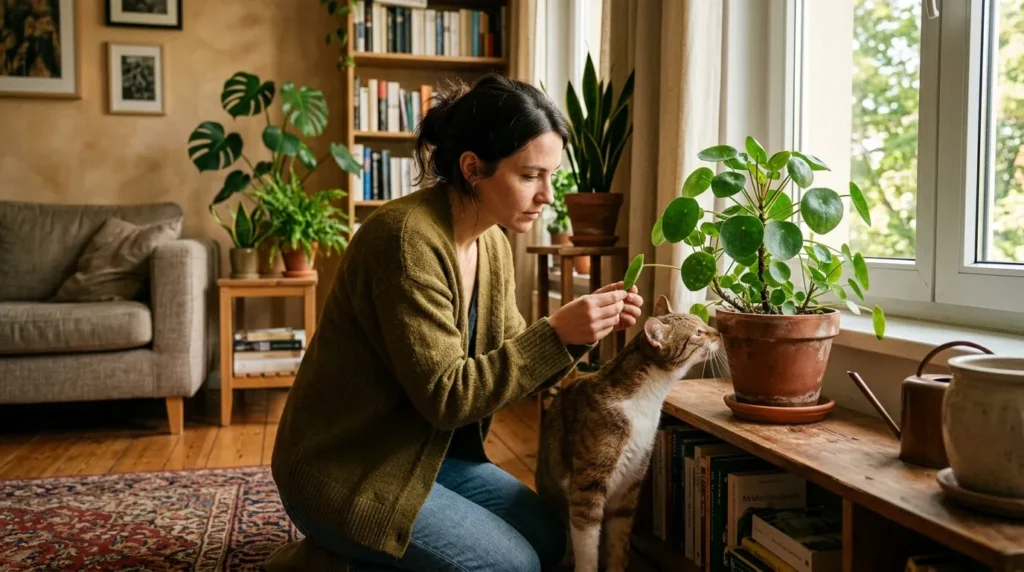
A cat-friendly home is a physically safe one, and that takes a deliberate walk-through before your cat has access to every room. Toxic plants are the most common hidden hazard. Lilies are fatal to cats even in small amounts, and they show up in most florist arrangements. Peace lilies, pothos and philodendrons are also toxic and common in apartments. Check every plant before assuming it’s safe. For a wider look at indoor health risks, see our indoor cat health guide.
- Cover or route exposed electrical cords behind furniture; kittens chew through them fast.
- Secure any cabinet holding cleaning products, medication or small swallowable objects with childproof latches.
- Check the washing machine and dryer before every use; cats sleep inside them given the chance.
- Verify every houseplant against a current ASPCA toxic plant list before it enters the home.
- Store rubber bands, hair ties and string toys out of reach when not supervised.
- Skip essential oil diffusers and go easy on scented candles; see the section below on which scents are actually risky.
- Install window screens throughout the home, not just in rooms you use often; see the balcony and window safety section above.
Cats learn to open lever-style cabinet handles faster than most owners expect. A latch costs a couple of dollars and closes that gap completely.
Essential Oils, Diffusers and Candles: What’s Actually Risky
Cats are more sensitive to essential oils than dogs or humans, and the ones that come up most often in poisoning reports are tea tree, eucalyptus, peppermint, cinnamon, citrus, wintergreen and pine. A diffuser running these in a closed room is a bigger risk than most owners assume, since cats can absorb oils both by inhaling and by grooming residue off their fur. If you use a diffuser at all, run it in a room your cat can’t access and skip it entirely if she free-roams the apartment.
Scented candles are a lower-grade version of the same risk, plus a separate fire hazard from a curious cat knocking one over. Paraffin candles release more airborne soot than soy or beeswax, so if you burn candles regularly, switching wax type is a simple swap. Unscented or lightly scented soy candles, burned somewhere your cat can’t reach and away from anything she could knock into, cut most of the risk without giving up candles entirely.
Cat-Safe Plants to Use Instead
Once the toxic plants are out, you don’t have to give up greenery altogether. Spider plants, areca palms, Boston ferns and cat grass are all considered non-toxic and give your cat something safe to sniff or nibble. Cat grass in particular doubles as enrichment, since chewing on it is a mild, safe outlet for the same instinct that goes after houseplants in the first place.
Step 7: Set Up a Consistent Feeding Station
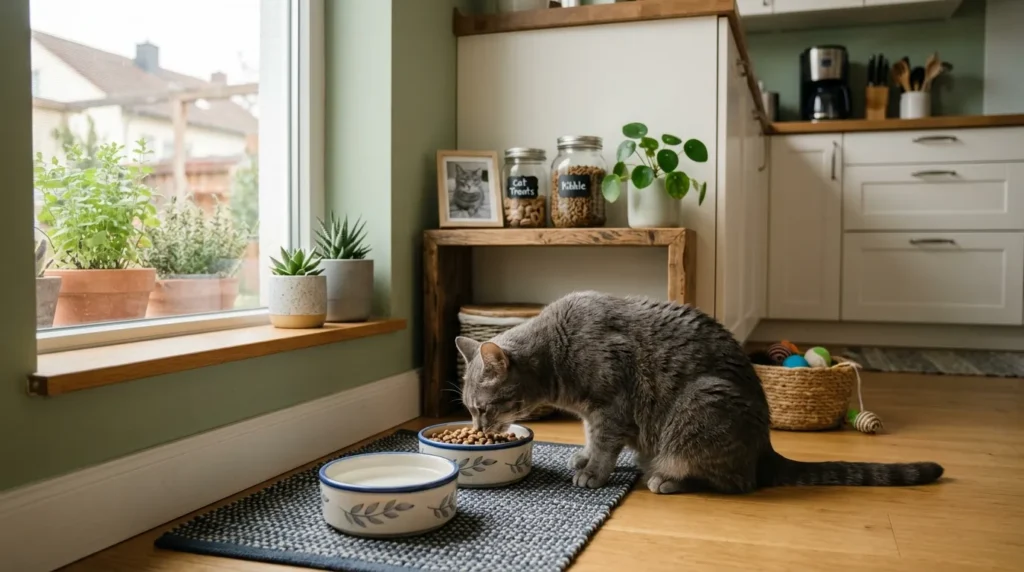
A feeding station is a fixed, consistent spot where food and water are always served. Cats are creatures of habit, and a stable location cuts down on the low-level anxiety that comes from an unpredictable routine. For a full setup guide, including portion timing, read how to feed an indoor cat properly.
Keep the station away from the litter box. Same room or just next door is still too close. Cats instinctively avoid eating near their own waste.
Place the water bowl apart from the food bowl too. This surprises most people, but cats evolved avoiding water near prey, since a carcass can contaminate a water source nearby. A bowl on the other side of the kitchen, or in a different room, increases how much your cat drinks without any other change.
Elevated feeding stations that raise the bowl off the floor help cats with joint issues or older cats who struggle to bend down. They also keep the area cleaner, since cats tend to eat neater at a comfortable height.
If your cat pushes food onto the floor before eating it, the bowl is likely too deep and the whiskers are brushing the sides. This is whisker fatigue, and it’s real. Switch to a wide, shallow dish or a flat plate and the floor-eating usually stops right away.
What a Cat-Friendly Starter Setup Costs
You don’t need to buy everything at once. Here’s a realistic budget for the core setup described above.
| Item | Estimated Cost | One-Time or Recurring |
|---|---|---|
| Cat tree or wall shelves | $30 to $80 | One-time |
| Window perch | $15 to $35 | One-time |
| Window screens (if not already installed) | $10 to $30 per window | One-time |
| Litter box (DIY storage tote works too) | $10 to $15 | One-time |
| Litter | $15 to $20 | Monthly |
| Scratching post plus flat scratcher | $20 to $35 | Mostly one-time |
| Rotating toy set | $15 to $25 | One-time, refresh occasionally |
| Puzzle feeder | $10 to $20 | One-time |
Total starter cost runs roughly $115 to $195, plus window screens if your building doesn’t already have them, plus $15 to $20 a month in litter. That covers every core need on this list.
Cat-Friendly Setup for Renters: No-Drill Options
Wall-mounted shelves are the best space-to-height ratio you can get, but a lease that bans drilling shouldn’t mean your cat goes without vertical space. A few options work without touching the walls:
- Freestanding cat trees give you real height with zero installation. A tree tall enough to reach a windowsill covers most of what wall shelves offer.
- Tension-mounted (pressure-fit) cat trees brace between floor and ceiling and hold far more weight than a screw-in shelf, without a single hole.
- Command-strip or adhesive hooks work for lightweight items like hanging toys and small perches, but skip them for anything a cat will jump onto with force.
- Furniture you already own counts too. A bookshelf, a dresser or a window ledge with a cushion adds height without buying anything.
Check your lease for a pet addendum before assuming shelves are off the table. Some landlords allow drilling with a patch-and-repaint clause at move-out, which opens up the full wall-shelf setup described in Step 1.
Apartment and Multi-Cat Considerations
Small apartments and multi-cat homes need the same five basics, just arranged more carefully. Our guide to keeping a cat happy in an apartment covers layout options in more depth, but a few points matter enough to repeat here.
Use walls and ceilings, not just floor space. Staggered shelving turns a studio into a home with real territory in it. In multi-cat households, duplicate the resources that cause conflict: litter boxes, feeding stations and high-value perches. One shared resource in a tight space is usually the root of most tension between cats.
Signs Your Home Is Not Cat Friendly Yet
Some setup problems show up fast. Others build slowly over weeks. Watch for these signs:
- Your cat hides for most of the day, even when the home is quiet.
- Scratching happens on furniture instead of any post you’ve provided.
- The litter box gets avoided even though it looks clean to you.
- Your cat startles easily or seems constantly on alert near shared spaces.
- Toys sit untouched within a week of being introduced.
These behaviors aren’t a personality problem. They’re feedback about the environment. Our indoor cat behavior guide breaks down what each sign usually means and how to respond.
Mistakes That Make a Home Less Cat Friendly Over Time
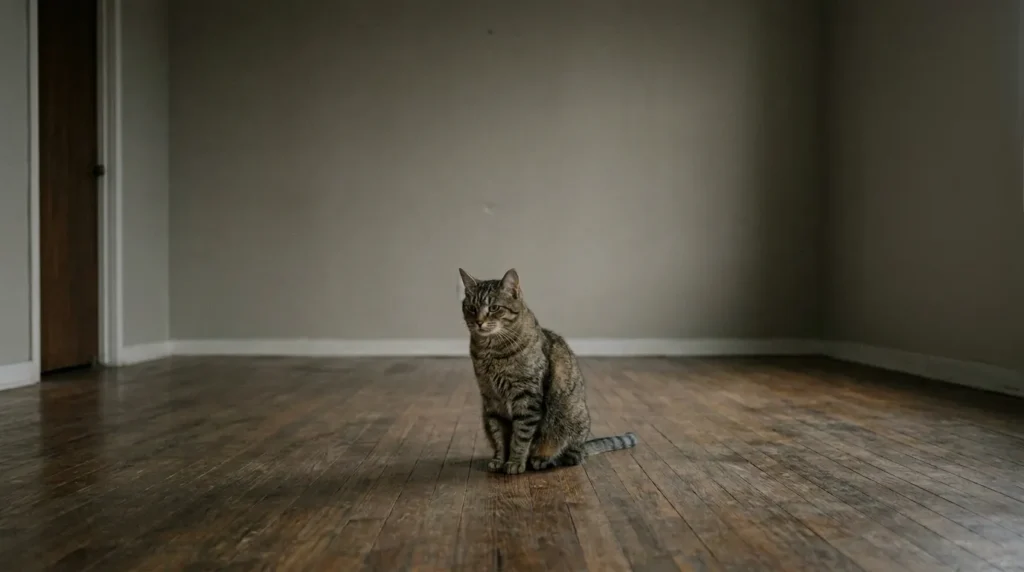
The most common mistake is setting up the home once and never updating it. Cats explore hard when they’re new to a space, then settle into fixed habits. A toy that thrilled your cat at three months gets ignored at eighteen months unless you rotate it out and bring it back later. Treat the setup as an ongoing system, not a one-time project.
The second mistake is choosing looks over function. A small decorative cat tree that wobbles when your cat jumps on it won’t get used. A litter box hidden inside furniture that limits turning room gets avoided. When something isn’t working, your cat will tell you by ignoring it. Trust that over how it photographs.
The third mistake is adding too much too fast. A new tree, a new scratcher and a rearranged room all in one weekend is genuinely stressful for a cat that relies on familiar markers. Add one change at a time and give your cat a few days to investigate before the next.
The fourth mistake is skipping litter maintenance once the box is set up correctly. A box that starts smelling within a day or two of a full clean usually means the litter type, depth or cleaning schedule needs adjusting, not the location. Our guide on why the litter box smells after cleaning walks through the common causes.
When Your Cat’s Behavior Is Telling You the Setup Is Wrong?
A cat that’s chronically destructive, hiding constantly or eliminating outside the litter box isn’t being difficult. The environment isn’t meeting its needs, and the behavior is the feedback. Most behavior problems in indoor cats trace back to a setup issue, not a personality issue.
Sudden changes are different from gradual ones. A cat that used the litter box reliably and suddenly stops, a cat that ate normally and abruptly refuses food, or a cat that turns aggressive without a clear trigger: these call for a vet visit before you touch the environment further. Urinary infections, dental pain and thyroid issues all produce behavior symptoms that look like attitude problems until they’re diagnosed.
Check the environment first for gradual changes. Call the vet first for sudden ones. That distinction covers most situations correctly.
This article is for informational purposes only. Always consult your vet if you have concerns about your cat’s health.
Frequently Asked Questions About Making Your Home Cat Friendly
How do I make my home cat friendly on a budget?
Start with three changes: a tall, stable scratching post near your couch, a cleared windowsill with a bird feeder outside and a larger litter box in a quiet spot. A storage tote makes a better box than most pet store options and costs under $10. Hardware store shelves cost less than half of branded cat furniture and work just as well.
What do cats need in a home to be happy?
Cats need vertical climbing space, a window with movement to watch, a clean and properly sized litter box in a quiet spot, daily interactive play and at least one enclosed hiding spot. These five things cover the core needs of most indoor cats. Anything beyond this improves quality of life but isn’t essential for baseline happiness.
Is it okay to keep a cat in a small apartment?
Yes. Cats adapt well to small spaces when the vertical dimension gets used. A small apartment with wall shelves, a window perch and a steady daily routine gives a cat a richer environment than a large apartment with nothing to climb. Square footage matters far less than how the space is set up.
How long does it take a cat to adjust to a new home setup?
Most cats need two to four weeks to settle into a new layout or new furniture. Shy or previously stray cats can take longer. Add one change at a time during this window rather than overhauling the whole space, so your cat has time to investigate each addition.
Do I need a pheromone diffuser to make my home cat friendly?
It’s not required, but a synthetic pheromone diffuser can help during a move, a new pet introduction or any other high-stress transition. It works best alongside the physical setup in this guide, not as a replacement for it. This is a different product from an essential oil diffuser, and the synthetic pheromone versions are made specifically to be cat-safe.
Are essential oil diffusers or scented candles safe around cats?
Essential oil diffusers carry real risk, since cats are more sensitive to oils like tea tree, eucalyptus, peppermint and citrus than dogs or people, and exposure happens through both breathing and grooming. Scented candles are lower risk but not risk-free, especially paraffin ones, and they add a fire hazard from a cat jumping near an open flame. If you want a scent in the home, an unscented or lightly scented soy candle kept out of reach is the safer middle ground.
What houseplants are safe for cats?
Spider plants, areca palms, Boston ferns and cat grass are all considered non-toxic and safe to keep around a cat. That’s a much shorter list than the toxic one, which includes lilies, pothos and philodendrons, so it’s worth checking any new plant against an ASPCA toxic plant list before it comes home rather than assuming it’s fine.
How do I cat-proof my home before bringing a new cat home?
Walk through every room at floor level and look for exposed cords, toxic plants, small swallowable objects and unsecured cabinets. Remove or secure all of these before the cat arrives. Check every plant against a verified toxic plant list from the ASPCA before assuming it’s safe. Secure the washing machine, dryer and any tight space a cat could get stuck inside. Install screens on every window before assuming an apartment on a high floor is safe. If your cat ingests anything potentially toxic, contact your vet or the ASPCA Animal Poison Control Center immediately.
What is the best room setup for an indoor cat?
The best room has a cat tree or shelves at multiple heights, a window perch with a real view and a secure screen, a flat or vertical scratcher nearby and a bed or hiding spot up high. Keep the feeding station and water bowl apart from each other and away from the litter box. Rotate toys weekly. That setup in a single room covers every core need an indoor cat has.
How much vertical space does one cat actually need?
One tall cat tree plus two or three shelves at different heights is enough for a single cat in an average room. Add one extra route to height for each additional cat, so they’re never forced to pass close to each other to reach a perch.
Is it safe to let my cat sit by an open window?
Only with a secure, snug-fitting screen in place. Cats fall out of open windows more often than most owners expect, a set of injuries vets call high-rise syndrome, and standard childproof guards have gaps a cat can slip through. Screen every window your cat can reach, not just the ones you open regularly.
How do I introduce a new cat safely into an already set-up home?
Keep the new cat in one base room, fully set up with its own litter box, food and hiding spot, for the first few days. Let scent exchange happen through a closed door before any face-to-face meeting, and expand her access to the rest of the home gradually once she’s using the litter box and eating normally in the base room.
Conclusion
Making your home cat friendly comes down to three things done well: vertical space your cat actually uses, a clean and correctly placed litter box, and a window with something worth watching that’s also screened so watching never turns into falling. Start with the change that costs the least and does the most. Move the litter box to a quiet spot if it currently sits in a noisy or high-traffic area. That single adjustment resolves more behavior problems faster than any other change on this list. Once the setup is right, our indoor cat enrichment guide and indoor cat care guide, both linked above, help you keep your cat engaged day to day.
Making a home cat friendly requires vertical climbing space such as a cat tree or wall shelves, a window perch with outdoor movement to watch, a properly sized litter box in a quiet low-traffic spot and a scratching post near furniture the cat already uses. Every window a cat can reach needs a snug, secure screen to prevent high-rise syndrome, the set of injuries vets see from cats falling out of open windows. Cats need at least one enclosed hiding spot, a stable feeding station kept away from the litter box, and toys rotated weekly. Toxic plants including lilies and pothos must be removed, essential oil diffusers should be avoided or kept out of a cat’s reach, and cat-safe alternatives like spider plants and cat grass can replace them. Renters without drilling rights can use freestanding or tension-mounted cat trees instead of wall shelves. A full starter setup costs roughly $115 to $195. These changes address a cat’s territorial, physical and mental needs in any size apartment.

Written by Mishu
A passionate cat lover and indoor living enthusiast, Mishu is the founder and voice behind Indoor Living Cat – a go-to resource for cat owners who want to create the happiest, healthiest life for their feline companions indoors.
View Full Profile