
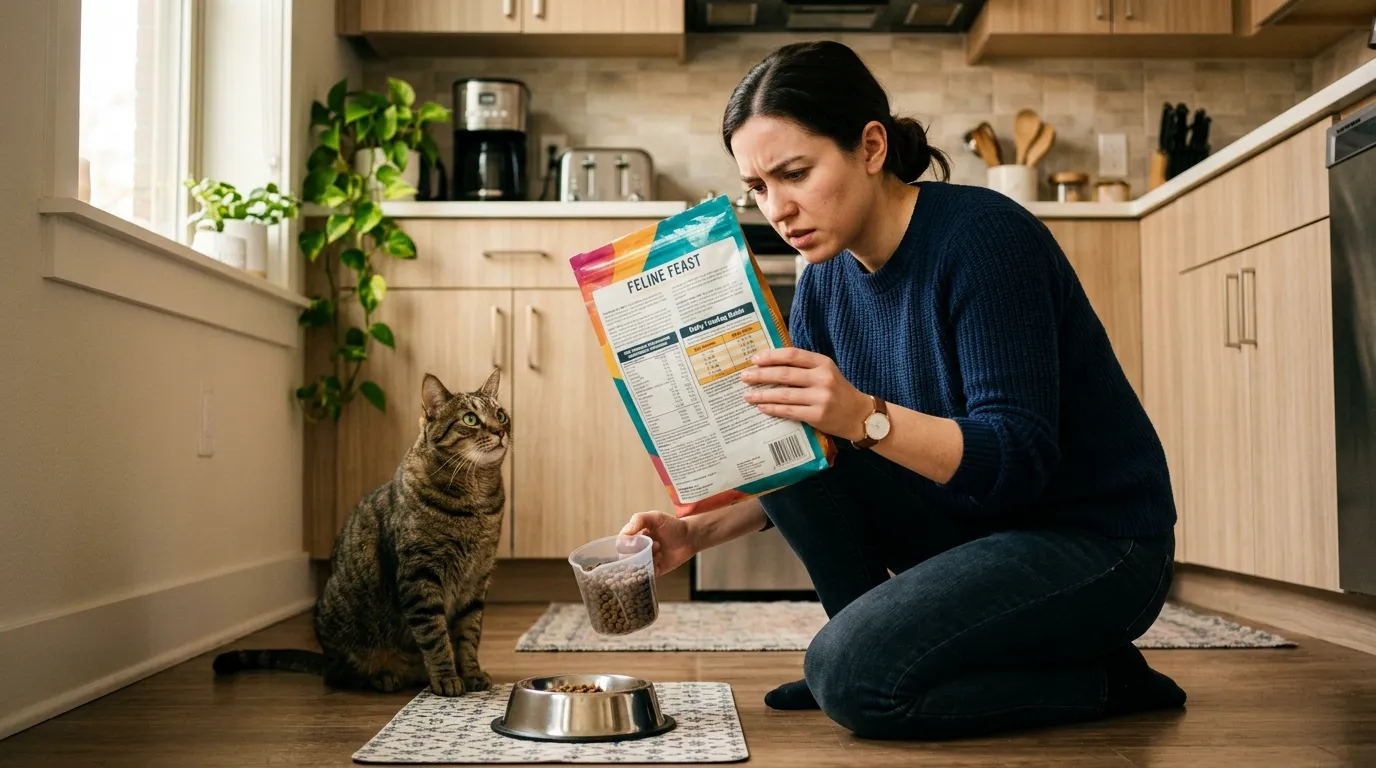
Every indoor cat owner has stood over that food bowl at some point and genuinely wondered if they’re doing this right. How much should indoor cat eat per day sounds like a simple question, but the real answer depends on weight, age, whether the cat is spayed or neutered, and what food you’re using. I found this out the hard way when my cat started gaining weight despite my following the bag instructions to the letter. Those instructions are calibrated for an active outdoor cat, and my apartment cat burned nowhere close to that much energy in a day. This guide walks through the actual calculation for your specific cat: calories, portion sizes, wet versus dry, how the numbers shift as your cat ages, and what to do when you’re switching foods or portions.
Quick answer: most healthy adult indoor cats need 200 to 260 calories a day based on body weight. A 10-pound spayed or neutered indoor cat lands around 200 to 250 calories daily, split across two or more meals. Calculate the portion by dividing that number by the calorie density printed on your food’s label, not by the serving size on the front of the bag. The full math, plus charts for weight, life stage, and food type, is below.
How Much Should Indoor Cat Eat Per Day, Based on Weight?
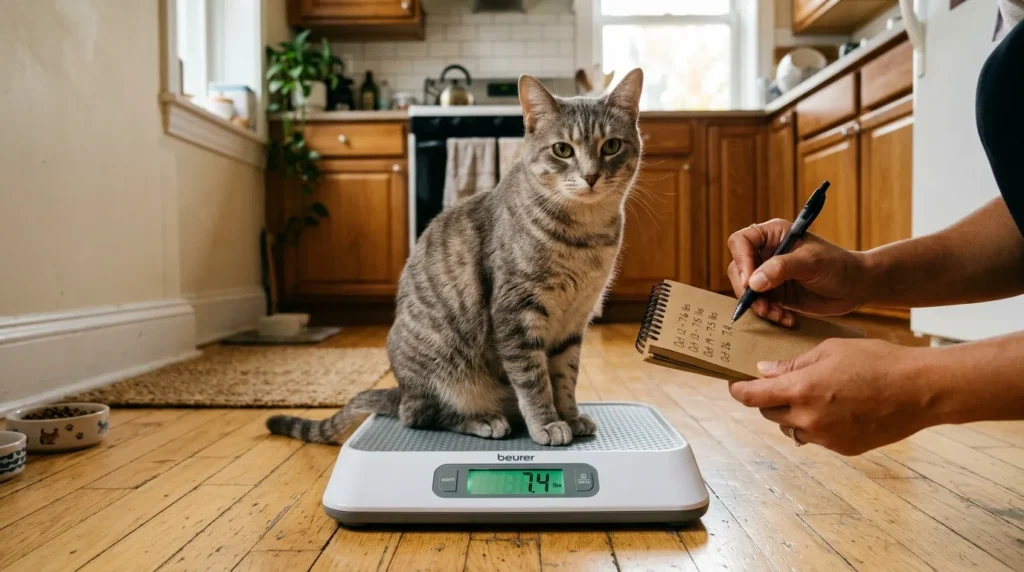
Weight comes first, since calorie needs scale directly with body size. Most veterinary guidelines start at 20 to 30 calories per pound of ideal body weight for indoor adult cats. An inactive or neutered indoor cat sits at the lower end of that range, and it’s a wider range than most feeding charts admit.
Use this chart as your starting point before calculating a specific portion from your own food’s label. Weights are in pounds with a kilogram conversion alongside, since not every label uses the same units:
| Cat Weight | Spayed or Neutered Indoor Cat (kcal/day) | Active Indoor Cat (kcal/day) | Weight Loss Target (kcal/day) |
| 5 lbs (2.3 kg) | 125 to 160 | 150 to 200 | 100 to 125 |
| 7 lbs (3.2 kg) | 175 to 220 | 210 to 270 | 140 to 175 |
| 8 lbs (3.6 kg) | 190 to 240 | 230 to 290 | 150 to 190 |
| 9 lbs (4.1 kg) | 195 to 250 | 240 to 305 | 155 to 195 |
| 10 lbs (4.5 kg) | 200 to 260 | 250 to 320 | 160 to 200 |
| 12 lbs (5.4 kg) | 240 to 300 | 290 to 370 | 190 to 240 |
| 15 lbs (6.8 kg) | 290 to 380 | 350 to 450 | 230 to 290 |
Calculate from your cat’s ideal body weight, not the number on the scale right now, if she’s already carrying extra pounds. A 14-pound cat with an ideal weight of 10 pounds gets fed like a 10-pound cat, full stop.
Insight: bag feeding guides are usually calibrated for an active cat sitting at the high end of the weight range. Your apartment cat is almost certainly more sedentary than that. Start low in the calorie range and check her weight monthly. You can always add more if she starts losing too much, and that’s an easier fix than clawing back weight she’s already gained.
How Do I Know If My Cat Is at a Healthy Weight?
The calorie math only works if you’re starting from the right target weight, and a bathroom scale reading alone doesn’t tell you that. A quick body condition check does. Run your hands along her sides, just behind the ribcage.
- Ribs: you should feel them easily under a thin layer of fat, without seeing them poke through the coat.
- Waist: looking down from above, there should be a visible inward curve behind the ribs, not a straight line or an outward bulge.
- Belly: a slight tuck up toward the hind legs is normal; a low, swinging pouch usually means excess fat rather than a natural body shape.
If ribs are hard to find under padding, or the waist has disappeared entirely, that’s your cue to calculate from a lower ideal weight than her current one. If you’re not confident doing this by feel, your vet can assign an actual body condition score in under a minute at any routine visit, and it’s worth asking for one the next time you’re in.
Why Indoor Cats Need Fewer Calories Than Outdoor Cats
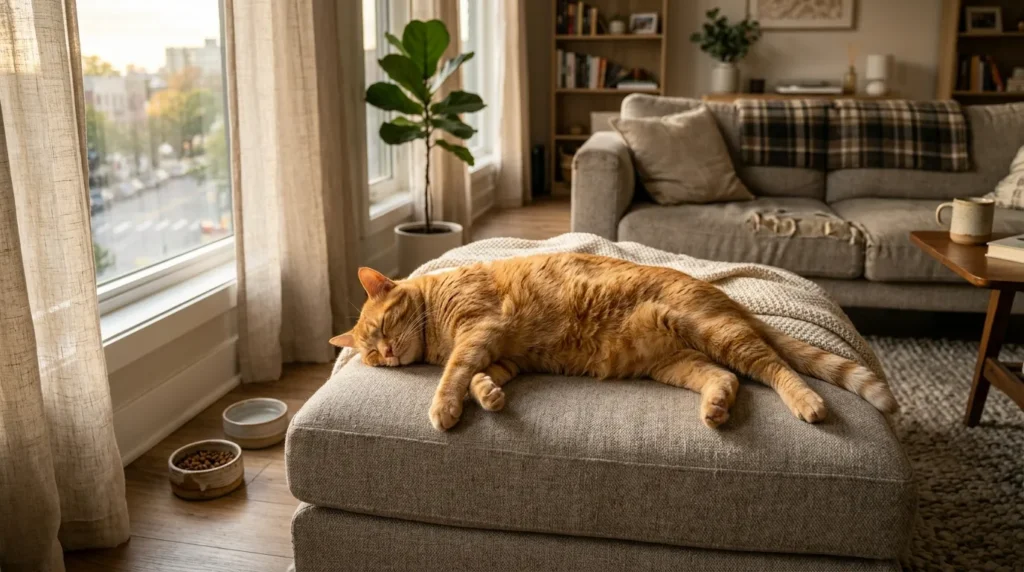
Indoor cats spend a large chunk of the day asleep. The American Association of Feline Practitioners puts average feline sleep at 12 to 16 hours daily, and indoor cats at the lower end of their natural activity range burn far fewer calories than outdoor cats out patrolling territory and hunting across open ground.
In practice, that puts indoor calorie needs roughly 20 to 30 percent below an equivalent-weight outdoor cat. Spaying and neutering lowers the metabolic rate further, since it cuts back the hormone-driven restlessness that burns extra energy. A neutered indoor cat can need as little as 20 calories per pound of body weight daily to hold a healthy weight, well under the 30-plus calories an active outdoor cat needs.
This lower need is the actual reason bag instructions overfeed so many indoor cats. Those guidelines are written for an average cat across every lifestyle, and they almost always overshoot what a sedentary apartment cat burns in a day. Our step-by-step guide to feeding an indoor cat properly walks through the process side of this in more detail, if you want the full setup rather than just the numbers here.
Wet Food vs. Dry Food: How Portion Size Changes Completely
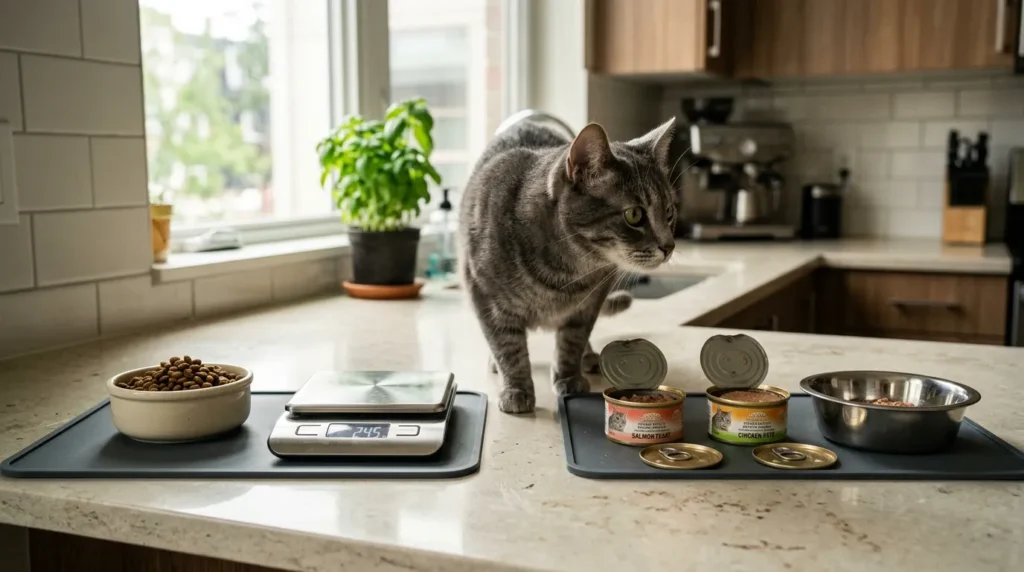
The food type changes the physical portion size a lot, even at the same calorie total. Dry kibble runs calorie-dense, typically 300 to 500 calories per cup depending on the brand. Wet food sits much lower, since it’s 70 to 80 percent moisture, so a 3-ounce can often holds only 70 to 100 calories.
Here’s what that looks like for a 10-pound indoor cat needing 220 calories a day:
| Food Type | Calorie Density (typical) | Daily Portion for 220 kcal |
| Dry kibble (standard) | 350 kcal per cup | About two-thirds of a cup |
| Dry kibble (calorie-dense) | 500 kcal per cup | Just under half a cup |
| Wet food (3 oz can) | 75 kcal per can | About 3 cans |
| Wet food (5.5 oz can) | 150 kcal per can | About 1.5 cans |
| Mixed feeding (50/50) | Varies | Half the dry portion plus 1 to 2 cans wet |
Never measure by cup count or can count alone. Check the calorie density on your specific food’s label and divide your daily target by that number. Two dry foods that look nearly identical on the shelf can differ by 200 calories per cup.
Insight: wet food earns a spot in every indoor cat’s diet for one practical reason beyond nutrition. It slows them down. The added moisture creates volume without extra calories, so a cat eating wet food tends to feel full longer. For cats that inhale dry food and beg all day anyway, switching even one meal to wet changes the whole pattern.
How to Switch Your Cat to a New Food or Portion Without Stomach Upset
Recalculating your cat’s portion often means changing the amount, and sometimes the food itself, in the same week. Do both slowly. A sudden jump to a smaller portion leaves a cat hunting for more food and begging harder, and a sudden food swap risks vomiting or loose stool, since the gut’s bacteria need time to adjust to a new formula.
For a portion change alone, drop the amount by about 10 percent every four to five days until you reach the target, rather than cutting straight to the new number overnight. For a food change, use a seven to ten day blend:
| Days | Old Food | New Food |
| Day 1 to 2 | 75% | 25% |
| Day 3 to 4 | 50% | 50% |
| Day 5 to 6 | 25% | 75% |
| Day 7+ | 0% | 100% |
Stretch this to ten or fourteen days for cats with a sensitive stomach or a history of food allergies. If you see soft stool, slow the transition down rather than pushing through it. A cat that refuses the new food outright at any blend ratio is worth a call to your vet, especially if she’s gone more than a day without eating.
Feeding Frequency: How Many Meals Do Indoor Cats Actually Need?
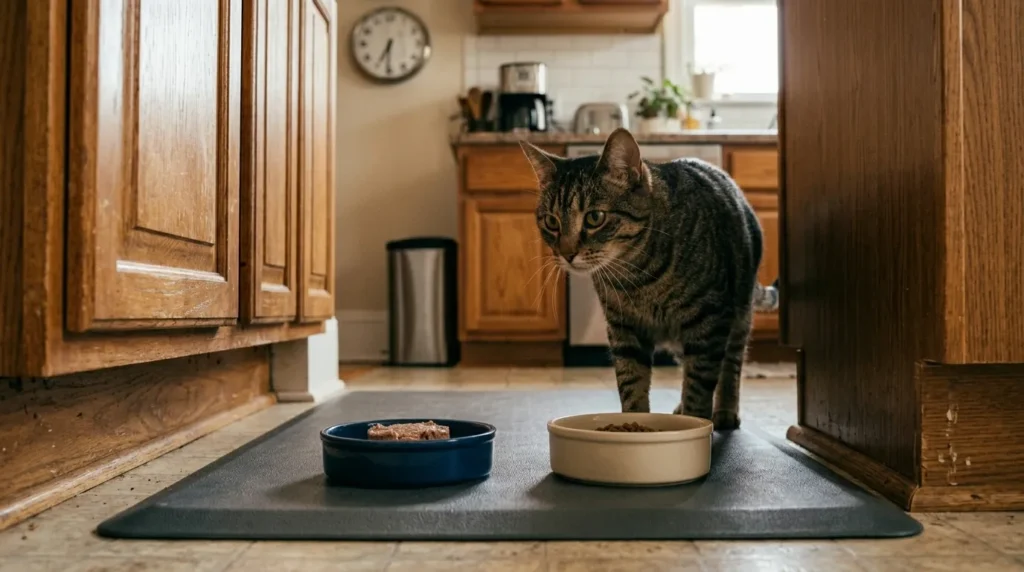
Two to three measured meals a day beats a bowl that’s always full for most indoor cats. Free-feeding dry food is the fastest route to an overweight cat, since kibble is calorie-dense and most cats eat out of boredom as readily as out of hunger once food is sitting there around the clock.
Split the daily target evenly across meals. A cat needing 220 calories a day on two meals gets 110 per meal. On three meals, that’s roughly 73 each. This matters because portions look alarmingly small the first time you measure them, especially with dry food, and knowing the math behind the number makes it easier to stay consistent instead of second-guessing yourself into overfeeding. An automatic timed feeder helps here too, since it dispenses a pre-set portion on schedule and takes the guesswork out of your own morning routine, particularly useful if you’re not around at feeding time every day.
The hunt-eat-groom-sleep cycle wild cats follow naturally is worth simulating indoors. Play actively for 10 to 15 minutes before each meal, then feed right after. Cats who’ve physically worked before eating are less likely to inhale their food and immediately demand more, and this same routine cuts down on nighttime hunger behavior significantly. If you’re feeding more than one cat, separate bowls and, ideally, separate rooms matter here too, since a faster eater will happily finish a slower cat’s portion given the chance, and that alone can throw off both cats’ calorie targets without either owner noticing. Our indoor cat care pillar guide covers how this feeding structure fits into the daily routine for cats in smaller spaces.
Sample Two-Meal and Three-Meal Schedules
A rough timing template helps if you’re setting up a routine from scratch. Adjust the clock times to fit your own day, but keep the spacing between meals reasonably even so your cat isn’t running on empty for ten hours and then stuffed for the other fourteen.
| Schedule | Meal 1 | Meal 2 | Meal 3 |
| Two meals | 7:00 AM | 6:00 PM | — |
| Three meals | 7:00 AM | 1:00 PM | 7:00 PM |
How Calorie Needs Change From Kitten to Senior Cat
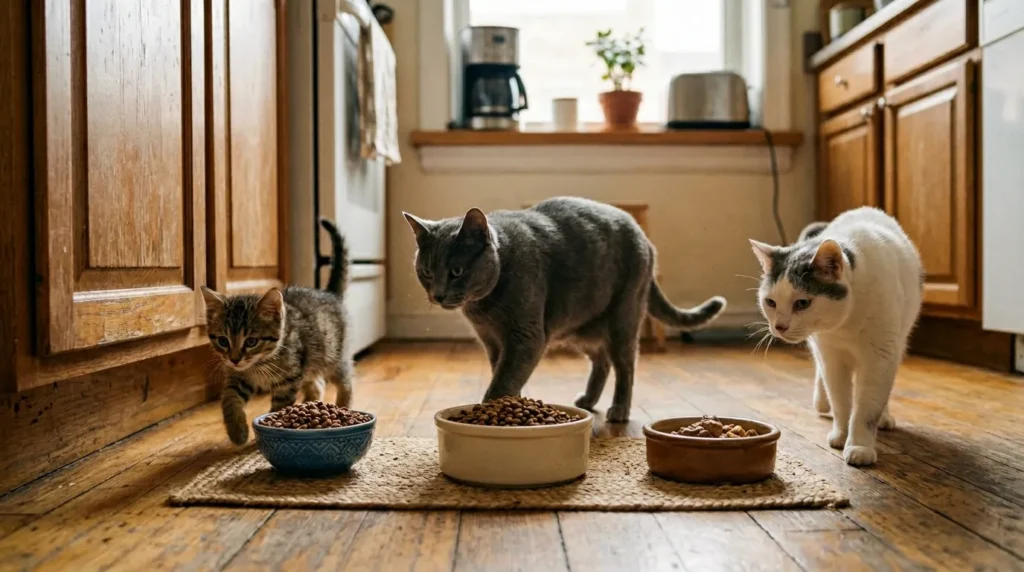
The daily number shifts hard across life stages, since metabolic needs change dramatically from kittenhood through senior years.
Kittens need the most relative to their size. A growing kitten needs roughly 50 to 65 calories per pound daily, more than double an adult indoor cat’s needs, and should eat three to four times a day to support growth without overloading a small stomach. Move to adult portions around 10 to 12 months.
Adult indoor cats settle into the 200 to 260 calorie range for most of their mature years. Senior cats aged 10 and up often need a recalculation, since some lose muscle mass and benefit from more protein-dense food to hold body condition, even if the total calorie count stays flat or dips slightly. Watch for unexplained weight loss here specifically. It’s often worth investigating rather than writing off as normal aging.
| Life Stage | Age Range | Approx. Calories Per Pound Per Day | Meals Per Day |
| Kitten | Under 12 months | 50 to 65 kcal/lb | 3 to 4 |
| Young Adult | 1 to 6 years | 25 to 30 kcal/lb | 2 to 3 |
| Adult Neutered Indoor | 1 to 10 years | 20 to 25 kcal/lb | 2 to 3 |
| Senior | 10 years and older | 18 to 25 kcal/lb (monitor closely) | 2 to 4 |
A note for two groups outside this table: pregnant and nursing cats have calorie needs well above any adult figure here, sometimes double by late pregnancy or peak lactation, and that’s specific enough to a cat’s condition that it needs a vet-guided plan rather than a general chart.
How to Read Your Cat’s Food Label and Calculate the Right Portion
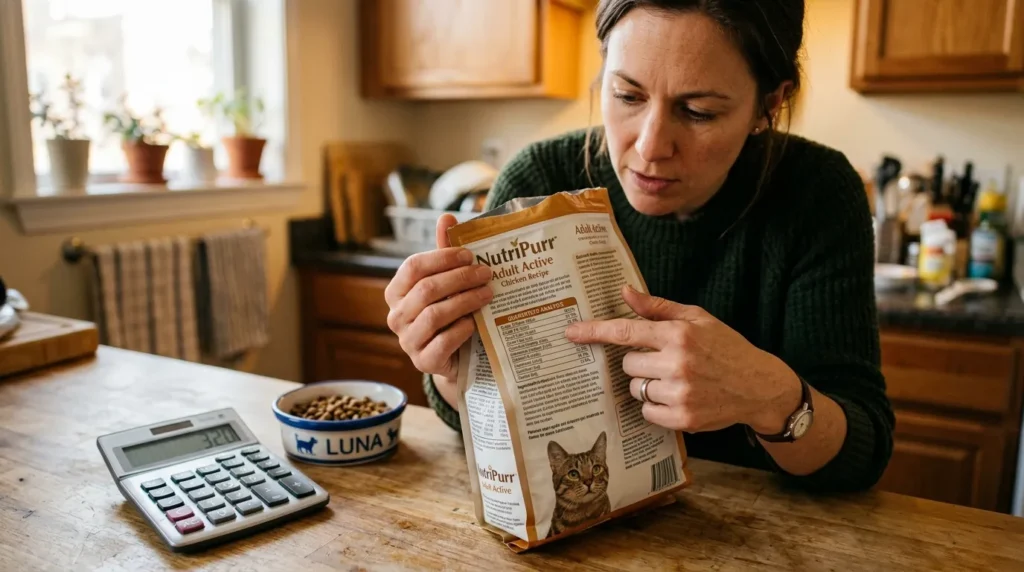
Reading a cat food label for calorie content takes about thirty seconds once you know where to look. Find the line labeled “Caloric Content” or “Metabolizable Energy.” It lists calories per cup for dry food, or per can or per 100 grams for wet food.
Once you have that figure, the math is simple:
Daily calorie target ÷ calories per cup (or per can, or per 100g) = daily portion.
A 10-pound cat needing 220 calories on a dry food listing 380 calories per cup works out to 220 divided by 380, or 0.58 cups, just under two-thirds, split across two or three meals. If your label lists calories per 100 grams instead of per cup, weigh a test portion on a kitchen scale once to see how many grams equal a cup for that specific food, then use that conversion going forward. A digital gram scale is more accurate than a scoop for kibble, since scoop sizes vary between bags even within the same brand.
Labels are a starting point, and individual cats vary by up to 20 percent in either direction based on metabolism, activity, and breed. Weigh her every three to four weeks for the first few months on a new routine, and adjust the portion up or down by 10 percent at a time based on what the scale actually shows.
Insight: most owners are surprised by how little food covers a day’s needs. Half a cup of dry food looks like nothing in the bowl. But a lean 10-pound cat at maintenance genuinely needs very little, and feeding even 20 percent too much every day adds up to real weight gain over a few months. Trust the math over the instinct to add a little extra for good measure.
How Much Water Should an Indoor Cat Drink Alongside Food?
Food amount and water intake are connected, and it’s easy to focus on one and forget the other. As a general rule, cats need roughly 3.5 to 4.5 ounces of water per 5 pounds of body weight each day, counting both what they drink and what’s already in wet food. A cat eating mostly wet food gets a good chunk of that from her meals already, since canned food runs 70 to 80 percent moisture. A cat on dry food alone needs to make up nearly all of it from the water bowl, which is one more reason mixed feeding tends to work well for cats who don’t drink much on their own. A running water fountain increases intake for a lot of cats simply because moving water gets more attention than a still bowl.
Common Feeding Mistakes That Lead to Overweight Indoor Cats
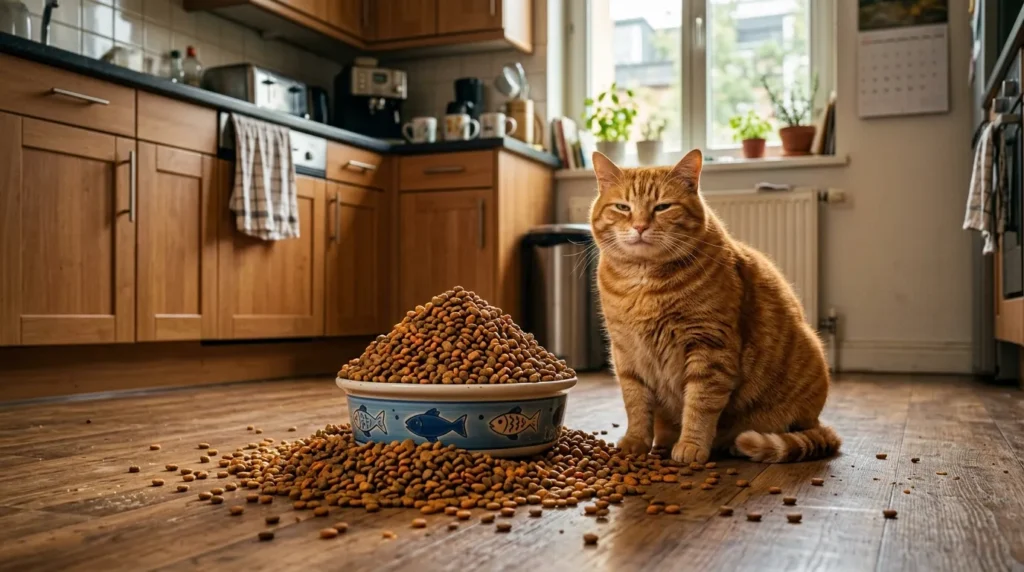
The most common mistake is following bag instructions without adjusting for lifestyle. Bag guidelines target an average active cat, and they routinely recommend 20 to 40 percent more food than a sedentary indoor cat needs. Weight creeps up so gradually that most owners don’t notice until the change is significant.
The second mistake is skipping measurement entirely. Eyeballing a portion drifts over time without you noticing, and it drifts toward more, not less. A kitchen scale or a standardized measuring cup, used every single time, is the only reliable way to keep portions accurate.
The third mistake is treats that don’t count toward the daily total. Treats should stay under 10 percent of daily calories. For a cat on 220 calories a day, that’s 22 calories max, roughly three to five small commercial treats depending on the brand. Treats handed out freely through the day can push a cat 30 to 50 percent over target without anyone realizing it happened.
When Your Cat’s Appetite Changes, and When to See a Vet
Normal variation is one thing. A cat eating slightly less on a hot day, or skipping a meal after a big play session, isn’t a concern on its own. A pattern is what matters: a cat eating noticeably less than usual for more than 48 hours, or losing visible weight over a few weeks, is telling you something worth checking.
Sudden, unexplained weight loss in a cat that’s still eating normally often points to hyperthyroidism in older cats, or diabetes at any age. Both change how efficiently the body uses calories and can shift body composition fast, even with steady food intake. Sudden weight gain with no feeding change, on the other hand, sometimes signals hypothyroidism or fluid retention.
Appetite loss past 48 hours in an adult cat, or past 24 hours in a kitten, needs a vet visit. Cats that stop eating entirely risk hepatic lipidosis within 24 to 72 hours, and that timeline moves faster than most owners expect.
This article is for informational purposes only. Always consult your vet if you notice sudden changes in your cat’s appetite, weight, or eating patterns.
Feeding Checklist: Get Your Cat’s Portion Right This Week
- Weigh your cat and estimate her ideal body weight, not just the current number on the scale.
- Pull the calorie target from the weight chart above, or calculate at 20 to 30 kcal per pound.
- Check the “Caloric Content” line on your food’s label and divide your target by that number.
- Split the portion across two or three measured meals, at roughly even intervals.
- Use a kitchen scale or a dedicated measuring cup, not a scoop from the bag or a guess.
- If changing food or cutting portion size, transition over seven to ten days rather than switching overnight.
- Weigh your cat again in three to four weeks and adjust the portion by about 10 percent if needed.
- Log any appetite change lasting more than 48 hours and call your vet if it continues.
Frequently Asked Questions About How Much Indoor Cats Should Eat
How many times a day should I feed my indoor cat?
Two to three measured meals works best for most adult indoor cats. Two meals avoids the long gaps that drive hunger-based behavior. Three meals suits cats prone to vomiting on an empty stomach, or cats who beg persistently on a two-meal schedule. Free-feeding dry food almost always leads to overeating in a low-activity indoor cat.
Is my indoor cat eating too much if they always beg for food?
Not necessarily. Indoor cats often beg from boredom rather than real hunger. Play for 10 minutes before feeding and watch whether the begging drops off. If it does, boredom’s the driver. A cat at a healthy weight who still begs constantly usually needs more enrichment and a tighter feeding schedule, not more food.
How much wet food should an indoor cat eat per day?
A 10-pound adult indoor cat on wet food alone needs roughly 3 to 4 small cans (3 ounces each) or 1.5 to 2 standard cans (5.5 ounces each) daily, depending on the specific food’s calorie density. Check the label every time. Wet portions look much bigger than dry portions for the same calorie total, thanks to the moisture content.
Should I feed my cat less as they get older?
Not automatically. Some senior cats need slightly fewer calories early in old age, but plenty of older cats need more after 12 or 13 to hold onto muscle mass as digestion gets less efficient. Watch body condition, not age. A senior cat losing weight despite eating normally needs a vet visit, not a smaller portion.
Why does my cat act hungry right after eating a full meal?
This is normal for a lot of cats, and usually reflects eating speed or the food’s satiety profile more than actual calorie need. Cats who eat fast feel hunger cues before digestion has caught up. Slow feeders or puzzle feeders stretch out mealtime and cut this down noticeably. If your cat genuinely seems hungry all the time and is losing weight, that’s worth a vet check.
How do I feed multiple cats different amounts without one stealing the other’s food?
Feed in separate rooms, or at minimum separate bowls placed a good distance apart, especially if one cat eats faster or needs a different calorie target. Timed microchip feeders solve this well in a shared space, since they only open for the cat whose chip matches, without you needing to supervise every meal.
How much water should an indoor cat drink each day?
Roughly 3.5 to 4.5 ounces per 5 pounds of body weight, including moisture from wet food. A cat eating mostly dry food needs to get nearly all of that from the water bowl, so a fountain or a second water station often helps if she’s not a big drinker on her own.
How much should I feed my cat to help her lose weight?
Use the weight loss column in the chart above, based on her target weight rather than her current one, and don’t drop below the low end without a vet checking in first. A safe rate is about 1 to 2 percent of body weight lost per week. Faster than that risks hepatic lipidosis, a dangerous liver condition that can hit cats who lose weight too quickly, so this is one case where slower is genuinely safer.
How many grams of dry food should my cat eat per day?
It depends on the food’s calorie density, so there’s no single gram number that applies across brands. A common range is 45 to 65 grams a day for a 10-pound cat on a standard dry food, but check your specific bag: divide the daily calorie target by calories per gram, which you can back into from the “calories per cup” figure and a kitchen scale.
Is it okay to feed my cat only once a day?
For most adult cats, no. One large meal spaced 24 hours apart causes a long fasting window that drives begging, vomiting bile on an empty stomach, and overeating when the meal finally arrives. Two meals is the practical minimum for most cats; kittens and cats with a history of vomiting need three or more.
Your Cat’s Daily Food Amount Is Simpler Than It Looks
How much an indoor cat should eat per day comes down to three things: her ideal body weight, the calorie density on the food label, and how many meals you want spread across the day. Calculate from the calorie target, not the bag’s suggested serving, and weigh her monthly to confirm the math holds up. Start at 200 to 220 calories daily for a 10-pound neutered indoor cat and adjust from there based on what the scale actually tells you.
This guide sits alongside our step-by-step guide to feeding an indoor cat properly under our Indoor Cat Care pillar. Between the two, you’ve got the exact numbers here and the full routine there. For anything appetite or weight-related that looks off after you’ve run these numbers, our indoor cat health guide covers what’s worth watching for.

Written by Mishu
A passionate cat lover and indoor living enthusiast, Mishu is the founder and voice behind Indoor Living Cat – a go-to resource for cat owners who want to create the happiest, healthiest life for their feline companions indoors.
View Full Profile
It’s very simple to find out any topic on web as compared to textbooks,
as I found this post at this site.
Thanks! I’m glad you found it helpful. 😊