

The best cat breeds for apartment living aren’t the smallest ones or the quietest ones on paper. They’re the ones whose temperament actually fits a limited-territory, high-routine lifestyle. I learned this the hard way after bringing a young Bengal mix into a one-bedroom apartment and spending eight months managing shredded blinds, 5 a.m. sprinting and general chaos before I rehomed him somewhere with more room to run. A cat that needs three acres doesn’t become a apartment cat because you love it enough.
The cats that do settle well share a specific trait: they prefer the security of a small, predictable territory over the stimulation of wide roaming, and they find human company genuinely satisfying instead of just tolerating it. This article covers six breeds (and one honest exception) that consistently produce calm, settled apartment cats, plus a breakdown of how they stack up on temperament, grooming and health so you’re not guessing.
Quick answer: the best cat breeds for apartment living are the British Shorthair, Ragdoll, Persian, Exotic Shorthair, Russian Blue and Scottish Fold. All six share low-to-moderate energy, quiet vocal habits and real contentment with an indoor routine. Mixed-breed cats adopted from shelters are just as good, often better, once you’ve watched the individual cat’s personality rather than trusted a pedigree.
What Actually Makes a Cat Breed Good for an Apartment?
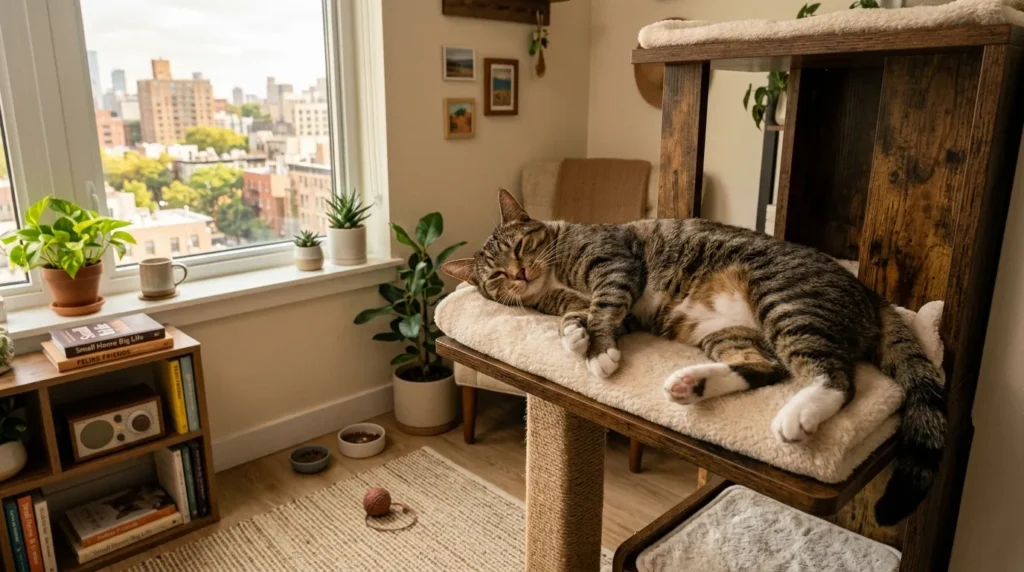
Three traits matter, not one. First is low-to-moderate energy drive: the cat needs daily play, but it doesn’t spend the hours between sessions pacing, climbing the curtains or crying for attention. Second is adaptability to a predictable indoor routine without developing stress behaviors like overgrooming or missing the litter box when the environment stays the same day after day. Third is a quiet demeanor, because in a building with shared walls, a cat that yowls at 6 a.m. becomes a lease problem fast.
Breed is a predictor, not a guarantee. Personality inside a breed varies a lot, and a calm British Shorthair and a restless British Shorthair both exist in shelters right now. Breed tells you the odds of landing a calm apartment cat. It doesn’t tell you about the specific cat sitting in the carrier in front of you. Assess the individual before you commit, and you’ll do better than picking a breed name off a list.
Enrichment quality outweighs breed selection in the long run. A high-energy breed in a well-set-up apartment, with wall shelves, a window bird feeder and two daily wand-toy sessions, can end up calmer day to day than a low-energy breed with a food bowl on the floor and nothing else to do. Breed sets the baseline. Environment decides what actually happens.
Apartment Cat Breeds Compared: Temperament, Grooming and Health
If you’re weighing breeds against each other rather than reading a list top to bottom, here’s the side-by-side. This is the version I wish existed when I was researching my second cat.
| Breed | Energy Level | Vocalization | Grooming Needs | Health Watch-Outs | Best Fit For |
|---|---|---|---|---|---|
| British Shorthair | Low | Low | Weekly brushing | Weight gain, joint strain from inactivity | Owners who want low-maintenance company |
| Ragdoll | Low to moderate | Moderate | 2-3x weekly brushing | Hypertrophic cardiomyopathy (HCM), bladder stones | Owners who want a cat that follows them room to room |
| Persian | Very low | Low | Daily brushing, daily eye/face cleaning | Brachycephalic breathing issues, polycystic kidney disease (PKD) | Owners who don’t mind a daily grooming routine |
| Exotic Shorthair | Very low | Low | Weekly brushing | Brachycephalic breathing issues, PKD | Owners who want Persian temperament without daily brushing |
| Russian Blue | Low to moderate | Very low, near-silent | Weekly brushing | Generally hardy; low rate of known inherited disease | Owners who work long hours away from home |
| Scottish Fold | Low to moderate | Low | Weekly brushing | Osteochondrodysplasia (joint and cartilage disease tied to the fold gene) | Owners who want a gentle middle-ground temperament |
Grooming needs and health risks aren’t equal across this list, and that matters as much as energy level when you’re deciding. A Persian’s coat is a daily commitment, not a weekly one. A Scottish Fold’s ears are the reason for its fame and also the reason it needs a vet who understands the breed’s cartilage condition. Factor that in before you fall for a face.
1. British Shorthair — The Easiest Apartment Cat in Existence
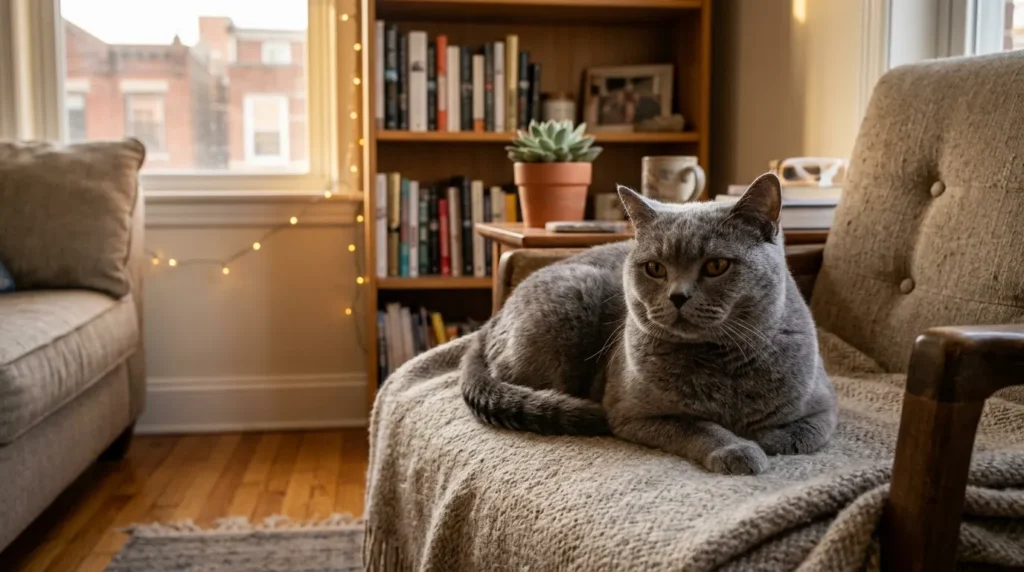
The British Shorthair tops most best cat breeds for apartment living lists for a reason, and if you’re specifically searching for a British Shorthair apartment setup, this is the breed section to read closely. It’s the least demanding cat available in terms of attention, the quietest in terms of vocalization, and the most content with a short daily play session followed by hours of settled, independent rest. It won’t need you to entertain it between sessions. It finds a spot and stays there.
The honest limitation in an apartment: weight gain. This breed needs monitored portions and real, active play rather than passive toy access, because it won’t self-exercise enough to offset its calm metabolism. A British Shorthair that free-feeds with no scheduled play gains weight fast and develops the joint and health problems that come with feline obesity within a year or two, not a decade.
British Shorthairs aren’t lap cats the way Ragdolls are. They’d rather sit beside you than on you, and they show affection through proximity, not physical contact-seeking. If you want a cat that climbs into your lap and demands cuddles, this breed can feel a little distant. If you want a cat that’s simply, reliably there without drama, it’s close to ideal.
Bottom line for British Shorthair apartment owners: pair a compact litter box setup, a scratching post near the entryway and two 10-minute play sessions a day with this breed, and you’ll rarely deal with a behavior problem. It’s the breed most forgiving of a busy owner’s schedule.
2. Ragdoll — The Apartment Cat That Actually Wants to Be Home With You
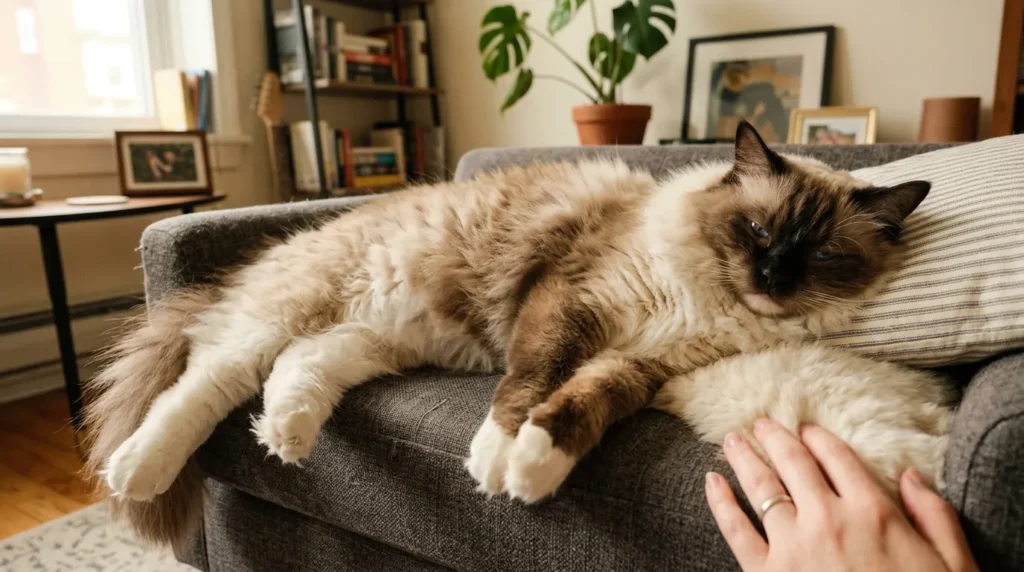
The Ragdoll is the best choice if you want a cat that actively engages with you instead of just coexisting in the space. Ragdolls follow their owners room to room, seek physical contact consistently, and visibly perk up when their person walks in the door. In a small apartment, where you’re already close to the cat most of the day, that companion-first temperament makes for a genuinely satisfying relationship.
The honest limitation: size. Ragdolls run large, often 12 to 20 pounds, and they need sturdy perches and a cat tree rated for their weight. A standard suction-cup perch built for a 10-pound cat fails under a full-grown Ragdoll. Check the weight rating before buying any elevated furniture for this breed, and go for a substantial floor-to-ceiling tree over a lightweight decorative one.
Ragdolls are moderately vocal and can get louder if they’re bored or left alone without enough passive enrichment. A midday bird video, an active window perch and a puzzle feeder for one meal fills the gap well and keeps a Ragdoll settled during the hours you’re out.
Ragdolls also carry a higher risk of hypertrophic cardiomyopathy, a thickening of the heart muscle that’s more common in this breed than in the general cat population. Ask any breeder about cardiac screening on the parents, and if you’re adopting from a shelter, budget for a cardiac check at your first vet visit.
3. Persian and Exotic Shorthair — The Lowest Energy Option Available
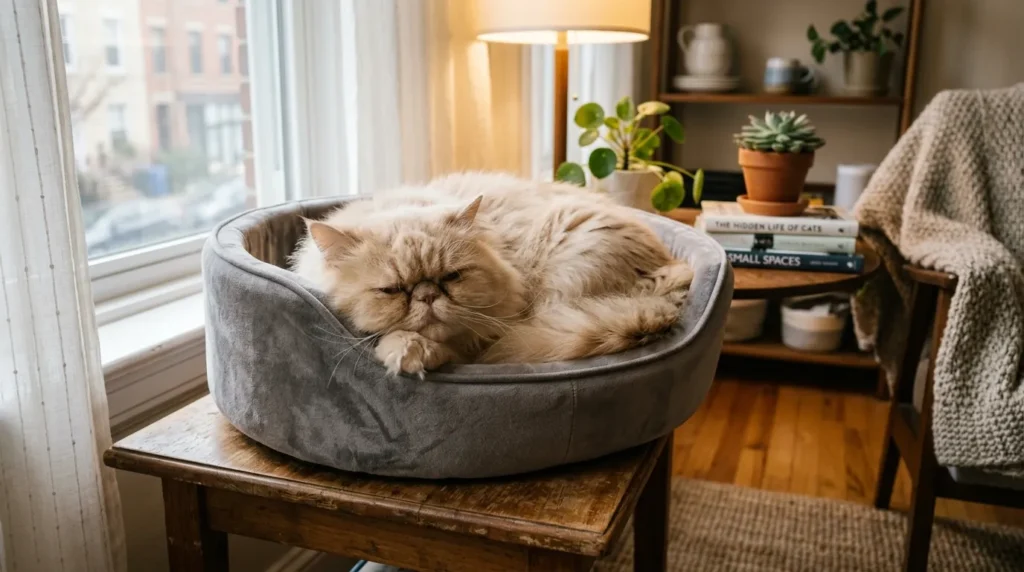
Persians and Exotic Shorthairs are the lowest-energy option on this list. They’d rather rest than do almost anything else, they rarely vocalize, and they adapt to apartment routine with less adjustment than any other breed, because they weren’t looking for more stimulation to begin with. A Persian in a small apartment isn’t bored. It’s home.
The honest limitation: grooming and health. Persian coats need daily brushing to prevent matting, and their flat faces need daily eye and facial-fold cleaning to head off infection. This isn’t a low-maintenance coat on a high-maintenance face; it’s high-maintenance on both fronts. The Exotic Shorthair solves the coat side with a dense, plush short coat that sheds but doesn’t mat, while keeping the same calm temperament and round face. If you want Persian temperament without the daily brushing commitment, the Exotic Shorthair is the more realistic pick.
Both variants are prone to brachycephalic breathing issues. If your apartment runs warm in summer, that matters more than it might for other breeds; plan on air conditioning or careful ventilation rather than relying on a fan and an open window. Polycystic kidney disease also shows up at higher rates in Persian lines, so ask about genetic screening (PKD testing) if you’re buying from a breeder.
4. Russian Blue — The Best Apartment Cat for Independent Owners
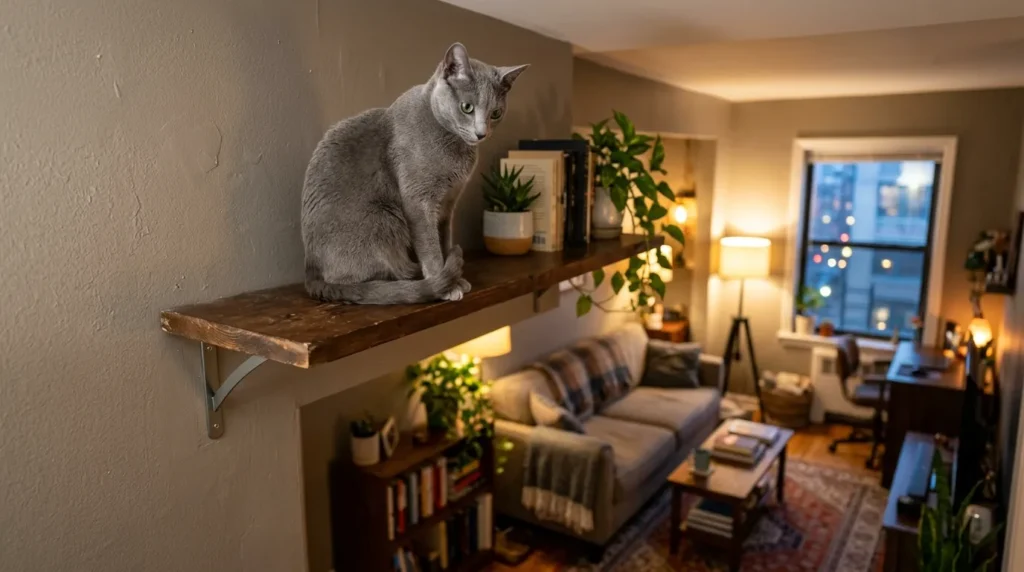
The Russian Blue suits owners who work long hours and can’t be home consistently, because it self-entertains more reliably than almost any other breed, through puzzle toys, window-watching and quiet exploration. It bonds deeply with one primary person and clearly prefers them over others, but it doesn’t develop the separation-anxiety behaviors that more people-dependent breeds show during a long workday.
Russian Blues are close to silent. In a building where a neighbor complaint over noise is a real, practical problem, that matters. This breed produces the occasional soft chirp, almost never the sustained meowing that owners of louder breeds deal with daily.
The one real challenge: this breed’s intelligence needs actual mental stimulation, not passive observation. A Russian Blue with no puzzle feeders, no foraging opportunities and no window activity gets bored in a way that shows up as persistent, out-of-character attention-seeking. Keeping its mind busy matters more than managing its energy.
5. Scottish Fold — The Adaptable, Sweet-Natured Apartment Cat
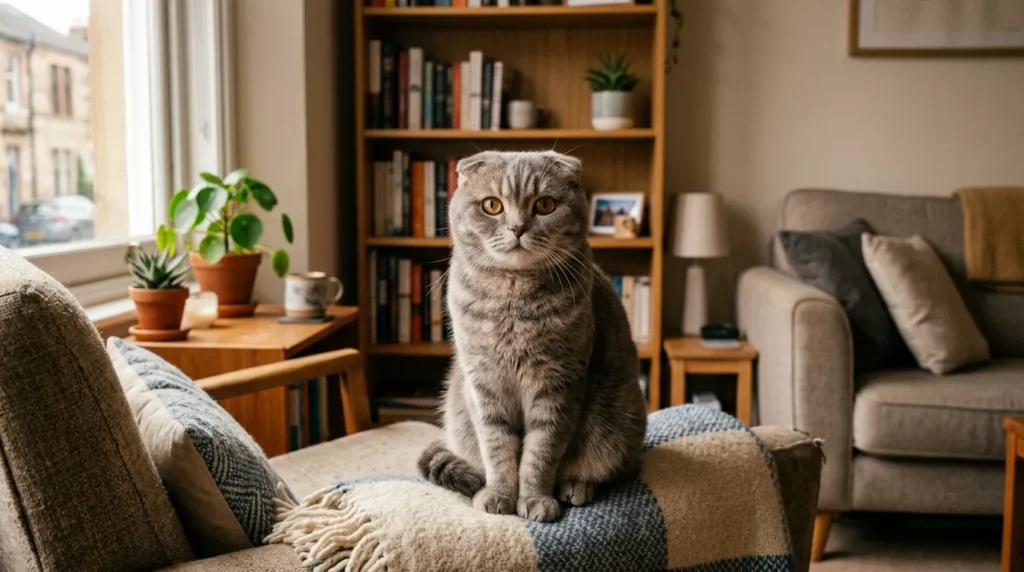
Scottish Folds adapt to apartment routine with minimal adjustment, because their temperament orients toward the people and spaces they already know rather than outside territory or stimulation. They’re affectionate without a Ragdoll’s intensity, playful without a kitten’s energy, and quiet without a Russian Blue’s aloofness. It’s a genuine middle-ground breed, and that middle ground works for most apartment households.
The honest, non-negotiable limitation: genetic health. The folded ear comes from a cartilage mutation that affects the whole body, not just the ears, and it causes joint and cartilage problems (osteochondrodysplasia) in many Scottish Folds as they age. Responsible breeding reduces this risk but doesn’t remove it. If you’re considering this breed, find a vet who already knows its specific health profile, and set money aside for orthopedic care later in life.
Scottish Folds with any joint stiffness need low-impact enrichment, not high-jump demands. Keep perches at accessible heights with ramps or steps in between, and switch to floor-level puzzle feeders as the cat ages.
Best Apartment Cat Breeds for First-Time Owners
If this is your first cat, the calculus shifts a little. You’re going to make routine mistakes early on, missed play sessions, an inconsistent feeding schedule, a litter box you clean less often than you should, and the breed you pick should tolerate that learning curve without falling apart behaviorally.
For a first-time owner in an apartment, prioritize:
- Forgiving temperament over high intelligence. A Russian Blue’s need for mental stimulation is manageable once you know to expect it, but a first-timer who doesn’t yet know that can end up with an anxious, attention-seeking cat by accident.
- Lower grooming demands while you’re still learning the basics. A Persian’s daily brushing and face-cleaning routine is a lot to add on top of learning to own a cat at all. The Exotic Shorthair or British Shorthair gets you a similar calm temperament with far less upkeep.
- A breed that doesn’t punish inconsistency. British Shorthairs and Scottish Folds tend to stay behaviorally stable even when your schedule isn’t perfect yet.
- Skip the high-companionship breeds if you travel or work unpredictable hours. A Ragdoll left alone too often without a plan can develop real distress. Save that breed for once your routine is settled.
My honest recommendation for a true first cat in a small apartment: British Shorthair or Exotic Shorthair. Both forgive a rough first few months, need modest grooming, and rarely develop behavior problems even when the owner’s routine is still a work in progress. A calm, individually-assessed shelter mix does just as well, and often costs a tenth of the price.
The Honest Truth About Breed vs. Individual Personality
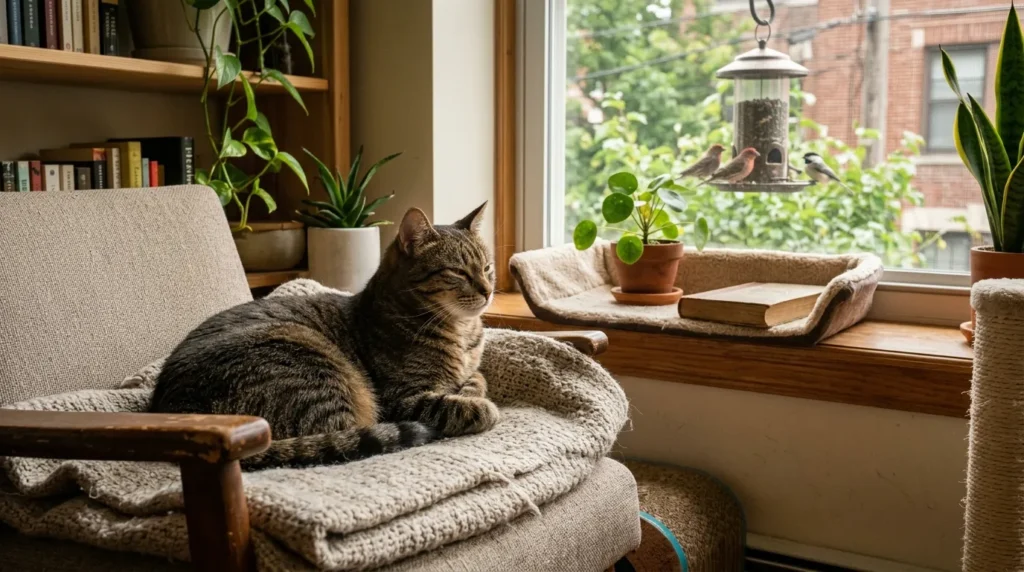
The biggest thing the best cat breeds for apartment living conversation leaves out: the specific cat in front of you at the shelter matters more than its ancestry. A calm three-year-old domestic shorthair mix that’s lived in a foster home, uses its litter box without fail, shows no anxiety when left alone and has low play energy beats a purebred British Shorthair with an unknown socialization history and high anxiety, every time.
Mixed-breed cats from shelters tend to be genetically diverse, which usually means fewer breed-specific health problems, longer average lifespans and personalities across the full range of feline temperament rather than a statistical breed average. This includes Ragdoll mixes, which show up in shelters more often than you’d expect and can make excellent apartment cats when the individual temperament checks out. A Ragdoll crossed with a domestic shorthair often keeps the affectionate, people-oriented streak while losing some of the purebred’s size and health risk, though every mix is its own animal and there’s no guarantee. Ask the shelter staff, who’ve lived with the cat for weeks, whether it vocalizes when alone, how it handles confined spaces, and whether its energy level is genuinely apartment-manageable.
The practical question for apartment life isn’t which breed to pick. It’s how to set up the space correctly once any cat arrives. The physical layout, the window enrichment setup, the daily play schedule and litter box management determine behavioral outcomes far more than breed genetics do. Everything that goes into a genuinely enriched small apartment for a cat applies equally to every breed, and to every mixed-breed individual.
Insight: I’ve seen apartments with British Shorthairs that look like disaster zones, and shelter mixes that live in one-bedroom apartments as perfectly settled companions. The breed conversation sets expectations before you adopt. After adoption, enrichment is the only conversation that matters. Get the play schedule right, put up one wall shelf near a window, add a bird feeder outside. The cat you chose correctly for temperament will be fine.
The Mistake That Makes Even the Best Breed Miserable in an Apartment
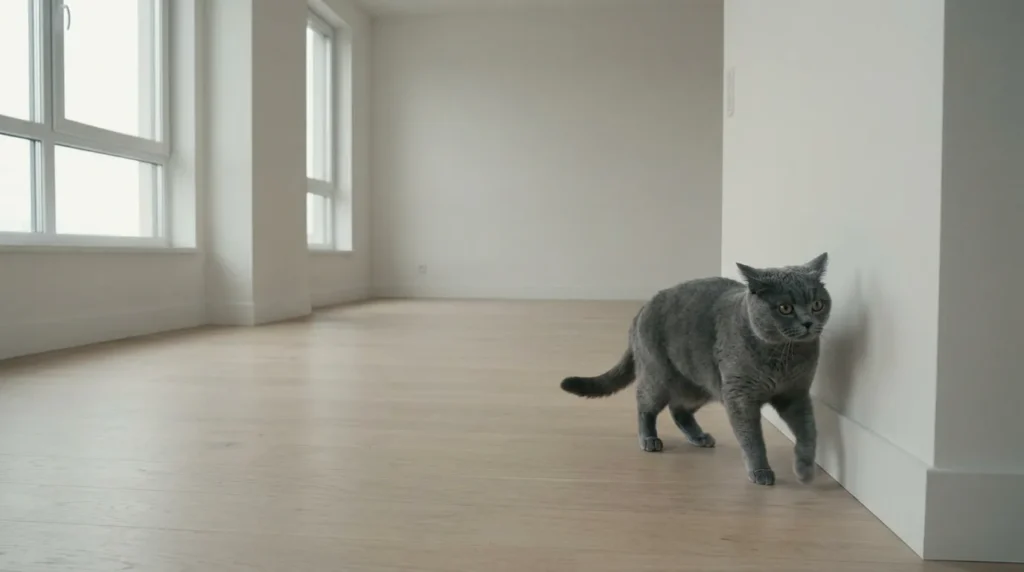
The mistake that undoes even a well-chosen breed: assuming a calm breed removes the need for proper enrichment. Owners who adopt a British Shorthair or Persian expecting calm behavior to show up automatically, regardless of what the apartment offers, consistently report the same problems: restlessness, persistent vocalization, torn-up furniture. Calm temperament produces calm behavior when the environment backs it up. Remove the environment, and the temperament advantage disappears fast.
A calm breed in a bare apartment, no vertical territory, no window enrichment, no daily structured play, ends up with the same behavior problems as a high-energy breed in the same conditions. The calm breed just recovers faster once you fix it. Breed selection and environment setup work as a pair. Neither one covers for the other.
Apartment Setup Checklist Before Your Cat Arrives
Whatever breed you choose, this is the baseline setup that keeps behavior problems from starting in the first place.
- Vertical territory: at least one wall shelf or a floor-to-ceiling cat tree, weight-rated for your breed.
- A window perch with a view of outdoor activity, ideally near a bird feeder or busy street.
- Two daily play sessions, 10 to 15 minutes each, timed near dawn and dusk when cats are naturally most active.
- A litter box in a low-traffic corner, away from food and water, cleaned at least once a day.
- One scratching post per room the cat spends real time in, both vertical and horizontal options if space allows.
- A puzzle feeder for at least one meal a day to replace some of the foraging a cat would do outdoors.
- A quiet hiding spot the cat can retreat to, especially in the first few weeks.
- A vet visit booked in the first two weeks, with breed-specific screening discussed up front (cardiac for Ragdolls, kidney and airway for Persians/Exotics, joint health for Scottish Folds).
Frequently Asked Questions
What is the best cat breed for a small apartment?
The British Shorthair gets recommended most often for small apartments because its low energy drive, quiet demeanor and genuine contentment with indoor routine produce settled behavior without needing extra stimulation. The Ragdoll works better if companionship is the priority. Mixed-breed cats from shelters with an assessed calm personality perform just as well in most apartment setups.
Are high-energy breeds like Bengals okay in apartments?
Not without a lot more enrichment than most apartment owners can realistically keep up. High-drive breeds need two or more substantial daily play sessions, real vertical territory and constant environmental novelty to stay settled. Most apartment owners can’t sustain that level of active management, and the cat develops behavior problems as a result. A lower-energy breed, or a calm individual mixed-breed cat, is the more realistic apartment choice.
Does breed matter more than enrichment for apartment cats?
Enrichment matters more. A calm breed in a bare apartment still develops behavior problems. A moderately energetic cat in a well-enriched apartment, wall shelves, a window bird feeder, two daily play sessions, lives well. Breed sets a useful baseline expectation. Environment and daily routine decide the actual outcome.
Can I adopt a mixed-breed cat for apartment living?
Yes, and it’s often the better choice. Shelter staff can tell you specifically how a mixed-breed cat behaves when left alone, whether it vocalizes, how it handles confined spaces, and what its real energy level looks like once the initial shelter stress wears off. That individual behavioral data beats breed statistics for apartment decision-making.
Is a Ragdoll mixed with a domestic shorthair good for apartment living?
Often, yes. A Ragdoll-domestic shorthair mix frequently keeps the affectionate, people-focused temperament Ragdolls are known for, while carrying a lower risk of the purebred’s size and cardiac concerns. There’s no guarantee with any mix, since genetics don’t split evenly, so assess the individual cat’s temperament and ask the shelter or breeder about any known health history before deciding.
What’s the best cat breed for a first-time apartment owner?
British Shorthair or Exotic Shorthair, for most first-timers. Both tolerate the routine mistakes that come with learning to own a cat, need modest grooming, and rarely develop behavior problems even when your schedule isn’t fully dialed in yet. A calm, individually-assessed shelter mix works just as well and typically costs far less.
Conclusion
The best cat breeds for apartment living share calm temperament, quiet demeanor and real contentment with a small-space indoor routine. British Shorthair, Ragdoll, Persian, Exotic Shorthair, Russian Blue and Scottish Fold all fit that profile consistently, each with its own tradeoffs on grooming and health. Mixed-breed cats from shelters with individually assessed temperaments are just as valid a choice, and often the healthier one. Whatever breed you pick, the apartment setup decides the behavioral outcome more than genetics do. Install vertical territory, set up a window enrichment station and commit to a daily play schedule before the cat arrives, not after the behavior problems start.
The best cat breeds for apartment living are the British Shorthair, Ragdoll, Persian, Exotic Shorthair, Russian Blue and Scottish Fold. These breeds share low-to-moderate energy drives, quiet vocalization and genuine contentment with indoor routine. On grooming and health, Persians and Exotic Shorthairs need the most upkeep and carry brachycephalic and kidney risks; Ragdolls carry a higher rate of heart disease; Scottish Folds carry a joint and cartilage condition tied to the fold gene; British Shorthairs and Russian Blues are the lowest-maintenance on both fronts. First-time apartment owners do best with a British Shorthair, Exotic Shorthair or a calm, individually assessed shelter mix. Mixed-breed domestic cats, including Ragdoll mixes, perform equally well in apartments once temperament is assessed individually. Breed selection sets behavioral expectations, but enrichment quality, vertical territory, a window perch with outdoor activity, and two daily 10-to-15-minute play sessions timed to dawn and dusk, determines the actual outcome.

Written by Mishu
A passionate cat lover and indoor living enthusiast, Mishu is the founder and voice behind Indoor Living Cat – a go-to resource for cat owners who want to create the happiest, healthiest life for their feline companions indoors.
View Full Profile