
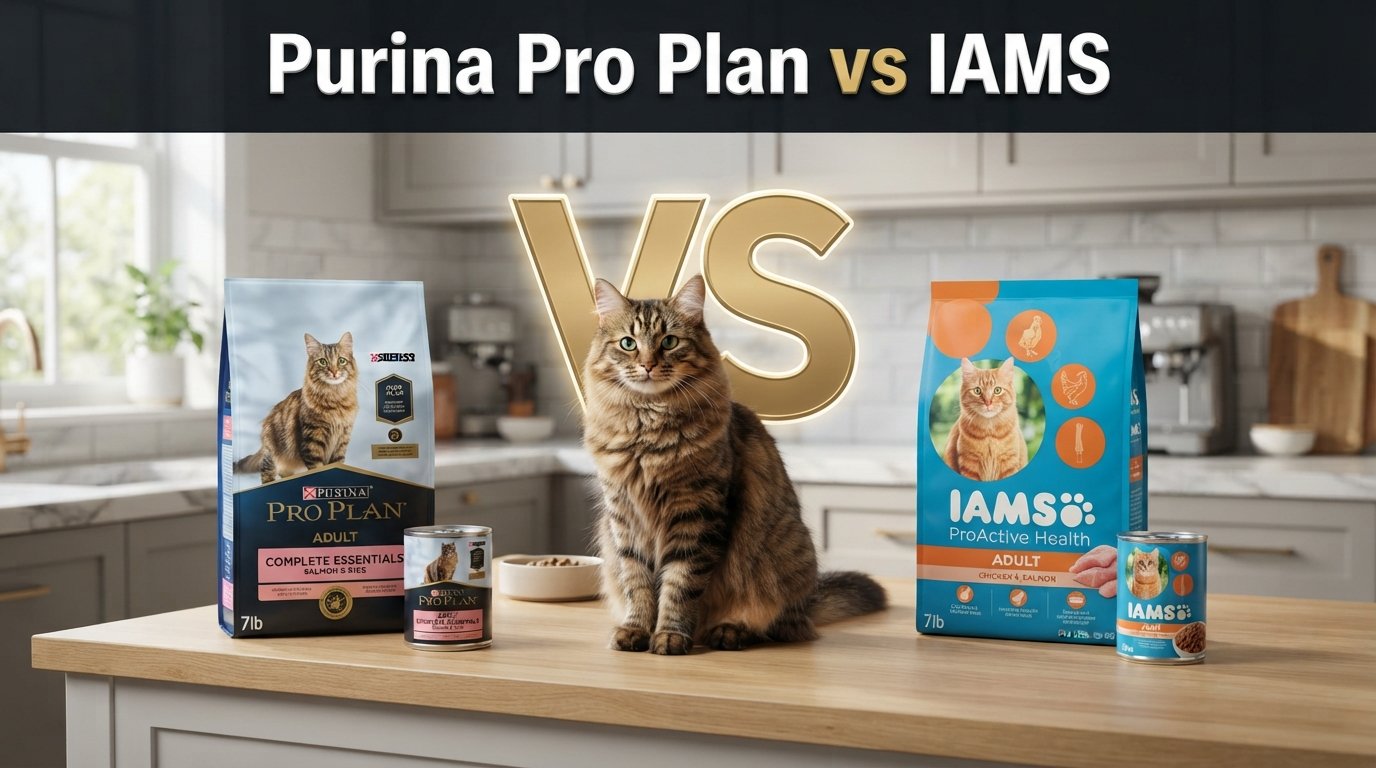
Purina Pro Plan vs IAMS cat food comes down to one trade: protein and probiotics against hairball control and a lower price. I put Purina Pro Plan Chicken & Rice with Probiotics next to IAMS Proactive Health Indoor and read every number on both bags. Real chicken leads both ingredient lists. After that, the two formulas split hard on crude protein, fiber source, and what problem they’re actually built to solve.
Short version: if you’re asking whether IAMS is better than Purina, or which one wins for your specific cat, the honest answer is it depends on what your cat needs most. An athletic cat that needs muscle support does better on Purina. A strictly indoor cat that hacks up hairballs twice a week does better on IAMS. Below, I break down exactly why, with the label numbers to back it up.
Quick Answer: Is Purina or IAMS Better for Cats?
Purina Pro Plan wins on raw nutrition: 36% minimum crude protein versus 28-30% in IAMS, plus a named probiotic strain (Bacillus coagulans) that IAMS doesn’t list. IAMS wins on price and on hairball control, since its beet pulp fiber blend is built specifically for that job and Purina’s isn’t. Neither food is “wrong.” They’re built for different cats.
Purina Pro Plan vs IAMS Cat Food: Full Comparison
⚡ Quick Verdict
My pick is Purina Pro Plan. It carries more protein per cup and adds live probiotics, which matters most for active cats. If your cat is strictly indoor and prone to hairballs, IAMS still earns a spot on the shelf, and it costs less to boot.
Analysis: Purina Pro Plan Chicken & Rice
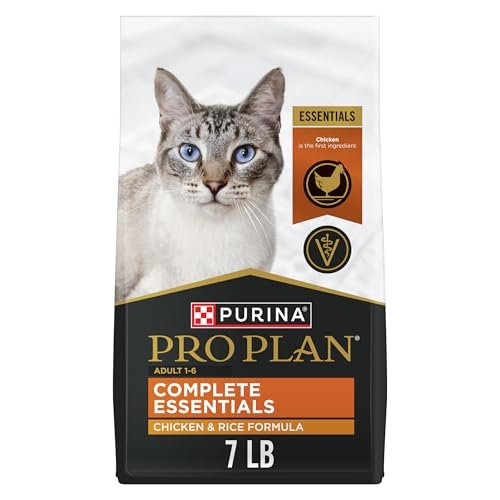
Best for owners who want higher protein and probiotic support in a standard chicken and rice formula.
Real chicken sits at the top of the ingredient list. That’s where most of your cat’s energy and amino acids come from. Purina also adds vitamin A and omega-6 fatty acids, so the coat looks healthy instead of dull. For how this formula performs across life stages, read our full Purina Pro Plan review.
Chicory root fiber feeds the good bacteria in your cat’s gut. Live probiotics back that up. Together, they help your cat absorb more nutrients instead of losing them in soft stool. If your cat’s digestion has been irregular, this pairing usually shows results in two to three weeks.
Build Quality & Design
The 7 lb bag reseals well and holds up through weeks of pantry storage. Nothing fancy here. It just keeps kibble fresh and away from moisture.
Performance & Speed
Most cats take to the kibble fast, often within the first bowl. Palatability runs high, which helps if you’ve ever tried switching a stubborn eater.
Features & Functionality
Protein, probiotics, and prebiotics form the core of this formula. It sold under the SAVOR name before, so longtime Purina buyers might recognize the recipe. No artificial flavors or preservatives make it into the bag.
User Experience
The ingredient panel reads clearly without a nutrition degree. Feeding amounts print on the bag, so portion size isn’t a guessing game.
Value for Money
At 36 percent minimum crude protein, this formula sits above most mid-tier competitors. You’ll pay a bit more per pound than IAMS, but the protein density closes that gap fast.
Analysis: IAMS Proactive Health Indoor
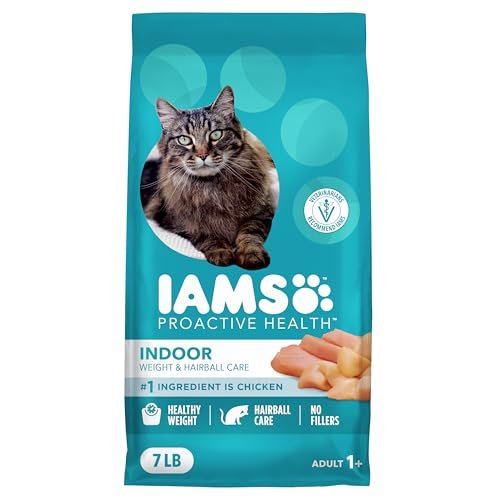
Best for indoor cats that groom often and need hairball control built into daily meals.
Chicken leads the ingredient list here too, giving your cat a solid protein base for daily activity. But this recipe is built around one job: keeping an indoor cat’s weight and hairballs in check. See our full IAMS Proactive Health Indoor review for feeding amounts by weight.
A tailored fiber blend with beet pulp is the standout ingredient. It bulks up swallowed hair, so more of it passes through instead of getting coughed up on your carpet. If hairballs are a regular problem, our guide to cat food for indoor cats that throw up covers fixes beyond diet alone.
Build Quality & Design
The bag carries clear IAMS branding and states the Proactive Health promise right on the front. It stays sealed well between feedings.
Performance & Speed
Chicken and turkey flavor goes over well with most cats. Lower calorie density helps indoor cats that don’t burn much energy chasing toys.
Features & Functionality
Hairball care, weight support, and heart health are the three focus areas. Beet pulp does most of the work, and vets commonly recommend this style of formula for indoor households.
User Experience
IAMS has decades of shelf history, so many owners already trust the name. Switching to this formula is simple, since feeding charts print by body weight.
Value for Money
IAMS usually costs a few dollars less per bag than Purina Pro Plan. For owners feeding multiple cats, that gap adds up fast over a year.
IAMS Cat Food Reviews: What Owners Report
If you’re searching specifically for IAMS cat food reviews rather than a head-to-head against Purina, here’s the pattern across the brand’s indoor line, not just this one formula.
- Owners lean on the brand’s decades of shelf history and its clinical, vet-forward labeling when deciding to trust it.
- The beet pulp fiber blend is the most consistently cited reason people switch, usually after a run of hairball incidents.
- Feeding charts printed by body weight make portioning easier for owners switching from a food with vaguer guidance.
- The tradeoff most owners accept: lower crude protein (28-30%) and no listed probiotic strain, in exchange for the lower price and hairball focus.
For a closer look at the full IAMS indoor lineup beyond this single formula, our roundup of the best IAMS indoor cat food options breaks down each recipe by price and target problem.
Guaranteed Analysis: Protein, Fat and Fiber Compared
Numbers on the bag tell you more than the marketing copy does. Here’s how the current labels compare. Check your own bag too, since formulas do get updated over time.
| Nutrient | Purina Pro Plan Chicken & Rice | IAMS Proactive Health Indoor |
|---|---|---|
| Crude Protein (min) | 36% | 28-30% |
| Crude Fat (min) | 16% | 11-13% |
| Crude Fiber (max) | 2% | 6.5-8.3% |
| Moisture (max) | 12% | 10% |
| Key Fiber Source | Chicory root inulin | Beet pulp |
| Added Probiotics | Bacillus coagulans | Not listed |
| AAFCO Statement | Complete & balanced, adult maintenance | Complete & balanced, adult maintenance |
Purina’s higher protein and lower fiber suit active or underweight cats. IAMS carries more fiber, which is exactly what pushes hair through the gut instead of up it. Neither number is wrong. They just serve different cats. Both formulas meet AAFCO’s complete-and-balanced standard for adult maintenance, so neither one requires a supplement to cover baseline nutrition.
Major Factors to Consider
Weigh performance, price, build, and durability before you commit to a bag.
Performance
Protein fuels muscle and daily energy. Purina’s 36 percent protein edges out IAMS, which matters most for cats that play hard.
Speed & Efficiency
Fiber and probiotics control how fast a cat digests and absorbs nutrients. Purina leans on probiotics; IAMS leans on fiber volume for hairball control.
Price & Value
IAMS usually runs cheaper per bag. Purina charges more for the extra protein and probiotic strain, and most owners find that trade worth it.
Build Quality
Both bags reseal well and hold up in normal pantry storage. Kibble size stays close between the two brands.
Design & Aesthetics
IAMS leans on clinical, vet-focused labeling. Purina leans on natural ingredient callouts. Both look credible on a store shelf.
Durability
Store either bag in a cool, dry spot and the kibble stays fresh through the printed best-by date.
Feature Comparison
This table lines up the specific features and ingredients in each formula.
| Feature | Purina Pro Plan Chicken & Rice | IAMS Proactive Health Indoor |
|---|---|---|
| Real Chicken First Ingredient | ✓ | ✓ |
| Probiotics Included | ✓ | ✗ |
| Prebiotic Fiber | ✓ | ✓ |
| Hairball Control | ✗ | ✓ |
| Indoor Cat Formula | ✗ | ✓ |
| Vitamin A & Omega-6 | ✓ | ✗ |
| Veterinarian Recommended | ✗ | ✓ |
| Beet Pulp | ✗ | ✓ |
| 7 lb Bag Size | ✓ | ✓ |
| Formerly Known as SAVOR | ✓ | ✗ |
Specifications Comparison
Here are the direct specifications for both products, including price and target use.
| Specification | Purina Pro Plan Chicken & Rice | IAMS Proactive Health Indoor |
|---|---|---|
| Price | $25-$30 | $20-$25 |
| Weight | 7 lb | 7 lb |
| Primary Protein | Real Chicken | Real Chicken |
| Key Ingredient | Chicory Root | Beet Pulp |
| Target | General Health | Indoor Health |
🏆 Winner: Purina Pro Plan Chicken & Rice
Score Breakdown
Purina Pro Plan takes the lead here because protein runs higher and probiotic support is more specific. If you want to maximize muscle health and gut function, it’s the better buy. That verdict flips, though, if hairballs are your cat’s main problem. See the section below.
Choose IAMS Proactive Health Indoor If…
If you’re on a budget but want a reputable brand, IAMS is usually the more affordable option. It works well for owners with multiple cats or long-term feeding plans. Check our roundup of the best IAMS indoor cat food options for more budget-friendly picks.
If your indoor cat struggles with hairballs, this formula solves it better because of the beet pulp. It gives peace of mind for owners dealing with messy litter boxes.
If you prefer a standard maintenance formula with hairball control over extreme protein levels, IAMS fits better. It targets the metabolic needs of indoor cats specifically.
If you value cost-effectiveness over maximum protein density, IAMS strikes a good balance for everyday feeding.
Choose Purina Pro Plan If…
If your cat plays hard or needs to hold onto muscle, the extra protein in Purina Pro Plan supports that better than a plain maintenance formula.
If your cat has had loose stools or slow digestion, the probiotic and chicory root combination targets that directly. Our guide to cat food for indoor cats covers more digestion-friendly options if this formula doesn’t fully fix it.
If you feed cats with different activity levels, the higher protein floor covers more of them without switching formulas constantly.
How to Switch Your Cat Between These Foods
Sudden food changes upset most cats’ stomachs. Stretch the switch over seven to ten days for the smoothest transition, whichever direction you’re moving.
- Days 1-2: Mix 25 percent new food with 75 percent old food.
- Days 3-5: Move to a 50/50 mix and watch stool consistency.
- Days 6-8: Shift to 75 percent new food, 25 percent old food.
- Days 9-10: Feed 100 percent new food, and keep the old bag on hand in case your cat rejects it.
- Vomiting or diarrhea lasting more than a day — pause the transition and hold at the previous ratio for a few extra days.
- Refusal to eat either food — go back to the last ratio your cat tolerated and slow the pace further.
- Persistent symptoms past 48 hours — that’s a call-your-vet situation, not a wait-it-out one.
For more on daily feeding amounts, see our guide to dry cat food for indoor cats.
🎯 Final Recommendation
Go with Purina if you want the highest protein and gut health support. If hairball management and saving a few dollars matter more, IAMS is the practical pick. Neither one is a bad bag of food. The right one just depends on which problem you’re actually trying to solve.
Summary
- Purina Pro Plan runs 36 percent minimum protein against 28 to 30 percent in IAMS.
- IAMS Proactive Health Indoor is built for indoor cats fighting hairballs.
- Both brands use real chicken to supply essential amino acids, and both meet AAFCO’s complete-and-balanced standard.
- Purina adds live probiotics (Bacillus coagulans) for stronger digestive support.
- IAMS uses beet pulp to reduce hairballs before they form.
- IAMS typically runs $20-$25 a bag against $25-$30 for Purina.
- A seven to ten day transition prevents stomach upset either way you switch.
Frequently Asked Questions
Is IAMS cat food better than Purina?
Not across the board. IAMS Proactive Health Indoor beats Purina Pro Plan on price and on hairball control, thanks to its beet pulp fiber blend. Purina beats IAMS on crude protein (36% vs 28-30%) and adds a named probiotic strain IAMS doesn’t have. “Better” depends on whether your cat’s biggest issue is hairballs or muscle and gut support.
Which is better, Purina or IAMS, for cats overall?
Purina Pro Plan is generally the stronger pick for general nutrition, due to its higher protein content and live probiotics. It supports muscle maintenance and digestive health more effectively across most cats. IAMS is a solid alternative, and the better call specifically for indoor cats fighting hairballs.
Is the price difference worth it?
The gap varies by retailer, but Purina usually runs $5 or so more per bag. That’s worth it if you want higher protein and added probiotics. IAMS is more budget-friendly and still provides adequate nutrition for many cats.
Which has better build quality?
Both brands use standard, durable 7 lb bags that keep food fresh. The packaging is functional and reliable, with no major difference in physical build.
Which is better for beginners?
Both brands are beginner-friendly, thanks to wide availability and clear labeling. IAMS may be easier if you’re worried about hairballs. Purina works well if you want to maximize protein intake.
Which offers better value for money?
IAMS wins on pure cost per pound. Purina wins on nutrient density and ingredient quality. It comes down to whether you value a lower price or higher nutrition per serving.
What are the main differences between IAMS and Purina Pro Plan?
Purina focuses on high protein and probiotics. IAMS focuses on hairball control and whole-body health for indoor cats. Purina targets athletic performance; IAMS targets everyday indoor maintenance. The fiber sources differ too: chicory root inulin in Purina versus beet pulp in IAMS.
Can I mix Purina Pro Plan and IAMS?
Yes, many owners blend both to combine higher protein with hairball control. Introduce any mix gradually over a week to avoid stomach upset, using the same ratio schedule you’d use for a full switch.
Which is better for a cat with a sensitive stomach?
Purina Pro Plan’s probiotics usually help more with general sensitive stomach issues. IAMS works better if the main problem is hairballs rather than everyday digestion.
How long does it take to switch cat food safely?
Plan on seven to ten days. Rushing the switch is the most common reason cats refuse new food or get diarrhea.
Where can I find more IAMS cat food reviews?
This page covers IAMS Proactive Health Indoor specifically, in a straight comparison against Purina Pro Plan. For a broader look at IAMS’s full indoor lineup, see our best IAMS indoor cat food roundup and our standalone IAMS Proactive Health Indoor review.

Written by Mishu
A passionate cat lover and indoor living enthusiast, Mishu is the founder and voice behind Indoor Living Cat – a go-to resource for cat owners who want to create the happiest, healthiest life for their feline companions indoors.
View Full Profile